

The Effectiveness of Multi-Session FMT Treatment in Active Ulcerative Colitis Patients: A Pilot Study
Open accessThe DOI matches its Crossref record; 77 of the 77 references it cites were found in a registry or an index.
Abstract
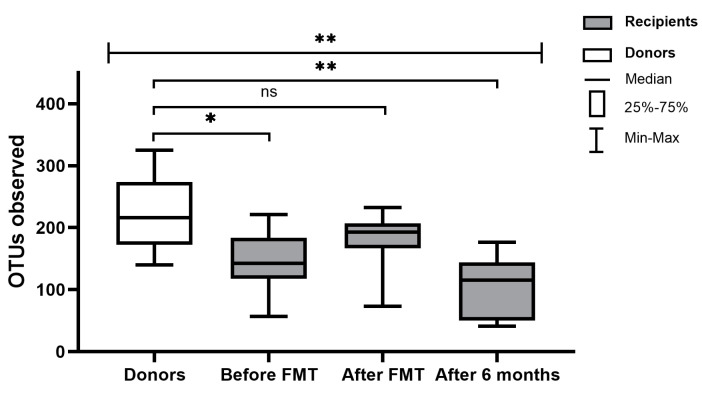
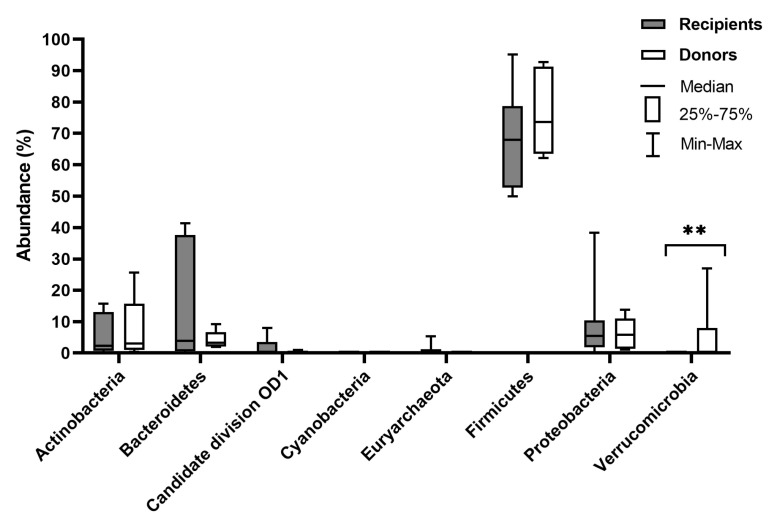
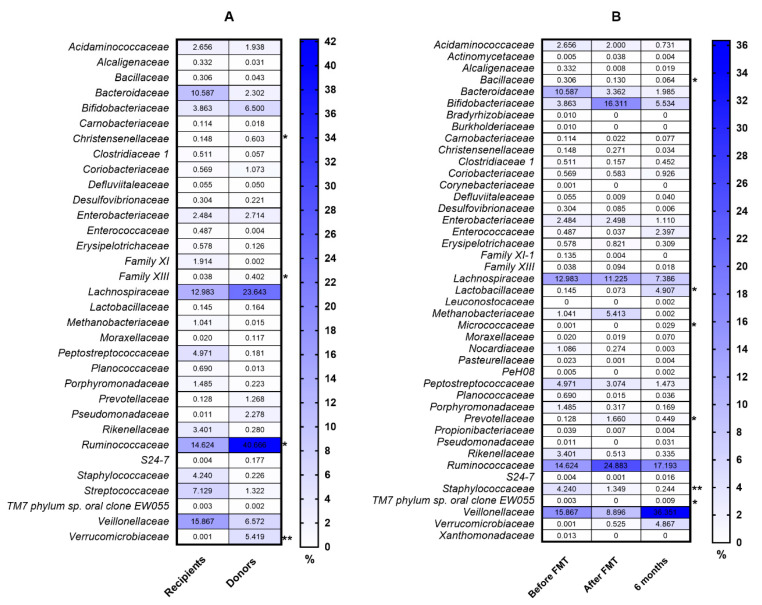
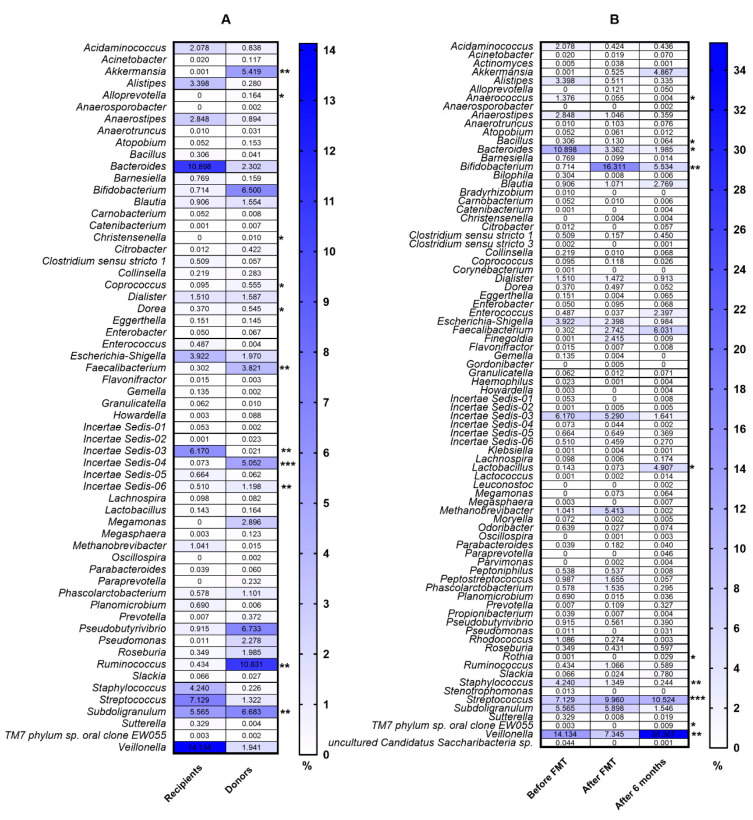
The modification of the microbiome through fecal microbiota transplantation (FMT) is becoming a very promising therapeutic option for inflammatory bowel disease (IBD) patients. Our pilot study aimed to assess the effectiveness of multi-session FMT treatment in active ulcerative colitis (UC) patients. Ten patients with UC were treated with multi-session FMT (200 mL) from healthy donors, via colonoscopy/gastroscopy. Patients were evaluated as follows: at baseline, at week 7, and after 6 months, routine blood tests (including C reactive protein (CRP) and calprotectin) were performed. 16S rRNA gene (V3V4) sequencing was used for metagenomic analysis. The severity of UC was classified based on the Truelove–Witts index. The assessment of microbial diversity showed significant differences between recipients and healthy donors. FMT contributed to long-term, significant clinical and biochemical improvement. Metagenomic analysis revealed an increase in the amount of Lactobacillaceaea, Micrococcaceae, Prevotellaceae, and TM7 phylumsp.oral clone EW055 during FMT, whereas Staphylococcaceae and Bacillaceae declined significantly. A positive increase in the proportion of the genera Bifidobacterium, Lactobacillus, Rothia, Streptococcus, and Veillonella and a decrease in Bacillus, Bacteroides, and Staphylococcus were observed based on the correlation between calprotectin and Bacillus and Staphylococcus; ferritin and Lactobacillus, Veillonella, and Bifidobacterium abundance was indicated. A positive change in the abundance of Firmicutes was observed during FMT and after 6 months. The application of multi-session FMT led to the restoration of recipients’ microbiota and resulted in the remission of patients with active UC.
Overview
The claims and statistics of this paper haven’t been checked yet.
Free: it reads the open-access text and checks the first 5 claims that cite a source we can check. Create a free account to check every claim.
Integrity signals
Registry
Cites
Statistics
Figures
Verification
Claims the paper makes
The claims and statistics of this paper haven’t been checked yet.
Free: it reads the open-access text and checks the first 5 claims that cite a source we can check. Create a free account to check every claim.
Self-check
Percentages, sums and reported differences re-computed from the paper’s own numbers.
The self-check needs the paper’s full text.
Citations
Cites
The SILVA ribosomal RNA gene database project: improved data processing and web-based tools
Quast, C., Pruesse, E., Yilmaz, P., Gerken, J., Schweer, T., Yarza, P., Peplies, J., & Glöckner, F. O. (2012) · Nucleic Acids Research · doi:10.1093/nar/gks1219 · Cited by 33,055
Frank, D. N., St. Amand, A. L., Feldman, R. A., Boedeker, E. C., Harpaz, N., & Pace, N. R. (2007) · Proceedings of the National Academy of Sciences · doi:10.1073/pnas.0706625104 · Cited by 4,611
Parada Venegas, D., De la Fuente, M. K., Landskron, G., González, M. J., Quera, R., Dijkstra, G., Harmsen, H. J. M., Faber, K. N., & Hermoso, M. A. (2019) · Frontiers in Immunology · doi:10.3389/fimmu.2019.00277 · Cited by 3,820
Duodenal Infusion of Donor Feces for Recurrent Clostridium difficile
van Nood, E., Vrieze, A., Nieuwdorp, M., Fuentes, S., Zoetendal, E. G., de Vos, W. M., Visser, C. E., Kuijper, E. J., Bartelsman, J. F. W. M., Tijssen, J. G. P., et al. (2013) · New England Journal of Medicine · doi:10.1056/nejmoa1205037 · Cited by 3,708
Human Genetics Shape the Gut Microbiome
Goodrich, J. K., Waters, J. L., Poole, A. C., Sutter, J. L., Koren, O., Blekhman, R., Beaumont, M., Van Treuren, W., Knight, R., Bell, J. T., et al. (2014) · Cell · doi:10.1016/j.cell.2014.09.053 · Cited by 3,164
An Immunomodulatory Molecule of Symbiotic Bacteria Directs Maturation of the Host Immune System
Mazmanian, S. K., Liu, C. H., Tzianabos, A. O., & Kasper, D. L. (2005) · Cell · doi:10.1016/j.cell.2005.05.007 · Cited by 2,910 · cited 1×
“For example, Bacteroides fragilis through the action of the bacterial-derived polysaccharide A (PSA) affects systemic Th1 response [5].”
BackgroundInfluence of diet on the gut microbiome and implications for human health
Singh, R. K., Chang, H.-W., Yan, D., Lee, K. M., Ucmak, D., Wong, K., Abrouk, M., Farahnik, B., Nakamura, M., Zhu, T. H., et al. (2017) · Journal of Translational Medicine · doi:10.1186/s12967-017-1175-y · Cited by 2,599
Population-level analysis of gut microbiome variation
Falony, G., Joossens, M., Vieira-Silva, S., Wang, J., Darzi, Y., Faust, K., Kurilshikov, A., Bonder, M. J., Valles-Colomer, M., Vandeputte, D., et al. (2016) · Science · doi:10.1126/science.aad3503 · Cited by 2,400
Inflammatory bowel disease: Pathogenesis
Zhang, Y.-Z. (2014) · World Journal of Gastroenterology · doi:10.3748/wjg.v20.i1.91 · Cited by 1,507
Moayyedi, P., Surette, M. G., Kim, P. T., Libertucci, J., Wolfe, M., Onischi, C., Armstrong, D., Marshall, J. K., Kassam, Z., Reinisch, W., et al. (2015) · Gastroenterology · doi:10.1053/j.gastro.2015.04.001 · Cited by 1,499 · cited 1×
“[28] performed FMT via enema, and Rossen et al.”
Method
Cited by
The role of gut dysbiosis in Parkinson’s disease: mechanistic insights and therapeutic options
Wang, Q., Luo, Y., Ray Chaudhuri, K., Reynolds, R., Tan, E.-K., & Pettersson, S. (2021) · Brain · doi:10.1093/brain/awab156 · Cited by 281
Helmy, Y. A., Taha-Abdelaziz, K., Hawwas, H. A. E.-H., Ghosh, S., AlKafaas, S. S., Moawad, M. M. M., Saied, E. M., Kassem, I. I., & Mawad, A. M. M. (2023) · Antibiotics · doi:10.3390/antibiotics12020274 · Cited by 200
Disturbances of the Gut Microbiota and Microbiota-Derived Metabolites in Inflammatory Bowel Disease
Hu, Y., Chen, Z., Xu, C., Kan, S., & Chen, D. (2022) · Nutrients · doi:10.3390/nu14235140 · Cited by 168
“The abundance of protective bacteria species such as Bifidobacterium and Lactobacilli was reported to decreased in IBD patients, and these protective bacteria could increase the frequency of mucosal Treg cells to ameliorate IBD symptoms [50].”
BackgroundIron status influences non-alcoholic fatty liver disease in obesity through the gut microbiome
Mayneris-Perxachs, J., Cardellini, M., Hoyles, L., Latorre, J., Davato, F., Moreno-Navarrete, J. M., Arnoriaga-Rodríguez, M., Serino, M., Abbott, J., Barton, R. H., et al. (2021) · Microbiome · doi:10.1186/s40168-021-01052-7 · Cited by 139
“Also in agreement with our results, low serum ferritin concentrations coexisted with decreased abundance of Veillonella species in ulcerative colitis patients receiving FMT from healthy donors [15], while Veillonella genus abundance was dose-dependently enriched after improvement of steatosis in NASH patients [16].”
ResultDysbiosis of gut microbiota in Polish patients with ulcerative colitis: a pilot study
Zakerska‐Banaszak, O., Tomczak, H., Gabryel, M., Baturo, A., Wolko, Ł., Michalak, M., Malińska, N., Mańkowska‐Wierzbicka, D., Eder, P., Dobrowolska, A., et al. (2021) · Scientific Reports · doi:10.1038/s41598-021-81628-3 · Cited by 143
Self-citationPotential roles of gut microbiota and microbial metabolites in Parkinson’s disease
Zheng, S.-Y., Li, H.-X., Xu, R.-C., Miao, W.-T., Dai, M.-Y., Ding, S.-T., & Liu, H.-D. (2021) · Ageing Research Reviews · doi:10.1016/j.arr.2021.101347 · Cited by 101
Wen, X., Wang, H., Zhang, M., Zhang, M., Wang, H., & Yang, X. (2021) · World Journal of Gastroenterology · doi:10.3748/wjg.v27.i21.2834 · Cited by 100
Xu, H., Huang, H., Xu, J., He, J., Zhao, C., Peng, Y., Zhao, H., Huang, W., Cao, C.-Y., Zhou, Y., et al. (2021) · Frontiers in Microbiology · doi:10.3389/fmicb.2021.658292 · Cited by 83
“Given that recent studies have shown that frequent FMT and continual monitoring of patients for 6 months are feasible and valuable (Paramsothy et al., 2019; Mañkowska-Wierzbicka et al., 2020), we should consider more frequent FMT for UC patients and extend our longitudinal studies for a longer period.”
BackgroundWierzbicka, A., Mańkowska‐Wierzbicka, D., Mardas, M., & Stelmach-Mardas, M. (2021) · Nutrients · doi:10.3390/nu13041160 · Cited by 72
“Due to their potential therapeutic anti-inflammatory components, some strains of Lactobacilli and Bacillus may positively influence the activity of inflammation [30].”
BackgroundSelf-citationCiaula, A. D., Bonfrate, L., Khalil, M., & Portincasa, P. (2023) · Internal and Emergency Medicine · doi:10.1007/s11739-023-03343-3 · Cited by 60
“…Bifidobacterium , and Listeria carrying bile salt hydrolase (BSH), the enzyme involved in the biotransformation of conjugated into unconjugated BA [100, 101], and microbes (mainly Bacteroides , Clostridium , Eubacterium , and Lacto-bacillus ) responsible for the 7α-dehydroxylation of…”
BackgroundSex, puberty, and the gut microbiome
Sisk-Hackworth, L., Kelley, S. T., & Thackray, V. G. (2023) · Reproduction · doi:10.1530/rep-22-0303 · Cited by 61
The Microbiome as a Therapy in Pouchitis and Ulcerative Colitis
LeBlanc, J., Segal, J. P., Braz, L. M. D. C., & Hart, A. L. (2021) · Nutrients · doi:10.3390/nu13061780 · Cited by 36
Mańkowska‐Wierzbicka, D., Żuraszek-Szymańska, J., Wierzbicka, A., Gabryel, M., Mahadea, D., Baturo, A., Zakerska‐Banaszak, O., Słomski, R., Skrzypczak-Zielińska, M., & Dobrowolska, A. (2023) · Biomedicines · doi:10.3390/biomedicines11020367 · Cited by 34
“Studies have shown that butyrate, one of the SCFAs in the intestinal epithelial cells, increases the formation and release of IL-18, which is crucial in maintaining homeostasis during inflammatory processes [49,50].”
BackgroundSelf-citationNigam, M., Panwar, A. S., & SINGH, R. K. (2022) · Frontiers in Medical Technology · doi:10.3389/fmedt.2022.961569 · Cited by 38
Gervason, S., Méleine, M., Lolignier, S., Meynier, M., Daugey, V., Birer, A., Aissouni, Y., Berthon, J., Ardid, D., Filaire, E., et al. (2023) · Pain · doi:10.1097/j.pain.0000000000003075 · Cited by 21
Boicean, A., Bratu, D. G., Bacila, C. I., Tanasescu, C. A. H., Fleacă, R. S., Mohor, C. I., Comaniciu, A., Băluță, T., Roman, M. D., Chicea, R., et al. (2023) · Pathogens · doi:10.3390/pathogens12060766 · Cited by 17
“This study shows the importance of FMT administration, even by enemas, without the need for a total colonoscopy [45].”
BackgroundGut microbiota — bidirectional modulator: role in inflammatory bowel disease and colorectal cancer
Cui, X., Li, C., Zhong, J., Liu, Y., Xiao, P., Liu, C., Zhao, M., & Yang, W. (2025) · Frontiers in Immunology · doi:10.3389/fimmu.2025.1523584 · Cited by 17
Sha, H., He, X., Yan, K., Li, J., Xu, L., Xie, Y., Yousheng, Y., Deng, Y., Li, G., & Yang, J. (2023) · Apmis · doi:10.1111/apm.13326 · Cited by 20
“It has broad application prospects in the treatment of inflammatory bowel diseases (IBD) [69], recurrent and refractory clostridium difficile infection [70].”
BackgroundShang, S., Zhu, J., Liu, X., Wang, W., Dai, T., Wang, L., & Li, B. (2023) · Polish Journal of Microbiology · doi:10.33073/pjm-2023-025 · Cited by 17
Cheng, H., Yuan, Y., Hu, J., Chen, L., Yuan, M., Du, H., Xu, Z., & Qiu, Z. (2024) · Life Sciences · doi:10.1016/j.lfs.2024.122901 · Cited by 17
Gut bacteria: an etiological agent in human pathological conditions
Islam, M. M., Mahbub, N. U., Hong, S., & Chung, H. (2024) · Frontiers in Cellular and Infection Microbiology · doi:10.3389/fcimb.2024.1291148 · Cited by 18
Zakerska‐Banaszak, O., Ladziak, K., Kruszka, D., Maciejewski, K., Wolko, Ł., Krela‐Kaźmierczak, I., Zawada, A. E., Vestergaard, M. V., Dobrowolska, A., & Skrzypczak-Zielińska, M. (2025) · Journal of Gastroenterology · doi:10.1007/s00535-025-02280-6 · Cited by 12
Self-citationYin, S., Liao, Y., Ma, Y., Han, X., Yang, Z., Fang, J. Q., Alahmadi, R. M., Hatamleh, A. A., Duraipandiyan, V., Gurusunathan, V. R., et al. (2023) · Beneficial Microbes · doi:10.1163/18762891-20230046 · Cited by 10
Gut microbiota and atrial cardiomyopathy
Sun, T., Song, B., & Li, B. (2025) · Frontiers in Cardiovascular Medicine · doi:10.3389/fcvm.2025.1541278 · Cited by 11
Zhao, Y., Simpson, A., Nakatsu, C. H., Cross, T.-W., Jones‐Hall, Y., & Jiang, Q. (2024) · Free Radical Biology and Medicine · doi:10.1016/j.freeradbiomed.2024.11.024 · Cited by 6
Ding, X. L., Yang, X., & Wang, H. (2020) · Medicine in Microecology · doi:10.1016/j.medmic.2020.100028 · Cited by 10
Gholam-Mostafaei, F. S., Azimirad, M., Naseri, K., Nabavi-Rad, A., Aghdaei, H. A., Shahrokh, S., Daryani, N. E., Yadegar, A., & Zali, M. R. (2023) · Frontiers in Microbiology · doi:10.3389/fmicb.2023.1147945 · Cited by 8
“These bacteria are responsible for carbohydrate fermentation in the colon and the production of short-chain fatty acids (SCFAs) including butyrate, propionate, and acetate (Mańkowska-Wierzbicka et al., 2020).”
BackgroundCross-kingdom microbial interactions in the gut during inflammatory bowel disease
Li, L., Cai, F., Liu, Z., Mo, W., Zhang, J., Qin, J., Liang, C., Xu, H., Liu, S., Tang, S., et al. (2026) · Journal of Translational Medicine · doi:10.1186/s12967-026-07692-3 · Cited by 5
“Additional research needs to establish the best treatment methods and determine how well FMT works in the long run [219–221].”
Gut microbiota and macrophage crosstalk: implications for colitis-associated colorectal cancer
Lyu, W., Zhang, Z., Liu, L., Sun, Y., Wang, B., Zhou, C., Liu, Z., & Feng, B. (2026) · Frontiers in Cellular and Infection Microbiology · doi:10.3389/fcimb.2026.1778244 · Cited by 5
“Furthermore, Bi fi dobacterium increases the frequency of mucosal Tregs, leading to amelioration of intestinal in fl ammation (Man ́ kowska-Wierzbicka et al., 2020).”
Fan, Y., Xiao, Y., Zhang, S., Bai, W., & Chen, J. (2024) · Food Science and Human Wellness · doi:10.26599/fshw.2024.9250129 · Cited by 4
“Coincidentally, UC patients in earlier studies showed the recovery of intestinal bacteria including Christensenellaceae and colitis remission after receiving multi-stage fecal microbiota transplantation (FMT) from healthy donors [53] .”
Omeragić, E., Imamović, B., Bečić, E., Dedić, M., & Hashemi, F. (2024) · Springer eBooks · doi:10.1007/978-981-97-3790-1_19 · Cited by 6
Gonzalez-Mercado, V. J., Lim, S. J., & Aouizerat, B. E. (2023) · Biological Research For Nursing · doi:10.1177/10998004231159623 · Cited by 2
“In fact, Staphylococcus spp was also enriched in stool of chemotherapy-induced diarrhea patients (Stringer et al., 2013) as well as in patients with inflammatory bowel disease (Mańkowska-Wierzbicka et al., 2020).”
BackgroundHamblin, H. S., Gunaratne, A. W., Clancy, A. K., Pilarinos, D., Busque, A. L., Dawson, M. V. M., & Borody, T. J. (2022) · Gastroenterology Research and Practice · doi:10.1155/2022/6083896 · Cited by 3
The Microbiome as a Therapy in Pouchitis and Ulcerative ColitisPreprint
Segal, J. P., LeBlanc, J., Braz, L. M. D. C., & Hart, A. L. (2021) · Preprints.org · doi:10.20944/preprints202103.0022.v1 · Cited by 1
Metabolic medicine: The mechanism of metabolic influence on diseases of various systems
Ding, S., Wu, Q., Lu, C., Wang, Z., Lan, Y., Fang, L., & Zheng, L. (2023) · Metabolism and Translational Medicine · doi:10.54844/mtm.2023.0345
Mayneris‐Perxachs, J., Cardellini, M., Hoyles, L., Latorre, J., Davato, F., Moreno-Navarrete, J. M., Arnoriaga‐Rodríguez, M., Serino, M., Abbott, J., Barton, R. H., et al. (2021) · Figshare · doi:10.6084/m9.figshare.14558984
Zhang, Z., Hu, X., & Ma, Y. (2026) · Frontiers in Microbiology · doi:10.3389/fmicb.2026.1765748 · Cited by 2
Bai, X., Ihara, E., & Akiho, H. (2026) · Elsevier eBooks · doi:10.1016/b978-0-443-40306-4.00016-8
Messiha, K., Khan, S., Houshyar, Y., Damm, G. K., & Hold, G. L. (2026) · Best Practice & Research Clinical Gastroenterology · doi:10.1016/j.bpg.2026.102139
Metadata
- Authors
- Mańkowska-Wierzbicka, D., Stelmach-Mardas, M., Gabryel, M., Tomczak, H., Skrzypczak-Zielińska, M., Zakerska-Banaszak, O., Sowińska, A., Mahadea, D., Baturo, A., Wolko, Ł., Słomski, R., & Dobrowolska, A.
- Affiliations
- Department of Gastroenterology, Dietetics and Internal Medicine, Poznan University of Medical Sciences, Heliodor Święcicki Hospital, Przybyszewskiego 49, 60-355 Poznań, Poland
- Poznan University of Medical Sciences (PL)
- Institute of Human Genetics (PL)
- Institute of Human Genetics, Polish Academy of Sciences, Strzeszyńska 32, 60-479 Poznań, Poland
- Poznań University of Life Sciences (PL)
- ORCID
- Venue
- Biomedicines
- Publisher
- MDPI AG
- Published
- 2020-08-03
- Volume
- 8
- Issue
- 8
- Pages
- 268
- ISSN
- 2227-9059 (ISSN-L)
- PMC
- PMC7459721
- OpenAlex
- W3046785006
- Semantic Scholar
- a9b53d77c6b47b1b229da5547f827168def23c80
- Cited by
- 39
- References
- 77
- Citations by year
- 2026: 5 · 2025: 3 · 2024: 5 · 2023: 11 · 2022: 4 · 2021: 10 · 2020: 1
- FWCI
- 3.81
- Type
- journal article
- Language
- en
- Open access
- gold
- doi.org
- Licence
- Locations
- Biomedicines (publishedVersion, cc-by)
- PubMed Central (publishedVersion, cc-by)
- PubMed (publishedVersion)
- DOAJ (DOAJ: Directory of Open Access Journals) (submittedVersion, cc-by-sa)
- Funders
- grant for young scientists from Poznan University of Medical Sciences, Poznan, Poland (502-01-222-38-000)
- Topics
- Health Sciences › Medicine › Gastroenterology › Inflammatory Bowel Disease
- Life Sciences › Biochemistry, Genetics and Molecular Biology › Molecular Biology › Gut microbiota and health
- Health Sciences › Medicine › Gastroenterology › Microscopic Colitis
- Keywords
- fecal microbiota transplantation, ulcerative colitis, gut microbiota, inflammatory bowel disease, microbial diversity, calprotectin, C-reactive protein, 16S rRNA gene sequencing, Firmicutes, Bifidobacterium, Lactobacillus, Veillonella, Bacillus, Staphylococcus, remission
About these checks
Registry, retraction, Cites and statistics results are computed, not judged, with one exception: a printed reference that no index lists is read once by a model before it counts as a citation error. Claims are extracted by a model and kept only when their quote appears verbatim in the text; each cited source is then checked, with a model’s help, for whether it says what the claim relies on. Those verdicts can be wrong — read the claim’s quote and the cited source before relying on one.
Statistics and arithmetic are recomputed, not judged.
Confidence bands are shown only for fields calibrated on our annotated test set. None is calibrated yet, so no band is shown.
What counts as a claim ›How we measure confidence ›How we check this ›
Are you an author, or do you see a problem with this page? Request a review
Data sources
Bibliographic data: Semantic Scholar, OpenAlex, Crossref.
Contains information from the Semantic Scholar Academic Graph Datasets, made available under the ODC Attribution License (ODC-BY 1.0).
Semantic Scholar’s data is described in: Kinney, R., et al. (2023). The Semantic Scholar Open Data Platform. arXiv:2301.10140.
