

Can optimizing the mechanical environment deliver a clinically significant reduction in fracture healing time
Open accessThe DOI matches its Crossref record; 51 of the 52 references it cites were found in a registry or an index.
Abstract
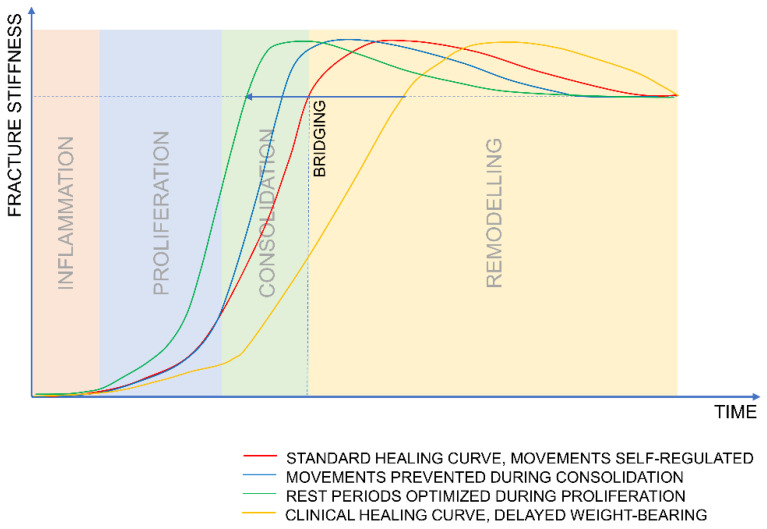
The impact of the local mechanical environment in the fracture gap on the bone healing process has been extensively investigated. Whilst it is widely accepted that mechanical stimulation is integral to callus formation and secondary bone healing, treatment strategies that aim to harness that potential are rare. In fact, the current clinical practice with an initially partial or non-weight-bearing approach appears to contradict the findings from animal experiments that early mechanical stimulation is critical. Therefore, we posed the question as to whether optimizing the mechanical environment over the course of healing can deliver a clinically significant reduction in fracture healing time. In reviewing the evidence from pre-clinical studies that investigate the influence of mechanics on bone healing, we formulate a hypothesis for the stimulation protocol which has the potential to shorten healing time. The protocol involves confining stimulation predominantly to the proliferative phase of healing and including adequate rest periods between applications of stimulation.
Overview
The claims and statistics of this paper haven’t been checked yet.
Free: it reads the open-access text and checks the first 5 claims that cite a source we can check. Create a free account to check every claim.
Integrity signals
Registry
Cites
Statistics
Figures



Verification
Claims the paper makes
The claims and statistics of this paper haven’t been checked yet.
Free: it reads the open-access text and checks the first 5 claims that cite a source we can check. Create a free account to check every claim.
Claims other papers make about this one
Each is checked against this paper’s own text: does it say what the citing paper says it does?
The source backs part of the claim, not all of it — or backs it for a different population, condition or comparison.
In the citing paper
“The mechanical demands for optimal healing are known to change throughout the healing process from little to more movement and forces in the fracture gap (10–12).”
From Methods to accelerate fracture healing – a narrative review from a clinical perspective (2024) · cites this paper as [10]
Experimental — accuracy not yet measuredThe source backs part of the claim, not all of it — or backs it for a different population, condition or comparison.
In the citing paper
“An optimized mechanical environment is known to shorten the healing time compared with the extended healing time in less favorable mechanical situations (10).”
From Methods to accelerate fracture healing – a narrative review from a clinical perspective (2024) · cites this paper as [10]
Experimental — accuracy not yet measuredThe cited source says what the claim attributes to it.
In the citing paper
“In their review on whether biomechanical optimization can shorten fracture-healing time, Barcik et al. (10) concluded that, ideally, stimulation should predominantly be limited to the proliferative phase of healing, and that adequate rest periods are required between applications of stimulation.”
From Methods to accelerate fracture healing – a narrative review from a clinical perspective (2024) · cites this paper as [10]
Self-check
Percentages, sums and reported differences re-computed from the paper’s own numbers.
The self-check needs the paper’s full text.
Citations
Cites
The biology of fracture healing in long bones
McKibbin, B. (1978) · The Journal of Bone and Joint Surgery. British volume · doi:10.1302/0301-620x.60b2.350882 · Cited by 1,180
Perren, S. M. (2002) · The Journal of Bone and Joint Surgery. British volume · doi:10.1302/0301-620x.84b8.0841093 · Cited by 916
The influence of induced micromovement upon the healing of experimental tibial fractures
Goodship, A., & Kenwright, J. (1985) · The Journal of Bone and Joint Surgery. British volume · doi:10.1302/0301-620x.67b4.4030869 · Cited by 903
Effects of Mechanical Factors on the Fracture Healing Process
Claes, L. E., Heigele, C. A., Neidlinger-Wilke, C., Kaspar, D., Seidl, W., Margevicius, K. J., & Augat, P. (1998) · Clinical Orthopaedics and Related Research · doi:10.1097/00003086-199810001-00015 · Cited by 705
Lacroix, D., & Prendergast, P. J. (2002) · Journal of Biomechanics · doi:10.1016/s0021-9290(02)00086-6 · Cited by 681
Bone fracture healing in mechanobiological modeling: A review of principles and methods
Ghiasi, M. S., Chen, J., Vaziri, A., Rodriguez, E. K., & Nazarian, A. (2017) · Bone Reports · doi:10.1016/j.bonr.2017.03.002 · Cited by 485
Shear movement at the fracture site delays healing in a diaphyseal fracture model
Augat, P., Burger, J., Schorlemmer, S., Henke, T., Peraus, M., & Claes, L. (2003) · Journal of Orthopaedic Research · doi:10.1016/s0736-0266(03)00098-6 · Cited by 369
The ‘diamond concept’ for long bone non-union management
Andrzejowski, P., & Giannoudis, P. V. (2019) · Journal of Orthopaedics and Traumatology · doi:10.1186/s10195-019-0528-0 · Cited by 276
The initial phase of fracture healing is specifically sensitive to mechanical conditions
Klein, P., Schell, H., Streitparth, F., Heller, M., Kassi, J., Kandziora, F., Bragulla, H., Haas, N. P., & Duda, G. N. (2003) · Journal of Orthopaedic Research · doi:10.1016/s0736-0266(02)00259-0 · Cited by 270
Strain Rate and Timing of Stimulation in Mechanical Modulation of Fracture Healing
Goodship, A. E., Cunningham, J. L., & Kenwright, J. (1998) · Clinical Orthopaedics and Related Research · doi:10.1097/00003086-199810001-00012 · Cited by 229
Research works printed but not linked: 1
- Uhthoff, H.K. (1980). The concept of interfragmentary strain. Current Concepts of Internal Fixation of Fractures, Springer.
Cited by
Boileau, P., Gendre, P., Saliken, D., Thélu, C.-E., & Trojani, C. (2022) · Journal of Shoulder and Elbow Surgery · doi:10.1016/j.jse.2022.01.126 · Cited by 37
Methods to accelerate fracture healing – a narrative review from a clinical perspective
Ganse, B. (2024) · Frontiers in Immunology · doi:10.3389/fimmu.2024.1384783 · Cited by 33
The absence of immediate stimulation delays bone healing
Barcik, J. P., Ernst, M., Buchholz, T., Constant, C., Mys, K., Epari, D. R., Zeiter, S., & Windolf, M. (2023) · Bone · doi:10.1016/j.bone.2023.116834 · Cited by 25
Self-citationWireless Measurements Using Electrical Impedance Spectroscopy to Monitor Fracture Healing
Fukase, N., Duke, V. R., Lin, M. C., Stake, I. K., Huard, M., Huard, J., Marmor, M. T., Maharbiz, M. M., Ehrhart, N. P., Bahney, C. S., et al. (2022) · Sensors · doi:10.3390/s22166233 · Cited by 24
Warmerdam, E., Wolff, C. G., Orth, M., Pohlemann, T., & Ganse, B. (2024) · Frontiers in Bioengineering and Biotechnology · doi:10.3389/fbioe.2024.1355254 · Cited by 20
Metadata
- Authors
- Barcik, J., & Epari, D. R.
- Affiliations
- AO Foundation (CH)
- Queensland University of Technology (AU)
- Corresponding author
- Barcik, Jan
- Venue
- Biomedicines
- Publisher
- MDPI AG
- Published
- 2021-06-18
- Volume
- 9
- Issue
- 6
- Pages
- 691
- ISSN
- 2227-9059 (ISSN-L)
- PMC
- PMC8234230
- OpenAlex
- W3174954758
- Cited by
- 28
- References
- 52
- Citations by year
- 2026: 5 · 2025: 7 · 2024: 9 · 2023: 2 · 2022: 4 · 2021: 1
- FWCI
- 0.61
- Type
- journal article
- Language
- en
- Open access
- gold
- doi.org
- Licence
- Locations
- Biomedicines (publishedVersion, cc-by)
- PubMed Central (publishedVersion, cc-by)
- PubMed (publishedVersion)
- QUT ePrints (Queensland University of Technology) (submittedVersion, cc-by)
- DOAJ (DOAJ: Directory of Open Access Journals) (submittedVersion, cc-by-sa)
- Funders
- AO Trauma (AR2019_06)
- Topics
- Health Sciences › Medicine › Orthopedics and Sports Medicine › Bone fractures and treatments
- Health Sciences › Medicine › Orthopedics and Sports Medicine › Bone health and osteoporosis research
- Physical Sciences › Engineering › Biomedical Engineering › Bone Tissue Engineering Materials
- Keywords
- fracture healing, mechanical stimulation, callus formation, secondary bone healing, non-weight bearing, proliferative phase, stimulation protocols
About these checks
Registry, retraction, Cites and statistics results are computed, not judged, with one exception: a printed reference that no index lists is read once by a model before it counts as a citation error. Claims are extracted by a model and kept only when their quote appears verbatim in the text; each cited source is then checked, with a model’s help, for whether it says what the claim relies on. Those verdicts can be wrong — read the claim’s quote and the cited source before relying on one.
Statistics and arithmetic are recomputed, not judged.
Confidence bands are shown only for fields calibrated on our annotated test set. None is calibrated yet, so no band is shown.
What counts as a claim ›How we measure confidence ›How we check this ›
Are you an author, or do you see a problem with this page? Request a review
How to cite
Cite CoChat for the checks on this page, and the paper for its own findings.
- This page
- CoChat. (2026). Citation check: Can optimizing the mechanical environment deliver a clinically significant reduction in fracture healing time. https://app.cochat.ai/papers/10.3390/biomedicines9060691
- The paper
- Barcik, J., & Epari, D. R. (2021). Can optimizing the mechanical environment deliver a clinically significant reduction in fracture healing time. Biomedicines. https://doi.org/10.3390/biomedicines9060691
Data sources
Bibliographic data: Semantic Scholar, OpenAlex, Crossref.
Contains information from the Semantic Scholar Academic Graph Datasets, made available under the ODC Attribution License (ODC-BY 1.0).
Semantic Scholar’s data is described in: Kinney, R., et al. (2023). The Semantic Scholar Open Data Platform. arXiv:2301.10140.
