

Can optimizing the mechanical environment deliver a clinically significant reduction in fracture healing time
Open accessThe DOI matches its Crossref record; 51 of the 52 references it cites were found in a registry or an index.
Abstract
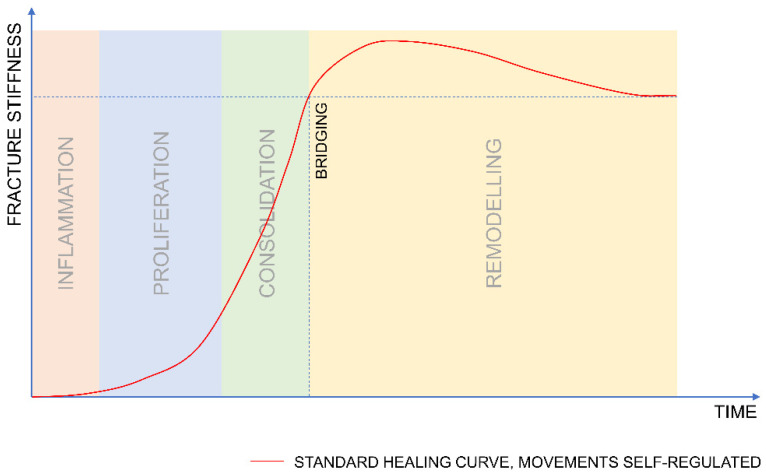
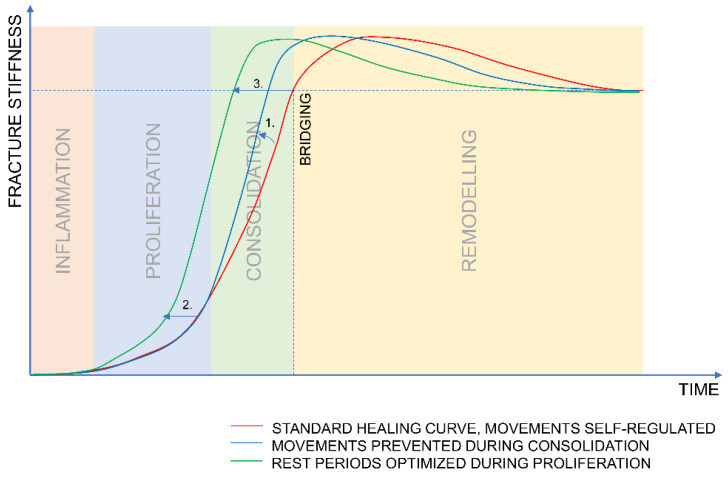
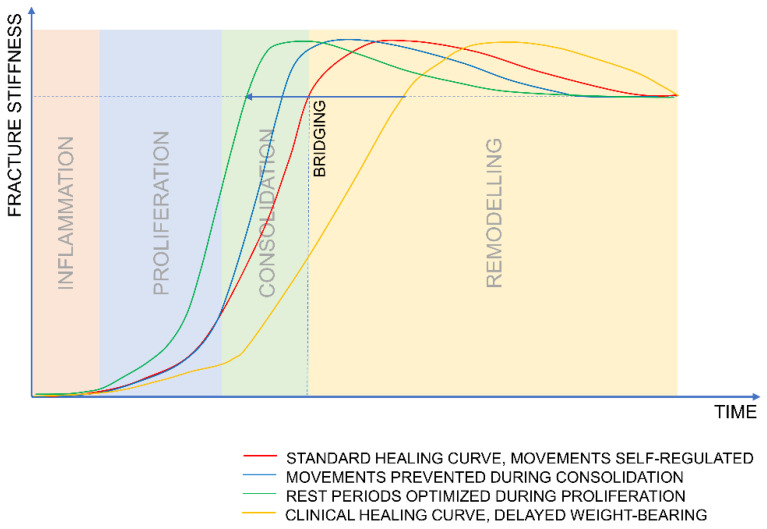
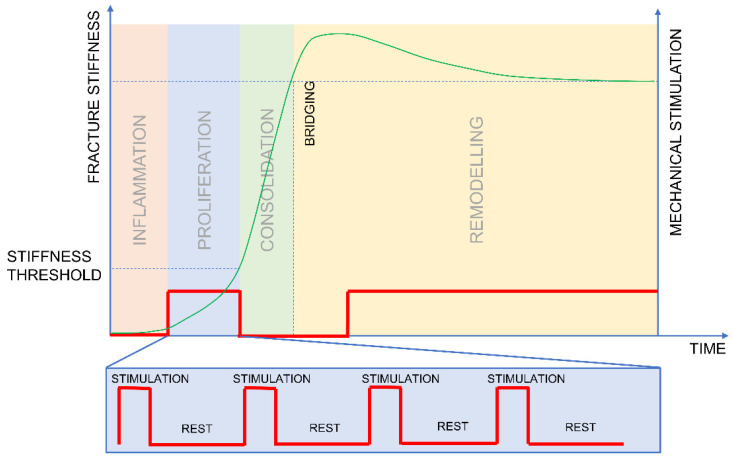
The impact of the local mechanical environment in the fracture gap on the bone healing process has been extensively investigated. Whilst it is widely accepted that mechanical stimulation is integral to callus formation and secondary bone healing, treatment strategies that aim to harness that potential are rare. In fact, the current clinical practice with an initially partial or non-weight-bearing approach appears to contradict the findings from animal experiments that early mechanical stimulation is critical. Therefore, we posed the question as to whether optimizing the mechanical environment over the course of healing can deliver a clinically significant reduction in fracture healing time. In reviewing the evidence from pre-clinical studies that investigate the influence of mechanics on bone healing, we formulate a hypothesis for the stimulation protocol which has the potential to shorten healing time. The protocol involves confining stimulation predominantly to the proliferative phase of healing and including adequate rest periods between applications of stimulation.
Overview
The claims and statistics of this paper haven’t been checked yet.
Free: it reads the open-access text and checks the first 5 claims that cite a source we can check. Create a free account to check every claim.
Integrity signals
Registry
Cites
Statistics
Figures
Verification
Claims the paper makes
The claims and statistics of this paper haven’t been checked yet.
Free: it reads the open-access text and checks the first 5 claims that cite a source we can check. Create a free account to check every claim.
Claims other papers make about this one
Each is checked against this paper’s own text: does it say what the citing paper says it does?
The source backs part of the claim, not all of it — or backs it for a different population, condition or comparison.
In the citing paper
“The mechanical demands for optimal healing are known to change throughout the healing process from little to more movement and forces in the fracture gap (10–12).”
From Methods to accelerate fracture healing – a narrative review from a clinical perspective (2024) · cites this paper as [10]
Experimental — accuracy not yet measuredThe source backs part of the claim, not all of it — or backs it for a different population, condition or comparison.
In the citing paper
“An optimized mechanical environment is known to shorten the healing time compared with the extended healing time in less favorable mechanical situations (10).”
From Methods to accelerate fracture healing – a narrative review from a clinical perspective (2024) · cites this paper as [10]
Experimental — accuracy not yet measuredThe cited source says what the claim attributes to it.
In the citing paper
“In their review on whether biomechanical optimization can shorten fracture-healing time, Barcik et al. (10) concluded that, ideally, stimulation should predominantly be limited to the proliferative phase of healing, and that adequate rest periods are required between applications of stimulation.”
From Methods to accelerate fracture healing – a narrative review from a clinical perspective (2024) · cites this paper as [10]
Self-check
Percentages, sums and reported differences re-computed from the paper’s own numbers.
The self-check needs the paper’s full text.
Citations
Cites
The biology of fracture healing in long bones
McKibbin, B. (1978) · The Journal of Bone and Joint Surgery. British volume · doi:10.1302/0301-620x.60b2.350882 · Cited by 1,180
Perren, S. M. (2002) · The Journal of Bone and Joint Surgery. British volume · doi:10.1302/0301-620x.84b8.0841093 · Cited by 916
The influence of induced micromovement upon the healing of experimental tibial fractures
Goodship, A., & Kenwright, J. (1985) · The Journal of Bone and Joint Surgery. British volume · doi:10.1302/0301-620x.67b4.4030869 · Cited by 903
Effects of Mechanical Factors on the Fracture Healing Process
Claes, L. E., Heigele, C. A., Neidlinger-Wilke, C., Kaspar, D., Seidl, W., Margevicius, K. J., & Augat, P. (1998) · Clinical Orthopaedics and Related Research · doi:10.1097/00003086-199810001-00015 · Cited by 705
Lacroix, D., & Prendergast, P. J. (2002) · Journal of Biomechanics · doi:10.1016/s0021-9290(02)00086-6 · Cited by 681
Bone fracture healing in mechanobiological modeling: A review of principles and methods
Ghiasi, M. S., Chen, J., Vaziri, A., Rodriguez, E. K., & Nazarian, A. (2017) · Bone Reports · doi:10.1016/j.bonr.2017.03.002 · Cited by 485
Shear movement at the fracture site delays healing in a diaphyseal fracture model
Augat, P., Burger, J., Schorlemmer, S., Henke, T., Peraus, M., & Claes, L. (2003) · Journal of Orthopaedic Research · doi:10.1016/s0736-0266(03)00098-6 · Cited by 369
The ‘diamond concept’ for long bone non-union management
Andrzejowski, P., & Giannoudis, P. V. (2019) · Journal of Orthopaedics and Traumatology · doi:10.1186/s10195-019-0528-0 · Cited by 276
The initial phase of fracture healing is specifically sensitive to mechanical conditions
Klein, P., Schell, H., Streitparth, F., Heller, M., Kassi, J., Kandziora, F., Bragulla, H., Haas, N. P., & Duda, G. N. (2003) · Journal of Orthopaedic Research · doi:10.1016/s0736-0266(02)00259-0 · Cited by 270
Strain Rate and Timing of Stimulation in Mechanical Modulation of Fracture Healing
Goodship, A. E., Cunningham, J. L., & Kenwright, J. (1998) · Clinical Orthopaedics and Related Research · doi:10.1097/00003086-199810001-00012 · Cited by 229
Bottlang, M., Doornink, J., Fitzpatrick, D. C., & Madey, S. M. (2009) · The Journal of Bone and Joint Surgery-American Volume · doi:10.2106/jbjs.h.01038 · Cited by 227
Measuring stiffness can define healing of tibial fractures
Richardson, J., Cunningham, J., Goodship, A., O'Connor, B., & Kenwright, J. (1994) · The Journal of Bone and Joint Surgery. British volume · doi:10.1302/0301-620x.76b3.8175839 · Cited by 204
THE BIOMECHANICS OF FRACTURE HEALING
Yamagishi, M., & Yoshimura, Y. (1955) · The Journal of Bone & Joint Surgery · doi:10.2106/00004623-195537050-00013 · Cited by 195
Influence of fracture gap size on the pattern of long bone healing: a computational study
Gómez-Benito, M. J., García-Aznar, J. M., Kuiper, J. H., & Doblaré, M. (2005) · Journal of Theoretical Biology · doi:10.1016/j.jtbi.2004.12.023 · Cited by 190
Selection and Development of Preclinical Models in Fracture-Healing Research
O’Loughlin, P. F., Morr, S., Bogunovic, L., Kim, A. D., Park, B., & Lane, J. M. (2008) · Journal of Bone and Joint Surgery · doi:10.2106/jbjs.g.01585 · Cited by 168
Wolf, S., Janousek, A., Pfeil, J., Veith, W., Haas, F., Duda, G. N., & Claes, L. (1998) · Clinical Biomechanics · doi:10.1016/s0268-0033(98)00097-7 · Cited by 163
Instability prolongs the chondral phase during bone healing in sheep
Epari, D. R., Schell, H., Bail, H. J., & Duda, G. N. (2005) · Bone · doi:10.1016/j.bone.2005.10.023 · Cited by 150
Self-citationThe influence of cyclic compression and distraction on the healing of experimental tibial fractures
Hente, R., Füchtmeier, B., Schlegel, U., Ernstberger, A., & Perren, S. M. (2004) · Journal of Orthopaedic Research · doi:10.1016/j.orthres.2003.11.007 · Cited by 145
Monitoring the Mechanical Properties of Healing Bone
Claes, L. E., & Cunningham, J. L. (2009) · Clinical Orthopaedics & Related Research · doi:10.1007/s11999-009-0752-7 · Cited by 144
Early, Full Weightbearing With Flexible Fixation Delays Fracture Healing
Augat, P., Merk, J., Ignatius, A., Margevicius, K., Bauer, G., Rosenbaum, D., & Claes, L. (1996) · Clinical Orthopaedics and Related Research · doi:10.1097/00003086-199607000-00031 · Cited by 142
Concept, design and fabrication of smart orthopedic implants
Burny, F., Donkerwolcke, M., Moulart, F., Bourgois, R., Puers, R., Van Schuylenbergh, K., Barbosa, M., Paiva, O., Rodes, F., Bégueret, J. B., et al. (2000) · Medical Engineering & Physics · doi:10.1016/s1350-4533(00)00062-x · Cited by 125
Claes, L., Blakytny, R., Göckelmann, M., Schoen, M., Ignatius, A., & Willie, B. (2009) · Journal of Orthopaedic Research · doi:10.1002/jor.20712 · Cited by 116
Goodship, A. E., Lawes, T. J., & Rubin, C. T. (2009) · Journal of Orthopaedic Research · doi:10.1002/jor.20824 · Cited by 103
Role of mathematical modeling in bone fracture healing
Pivonka, P., & Dunstan, C. R. (2012) · BoneKEy Reports · doi:10.1038/bonekey.2012.221 · Cited by 99
Shear Does Not Necessarily Inhibit Bone Healing
Bishop, N. E., van Rhijn, M., Tami, I., Corveleijn, R., Schneider, E., & Ito, K. (2006) · Clinical Orthopaedics & Related Research · doi:10.1097/01.blo.0000191272.34786.09 · Cited by 88
Mechanobiology of bone healing and regeneration: in vivo models
Epari, D. R., Duda, G. N., & Thompson, M. S. (2010) · Proceedings of the Institution of Mechanical Engineers Part H Journal of Engineering in Medicine · doi:10.1243/09544119jeim808 · Cited by 85
Self-citationAugat, P., Merk, J., Wolf, S., & Claes, L. (2001) · Journal of Orthopaedic Trauma · doi:10.1097/00005131-200101000-00010 · Cited by 81
Metaphyseal fracture healing follows similar biomechanical rules as diaphyseal healing
Claes, L., Reusch, M., Göckelmann, M., Ohnmacht, M., Wehner, T., Amling, M., Beil, F. T., & Ignatius, A. (2011) · Journal of Orthopaedic Research · doi:10.1002/jor.21227 · Cited by 79
Glatt, V., Miller, M., Ivkovic, A., Liu, F., Parry, N., Griffin, D., Vrahas, M., & Evans, C. (2012) · The Journal of Bone and Joint Surgery-American Volume · doi:10.2106/jbjs.k.01604 · Cited by 76
Claes, L., Blakytny, R., Besse, J., Bausewein, C., Ignatius, A., & Willie, B. (2011) · Journal of Orthopaedic Trauma · doi:10.1097/bot.0b013e3181e3d994 · Cited by 75 · cited 1×
“Dynamization of nails is a common practice; however, rather than a mechanical dynamization that changes fixation stiffness, the benefit is typically derived from reducing the size of the fracture gap [10,11].”
BackgroundHankemeier, S., Grässel, S., Plenz, G., Spiegel, H. U., Bruckner, P., & Probst, A. (2001) · Journal of Orthopaedic Research · doi:10.1016/s0736-0266(00)00044-9 · Cited by 61
Modulation of fixation stiffness from flexible to stiff in a rat model of bone healing
Bartnikowski, N., Claes, L. E., Koval, L., Glatt, V., Bindl, R., Steck, R., Ignatius, A., Schuetz, M. A., & Epari, D. R. (2017) · Acta Orthopaedica · doi:10.1080/17453674.2016.1256940 · Cited by 60
Self-citationNumerical simulation of callus healing for optimization of fracture fixation stiffness
Steiner, M., Claes, L., Ignatius, A., Simon, U., & Wehner, T. (2014) · PLoS ONE · doi:10.1371/journal.pone.0101370 · Cited by 58 · cited 1×
“Multiple computational studies have focused on the impact of clinical parameters on healing progression, such as the fracture gap size [47,48], type and configuration of the fixation [49] or the fixator’s stiffness [50,51].”
BackgroundMiramini, S., Zhang, L., Richardson, M., Pirpiris, M., Mendis, P. A., Oloyede, K., & Edwards, G. A. (2013) · Computer Methods in Biomechanics & Biomedical Engineering · doi:10.1080/10255842.2013.855729 · Cited by 56
Reverse Dynamization Accelerates Bone-Healing in a Large-Animal Osteotomy Model
Glatt, V., Samchukov, M. L., Cherkashin, A. M., & Iobst, C. (2020) · Journal of Bone and Joint Surgery · doi:10.2106/jbjs.20.00380 · Cited by 47
Early mechanical stimulation only permits timely bone healing in sheep
Tufekci, P. M., Tavakoli, A., Dlaska, C. E., Neumann, M., Shanker, M., Saifzadeh, S., Steck, R., Schuetz, M., & Epari, D. R. (2017) · Journal of Orthopaedic Research® · doi:10.1002/jor.23812 · Cited by 45
Self-citationWehner, T., Steiner, M., Ignatius, A. A., & Claes, L. (2014) · PLoS ONE · doi:10.1371/journal.pone.0115695 · Cited by 42
Willie, B. M., Blakytny, R., Glöckelmann, M., Ignatius, A., & Claes, L. (2011) · Clinical Orthopaedics & Related Research · doi:10.1007/s11999-011-1866-2 · Cited by 39
Suzuki, T., Matsuura, Y., Yamazaki, T., Akasaka, T., Ozone, E., Matsuyama, Y., Mukai, M., Ohara, T., Wakita, H., Taniguchi, S., et al. (2019) · Bone · doi:10.1016/j.bone.2019.115212 · Cited by 36
A case for optimising fracture healing through inverse dynamization
Epari, D. R., Wehner, T., Ignatius, A. A., Schuetz, M., & Claes, L. (2013) · Medical Hypotheses · doi:10.1016/j.mehy.2013.04.044 · Cited by 34
Self-citationThe combined effects of dynamization time and degree on bone healing
Fu, R., Feng, Y., Liu, Y., Willie, B. M., & Yang, H. (2021) · Journal of Orthopaedic Research® · doi:10.1002/jor.25060 · Cited by 31
Müller, C. W., Pfeifer, R., Meier, K., Decker, S., Reifenrath, J., Gösling, T., Wesling, V., Krettek, C., Hurschler, C., & Ferle, M. (2015) · BioMed Research International · doi:10.1155/2015/652940 · Cited by 30
Perren, S. M. (2015) · Acta chirurgiae orthopaedicae et traumatologiae Cechoslovaca · doi:10.55095/achot2015/002 · Cited by 28
Pause Insertions During Cyclic In Vivo Loading Affect Bone Healing
Gardner, M. J., Ricciardi, B. F., Wright, T. M., Bostrom, M. P., & van der Meulen, M. C. H. (2008) · Clinical Orthopaedics and Related Research · doi:10.1007/s11999-008-0155-1 · Cited by 27
Fountain, S., Windolf, M., Henkel, J., Tavakoli, A., Schuetz, M., Hutmacher, D. W., & Epari, D. R. (2015) · Tissue Engineering Part B Reviews · doi:10.1089/ten.teb.2015.0123 · Cited by 26
Self-citationA Biofeedback System for Continuous Monitoring of Bone Healing
Windolf, M., Ernst, M., Schwyn, R., Perren, S. M., Mathis, H., Wilke, M., & Richards, R. G. (2014) · International Conference on Biomedical Electronics and Devices · doi:10.5220/0004913002430248 · Cited by 26
Meyers, N., Schülke, J., Ignatius, A. A., & Claes, L. (2017) · PLoS ONE · doi:10.1371/journal.pone.0189432 · Cited by 18
Potter, B. K. (2016) · Clinical Orthopaedics and Related Research · doi:10.1007/s11999-016-4885-1 · Cited by 13
Gardner, T., Evans, M., & Simpson, H. (1998) · Medical Engineering & Physics · doi:10.1016/s1350-4533(98)00035-6 · Cited by 12
Mechanical Stimulation of Fracture Healing - Stimulation of Callus by Improved Recovery
HENTE, R., & PERREN, S. M. (2018) · Acta chirurgiae orthopaedicae et traumatologiae Cechoslovaca · doi:10.55095/achot2018/066 · Cited by 12
Programable Active Fixator System for Systematic In Vivo Investigation of Bone Healing Processes
Barcik, J. P., Ernst, M., Dlaska, C. E., Drenchev, L. B., Zeiter, S., Epari, D. R., & Windolf, M. (2020) · Sensors · doi:10.3390/s21010017 · Cited by 7
Self-citation
Research works printed but not linked: 1
- Perren S.M. Cordey J. The concept of interfragmentary strain Current Concepts of Internal Fixation of Fractures Uhthoff H.K. Springer Berlin/Heidelberg, Germany New York, NY, USA 1980 63 77
Cited by
Boileau, P., Gendre, P., Saliken, D., Thélu, C.-E., & Trojani, C. (2022) · Journal of Shoulder and Elbow Surgery · doi:10.1016/j.jse.2022.01.126 · Cited by 37
Methods to accelerate fracture healing – a narrative review from a clinical perspective
Ganse, B. (2024) · Frontiers in Immunology · doi:10.3389/fimmu.2024.1384783 · Cited by 33
The absence of immediate stimulation delays bone healing
Barcik, J. P., Ernst, M., Buchholz, T., Constant, C., Mys, K., Epari, D. R., Zeiter, S., & Windolf, M. (2023) · Bone · doi:10.1016/j.bone.2023.116834 · Cited by 25
Self-citationWireless Measurements Using Electrical Impedance Spectroscopy to Monitor Fracture Healing
Fukase, N., Duke, V. R., Lin, M. C., Stake, I. K., Huard, M., Huard, J., Marmor, M. T., Maharbiz, M. M., Ehrhart, N. P., Bahney, C. S., et al. (2022) · Sensors · doi:10.3390/s22166233 · Cited by 24
Warmerdam, E., Wolff, C. G., Orth, M., Pohlemann, T., & Ganse, B. (2024) · Frontiers in Bioengineering and Biotechnology · doi:10.3389/fbioe.2024.1355254 · Cited by 20
Metadata
- Authors
- Barcik, J., & Epari, D. R.
- Affiliations
- AO Foundation (CH)
- Queensland University of Technology (AU)
- Corresponding author
- Barcik, Jan
- Venue
- Biomedicines
- Publisher
- MDPI AG
- Published
- 2021-06-18
- Volume
- 9
- Issue
- 6
- Pages
- 691
- ISSN
- 2227-9059 (ISSN-L)
- PMC
- PMC8234230
- OpenAlex
- W3174954758
- Cited by
- 28
- References
- 52
- Citations by year
- 2026: 5 · 2025: 7 · 2024: 9 · 2023: 2 · 2022: 4 · 2021: 1
- FWCI
- 0.61
- Type
- journal article
- Language
- en
- Open access
- gold
- doi.org
- Licence
- Locations
- Biomedicines (publishedVersion, cc-by)
- PubMed Central (publishedVersion, cc-by)
- PubMed (publishedVersion)
- QUT ePrints (Queensland University of Technology) (submittedVersion, cc-by)
- DOAJ (DOAJ: Directory of Open Access Journals) (submittedVersion, cc-by-sa)
- Funders
- AO Trauma (AR2019_06)
- Topics
- Health Sciences › Medicine › Orthopedics and Sports Medicine › Bone fractures and treatments
- Health Sciences › Medicine › Orthopedics and Sports Medicine › Bone health and osteoporosis research
- Physical Sciences › Engineering › Biomedical Engineering › Bone Tissue Engineering Materials
- Keywords
- fracture healing, mechanical stimulation, callus formation, secondary bone healing, non-weight bearing, proliferative phase, stimulation protocols
About these checks
Registry, retraction, Cites and statistics results are computed, not judged, with one exception: a printed reference that no index lists is read once by a model before it counts as a citation error. Claims are extracted by a model and kept only when their quote appears verbatim in the text; each cited source is then checked, with a model’s help, for whether it says what the claim relies on. Those verdicts can be wrong — read the claim’s quote and the cited source before relying on one.
Statistics and arithmetic are recomputed, not judged.
Confidence bands are shown only for fields calibrated on our annotated test set. None is calibrated yet, so no band is shown.
What counts as a claim ›How we measure confidence ›How we check this ›
Are you an author, or do you see a problem with this page? Request a review
Data sources
Bibliographic data: Semantic Scholar, OpenAlex, Crossref.
Contains information from the Semantic Scholar Academic Graph Datasets, made available under the ODC Attribution License (ODC-BY 1.0).
Semantic Scholar’s data is described in: Kinney, R., et al. (2023). The Semantic Scholar Open Data Platform. arXiv:2301.10140.
