

A Deep Siamese Convolution Neural Network for Multi-Class Classification of Alzheimer Disease
Open accessThe DOI matches its Crossref record; 56 of the 56 references it cites were found in a registry or an index.
Abstract
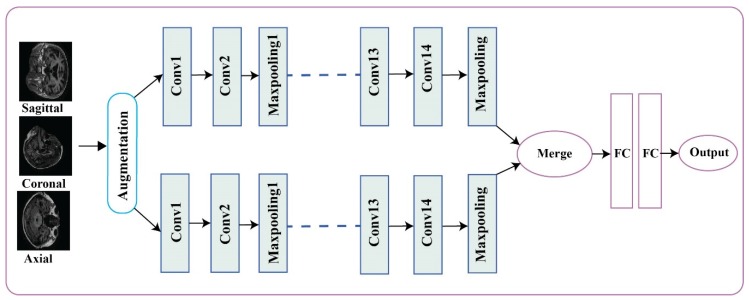
Alzheimer’s disease (AD) may cause damage to the memory cells permanently, which results in the form of dementia. The diagnosis of Alzheimer’s disease at an early stage is a problematic task for researchers. For this, machine learning and deep convolutional neural network (CNN) based approaches are readily available to solve various problems related to brain image data analysis. In clinical research, magnetic resonance imaging (MRI) is used to diagnose AD. For accurate classification of dementia stages, we need highly discriminative features obtained from MRI images. Recently advanced deep CNN-based models successfully proved their accuracy. However, due to a smaller number of image samples available in the datasets, there exist problems of over-fitting hindering the performance of deep learning approaches. In this research, we developed a Siamese convolutional neural network (SCNN) model inspired by VGG-16 (also called Oxford Net) to classify dementia stages. In our approach, we extend the insufficient and imbalanced data by using augmentation approaches. Experiments are performed on a publicly available dataset open access series of imaging studies (OASIS), by using the proposed approach, an excellent test accuracy of 99.05% is achieved for the classification of dementia stages. We compared our model with the state-of-the-art models and discovered that the proposed model outperformed the state-of-the-art models in terms of performance, efficiency, and accuracy.
Overview
The claims and statistics of this paper haven’t been checked yet.
Free: it reads the open-access text and checks the first 5 claims that cite a source we can check. Create a free account to check every claim.
Integrity signals
Registry
Cites
Statistics
Figures
Verification
Claims the paper makes
The claims and statistics of this paper haven’t been checked yet.
Free: it reads the open-access text and checks the first 5 claims that cite a source we can check. Create a free account to check every claim.
Claims other papers make about this one
Each is checked against this paper’s own text: does it say what the citing paper says it does?
The cited source says what the claim attributes to it.
In the citing paper
“They achieved state-of-the-art results by obtaining an accuracy of 99.05%.”
From Review of deep learning: concepts, CNN architectures, challenges, applications, future directions (2021) · cites this paper as [240]
Experimental — accuracy not yet measuredThe cited source says what the claim attributes to it.
In the citing paper
“In 2020, Mehmood et al. [240] trained a developed CNN-based network called “SCNN” with MRI images for the tasks of classification of Alzheimer’s disease.”
From Review of deep learning: concepts, CNN architectures, challenges, applications, future directions (2021) · cites this paper as [240]
The cited source says what the claim attributes to it.
In the citing paper
“Diagnosing normal versus Alzheimer’s disease patients has been achieved by several CNN models [239, 240].”
From Review of deep learning: concepts, CNN architectures, challenges, applications, future directions (2021) · cites this paper as [240]
Self-check
Percentages, sums and reported differences re-computed from the paper’s own numbers.
The self-check needs the paper’s full text.
Citations
Cites
Deep learning in neural networks: an overview
Schmidhuber, J. (2015) · Neural Networks · doi:10.1016/j.neunet.2014.09.003 · Cited by 18,570
A survey on deep learning in medical image analysis
Litjens, G., Kooi, T., Bejnordi, B. E., Setio, A. A. A., Ciompi, F., Ghafoorian, M., van der Laak, J. A. W. M., van Ginneken, B., & Sánchez, C. I. (2017) · Medical Image Analysis · doi:10.1016/j.media.2017.07.005 · Cited by 15,332 · cited 1×
“Recently, the researchers are developing deep learning models / techniques to extract the features directly from medical images [12].”
BackgroundBatch Normalization: Accelerating Deep Network Training by Reducing Internal Covariate Shift
Ioffe, S. (2024) · arXiv (Cornell University) · doi:10.57702/o9raffed · Cited by 14,214
Artificial intelligence in radiology
Hosny, A., Parmar, C., Quackenbush, J., Schwartz, L. H., & Aerts, H. J. W. L. (2018) · Nature Reviews Cancer · doi:10.1038/s41568-018-0016-5 · Cited by 3,803 · cited 1×
“Deep learning models have achieved major conquest in medical images such as CT, MRI, X-ray, microscopy, and mammography [13].”
BackgroundForecasting the global burden of Alzheimer's disease
Brookmeyer, R., Johnson, E., Ziegler‐Graham, K., & Arrighi, H. M. (2007) · Alzheimer's & Dementia · doi:10.1016/j.jalz.2007.04.381 · Cited by 3,370
The Effectiveness of Data Augmentation in Image Classification using Deep Learning
Perez, L., & Wang, J. (2017) · arXiv · doi:10.48550/arxiv.1712.04621 · Cited by 2,499 · cited 1×
“In medical research, due to privacy concerns, the access to large data is a big problem [47], especially, the classification of cancer and AD are problematic due to lack of availability of data.”
Background2019 Alzheimer’s disease facts and figures.
Alzheimer's Association (2019) · Alzheimer's & Dementia · doi:10.1016/j.jalz.2019.01.010 · Cited by 2,461
Automatic classification of MR scans in Alzheimer’s disease.
Kloppel, S., Stonnington, C. M., Chu, C., Draganski, B., Scahill, R. I., Rohrer, J. D., Fox, N. C., Jack, C. R., Ashburner, J., & Frackowiak, R. S. J. (2008) · Brain · doi:10.1093/brain/awm319 · Cited by 1,170 · cited 1×
“[21] developed a dimensional reduction model to detect AD patients by using a linear support vector machine on T1-weighted MRI images.”
MethodVery deep convolutional neural network based image classification using small training sample size
Liu, S., & Deng, W. (2015) · 2015 3rd IAPR Asian Conference on Pattern Recognition (ACPR) · doi:10.1109/acpr.2015.7486599 · Cited by 1,056 · cited 1×
“We modified the VGG16 and inserted one extra Conv layer in the model which was effective to grasp maximum features on a small dataset [43].”
Method2011 Alzheimer's disease facts and figures
Alzheimer's Association (2011) · Alzheimer's & Dementia · doi:10.1016/j.jalz.2011.02.004 · Cited by 908
Research works printed but not linked: 1
- Bjerrum E.J. SMILES enumeration as data augmentation for neural network modeling of molecules arXiv 2015 1703.07076
Cited by
Items 201–262 of 262
Study on MRI Slices-based Lightweight Neural Network in Alzheimer's Disease Detection
Zhang, Q., Long, Y., & Cai, H. (2023) · International Conference on Neural Networks, Information and Communication Engineering (NNICE) · doi:10.1109/nnice58320.2023.10105740 · Cited by 1
“Mehmood et al. [3] proposed an improved Siamese convolutional neural network to classify the stages of AD.”
Background(2023) · International Journal of Advanced Technology and Engineering Exploration · doi:10.19101/ijatee.2023.10101219 · Cited by 6
Reyes, I., Cedeño, F. J., Loza, J. E., Villalba-Meneses, F., Tirado-Espín, A., Cadena-Morejón, C., Alvarado-Cando, O., & Almeida-Galárraga, D. A. (2023) · Communications in computer and information science · doi:10.1007/978-3-031-45438-7_19 · Cited by 1
Privacy Policies of Free Medical, Health, Fitness Mobile Applications and the GDPR
Yaqub, M., Feng, J., Chuhan, I. S., Arshid, K., & Zhang, W. (2023) · International Conference on Intelligent Medicine and Image Processing (IMIP) · doi:10.1109/imip57114.2023.00021 · Cited by 4
“Medical healthcare is a hot topic and rapidly growing that has ample attention in many aspects, for instance, medical diagnosis [2-5].”
BackgroundMachine Learning Model to Detect Parkinson's Disease using MRI Data
Rama, B. K., Praveen, P., & Shaik, M. A. (2023) · International Conference on Sustainable Communication Networks and Application (ICSCNA) · doi:10.1109/icscna58489.2023.10370527 · Cited by 1
Comparative Analysis of CNN and Different R-CNN based Model for Prediction of Alzheimer’s Disease
Roobini, S., Kavitha, M. S., & Karthik, S. (2024) · EAI Endorsed Transactions on Pervasive Health and Technology · doi:10.4108/eetpht.10.5267 · Cited by 1
“The region proposals can be created using a network referred to as the RPN (region proposal network) [25].”
BackgroundSmolin, A., Chukalina, M. V., Bukreeva, I., Junemann, O., Cedola, A., Fratini, M., Saveliev, S. V., & Yamaev, A. (2024) · International Conference on Machine Vision · doi:10.1117/12.3023398 · Cited by 1
“Deep learning is a powerful tool used to analyze complex data, such as images of central nervous system [5-9].”
MethodEmpirical Assessment of Transfer Learning Strategies for Dementia Classification Using MRI Images
Almufareh, M. F., Kausar, S., Humayun, M., & Tehsin, S. (2024) · Journal of Disability Research · doi:10.57197/jdr-2024-0047 · Cited by 1
“Multiclass classification for the subtypes of dementia has also been considered an interesting research area by the relevant researchers (Mehmood et al., 2020; Asanomi et al., 2021; Sharma et al., 2021a; Biswas and Gini, 2023; Lampe et al., 2023).”
BackgroundSuryavanshi, A., Sharma, R., Kumar, M., & Manwal, M. (2024) · International Conference on Electronics, Computing, Communication and Control Technology (ICECCC) · doi:10.1109/iceccc61767.2024.10593892 · Cited by 1
“…and data rate of their decision-making processes encourage the application of machine learning algorithms in plant pathology using their capabilities of automatically extracting the most relevant features in a visual context, which are much compared to traditional image processing approaches [4].”
BackgroundAlzheimer's Disease Detection and Classification: A Survey
Saini, R., & Sharma, K. P. (2024) · International Conference on Pioneering Developments in Computer Science & Digital Technologies (IC2SDT) · doi:10.1109/ic2sdt62152.2024.10695982 · Cited by 1
“The study employed a CNN methodology, enhancing the VGG16 [26] framework by incorporating an additional convolutional layer to better extract features from MRI images.”
MethodDeep Learning-Inspired Multiclass and Multi-label Classifications
Chakraborty, S., & Dey, L. (2024) · Springer tracts in nature-inspired computing · doi:10.1007/978-981-97-9622-9_5 · Cited by 1
Effective Alzheimer’s Stage Classification Using Transfer Learning Based on MRI Images
Hamdani, H., Septiarini, A., Pawitra, T. A., Sumampouw, A., Tejawati, A., & Kurniawan, T. B. (2024) · International Conference on Vocational Education and Electrical Engineering (ICVEE) · doi:10.1109/icvee63912.2024.10824040 · Cited by 1
Jain, A., & Kumar, B. (2025) · IEEE International Students' Conference on Electrical, Electronics and Computer Science (SCEECS) · doi:10.1109/sceecs64059.2025.10940174 · Cited by 3
“In [17], researchers used the Siamese CNN (SCNN) model to categorize AD into many classes.”
El-Geneedy, M., Akram, S., & Gamel, S. A. (2024) · International Conference on Future Telecommunications and Artificial Intelligence (IC-FTAI) · doi:10.1109/ic-ftai62324.2024.10950034 · Cited by 1
Smart Health Care Management System for Diagnosis of Lungs Cancer
Abugabah, A., Shahid, F., Alafeef, A., & Khan, R. (2023) · International Conference on Ubiquitous and Future Networks · doi:10.1109/icufn57995.2023.10200746 · Cited by 1
“Additionally, CNN can achieve a higher performance level than its contemporaries, such as feedforward neural networks [13].”
BackgroundAutomated detection of genetic relatedness from fundus photographs using Siamese Neural NetworksPreprint
Bhandari, S. M., Singh, P., Arun, N., Sekimitsu, S., Raghu, V. K., Rauscher, F. G., Elze, T., Horn, K., Kirsten, T., Scholz, M. R., et al. (2023) · medRxiv · doi:10.1101/2023.08.16.23294183 · Cited by 1
Agarwal, D. (2023) · UVaDOC UVaDOC University of Valladolid Documentary Repository (University of Valladolid) · doi:10.35376/10324/62581 · Cited by 2
Shakkeera, L., & Sowmiya, K. (2021) · Lecture notes in electrical engineering · doi:10.1007/978-981-16-1244-2_3 · Cited by 1
A System for Interactive and Intelligent AD Auxiliary Screening
Yang, S., Zhao, Q., Miao, L., Chen, M., Gao, L., Song, J., & Le, W. (2021) · ACM International Conference on Multimedia (ACM MM) · doi:10.1145/3474085.3478549
“With the development of machine learning and deep learning technologies, there exist some works [6, 8] employing Magnetic Resonance Imaging (MRI) to predict occurrence of the disease.”
BackgroundArtificial Intelligence/Machine Learning in Nuclear Medicine
Lee, S., Oh, K. T., Choi, Y., Yoo, S. K., & Yun, M. (2022) · Springer eBooks · doi:10.1007/978-3-031-00119-2_9
AN APPLICATION OF MACHINE LEARNING TO COLLEGE ADMISSIONS: THE SUMMER MELT PROBLEM
Basu, T. S., Buckmire, R., & Tweneboah, O. K. (2022) · Journal of Machine Learning for Modeling and Computing · doi:10.1615/jmachlearnmodelcomput.2022046289 · Cited by 3
A Novel Approach for Alzheimer Detection Using SMLT
Ramesh, T., Madhubala, E., Rani, N. S., & Roshini, K. T. (2022) · International Conference on Technological Advancements in Computational Sciences (ICTACS) · doi:10.1109/ictacs56270.2022.9988214
(2022) · Journal of Machine Learning for Modeling and Computing · doi:10.1615/jmachlearnmodelcomput.v3.i4.60
Bhade, A. W., & Bamnote, G. R. (2023) · Proceedings in adaptation, learning and optimization · doi:10.1007/978-3-031-31164-2_26
Revolutionizing Alzheimer’s Disease Diagnosis using Deep Learning Approach
Arsah, A., Karolin Kiruba, R., Kishan, I., Neekitha, C., & Padmapriya, M. (2023) · International Journal for Research in Applied Science and Engineering Technology · doi:10.22214/ijraset.2023.51715
Güven, Y. (2023) · SSRN Electronic Journal · doi:10.2139/ssrn.4460030
Spider Plus: A Text Classifier for Research Article Components
Bahala, R. G., & Sagum, R. A. (2023) · Procedia Computer Science · doi:10.1016/j.procs.2023.10.515
Enumula, R. R. (2024) · Journal of Electrical Systems · doi:10.52783/jes.1999
“The Kennedy and Eberhart-proposed Particle Swarm Optimization (PSO) method appear to be a viable option in the search for an appropriate method [31].”
MethodAlzheimer's disease Development and Classification using MRI
Chitra, P., Naganandhini, S., Ramkumar, R., Merin Stepha, J., Jessy, K., & Hemalatha, S. (2023) · International Conference on Information Management & Machine Intelligence (ICIMMI) · doi:10.1145/3647444.3647870
“One of them the most common and common technique, hot encoding, which works very well, unless a large number of categorical attributes are available [13-16].”
BackgroundKumar, M., Sharma, P., & Kumar, B. (2024) · Multimedia Tools and Applications · doi:10.1007/s11042-024-19077-z
Logistic-Based OVA-CNN Model for Alzheimer’s Disease Detection and Prediction Using MR Images
John, C. M., & Phalgunan, P. (2024) · Lecture notes in networks and systems · doi:10.1007/978-981-99-9442-7_18
A Deep Learning Approach With Sparse Autoencoder for Alzheimers Disease Classification
Oommen, D. K., & Arunnehru, J. (2024) · Lecture notes in networks and systems · doi:10.1007/978-3-031-64813-7_18
A Review on Alzheimer's Disease Classification Using Deep Learning
Abdulqadir, M. M. (2024) · Indonesian Journal of Computer Science · doi:10.33022/ijcs.v13i3.4031
Uvaneshwari, M., & Baskar, M. (2024) · AIP conference proceedings · doi:10.1063/5.0217029
MosquitoNet: A Siamese CNN Mosquito Species Identification System Using Audio Signals
Mate, C. J. P., & Yusiong, J. P. T. (2024) · Lecture notes in networks and systems · doi:10.1007/978-3-031-73344-4_7
Sandhu, K. K., & Kaur, D. (2025) · AIP conference proceedings · doi:10.1063/5.0247907
A comprehensive approach to anticipating the progression of mild cognitive impairment
Shahid, F., Khan, R., Mehmood, A., Smadi, A. A., Ibrahim, M. M., & Zheng, Z. (2025) · Brain Research · doi:10.1016/j.brainres.2025.149549
Self-citationJoshi, P., Mundra, S., & Mundra, A. (2025) · Social Network Analysis and Mining · doi:10.1007/s13278-025-01436-9
“Mehmood et al. (2020) utilized a Siamese Convolu-tional Neural Network based on the VGG16 architecture to achieve more accurate Alzheimer’s disease detection from Magnetic Resonance Imaging (MRI) scans.”
Alzheimer's Disease Diagnosis from Brain MRI Using Deep Learning Techniques
Patil, S. V., Patil, S., & Bhisikar, S. A. (2025) · International Conference on Emerging Smart Computing and Informatics (ESCI) · doi:10.1109/esci63694.2025.10988365
Kumar, D., Gupta, M., Kumar, R., Gupta, N., & Gupta, K. (2025) · International Conference on Advancement in Computation & Computer Technologies (InCACCT) · doi:10.1109/incacct65424.2025.11011410
“A. Mehmood et al. [12] proposed a Siamese CNN model based on the VGG-16 keras application for the multi-class image classification for Alzheimer’s disease and a model trained on magnetic resonance imaging (MRI), and the test accuracy achieved by author 99.05 percent.”
InfluentialArefin, M. R., Chowdhury, N. J. K., Hassan, M. Z., & Roy, S. (2024) · International Conference on Computing Advancements (ICCA) · doi:10.1145/3723178.3723302
“A deep siamese neural network is introduced in [15] for multi-class classification of the Alzheimer’s disease.”
Saim, M., & Feroui, A. (2024) · International Conference of the African Federation of Operational Research Societies (AFROS) · doi:10.1109/afros62115.2024.11036956
He, E., Wang, Y., Wang, X., Yi, Z., Grzegorzek, M., Yang, P., Hu, X., Feng, Y., & Wang, Z. (2025) · Journal of Medical and Biological Engineering · doi:10.1007/s40846-025-00957-0
“In this study, we constructed a multiclass deep learning model [14] utilizing fully connected layers.”
Ismail, W. N., P., F. R. P., & Ali, M. A. S. (2025) · Computer Modeling in Engineering & Sciences · doi:10.32604/cmes.2025.065564
Gündüzvar, E., Kayık, A., & Altuncu, M. A. (2025) · Balkan Journal of Electrical and Computer Engineering · doi:10.17694/bajece.1535631 · Cited by 1
Suravarapu, V. K., & Patil, H. Y. (2025) · Scientific Reports · doi:10.1038/s41598-025-12474-w
“The PHC layer is a method that uses hypercomplex numbers to expand the traditional convolution 58,59 .”
Efficient Multi-Class Alzheimer's Detection Using Fuzzy and Decision Tree Algorithms
Elshanwani, M., El-Sobky, B., & Elmorsy, S. A. (2025) · International Conference on Machine Intelligence and Smart Innovation (ICMISI) · doi:10.1109/icmisi65108.2025.11115592
“CNNs based on deep learning has proven to be incredibly performance in a number of domains, including medical imaging [19].”
SCLe ‐Net: Siamese Convolutional Le‐Network for Hand Bone Age Estimation Using X‐Ray Image
Raju, S., & Rao, P. V. V. (2025) · X-Ray Spectrometry · doi:10.1002/xrs.70037
Performance Improvement of an Automated Alzheimer Classification System
Kumari, L. V. R., Sai, Y. P., Kabra, A. N., Anunya, P., & Suvarna, D. (2025) · Lecture notes in networks and systems · doi:10.1007/978-981-96-6348-4_32
MRI-Based Early Detection and Classification of Alzheimer’s Disease with Grad-CAM Explainability
Agarwal, P., Saini, P., Ghosh, D., Kumar, V., & Gupta, P. (2025) · International Conference on Contemporary Computing · doi:10.1109/ic366947.2025.11290211
Analyzing unique feature for Early Diagnosis of Alzheimer Disease by Using Machine Learning
Madnaik, D. S., Kheradkar, V. V., & Sangewar, S. S. (2025) · International Conference on Future Technologies (ICFT) · doi:10.1109/icft66708.2025.11336717
A Deep Learning Approach for Alzheimer's Disease Classification from Brain MRI
Mohmmad, S., Nomula, E., Chauhan, G. S., Rachavaram, R. K., & Rao, B. S. (2025) · International Conference on Emerging Research in Electronics, Computer Science and Technology (ICERECT) · doi:10.1109/icerect65215.2025.11375940
“For example, ocular biomarkers were promising for identifying AD at preclinical levels [6][7].”
Ensemble-Driven Alzheimer's Classification Model Using 2D MRI and Deep CNN Fusion
Pandule, N. T., Khadse, V. M., & Bagade, V. V. (2025) · International Conference on Electronics and Computing, Communication Networking Automation Technologies (ICEC2NT) · doi:10.1109/icec2nt65402.2025.11379963
El-Bakry, M. A. R. A. H. M. (2026) · International Journal of Advanced Research in Science Communication and Technology · doi:10.48175/ijarsct-31584
Saim, M., & Feroui, A. (2026) · Journal of Mechanics in Medicine and Biology · doi:10.1142/s0219519426500107
Toofanee, M. S. A. (2023) · theses.fr (ABES) · doi:10.70675/600337cazbfe4z405fz9538za725b88272b7
Cheedepudi, V. K., & Chakravarthi, S. S. (2026) · Contemporary Computing Innovations Conference (CCIC) · doi:10.1109/ccic68129.2026.11485910
Olaoluwa, M., Loukil, H., Sbei, A., & Drira, H. (2026) · IEEE Winter Conference on Applications of Computer Vision · doi:10.1109/wacv61042.2026.00214 · Cited by 1
“Furthermore, other non-hippocampus-based approaches have been proposed, operating directly on images such as approaches based on convolutional networks [1, 44, 51, 61, 62], deep generative models [2, 40, 52, 64] and even reinforcement learning [27, 28, 57].”
Dynamic Cross-Modal Fusion and Feature Alignment for Multi-Stage Diagnosis of Alzheimer’s Disease
Qu, J., Geng, K., Ma, X., Zhang, H., Wang, H., & Liu, G. (2026) · Lecture notes in computer science · doi:10.1007/978-981-92-3719-7_1
An Enhanced Artificial Intelligence Model for Alzheimer Disease Diagnosis
Sayed, S., Mohamed, A. A., & Omara, F. A. (2026) · Journal of Advances in Information Technology · doi:10.12720/jait.17.10.2008-2020
“On the other hand, the late stage of AD could cause heart failure and death respiratory system malfunction [2, 3].”
Tuteja, G., Keerthi, M. M., Gopal, L., Agarwal, V., Singh, P., Nisha, & Gupta, R. (2026) · doi:10.1109/incect72370.2026.11742584
“Also, Mehmood et al. introduced a deep Siamese convolutional neural network for multiclass Alzheimer’s disease classification from MRI images, which enables the disease stage differentiation through similarity-based learning and obtains 92.85% classification accuracy [12].”
Influential
Metadata
- Authors
- Mehmood, A., Maqsood, M., Bashir, M., & Shuyuan, Y.
- Affiliations
- Xidian University (CN)
- COMSATS University Islamabad (PK)
- University of the Punjab (PK)
- Corresponding author
- Shuyuan, Yang
- Venue
- Brain Sciences
- Publisher
- MDPI AG
- Published
- 2020-02-05
- Volume
- 10
- Issue
- 2
- Pages
- 84
- ISSN
- 2076-3425 (ISSN-L)
- PMC
- PMC7071616
- OpenAlex
- W3005273529
- Cited by
- 264
- References
- 56
- Citations by year
- 2026: 11 · 2025: 43 · 2024: 60 · 2023: 65 · 2022: 45 · 2021: 31 · 2020: 9
- FWCI
- 27.36
- Type
- journal article
- Language
- en
- Open access
- gold
- dx.doi.org
- Licence
- Locations
- Brain Sciences (publishedVersion, cc-by)
- PubMed Central (publishedVersion, cc-by)
- PubMed (publishedVersion)
- DOAJ (DOAJ: Directory of Open Access Journals) (submittedVersion, cc-by-sa)
- Funders
- National Natural Science Foundation of China (*Nos.61771380, 61906145, U1730109, 91438103, 61771376, 61703328, 91438201, U1701267, 61703328),)
- The Science Basis Research Program in Shaanxi Province of China (Nos.16JK1823, 2017JM6086, 2019JQ-663)
- Topics
- Health Sciences › Medicine › Psychiatry and Mental health › Dementia and Cognitive Impairment Research
- Physical Sciences › Computer Science › Computer Vision and Pattern Recognition › Advanced Neural Network Applications
- Health Sciences › Medicine › Radiology, Nuclear Medicine and Imaging › Retinal Imaging and Analysis
- Keywords
- Alzheimer's disease, Siamese convolutional neural network, VGG16, magnetic resonance imaging, brain image analysis, data augmentation, class imbalance, overfitting, OASIS dataset, multi-class classification
About these checks
Registry, retraction, Cites and statistics results are computed, not judged, with one exception: a printed reference that no index lists is read once by a model before it counts as a citation error. Claims are extracted by a model and kept only when their quote appears verbatim in the text; each cited source is then checked, with a model’s help, for whether it says what the claim relies on. Those verdicts can be wrong — read the claim’s quote and the cited source before relying on one.
Statistics and arithmetic are recomputed, not judged.
Confidence bands are shown only for fields calibrated on our annotated test set. None is calibrated yet, so no band is shown.
What counts as a claim ›How we measure confidence ›How we check this ›
Are you an author, or do you see a problem with this page? Request a review
Data sources
Bibliographic data: Semantic Scholar, OpenAlex, Crossref.
Contains information from the Semantic Scholar Academic Graph Datasets, made available under the ODC Attribution License (ODC-BY 1.0).
Semantic Scholar’s data is described in: Kinney, R., et al. (2023). The Semantic Scholar Open Data Platform. arXiv:2301.10140.
