

Hand Fine Motor Skill Disability Correlates with Cognition in Patients with Moderate-to-Advanced Parkinson’s Disease
Open accessThe DOI matches its Crossref record; 32 of the 33 references it cites were found in a registry or an index.
Abstract
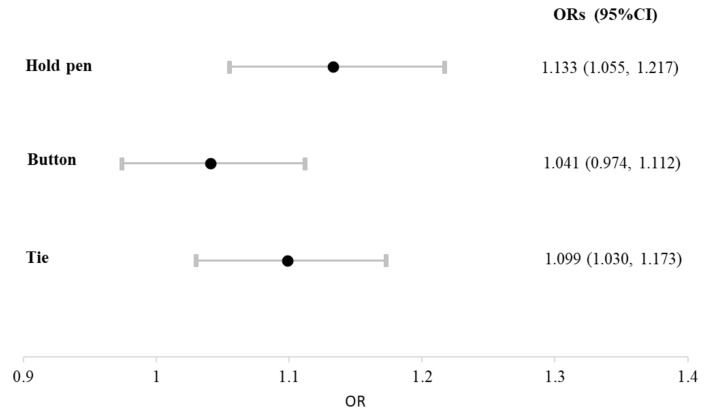
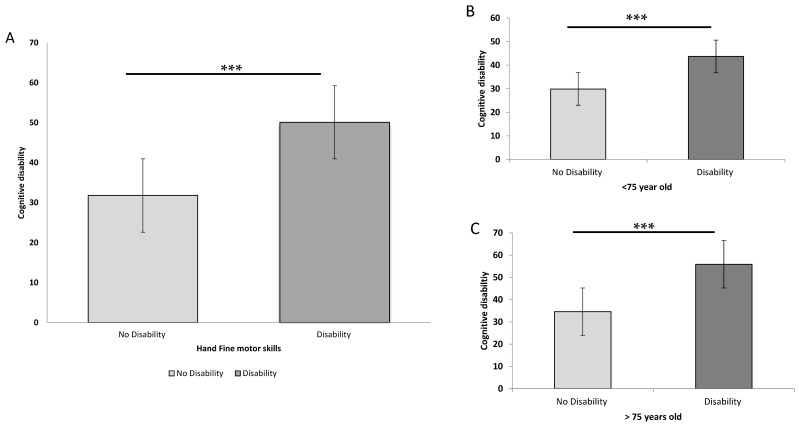
In older individuals, hand fine motor skill disability is associated with cognitive levels. Similarly, patients with moderate-to-advanced Parkinson’s disease (PD) often have cognitive dysfunction. Here, we investigated the association between hand fine motor skill and cognitive dysfunction in patients with moderate-to-advanced PD. Moderate and advanced PD patients with and without dementia were identified from the Taiwan Data Bank of Persons with Disability. Hand fine motor capacities, namely pen holding, buttoning, and knotting, were assessed with the World Health Organization Disability Assessment Schedule 2.0. Statistical analyses were performed on Statistical Analysis System (SAS) and a p value of <0.05 was considered significant. In total, 3440 patients with PD were enrolled, of which 612 had dementia, exhibiting significant disability in all three tasks. After adjustments for age, sex, and PD severity, pen holding and knotting were significantly associated with PD dementia. The presence of any disability in either task was not only sensitive to the presence of dementia but also associated with cognitive disability in moderate and advanced PD patients without dementia. In conclusion, hand fine motor skill disability was associated with cognitive disability in patients with moderate-to-advanced PD. These simple hand fine motor skills may thus be applicable in screening tests for the early identification of cognitive dysfunction in patients with moderate-to-advanced PD.
Overview
The claims and statistics of this paper haven’t been checked yet.
Free: it reads the open-access text and checks the first 5 claims that cite a source we can check. Create a free account to check every claim.
Integrity signals
Registry
Cites
Statistics
Figures
Verification
Claims the paper makes
The claims and statistics of this paper haven’t been checked yet.
Free: it reads the open-access text and checks the first 5 claims that cite a source we can check. Create a free account to check every claim.
Self-check
Percentages, sums and reported differences re-computed from the paper’s own numbers.
The self-check needs the paper’s full text.
Citations
Cites
Kalia, L. V., & Lang, A. E. (2015) · The Lancet · doi:10.1016/s0140-6736(14)61393-3 · Cited by 6,184
Poewe, W., Seppi, K., Tanner, C. M., Halliday, G. M., Brundin, P., Volkmann, J., Schrag, A.-E., & Lang, A. E. (2017) · Nature Reviews Disease Primers · doi:10.1038/nrdp.2017.13 · Cited by 5,415
The Sydney multicenter study of Parkinson's disease: The inevitability of dementia at 20 years
Hely, M. A., Reid, W. G. J., Adena, M. A., Halliday, G. M., & Morris, J. G. L. (2008) · Movement Disorders · doi:10.1002/mds.21956 · Cited by 2,246 · cited 1×
“Patients also experience nonmotor symptoms (NMSs), which adversely affect their cognition, behavior, sleep, and autonomic and sensory function [4].”
BackgroundA systematic review of prevalence studies of dementia in Parkinson's disease
Aarsland, D., Zaccai, J., & Brayne, C. (2005) · Movement Disorders · doi:10.1002/mds.20527 · Cited by 1,689 · cited 1×
“8% in our study population, similar to the dementia prevalence in PD reported elsewhere [32].”
ResultDeMaagd, G. A., & Philip, A. (2015) · PubMed Central · Cited by 956
Kehagia, A. A., Barker, R. A., & Robbins, T. W. (2010) · The Lancet Neurology · doi:10.1016/s1474-4422(10)70212-x · Cited by 881 · cited 1×
“The pathologic hallmark of dopamine neuron depletion could cause typical motor impairment in patients with PD; moreover, extensive cortical degeneration might lead to cognitive impairment in patients with PD [15,16].”
BackgroundSensorimotor integration in movement disorders
Abbruzzese, G., & Berardelli, A. (2003) · Movement Disorders · doi:10.1002/mds.10327 · Cited by 634 · cited 1×
“Early defects in peripheral afferent inputs in patients with PD [28] may explain the nonsignificant differences in the buttoning performance between patients with and without cognitive impairments [29,30].”
BackgroundAarsland, D., Bronnick, K., Ehrt, U., De Deyn, P. P., Tekin, S., Emre, M., & Cummings, J. L. (2007) · Journal of Neurology, Neurosurgery & Psychiatry · doi:10.1136/jnnp.2005.083113 · Cited by 521 · cited 1×
“Patients with PD and their caregivers frequently report cognitive decline as one of their greatest concerns [7,8].”
BackgroundCaligiore, D., Pezzulo, G., Baldassarre, G., Bostan, A. C., Strick, P. L., Doya, K., Helmich, R. C., Dirkx, M., Houk, J., Jörntell, H., et al. (2017) · The Cerebellum · doi:10.1007/s12311-016-0763-3 · Cited by 421 · cited 1×
“Hand fine motor movement performances are also associated with sensorimotor, secondary somatosensory, temporal, limbic, frontooccipital, frontoparietal, and cerebellar networks, and are well described in various studies [20,21,25].”
BackgroundLeroi, I., McDonald, K., Pantula, H., & Harbishettar, V. (2012) · Journal of Geriatric Psychiatry and Neurology · doi:10.1177/0891988712464823 · Cited by 378
Cited by
Liebermann‐Jordanidis, H., Roheger, M., Boosfeld, L., Franklin, J. G., & Kalbe, E. (2022) · Journal of Parkinson s Disease · doi:10.3233/jpd-223238 · Cited by 16
Huang, Y.-C., Hong, C., Chi, W., Yen, C.-F., Liao, H. F., Liou, T., & Chan, L. (2024) · Archives of Gerontology and Geriatrics · doi:10.1016/j.archger.2024.105366 · Cited by 10
Self-citationSchiavo, A., Martins, L. A., Wearick‐Silva, L. E., Orso, R., Xavier, L. L., & Mestriner, R. G. (2023) · Frontiers in Behavioral Neuroscience · doi:10.3389/fnbeh.2023.1059029 · Cited by 8
“A better understanding of this functional relationship might help predict cognitive-motor disorders, such as Alzheimer (Buchman and Bennett, 2011) or Parkinsonrelated dementia (Tan et al., 2020).”
BackgroundCai, Q., Xu, N., He, Y., Zhu, J., Ye, F., Zhi, L., Lu, R., Huang, L., Zhang, F., Chen, J., et al. (2023) · International Journal of Molecular Sciences · doi:10.3390/ijms24021365 · Cited by 9
“(such as tying a shoe and wearing a shirt) and thus reduce the quality of life of PD patients [4].”
BackgroundSelf-citationMaio, M. D., Castellani, L., Cugusi, L., Cortis, C., & Fusco, A. (2022) · International Journal of Environmental Research and Public Health · doi:10.3390/ijerph192215216 · Cited by 7
“Motor impairments, such as tremor disorder and postural changes, result in an increase of rate of falls and dysfunction in ambulation and the fine motor skills system [5,6], thus negatively affecting the individual’s self-care activities and quality of life [7].”
BackgroundVidal, E., Castro-Gutierrez, E., Arisaca, R., Paz-Valderrama, A., & Albiol-Pérez, S. (2023) · JMIR Formative Research · doi:10.2196/50492 · Cited by 4
“The literature shows that there are fine motor disabilities in pathologies such as Parkinson disease, acquired brain injury, cerebral palsy, and epileptic encephalopathy (EE) [3-6].”
BackgroundLee, M., Lin, G., Wang, Y., Lee, S., & Hsieh, C. (2025) · Parkinsonism & Related Disorders · doi:10.1016/j.parkreldis.2025.107316 · Cited by 4
Liao, H., Yen, C.-F., Chiu, T., Chi, W., Liou, T., Chang, B.-S., Wu, T., & Lu, S.-J. (2022) · Frontiers in Rehabilitation Sciences · doi:10.3389/fresc.2022.879898 · Cited by 7
Self-citationHryb, V. A., Герасимчук, В. Р., Uwa-Agbonikhena, I. F., Н.П., Т., Дорошенко, О. О., & Генык, С. И. (2021) · Український медичний часопис · doi:10.32471/umj.1680-3051.142.204897 · Cited by 3
An Interdisciplinary Approach to Assistive Technology for Parkinson’s Disease Dementia
Munzesheimer, S., Siu, T. W., Yacinthe, D., Garcia-Casals, M., Haq, I. U., & Shpiner, D. S. (2025) · Clinical Interventions in Aging · doi:10.2147/cia.s516786 · Cited by 2
“46 Implementing low-to mid-tech AT can assist in performing functional tasks safely and reduce frustration due to symptom interference.”
Smits-Engelsman, B. C. M., & Duysens, J. (2025) · Scientific Reports · doi:10.1038/s41598-025-96594-3 · Cited by 1
Multimodal Contactless Architecture for Upper Limb Virtual Rehabilitation
Valdivia-Cisneros, E., Vidal, E., & Castro-Gutiérrez, E. (2023) · International Journal of Advanced Computer Science and Applications · doi:10.14569/ijacsa.2023.0140831 · Cited by 1
“Limited mobility is a prevalent dysfunction that is observed in patients suffering from neurological diseases such as Stroke, Epileptic Encephalopathy, Cerebral Palsy or Parkinson diseases [1, 2, 3, 4].”
BackgroundValenzuela, C. S. M. (2022) · IntechOpen eBooks · doi:10.5772/intechopen.98773
Hand motor dexterity as one of neurological status assessing indicators
Shavlovskaya, O. A. (2022) · S S Korsakov Journal of Neurology and Psychiatry · doi:10.17116/jnevro2022122101121
Pereira, N. D. B., Dias, R. A., Nóbrega, K. C. C., Nascimento, I. A. P. D. S., Bocicovar, R. P., Santana, C. D., Matos, L. R., Fidelis, F. F. D. S., de Campos, G. T. C., Aranha, L. M., et al. (2025) · medRxiv · doi:10.1101/2025.07.31.25331974
“Previous studies that utilized the WHODAS 2.0 to assess disability levels did not include patients in stage 1 of H&Y, did not use several scoring methods, and did not account for several confounding factors (43, 44, 46, 47).”
InfluentialAdjustable Transobturator Male System in Artificial Urinary Sphincter Patients: A Good Alternative?
Kidess, M. A., Lederer, E., Georgieva, T., Hermans, J., Stadelmeier, L. F., Hoffmann, M., Pyrgidis, N., Marcon, J., Weinhold, P., Keller, P., et al. (2026) · Urologia Internationalis · doi:10.1159/uin/aewag023
Pereira, N. D. B., Dias, R. A., Nóbrega, K. C. C., Nascimento, I. A. P. D. S., Fidelis, F. F. D. S., Aranha, L. M., Helene, A. F., Roque, A. C., Eggers, C., & Piemonte, M. E. P. (2026) · Journal of Parkinson s Disease · doi:10.1177/1877718x261470254
Metadata
- Authors
- Tan, S., Hong, C. T., Chen, J.-H., Chan, L., Chi, W.-C., Yen, C.-F., Liao, H.-F., Liou, T.-H., & Wu, D.
- Affiliations
- Taipei Medical University-Shuang Ho Hospital (TW)
- Chung Shan Medical University (TW)
- Tzu Chi University (TW)
- National Taiwan University (TW)
- Corresponding author
- Wu, Dean
- ORCID
- Venue
- Brain Sciences
- Publisher
- MDPI AG
- Published
- 2020-06-02
- Volume
- 10
- Issue
- 6
- Pages
- 337
- ISSN
- 2076-3425 (ISSN-L)
- PMC
- PMC7349665
- OpenAlex
- W3030445574
- Cited by
- 17
- References
- 33
- Citations by year
- 2026: 2 · 2025: 4 · 2024: 1 · 2023: 4 · 2022: 4 · 2021: 2
- FWCI
- 1.08
- Type
- journal article
- Language
- en
- Open access
- gold
- doi.org
- Licence
- Locations
- Brain Sciences (publishedVersion, cc-by)
- PubMed Central (publishedVersion, cc-by)
- PubMed (publishedVersion)
- DOAJ (DOAJ: Directory of Open Access Journals) (submittedVersion, cc-by-sa)
- Topics
- Health Sciences › Medicine › Clinical Neurology › Parkinson's Disease Mechanisms and Treatments
- Health Sciences › Medicine › Psychiatry and Mental health › Dementia and Cognitive Impairment Research
- Health Sciences › Medicine › Clinical Neurology › Deep Brain Stimulation and Movement Disorders
- Keywords
- Parkinson's disease, motor impairment, cognitive impairment, dementia, knotting, disability assessment
About these checks
Registry, retraction, Cites and statistics results are computed, not judged, with one exception: a printed reference that no index lists is read once by a model before it counts as a citation error. Claims are extracted by a model and kept only when their quote appears verbatim in the text; each cited source is then checked, with a model’s help, for whether it says what the claim relies on. Those verdicts can be wrong — read the claim’s quote and the cited source before relying on one.
Statistics and arithmetic are recomputed, not judged.
Confidence bands are shown only for fields calibrated on our annotated test set. None is calibrated yet, so no band is shown.
What counts as a claim ›How we measure confidence ›How we check this ›
Are you an author, or do you see a problem with this page? Request a review
Data sources
Bibliographic data: Semantic Scholar, OpenAlex, Crossref.
Contains information from the Semantic Scholar Academic Graph Datasets, made available under the ODC Attribution License (ODC-BY 1.0).
Semantic Scholar’s data is described in: Kinney, R., et al. (2023). The Semantic Scholar Open Data Platform. arXiv:2301.10140.
