

Electroacupuncture Alleviates Depressive-like Behavior by Modulating the Expression of P2X7/NLRP3/IL-1β of Prefrontal Cortex and Liver in Rats Exposed to Chronic Unpredictable Mild Stress
Open accessThe DOI matches its Crossref record; 78 of the 79 references it cites were found in a registry or an index.
Abstract
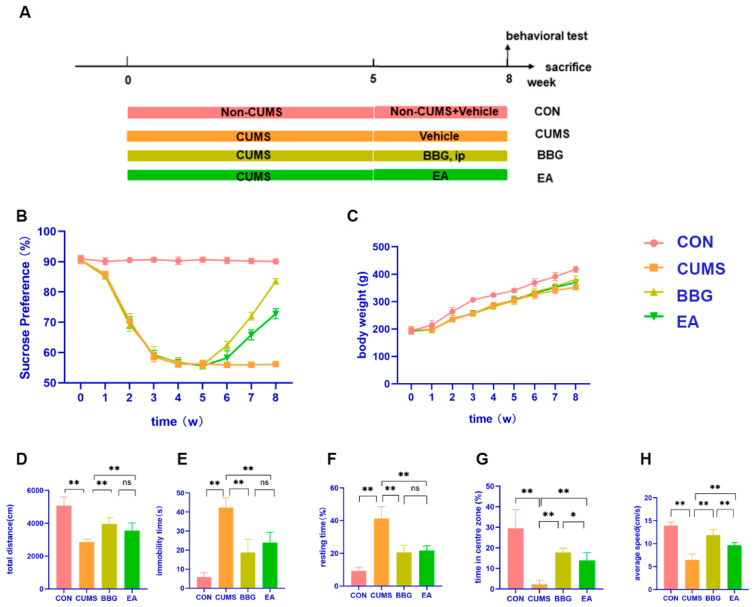
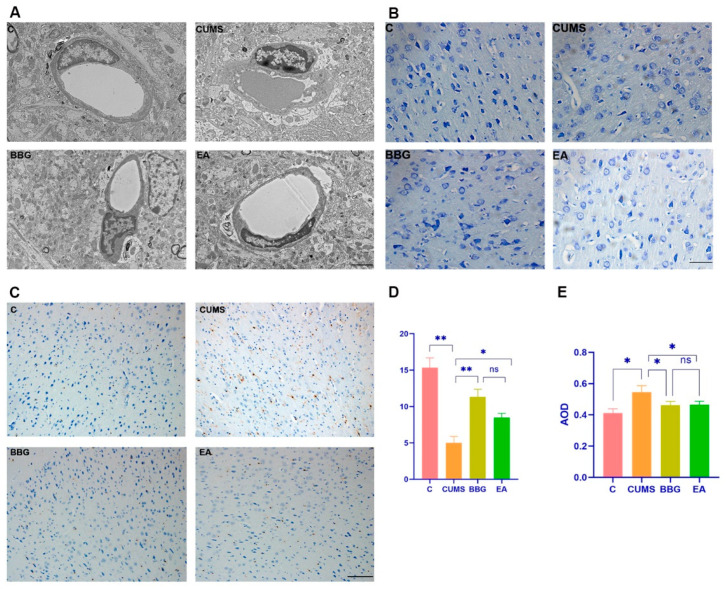
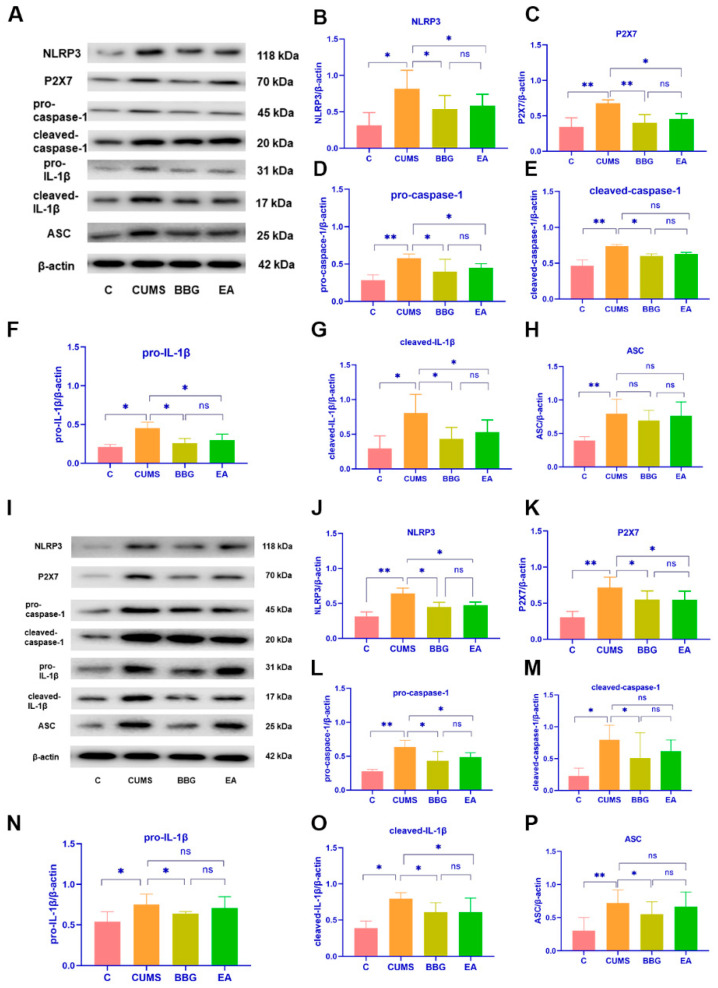
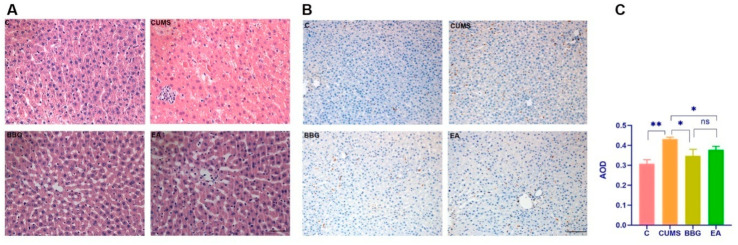
Depression is a complex clinical disorder associated with poor outcomes. Electroacupuncture (EA) has been demonstrated to have an important role in both clinical and pre-clinical depression investigations. Evidence has suggested that the P2X7 receptor (P2X7R), NLRP3, and IL-1β play an important role in depressive disorder. Our study is aimed at exploring the role of EA in alleviating depression-like behaviors in rats. We therefore investigated the effects of EA on the prefrontal cortex and liver of rats subjected to chronic unpredictable mild stress (CUMS) through behavior tests, transmission electron microscopy, Nissl staining, HE staining, immunohistochemistry and Western blotting. Five weeks after exposure to CUMS, Sprague-Dawley (SD) rats showed depression-like behavior. Three weeks after treatment with brilliant blue G (BBG) or EA, depressive symptoms were significantly improved. Liver cells and microglia showed regular morphology and orderly arrangement in the BBG and EA groups compared with the CUMS group. Here we show that EA downregulated P2X7R/NLRP3/IL-1β expression and relieved depression-like behavior. In summary, our findings demonstrated the efficacy of EA in alleviating depression-like behaviors induced by CUMS in rats. This suggests that EA may serve as an adjunctive therapy in clinical practice, and that P2X7R may be a promising target for EA intervention on the liver–brain axis in treatment of depression.
Overview
The claims and statistics of this paper haven’t been checked yet.
Free: it reads the open-access text and checks the first 5 claims that cite a source we can check. Create a free account to check every claim.
Integrity signals
Registry
Cites
Statistics
Figures
Verification
Claims the paper makes
The claims and statistics of this paper haven’t been checked yet.
Free: it reads the open-access text and checks the first 5 claims that cite a source we can check. Create a free account to check every claim.
Claims other papers make about this one
Each is checked against this paper’s own text: does it say what the citing paper says it does?
The cited source says what the claim attributes to it.
In the citing paper
“In a rat model of CUMS, electroacupuncture (EA) was found to downregulate P2X 7 R, NLRP3, and IL-1β expression in the prefrontal cortex and liver and relieved depression-like behavior. 252”
From Major depressive disorder: hypothesis, mechanism, prevention and treatment (2024) · cites this paper as [252]
Self-check
Percentages, sums and reported differences re-computed from the paper’s own numbers.
The self-check needs the paper’s full text.
Citations
Cites
Malhi, G. S., & Mann, J. J. (2018) · The Lancet · doi:10.1016/s0140-6736(18)31948-2 · Cited by 4,099
Howard, D. M., Adams, M. J., Clarke, T.-K., Hafferty, J. D., Gibson, J., Shirali, M., Coleman, J. R. I., Hagenaars, S. P., Ward, J., Wigmore, E. M., et al. (2019) · Nature Neuroscience · doi:10.1038/s41593-018-0326-7 · Cited by 2,565
Willner, P., Towell, A., Sampson, D., Sophokleous, S., & Muscat, R. (1987) · Psychopharmacology · doi:10.1007/bf00187257 · Cited by 1,993
Inflammation as a link between obesity, metabolic syndrome and type 2 diabetes
Esser, N., Legrand-Poels, S., Piette, J., Scheen, A. J., & Paquot, N. (2014) · Diabetes Research and Clinical Practice · doi:10.1016/j.diabres.2014.04.006 · Cited by 1,981 · cited 1×
“Depression is considered a metabolic disease related to liver function, and it has been shown that apolipoprotein B, very-low-density lipoprotein cholesterol, triglycerides, unsaturated fatty acids, tyrosine and abnormal metabolism are related to depression [64,65].”
BackgroundNeuronal signalling of fear memory
Maren, S., & Quirk, G. J. (2004) · Nature Reviews Neuroscience · doi:10.1038/nrn1535 · Cited by 1,428
Neuroinflammation and depression: A review
Troubat, R., Barone, P., Leman, S., Desmidt, T., Cressant, A., Atanasova, B., Brizard, B., El Hage, W., Surget, A., Belzung, C., et al. (2021) · European Journal of Neuroscience · doi:10.1111/ejn.14720 · Cited by 1,107 · cited 1×
“Additionally, the relationship between depression and neuroinflammation has been widely recognized [18], as increased microglia activation has been observed in depression-related brain regions, including the PFC [19].”
BackgroundThe P2X7 Receptor: A Key Player in IL-1 Processing and Release
Ferrari, D., Pizzirani, C., Adinolfi, E., Lemoli, R. M., Curti, A., Idzko, M., Panther, E., & Di Virgilio, F. (2006) · The Journal of Immunology · doi:10.4049/jimmunol.176.7.3877 · Cited by 1,025 · cited 1×
“Furthermore, P2X7R is a critical player in activating the NLRP3 inflammasome, which in turn acts as a signal for the release of IL-1β [30,31].”
BackgroundWree, A., Eguchi, A., McGeough, M. D., Pena, C. A., Johnson, C. D., Canbay, A., Hoffman, H. M., & Feldstein, A. E. (2014) · Hepatology · doi:10.1002/hep.26592 · Cited by 945 · cited 1×
“Interestingly, NLRP3 inflammasome is the pathogenesis of both chronic liver disease and depression [22,32,33].”
BackgroundSetiawan, E., Wilson, A. A., Mizrahi, R., Rusjan, P. M., Miler, L., Rajkowska, G., Suridjan, I., Kennedy, J. L., Rekkas, P. V., Houle, S., et al. (2015) · JAMA Psychiatry · doi:10.1001/jamapsychiatry.2014.2427 · Cited by 939 · cited 1×
“Additionally, the relationship between depression and neuroinflammation has been widely recognized [18], as increased microglia activation has been observed in depression-related brain regions, including the PFC [19].”
BackgroundKoolschijn, P. C. M. P., van Haren, N. E. M., Lensvelt‐Mulders, G. J. L. M., Hulshoff Pol, H. E., & Kahn, R. S. (2009) · Human Brain Mapping · doi:10.1002/hbm.20801 · Cited by 902 · cited 1×
“Common themes have emerged, including alterations in volume [12], gray matter density [13] and activity levels across a network of regions including PFC, hippocampus, and amygdala.”
Background
Research works printed but not linked: 2
- Mennin D.S. Fresco D.M. Emotion regulation as an integrative framework for understanding and treating psychopathology Emotion Regulation and Psychopathology: A Transdiagnostic Approach to Etiology and Treatment The Guilford Press New York, NY, USA 2010
- Yang X.Y.H. Zhao T.Y. Sun S.Y. Pan X.F. Guo Y. Study on Compatibility Law of Acupoints in Patients with Depression Treated by Acupuncture Based on Data Mining Zhongguo Zhongyiyao Xinxi Zazhi 2021 28 21 25 10.19879/j.cnki.1005-5304.202001234 · doi:10.19879/j.cnki.1005-5304.202001234
Cited by
Major depressive disorder: hypothesis, mechanism, prevention and treatment
Cui, L., Li, S., Wang, S., Wu, X., Liu, Y., Yu, W., Wang, Y., Tang, Y., Xia, M., & Li, B. (2024) · Signal Transduction and Targeted Therapy · doi:10.1038/s41392-024-01738-y · Cited by 1,244
“252 In summary, as shown in Fig.”
Mechanisms of acupuncture in treating depression: a review
Ma, J., Yin, X., Cui, K., Wang, J., Li, W., & Xu, S. (2025) · Chinese Medicine · doi:10.1186/s13020-025-01080-7 · Cited by 43
Acupuncture may play a key role in anti-depression through various mechanisms in depression
Li, P., Zhao, J., Wei, X., Luo, L., Chu, Y., Zhang, T., Zhu, A., & Yan, J. (2024) · Chinese Medicine · doi:10.1186/s13020-024-00990-2 · Cited by 39
Purinergic P2X7 receptor as a potential therapeutic target in depression
Wang, Q., Jin, X., & Guan, W. (2023) · Biochemical Pharmacology · doi:10.1016/j.bcp.2023.115959 · Cited by 25
Possible antidepressant mechanism of acupuncture: targeting neuroplasticity
Xu, N., He, Y., Wei, Y.-N., Bai, L., & Wang, L. (2025) · Frontiers in Neuroscience · doi:10.3389/fnins.2025.1512073 · Cited by 20
Fang, H., Fan, L.-L., Ding, Y.-L., Wu, D., Zheng, J., Cai, Y.-F., Huang, Y., Qiao, L., Zhang, S., & Zhan, J. (2024) · Neurochemical Research · doi:10.1007/s11064-024-04228-3 · Cited by 19
Single-cell RNA-seq reveals the role of YAP1 in prefrontal cortex microglia in depression
Ma, F., Bian, H., Jiao, W., & Zhang, N. (2024) · BMC Neurology · doi:10.1186/s12883-024-03685-1 · Cited by 17
“Mounting evidence suggests a close association between microglial activation and dysfunctional states and the onset of depression [7, 8].”
BackgroundBissacotti, B. F., da Silveira, M. V., Assmann, C. E., Copetti, P. M., dos Santos, A. F., Fagan, S. B., da Rocha, J. A. P., Schetinger, M. R. C., Morsch, V. M., Bottari, N. B., et al. (2025) · Pharmaceuticals · doi:10.3390/ph18070950 · Cited by 16
Lai, Z., Cao, Y., Zhang, Y., Cai, Y., Zhang, S., Li, Y., Wang, H., & Sabihi, S.-S. (2025) · Phytochemistry Reviews · doi:10.1007/s11101-025-10125-6 · Cited by 13
“…to elevated ATP release, which activates P2X7 receptors (P2X7R) in microglia and astrocytes, triggering the NLRP3 inflammasome cascade and promoting proinflamma-tory cytokine release (IL-1 b , IL-18), thereby worsening neuroinflammation and depressive symptoms (Wang et al. 2020a, b; Pang et al. 2023).”
Self-citationLi, Z., Cao, S., Yang, J., Chen, L., Lv, J., Lu, P., Liu, J., Liu, M., & Liu, Q. (2025) · Journal of Inflammation Research · doi:10.2147/jir.s534219 · Cited by 12
“18,19 Nevertheless, there is still a relative scarcity of studies investigating the specific mechanisms through which electroacupuncture mitigates depression symptoms caused by IBD.”
The P2X7 receptor in depression: Novel insights and therapeutic implications
Zhong, Y.-T., Pi, C., Zuo, Y., Wei, Y., Li, W., Jiang, Y.-Q., Tao, L., Zheng, W.-W., Jiang, J., Yang, Y., et al. (2025) · Neurobiology of Disease · doi:10.1016/j.nbd.2025.107011 · Cited by 11
Self-citationLv, S., Kong, L., Zhong, X., Shang, R., Lu, Y., Zhang, G., Gao, H., Hou, X., Li, G., & Yu, X. (2025) · Frontiers in Immunology · doi:10.3389/fimmu.2025.1642001 · Cited by 6
Ojiakor, V. O., Ben-Azu, B., Finbarrs-Bello, E., Esom, E. A., Anibeze, C., & Anyanwu, G. E. (2026) · European Journal of Medicinal Chemistry Reports · doi:10.1016/j.ejmcr.2026.100323 · Cited by 7
Xu, J., Zhang, Y., Wang, X., Xu, W., Chen, S., Pan, L., & Gao, J. (2025) · Journal of Affective Disorders · doi:10.1016/j.jad.2025.119859 · Cited by 3
Wang, Y., & Zhang, L. (2026) · Frontiers in Medicine · doi:10.3389/fmed.2026.1783519 · Cited by 5
Khastoo, D., Jafari, F., Yekta, B. G., Ale‐Ebrahim, M., Fazli‐Tabaei, S., & Vaseghi, S. (2025) · Behavioural Pharmacology · doi:10.1097/fbp.0000000000000848 · Cited by 3
Yang, X., Zhao, B., Li, J., Shi, C., Gao, X., Wang, Y., Jiang, H., Feng, S., Bao, T., & Zhang, Z. (2025) · Journal of Traditional and Complementary Medicine · doi:10.1016/j.jtcme.2025.02.002 · Cited by 2
Ma, H., Zhu, S.-L., Li, X., Yuan, Y., Huang, Q.-Y., Wang, H., Shen, G.-M., & Wang, X.-Y. (2026) · World Journal of Psychiatry · doi:10.5498/wjp.v16.i2.114736 · Cited by 1
Zhang, X., Zhao, X.-R., You, C.-L., Zhang, F., Zhu, H.-Y., Gu, T., & Li, J. (2026) · ASN NEURO · doi:10.1080/17590914.2026.2624589 · Cited by 1
“Although prior research has reported the emotional regulatory effects of acupuncture, these findings were largely confined to models of chronic stress or brain injury (Guo et al., 2020; Pang et al., 2023).”
Zhao, S., Gong, J., Wu, R., Xiong, Y., Gu, Y., Wang, Y., & Song, Z. (2026) · Frontiers in Physiology · doi:10.3389/fphys.2026.1752608 · Cited by 1
Targeting P2X Receptors—Current Progress in Sepsis
Luo, L., Zhao, Q., Tian, Y.-F., Sun, M., Zhang, M., & Wang, B. (2025) · International Journal of Inflammation · doi:10.1155/ijin/1083543
“Mod-ulating this signaling pathway using 2 International Journal of Infammation electroacupuncture may alleviate liver infammation and, through the gut–brain axis, potentially ameliorate symptoms of depression [51].”
ATP and major affective disorders: the involvement of P2X receptors in pathophysiology
Mattova, S., Šimko, P., Colzi, E., Štammová, E., Urbanská, N., Grigoroiu‐Serbânescu, M., Coppi, E., & Kisková, T. (2026) · Purinergic Signalling · doi:10.1007/s11302-026-10147-5
Zhu, M., Chang, Y., Hu, Y., Wang, Z., & Yu, S. (2026) · Food & Function · doi:10.1039/d6fo00833j
Li, Y., Fu, J., Yu, S., Ye, Z., Jiang, Y., & Geng, S. (2026) · Open Journal of Depression · doi:10.4236/ojd.2026.153005
Self-citationWang, Y., & Liu, J. (2026) · Acupuncture & Electro-Therapeutics Research · doi:10.1177/03601293261493171
Metadata
- Authors
- Pang, F., Yang, Y., Huang, S., Yang, Z., Zhu, Z., Liao, D., Guo, X., Zhou, M., Li, Y., & Tang, C.
- Affiliations
- Chongqing Medical University (CN)
- Chongqing Key Laboratory of Traditional Chinese Medicine for Prevention and Cure of Metabolic Diseases, College of Traditional Chinese Medicine, Chongqing Medical University, Chongqing 400016, China
- Corresponding author
- Tang, Chenglin
- Venue
- Brain Sciences
- Publisher
- MDPI AG
- Published
- 2023-03-03
- Volume
- 13
- Issue
- 3
- Pages
- 436
- ISSN
- 2076-3425 (ISSN-L)
- PMC
- PMC10046261
- OpenAlex
- W4323318291
- Cited by
- 25
- References
- 79
- Citations by year
- 2026: 9 · 2025: 11 · 2024: 4 · 2023: 1
- FWCI
- 7.64
- Type
- journal article
- Language
- en
- Open access
- gold
- doi.org
- Licence
- Locations
- Brain Sciences (publishedVersion, cc-by)
- PubMed Central (publishedVersion, cc-by)
- PubMed (publishedVersion)
- DOAJ (DOAJ: Directory of Open Access Journals) (submittedVersion, cc-by-sa)
- Funders
- Chongqing Municipal Education Commission (CYB20166)
- Topics
- Health Sciences › Medicine › Complementary and alternative medicine › Acupuncture Treatment Research Studies
- Health Sciences › Medicine › Pharmacology (medical) › Treatment of Major Depression
- Life Sciences › Neuroscience › Neurology › Vagus Nerve Stimulation Research
- Keywords
- electroacupuncture, depression, chronic unpredictable mild stress, P2X7 receptor, NLRP3 inflammasome, IL-1β, prefrontal cortex, liver, liver-brain axis, microglia, neuroinflammation, antidepressant effects
About these checks
Registry, retraction, Cites and statistics results are computed, not judged, with one exception: a printed reference that no index lists is read once by a model before it counts as a citation error. Claims are extracted by a model and kept only when their quote appears verbatim in the text; each cited source is then checked, with a model’s help, for whether it says what the claim relies on. Those verdicts can be wrong — read the claim’s quote and the cited source before relying on one.
Statistics and arithmetic are recomputed, not judged.
Confidence bands are shown only for fields calibrated on our annotated test set. None is calibrated yet, so no band is shown.
What counts as a claim ›How we measure confidence ›How we check this ›
Are you an author, or do you see a problem with this page? Request a review
Data sources
Bibliographic data: Semantic Scholar, OpenAlex, Crossref.
Contains information from the Semantic Scholar Academic Graph Datasets, made available under the ODC Attribution License (ODC-BY 1.0).
Semantic Scholar’s data is described in: Kinney, R., et al. (2023). The Semantic Scholar Open Data Platform. arXiv:2301.10140.
