

Beyond Cognitive Load Theory: Why Learning Needs More than Memory Management
Open accessThe DOI matches its Crossref record; 113 of the 113 references it cites were found in a registry or an index.
Abstract
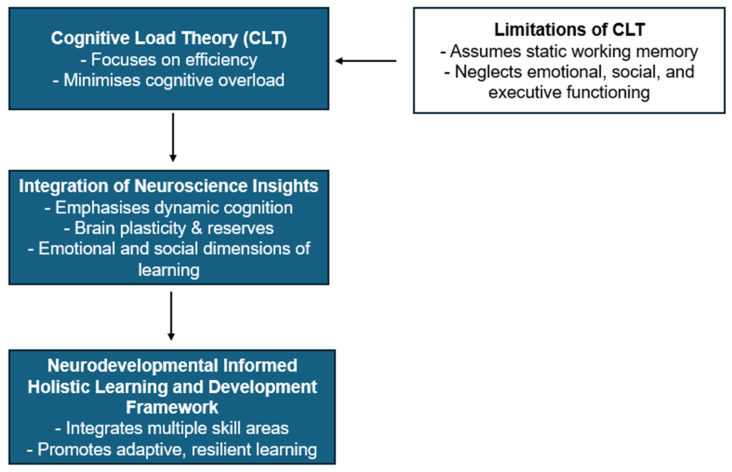
Background: The role of cognitive load theory (CLT) in understanding effective pedagogy has received increased attention in the fields of education and psychology in recent years. A considerable amount of literature has been published on the CLT construct as foundational guidance for instructional design by focusing on managing cognitive load in working memory to enhance learning outcomes. However, recent neuroscientific findings and practical critiques suggest that CLT’s emphasis on content-focused instruction and cognitive efficiency may overlook the complexity of human learning. Methods: This conceptual paper synthesises evidence from cognitive science, developmental psychology, neuroscience, health sciences and educational research to examine the scope conditions and limitations of CLT when applied as a general framework for K–12 learning. One of the major theoretical issues identified is the lack of consideration for the broad set of interpersonal and self-management skills, creating potential limitations for real-world educational contexts, where social-emotional and self-regulatory abilities are as crucial as cognitive competencies. Results: As a result of the critique, this paper introduces the Neurodevelopmental Informed Holistic Learning and Development Framework as a neuroscience-informed construct that integrates cognitive, emotional, and interpersonal dimensions essential for effective learning. Conclusions: In recognising the limitations of CLT, the paper offers practitioners contemporary, neurodevelopmentally informed insights that extend beyond cognitive efficiency alone and better reflect the multidimensional nature of real-world learning.
Overview
The claims and statistics of this paper haven’t been checked yet.
Free: it reads the open-access text and checks the first 5 claims that cite a source we can check. Create a free account to check every claim.
Integrity signals
Registry
Cites
Statistics
Figures
Verification
Claims the paper makes
The claims and statistics of this paper haven’t been checked yet.
Free: it reads the open-access text and checks the first 5 claims that cite a source we can check. Create a free account to check every claim.
Self-check
Percentages, sums and reported differences re-computed from the paper’s own numbers.
The self-check needs the paper’s full text.
Citations
Cites
The "what" and "why" of goal pursuits: Human needs and the self-determination of behavior
Deci, E. L., & Ryan, R. M. (2000) · Psychological Inquiry · doi:10.1207/s15327965pli1104_01 · Cited by 34,210 · cited 1×
“For example, theories of motivation, such as self-determination theory, suggest that autonomy, competence, and relatedness are important in fostering student intrinsic motivation and engagement [110].”
Diamond, A. (2013) · Annual Review of Psychology · doi:10.1146/annurev-psych-113011-143750 · Cited by 13,268 · cited 2×
“By prioritising a primary focus on reducing cognitive load, traditional CLT-matched instruction may actually restrict potential growth of the learner’s cognitive abilities (i.e., cognitive flexibility, creativity, resilience) that are increasingly identified as critical throughout life [55].”
An Integrative Theory of Prefrontal Cortex Function
Miller, E. K., & Cohen, J. D. (2001) · Annual Review of Neuroscience · doi:10.1146/annurev.neuro.24.1.167 · Cited by 12,803 · cited 1×
“…prefrontal cortex is the part of the brain region responsible for the regulation of higher-order cognitive operations [81], that engages and interacts with networks such as the anterior cingulate cortex, basal ganglia, and parietal lobes to make flexible goal-directed behaviour possible [82,83].”
Cognitive Load During Problem Solving: Effects on Learning
Sweller, J. (1988) · Cognitive Science · doi:10.1016/0364-0213(88)90023-7 · Cited by 11,048 · cited 1×
“Since its introduction by Sweller in the 1980s, Cognitive Load Theory (CLT) has been recognised as a potential construct in the field of instructional design in Australia and across Europe, primarily through its emphasis on managing working memory constraints to prevent cognitive overload [1].”
Durlak, J. A., Weissberg, R. P., Dymnicki, A. B., Taylor, R. D., & Schellinger, K. B. (2011) · Child Development · doi:10.1111/j.1467-8624.2010.01564.x · Cited by 10,854 · cited 1×
“Previous research has established that emotional and social factors are essential for learning, suggesting that overly simplistic or unengaging environments could hinder the development of critical thinking and problem-solving skills [7,22–24].”
The Brain's Default Network: Anatomy, Function, and Relevance to Disease
Buckner, R. L., Andrews‐Hanna, J. R., & Schacter, D. L. (2008) · Annals of the New York Academy of Sciences · doi:10.1196/annals.1440.011 · Cited by 9,761 · cited 1×
“In this regard, evidence of the involvement of the DMN in self-referential thinking, access to autobiographical memory, and mental simulation that provides important facilitation to a coherent ‘sense of self’ and the ability to learn from one’s experiences has been documented [109].”
Rizzolatti, G., & Craighero, L. (2004) · Annual Review of Neuroscience · doi:10.1146/annurev.neuro.27.070203.144230 · Cited by 7,433 · cited 1×
“Mirror neurons are a class of special neurons that are fired when a person acts and when they observe somebody else acting, thus providing insight into others’ actions and emotions while helping them learn new things and mimicking people through observing actions and understanding actions [75].”
Cognitive and emotional influences in anterior cingulate cortex
Bush, G., Luu, P., & Posner, M. I. (2000) · Trends in Cognitive Sciences · doi:10.1016/s1364-6613(00)01483-2 · Cited by 6,259 · cited 2×
“Moderate extraneous stimuli can activate areas such as the anterior cingulate cortex, enhancing attentional flexibility and enabling learners to better adapt to complex or changing environments [105,106].”
Working memory: Looking back and looking forward
Baddeley, A. (2003) · Nature Reviews Neuroscience · doi:10.1038/nrn1201 · Cited by 5,200 · cited 2×
“Studies show that working memory capacity can be modulated by factors like attentional focus and neural plasticity, particularly in task-relevant regions like the prefrontal cortex (PFC) and parietal lobes [49,58].”
A gradient of childhood self-control predicts health, wealth, and public safety
Moffitt, T. E., Arseneault, L., Belsky, D., Dickson, N., Hancox, R. J., Harrington, H., Houts, R., Poulton, R., Roberts, B. W., Ross, S., et al. (2011) · Proceedings of the National Academy of Sciences · doi:10.1073/pnas.1010076108 · Cited by 4,885 · cited 2×
“…abilities not only contributes to cognitive and learning success in childhood but also has lasting impacts across the lifespan, influencing health, substance addiction, criminal behaviour, educational achievement, income, financial management, pregnancy planning, and parenting style [29,30].”
Research works printed but not linked: 9
- 24. Sachdeva, S.; Eggen, P.-O. Students' Critical Perceptions About Mathematics Education. In Proceedings of the Tenth International Mathematics Education and Society Conference, Hyderabad, India, 28 January-2 February 2019.
- Blewitt, 2024, Does social and emotional learning intervention influence physiological and biological indicators? A systematic literature review of universal and targeted programs in Pre-K to grade 12, Soc. Emot. Learn. Res. Pract. Policy, 3, 100028
- Kumar, 2023, Innovative Approaches and Therapies to Enhance Neuroplasticity and Promote Recovery in Patients with Neurological Disorders: A Narrative Review, Cureus, 15, e41914
- Arain, 2013, Maturation of the adolescent brain, Neuropsychiatr. Dis. Treat., 9, 449
- Narengaowa, 2024, Research on metacognitive strategies of children’s self-regulated learning, Health Psychol. Res., 12, 120366
- Schneider, W., and Lockl, K. (2008). Procedural metacognition in children: Evidence for developmental trends. Handbook of Metamemory and Memory, Psychology Press.
- Shimamura, A.P. (2008). A neurocognitive approach to metacognitive monitoring and control. Handbook of Metamemory and Memory, Psychology Press.
- Huang, 2023, Social emotional interaction in collaborative learning: Why it matters and how can we measure it?, Soc. Sci. Humanit. Open, 7, 100447
- Silke, 2024, Activating Social Empathy: An evaluation of a school-based social and emotional learning programme, Soc. Emot. Learn. Res. Pract. Policy, 3, 100021
Cited by
Christopoulou, S., Antonopoulou, H., Zapantis, R., Gkintoni, E., & Halkiopoulos, C. (2026) · International Journal of Environmental Research and Public Health · doi:10.3390/ijerph23020190 · Cited by 13
“Recent theoretical advances underscore that effective professional development for educators experiencing burnout must move beyond simple workload reduction to address deeper cognitive, motivational, and emotional factors [58].”
Self-citationNtavlourou, A., Antonopoulou, H., & Halkiopoulos, C. (2026) · Sustainability · doi:10.3390/su18031555 · Cited by 11
Ntouka, E., Antonopoulou, H., ΡΕΚΚΑ, Ε., Gkintoni, E., & Halkiopoulos, C. (2026) · Societies · doi:10.3390/soc16020052 · Cited by 10
Self-citationKokkonesi, E., Antonopoulou, H., Igoumenakis, G., & Halkiopoulos, C. (2026) · Administrative Sciences · doi:10.3390/admsci16020101 · Cited by 3
“…neuroscience research highlights the need to move beyond traditional cognitive load management approaches, recognizing that effective learning and professional functioning require attention to emotional, motivational, and contextual factors that influence teacher well-being (Sortwell et al., 2026).”
Joshua Abah, A. B. A. H., & Vilakazi, Z. F. (2026) · International Journal of Educational Qualitative Quantitative Research · doi:10.58418/ijeqqr.v5i1.176 · Cited by 3
“To be sure, structured memorization offers distinct cognitive affordances, including expanding working memory capacity and enhancing overall memory flexibility (Sortwell et al., 2026; Wyble et al., 2025).”
Spyropoulos, N. I., Antonopoulou, H., Rafailidis, A., & Halkiopoulos, C. (2026) · Administrative Sciences · doi:10.3390/admsci16020072 · Cited by 2
Cognitive Load Theory-Informed Curriculum Design in Health Sciences Education
Rana, K., Alford, S., Moore, A., & Chimoriya, R. (2026) · Encyclopedia · doi:10.3390/encyclopedia6050102 · Cited by 2
“Aligning educational strategies with CLT, instructors and curriculum designers can better manage cognitive load and foster deeper learning [10].”
Gkintoni, E., Kanellopoulou, H. A., Pouris, C., Vassilopoulos, S. P., Nikolaou, G., & Halkiopoulos, C. (2026) · Brain Sciences · doi:10.3390/brainsci16020161 · Cited by 1
“Importantly, contemporary theoretical perspectives emphasize that effective learning requires more than traditional cognitive load management, highlighting the critical role of affective and motivational processes in optimizing educational outcomes [129].”
Self-citationPersonalized Recommendation Algorithm of Piano Practice Scheme Based on Multi Objective Optimization
Feng, C. (2026) · International Scientific Technical and Economic Research · doi:10.71451/istaer2612 · Cited by 1
“In practical teaching, a good practice program needs to balance multiple objectives, such as skill improvement efficiency, time cost control, user learning experience, and cognitive load management [6] , [7] , [8] .”
Adaptive nano-learning improves working memory quality in high school students
Alwazzan, M. S. (2026) · Frontiers in Education · doi:10.3389/feduc.2026.1812472 · Cited by 1
Ametepey, I., Mpuangnan, K. N., & Ankudze, B. (2026) · Edelweiss Applied Science and Technology · doi:10.55214/2576-8484.v10i7.13197 · Cited by 1
Bolatimi, O. S., Ricky-Okine, C., Bolatimi, F. E., Agbesi, C. C. M., Martey, F., Bolatimi, O. R., Peter, A., & Kwaku, E. O. (2026) · Discover Artificial Intelligence · doi:10.1007/s44163-026-02082-6
“Secondly, while the theoretical tension between learning efficiency and deep cognitive development is well-recognised [13, 58, 59], no research or study has simultaneously operationalised and predicted both Study Efficiency and Cognitive Skill as separate outcome constructs within a single GenAI…”
Tu, Y., Huang, C., Gao, C., Tu, Y.-F., Pan, Y., & Hwang, G. (2026) · Computers in Human Behavior · doi:10.1016/j.chb.2026.108998
Teacher Attitudes and Barriers to GeoGebra Adoption in Secondary Mathematics Education
Vlachoni, G., Antonopoulou, H., Καρανικόλα, Ζ., & Halkiopoulos, C. (2026) · Emerging Science Journal · doi:10.28991/esj-2025-sied1-028
Munene, M., & Kirui, A. K. (2026) · Research Journal of Education Teaching and Curriculum Studies · doi:10.58721/rjetcs.v4i1.1737
Nengseh, H., & Prayogo, M. S. (2026) · Abdi Cendekia Jurnal Pengabdian Masyarakat · doi:10.61253/abdicendekia.v5i2.593
“Fenomena beban kognitif berlebih juga dapat dijelaskan melalui teori cognitive load, di mana kapasitas memori kerja anak terbatas (Sortwell et al., 2026).”
Computer-Aided Instruction in Mathematics to Mentally Challenge Learners
Edicto, Q. M., Reyes, C. E. D., Espina, R. C., Manguilimotan, R. P., Padillo, G. G., Capuno, R. G., Lachica, V. D., & Etcuban, J. O. (2026) · British Journal of Teacher Education and Pedagogy · doi:10.32996/bjtep.2026.5.6.1
“CAI builds upon CLT by offering multimodal (visual, auditory) learning support and by breaking complex problems into steps while simultaneously providing scaffolded solutions to exercises through interactive breakdowns of complex problem scenarios (Sortwell et al., 2026).”
Mack, M., Pugnale, A., & Skillington, K. M. (2026) · Frontiers in Education · doi:10.3389/feduc.2026.1789814
Al‐Beltagi, M. (2026) · World Journal of Clinical Pediatrics · doi:10.5409/wjcp.120091
Kusuma, E., Kurnianto, S., Widianto, E. P., Paraswati, M. D., & Wibowo, S. A. (2026) · Nursing and Health Sciences Journal (NHSJ) · doi:10.53713/nhsj.v6i2.700
“Cognitive Load Theory further supports breaking complex procedures into component skills to reduce working memory demands, while immediate feedback enables error correction before maladaptive patterns consolidate (Sortwell et al., 2025).”
Praktiline juhendmaterjal “stop motion studio” mobiilirakendusele
Muru, S. (2026) · DSpace repository (University of Tartu)
Abella, D. R. L. (2026) · International Journal of Research Publications · doi:10.47119/ijrp1001981620269269
Crothers, C. (2026) · Lund University Publications Student Papers (Lund University)
Restuputri, D. P., Yassierli, & Widyanti, A. (2026) · Behavioral Sciences · doi:10.3390/bs16071053
“These include reasoning, memory, attention, coordination, and perception, which enable individuals to recognize relevant information, manage cognitive load, and maintain performance in complex work situations (Sortwell et al., 2026).”
Jha, N. K., Akcayli, J., Menezes, G., Shetty, D. P., Scott, B., & Jack-Edwards, F. (2026) · IOSR Journal of Dental and Medical Sciences · doi:10.9790/0853-2504033148
Wilson, R. D., Arefin, P., & Sansgiry, S. S. (2026) · Pharmacy · doi:10.3390/pharmacy14040105
“Instructional efficiency reflects how effectively learners perform relative to the mental effort required to achieve that performance, with higher instructional efficiency indicating better learning achieved with lower cognitive effort [20,21].”
Seriati, S., Masriani, M., & Halidjah, S. (2026) · ALINEA Jurnal Bahasa Sastra dan Pengajarannya · doi:10.58218/alinea.v6i2.3051
“These findings are consistent with previous studies reporgng that segmentagon or chunking strategies can reduce cognigve load and improve learning outcomes in mulgmedia-based environments (Beege et al., 2023; Sortwell et al., 2026).”
Ibermarza, I., Dewi, Y., Wiseza, F. C., & Wandari, A. (2026) · Indonesian Technology and Education Journal · doi:10.61255/itej.v4i2.1669
“Complementing this perspective, Cognitive Load Theory argues that instructional materials should minimize unnecessary cognitive demands and optimize the limited capacity of working memory (Sortwell et al., 2026 2020).”
Schneidereith, T., Farina, C. L., Watts, P. I., & Brown, K. M. (2026) · Nurse Educator · doi:10.1097/nne.0000000000002287
Hasanuddin, H., Kahar, A., Ri, J. S., & Lopes, D. (2026) · Journal of Paddisengeng Technology · doi:10.65224/jopate.v2i2.76
“VR should therefore be evaluated not merely by its visual attractiveness, but by its capacity to support instructional objectives, learner control, and manageable cognitive processing (Desvaux et al., 2026; Sortwell et al., 2026).”
Instructional Design in Teaching and Learning
Mmeko, G., & -, D. M. (2026) · Journal of Education and Training Studies · doi:10.11114/jets.v14i4.8832
Radulović, B. N., Radovanović, J. Ž., & Bajc, J. (2026) · Education Sciences · doi:10.3390/educsci16081296
Dawam, A., & Yamin, S. (2026) · Assoeltan Indonesian Journal of Community Research and Engagement · doi:10.70610/edujavare.v4i02.1916
Tekutienė, M., & Jakavonytė-Staškuvienė, D. (2026) · Societies · doi:10.3390/soc16080269
“This is highly significant, as other studies also indicate that it is important to view self-regulation as a multi-dimensional construct [7–9].”
Beyond the Pencil: Creating Early Writers
Gernaat, P. L. (2026) · ScholarWorks - GVSU (Grand Valley State University)
A full review of online education resources available on antifungal stewardship
Abraham, K., Dellière, S., Smith, D. J., Stone, N. R. H., & Rautemaa‐Richardson, R. (2026) · JAC-Antimicrobial Resistance · doi:10.1093/jacamr/dlag191
“23 The latter is important as knowledge alone does not guarantee application.”
Junianingsih, N. P. E. P., Ambara, D. P., & Wirabrata, D. G. F. (2026) · International Journal of Elementary Education · doi:10.23887/ijee.v10i2.118132
Narrative education: Towards a theory of story-based learning
Feldman, D. P., Oh, H., & Park, D. (2026) · Educational Philosophy and Theory · doi:10.1080/00131857.2026.2733634
Nurfaikah, N., Suryadi, S., O'Donovan, R., & Nolan, C. (2026) · Journal of Paddisengeng Technology · doi:10.65224/jopate.v2i3.292
“…that have been established as the fundamental foundation of this research, so that the final product is not only assessed for technical feasibility, but also for its contribution to strengthening students ’ integrity and character (Alam et al., 2026; Sortwell et al., 2026; J. Zhang et al., 2026).”
Fuady, A. S., Silmiyah, S., Agustin, R. A., Bahri, N. S. A., & Bahri, N. S. A. (2025) · Social Science Academic
Shaheen, N., Hussain, A., Jan, A. S., Iqbal, S., Khan, N. U., & Tajuddin, F. (2026) · Annual Methodological Archive Research Review
Jamil, S., Siddiqui, M. U., & Lodhi, A. S. (2026) · Journal of Finance & Economic Research · doi:10.20547/jfer2611104
Influencia de la carga cognitiva en el aprendizaje profundo de estudiantes de ciencias de la salud
Rodriguez, M. D. L. A. C., Olivera, A. I. L., Jaramillo, E. V. M., Quintero, B. B., & Pardillo, T. B. (2026) · Revista Interdisciplinaria de Educación, Salud, Actividad Física y Deporte. · doi:10.70262/riesafd.v3i3.2026.116
Candra, O., Sari, P. M., Revina, R., Yanto, D. T. P., & Ayasrah, F. T. (2026) · Journal of Technical Education and Training · doi:10.30880/jtet.2026.18.02.026
Syamsudin, A. F., Agustin, M., & Fitriani, A. D. (2026) · Journal of Advanced Sciences and Mathematics Education · doi:10.58524/jasme.v6i3.1414
“…explains that students experiencing excessive cognitive demands allocate much of their working memory capacity to basic calculations, leaving insufficient cognitive resources for higher-order reasoning and problem representation (Pyke et al., 2025; Sortwell et al., 2026; van Nooijen et al., 2024).”
Ketika Pendidikan Direduksi Menjadi Angka: Kritik Terhadap Orientasi Evaluasi dalam Pendidikan Islam
Syakirah, A. A., Azzahrah, F., Angga Zeftyan., A., & Supardi, M. (2026) · Al-Ilmiya: Jurnal Pendidikan Islam
Tuan, K. M., Nguyen, L. P., Nguyen, B. N., Khuyen, M. T., & Phan, T. T. (2026) · SAGE Open · doi:10.1177/21582440261503658
da Rosa, B. M. V. F., Kowacs, P. A., Peters, G., Sbalqueiro, R., Carmo, R., Hummig, W., & Nohama, P. (2026) · Sensors · doi:10.3390/s26216952
GraphRAG-Based Generation of Mathematics Assessments Using Prerequisite Knowledge Graphs
Pérez-Cebreros, J. A., Cervantes, F., & Hernández-Granados, J. I. (2026) · Applied Sciences · doi:10.3390/app162211202
Metadata
- Authors
- Sortwell, A., Gkintoni, E., Díaz-García, J., Ellerton, P., Ferraz, R., & Hine, G.
- Affiliations
- University of Beira Interior (PT)
- University of Patras (GR)
- Department of Psychology, University G’ d Annunzio, 66100 Chieti, Italy
- The University of Queensland (AU)
- The University of Notre Dame Australia (AU)
- Corresponding author
- Sortwell, Andrew
- Venue
- Brain Sciences
- Publisher
- MDPI AG
- Published
- 2026-01-19
- Volume
- 16
- Issue
- 1
- Pages
- 109
- ISSN
- 2076-3425 (ISSN-L)
- PMC
- PMC12839043
- OpenAlex
- W7124676592
- Cited by
- 20
- References
- 112
- Citations by year
- 2026: 20
- FWCI
- 30.13
- Type
- journal article
- Language
- en
- Open access
- gold
- doi.org
- Licence
- Locations
- Brain Sciences (publishedVersion, cc-by)
- PubMed (publishedVersion)
- PubMed Central (publishedVersion, cc-by)
- DOAJ (DOAJ: Directory of Open Access Journals) (submittedVersion, cc-by-sa)
- Topics
- Life Sciences › Neuroscience › Cognitive Neuroscience › Neuroscience, Education and Cognitive Function
- Social Sciences › Psychology › Experimental and Cognitive Psychology › Visual and Cognitive Learning Processes
- Social Sciences › Psychology › Developmental and Educational Psychology › Innovative Teaching and Learning Methods
- Keywords
- cognitive load theory, working memory, instructional design, K-12 education, socioemotional skills, self-regulation, social skills, brain development, real-world learning
About these checks
Registry, retraction, Cites and statistics results are computed, not judged, with one exception: a printed reference that no index lists is read once by a model before it counts as a citation error. Claims are extracted by a model and kept only when their quote appears verbatim in the text; each cited source is then checked, with a model’s help, for whether it says what the claim relies on. Those verdicts can be wrong — read the claim’s quote and the cited source before relying on one.
Statistics and arithmetic are recomputed, not judged.
Confidence bands are shown only for fields calibrated on our annotated test set. None is calibrated yet, so no band is shown.
What counts as a claim ›How we measure confidence ›How we check this ›
Are you an author, or do you see a problem with this page? Request a review
Data sources
Bibliographic data: Semantic Scholar, OpenAlex, Crossref.
Contains information from the Semantic Scholar Academic Graph Datasets, made available under the ODC Attribution License (ODC-BY 1.0).
Semantic Scholar’s data is described in: Kinney, R., et al. (2023). The Semantic Scholar Open Data Platform. arXiv:2301.10140.
