

Current Intervention Treatments for Food Addiction: A Systematic Review
Open accessThe DOI matches its Crossref record; 49 of the 50 references it cites were found in a registry or an index.
Abstract
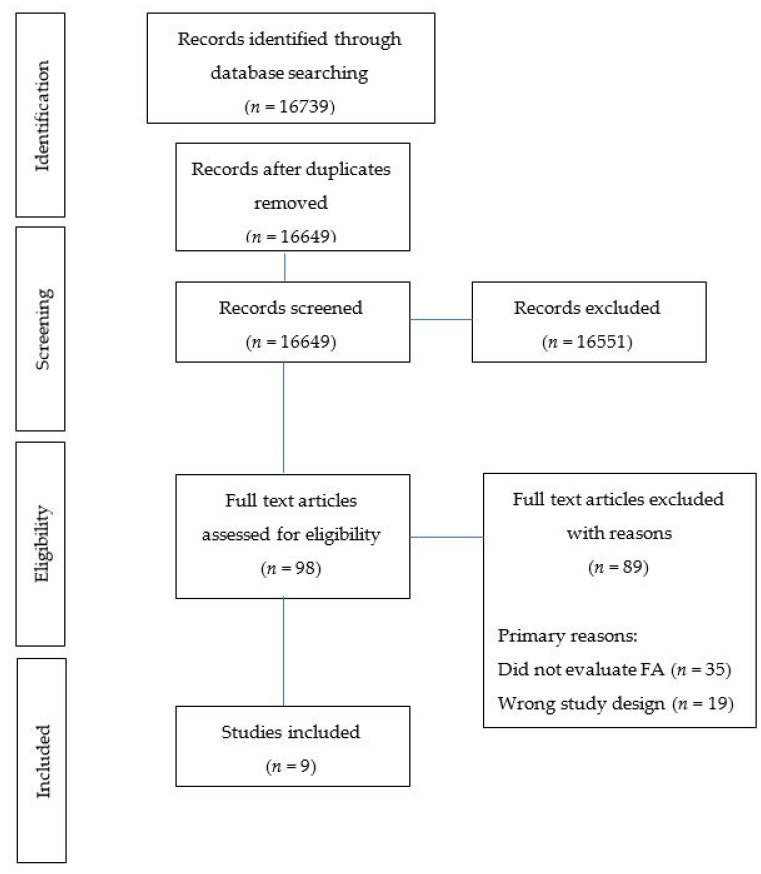
Research on the concept of food addiction (FA) has steadily grown and, based on a widely used self-report, FA is estimated to affect between 16–20% of the adult population. However, there are few interventions available for people with self-reported FA, and their efficacy is unclear. The primary aim of the review was to examine the efficacy of different interventions, including behavioural/lifestyle, medication and surgical approaches, for reducing symptoms and/or changing diagnosis of FA among adolescents and adults. A secondary aim was to examine the influence of sex as a moderator of intervention effects. A systematic search was performed from 2008–2020 to identify studies that used the YFAS to assess the effectiveness of interventions on FA. Nine studies were identified (n = 7 adults, n = 2 adolescents) including a total of 812 participants (range 22–256) with an average of 69% females per study. The types of interventions included medications (n = 3), lifestyle modification (n = 3), surgical (n = 2) and behavioural (n = 1), with FA being assessed as a secondary outcome in all studies. Five studies in adults reported a significant reduction in FA symptoms or diagnosis from pre to post-intervention, two when compared to a control group and three in the intervention group only. Efficacious interventions included: medication (combination of naltrexone and bupropion, as well as pexacerfont), bariatric surgery and lifestyle modification. No significant changes in FA were reported in adolescent studies. Given few studies were identified by the review, there is insufficient evidence to provide clear recommendations for practice; however, some interventions show potential for reducing self-reported FA outcomes in adults. Future research should explore the longer-term efficacy of interventions and the effectiveness of treatments with sufficient sample sizes.
Overview
The claims and statistics of this paper haven’t been checked yet.
Free: it reads the open-access text and checks the first 5 claims that cite a source we can check. Create a free account to check every claim.
Integrity signals
Registry
Cites
Statistics
Figures
Verification
Claims the paper makes
The claims and statistics of this paper haven’t been checked yet.
Free: it reads the open-access text and checks the first 5 claims that cite a source we can check. Create a free account to check every claim.
Claims other papers make about this one
Each is checked against this paper’s own text: does it say what the citing paper says it does?
The source backs part of the claim, not all of it — or backs it for a different population, condition or comparison.
In the citing paper
“In addition, naltrexone can be highly effective in reducing alcohol intake as well as combating non-suicidal self-injury and binge eating (200–210).”
From The integrated treatment of eating disorders, posttraumatic stress disorder, and psychiatric comorbidity: a commentary on the evolution of principles and guidelines (2023) · cites this paper as [205]
Experimental — accuracy not yet measured
Self-check
Percentages, sums and reported differences re-computed from the paper’s own numbers.
The self-check needs the paper’s full text.
Citations
Cites
Liberati, A., Altman, D. G., Tetzlaff, J., Mulrow, C., Gøtzsche, P. C., Ioannidis, J. P. A., Clarke, M., Devereaux, P. J., Kleijnen, J., & Moher, D. (2009) · PLoS Medicine · doi:10.1371/journal.pmed.1000100 · Cited by 28,164
Liberati, A., Altman, D. G., Tetzlaff, J., Mulrow, C., Gotzsche, P. C., Ioannidis, J. P. A., Clarke, M., Devereaux, P. J., Kleijnen, J., & Moher, D. (2009) · BMJ · doi:10.1136/bmj.b2700 · Cited by 17,648
Hoffmann, T. C., Glasziou, P. P., Boutron, I., Milne, R., Perera, R., Moher, D., Altman, D. G., Barbour, V., Macdonald, H., Johnston, M., et al. (2014) · BMJ · doi:10.1136/bmj.g1687 · Cited by 10,548 · cited 1×
“More specifically, FA studies that adopt a nutrition component in their intervention should be encouraged to provide a detailed nutrition description and use checklists such as TIDIER [40] to better ensure progress in the field.”
Preliminary validation of the Yale Food Addiction Scale
Gearhardt, A. N., Corbin, W. R., & Brownell, K. D. (2009) · Appetite · doi:10.1016/j.appet.2008.12.003 · Cited by 1,369 · cited 2×
“FA is often accompanied by symptoms characterised by a sense of loss of control, continued use regardless of adverse consequences and inability to reduce consumption despite the desire to do so [1,6].”
BackgroundMethodElfhag, K., & Rössner, S. (2005) · Obesity Reviews · doi:10.1111/j.1467-789x.2005.00170.x · Cited by 1,343 · cited 1×
“such as those focused on weight loss, whereby the short-term success of initial weight loss may reflect better compliance with the treatment from participants [46].”
BackgroundWilfley, D. E., Welch, R. R., Stein, R. I., Spurrell, E. B., Cohen, L. R., Saelens, B. E., Dounchis, J. Z., Frank, M. A., Wiseman, C. V., & Matt, G. E. (2002) · Archives of General Psychiatry · doi:10.1001/archpsyc.59.8.713 · Cited by 603 · cited 1×
“, >20 sessions over a longer follow up [41], intervention lengths of the studies in this review are relatively short.”
BackgroundThe Prevalence of Food Addiction as Assessed by the Yale Food Addiction Scale: A Systematic Review
Pursey, K., Stanwell, P., Gearhardt, A., Collins, C., & Burrows, T. (2014) · Nutrients · doi:10.3390/nu6104552 · Cited by 537 · cited 6×
“The search was conducted in the following databases and based on previous reviews of FA [4,5]: The Cochrane Library, CINAHL (Cumulative Index to Nursing and Allied Health), MEDLINE, EMBASE (Excerpta Medica Database), Scopus, Informit Health Collection, Proquest, Web of Science and PsycINFO.”
BackgroundMethodInfluentialInterrelationships among impulsive personality traits, food addiction, and Body Mass Index
Murphy, C. M., Stojek, M. K., & MacKillop, J. (2014) · Appetite · doi:10.1016/j.appet.2013.10.008 · Cited by 329 · cited 1×
“The lower date range for the search criteria was chosen to reflect the emergence and publication of the YFAS tool [29].”
MethodFood addiction and associations with mental health symptoms: A systematic review with meta-analysis
Burrows, T., Kay‐Lambkin, F., Pursey, K., Skinner, J., & Dayas, C. (2018) · Journal of Human Nutrition and Dietetics · doi:10.1111/jhn.12532 · Cited by 245 · cited 8×
“The search was conducted in the following databases and based on previous reviews of FA [4,5]: The Cochrane Library, CINAHL (Cumulative Index to Nursing and Allied Health), MEDLINE, EMBASE (Excerpta Medica Database), Scopus, Informit Health Collection, Proquest, Web of Science and PsycINFO.”
BackgroundMethodInfluentialSelf-citationBurmeister, J. M., Hinman, N., Koball, A., Hoffmann, D. A., & Carels, R. A. (2013) · Appetite · doi:10.1016/j.appet.2012.09.013 · Cited by 232 · cited 1×
“7–100%), when compared to similar FA weight loss studies where retention rates are usually higher with an average of 88% [43,44].”
Research works printed but not linked: 1
- Covidence Systematic Review Software. Veritas Health Innovation, Melbourne, Australia Available online: www.covidence.org (accessed on 26 May 2020)
Cited by
Praxedes, D. R. S., Júnior, A. E. D. S., Macêna, M. D. L., de Oliveira, A. D. S., Cardoso, K. S., Nunes, L. O., Monteiro, M. B. L., de Melo, I. S. V., Gearhardt, A. N., & Bueno, N. B. (2021) · European Eating Disorders Review · doi:10.1002/erv.2878 · Cited by 192
“…reviews are aimed at specific population groups (Skinner et al., 2021; Yekaninejad et al., 2021), specific clinical contexts (Burrows et al., 2018; Leary et al., 2021), with data from only one of the YFAS versions (Oliveira et al., 2021) or just intended to explore the construct of FA…”
BackgroundUltra-Processed Food Addiction: A Research Update
LaFata, E. M., Allison, K. C., Audrain-McGovern, J. E., & Forman, E. M. (2024) · Current Obesity Reports · doi:10.1007/s13679-024-00569-w · Cited by 114
“From the small number of studies included in Leary and colleagues’ review [71], it is apparent that more research is needed to explore how existing interventions for overweight and obesity may have secondary benefits for improving UPF addiction.”
BackgroundInfluentialBrewerton, T. D. (2023) · Frontiers in Psychiatry · doi:10.3389/fpsyt.2023.1149433 · Cited by 46
Wiss, D. A. (2022) · Current Addiction Reports · doi:10.1007/s40429-022-00411-0 · Cited by 43
Food Addiction: A Comprehensive Review
Florio, L., Lassi, D. L. S., Périco, C. D. A.-M., Vignoli, N. G., Torales, J. C., Ventriglio, A., & Castaldelli-Maia, J. M. (2022) · The Journal of Nervous and Mental Disease · doi:10.1097/nmd.0000000000001555 · Cited by 42
“High BMI, increased abdominal fat, BED, bulimia nervosa, depression, anxiety, posttraumatic stress disorder, and substance use are all risk factors for disordered eating behavior (Leary et al., 2021).”
Background
Metadata
- Authors
- Leary, M., Pursey, K. M., Verdejo-Garcia, A., & Burrows, T. L.
- Affiliations
- University of Newcastle Australia (AU)
- School of Psychological Sciences and Turner Institute for Brain and Mental Health, Monash University, Clayton, VIC 3800, Australia
- Corresponding author
- Burrows, Tracy L.
- Venue
- Behavioral Sciences
- Publisher
- MDPI AG
- Published
- 2021-05-23
- Volume
- 11
- Issue
- 6
- Pages
- 80
- ISSN
- 2076-328X (ISSN-L)
- PMC
- PMC8224570
- OpenAlex
- W3165345793
- Cited by
- 50
- References
- 50
- Citations by year
- 2026: 5 · 2025: 12 · 2024: 11 · 2023: 8 · 2022: 12 · 2021: 2
- FWCI
- 1.10
- Type
- journal article
- Language
- en
- Open access
- gold
- doi.org
- Licence
- Locations
- Behavioral Sciences (publishedVersion, cc-by)
- PubMed Central (publishedVersion, cc-by)
- PubMed (publishedVersion)
- DOAJ (DOAJ: Directory of Open Access Journals) (submittedVersion, cc-by-sa)
- Figshare (submittedVersion, cc-by)
- NOVA (University of Newcastle Australia) (submittedVersion, cc-by)
- Funders
- National Health and Medical Research Council (NHMRC) (G1801414)
- Topics
- Social Sciences › Psychology › Clinical Psychology › Eating Disorders and Behaviors
- Health Sciences › Nursing › Nutrition and Dietetics › Nutrition, Health and Food Behavior
- Health Sciences › Medicine › Epidemiology › Substance Abuse Treatment and Outcomes
- Keywords
- food addiction, therapeutic interventions, naltrexone, bupropion, bariatric surgery, lifestyle modification, behavioral interventions, adolescents, sex differences, intervention efficacy
About these checks
Registry, retraction, Cites and statistics results are computed, not judged, with one exception: a printed reference that no index lists is read once by a model before it counts as a citation error. Claims are extracted by a model and kept only when their quote appears verbatim in the text; each cited source is then checked, with a model’s help, for whether it says what the claim relies on. Those verdicts can be wrong — read the claim’s quote and the cited source before relying on one.
Statistics and arithmetic are recomputed, not judged.
Confidence bands are shown only for fields calibrated on our annotated test set. None is calibrated yet, so no band is shown.
What counts as a claim ›How we measure confidence ›How we check this ›
Are you an author, or do you see a problem with this page? Request a review
Data sources
Bibliographic data: Semantic Scholar, OpenAlex, Crossref.
Contains information from the Semantic Scholar Academic Graph Datasets, made available under the ODC Attribution License (ODC-BY 1.0).
Semantic Scholar’s data is described in: Kinney, R., et al. (2023). The Semantic Scholar Open Data Platform. arXiv:2301.10140.
