

The DOI matches its Crossref record; 51 of the 51 references it cites were found in a registry or an index.
Ovarian Cancer Relies on Glucose Transporter 1 to Fuel Glycolysis and Growth: Anti-Tumor Activity of BAY-876
Open accessAbstract
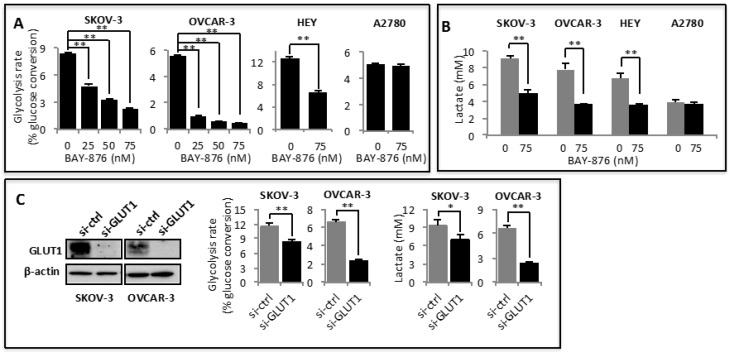
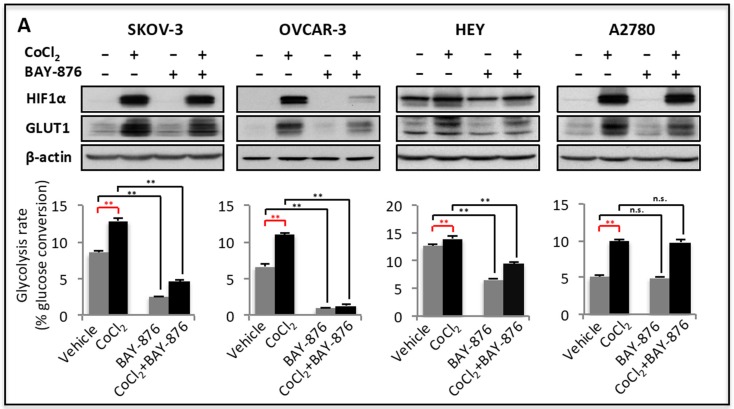
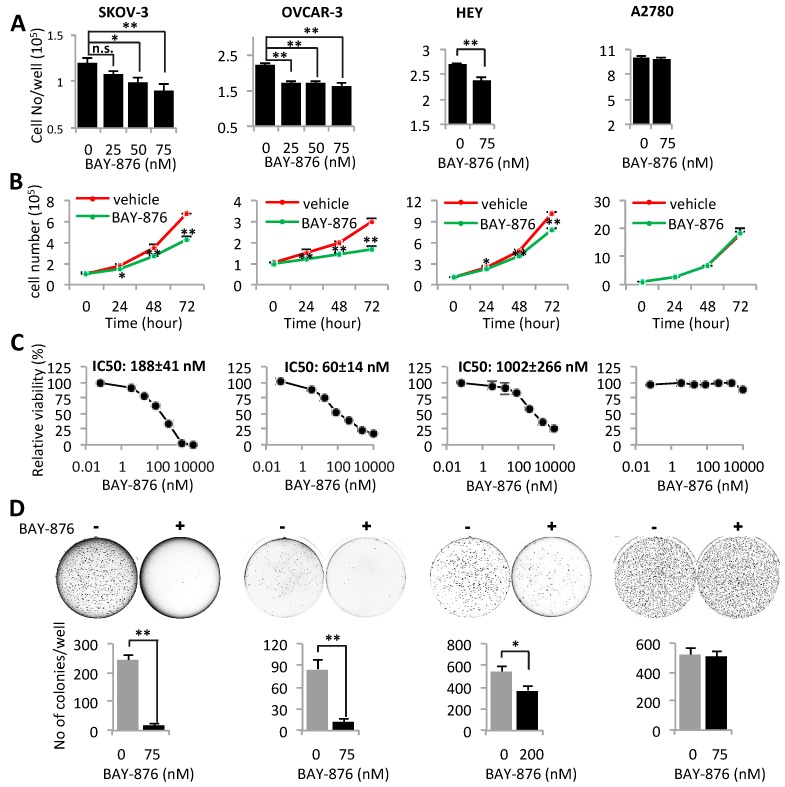
The recent progresses in understanding of cancer glycolytic phenotype have offered new strategies to manage ovarian cancer and other malignancies. However, therapeutic targeting of glycolysis to treat cancer remains unsuccessful due to complex mechanisms of tumor glycolysis and the lack of selective, potent and safe glycolytic inhibitors. Recently, BAY-876 was identified as a new-generation inhibitor of glucose transporter 1 (GLUT1), a GLUT isoform commonly overexpressed but functionally poorly defined in ovarian cancer. Notably, BAY-876 has not been evaluated in any cell or preclinical animal models since its discovery. We herein took advantage of BAY-876 and molecular approaches to study GLUT1 regulation, targetability, and functional relevance to cancer glycolysis. The anti-tumor activity of BAY-876 was evaluated with ovarian cancer cell line- and patient-derived xenograft (PDX) models. Our results show that inhibition of GLUT1 is sufficient to block basal and stress-regulated glycolysis, and anchorage-dependent and independent growth of ovarian cancer cells. BAY-876 dramatically inhibits tumorigenicity of both cell line-derived xenografts and PDXs. These studies provide direct evidence that GLUT1 is causally linked to the glycolytic phenotype in ovarian cancer. BAY-876 is a potent blocker of GLUT1 activity, glycolytic metabolism and ovarian cancer growth, holding promise as a novel glycolysis-targeted anti-cancer agent.
Overview
The claims and statistics of this paper haven’t been checked yet.
Run the check — free, no account needed. It reads the open-access text and checks the sources it cites.
Integrity signals
Registry
Cites
Statistics
Figures
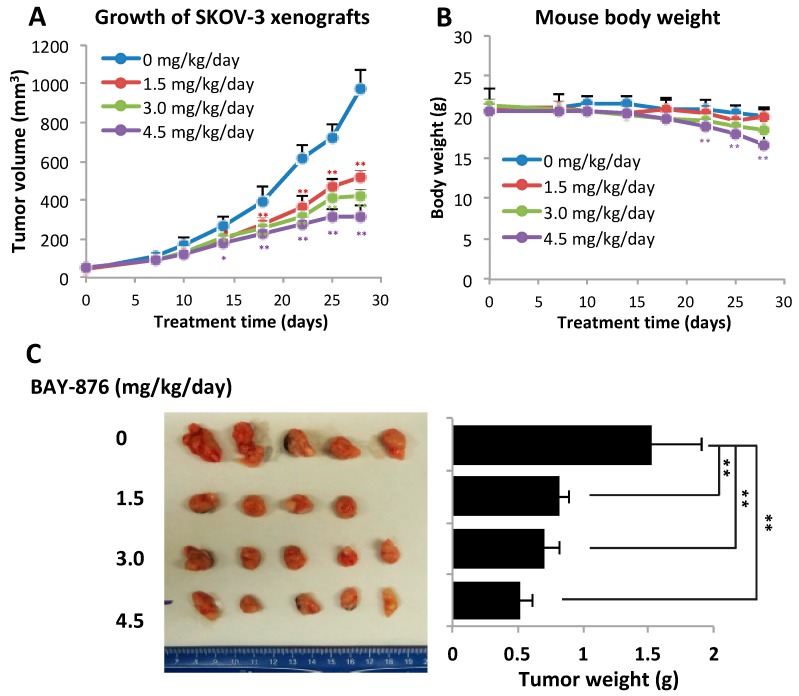
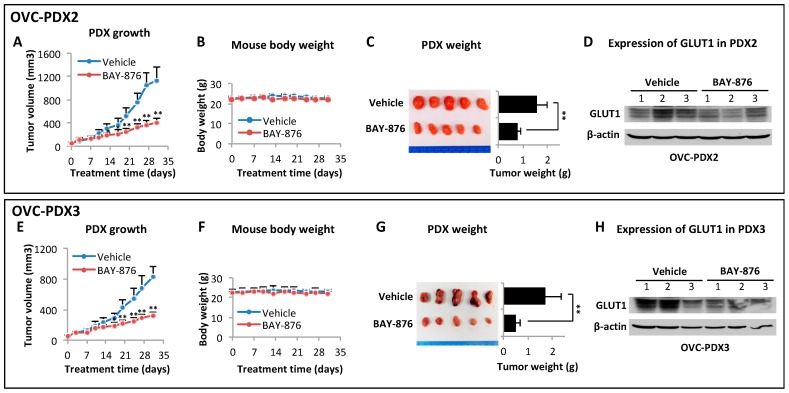
Verification
Claims the paper makes
The claims and statistics of this paper haven’t been checked yet.
Run the check — free, no account needed. It reads the open-access text and checks the sources it cites.
Claims other papers make about this one
Each is checked against this paper’s own text: does it say what the citing paper says it does?
In the citing paper
“BAY-876, a potent GLUT1 inhibitor49, was separately shown as an effective candidate in pre-clinical setting 50.”
From The metabolic landscape of RAS-driven cancers from biology to therapy (2021) · cites this paper as [50]
Self-check
Percentages, sums and reported differences re-computed from the paper’s own numbers.
The self-check needs the paper’s full text.
Citations
Cites
Warburg, O. (1956) · Science · doi:10.1126/science.123.3191.309 · Cited by 13,425
The Warburg Effect: How Does it Benefit Cancer Cells?
Liberti, M. V., & Locasale, J. W. (2016) · Trends in Biochemical Sciences · doi:10.1016/j.tibs.2015.12.001 · Cited by 5,150
Regulation of cancer cell metabolism
Cairns, R. A., Harris, I. S., & Mak, T. W. (2011) · Nature Reviews Cancer · doi:10.1038/nrc2981 · Cited by 4,744
ONCOMINE: A Cancer Microarray Database and Integrated Data-Mining Platform
Rhodes, D. R., Yu, J., Sundaram, S. K., Deshpande, N., Varambally, R., Ghosh, D., Barrette, T. R., Pander, A., & Chinnaiyan, A. M. (2004) · Neoplasia · doi:10.1016/s1476-5586(04)80047-2 · Cited by 3,719
Fundamentals of Cancer Metabolism
DeBerardinis, R. J., & Chandel, N. S. (2016) · Science Advances · doi:10.1126/sciadv.1600200 · Cited by 3,013
Inhibition of lactate dehydrogenase A induces oxidative stress and inhibits tumor progression
Le, A., Cooper, C. R., Gouw, A. M., Dinavahi, R., Maitra, A., Deck, L. M., Royer, R. E., Jagt, D. L. V., Semenza, G. L., & Dang, C. V. (2010) · Proceedings of the National Academy of Sciences · doi:10.1073/pnas.0914433107 · Cited by 1,528
Rethinking ovarian cancer: recommendations for improving outcomes
Vaughan, S., Coward, J. I. G., Bast, R. C., Berchuck, A., Berek, J. S., Brenton, J. D., Coukos, G., Crum, C. P., Drapkin, R., Etemadmoghadam, D., et al. (2011) · Nature reviews. Cancer · doi:10.1038/nrc3144 · Cited by 1,484
The Control of the Metabolic Switch in Cancers by Oncogenes and Tumor Suppressor Genes
Levine, A. J., & Puzio-Kuter, A. M. (2010) · Science · doi:10.1126/science.1193494 · Cited by 1,243
The hypoxic tumour microenvironment
Petrova, V., Annicchiarico‐Petruzzelli, M., Melino, G., & Amelio, I. (2018) · Oncogenesis · doi:10.1038/s41389-017-0011-9 · Cited by 1,077
Glucose transporters in the 21st Century
Thorens, B., & Mueckler, M. (2010) · American Journal of Physiology-Endocrinology and Metabolism · doi:10.1152/ajpendo.00712.2009 · Cited by 1,013
Research works printed but not linked: 1
- Warburg, 1924, üeber den Stoffwechsel der Tumoren, Biochem. Z., 152, 319
Cited by
Sorted by citations
Metabolomics in cancer research and emerging applications in clinical oncology
Schmidt, D. R., Patel, R., Kirsch, D. G., Lewis, C. A., Heiden, M. G. V., & Locasale, J. W. (2021) · CA A Cancer Journal for Clinicians · doi:10.3322/caac.21670 · Cited by 675
The metabolic landscape of RAS-driven cancers from biology to therapy
Mukhopadhyay, S., Vander Heiden, M. G., & McCormick, F. (2021) · Nature Cancer · doi:10.1038/s43018-021-00184-x · Cited by 315
GLUT1 inhibition blocks growth of RB1-positive triple negative breast cancer
Wu, Q., Ba-Alawi, W., Deblois, G., Cruickshank, J., Duan, S., Lima‐Fernandes, E., Haight, J., Tonekaboni, S. A. M., Fortier, A.-M., Kuasne, H., et al. (2020) · Nature Communications · doi:10.1038/s41467-020-18020-8 · Cited by 305
TGFβ-induced metabolic reprogramming during epithelial-to-mesenchymal transition in cancer
Hua, W., ten Dijke, P., Kostidis, S., Giera, M. A., & Hornsveld, M. (2019) · Cellular and Molecular Life Sciences · doi:10.1007/s00018-019-03398-6 · Cited by 245
Gao, T., Zhang, X., Zhao, J., Zhou, F., Wang, Y., Zhao, Z., Xing, J., Chen, B., Li, J., & Liu, S. (2019) · Cancer Letters · doi:10.1016/j.canlet.2019.10.029 · Cited by 158
Metadata
- Authors
- Ma, Y., Wang, W., Idowu, M. O., Oh, U., Wang, X.-Y., Temkin, S. M., & Fang, X.
- Affiliations
- Virginia Commonwealth University (US)
- Corresponding author
- Fang, Xianjun
- Venue
- Cancers
- Publisher
- MDPI AG
- Published
- 2018-12-31
- Volume
- 11
- Issue
- 1
- Pages
- 33
- ISSN
- 2072-6694 (ISSN-L)
- PMC
- PMC6356953
- OpenAlex
- W2907710771
- Cited by
- 145
- References
- 51
- Citations by year
- 2026: 14 · 2025: 15 · 2024: 21 · 2023: 25 · 2022: 18 · 2021: 27 · 2020: 9 · 2019: 14
- FWCI
- 3.85
- Type
- journal article
- Language
- en
- Open access
- gold
- dx.doi.org
- Licence
- Locations
- Cancers (publishedVersion, cc-by)
- Europe PMC (PubMed Central) (publishedVersion, cc-by)
- PubMed Central (publishedVersion, cc-by)
- PubMed (publishedVersion)
- DOAJ (DOAJ: Directory of Open Access Journals) (submittedVersion, cc-by-sa)
- Funders
- National Institutes of Health (P30 CA16059)
- Astar Biotechnology Research award (N/A)
- Topics
- Life Sciences › Biochemistry, Genetics and Molecular Biology › Cancer Research › Cancer, Hypoxia, and Metabolism
- Life Sciences › Biochemistry, Genetics and Molecular Biology › Molecular Biology › Metabolism, Diabetes, and Cancer
- Health Sciences › Medicine › Oncology › Ovarian cancer diagnosis and treatment
- Keywords
- ovarian cancer, glucose transporter 1, GLUT1, BAY-876, glycolysis, cancer metabolism, glycolysis inhibitors, tumor growth, patient-derived xenografts, anchorage-independent growth, anticancer activity
About these checks
Registry, retraction, Cites and statistics results are computed, not judged, with one exception: a printed reference that no index lists is read once by a model before it counts as a citation error. Claims are extracted by a model and kept only when their quote appears verbatim in the text; each cited source is then checked, with a model’s help, for whether it says what the claim relies on. Those verdicts can be wrong — read the claim’s quote and the cited source before relying on one.
Statistics and arithmetic are recomputed, not judged.
Confidence bands are shown only for fields calibrated on our annotated test set. None is calibrated yet, so no band is shown.
What counts as a claim ›How we measure confidence ›How we check this ›
Are you an author, or do you see a problem with this page? Request a review
