

Breast Fibroblasts and ECM Components Modulate Breast Cancer Cell Migration through the Secretion of MMPs in a 3D Microfluidic Co-Culture Model
Open accessThe DOI matches its Crossref record; 79 of the 80 references it cites were found in a registry or an index.
Abstract
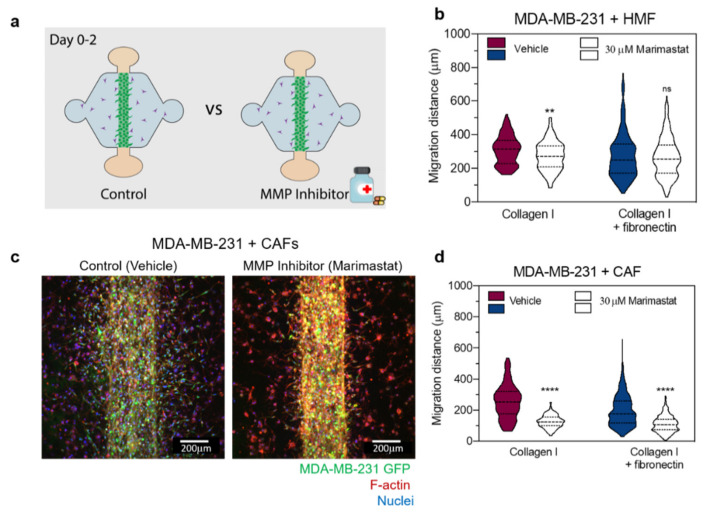
The extracellular matrix (ECM) composition greatly influences cancer progression, leading to differential invasion, migration, and metastatic potential. In breast cancer, ECM components, such as fibroblasts and ECM proteins, have the potential to alter cancer cell migration. However, the lack of in vitro migration models that can vary ECM composition limits our knowledge of how specific ECM components contribute to cancer progression. Here, a microfluidic model was used to study the effect of 3D heterogeneous ECMs (i.e., fibroblasts and different ECM protein compositions) on the migration distance of a highly invasive human breast cancer cell line, MDA-MB-231. Specifically, we show that in the presence of normal breast fibroblasts, a fibronectin-rich matrix induces more cancer cell migration. Analysis of the ECM revealed the presence of ECM tunnels. Likewise, cancer-stromal crosstalk induced an increase in the secretion of metalloproteinases (MMPs) in co-cultures. When MMPs were inhibited, migration distance decreased in all conditions except for the fibronectin-rich matrix in the co-culture with human mammary fibroblasts (HMFs). This model mimics the in vivo invasion microenvironment, allowing the examination of cancer cell migration in a relevant context. In general, this data demonstrates the capability of the model to pinpoint the contribution of different components of the tumor microenvironment (TME).
Overview
The claims and statistics of this paper haven’t been checked yet.
Free: it reads the open-access text and checks the first 5 claims that cite a source we can check. Create a free account to check every claim.
Integrity signals
Registry
Cites
Statistics
Figures
Verification
Claims the paper makes
The claims and statistics of this paper haven’t been checked yet.
Free: it reads the open-access text and checks the first 5 claims that cite a source we can check. Create a free account to check every claim.
Claims other papers make about this one
Each is checked against this paper’s own text: does it say what the citing paper says it does?
The check wasn’t confident either way, so it gives no verdict — never disputed.
In the citing paper
“As a result, a structural in vitro BBB model with size‐selective permeability was generated, but this platform lacked in vivo‐like direct interfaces between vascular networks and astrocytes.”
From 3D Biomimetic Models to Reconstitute Tumor Microenvironment In Vitro: Spheroids, Organoids, and Tumor‐on‐a‐Chip (2023) · cites this paper as [147]
Experimental — accuracy not yet measuredThe check wasn’t confident either way, so it gives no verdict — never disputed.
In the citing paper
“First, HUVECs form a leakier barrier than brain endothelial cells.[ 147 , 149 ]”
From 3D Biomimetic Models to Reconstitute Tumor Microenvironment In Vitro: Spheroids, Organoids, and Tumor‐on‐a‐Chip (2023) · cites this paper as [147]
Experimental — accuracy not yet measured
Self-check
Percentages, sums and reported differences re-computed from the paper’s own numbers.
The self-check needs the paper’s full text.
Citations
Cites
Bray, F., Ferlay, J., Soerjomataram, I., Siegel, R. L., Torre, L. A., & Jemal, A. (2018) · CA: A Cancer Journal for Clinicians · doi:10.3322/caac.21492 · Cited by 84,109 · cited 1×
“Breast cancer is among the three most common cancers worldwide and is the most common malignancy in women [1,2].”
BackgroundHallmarks of Cancer: The Next Generation
Hanahan, D., & Weinberg, R. A. (2011) · Cell · doi:10.1016/j.cell.2011.02.013 · Cited by 66,590 · cited 1×
“In recent years, the TME has emerged as a highly regulative factor of cancer progression [48].”
BackgroundNIH Image to ImageJ: 25 years of image analysis
Schneider, C. A., Rasband, W. S., & Eliceiri, K. W. (2012) · Nature Methods · doi:10.1038/nmeth.2089 · Cited by 64,638 · cited 1×
“To analyze the migration distance, each Z-stack was Z-projected, and the MDA-MB-231 distance from the lumen was quantified using Image J [73].”
MethodMatrix Metalloproteinases: Regulators of the Tumor Microenvironment
Kessenbrock, K., Plaks, V., & Werb, Z. (2010) · Cell · doi:10.1016/j.cell.2010.03.015 · Cited by 5,151 · cited 1×
“In breast cancer, tumor progression and metastasis have been found to be driven by matrix metalloproteinases (MMPs) shaping of the TME [58,59].”
BackgroundIn vitro scratch assay: a convenient and inexpensive method for analysis of cell migration in vitro
Liang, C.-C., Park, A. Y., & Guan, J.-L. (2007) · Nature Protocols · doi:10.1038/nprot.2007.30 · Cited by 4,696 · cited 1×
“However, it is well known that the mechanisms of cell migration used in 2D differ from those in 3D environments [24,25].”
BackgroundTargeting the IL-6/JAK/STAT3 signalling axis in cancer
Johnson, D. E., O'Keefe, R. A., & Grandis, J. R. (2018) · Nature Reviews Clinical Oncology · doi:10.1038/nrclinonc.2018.8 · Cited by 3,110
Matrix Metalloproteinase Inhibitors and Cancer—Trials and Tribulations
Coussens, L. M., Fingleton, B., & Matrisian, L. M. (2002) · Science · doi:10.1126/science.1067100 · Cited by 2,761 · cited 1×
“Previous in vitro results have led to intensive efforts to develop and translate broad-spectrum MMP inhibitors, such as marimastat for cancer treatment, which concluded due to disappointing results in multiple clinical trials [64].”
ResultThe tumor microenvironment at a glance
Balkwill, F. R., Capasso, M., & Hagemann, T. (2012) · Journal of Cell Science · doi:10.1242/jcs.116392 · Cited by 1,857 · cited 1×
“The TME has two major components, cellular and a non-cellular component [8,9].”
BackgroundCollagen reorganization at the tumor-stromal interface facilitates local invasion
Provenzano, P. P., Eliceiri, K. W., Campbell, J. M., Inman, D. R., White, J. G., & Keely, P. J. (2006) · BMC Medicine · doi:10.1186/1741-7015-4-38 · Cited by 1,804
Role of tumor microenvironment in tumorigenesis
Wang, M., Zhao, J., Zhang, L., Wei, F., Lian, Y., Wu, Y., Gong, Z., Zhang, S., Zhou, J., Cao, K., et al. (2017) · Journal of Cancer · doi:10.7150/jca.17648 · Cited by 1,404
Cited by
Three-Dimensional Cell Cultures: The Bridge between In Vitro and In Vivo Models
Urzì, O., Gasparro, R., Costanzo, E., De Luca, A., Giavaresi, G., Fontana, S., & Alessandro, R. (2023) · International Journal of Molecular Sciences · doi:10.3390/ijms241512046 · Cited by 224
A role for microfluidic systems in precision medicine
Ayuso, J. M., Virumbrales-Muñoz, M., Lang, J. M., & Beebe, D. J. (2022) · Nature Communications · doi:10.1038/s41467-022-30384-7 · Cited by 216
Self-citationLi, W., Zhou, Z., Zhou, X., Khoo, B. L., Gunawan, R., Chin, Y. R., Zhang, L., Yi, C., Guan, X., & Yang, M. (2023) · Advanced Healthcare Materials · doi:10.1002/adhm.202202609 · Cited by 119
Zhang, J., Tavakoli, H., Ma, L., Li, X., Han, L., & Li, X. (2022) · Advanced Drug Delivery Reviews · doi:10.1016/j.addr.2022.114365 · Cited by 114
In vitro 3d cultures to model the tumor microenvironment
Fontana, F., Marzagalli, M., Sommariva, M., Gagliano, N., & Limonta, P. (2021) · Cancers · doi:10.3390/cancers13122970 · Cited by 103
Metadata
- Authors
- Lugo-Cintrón, K. M., Gong, M. M., Ayuso, J. M., Tomko, L. A., Beebe, D. J., Virumbrales-Muñoz, M., & Ponik, S. M.
- Affiliations
- University of Wisconsin–Madison (US)
- Department of Pathology and Laboratory Medicine, University of Wisconsin, 1111 Highland Ave., Madison, WI 53705, USA
- Corresponding author
- Ponik, Suzanne M.
- ORCID
- Venue
- Cancers
- Publisher
- MDPI AG
- Published
- 2020-05-06
- Volume
- 12
- Issue
- 5
- Pages
- 1173
- ISSN
- 2072-6694 (ISSN-L)
- PMC
- PMC7281408
- OpenAlex
- W3023106176
- Semantic Scholar
- 25d76113d6bb98706054116ac0624b499d5ea60f
- Cited by
- 103
- References
- 80
- Citations by year
- 2026: 12 · 2025: 15 · 2024: 21 · 2023: 19 · 2022: 21 · 2021: 12 · 2020: 3
- FWCI
- 6.86
- Type
- journal article
- Language
- en
- Open access
- gold
- dx.doi.org
- Licence
- Locations
- Cancers (publishedVersion, cc-by)
- PubMed Central (publishedVersion, cc-by)
- PubMed (publishedVersion)
- DOAJ (DOAJ: Directory of Open Access Journals) (submittedVersion, cc-by-sa)
- Funders
- UW-Madison Graduate Engineering Research Scholars (Karina Lugo)
- Natural Sciences and Engineering Research Council of Canada (Max Gong)
- NIH (R01EB010039 BRG)
- Topics
- Life Sciences › Biochemistry, Genetics and Molecular Biology › Cell Biology › Cellular Mechanics and Interactions
- Health Sciences › Medicine › Oncology › Cancer Cells and Metastasis
- Life Sciences › Biochemistry, Genetics and Molecular Biology › Cancer Research › Protease and Inhibitor Mechanisms
- Keywords
- breast cancer cell migration, breast fibroblasts, extracellular matrix, microfluidic co-culture, matrix metalloproteinases, tumor microenvironment, MDA-MB-231 cells, tumor invasion
About these checks
Registry, retraction, Cites and statistics results are computed, not judged, with one exception: a printed reference that no index lists is read once by a model before it counts as a citation error. Claims are extracted by a model and kept only when their quote appears verbatim in the text; each cited source is then checked, with a model’s help, for whether it says what the claim relies on. Those verdicts can be wrong — read the claim’s quote and the cited source before relying on one.
Statistics and arithmetic are recomputed, not judged.
Confidence bands are shown only for fields calibrated on our annotated test set. None is calibrated yet, so no band is shown.
What counts as a claim ›How we measure confidence ›How we check this ›
Are you an author, or do you see a problem with this page? Request a review
Data sources
Bibliographic data: Semantic Scholar, OpenAlex, Crossref.
Contains information from the Semantic Scholar Academic Graph Datasets, made available under the ODC Attribution License (ODC-BY 1.0).
Semantic Scholar’s data is described in: Kinney, R., et al. (2023). The Semantic Scholar Open Data Platform. arXiv:2301.10140.
