

Mechanisms of Taxane Resistance
Open accessThe DOI matches its Crossref record; 494 of the 503 references it cites were found in a registry or an index.
Abstract
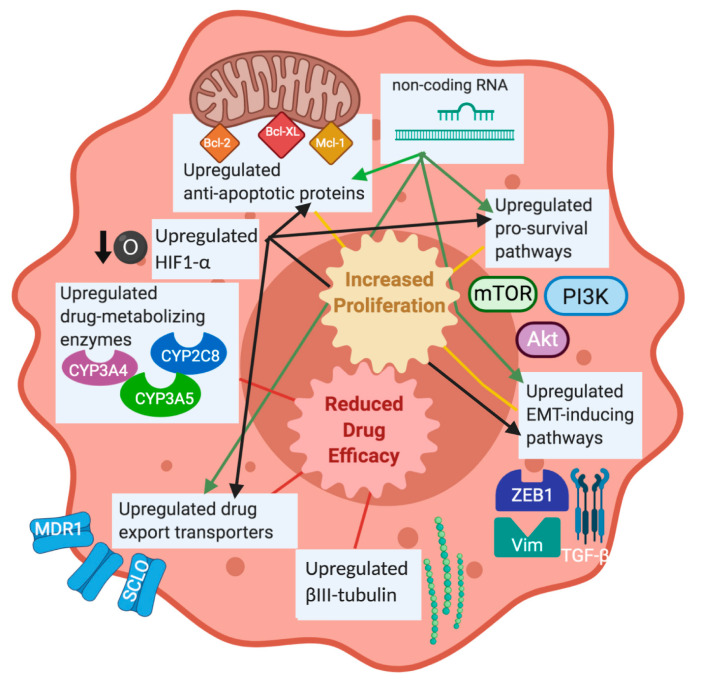
The taxane family of chemotherapy drugs has been used to treat a variety of mostly epithelial-derived tumors and remain the first-line treatment for some cancers. Despite the improved survival time and reduction of tumor size observed in some patients, many have no response to the drugs or develop resistance over time. Taxane resistance is multi-faceted and involves multiple pathways in proliferation, apoptosis, metabolism, and the transport of foreign substances. In this review, we dive deeper into hypothesized resistance mechanisms from research during the last decade, with a focus on the cancer types that use taxanes as first-line treatment but frequently develop resistance to them. Furthermore, we will discuss current clinical inhibitors and those yet to be approved that target key pathways or proteins and aim to reverse resistance in combination with taxanes or individually. Lastly, we will highlight taxane response biomarkers, specific genes with monitored expression and correlated with response to taxanes, mentioning those currently being used and those that should be adopted. The future directions of taxanes involve more personalized approaches to treatment by tailoring drug-inhibitor combinations or alternatives depending on levels of resistance biomarkers. We hope that this review will identify gaps in knowledge surrounding taxane resistance that future research or clinical trials can overcome.
Overview
The claims and statistics of this paper haven’t been checked yet.
Free: it reads the open-access text and checks the first 5 claims that cite a source we can check. Create a free account to check every claim.
Integrity signals
Registry
Cites
Statistics
Figures
Verification
Claims the paper makes
The claims and statistics of this paper haven’t been checked yet.
Free: it reads the open-access text and checks the first 5 claims that cite a source we can check. Create a free account to check every claim.
Claims other papers make about this one
Each is checked against this paper’s own text: does it say what the citing paper says it does?
The source backs part of the claim, not all of it — or backs it for a different population, condition or comparison.
In the citing paper
“However, nearly all tumors eventually develop resistance to taxanes, mediated by mutations in tubulin, decreased microtubule bundling, and development of drug efflux pumps (e.g. P-glycoprotein)16,17.”
From The evolving landscape of antibody-drug conjugates (ADCs) for treatment of prostate cancer (2025) · cites this paper as [16]
Experimental — accuracy not yet measured
Self-check
Percentages, sums and reported differences re-computed from the paper’s own numbers.
The self-check needs the paper’s full text.
Citations
Cites
3 retracted
Samanta, D., Gilkes, D. M., Chaturvedi, P., Xiang, L., & Semenza, G. L. (2014) · Proceedings of the National Academy of Sciences · doi:10.1073/pnas.1421438111 · Cited by 460 · cited 2×
“There is very limited information on the induction of drug efflux pumps by HIF1-α in breast cancer [143], though this seems to connect a possible hypoxia-independent function of HIF1-α, because the upregulation of MDR1 was not observed in hypoxic conditions.”
BackgroundRetractedRETRACTED: Role of Autophagy as a Survival Mechanism for Hypoxic Cells in Tumors
Tan, Q., Wang, M., Yu, M., Zhang, J., Bristow, R. G., Hill, R. P., & Tannock, I. F. (2016) · Neoplasia · doi:10.1016/j.neo.2016.04.003 · Cited by 98
RetractedWang, Q., Zhang, W., & Hao, S. (2017) · Cell Cycle · doi:10.1080/15384101.2017.1301334 · Cited by 73
RetractedSiegel, R. L., Miller, K. D., & Jemal, A. (2019) · CA: A Cancer Journal for Clinicians · doi:10.3322/caac.21551 · Cited by 20,160
Estimating the global cancer incidence and mortality in 2018: GLOBOCAN sources and methods
Ferlay, J., Colombet, M., Soerjomataram, I., Mathers, C., Parkin, D. M., Piñeros, M., Znaor, A., & Bray, F. (2019) · International Journal of Cancer · doi:10.1002/ijc.31937 · Cited by 7,553
Increased Survival in Pancreatic Cancer with nab-Paclitaxel plus Gemcitabine
Von Hoff, D. D., Ervin, T., Arena, F. P., Chiorean, E. G., Infante, J., Moore, M., Seay, T., Tjulandin, S. A., Ma, W. W., Saleh, M. N., et al. (2013) · New England Journal of Medicine · doi:10.1056/nejmoa1304369 · Cited by 6,712 · cited 3×
“[465] III Nab-PTX+ gemcitabine N/A Metastatic pancreatic Nab-PTX + gemcitabine improved OS”
BackgroundTargeting Hypoxia-Inducible Factors for the Treatment of Anemia in Chronic Kidney Disease Patients
Locatelli, F., Fishbane, S., Block, G. A., & Macdougall, I. C. (2017) · American Journal of Nephrology · doi:10.1159/000455166 · Cited by 4,813
Wani, M. C., Taylor, H. L., Wall, M. E., Coggon, P., & McPhail, A. T. (1971) · Journal of the American Chemical Society · doi:10.1021/ja00738a045 · Cited by 4,073
Microtubules as a target for anticancer drugs
Jordan, M. A., & Wilson, L. (2004) · Nature Reviews Cancer · doi:10.1038/nrc1317 · Cited by 4,000
Integrative Genomic Profiling of Human Prostate Cancer
Taylor, B. S., Schultz, N., Hieronymus, H., Gopalan, A., Xiao, Y., Carver, B. S., Arora, V. K., Kaushik, P., Cerami, E., Reva, B., et al. (2010) · Cancer Cell · doi:10.1016/j.ccr.2010.05.026 · Cited by 3,701
Research works printed but not linked: 1
- Jiang J. Huang H. Targeting the androgen receptor by taxol in castration-resistant prostate cancer Mol. Cell Pharmacol. 2010 2 1 5 20419056 PMC2858463
Cited by
Sousa‐Pimenta, M., Estevinho, L. M., Szopa, A., Basit, M., Khan, K., Armaghan, M., Ibrayeva, M., Gürer, E. S., Călina, D. C., Hano, C., et al. (2023) · Frontiers in Pharmacology · doi:10.3389/fphar.2023.1157306 · Cited by 143
Amyloid-beta and tau protein beyond Alzheimer’s disease
Abyadeh, M., Gupta, V., Paulo, J. A., Mahmoudabad, A. G., Shadfar, S., Mirshahvaladi, S., Gupta, V. B., Nguyen, C. T. O., Finkelstein, D. I., You, Y., et al. (2023) · Neural Regeneration Research · doi:10.4103/1673-5374.386406 · Cited by 133
Curcumin as an Enhancer of Therapeutic Efficiency of Chemotherapy Drugs in Breast Cancer
Farghadani, R., & Naidu, R. (2022) · International Journal of Molecular Sciences · doi:10.3390/ijms23042144 · Cited by 133
Mechanisms of chemotherapy resistance in ovarian cancer
Ortiz, M. M. O., Wabel, E., Mitchell, K., & Horibata, S. (2022) · Cancer Drug Resistance · doi:10.20517/cdr.2021.147 · Cited by 157
Ren, Y., Wang, Y., Li, G., Zhang, Z., Ma, L., Cheng, B., & Chen, J. (2021) · Journal of Medicinal Chemistry · doi:10.1021/acs.jmedchem.0c01837 · Cited by 112
Metadata
- Authors
- Maloney, S., Spring, C., Morejon-Lasso, L., & Prosperi, J.
- Affiliations
- Indiana University South Bend (US)
- University of Notre Dame (US)
- Corresponding author
- Prosperi, Jenifer
- Venue
- Cancers
- Publisher
- MDPI AG
- Published
- 2020-11-10
- Volume
- 12
- Issue
- 11
- Pages
- 3323
- ISSN
- 2072-6694 (ISSN-L)
- PMC
- PMC7697134
- OpenAlex
- W3101097745
- Cited by
- 198
- References
- 503
- Citations by year
- 2026: 27 · 2025: 32 · 2024: 42 · 2023: 32 · 2022: 45 · 2021: 19 · 2020: 1
- FWCI
- 2.60
- Type
- journal article
- Language
- en
- Open access
- gold
- doi.org
- Licence
- Locations
- Cancers (publishedVersion, cc-by)
- PubMed Central (publishedVersion, cc-by)
- PubMed (publishedVersion)
- DOAJ (DOAJ: Directory of Open Access Journals) (submittedVersion, cc-by-sa)
- IUScholarWorks (Indiana University) (submittedVersion, cc-by)
- Funders
- American Cancer Society (RSG TBG – 133116)
- Ralph W. and Grace M. Showalter Research Trust (NA)
- Topics
- Health Sciences › Medicine › Oncology › Cancer Treatment and Pharmacology
- Health Sciences › Medicine › Oncology › Drug Transport and Resistance Mechanisms
- Life Sciences › Biochemistry, Genetics and Molecular Biology › Cell Biology › Microtubule and mitosis dynamics
- Keywords
- taxane resistance, taxanes, chemotherapy resistance mechanisms, apoptosis, drug metabolism, drug transport, precision oncology, epithelial tumors
About these checks
Registry, retraction, Cites and statistics results are computed, not judged, with one exception: a printed reference that no index lists is read once by a model before it counts as a citation error. Claims are extracted by a model and kept only when their quote appears verbatim in the text; each cited source is then checked, with a model’s help, for whether it says what the claim relies on. Those verdicts can be wrong — read the claim’s quote and the cited source before relying on one.
Statistics and arithmetic are recomputed, not judged.
Confidence bands are shown only for fields calibrated on our annotated test set. None is calibrated yet, so no band is shown.
What counts as a claim ›How we measure confidence ›How we check this ›
Are you an author, or do you see a problem with this page? Request a review
How to cite
Cite CoChat for the checks on this page, and the paper for its own findings.
- This page
- CoChat. (2026). Citation check: Mechanisms of Taxane Resistance. https://app.cochat.ai/papers/10.3390/cancers12113323
- The paper
- Maloney, S., Spring, C., Morejon-Lasso, L., & Prosperi, J. (2020). Mechanisms of Taxane Resistance. Cancers. https://doi.org/10.3390/cancers12113323
Data sources
Bibliographic data: Semantic Scholar, OpenAlex, Crossref.
Contains information from the Semantic Scholar Academic Graph Datasets, made available under the ODC Attribution License (ODC-BY 1.0).
Semantic Scholar’s data is described in: Kinney, R., et al. (2023). The Semantic Scholar Open Data Platform. arXiv:2301.10140.
