

The DOI matches its Crossref record; 176 of the 179 references it cites were found in a registry or an index.
Senolytics for Cancer Therapy: Is All that Glitters Really Gold?
Open accessAbstract
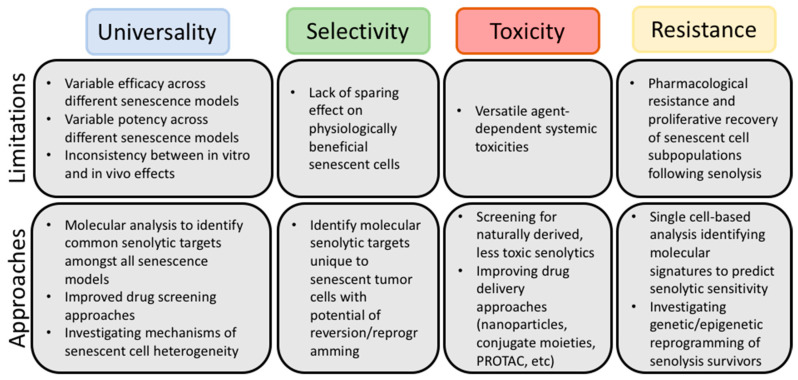
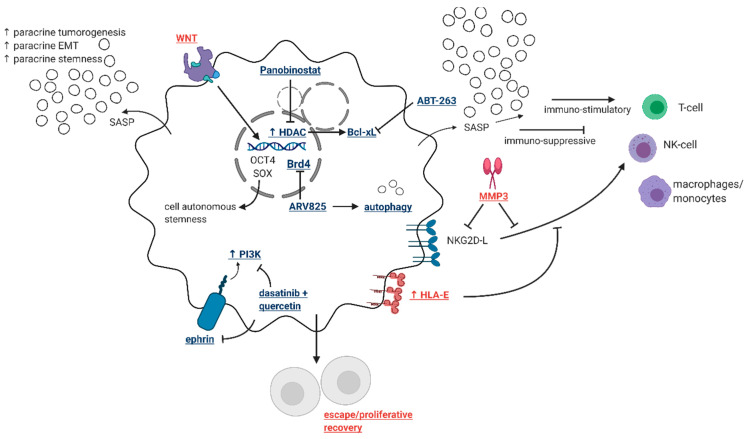
Senolytics represent a group of mechanistically diverse drugs that can eliminate senescent cells, both in tumors and in several aging-related pathologies. Consequently, senolytic use has been proposed as a potential adjuvant approach to improve the response to senescence-inducing conventional and targeted cancer therapies. Despite the unequivocal promise of senolytics, issues of universality, selectivity, resistance, and toxicity remain to be further clarified. In this review, we attempt to summarize and analyze the current preclinical literature involving the use of senolytics in senescent tumor cell models, and to propose tenable solutions and future directions to improve the understanding and use of this novel class of drugs.
Overview
The claims and statistics of this paper haven’t been checked yet.
Run the check — free, no account needed. It reads the open-access text and checks the sources it cites.
Integrity signals
Registry
Cites
Statistics
Figures
Verification
Claims the paper makes
The claims and statistics of this paper haven’t been checked yet.
Run the check — free, no account needed. It reads the open-access text and checks the sources it cites.
Claims other papers make about this one
Each is checked against this paper’s own text: does it say what the citing paper says it does?
The cited source says what the claim attributes to it.
In the citing paper
“To alleviate these harmful traits, a series of senolytic drugs are currently being developed [110,111].”
From The role of cellular senescence and SASP in tumour microenvironment (2023) · cites this paper as [111]
The cited source says what the claim attributes to it.
In the citing paper
“Early “first-generation” senolytics, including navitoclax (ABT-263) and the dasatinib–quercetin (D + Q) combination, provided proof-of-concept that selective removal of SnCs can alleviate certain fibrotic, metabolic, and cardiovascular pathologies in preclinical studies.”
From Emerging strategies in senotherapeutics: from broad-spectrum senolysis to precision reprogramming (2026) · cites this paper as [52]
In the citing paper
“First-generation senolytics provided critical proof-of-concept for the therapeutic potential of SnC clearance52.”
From Emerging strategies in senotherapeutics: from broad-spectrum senolysis to precision reprogramming (2026) · cites this paper as [52]
Self-check
Percentages, sums and reported differences re-computed from the paper’s own numbers.
The self-check needs the paper’s full text.
Citations
Cites
Oncogenic ras provokes premature cell senescence associated with accumulation of p53 and p16INK4a
Serrano, M., Lin, A. W., McCurrach, M. E., Beach, D., & Lowe, S. W. (1997) · Cell · doi:10.1016/s0092-8674(00)81902-9 · Cited by 5,218
The senescence-associated secretory phenotype: the dark side of tumor suppression
Coppé, J.-P., Desprez, P.-Y., Krtolica, A., & Campisi, J. (2010) · Annual Review of Pathology: Mechanisms of Disease · doi:10.1146/annurev-pathol-121808-102144 · Cited by 5,206
Naturally occurring p16Ink4a-positive cells shorten healthy lifespan
Baker, D. J., Childs, B. G., Durik, M., Wijers, M. E., Sieben, C. J., Zhong, J., A. Saltness, R., Jeganathan, K. B., Verzosa, G. C., Pezeshki, A., et al. (2016) · Nature · doi:10.1038/nature16932 · Cited by 2,876
The Achilles' heel of senescent cells: from transcriptome to senolytic drugs
Zhu, Y., Tchkonia, T., Pirtskhalava, T., Gower, A. C., Ding, H., Giorgadze, N., Palmer, A. K., Ikeno, Y., Hubbard, G. B., Lenburg, M., et al. (2015) · Aging Cell · doi:10.1111/acel.12344 · Cited by 2,584 · cited 5×
“The first step in the development of senolytics was the identification of transcriptomic signatures unique to irradiated, senescent human fat cell progenitors, or pre-adipocytes [60].”
BackgroundInfluentialSenescence and tumour clearance is triggered by p53 restoration in murine liver carcinomas
Xue, W., Zender, L., Miething, C., Dickins, R. A., Hernando, E., Krizhanovsky, V., Cordon-Cardo, C., & Lowe, S. W. (2007) · Nature · doi:10.1038/nature05529 · Cited by 2,473
Senolytics improve physical function and increase lifespan in old age
Xu, M., Pirtskhalava, T., Farr, J. N., Weigand, B. M., Palmer, A. K., Weivoda, M. M., Inman, C. L., Ogrodnik, M. B., Hachfeld, C. M., Fraser, D. G., et al. (2018) · Nature Medicine · doi:10.1038/s41591-018-0092-9 · Cited by 2,287
Persistent DNA damage signalling triggers senescence-associated inflammatory cytokine secretion
Rodier, F., Coppé, J.-P., Patil, C. K., Hoeijmakers, W. A. M., Muñoz, D. P., Raza, S. R., Freund, A., Campeau, E., Davalos, A. R., & Campisi, J. (2009) · Nature Cell Biology · doi:10.1038/ncb1909 · Cited by 2,232
An Essential Role for Senescent Cells in Optimal Wound Healing through Secretion of PDGF-AA
Demaria, M., Ohtani, N., Youssef, S. A., Rodier, F., Toussaint, W., Mitchell, J. R., Laberge, R.-M., Vijg, J., Van Steeg, H., Dollé, M. E. T., et al. (2014) · Developmental Cell · doi:10.1016/j.devcel.2014.11.012 · Cited by 2,045
ABT-263: A Potent and Orally Bioavailable Bcl-2 Family Inhibitor
Tse, C., Shoemaker, A. R., Adickes, J., Anderson, M. G., Chen, J., Jin, S., Johnson, E. F., Marsh, K. C., Mitten, M. J., Nimmer, P., et al. (2008) · Cancer Research · doi:10.1158/0008-5472.can-07-5836 · Cited by 1,992
Clearance of senescent cells by ABT263 rejuvenates aged hematopoietic stem cells in mice
Chang, J., Wang, Y., Shao, L., Laberge, R.-M., Demaria, M., Campisi, J., Janakiraman, K., Sharpless, N. E., Ding, S., Feng, W., et al. (2016) · Nature Medicine · doi:10.1038/nm.4010 · Cited by 1,819
Cited by
Sorted by citations
Exploiting senescence for the treatment of cancer
Wang, L., Lankhorst, L., & Bernards, R. (2022) · Nature Reviews Cancer · doi:10.1038/s41568-022-00450-9 · Cited by 867
Therapy-Induced Senescence: Opportunities to Improve Anticancer Therapy
Prasanna, P. G. S., Citrin, D. E., Hildesheim, J., Ahmed, M. M., Venkatachalam, S., Riscuta, G., Xi, D., Zheng, G., van Deursen, J., Goronzy, J. J., et al. (2021) · JNCI Journal of the National Cancer Institute · doi:10.1093/jnci/djab064 · Cited by 359
Self-citationCellular senescence and the tumour microenvironment
Takasugi, M., Yoshida, Y., & Ohtani, N. (2022) · Molecular Oncology · doi:10.1002/1878-0261.13268 · Cited by 190
Cellular Senescence: Molecular Targets, Biomarkers, and Senolytic Drugs
Kudlová, N., Sanctis, J. B. D., & Hajdúch, M. (2022) · International Journal of Molecular Sciences · doi:10.3390/ijms23084168 · Cited by 186
GCN2 inhibition sensitizes arginine-deprived hepatocellular carcinoma cells to senolytic treatment
Missiaen, R., Anderson, N. M., Kim, L. C., Nance, B., Burrows, M., Skuli, N., Carens, M., Riscal, R., Steensels, A., Li, F., et al. (2022) · Cell Metabolism · doi:10.1016/j.cmet.2022.06.010 · Cited by 154
Metadata
- Authors
- Carpenter, V. J., Saleh, T., & Gewirtz, D. A.
- Affiliations
- Virginia Commonwealth University (US)
- Hashemite University (JO)
- Corresponding author
- Gewirtz, David A.
- Venue
- Cancers
- Publisher
- MDPI AG
- Published
- 2021-02-10
- Volume
- 13
- Issue
- 4
- Pages
- 723
- ISSN
- 2072-6694 (ISSN-L)
- PMC
- PMC7916462
- OpenAlex
- W3128445174
- Cited by
- 124
- References
- 179
- Citations by year
- 2026: 17 · 2025: 24 · 2024: 21 · 2023: 18 · 2022: 28 · 2021: 16
- FWCI
- 2.77
- Type
- journal article
- Language
- en
- Open access
- gold
- doi.org
- Licence
- Locations
- Cancers (publishedVersion, cc-by)
- PubMed Central (publishedVersion, cc-by)
- PubMed (publishedVersion)
- DOAJ (DOAJ: Directory of Open Access Journals) (submittedVersion, cc-by-sa)
- Funders
- National Institutes of Health (CA-239706)
- Topics
- Life Sciences › Biochemistry, Genetics and Molecular Biology › Cell Biology › Telomeres, Telomerase, and Senescence
- Life Sciences › Biochemistry, Genetics and Molecular Biology › Aging › Genetics, Aging, and Longevity in Model Organisms
- Life Sciences › Biochemistry, Genetics and Molecular Biology › Cell Biology › Autophagy in Disease and Therapy
- Keywords
- senolytics, senescent cells, cancer therapy, senescence, tumor cell models, drug selectivity, drug resistance, drug toxicity, aging, adjuvant therapy
About these checks
Registry, retraction, Cites and statistics results are computed, not judged, with one exception: a printed reference that no index lists is read once by a model before it counts as a citation error. Claims are extracted by a model and kept only when their quote appears verbatim in the text; each cited source is then checked, with a model’s help, for whether it says what the claim relies on. Those verdicts can be wrong — read the claim’s quote and the cited source before relying on one.
Statistics and arithmetic are recomputed, not judged.
Confidence bands are shown only for fields calibrated on our annotated test set. None is calibrated yet, so no band is shown.
What counts as a claim ›How we measure confidence ›How we check this ›
Are you an author, or do you see a problem with this page? Request a review
