

Graves’ Disease during Immune Checkpoint Inhibitor Therapy (A Case Series and Literature Review)
Open accessThe DOI matches its Crossref record; 65 of the 67 references it cites were found in a registry or an index; 38 of the 63 sources its claims cite were checked for support.
Abstract
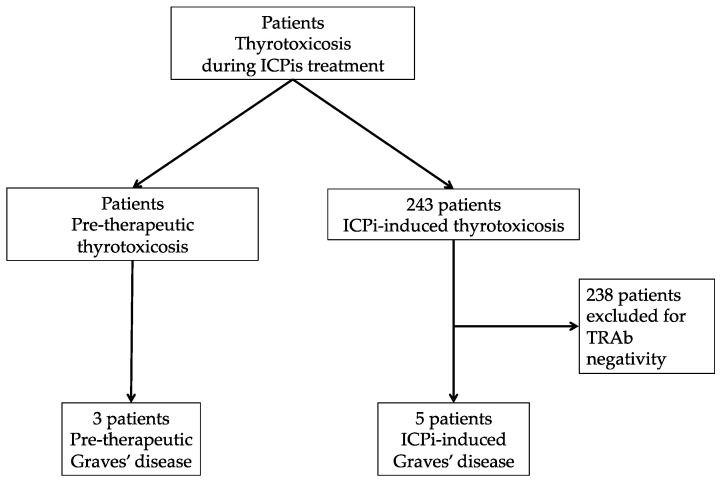
Thyrotoxicosis is an adverse event associated with immune checkpoint inhibitors (ICPis) that occurs in 0.6 to 3.2% of treated patients, depending on ICPi class. Presentation usually consists of a biphasic thyroiditis with transient thyrotoxicosis and secondary hypothyroidism. ICPi-induced Graves’ disease (GD), due to the stimulating activity of TSH-receptor autoantibodies (TRAb), is extremely rare. The aim of this retrospective study was to describe the characteristics and evolution of GD during ICPi therapy. Five among 243 patients followed for ICPi-induced thyrotoxicosis showed TRAb positivity (2% of the cohort). GD occurred quickly after initiation of ICPis; its course was typical for two patients, with prolonged requirement for antithyroid drug treatment (ATD). The three other patients experienced biphasic thyroiditis with secondary hypothyroidism requiring long-term substitution. Three other patients had a diagnosis of GD before starting ICPis; they evolved toward hypothyroidism with early cessation of ATD and long-term substitution treatment during ICPi treatment. None developed significant Graves’ orbitopathy. ICPi treatment was not interrupted for thyroid dysfunction. In conclusion, GD is a rare, immune-related adverse event of ICPis with an unusual course and frequent evolution to biphasic thyroiditis. In the case of ICPi-induced thyrotoxicosis in the presence of TRAb, observing the spontaneous evolution and performing a scintigraphy are useful before starting ATD treatment. Pre-existing GD is not exacerbated by ICPis and tends to evolve towards hypothyroidism. ICPi treatment can be maintained with adequate biochemical surveillance.
Overview
CoChat Summary
TL;DR
In a retrospective Lyon cohort of 243 patients with ICPi-induced thyrotoxicosis, 5 (2%) had TRAb-positive induced Graves’ disease and 3 had pre-existing Graves’ disease. Induced GD often followed an atypical course, with 3/5 evolving to hypothyroidism, while pre-existing GD uniformly evolved to hypothyroidism; no severe hyperthyroidism or significant orbitopathy occurred and ICPi was maintained.
Key findings
- Among 243 patients referred for thyrotoxicosis during ICPi treatment, 5 (2%) had TRAb-positive ICPi-induced GD; 3 additional patients had pre-existing GD before starting ICPis.
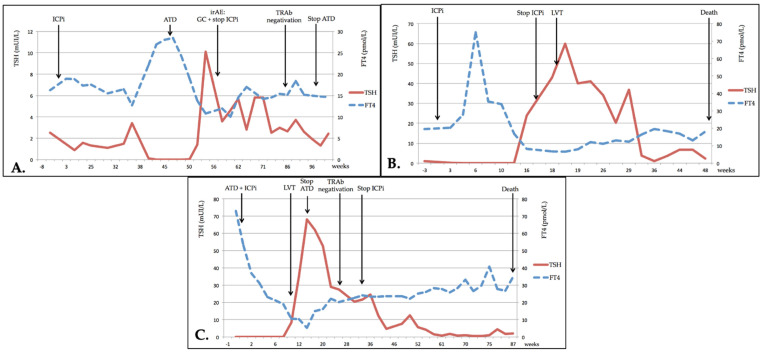
- In induced GD, 2/5 had a typical Graves’ course requiring prolonged antithyroid drug treatment (about one year for patient 1; patient 2 was still on ATD after 6 months because tapering caused recurrence), while 3/5 had transient thyrotoxicosis and evolved to hypothyroidism requiring long-term substitution.
- All 3 patients with pre-existing GD developed secondary hypothyroidism with early ATD cessation and long-term levothyroxine; none developed irAE. None of the 8 patients developed significant Graves’ orbitopathy or severe hyperthyroidism, and ICPi treatment was not interrupted for thyroid dysfunction.
- The literature review found only nine reported cases of ICPi-induced Graves’ hyperthyroidism and seven of induced Graves’ orbitopathy, with one patient having both; all eight induced GD cases without orbitopathy had TRAb positivity and/or high iodine uptake, and only one evolved to spontaneous hypothyroidism.
Methods
- Retrospective descriptive cohort study with longitudinal follow-up at the University Hospital of Lyon, France, from December 2015 to December 2020, via the ImmuCare and Tox’imm networks; included adults with thyrotoxicosis diagnosed at pre-therapeutic screening or during ICPi treatment for any cancer and positive TRAb.
- Thyrotoxicosis was defined as low TSH (normal 0.4–4 mUI/L) with high FT4 (normal 12–22 pmol/L) and/or high FT3 (normal 3.1–6.8 pmol/L); TRAb positivity was >1.6 UI/L, TPOAb positivity >34 UI/mL; scintigraphy/ultrasound were used when required; secondary hypothyroidism was high TSH with low FT4/FT3 without thyroid treatment.
- The paper also reviews published cases of ICPi-induced Graves’ hyperthyroidism and orbitopathy (Table 3).
Limitations
- Stated: the series is small (5 induced GD, 3 pre-existing GD), retrospective, and from a single tertiary referral center; the authors state the 2% TRAb-positive prevalence is probably an overestimate because patients with mild thyrotoxicosis may not have been referred.
- Stated: TRAb bioassays could not be performed to distinguish stimulating from blocking antibodies, and no information was available on time to TRAb negativity in the induced GD patients.
- Evident from the text: there was no control group; ICPi regimens, cancer types, follow-up frequency, and scintigraphy timing were heterogeneous, and the literature comparison relies on case reports.
Model-written summary. Check it against the paper before relying on it.
Integrity signals
Registry
Cites
Statistics
Figures
Verification
Claims the paper makes
19 Valid · 3 Not valid · 9 Not checked · 37 Own results and interpretations
The cited sources support only part of this claim — read each source’s verdict below.
In the paper
“Histological and morphological analysis can demonstrate different pathophysiological mechanisms between autoimmune and ICPi-induced thyrotoxicosis [26,27].”
§ Graves’ Disease during Immune Checkpoint Inhibitor Therapy (A Case Series and Literature Review) > 4. Discussion
What the sources say
- Not checked — no full text of the sourcecites [26] Torimoto K. Okada Y. Nakayamada S. Kubo S. Tanaka Y. Anti-PD-1 Antibody Therapy Induces Hashimoto’s Disease with an Increase in Peripheral Blood Follicular Helper T Cells Thyroid. 2017 27 1335 1336 10.1089/thy.2017.0062 28699391 source
- Partly supportedcites [27] Angell T.E. Min L. Wieczorek T.J. Hodi F.S. Unique cytologic features of thyroiditis caused by immune checkpoint inhibitor therapy for malignant melanoma Genes Dis. 2018 5 46 48 10.1016/j.gendis.2017.11.002 29619406 PMC5879785 sourceExperimental — accuracy not yet measured
The Case discussion reports a cytologic difference: necrotic cells appeared in checkpoint-inhibitor thyroiditis but are not present in autoimmune thyroid disease. It says these features may help explain mechanisms that remain to be elucidated; it does not demonstrate different pathophysiological mechanisms. (LLM, conf=0.86)
plainstates an association- Asserted: passes — The authors put it forward as true.
- Checkable: passes — It can be checked against evidence.
- Load-bearing: unclear — It is unclear whether the paper’s conclusions depend on it.
- Based: passes — The paper gives a reason why it holds.
The sources with a verdict support this claim; the rest weren’t checked yet, have no full text we could read, or their verdicts aren’t rated yet.
In the paper
“Corticosteroid therapy may influence the course of ICPi-induced thyroid dysfunction [57,61].”
§ Graves’ Disease during Immune Checkpoint Inhibitor Therapy (A Case Series and Literature Review) > 4. Discussion
What the sources say
- Supportedcites [57] Kimbara S. Fujiwara Y. Iwama S. Ohashi K. Kuchiba A. Arima H. Yamazaki N. Kitano S. Yamamoto N. Ohe Y. Association of antithyroglobulin antibodies with the development of thyroid dysfunction induced by nivolumab Cancer Sci. 2018 109 3583 3590 10.1111/cas.13800 30230649 PMC6215874 source
The Results section (Onset and timing of TD) reports that thyrotoxicosis did not progress to hypothyroidism in five of six patients given systemic steroids at its onset. The Discussion explicitly suggests that steroid therapy could prevent permanent hypothyroidism, while noting that further investigation is warranted. This supports the citing sentence’s hedged wording. (LLM, conf=0.92)
- Not checked — no full text of the sourcecites [61] Yamauchi I. Sakane Y. Fukuda Y. Fujii T. Taura D. Hirata M. Hirota K. Ueda Y. Kanai Y. Yamashita Y. Clinical Features of Nivolumab-Induced Thyroiditis: A Case Series Study Thyroid. 2017 27 894 901 10.1089/thy.2016.0562 28537531 source
hedgedstates a possible causen = 2- Asserted: passes — The authors put it forward as true.
- Checkable: passes — It can be checked against evidence.
- Load-bearing: unclear — It is unclear whether the paper’s conclusions depend on it.
- Based: passes — The paper gives a reason why it holds.
- Supported
The cited sources support only part of this claim — read each source’s verdict below.
In the paper
“Clinical trials of ICPis excluded patients with pre-existing active autoimmune diseases because of concerns of a high susceptibility to severe irAEs [49,50].”
§ Graves’ Disease during Immune Checkpoint Inhibitor Therapy (A Case Series and Literature Review) > 4. Discussion
What the sources say
- Partly supportedcites [49] Hodi F.S. O’Day S.J. McDermott D.F. Weber R.W. Sosman J.A. Haanen J.B. Gonzalez R. Robert C. Schadendorf D. Hassel J.C. Improved Survival with Ipilimumab in Patients with Metastatic Melanoma N. Engl. J. Med. 2010 363 711 723 10.1056/NEJMoa1003466 20525992 PMC3549297 sourceExperimental — accuracy not yet measured
The Methods (Patients; page not provided) list autoimmune disease as an exclusion criterion for this ipilimumab trial. The Results (Adverse Events; page not provided) report severe immune-related adverse events, but the paper does not state that heightened susceptibility to those events in patients with pre-existing autoimmune disease was the reason for exclusion. It also does not establish the claim for checkpoint-inhibitor trials generally. (LLM, conf=0.86)
- Partly supportedcites [50] Robert C. Schachter J. Long G.V. Arance A. Grob J.J. Mortier L. Daud A. Carlino M.S. McNeil C. Lotem M. Pembrolizumab versus Ipilimumab in Advanced Melanoma N. Engl. J. Med. 2015 372 2521 2532 10.1056/NEJMoa1503093 25891173 sourceExperimental — accuracy not yet measured
The Patients section (page unavailable) says this trial excluded people with a history of serious autoimmune disease. It does not limit that exclusion to active disease or state that concern about heightened susceptibility to severe immune-related adverse events was the reason. The Adverse Events section (page unavailable) reports immune-related events but does not establish that rationale. (LLM, conf=0.87)
plainstates a cause- Asserted: passes — The authors put it forward as true.
- Checkable: passes — It can be checked against evidence.
- Load-bearing: unclear — It is unclear whether the paper’s conclusions depend on it.
- Based: passes — The paper gives a reason why it holds.
- Partly supported
The cited sources support only part of this claim — read each source’s verdict below.
In the paper
“and that patients who had ICPi-induced hypothyroidism had positive anti-thyroid autoantibodies in 75 to 100% of cases [54,55,56,57].”
§ Graves’ Disease during Immune Checkpoint Inhibitor Therapy (A Case Series and Literature Review) > 4. Discussion
What the sources say
- Supportedcites [54] Kobayashi T. Iwama S. Yasuda Y. Okada N. Tsunekawa T. Onoue T. Takagi H. Hagiwara D. Ito Y. Morishita Y. Patients With Antithyroid Antibodies Are Prone To Develop Destructive Thyroiditis by Nivolumab: A Prospective Study J. Endocr. Soc. 2018 2 241 251 10.1210/js.2017-00432 29600292 PMC5836529 source
Results §2B identifies three nivolumab-treated patients who developed hypothyroidism (cases 021, 034, and 038). Table 3 shows that all three had positive TPOAb or TgAb levels at some point, yielding 3/3 (100%). Case 034 was antibody-negative at baseline and became positive during treatment, so the 100% figure does not describe baseline positivity. (LLM, conf=0.86)
- Partly supportedcites [55] Maekura T. Naito M. Tahara M. Ikegami N. Kimura Y. Sonobe S. Kobayashi T. Tsuji T. Minomo S. Tamiya A. Predictive Factors of Nivolumab-induced Hypothyroidism in Patients with Non-small Cell Lung Cancer Vivo 2018 31 1035 1039 10.21873/invivo.11166 PMC5656848 28882978 sourceExperimental — accuracy not yet measured
Our copy supports antibody positivity only for this paper's own small nivolumab cohort: Discussion reports 'Among the 5 patients who developed hypothyroidism, 4 were positive for TPO antibodies and 5 were positive for thyroglobulin antibodies' (80% and 100%, consistent with the 75-100% band), and Table I/Table II give the same per-patient TPOAb/TgAb status for the 5 hypothyroidism cases. What the source does not support is the claim's generalisation to ICPi-induced hypothyroidism at 75-100%: the paper's own data are n=5, single-agent nivolumab in NSCLC, and the ICI cohorts it cites in the Discussion fall far below that band (de Filette et al.: thyroid auto-antibodies elevated in 4 of 10 assessed pembrolizumab patients; Alhusseini et al.: 50%/40%/40% elevated antibodies during the thyroiditis phase), and it explicitly notes ICI-induced thyroid dysfunction without anti-thyroid antibody association (Torino et al., ref 19). Only Osorio et al. (8 of 10) lies within the quoted range, and that is another work's result, not this paper's finding. (LLM, conf=0.78)
- Supportedcites [56] Osorio J.C. Ni A. Chaft J.E. Pollina R. Kasler M.K. Stephens D. Rodriguez C. Cambridge L. Rizvi H. Wolchok J.D. Antibody-mediated thyroid dysfunction during T-cell checkpoint blockade in patients with non-small-cell lung cancer Ann. Oncol. 2017 28 583 589 10.1093/annonc/mdw640 27998967 PMC5834017 source
The “TSH kinetics and association of thyroid dysfunction with anti-thyroid antibodies” section reports positive antibodies in 8 of 10 patients (80%) who developed thyroid dysfunction during pembrolizumab treatment. These patients required thyroid replacement, and 80% falls within the cited 75–100% range. Page numbers are unavailable in our copy. (LLM, conf=0.90)
- Supportedcites [57] Kimbara S. Fujiwara Y. Iwama S. Ohashi K. Kuchiba A. Arima H. Yamazaki N. Kitano S. Yamamoto N. Ohe Y. Association of antithyroglobulin antibodies with the development of thyroid dysfunction induced by nivolumab Cancer Sci. 2018 109 3583 3590 10.1111/cas.13800 30230649 PMC6215874 source
The Discussion reports that antithyroid antibodies were present in 8 of 10 patients (80%) who developed hypothyroidism during pembrolizumab treatment, within the cited 75–100% range. This figure is reported from another study, not from Kimbara's nivolumab cohort. (LLM, conf=0.85)
plainstates an association- Asserted: passes — The authors put it forward as true.
- Checkable: passes — It can be checked against evidence.
- Load-bearing: passes — The paper’s conclusions depend on it.
- Based: passes — The paper gives a reason why it holds.
- Supported
The cited sources support only part of this claim — read each source’s verdict below.
In the paper
“Two retrospective and two prospective studies reported that positive TPOAb and/or thyroglobulin autoantibodies (TgAb) are associated with a 40 to 70% risk of hypothyroidism during treatment”
§ Graves’ Disease during Immune Checkpoint Inhibitor Therapy (A Case Series and Literature Review) > 4. Discussion
What the sources say
- Partly supportedcites [54] Kobayashi T. Iwama S. Yasuda Y. Okada N. Tsunekawa T. Onoue T. Takagi H. Hagiwara D. Ito Y. Morishita Y. Patients With Antithyroid Antibodies Are Prone To Develop Destructive Thyroiditis by Nivolumab: A Prospective Study J. Endocr. Soc. 2018 2 241 251 10.1210/js.2017-00432 29600292 PMC5836529 sourceExperimental — accuracy not yet measured
The Results and Discussion (pages unavailable in our copy) report that 3 of 6 antibody-positive patients developed destructive thyroiditis during nivolumab treatment, a 50% incidence. But 50% is the figure for thyroiditis, not hypothyroidism: the Discussion says only three of the four thyroiditis cases progressed to hypothyroidism, and the Results identify one of those cases as antibody-negative. The paper therefore does not support a 40–70% hypothyroidism risk in antibody-positive patients. (LLM, conf=0.87)
- Partly supportedcites [55] Maekura T. Naito M. Tahara M. Ikegami N. Kimura Y. Sonobe S. Kobayashi T. Tsuji T. Minomo S. Tamiya A. Predictive Factors of Nivolumab-induced Hypothyroidism in Patients with Non-small Cell Lung Cancer Vivo 2018 31 1035 1039 10.21873/invivo.11166 PMC5656848 28882978 sourceExperimental — accuracy not yet measured
Our copy is a single retrospective nivolumab study in 64 NSCLC patients; its Abstract and Results state that 'The TPO and thyroglobulin antibodies were significantly positive in patients who developed primary hypothyroidism', and the Discussion/Conclusion hedge that baseline TPOAb and TgAb 'may be predictive of hypothyroidism' (Discussion, p. 1038). That supports the association and the retrospective design, but the paper nowhere reports a '40 to 70%' risk figure, nor does it synthesise two retrospective and two prospective studies; the closest numbers it carries are the antibody-positivity percentages quoted from Alhusseini et al. during the thyroiditis phase (50%, 40%, 40%), which are a different measure. The magnitude and the multi-study attribution are therefore not supported by this source. (LLM, conf=0.75)
- Partly supportedcites [56] Osorio J.C. Ni A. Chaft J.E. Pollina R. Kasler M.K. Stephens D. Rodriguez C. Cambridge L. Rizvi H. Wolchok J.D. Antibody-mediated thyroid dysfunction during T-cell checkpoint blockade in patients with non-small-cell lung cancer Ann. Oncol. 2017 28 583 589 10.1093/annonc/mdw640 27998967 PMC5834017 sourceExperimental — accuracy not yet measured
The ‘TSH kinetics and association of thyroid dysfunction with anti-thyroid antibodies’ section reports a strong association during pembrolizumab treatment: antibodies were present in 8 of 10 patients who developed thyroid dysfunction, versus 3 of 38 who did not. But the paper does not report a 40–70% risk of hypothyroidism among antibody-positive patients. Its figures concern thyroid dysfunction in patients with non-small-cell lung cancer, and antibody positivity could arise during treatment rather than being present beforehand. (LLM, conf=0.88)
- Partly supportedcites [57] Kimbara S. Fujiwara Y. Iwama S. Ohashi K. Kuchiba A. Arima H. Yamazaki N. Kitano S. Yamamoto N. Ohe Y. Association of antithyroglobulin antibodies with the development of thyroid dysfunction induced by nivolumab Cancer Sci. 2018 109 3583 3590 10.1111/cas.13800 30230649 PMC6215874 sourceExperimental — accuracy not yet measured
The Results section (page not available) reports thyroid dysfunction in 40% of patients with baseline thyroid autoimmunity and 63% of those with TgAb during nivolumab treatment. Those figures are for thyroid dysfunction, which includes thyrotoxicosis, rather than specifically hypothyroidism. TPOAb alone was not significantly associated with thyroid dysfunction; 2 of 16 patients with TPOAb alone developed it. (LLM, conf=0.90)
plainstates an association- Asserted: passes — The authors put it forward as true.
- Checkable: passes — It can be checked against evidence.
- Load-bearing: unclear — It is unclear whether the paper’s conclusions depend on it.
- Based: passes — The paper gives a reason why it holds.
- Partly supported
29 more claims · 6 with their cited sources checked
Create a free account to see all 68 claims and to verify the 2 references still open.
- It may state two separate claims as one. 29
- Probably not a substantial claim. 6
Self-check
Percentages, sums and reported differences re-computed from the paper’s own numbers.
Each contradiction between two passages listed here was confirmed by an independent check.
Rated minor: it would not touch a result — a value no result rests on, a p-value that stays on the same side of the significance level, or a conflict that is clerical, resolved elsewhere in the paper, or outside its own findings.
In the paper
§ Graves’ Disease during Immune Checkpoint Inhibitor Therapy (A Case Series and Literature Review) > Abstract
“The three other patients experienced biphasic thyroiditis with secondary hypothyroidism requiring long-term substitution.”
§ Graves’ Disease during Immune Checkpoint Inhibitor Therapy (A Case Series and Literature Review) > 3. Results > 3.2. ICPi-Induced Graves’ Disease
“In patients 3 and 5, thyrotoxicosis evolved to hypothyroidism after a few months, requiring long-term substitution of thyroid hormone. Patient 4 died soon after spontaneous evolution towards hypothyroidism”
Citations
Cites
Improved Survival with Ipilimumab in Patients with Metastatic Melanoma
Hodi, F. S., O'Day, S. J., McDermott, D. F., Weber, R. W., Sosman, J. A., Haanen, J. B., Gonzalez, R., Robert, C., Schadendorf, D., Hassel, J. C., et al. (2010) · New England Journal of Medicine · doi:10.1056/nejmoa1003466 · Cited by 15,155 · cited 1×
“Clinical trials of ICPis excluded patients with pre-existing active autoimmune diseases because of concerns of a high susceptibility to severe irAEs [49,50].”
BackgroundPembrolizumab versus Ipilimumab in Advanced Melanoma
Robert, C., Schachter, J., Long, G. V., Arance, A., Grob, J. J., Mortier, L., Daud, A., Carlino, M. S., McNeil, C., Lotem, M., et al. (2015) · New England Journal of Medicine · doi:10.1056/nejmoa1503093 · Cited by 5,887 · cited 1×
“Clinical trials of ICPis excluded patients with pre-existing active autoimmune diseases because of concerns of a high susceptibility to severe irAEs [49,50].”
BackgroundBrahmer, J. R., Lacchetti, C., Schneider, B. J., Atkins, M. B., Brassil, K. J., Caterino, J. M., Chau, I., Ernstoff, M. S., Gardner, J. M., Ginex, P., et al. (2018) · Journal of Clinical Oncology · doi:10.1200/jco.2017.77.6385 · Cited by 3,713 · cited 1×
“A recent review of the literature is reassuring on the use of corticosteroids for irAE management, finding that it seems not to reduce overall survival in cancer patients treated with ICPis [62,63] and may be safely administered without compromising outcomes [16,64].”
BackgroundHaanen, J. B. A. G., Carbonnel, F., Robert, C., Kerr, K. M., Peters, S., Larkin, J., & Jordan, K. (2017) · Annals of Oncology · doi:10.1093/annonc/mdx225 · Cited by 2,367
Association of the T-cell regulatory gene CTLA4 with susceptibility to autoimmune disease
Ueda, H., Howson, J. M. M., Esposito, L., Heward, J., Snook, Chamberlain, G., Rainbow, D. B., Hunter, K. M. D., Smith, A. N., Di Genova, G., et al. (2003) · Nature · doi:10.1038/nature01621 · Cited by 2,175
Eggermont, A. M. M., Chiarion-Sileni, V., Grob, J.-J., Dummer, R., Wolchok, J. D., Schmidt, H., Hamid, O., Robert, C., Ascierto, P. A., Richards, J. M., et al. (2015) · The Lancet Oncology · doi:10.1016/s1470-2045(15)70122-1 · Cited by 1,262 · cited 1×
“A dose-effect is also suggested by a study that used a high dose of Ipilimumab (10 mg/kg), where 10% of patients developed dysthyroidism [14].”
ResultVaddepally, R. K., Kharel, P., Pandey, R., Garje, R., & Chandra, A. B. (2020) · Cancers · doi:10.3390/cancers12030738 · Cited by 1,196 · cited 1×
“The range of indications for these treatments has been broadening each year [1].”
BackgroundSafety Profile of Nivolumab Monotherapy: A Pooled Analysis of Patients With Advanced Melanoma
Weber, J. S., Hodi, F. S., Wolchok, J. D., Topalian, S. L., Schadendorf, D., Larkin, J., Sznol, M., Long, G. V., Li, H., Waxman, I. M., et al. (2017) · Journal of Clinical Oncology · doi:10.1200/jco.2015.66.1389 · Cited by 1,158
Barroso-Sousa, R., Barry, W. T., Garrido-Castro, A. C., Hodi, F. S., Min, L., Krop, I. E., & Tolaney, S. M. (2018) · JAMA Oncology · doi:10.1001/jamaoncol.2017.3064 · Cited by 1,115
Association of Immune-Related Adverse Events With Nivolumab Efficacy in Non–Small-Cell Lung Cancer
Haratani, K., Hayashi, H., Chiba, Y., Kudo, K., Yonesaka, K., Kato, R., Kaneda, H., Hasegawa, Y., Tanaka, K., Takeda, M., et al. (2018) · JAMA Oncology · doi:10.1001/jamaoncol.2017.2925 · Cited by 1,003
Cited by
Dwivedi, S. N., Kalaria, T., & Buch, H. (2022) · Journal of Clinical Pathology · doi:10.1136/jcp-2022-208290 · Cited by 91
Thyroid-related adverse events induced by immune checkpoint inhibitors
Chera, A., Stancu, A. L., & Bucur, O. (2022) · Frontiers in Endocrinology · doi:10.3389/fendo.2022.1010279 · Cited by 68
Endocrine side effects of immune checkpoint inhibitors
Cardona, Z., Sosman, J. A., Chandra, S., & Huang, W. (2023) · Frontiers in Endocrinology · doi:10.3389/fendo.2023.1157805 · Cited by 64
Clinical Characters and Influence Factors of Immune Checkpoint Inhibitor-related Thyroid Dysfunction
Zhang, Q., Jiao, X., & Lai, X. (2023) · The Journal of Clinical Endocrinology & Metabolism · doi:10.1210/clinem/dgad260 · Cited by 31
Percik, R., Criseno, S., Adam, S., Young, K., & Morganstein, D. L. (2023) · Endocrine Connections · doi:10.1530/ec-22-0513 · Cited by 35
Immune checkpoint inhibitor induced thyroid dysfunction is a frequent event post-treatment in NSCLC
Zhou, N., Velez, M. A., Bachrach, B., Gukasyan, J., Fares, C. M., Cummings, A. L., Lind-Lebuffe, J. P., Akingbemi, W. O., Li, D., Brodrick, P. M., et al. (2021) · Lung Cancer · doi:10.1016/j.lungcan.2021.08.009 · Cited by 20
Ruggeri, R. M., Spagnolo, C. C., Alibrandi, A., Silvestris, N., Cannavò, S., & Santarpía, M. (2023) · Journal of Endocrinological Investigation · doi:10.1007/s40618-023-02096-2 · Cited by 19
Endocrinopathies Associated With Immune Checkpoint Inhibitor Use
Kotwal, A., Kennedy, R., Kikani, N. J., Thosani, S., Goldner, W. S., & Shariff, A. I. (2024) · Endocrine Practice · doi:10.1016/j.eprac.2024.03.023 · Cited by 22
Immune checkpoint inhibitor-induced hypothyroidism predicts treatment response in Japanese subjects
Iwamoto, Y., Kimura, T., Dan, K., Ohnishi, M., Takenouchi, H., Iwamoto, H., Sanada, J., Fushimi, Y., Katakura, Y., Shimoda, M., et al. (2023) · Frontiers in Endocrinology · doi:10.3389/fendo.2023.1221723 · Cited by 15
“The frequency of ICI-induced Graves’ disease is low; about 2% of patients show thyrotoxicosis after ICI administration (3).”
BackgroundImmune checkpoint inhibitor-related thyroid dysfunction
Illouz, F., Briet, C., & Rodien, P. (2023) · Annales d Endocrinologie · doi:10.1016/j.ando.2023.03.005 · Cited by 12
Kotwal, A., Perlman, J. E., Goldner, W. S., Marr, A., & Mammen, J. S. (2023) · JCO Oncology Practice · doi:10.1200/op.23.00023 · Cited by 11
Zhu, L., Cheung, Y.-M. M., Chiang, C. Y., Gallagher, E. J., Hamnvik, O. R., Mammen, J. S., Quandt, Z., Jones, R., McDunn, J., Al-Bahadili, H., et al. (2025) · Journal for ImmunoTherapy of Cancer · doi:10.1136/jitc-2025-011865 · Cited by 17
“62 However, in patients without convincing features of Graves’ disease, whose thyrotoxicosis is self-limiting without need for antithyroid drugs, ir-thyroiditis should be the primary consideration.”
Chilelli, M. G., Signorelli, C., Berrìos, J. R. G., Onorato, A., Nelli, F., Fabbri, A., Primi, F., Marrucci, E., Virtuoso, A., Schirripa, M., et al. (2022) · Cancer Diagnosis & Prognosis · doi:10.21873/cdp.10076 · Cited by 9
“However, some cases of isolated hypothyroidism (22) and thyrotoxicosis due to Graves’ disease have been described under ICIs (26).”
BackgroundA Rare Case of Pembrolizumab-Associated Graves’ Disease
Alqaisi, S., & Rahman, A. (2023) · Cureus · doi:10.7759/cureus.34696 · Cited by 5
Thyroid Dysfunction from Treatments for Solid Organ Cancers
Kotwal, A., & McLeod, D. S. A. (2022) · Endocrinology and Metabolism Clinics of North America · doi:10.1016/j.ecl.2021.12.006 · Cited by 5
Immune checkpoint inhibitors associated thyroiditis: mechanisms and clinical outcomes
Hammerstad, S. S., Lee, H. J., Tomer, Y., & Stefan–Lifshitz, M. (2025) · Journal of Endocrinological Investigation · doi:10.1007/s40618-025-02608-2 · Cited by 4
“The course of the disease was typical for Graves’ disease in 2 patients who were treated with anti-thyroid drug [ 36 ].”
Thomsen, M. J., Andersen, S. L., Torp, N. M. U., Andersen, S., & Carlé, A. (2025) · Thyroid Research · doi:10.1186/s13044-025-00254-7 · Cited by 4
“Peiffert et al. reported further details for the five patients that were classified with ICI-induced Graves’ disease [10].”
InfluentialSharma, R. (2022) · JCEM Case Reports · doi:10.1210/jcemcr/luac024 · Cited by 4
“Peiffert and colleagues in a case series of ICI-induced thyro-toxicosis identified 8 patients with Graves’ disease at their University Hospital and 8 more patients from a review of the literature [9].”
BackgroundOyibo, S. O., & Mahgoub, M. O. (2021) · Cureus · doi:10.7759/cureus.19736 · Cited by 2
Ferreira, M., Rao, M., Kamal, A. H., & Shariff, A. I. (2022) · Journal of Palliative Medicine · doi:10.1089/jpm.2022.0204 · Cited by 2
Liguori, L., Luciano, A., Polcaro, G., Ottaiano, A., Cascella, M., Perri, F., Pepe, S., & Sabbatino, F. (2023) · Biomedicines · doi:10.3390/biomedicines11112974 · Cited by 3
Wang, X., Chen, D., Shi, Y., Yang, T., & Zheng, X. (2025) · Endocrine Metabolic & Immune Disorders - Drug Targets · doi:10.2174/0118715303317264250116095028 · Cited by 2
Hidaka, R., Hiromatsu, Y., Tatsumoto, N., Fukuyama, T., SAGARA, Y., Uchida, A., TAMAI, H., Tojikubo, M., Akehi, Y., Kawasaki, E., et al. (2024) · The Kurume Medical Journal · doi:10.2739/kurumemedj.ms7134008 · Cited by 2
Hirao, N., Iijima, T., Tanuma, D., Ohira, E., Kurai, H., Shinzawa, T., Kase, M., Sakurai, S., Tomaru, T., Jojima, T., et al. (2022) · Clinical Endocrinology · doi:10.1111/cen.14788 · Cited by 4
Thyroid storm triggered by immune checkpoint inhibitor therapy
Hagiwara, J., Sekine, M., Sakawaki, E., Sakawaki, S., & Takeyama, Y. (2026) · BMJ Case Reports · doi:10.1136/bcr-2026-272027 · Cited by 1
Liu, Z., Yang, H., Chen, Z., & Jing, C. (2022) · Hereditas · doi:10.1186/s41065-022-00253-w · Cited by 1
“As ICB therapies targeting PD-1/PD-L1 [49] and CTLA-4 [50] have shown promising results in clinical trials, tumor immunotherapy is attracting more attention.”
BackgroundInibitori dei checkpoint immunitari e patologia tiroidea
Patti, L., Musso, L., Ferone, D., & Albertelli, M. (2022) · L Endocrinologo · doi:10.1007/s40619-022-01038-z
(2021) · Reactions Weekly · doi:10.1007/s40278-021-96437-9
THYROID DYSFUNCTIONS INDUCED BY IMMUNE CHECK-POINT INHIBITORS
Lomidze, K., Gordeladze, M., Kikodze, N., Charkviani, N., & Chikovani, T. (2022) · EXPERIMENTAL & CLINICAL MEDICINE GEORGIA · doi:10.52340/jecm.2022.06.05.08
Immunotherapy and Endocrine Oncology
Contreras, M., Sánchez, J. C., & Iglesias, P. (2022) · Springer eBooks · doi:10.1007/978-3-030-80962-1_242-1
Immunotherapy for Endocrine Oncology
Contreras, M., Sánchez, J. C., & Iglesias, P. (2024) · Springer eBooks · doi:10.1007/978-3-030-80962-1_242-2
Howerton, B. S., Yu, P., & Chapelin, F. (2025) · Elsevier eBooks · doi:10.1016/b978-0-443-21521-6.00007-7
Immunotherapy for Endocrine Oncology
Contreras, M., Sánchez, J. C., & Iglesias, P. (2025) · Springer eBooks · doi:10.1007/978-3-032-00769-8_242
Metadata
- Authors
- Peiffert, M., Cugnet-Anceau, C., Dalle, S., Chikh, K., Assaad, S., Disse, E., Raverot, G., Borson-Chazot, F., & Abeillon-du Payrat, J.
- Affiliations
- Lyon 1 Université (FR)
- Service d’Endocrinologie-Diabète-Nutrition, Hôpital Lyon Sud, Hospices Civils de Lyon, 69310 Pierre-Bénite, France
- Faculté de Médecine, Université Lyon 1, 69008 Lyon, France
- Centre Léon Bérard (FR)
- Fédération d’Endocrinologie, Hôpital Louis Pradel, Groupement Hospitalier Est, Hospices Civils de Lyon, 69500 Bron, France
- Corresponding author
- Peiffert, Mathilde
- Venue
- Cancers
- Publisher
- MDPI AG
- Published
- 2021-04-17
- Volume
- 13
- Issue
- 8
- Pages
- 1944
- ISSN
- 2072-6694 (ISSN-L)
- PMC
- PMC8073133
- OpenAlex
- W3156514035
- Semantic Scholar
- fb8f92b79dd658eabce3ac01aff634dba7ba820d
- Cited by
- 33
- References
- 67
- Citations by year
- 2026: 1 · 2025: 6 · 2024: 3 · 2023: 9 · 2022: 11 · 2021: 3
- FWCI
- 4.85
- Type
- journal article
- Language
- en
- Open access
- gold
- doi.org
- Licence
- Locations
- Cancers (publishedVersion, cc-by)
- PubMed Central (publishedVersion, cc-by)
- PubMed (publishedVersion)
- HAL (submittedVersion, cc-by)
- DOAJ (DOAJ: Directory of Open Access Journals) (submittedVersion, cc-by-sa)
- Topics
- Health Sciences › Medicine › Endocrinology, Diabetes and Metabolism › Thyroid Disorders and Treatments
- Health Sciences › Medicine › Oncology › Cancer Immunotherapy and Biomarkers
- Health Sciences › Medicine › Ophthalmology › Ophthalmology and Eye Disorders
- Keywords
- Graves' disease, immune checkpoint inhibitors, immune-related adverse events, thyrotoxicosis, TSH receptor antibodies, central hypothyroidism, antithyroid drugs, Graves' ophthalmopathy, thyroid scintigraphy
About these checks
Registry, retraction, Cites and statistics results are computed, not judged, with one exception: a printed reference that no index lists is read once by a model before it counts as a citation error. Claims are extracted by a model and kept only when their quote appears verbatim in the text; each cited source is then checked, with a model’s help, for whether it says what the claim relies on. Those verdicts can be wrong — read the claim’s quote and the cited source before relying on one.
The claim verdicts this report counts are experimental: their accuracy is not yet measured.
A language model drew the claims from the paper on 2026-10-10, under version 3 of the claim definition (model deepseek-v4.1-flash, prompt extract-v3).
A second model labelled each claim on 2026-10-10 (model jev-1.13-20260917, definition revision gold-guideline-v0.2).
Cited sources are checked with a language model’s help (gpt-6-sol and qwen3.8-omni-flash).
Statistics and arithmetic are recomputed, not judged.
Confidence bands are shown only for fields calibrated on our annotated test set. None is calibrated yet, so no band is shown.
What counts as a claim ›How we measure confidence ›How we check this ›
Are you an author, or do you see a problem with this page? Request a review
Data sources
Bibliographic data: Semantic Scholar, OpenAlex, Crossref.
Contains information from the Semantic Scholar Academic Graph Datasets, made available under the ODC Attribution License (ODC-BY 1.0).
Semantic Scholar’s data is described in: Kinney, R., et al. (2023). The Semantic Scholar Open Data Platform. arXiv:2301.10140.
