

The DOI matches its Crossref record; 230 of the 234 references it cites were found in a registry or an index.
Hypoxia Dictates Metabolic Rewiring of Tumors: Implications for Chemoresistance
Open accessAbstract
Hypoxia is a condition commonly observed in the core of solid tumors. The hypoxia-inducible factors (HIF) act as hypoxia sensors that orchestrate a coordinated response increasing the pro-survival and pro-invasive phenotype of cancer cells, and determine a broad metabolic rewiring. These events favor tumor progression and chemoresistance. The increase in glucose and amino acid uptake, glycolytic flux, and lactate production; the alterations in glutamine metabolism, tricarboxylic acid cycle, and oxidative phosphorylation; the high levels of mitochondrial reactive oxygen species; the modulation of both fatty acid synthesis and oxidation are hallmarks of the metabolic rewiring induced by hypoxia. This review discusses how metabolic-dependent factors (e.g., increased acidification of tumor microenvironment coupled with intracellular alkalinization, and reduced mitochondrial metabolism), and metabolic-independent factors (e.g., increased expression of drug efflux transporters, stemness maintenance, and epithelial-mesenchymal transition) cooperate in determining chemoresistance in hypoxia. Specific metabolic modifiers, however, can reverse the metabolic phenotype of hypoxic tumor areas that are more chemoresistant into the phenotype typical of chemosensitive cells. We propose these metabolic modifiers, able to reverse the hypoxia-induced metabolic rewiring, as potential chemosensitizer agents against hypoxic and refractory tumor cells.
Overview
The claims and statistics of this paper haven’t been checked yet.
Run the check — free, no account needed. It reads the open-access text and checks the sources it cites.
Integrity signals
Registry
Cites
Statistics
Figures
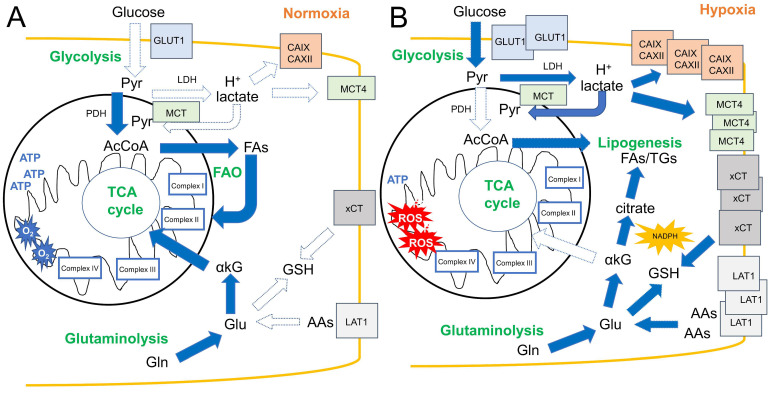
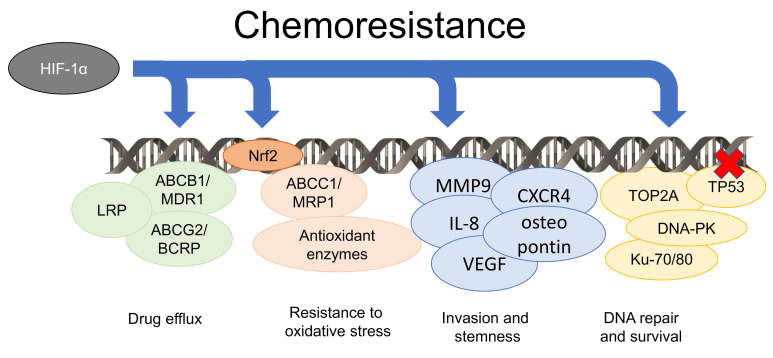
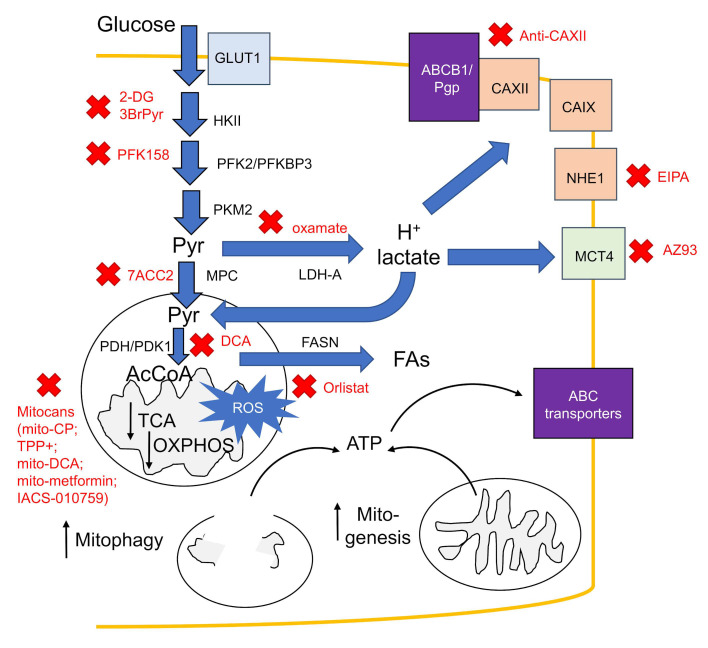
Verification
Claims the paper makes
The claims and statistics of this paper haven’t been checked yet.
Run the check — free, no account needed. It reads the open-access text and checks the sources it cites.
Claims other papers make about this one
Each is checked against this paper’s own text: does it say what the citing paper says it does?
In the citing paper
“On the other hand, in hypoxia oxygenic stress response is activated by NRF2, which activates HIF1α, but more importantly an array of multidrug resistance genes such as MDR1/ABCB1, MRP1/ABCC1 and BCRP/ABCG2 resulting in resistance to a variety of other chemotherapeutics [59, 60].”
From Hypoxia Signaling in Cancer: From Basics to Clinical Practice (2021) · cites this paper as [60]
Self-check
Percentages, sums and reported differences re-computed from the paper’s own numbers.
The self-check needs the paper’s full text.
Citations
Cites
1 retracted
Mitochondrial Autophagy Is an HIF-1-dependent Adaptive Metabolic Response to Hypoxia
Zhang, H., Bosch-Marce, M., Shimoda, L. A., Tan, Y. S., Baek, J. H., Wesley, J. B., Gonzalez, F. J., & Semenza, G. L. (2008) · Journal of Biological Chemistry · doi:10.1074/jbc.m800102200 · Cited by 1,601
RetractedHallmarks of Cancer: The Next Generation
Hanahan, D., & Weinberg, R. A. (2011) · Cell · doi:10.1016/j.cell.2011.02.013 · Cited by 66,590
Understanding the Warburg Effect: The Metabolic Requirements of Cell Proliferation
Vander Heiden, M. G., Cantley, L. C., & Thompson, C. B. (2009) · Science · doi:10.1126/science.1160809 · Cited by 16,197
Molecular mechanisms of epithelial–mesenchymal transition
Lamouille, S., Xu, J., & Derynck, R. (2014) · Nature Reviews Molecular Cell Biology · doi:10.1038/nrm3758 · Cited by 8,091
Multidrug resistance in cancer: role of ATP–dependent transporters
Gottesman, M. M., Fojo, T., & Bates, S. E. (2002) · Nature Reviews Cancer · doi:10.1038/nrc706 · Cited by 5,536
Hypoxia — a key regulatory factor in tumour growth
Harris, A. L. (2002) · Nature Reviews Cancer · doi:10.1038/nrc704 · Cited by 5,177
Kim, J.-W., Tchernyshyov, I., Semenza, G. L., & Dang, C. V. (2006) · Cell Metabolism · doi:10.1016/j.cmet.2006.02.002 · Cited by 3,905
On Respiratory Impairment in Cancer Cells
Warburg, O. H. (1956) · Science · doi:10.1126/science.124.3215.269 · Cited by 3,472
Metabolic Competition in the Tumor Microenvironment Is a Driver of Cancer Progression
Chang, C.-H., Qiu, J., O’Sullivan, D., Buck, M. D., Noguchi, T., Curtis, J. D., Chen, Q., Gindin, M., Gubin, M. M., van der Windt, G. J. W., et al. (2015) · Cell · doi:10.1016/j.cell.2015.08.016 · Cited by 3,331
Regulation of Translation Initiation in Eukaryotes: Mechanisms and Biological Targets
Sonenberg, N., & Hinnebusch, A. G. (2009) · Cell · doi:10.1016/j.cell.2009.01.042 · Cited by 3,304 · cited 1×
“Concurrently HIF-2α activates mTOR, a sensor of the cellular energy status and of the AA availability, and a stimulator of protein translation and cell proliferation [104].”
Background
Cited by
Sorted by citations
Items 101–134 of 134
Abbasvandi, F., Miripour, Z. S., Bayat, M., Mousavi‐kiasary, S. M. S., Shayanfar, S., Shojaeian, F., Aghaei, F., Jahanbakhshi, F., Abbasvandi, N., Omrani-Hashemi, M., et al. (2024) · Diagnostic Pathology · doi:10.1186/s13000-024-01574-2 · Cited by 1
Evolution-Informed Modeling and Control of Tumor Growth
Romano, C., Benedetto, M. D. D., & Borri, A. (2025) · IEEE Transactions on Automation Science and Engineering · doi:10.1109/tase.2025.3605540 · Cited by 2
Redmond, J., Agarwal, S., McCarthy, H. O., Buchanan, P., Levingstone, T. J., & Dunne, N. (2025) · Biomaterials Advances · doi:10.1016/j.bioadv.2025.214635 · Cited by 1
Coutinho, L. L., Palmieri, E. M., Ridnour, L. A., Cheng, R. Y. S., Heinz, W. F., Anderson, S. K., Billiar, T. R., Chang, J. C., Lockett, S., Rangel, M. C., et al. (2026) · Redox Biology · doi:10.1016/j.redox.2026.104245 · Cited by 2
Recent progress of biocompatible carbon dots in hypoxia-related fields
Huang, Q., Lv, Q., Jiang, L., Chen, Q., & Zhang, K. (2022) · Journal of Biomaterials Applications · doi:10.1177/08853282221125313 · Cited by 1
Boosting antitumor immunity in breast cancers: Potential of adjuvants, drugs, and nanocarriers
Chen, P., Ren, L., Guo, Y.-W., & Sun, Y. (2024) · International Reviews of Immunology · doi:10.1080/08830185.2024.2432499 · Cited by 2
Zapotin mitigates breast cancer progression by targeting PKCε mediated glycolytic pathway regulation
Khan, K., Anwar, M., Badshah, Y., Ashraf, N. M., Hamid, A., Trembley, J. H., Shabbir, M., Afsar, T., Husain, F. M., Khan, D., et al. (2025) · BMC Cancer · doi:10.1186/s12885-025-14202-z · Cited by 1
Anand, S., Khan, M. A., & Singh, A. P. (2022) · Cancers · doi:10.3390/cancers15010166 · Cited by 1
C/EBP-β LAP regulates chemo-immuno-resistance in hypoxic non-small cell lung cancerPreprint
Salaroglio, I. C., Belisario, D. C., Akman, M., Vecchia, S. L., Godel, M., Anobile, D. P., Ortone, G., Digiovanni, S., Fontana, S., Costamagna, C., et al. (2022) · Research Square · doi:10.21203/rs.3.rs-1503033/v1
Xu, Z., Liu, Y., Su, Y., Lv, G., & Wang, Y. (2022) · Research Square · doi:10.21203/rs.3.rs-1856054/v1
C/EBP-β LAP regulates chemo-immuno-resistance in hypoxic non-small cell lung cancerPreprint
Riganti, C., Salaroglio, I. C., Belisario, D. C., Akman, M., Vecchia, S. L., Godel, M., Anobile, D. P., Ortone, G., Digiovanni, S., Fontana, S., et al. (2022) · Research Square · doi:10.21203/rs.3.rs-1503033/v2
Kulkarni, A., Masarkar, N., Ray, S. K., & Mukherjee, S. (2023) · Springer eBooks · doi:10.1007/978-981-99-0313-9_2
A method to identify high consensus predictions of single-cell metabolic fluxPreprint
Amiss, M., Lum, J. J., & Jabbari, H. (2024) · bioRxiv (Cold Spring Harbor Laboratory) · doi:10.1101/2024.01.15.572211
Changes in RNA dynamics in the course of hypoxia in myeloid cells
Bauer, R. (2024) · Publication Server of Goethe University Frankfurt am Main (Goethe University Frankfurt) · doi:10.21248/gups.81926
Murray, R. C. (2024) · Digital Repository Service (Northeastern University) · doi:10.17760/d20653008
Akl, M. M., & Ahmed, A. K. K. (2025) · Сибирский научный медицинский журнал · doi:10.18699/ssmj20250401
Kumari, P., & Kumar, S. (2025) · ChemistrySelect · doi:10.1002/slct.202503162
A Mathematical Model of Chemotaxis in Cancer Treatment
Al-Azem, B., & Nadim, A. (2025) · Applied Mathematics · doi:10.4236/am.2025.1611041
Agrawal, M., & Agrawal, S. K. (2026) · Elsevier eBooks · doi:10.1016/b978-0-443-40535-8.00006-5
Wang, W., Feng, P., Zhou, R., Han, Y.-H., Peng, W., Bo, R., Liu, M., Yu, J., & Li, J. (2026) · Materials & Design · doi:10.1016/j.matdes.2026.115948
Hypoxia-on-chip : from technological developments to biological applications
Bouquerel, C. (2023) · theses.fr (ABES) · doi:10.70675/d7d58b5dzd927z4235z8c54z8dbb6fd4757e
Hypoxia Induces a Mitotic Survival Advantage After Radiotherapy in Head and Neck Cancer Cells
Wegge, M., Dok, R., Dubois, L. J., & Nuyts, S. (2026) · International Journal of Cancer · doi:10.1002/ijc.70479
Li, A., Chang, Q., Wu, Y., Huang, K., Chen, Y., Wei, M., Huo, Y., Liu, M., Yh, M., Lin, Q., et al. (2026) · Journal of Medicinal Chemistry · doi:10.1021/acs.jmedchem.6c00780 · Cited by 1
Impact of hypoxia, angiogenesis, and immunosuppression in chemoresistance
Ashrai, P., Zishan, S., & Kotnis, A. L. (2026) · Elsevier eBooks · doi:10.1016/b978-0-443-45717-3.00016-7
Lomer, N. B., Sadeghpour, S., & Torigian, D. A. (2026) · Annals of Nuclear Medicine · doi:10.1007/s12149-026-02240-x
Nanomedicine delivery systems of natural products from herbal medicine for tumor metabolic blockade
Yuan, L., Zeng, Y., Wang, X., Mao, R., Li, D., Chai, Q., Gu, Y., Sun, T., Li, A., & Liu, J. Z. (2026) · Chinese Chemical Letters · doi:10.1016/j.cclet.2026.113040
Gómez-Escudero, J., Maniati, E., Holdsworth, J., Beattie, G., Hijazi, M., Guelbert, M., Elorbany, S., Cutillas, P. R., Wang, J., Hodivala‐Dilke, K., et al. (2026) · Angiogenesis · doi:10.1007/s10456-026-10063-7 · Cited by 1
Li, B., Wang, Y., Lin, Z., Wang, X., Fu, Z., Guo, B., Xu, Y., Chen, J., Ding, B., & Wu, X. (2026) · Nanomedicine Nanotechnology Biology and Medicine · doi:10.1016/j.nano.2026.103006
Tangyingyong, S., Abu‐Fares, H., & Susiriwatananont, T. (2026) · Microorganisms · doi:10.3390/microorganisms14092046
Extracellular vesicle-mediated drug resistance in cancer
Zhao, B., Chen, Y., Khan, H., Wang, Y., Tang, H., Swati, K., Anand, K., Parvez, S., Lin, Y., & Wu, H. (2026) · Drug Resistance Updates · doi:10.1016/j.drup.2026.101474
Nanocarrier-based drug delivery systems for remodeling the melanoma tumor microenvironment
Wang, H., Sun, C., Wang, H., Shen, W., Ren, G., & Wang, M. (2026) · Journal of drug targeting · doi:10.1080/1061186x.2026.2743182
陈立天, Fu, P., Wu, S., Chen, B., & Wen, X. (2026) · Frontiers in Genetics · doi:10.3389/fgene.2026.1943981
Metadata
- Authors
- Belisario, D. C., Kopecka, J., Pasino, M., Akman, M., De Smaele, E., Donadelli, M., & Riganti, C.
- Affiliations
- University of Turin (IT)
- Department of Experimental Medicine, Sapienza University of Roma, 00185 Roma, Italy
- University of Verona (IT)
- Corresponding author
- Riganti, Chiara
- Venue
- Cells
- Publisher
- MDPI AG
- Published
- 2020-12-04
- Volume
- 9
- Issue
- 12
- Pages
- 2598
- ISSN
- 2073-4409 (ISSN-L)
- PMC
- PMC7761956
- OpenAlex
- W3109893680
- Cited by
- 133
- References
- 234
- Citations by year
- 2026: 17 · 2025: 27 · 2024: 23 · 2023: 24 · 2022: 24 · 2021: 18
- FWCI
- 1.71
- Type
- journal article
- Language
- en
- Open access
- gold
- doi.org
- Licence
- Locations
- Cells (publishedVersion, cc-by)
- PubMed Central (publishedVersion, cc-by)
- PubMed (publishedVersion)
- Institutional Research Information System University of Turin (University of Turin) (submittedVersion, other-oa)
- DOAJ (DOAJ: Directory of Open Access Journals) (submittedVersion, cc-by-sa)
- IRIS Research product catalog (Sapienza University of Rome) (submittedVersion, cc-by)
- Funders
- AIRC (Associazione Italiana per la Ricerca sul Cancro) (IG21408)
- Topics
- Life Sciences › Biochemistry, Genetics and Molecular Biology › Cancer Research › Cancer, Hypoxia, and Metabolism
- Life Sciences › Biochemistry, Genetics and Molecular Biology › Cancer Research › Cancer, Lipids, and Metabolism
- Health Sciences › Medicine › Oncology › Cancer Cells and Metastasis
- Keywords
- tumor hypoxia, metabolic reprogramming, chemoresistance, hypoxia-inducible factor, tumor microenvironment acidification, efflux pumps, cancer stemness, epithelial-mesenchymal transition, glycolysis, glutamine metabolism, oxidative phosphorylation, fatty acid metabolism, reactive oxygen species, cancer metabolism
- MeSH terms
- Amino Acids, Animals, Hypoxia, Citric Acid Cycle, Glucose, Glutamine, Humans, Mitochondria, Neoplasms, Oxidation-Reduction, Oxidative Phosphorylation, Oxygen, Phenotype, Reactive Oxygen Species, Disease Progression, Drug Resistance, Neoplasm, Dimerization, Lactic Acid, Mice, Epithelial-Mesenchymal Transition, Tumor Microenvironment
About these checks
Registry, retraction, Cites and statistics results are computed, not judged, with one exception: a printed reference that no index lists is read once by a model before it counts as a citation error. Claims are extracted by a model and kept only when their quote appears verbatim in the text; each cited source is then checked, with a model’s help, for whether it says what the claim relies on. Those verdicts can be wrong — read the claim’s quote and the cited source before relying on one.
Statistics and arithmetic are recomputed, not judged.
Confidence bands are shown only for fields calibrated on our annotated test set. None is calibrated yet, so no band is shown.
What counts as a claim ›How we measure confidence ›How we check this ›
Are you an author, or do you see a problem with this page? Request a review
