

On Global Electricity Usage of Communication Technology: Trends to 2030
Open accessThe DOI matches its Crossref record; 163 of the 165 references it cites were found in a registry or an index.
Abstract
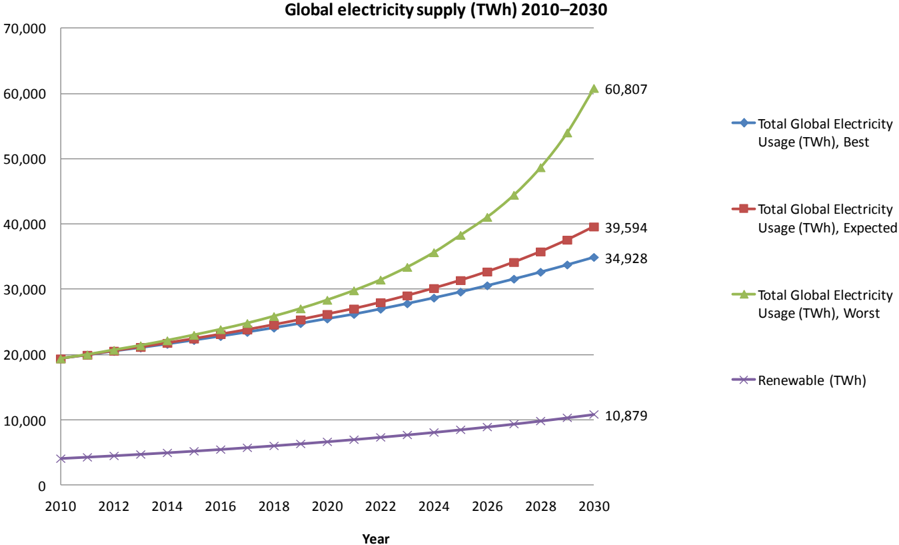
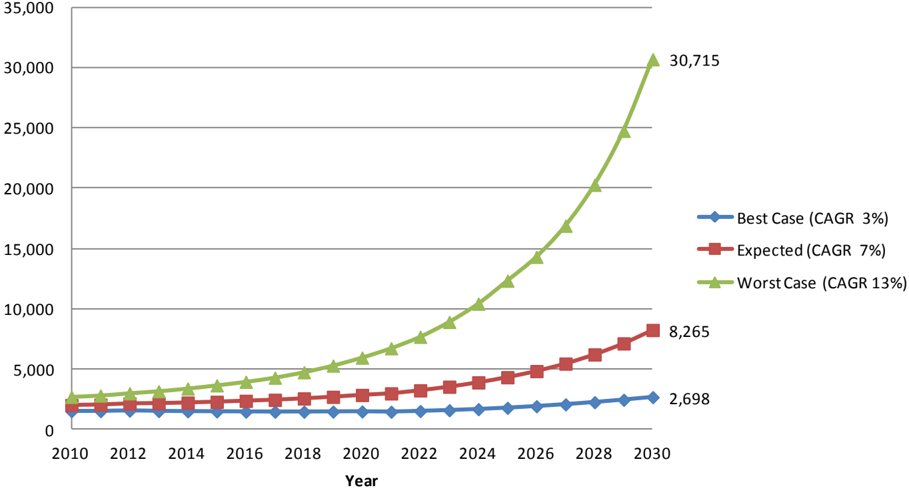
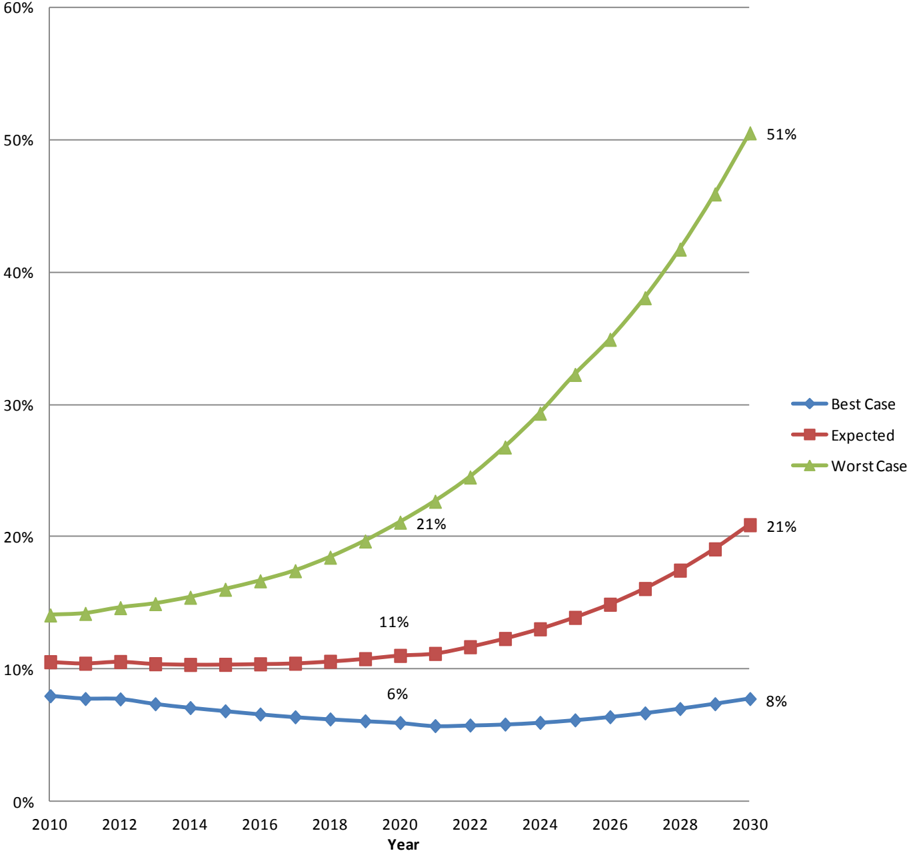
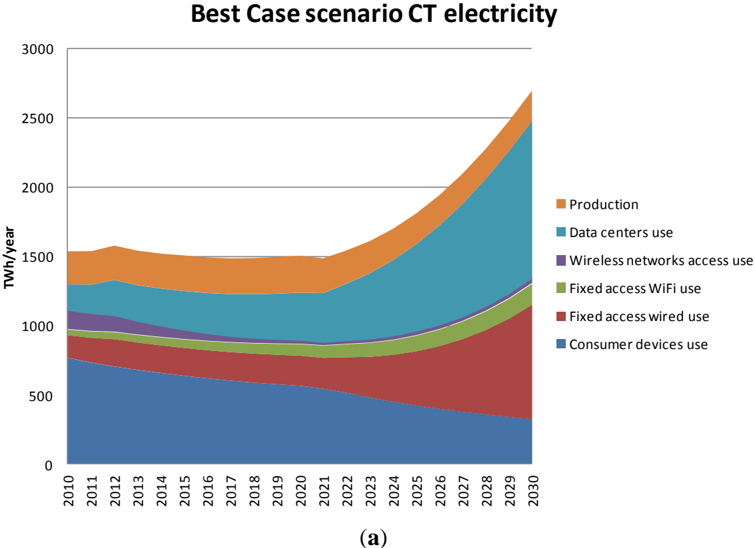
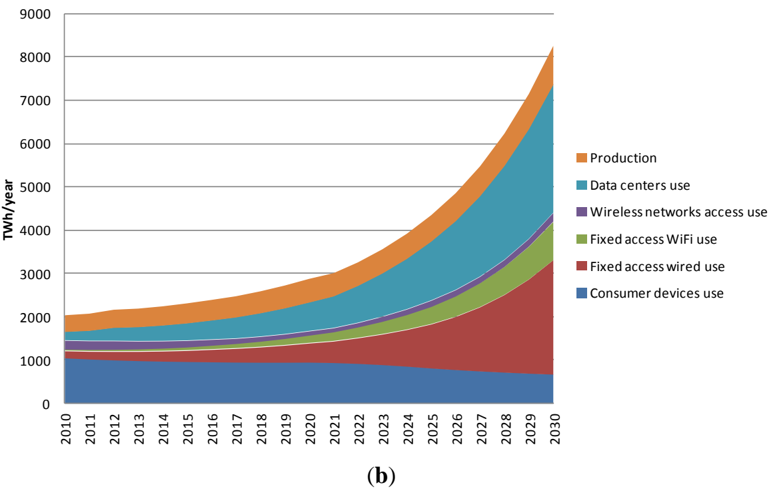
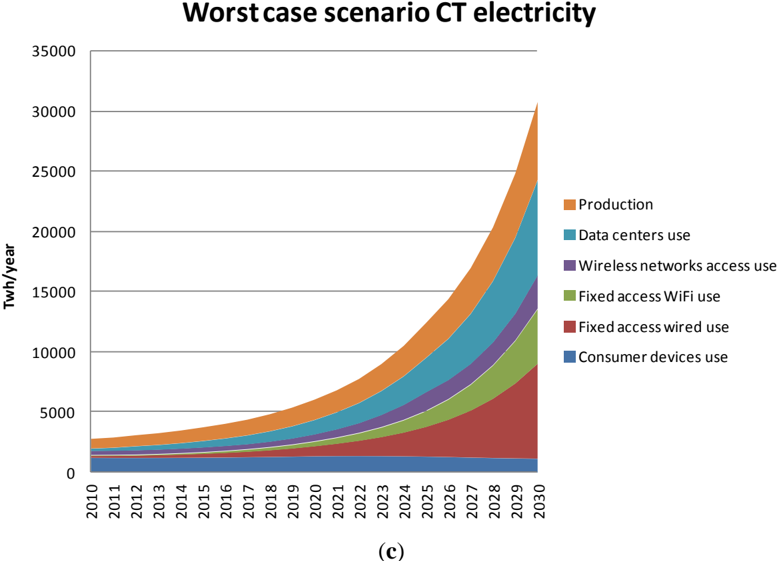
This work presents an estimation of the global electricity usage that can be ascribed to Communication Technology (CT) between 2010 and 2030. The scope is three scenarios for use and production of consumer devices, communication networks and data centers. Three different scenarios, best, expected, and worst, are set up, which include annual numbers of sold devices, data traffic and electricity intensities/efficiencies. The most significant trend, regardless of scenario, is that the proportion of use-stage electricity by consumer devices will decrease and will be transferred to the networks and data centers. Still, it seems like wireless access networks will not be the main driver for electricity use. The analysis shows that for the worst-case scenario, CT could use as much as 51% of global electricity in 2030. This will happen if not enough improvement in electricity efficiency of wireless access networks and fixed access networks/data centers is possible. However, until 2030, globally-generated renewable electricity is likely to exceed the electricity demand of all networks and data centers. Nevertheless, the present investigation suggests, for the worst-case scenario, that CT electricity usage could contribute up to 23% of the globally released greenhouse gas emissions in 2030.
Overview
The claims and statistics of this paper haven’t been checked yet.
Free: it reads the open-access text and checks the first 5 claims that cite a source we can check. Create a free account to check every claim.
Integrity signals
Registry
Cites
Statistics
Figures
Verification
Claims the paper makes
The claims and statistics of this paper haven’t been checked yet.
Free: it reads the open-access text and checks the first 5 claims that cite a source we can check. Create a free account to check every claim.
Claims other papers make about this one
Each is checked against this paper’s own text: does it say what the citing paper says it does?
The source backs part of the claim, not all of it — or backs it for a different population, condition or comparison.
In the citing paper
“According to some scenarios, ICT's future electricity consumption is expected to rise from 1500 TWh (8% of global electricity consumption) in 2010 to 5700 TWh (14% of global electricity consumption) in 2030 [119,122].”
From Digitalization and the Decoupling Debate: Can ICT Help to Reduce Environmental Impacts While the Economy Keeps Growing? (2020) · cites this paper as [119]
Experimental — accuracy not yet measuredThe source backs part of the claim, not all of it — or backs it for a different population, condition or comparison.
In the citing paper
“Studies on the energy consumption of the ICT sector show a steadily and quickly increasing energy demand over recent years [119-121].”
From Digitalization and the Decoupling Debate: Can ICT Help to Reduce Environmental Impacts While the Economy Keeps Growing? (2020) · cites this paper as [119]
Experimental — accuracy not yet measuredThe source backs part of the claim, not all of it — or backs it for a different population, condition or comparison.
In the citing paper
“All analysts think that it would be possible in theory for ICT to decrease its emissions with broad political and industry action—but Malmodin is more optimistic that this will happen than Belkhir and Elmeligi7 and Andrae and Edler.3”
From The real climate and transformative impact of ICT: A critique of estimates, trends, and regulations (2021) · cites this paper as [3]
Experimental — accuracy not yet measuredThe source backs part of the claim, not all of it — or backs it for a different population, condition or comparison.
In the citing paper
“From 2015 to 2020, Belkhir and Elmeligi's7 and Andrae and Edler's3 estimates of ICT emissions have increased due to an increase in data traffic and the number of user devices (see Figure 2).”
From The real climate and transformative impact of ICT: A critique of estimates, trends, and regulations (2021) · cites this paper as [3]
Experimental — accuracy not yet measuredThe source backs part of the claim, not all of it — or backs it for a different population, condition or comparison.
In the citing paper
“However, Andrae and Edler,3 Belkhir and Elmeligi,7 and Malmodin and Lundén8,9 all follow LCA methodologies, which are unable to include the infinite number of supply chain pathways of a product, thereby incurring “truncation error” in their carbon accounting.”
From The real climate and transformative impact of ICT: A critique of estimates, trends, and regulations (2021) · cites this paper as [3]
Experimental — accuracy not yet measured
2 more claims about this paper
Create a free account to see every claim other papers make about this one.
Self-check
Percentages, sums and reported differences re-computed from the paper’s own numbers.
The self-check needs the paper’s full text.
Citations
Cites
The Internet of Things: A survey
Atzori, L., Iera, A., & Morabito, G. (2010) · Computer Networks · doi:10.1016/j.comnet.2010.05.010 · Cited by 15,613
Armbrust, M., Fox, A., Griffith, R., Joseph, A. D., Katz, R., Konwinski, A., Lee, G., Patterson, D., Rabkin, A., Stoica, I., et al. (2010) · Communications of the ACM · doi:10.1145/1721654.1721672 · Cited by 9,464
Buyya, R., Yeo, C. S., Venugopal, S., Broberg, J., & Brandic, I. (2009) · Future Generation Computer Systems · doi:10.1016/j.future.2008.12.001 · Cited by 5,937
Cloud computing: state-of-the-art and research challenges
Zhang, Q., Cheng, L., & Boutaba, R. (2010) · Journal of Internet Services and Applications · doi:10.1007/s13174-010-0007-6 · Cited by 3,515
Beloglazov, A., Abawajy, J., & Buyya, R. (2012) · Future Generation Computer Systems · doi:10.1016/j.future.2011.04.017 · Cited by 2,761
The cost of a cloud: research problems in data center networks
Greenberg, A., Hamilton, J., Maltz, D. A., & Patel, P. (2008) · ACM SIGCOMM Computer Communication Review · doi:10.1145/1496091.1496103 · Cited by 1,621
How much energy is needed to run a wireless network?
Auer, G., Giannini, V., Desset, C., Godor, I., Skillermark, P., Olsson, M., Imran, M., Sabella, D., Gonzalez, M., Blume, O., et al. (2011) · IEEE Wireless Communications · doi:10.1109/mwc.2011.6056691 · Cited by 1,539
Cloud computing for mobile users: can offloading computation save energy?
Kumar, K., & Lu, Y.-H. (2010) · Computer · doi:10.1109/mc.2010.98 · Cited by 1,493 · cited 1×
“The general problems and opportunities regarding electricity usage of WAN have been widely discussed [111–116].”
BackgroundWeb search for a planet: the google cluster architecture
Barroso, L. A., Dean, J., & Holzle, U. (2003) · IEEE Micro · doi:10.1109/mm.2003.1196112 · Cited by 1,025
A close examination of performance and power characteristics of 4G LTE networks
Huang, J., Qian, F., Gerber, A., Mao, Z. M., Sen, S., & Spatscheck, O. (2012) · Proceedings of the 10th international conference on Mobile systems, applications, and services · doi:10.1145/2307636.2307658 · Cited by 995
Research works printed but not linked: 10
- 23. Kamilaris, A.; Tofis, Y.; Bekara, C.; Pitsillides, A.; Kyriakides, E. Integrating web-enabled energy- aware smart homes to the smart grid. Int. J. Adv. Intell. Syst. 2012, 5, 15-31.
- 43. Malmodin, J. European Telecommunication Standards Institute. 2013. Available online: http://docbox.etsi.org/Workshop/2013/201310_EEWORKSHOP/S05_Environ.alImpactAssessm entsofICT/ERICSSON_Malmodin.pdf (accessed on 9 April 2015).
- 48. Kuroda, K.; Kishita, Y.; Yamaguchi, Y.; Umeda, Y.; Hara, M.; Oka, H.; Nakamura, J. Scenario Analysis of the electricity consumption in the Japanese information and communications sector toward green of ICT. In Proceedings of Going Green CARE Innovation, Vienna, Austria, 18-20 November 2014.
- 65. Andrae, A.S.G. Comparative micro life cycle assessment of physical and virtual desktops in a cloud computing network with consequential, efficiency, and rebound considerations. J. Green Eng. 2013, 3, 193-218.
- 80. Dharmaweera, M. N.; Parthiban, R.; Sekercioglu, Y.A. Towards a power-efficient backbone network: The state of research. IEEE Commun. Surv. Tutor. 2014, 99, 1-30.
- 92. Hesselbach, J., Herrmann, C., Eds.; Springer: Berlin, Germany, 2011; Volume 1, pp. 124-129.
- Scheck, H.O. European Telecommunication Standards Institute. Available online:http://docbox.etsi.org/Workshop/2013/201310_EEWORKSHOP/S04_EE_ApplicationofMethodologies/NSN_SCHECK.pdf.
- Olsson, M. European Telecommunication Standards Institute. Available online:http://docbox.etsi.org/Workshop/2013/201310_EEWORKSHOP/S07_RESEARCH/5GrEEn_Olsson.pdf.
- Teehan, 2013, Comparing embodied greenhouse gas emissions of modern computing and electronics products, Environ. Sci. Technol., 47, 3997, 10.1021/es303012r · DOI · Paper page
- Yang, Q. ResearchGate. Available online:https://www.researchgate.net/publication/265617116_Life_cycle_assessment_in_sustainable_product_design.
Cited by
Recalibrating global data center energy-use estimates
Masanet, E., Shehabi, A., Lei, N., Smith, S., & Koomey, J. (2020) · Science · doi:10.1126/science.aba3758 · Cited by 1,545
Digitalization and energy consumption. Does ICT reduce energy demand?
Lange, S., Pohl, J., & Santarius, T. (2020) · Ecological Economics · doi:10.1016/j.ecolecon.2020.106760 · Cited by 1,132
How to stop data centres from gobbling up the world’s electricity
Jones, N. (2018) · Nature · doi:10.1038/d41586-018-06610-y · Cited by 1,166
Assessing ICT global emissions footprint: Trends to 2040 & recommendations
Belkhir, L., & Elmeligi, A. (2018) · Journal of Cleaner Production · doi:10.1016/j.jclepro.2017.12.239 · Cited by 970
Zhang, J., & Tao, D. (2021) · IEEE Internet of Things Journal · doi:10.1109/jiot.2020.3039359 · Cited by 774
“According to [266], electricity use by communication technologies is expected to account for 21% of global total”
BackgroundGreen Algorithms: Quantifying the Carbon Footprint of Computation
Lannelongue, L., Grealey, J., & Inouye, M. (2021) · Advanced Science · doi:10.1002/advs.202100707 · Cited by 543
The real climate and transformative impact of ICT: A critique of estimates, trends, and regulations
Freitag, C., Berners-Lee, M., Widdicks, K., Knowles, B., Blair, G. S., & Friday, A. (2021) · Patterns · doi:10.1016/j.patter.2021.100340 · Cited by 570
“ICT’s future carbon footprint: unpacking the studies’ assumptions In the key studies reviewed here, there is disagreement on whether or not: (A) Andrae and Edler (2015): 2020 best case (total of 623 MtCO2e).”
BackgroundCowls, J., Tsamados, A., Taddeo, M., & Floridi, L. (2023) · AI & SOCIETY · doi:10.1007/s00146-021-01294-x · Cited by 552
Cowls, J., Tsamados, A., Taddeo, M., & Floridi, L. (2021) · doi:10.2139/ssrn.3804983 · Cited by 552
Impacts of COVID-19 on energy demand and consumption: Challenges, lessons and emerging opportunities
Jiang, P., Fan, Y. V., & Klemeš, J. J. (2021) · Applied Energy · doi:10.1016/j.apenergy.2021.116441 · Cited by 535
The Ethics of Artificial Intelligence: Principles, Challenges, and Opportunities
Floridi, L. (2023) · doi:10.1093/oso/9780198883098.001.0001 · Cited by 507
Usage impact on data center electricity needs: A system dynamic forecasting model
Koot, M., & Wijnhoven, F. (2021) · Applied Energy · doi:10.1016/j.apenergy.2021.116798 · Cited by 403
“Much of this discussion has also been described and analyzed in a 2015 paper of Andrae and Edler [13].”
MethodThe Energy and Carbon Footprint of the Global ICT and E&M Sectors 2010–2015
Malmodin, J., & Lundén, D. (2018) · Sustainability · doi:10.3390/su10093027 · Cited by 365
Carbon-aware computing for datacenters
Radovanović, A., Koningstein, R., Schneider, I., Chen, B., Duarte, A., Roy, B., Xiao, D., Haridasan, M., Hung, P., Care, N., et al. (2023) · IEEE Transactions on Power Systems · doi:10.1109/tpwrs.2022.3173250 · Cited by 353
“The datacenter industry accounts for an expanding electricity demand, expected to reach anywhere from 3 to 13% of global electricity demand by 2030 [43].”
Spintronic devices for energy-efficient data storage and energy harvesting
Puebla, J., Kim, J., Kondou, K., & Otani, Y. (2020) · Communications Materials · doi:10.1038/s43246-020-0022-5 · Cited by 303
AI Models for Green Communications Towards 6G
Mao, B., Tang, F., Kawamoto, Y., & Kato, N. (2022) · IEEE Communications Surveys & Tutorials · doi:10.1109/comst.2021.3130901 · Cited by 300
Digital economy, entrepreneurship and energy efficiency
Wang, L., & Shao, J. (2023) · Energy · doi:10.1016/j.energy.2023.126801 · Cited by 288
Lu, W.-C. (2018) · Mitigation and Adaptation Strategies for Global Change · doi:10.1007/s11027-018-9787-y · Cited by 288
Visible Light Communication: A System Perspective—Overview and Challenges
Rehman, S., Ullah, S., Chong, P., Yongchareon, S., & Komosny, D. (2019) · Sensors · doi:10.3390/s19051153 · Cited by 258
Morley, J., Widdicks, K., & Hazas, M. (2018) · Energy Research & Social Science · doi:10.1016/j.erss.2018.01.018 · Cited by 257
Kunkel, S., & Matthess, M. (2020) · Environmental Science & Policy · doi:10.1016/j.envsci.2020.06.022 · Cited by 253
A Systematic Survey on Energy-Efficient Techniques in Sustainable Cloud Computing
Bharany, S., Sharma, S., Khalaf, O. I., Abdulsahib, G. M., Al Humaimeedy, A. S., Aldhyani, T. H. H., Maashi, M., & Alkahtani, H. (2022) · Sustainability · doi:10.3390/su14106256 · Cited by 236
Mytton, D. (2021) · npj Clean Water · doi:10.1038/s41545-021-00101-w · Cited by 225
Chasing Carbon: The Elusive Environmental Footprint of Computing
Gupta, U., Kim, Y. G., Lee, S., Tse, J., Lee, H.-H. S., Wei, G.-Y., Brooks, D., & Wu, C.-J. (2021) · 2021 IEEE International Symposium on High-Performance Computer Architecture (HPCA) · doi:10.1109/hpca51647.2021.00076 · Cited by 221
The Geopolitics of the Global Energy Transition
(2020) · Lecture Notes in Energy · doi:10.1007/978-3-030-39066-2 · Cited by 234
Liu, Y., Wei, X., Xiao, J., Liu, Z., Xu, Y., & Tian, Y. (2020) · Global Energy Interconnection · doi:10.1016/j.gloei.2020.07.008 · Cited by 233
Progress in neuromorphic photonics
Ferreira de Lima, T., Shastri, B. J., Tait, A. N., Nahmias, M. A., & Prucnal, P. R. (2017) · Nanophotonics · doi:10.1515/nanoph-2016-0139 · Cited by 226
Gridmonitoring: secured sovereign blockchain based monitoring on smart grid
Gao, J., Asamoah, K. O., Sifah, E. B., Smahi, A., Xia, Q., Xia, H., Zhang, X., & Dong, G. (2018) · IEEE Access · doi:10.1109/access.2018.2806303 · Cited by 219
“Electricity as a commodity has become themain driver of technology andwithout it, most technologies are limited or unusable [2], [3].”
BackgroundMugge, R., Jockin, B., & Bocken, N. (2017) · Journal of Cleaner Production · doi:10.1016/j.jclepro.2017.01.111 · Cited by 206
“Total smartphone shipments reached 1.3 billion in 2014 (Danova, 2015) and are expected to rise to 3 billion in 2030 (Andrae & Edler, 2015).”
BackgroundInfluentialHow does information and communication technology affect energy security? International evidence
Lee, C.-C., Yuan, Z., & Wang, Q. (2022) · Energy Economics · doi:10.1016/j.eneco.2022.105969 · Cited by 203
Does digital infrastructure cut carbon emissions in Chinese cities?
Tang, K., & Yang, G. (2023) · Sustainable Production and Consumption · doi:10.1016/j.spc.2022.11.022 · Cited by 201
Life cycle assessment and environmental cost accounting of coal-fired power generation in China
Wang, J., Wang, R., Zhu, Y., & Li, J. (2018) · Energy Policy · doi:10.1016/j.enpol.2018.01.040 · Cited by 200
“Coal-fired power generation leads to serious environmental pollution, such as air pollution, water pollution, and noise pollution (Andrae and Edler, 2015; Cristobal et al., 2012; Rigotto, 2009; Song and Li, 2015; Zhou et al., 2013).”
BackgroundCasciani, D., Chkanikova, O., & Pal, R. (2022) · Sustainability: Science, Practice and Policy · doi:10.1080/15487733.2022.2125640 · Cited by 197
“…and communications technology (ICT) sector is a source of 1.8–2.8% of global greenhouse-gas emissions, and these values are underestimations because they fail to account for the full extent of the associated supply chain and life cycle impacts (Andrae and Edler 2015; Freitag et al. 2021).”
BackgroundInfluentialData center growth in the United States: decoupling the demand for services from electricity use
Shehabi, A., Smith, S. J., Masanet, E., & Koomey, J. (2018) · Environmental Research Letters · doi:10.1088/1748-9326/aaec9c · Cited by 189
Internet of Things: Energy boon or bane?
Hittinger, E., & Jaramillo, P. (2019) · Science · doi:10.1126/science.aau8825 · Cited by 187
Toward a Systematic Survey for Carbon Neutral Data Centers
Cao, Z., Zhou, X., Hu, H., Wang, Z., & Wen, Y. (2022) · IEEE Communications Surveys & Tutorials · doi:10.1109/comst.2022.3161275 · Cited by 179
Chen, S., Zhang, T., Tappertzhofen, S., Yang, Y., & Valov, I. (2023) · Advanced Materials · doi:10.1002/adma.202301924 · Cited by 177
ACT: designing sustainable computer systems with an architectural carbon modeling tool
Gupta, U., Elgamal, M., Hills, G., Wei, G.-Y., Lee, H.-H. S., Brooks, D., & Wu, C.-J. (2022) · Proceedings of the 49th Annual International Symposium on Computer Architecture · doi:10.1145/3470496.3527408 · Cited by 178
Yadav, R., Zhang, W., Kaiwartya, O., Singh, P. R., Elgendy, I. A., & Tian, Y.-C. (2018) · IEEE Access · doi:10.1109/access.2018.2872750 · Cited by 177
Waste heat recoveries in data centers: A review
Yuan, X., Liang, Y., Hu, X., Xu, Y., Chen, Y., & Kosonen, R. (2023) · Renewable and Sustainable Energy Reviews · doi:10.1016/j.rser.2023.113777 · Cited by 177
Carbon Explorer: A Holistic Framework for Designing Carbon Aware Datacenters
Acun, B., Lee, B., Kazhamiaka, F., Maeng, K., Gupta, U., Chakkaravarthy, M., Brooks, D., & Wu, C.-J. (2023) · Proceedings of the 28th ACM International Conference on Architectural Support for Programming Languages and Operating Systems, Volume 2 · doi:10.1145/3575693.3575754 · Cited by 171
A Novel ICT Framework for Sustainable Development Goals
Kostoska, O., & Kocarev, L. (2019) · Sustainability · doi:10.3390/su11071961 · Cited by 176
Eco‐Friendly Electronics—A Comprehensive Review
Cenci, M. P., Scarazzato, T., Munchen, D. D., Dartora, P. C., Veit, H. M., Bernardes, A. M., & Dias, P. R. (2022) · Advanced Materials Technologies · doi:10.1002/admt.202001263 · Cited by 172
Does telecommuting save energy? A critical review of quantitative studies and their research methods
O'Brien, W., & Yazdani Aliabadi, F. (2020) · Energy and Buildings · doi:10.1016/j.enbuild.2020.110298 · Cited by 165
Demand, Services and Social Aspects of Mitigation
(IPCC), I. P. O. C. C. (2023) · Cambridge University Press eBooks · doi:10.1017/9781009157926.007 · Cited by 279
Pohl, J., Hilty, L. M., & Finkbeiner, M. (2019) · Journal of Cleaner Production · doi:10.1016/j.jclepro.2019.02.018 · Cited by 164
Trend towards virtual and hybrid conferences may be an effective climate change mitigation strategy
Tao, Y., Steckel, D., Klemeš, J. J., & You, F. (2021) · Nature Communications · doi:10.1038/s41467-021-27251-2 · Cited by 164
Data centres in future European energy systems—energy efficiency, integration and policy
Koronen, C., Åhman, M., & Nilsson, L. J. (2019) · Energy Efficiency · doi:10.1007/s12053-019-09833-8 · Cited by 203
Sources of data center energy estimates: A comprehensive review
Mytton, D., & Ashtine, M. (2022) · Joule · doi:10.1016/j.joule.2022.07.011 · Cited by 224
A Taxonomy and Future Directions for Sustainable Cloud Computing: 360 Degree View
Gill, S. S., & Buyya, R. (2019) · ACM Computing Surveys · doi:10.1145/3241038 · Cited by 148
Petabit-per-second data transmission using a chip-scale microcomb ring resonator source
Jørgensen, A. A., Kong, D., Henriksen, M. R., Klejs, F., Ye, Z., Helgason, Ó. B., Hansen, H. E., Hu, H., Yankov, M. P., Forchhammer, S. O., et al. (2022) · Nature Photonics · doi:10.1038/s41566-022-01082-z · Cited by 186
Chinnici, M., Gebreyesus, Y., Dalton, D., Nixon, S., & Chiara, D. D. (2023) · Future Internet · doi:10.3390/fi15030088 · Cited by 168
Israr, A., Yang, Q., Li, W., & Zomaya, A. Y. (2020) · Journal of Network and Computer Applications · doi:10.1016/j.jnca.2020.102910 · Cited by 142
Data and oil: Metaphor, materiality and metabolic rifts
Taffel, S. (2021) · New Media & Society · doi:10.1177/14614448211017887 · Cited by 176
Evaluating Sustainable Interaction Design of Digital Services: The Case of YouTube
Preist, C., Schien, D., & Shabajee, P. (2019) · Proceedings of the 2019 CHI Conference on Human Factors in Computing Systems · doi:10.1145/3290605.3300627 · Cited by 126
Roberts, H., Zhang, J., Bariach, B., Cowls, J., Gilburt, B., Juneja, P., Tsamados, A., Ziosi, M., Taddeo, M., & Floridi, L. (2024) · AI & SOCIETY · doi:10.1007/s00146-022-01596-8 · Cited by 123
Quantum computing models for artificial neural networks
Mangini, S., Tacchino, F., Gerace, D., Bajoni, D., & Macchiavello, C. (2021) · Europhysics Letters (EPL) · doi:10.1209/0295-5075/134/10002 · Cited by 159
Goel, A., Masurkar, S., & Pathade, G. R. (2024) · Sustainability · doi:10.3390/su162411079 · Cited by 190
Economics for the future – Beyond the superorganism
Hagens, N. J. (2019) · Ecological Economics · doi:10.1016/j.ecolecon.2019.106520 · Cited by 184
Buyya, R., Ilager, S., & Arroba, P. (2023) · Software Practice and Experience · doi:10.1002/spe.3248 · Cited by 217
The Carbon Footprint of Bioinformatics
Grealey, J., Lannelongue, L., Saw, W.-Y., Marten, J., Méric, G., Ruiz-Carmona, S., & Inouye, M. (2022) · Molecular Biology and Evolution · doi:10.1093/molbev/msac034 · Cited by 114
Chasing Carbon: The Elusive Environmental Footprint of Computing
Gupta, U., Kim, Y. G., Lee, S., Tse, J., Lee, H.-H. S., Wei, G.-Y., Brooks, D. M., & Wu, C.-J. (2022) · IEEE Micro · doi:10.1109/mm.2022.3163226 · Cited by 251
Shaw, R., Howley, E., & Barrett, E. (2022) · Information Systems · doi:10.1016/j.is.2021.101722 · Cited by 112
Digitalization and the Anthropocene
Creutzig, F., Acemoglu, D., Bai, X., Edwards, P. N., Hintz, M. J., Kaack, L. H., Kilkis, S., Kunkel, S., Luers, A., Milojevic-Dupont, N., et al. (2022) · Annual Review of Environment and Resources · doi:10.1146/annurev-environ-120920-100056 · Cited by 112
Mughees, A., Tahir, M., Sheikh, M. A., & Ahad, A. (2020) · IEEE Access · doi:10.1109/access.2020.3029903 · Cited by 129
Digital economy development, corporate social responsibility and low‐carbon innovation
Chen, W. (2023) · Corporate Social Responsibility and Environmental Management · doi:10.1002/csr.2443 · Cited by 120
Güğül, G. N., Gökçül, F., & Eicker, U. (2022) · Energy · doi:10.1016/j.energy.2022.125495 · Cited by 113
Santarius, T., Pohl, J., & Lange, S. (2020) · Sustainability · doi:10.3390/su12187496 · Cited by 132
“According to some scenarios, ICT’s future electricity consumption is expected to rise from 1500 TWh (8% of global electricity consumption) in 2010 to 5700 TWh (14% of global electricity consumption) in 2030 [119,122].”
BackgroundUtilizing power consumption and SLA violations using dynamic VM consolidation in cloud data centers
Arshad, U., Aleem, M., Srivastava, G., & Lin, J. C. (2022) · Renewable and Sustainable Energy Reviews · doi:10.1016/j.rser.2022.112782 · Cited by 103
Distributed Artificial Intelligence-as-a-Service (DAIaaS) for Smarter IoE and 6G Environments
Janbi, N., Katib, I., Albeshri, A., & Mehmood, R. (2020) · Sensors · doi:10.3390/s20205796 · Cited by 102
Development of a cloud-based platform for footprint assessment in green supply chain management
Xing, K., Qian, W., & Zaman, A. U. (2016) · Journal of Cleaner Production · doi:10.1016/j.jclepro.2016.08.042 · Cited by 111
Greener, Energy-Efficient and Sustainable Networks: State-Of-The-Art and New Trends
Lörincz, J., Capone, A., & Wu, J. (2019) · Sensors · doi:10.3390/s19224864 · Cited by 134
Digital sufficiency: conceptual considerations for ICTs on a finite planet
Santarius, T., Bieser, J. C. T., Frick, V., Höjer, M., Gossen, M., Hilty, L. M., Kern, E., Pohl, J., Rohde, F., & Lange, S. (2022) · Annals of Telecommunications · doi:10.1007/s12243-022-00914-x · Cited by 171
Jin, X., & Yu, W. (2022) · Sustainable Production and Consumption · doi:10.1016/j.spc.2022.06.004 · Cited by 107
Two-Dimensional Materials for Brain-Inspired Computing Hardware
Hadke, S. S., Kang, M., Sangwan, V. K., & Hersam, M. C. (2025) · Chemical Reviews · doi:10.1021/acs.chemrev.4c00631 · Cited by 112
Williams, L., Sovacool, B. K., & Foxon, T. J. (2022) · Renewable and Sustainable Energy Reviews · doi:10.1016/j.rser.2021.112033 · Cited by 128
Endoscopy's Current Carbon Footprint
Siau, K., Hayee, B., & Gayam, S. (2021) · Techniques and Innovations in Gastrointestinal Endoscopy · doi:10.1016/j.tige.2021.06.005 · Cited by 107
Critically reviewing smart home technology applications and business models in Europe
Rio, D. D. F. D., Sovacool, B. K., Bergman, N. M., & Makuch, Z. (2020) · Energy Policy · doi:10.1016/j.enpol.2020.111631 · Cited by 114
Life cycle assessment of a cleaner supercritical coal-fired power plant
Rasheed, R., Javed, H., Rizwan, A., Sharif, F., Yasar, A., Tabinda, A. B., Ahmad, S. R., Wang, Y., & Su, Y. (2020) · Journal of Cleaner Production · doi:10.1016/j.jclepro.2020.123869 · Cited by 95
Artificial intelligence and climate change: ethical issues
Nordgren, A. (2023) · Journal of Information, Communication and Ethics in Society · doi:10.1108/jices-11-2021-0106 · Cited by 94
How does digitization enable green innovation? Evidence from Chinese listed companies
Chen, W., Zhu, C., Cheung, Q., Wu, S., Zhang, J., & Cao, J. (2024) · Business Strategy and the Environment · doi:10.1002/bse.3672 · Cited by 108
Investigations on performance of single-phase immersion cooling system
Shrigondekar, H. H., Lin, Y.-C., & Wang, C. (2023) · International Journal of Heat and Mass Transfer · doi:10.1016/j.ijheatmasstransfer.2023.123961 · Cited by 90
A review of energy efficiency evaluation technologies in cloud data centers
Long, S., Li, Y., Huang, J., Li, Z., & Li, Y. (2022) · Energy and Buildings · doi:10.1016/j.enbuild.2022.111848 · Cited by 109
Muneeshwaran, M., Lin, Y.-C., & Wang, C. (2023) · International Communications in Heat and Mass Transfer · doi:10.1016/j.icheatmasstransfer.2023.106843 · Cited by 108
Repositories for Taxonomic Data: Where We Are and What is Missing
Miralles, A., Bruy, T., Wolcott, K., Scherz, M. D., Begerow, D., Beszteri, B., Bonkowski, M., Felden, J., Gemeinholzer, B., Glaw, F., et al. (2020) · Systematic Biology · doi:10.1093/sysbio/syaa026 · Cited by 100
Life cycle assessment of opencast coal mine production: a case study in Yimin mining area in China
Zhang, L., Wang, J. M., & Feng, Y. Z. (2018) · Environmental Science and Pollution Research · doi:10.1007/s11356-017-1169-6 · Cited by 95
Recent Progress in Proximity Coupling of Magnetism to Topological Insulators
Bhattacharyya, S., Akhgar, G., Gebert, M., Karel, J., Edmonds, M. T., & Fuhrer, M. S. (2021) · Advanced Materials · doi:10.1002/adma.202007795 · Cited by 99
Access Point Switch ON/OFF Strategies for Green Cell-Free Massive MIMO Networking
Femenias, G., Lassoued, N., & Riera-Palou, F. (2020) · IEEE Access · doi:10.1109/access.2020.2969815 · Cited by 85
Ayala, C. L., Tanaka, T., Saito, R., Nozoe, M., Takeuchi, N., & Yoshikawa, N. (2020) · IEEE Journal of Solid-State Circuits · doi:10.1109/jssc.2020.3041338 · Cited by 100
Green IT scheduling for data center powered with renewable energy
Grange, L., Georges Da Costa, B., & Stolf, P. (2018) · Future Generation Computer Systems · doi:10.1016/j.future.2018.03.049 · Cited by 88
CarbonScaler: Leveraging Cloud Workload Elasticity for Optimizing Carbon-Efficiency
Hanafy, W. A., Liang, Q., Bashir, N., Irwin, D., & Shenoy, P. J. (2023) · Proceedings of the ACM on Measurement and Analysis of Computing Systems · doi:10.1145/3626788 · Cited by 152
A Comparative Study of Methods for Measurement of Energy of Computing
Fahad, M., Shahid, A., Manumachu, R. R., & Lastovetsky, A. (2019) · Energies · doi:10.3390/en12112204 · Cited by 117
Qin, Y., Wang, H., Yi, S., Li, X., & Zhai, L. (2019) · The Journal of Supercomputing · doi:10.1007/s11227-019-03033-y · Cited by 92
Vector Symbolic Architectures as a Computing Framework for Emerging Hardware
Kleyko, D. V., Davies, M., Frady, E. P., Kanerva, P., Kent, S. J., Olshausen, B. A., Osipov, E., Rabaey, J. M., Rachkovskij, D. A., Rahimi, A., et al. (2022) · Proceedings of the IEEE · doi:10.1109/jproc.2022.3209104 · Cited by 171
Li, X., Lepour, D., Heymann, F., & Maréchal, F. (2023) · Energy · doi:10.1016/j.energy.2023.127992 · Cited by 80
The water use of data center workloads: A review and assessment of key determinants
Lei, N., Lu, J., Shehabi, A., & Masanet, E. (2025) · Resources, Conservation and Recycling · doi:10.1016/j.resconrec.2025.108310 · Cited by 79
Pihkola, H., Hongisto, M., Apilo, O., & Lasanen, M. (2018) · Sustainability · doi:10.3390/su10072494 · Cited by 108
Energy sustainable paradigms and methods for future mobile networks: A survey
Piovesan, N., Gambín, Á. F., Miozzo, M., Rossi, M., & Dini, P. (2018) · Computer Communications · doi:10.1016/j.comcom.2018.01.005 · Cited by 89
Enabling Technologies for Optical Data Center Networks: Spatial Division Multiplexing
Zhang, L., Chen, J., Agrell, E., Lin, R., & Wosinska, L. (2019) · Journal of Lightwave Technology · doi:10.1109/jlt.2019.2941765 · Cited by 77
Silicon Photonic 2.5D Multi-Chip Module Transceiver for High-Performance Data Centers
Abrams, N., Cheng, Q., Glick, M. S., Jezzini, M. A., Morrissey, P. E., O'Brien, P. A., & Bergman, K. (2020) · Journal of Lightwave Technology · doi:10.1109/jlt.2020.2967235 · Cited by 80
Metadata
- Authors
- Andrae, A., & Edler, T.
- Affiliations
- Huawei Technologies (Sweden) (SE)
- Corresponding author
- Andrae, Anders
- ORCID
- Andrae, Anders
- Venue
- Challenges
- Publisher
- MDPI AG
- Published
- 2015-04-30
- Volume
- 6
- Issue
- 1
- Pages
- 117-157
- ISSN
- 2078-1547 (ISSN-L)
- OpenAlex
- W2075863084
- Cited by
- 1,334
- References
- 165
- Citations by year
- 2026: 122 · 2025: 184 · 2024: 161 · 2023: 253 · 2022: 150 · 2021: 163 · 2020: 124 · 2019: 85 · 2018: 50 · 2017: 25 · 2016: 10 · 2015: 5
- FWCI
- 14.47
- Type
- journal article
- Language
- en
- Open access
- gold
- doi.org
- Licence
- Locations
- Challenges (publishedVersion, cc-by)
- RePEc: Research Papers in Economics (submittedVersion)
- DOAJ (DOAJ: Directory of Open Access Journals) (submittedVersion, cc-by-sa)
- Funders
- National University of Ireland
- University of Galway
- Topics
- Physical Sciences › Engineering › Electrical and Electronic Engineering › Green IT and Sustainability
- Physical Sciences › Computer Science › Hardware and Architecture › Energy Efficiency in Computing
- Social Sciences › Economics, Econometrics and Finance › Economics and Econometrics › ICT Impact and Policies
- Keywords
- data centers, wireless access networks, fixed access networks, consumer devices, data traffic, energy efficiency, renewable electricity, greenhouse gas emissions, energy scenarios, 2030 projections
About these checks
Registry, retraction, Cites and statistics results are computed, not judged, with one exception: a printed reference that no index lists is read once by a model before it counts as a citation error. Claims are extracted by a model and kept only when their quote appears verbatim in the text; each cited source is then checked, with a model’s help, for whether it says what the claim relies on. Those verdicts can be wrong — read the claim’s quote and the cited source before relying on one.
Statistics and arithmetic are recomputed, not judged.
Confidence bands are shown only for fields calibrated on our annotated test set. None is calibrated yet, so no band is shown.
What counts as a claim ›How we measure confidence ›How we check this ›
Are you an author, or do you see a problem with this page? Request a review
Data sources
Bibliographic data: Semantic Scholar, OpenAlex, Crossref.
Contains information from the Semantic Scholar Academic Graph Datasets, made available under the ODC Attribution License (ODC-BY 1.0).
Semantic Scholar’s data is described in: Kinney, R., et al. (2023). The Semantic Scholar Open Data Platform. arXiv:2301.10140.
