

School-Based Circuit Training Intervention Improves Local Muscular Endurance in Primary School Students: A Randomized Controlled Trial
Open accessThe DOI matches its Crossref record; 25 of the 25 references it cites were found in a registry or an index.
Abstract
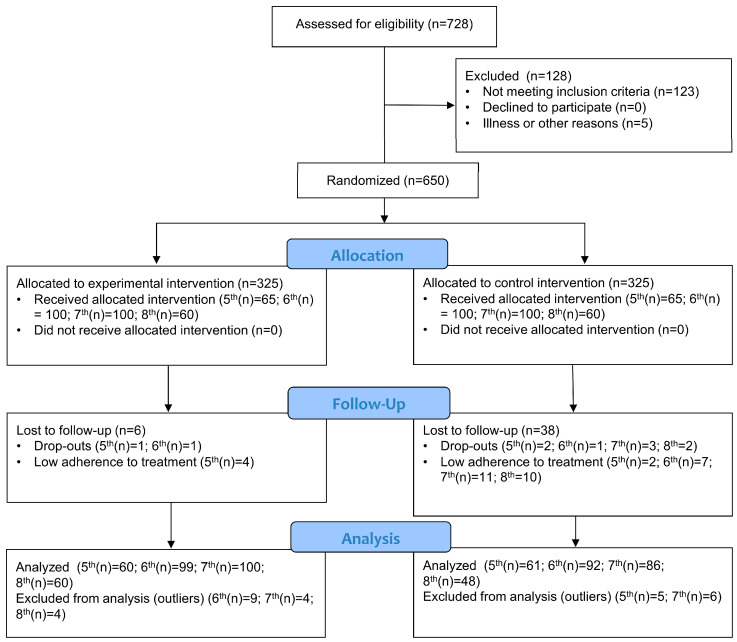
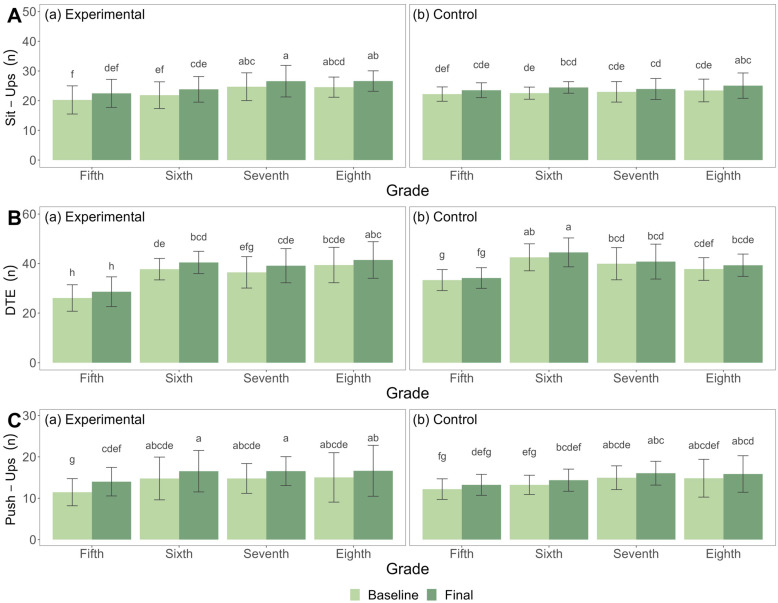
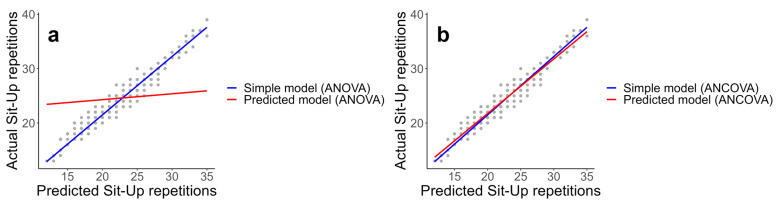
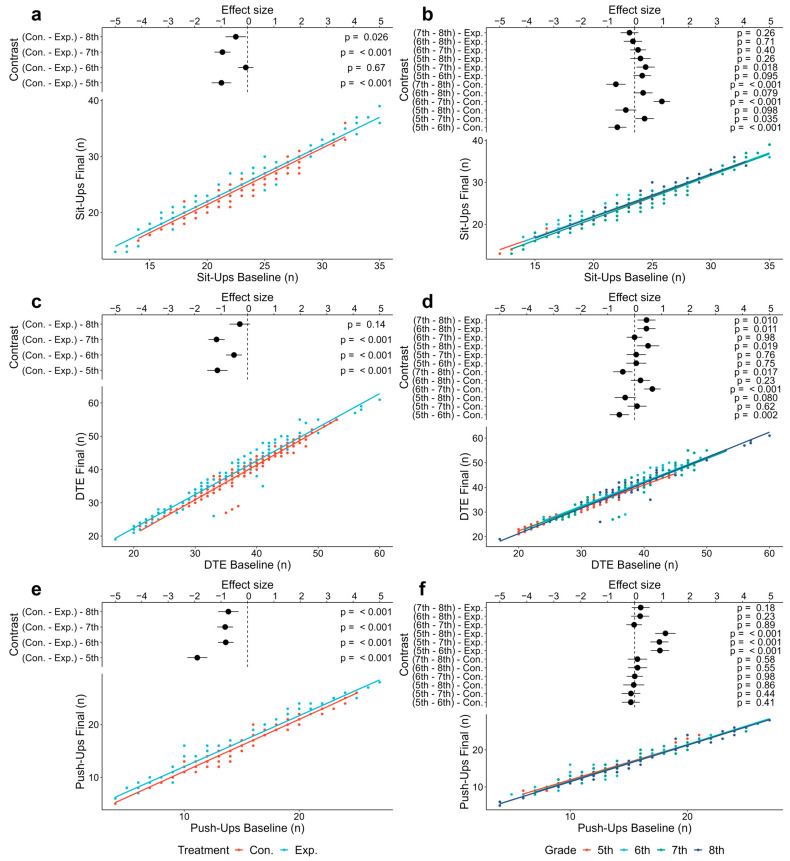
Background: This study aimed to explore the effectiveness of a 12-week circuit training program in improving local muscular endurance in normal-weighted primary school students. Methods: The study involved a parallel-group randomized trial with 606 primary school boys assigned to an experimental or a control group. The participants underwent a 12-week circuit training program that involved multi-joint, total-body workouts using body weight, resistance bands, and medicine ball exercises. The study measured the participants’ local muscular endurance during sit-ups, dynamic trunk extensions on a Roman bench (DTE), and push-ups. Results: After adjusting for the baseline, the treatment–grade interaction was significant for sit-ups (F = 7.74, p < 0.001, ηp2 = 0.04), DTE (F = 6.49, p < 0.001, ηp2 = 0.03), and push-ups (F = 9.22, p < 0.001, ηp2 = 0.05), where the experimental treatment was more beneficial than the control. The treatment effect seemed to vary depending on the individual’s baseline local muscle endurance capacity. As the baseline local muscular endurance values increased, the treatment and grade effects became less beneficial. Conclusion: A 12-week circuit training program involving body weight, resistance bands, and medicine ball exercises suits school-based programs and can improve local muscular endurance in normal-weighted primary school boys. The experimental treatment was more effective than the control, and the individual baseline muscular endurance should be considered when designing training programs.
Overview
The claims and statistics of this paper haven’t been checked yet.
Free: it reads the open-access text and checks the first 5 claims that cite a source we can check. Create a free account to check every claim.
Integrity signals
Registry
Cites
Statistics
Figures
Verification
Claims the paper makes
The claims and statistics of this paper haven’t been checked yet.
Free: it reads the open-access text and checks the first 5 claims that cite a source we can check. Create a free account to check every claim.
Claims other papers make about this one
Each is checked against this paper’s own text: does it say what the citing paper says it does?
The check wasn’t confident either way, so it gives no verdict — never disputed.
In the citing paper
“We found that it could be an interesting subject because somatosensory and proprioceptions neurons of the body are located in the dorsal root spinal ganglia [31,32,33,34].”
From Postural Differences in Speaking Versus Non-Speaking Children with Autism Spectrum Disorder (2025) · cites this paper as [31]
Experimental — accuracy not yet measuredThe check wasn’t confident either way, so it gives no verdict — never disputed.
In the citing paper
“The human body functions as a unified whole; therefore, changing one parameter in body posture affects other elements, impacting both the ability and quality of locomotion [31,33].”
From Postural Differences in Speaking Versus Non-Speaking Children with Autism Spectrum Disorder (2025) · cites this paper as [31]
Experimental — accuracy not yet measured
Self-check
Percentages, sums and reported differences re-computed from the paper’s own numbers.
The self-check needs the paper’s full text.
Citations
Cites
Statistical power analyses using G∗Power 3.1: tests for correlation and regression analyses
Faul, F., Erdfelder, E., Buchner, A., & Lang, A.-G. (2009) · Behavior Research Methods · doi:10.3758/brm.41.4.1149 · Cited by 37,615 · cited 1×
“We conducted an a priori power analysis using G*Power [25] for the three-way mixed model ANOVA with eight groups (treatment (two levels: experimental and control), and grade (four levels: fifth, sixth, seventh, and eighth)) and two measurements (baseline and final) as the input parameters.”
MethodProgressive Statistics for Studies in Sports Medicine and Exercise Science
HOPKINS, W. G., MARSHALL, S. W., BATTERHAM, A. M., & HANIN, J. (2009) · Medicine & Science in Sports & Exercise · doi:10.1249/mss.0b013e31818cb278 · Cited by 9,128
Development of a WHO growth reference for school-aged children and adolescents
de Onis, M. (2007) · Bulletin of the World Health Organization · doi:10.2471/blt.07.043497 · Cited by 8,826 · cited 2×
“[19], (3) they did not suffer from chronic diseases, nd (4) they were not involved in any organized form of physical activity for at least three months prior to the start of the trial.”
BackgroundDesigning Resistance Training Programs
Fleck, S. J., & Kraemer, W. J. (2014) · Human Kinetics eBooks · doi:10.5040/9781718225107 · Cited by 1,360
Faigenbaum, A. D., Kraemer, W. J., Blimkie, C. J. R., Jeffreys, I., Micheli, L. J., Nitka, M., & Rowland, T. W. (2009) · Journal of Strength and Conditioning Research · doi:10.1519/jsc.0b013e31819df407 · Cited by 1,209 · cited 6×
“Moreover, previous studies proved that relative strength improvements in prepubescents are equivalent to or larger than in adolescents, consistent with our results [9,13].”
BackgroundResultInfluentialKriemler, S., Meyer, U., Martin, E., van Sluijs, E. M. F., Andersen, L. B., & Martin, B. W. (2011) · British Journal of Sports Medicine · doi:10.1136/bjsports-2011-090186 · Cited by 827 · cited 1×
“Research suggests that school-based physical activity should be extended to at least 60 min per day [2,3], which exceeds the current standard of 3 45 min physical education classes in public schools in Serbia.”
BackgroundSmith, J. J., Eather, N., Morgan, P. J., Plotnikoff, R. C., Faigenbaum, A. D., & Lubans, D. R. (2014) · Sports Medicine · doi:10.1007/s40279-014-0196-4 · Cited by 795 · cited 5×
“Specifically, building muscular endurance can result in a more resilient musculoskeletal system, reducing sports-related injuries, and improving overall health-related fitness [5].”
BackgroundInfluentialHills, A. P., Dengel, D. R., & Lubans, D. R. (2015) · Progress in Cardiovascular Diseases · doi:10.1016/j.pcad.2014.09.010 · Cited by 705 · cited 1×
“Research suggests that school-based physical activity should be extended to at least 60 min per day [2,3], which exceeds the current standard of 3 45 min physical education classes in public schools in Serbia.”
BackgroundResistance training among young athletes: safety, efficacy and injury prevention effects
Faigenbaum, A. D., & Myer, G. D. (2010) · British Journal of Sports Medicine · doi:10.1136/bjsm.2009.068098 · Cited by 428 · cited 2×
“Contrariwise, it seems that the stresses exerted on the joints of young athletes during sports participation may be much larger and more challenging to predict than those produced by resistance training regimens [30].”
BackgroundBehm, D. G., Faigenbaum, A. D., Falk, B., & Klentrou, P. (2008) · Applied Physiology, Nutrition, and Metabolism · doi:10.1139/h08-020 · Cited by 372 · cited 1×
“Additionally, students without experience of strength training, performing 10 to 15 light resistance repetitions in each set, may experience local muscular endurance similar to higher training intensity [11,30,31].”
Background
Research works printed but not linked: 2
- Eston R.G. Reilly T. Kinanthropometry and Exercise Physiology Laboratory Manual Routledge London, UK 2001 Volume 1
- Kohl III H.W. Cook H.D. Educating the Student Body: Taking Physical Activity and Physical Education to School National Academies Press Washington, DC, USA 2013 24851299
Cited by
Stojanović, D., Momčilović, V., Zadražnik, M., Ilić, I., Koničanin, A., Padulo, J., Russo, L., & Stojanović, T. (2023) · Healthcare · doi:10.3390/healthcare11111600 · Cited by 37
Self-citationValle-Muñoz, V. M., Saucedo‐Araujo, R. G., Brand, C., Martins, C., Henrique, R. D. S., Gaya, A. R., López‐Gil, J. F., Faigenbaum, A. D., Barranco-Ruíz, Y., & Villa‐González, E. (2025) · Journal of Public Health · doi:10.1007/s10389-025-02533-x · Cited by 9
Fachrezzy, F., Maslikah, U., Hermawan, I., Jariono, G., Nugroho, H., & Syahruddin, S. (2024) · Physical Education Theory and Methodology · doi:10.17309/tmfv.2024.5.19 · Cited by 7
“According to Stojanović et al (Stojanović et al., 2023) the circuit training approach consists of a sequence of exercises where each post has a single type of action.”
MethodPostural Differences in Speaking Versus Non-Speaking Children with Autism Spectrum Disorder
Będziechowska-Czyżewska, M., Malak, R., Romanowski, M., Andrusiewicz, M., Samborski, W., & Baum, E. (2025) · Children · doi:10.3390/children12020145 · Cited by 4
“The time to maintain the position was measured in seconds [26–31].”
Longakit, J. C., Fajardo, R. A., Coming, L., Toring-Aque, L., Aque, F. J., Villaganas, E. J., Bagayas, J. C., Cuya, M., & Cordova, A. J. (2025) · Pedagogy of Physical Culture and Sports · doi:10.15561/26649837.2025.0403 · Cited by 4
“Moreover, the blend of aerobic and functional exercises in this study likely improved exercise variety and reduced monotony, which is known to support adherence [45].”
The Health and Physical Education Curriculum: Does It Address Muscular Fitness?
Sortwell, A., Ramírez‐Campillo, R., Granacher, U., Joyce, C., Forte, P. M., Marinho, D. A., Ferraz, R. M. P., & Trimble, K. (2026) · Journal of Functional Morphology and Kinesiology · doi:10.3390/jfmk11010040 · Cited by 4
“…group [92,93], Fundamental Integrative Training (FIT) [33], static strength training [upper body, lower body, core], and circuit training [93–95]); (ii) resistance-based training (4 activities: free-weight strength training [96], resistance training including weight machines, free weights,…”
Irvan, I., Hasmyati, H., Sufitriyono, S., Bachtiar, B., Tannoubi, A., Hasyim, H., Kozina, Z. L., Kurtoğlu, A., Govindasamy, K., & Setiawan, E. (2024) · Cultura Ciencia y Deporte · doi:10.12800/ccd.v19i62.2194 · Cited by 3
Ubilla-Mejias, M., Espoz-Lazo, S., Valdívia-Moral, P., Piñeiro-Cossio, J., Castillo-Paredes, A., Martín, P. D. V., Andrades-Ramírez, O., Baeza, A. P., & Farías‐Valenzuela, C. (2024) · SPORT TK-Revista EuroAmericana de Ciencias del Deporte · doi:10.6018/sportk.634631 · Cited by 2
Goss, J. M., Watkins, J. M., Kwaiser, M. M., Medellin, A. M., Golzarri‐Arroyo, L., Schigur, A. P., Hobson, J. M., Kercher, V. M. M., & Kercher, K. A. (2025) · Sports · doi:10.3390/sports13070200 · Cited by 1
“Other research has found that school-based strength interventions can increase resistance training-related repetitions [20] and ROM [21].”
Naas, S., Kolozsvári, D., Varga, L., Tassó, Z., Hammer, D., Palmer, E., Polivka, L., Kováts, Z., Müller, V., & Varga, J. T. (2025) · Physiology International · doi:10.1556/2060.2025.00713 · Cited by 1
Effects of Body Weight Training Program on Strength and Power of Primary School Students
Chen, L., Tongdecharoen, W., & Bangthamai, W. (2024) · International Journal of Sociologies and Anthropologies Science Reviews · doi:10.60027/ijsasr.2024.4724
Akbaş, E., & Özkan, T. D. (2025) · Gümüşhane Üniversitesi Sağlık Bilimleri Dergisi · doi:10.37989/gumussagbil.1607640 · Cited by 1
Feel the Movement: Adaptive Circuit Training for People with Visual Impairment
Echague, E. T., & Gomez, M. G. A. (2025) · IGI Global eBooks · doi:10.4018/979-8-3373-2160-8.ch011
Clavijo Carreño, V., Vidal Espinoza, R., Vidal Fernández, N., & Alvear-Vasquez, F. (2025) · Dialnet (Universidad de la Rioja)
Sabzi, A. H. (2025) · Physical Activity in Children · doi:10.61882/pach.2025.560762.1079
Butnariu, M., Tănăsescu, D. E., Rada, L., & Amzar, E. L. (2026) · Revista Romaneasca pentru Educatie Multidimensionala · doi:10.66388/rrem/18.1/20
Sundar, M., Amutha, V., Nithya, G., & Niraipandiyan, M. (2026) · Iconic Research and Engineering Journals · doi:10.64388/irev9i11-1718405
Juang, A., Anggraini, D., & Hendra, J. (2026) · Journal of Physical Activity and Sports (JPAS) · doi:10.53869/jpas.v7i2.472
“Another study of a 12-week circuit training program in elementary school students also showed that structured circuit training can provide benefits to components of physical fitness, particularly muscular endurance (Stojanovi´c et al., 2023) ; (Sukron & Firjatulloh, 2025).”
Sundari, S., Jumareng, H., Faozi, F., Nugroho, W. A., & Getu, S. (2026) · Edu Sportivo/Edu Sportivo · doi:10.25299/esijope.2026.vol7(2).25281
Nuraini, N., Kasmad, M. R., & Hudain, M. A. (2026) · ETDC Indonesian Journal of Research and Educational Review · doi:10.51574/ijrer.v6i1.4747
PENGARUH LATIHAN CIRCUIT TRAINING TERHADAP KEBUGARAN JASMANI SISWA SDN 2 CANDISARI LAMONGAN
Khomariyah, S. A. N., Lestari, B., Suyoko, A., & faruk, M. F. (2026) · Jurnal Prestasi Olahraga
APAKAH KEBUGARAN JASMANI SISWA SEKOLAH DASAR DAPAT DITINGKATKAN DENGAN LATIHAN SIRKUIT?
Jariono, G., Nurhidayat, N., Sudarmanto, E., Indarto, P., Yunita, P., & Nugroho, H. (2024) · Prosiding University Research Colloquium
Teimoori, A. (2026) · Physical Activity in Children · doi:10.66224/pach.2026.587108.1094
Trujillo, J. J. P., Valderrama, M. A. C., Suárez, D. P. M., González, E. P. R., & Arciniegas, O. L. C. (2026) · Retos · doi:10.47197/retos.v85.119907
Rahmadhanty, O. Y., Yudanto, Y., Asep Suherman, S. P., Munawar, S. A. R., & Nevitaningrum, N. (2026) · Sportis Scientific Journal of School Sport Physical Education and Psychomotricity · doi:10.55040/sha1m146
Metadata
- Authors
- Stojanović, N., Stupar, D., Marković, M., Trajković, N., Aleksić, D., Pašić, G., Koničanin, A., Zadražnik, M., & Stojanović, T.
- Affiliations
- University of Nis (RS)
- Educons University (RS)
- Univerzitet Union Nikola Tesla (RS)
- University of Priština - Kosovska Mitrovica (XK)
- University of Banja Luka (BA)
- State University of Novi Pazar (RS)
- University of Ljubljana (SI)
- Corresponding author
- Stupar, Dušan
- ORCID
- Venue
- Children
- Publisher
- MDPI AG
- Published
- 2023-04-14
- Volume
- 10
- Issue
- 4
- Pages
- 726
- ISSN
- 2227-9067 (ISSN-L)
- PMC
- PMC10136923
- OpenAlex
- W4365512136
- Cited by
- 14
- References
- 25
- Citations by year
- 2026: 3 · 2025: 8 · 2024: 2 · 2023: 1
- FWCI
- 8.64
- Type
- journal article
- Language
- en
- Open access
- gold
- doi.org
- Licence
- Locations
- Children (publishedVersion, cc-by)
- PubMed Central (publishedVersion, cc-by)
- PubMed (publishedVersion)
- REDUN - Repository of the EDUCONS University (submittedVersion, cc-by)
- DOAJ (DOAJ: Directory of Open Access Journals) (submittedVersion, cc-by-sa)
- Topics
- Health Sciences › Health Professions › Physical Therapy, Sports Therapy and Rehabilitation › Physical Education and Training Studies
- Health Sciences › Medicine › Orthopedics and Sports Medicine › Sports Performance and Training
- Health Sciences › Medicine › Public Health, Environmental and Occupational Health › Physical Activity and Health
- Keywords
- circuit training, elementary school students, school-based physical activity intervention, resistance bands, calisthenics, sit-ups, push-ups, boys, exercise program design
About these checks
Registry, retraction, Cites and statistics results are computed, not judged, with one exception: a printed reference that no index lists is read once by a model before it counts as a citation error. Claims are extracted by a model and kept only when their quote appears verbatim in the text; each cited source is then checked, with a model’s help, for whether it says what the claim relies on. Those verdicts can be wrong — read the claim’s quote and the cited source before relying on one.
Statistics and arithmetic are recomputed, not judged.
Confidence bands are shown only for fields calibrated on our annotated test set. None is calibrated yet, so no band is shown.
What counts as a claim ›How we measure confidence ›How we check this ›
Are you an author, or do you see a problem with this page? Request a review
Data sources
Bibliographic data: Semantic Scholar, OpenAlex, Crossref.
Contains information from the Semantic Scholar Academic Graph Datasets, made available under the ODC Attribution License (ODC-BY 1.0).
Semantic Scholar’s data is described in: Kinney, R., et al. (2023). The Semantic Scholar Open Data Platform. arXiv:2301.10140.
