

The Effects of Physical Activity on Academic Performance in School-Aged Children: A Systematic Review
Open accessThe DOI matches its Crossref record; 66 of the 69 references it cites were found in a registry or an index, and 1 are not checked yet; 35 of the 112 sources its claims cite were checked for support.
Abstract
Schools offer a unique environment to influence children's physical activity (PA) levels positively. This study aims to systematically review the evidence surrounding how PA affects academic performance by analysing how the frequency, intensity, time, and type of PA mediate academic performance outcomes. This review was conducted using the PRISMA framework. Keyword searches were conducted in Science Direct, PubMed, and SPORTDiscus. Children that were obese, typically developing, typical weight, disabled, with a developmental disability, from a low socio-economic background, or an ethnic minority were included. A total of 19 studies were included, with a total of 6788 participants, a mean age of 9.3 years (50.2% boys, and 49.8% girls). Overall, 63.2% were nondisabled, while 36.8% were diagnosed with a disability. Two authors met, reviewed papers with regard to the inclusion criteria, and agreed on outputs to be included. Evidence suggests that associations between PA and academic performance were primarily positive or nonsignificant. PA levels of 90 min plus per week were associated with improved academic performance, as was PA performed at moderate to vigorous intensity. The optimal duration of PA was 30-60 min per session, whilst various sports induced positive academic effects. Importantly, findings support that PA does not have a deleterious effect on academic performance but can enhance it.
Verified 2026-11-22 · 1 reference not checked yet
Overview
CoChat Summary
# TL;DR
This PRISMA-guided systematic review found that physical activity (PA) in school-aged children is generally associated with either improved or unchanged academic performance, not harm. Across 19 studies (6788 participants), the authors conclude that PA levels of at least 90 min per week, especially moderate-to-vigorous or high-intensity PA, were most often linked to better outcomes.
# Key findings
- The review included 19 studies with 6788 participants (mean age 9.3 years); 50.2% were boys and 49.8% girls, and 36.8% of participants were diagnosed with a disability.
- For academic performance outcomes (n = 9 studies), 2 reported positive significant effects, 2 reported insignificant effects, and 5 reported mixed conclusions; the paper states that PA does not diminish academic performance and potentially enhances it.
- For cognitive performance outcomes (n = 14 studies), 6 studies reported positive significant effects, 4 insignificant effects, and 4 mixed conclusions.
- The authors report that PA levels of 90 min+ per week were associated with improved academic performance, and that high-intensity PA showed positive effects in 100% of studies reporting that intensity, while moderate-to-vigorous PA showed positive effects in 57.1% of studies.
# Methods
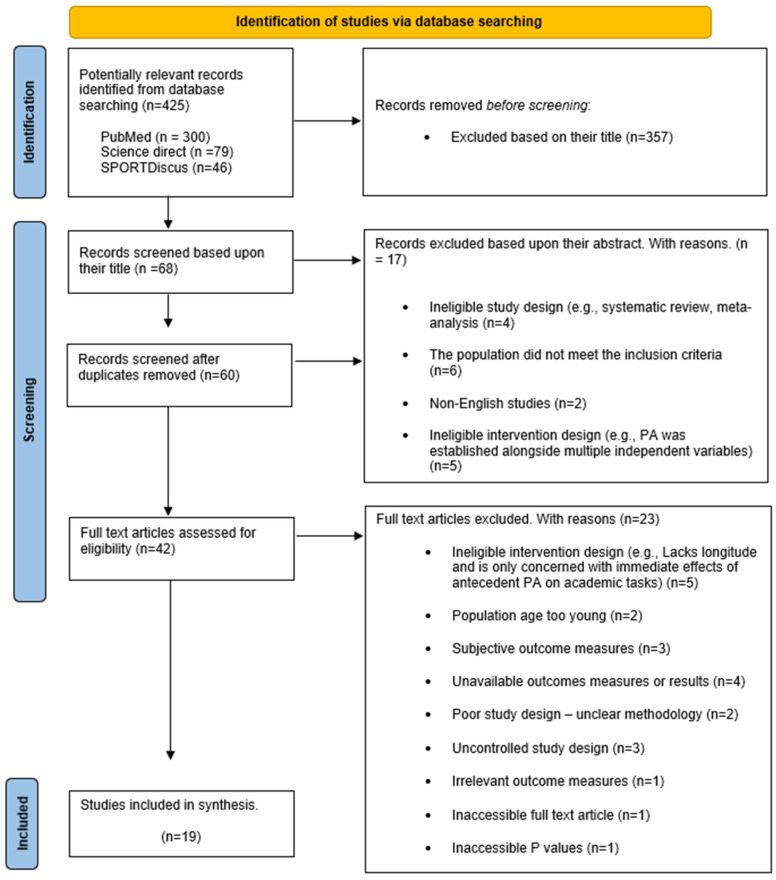
- The review followed PRISMA guidelines and searched Science Direct, PubMed, and SPORTDiscus for studies published 2012–2022 and indexed up to 9 March 2022.
- Inclusion criteria targeted English-language, peer-reviewed, longitudinal experimental studies in school-aged children 6–14 years that examined a PA intervention and academic-performance-related outcomes; studies without control groups, significance values, or with immediate antecedent-PA effects only were excluded.
- The authors extracted study characteristics and outcomes, then used a narrative analysis rather than meta-analysis because of heterogeneity in populations, interventions, and outcome measures.
# Limitations
- The paper states that effect sizes were ill-reported in the literature, limiting conclusions about the strength of associations.
- The included studies varied considerably in designs, outcome measures, and PA interventions, which limited objective comparisons; this is a limitation the paper explicitly states.
- The review also notes that many studies used subjective rather than objective PA measures, which the text says affects validity and reliability; this is a limitation evident from the text.
- The paper’s broad umbrella term “academic performance” grouped direct academic measures with related cognitive outcomes, which the authors acknowledge can obscure differences between direct and indirect effects; this is a limitation evident from the text.
Model-written summary. Check it against the paper before relying on it.
Integrity signals
Registry
Cites
Statistics
Figures
Verification
Claims the paper makes
28 Valid · 1 Not valid · 50 Not checked · 86 Own results and interpretations
Every source the paper cites for this claim was checked and supports it.
In the paper
“Likewise, a study conducted by García-Hermoso et al. [50] reported that increased moderate to vigorous PA has a significant (p < 0.001), positive effect on academic performance.”
§ The Effects of Physical Activity on Academic Performance in School-Aged Children: A Systematic Review > 3. Results > 3.3. Physical Activities Effect on Academic Performance
What the sources say
- Supportedcites [50] García-Hermoso A. Hormazábal-Aguayo I. Fernández-Vergara O. González-Calderón N. Russell-Guzmán J. Vicencio-Rojas F. Chacana-Cañas C. Ramírez-Vélez R. A before-school physical activity intervention to improve cognitive parameters in children: The Active-Start study Scand. J. Med. Sci. Sports 2020 30 108 116 10.1111/sms.13537 31410887 source
The Active-Start intervention section says children attended before-school sessions five times weekly for eight weeks and that the main part of each session was moderate-to-vigorous activity. The Results section reports improved language and mathematics performance compared with controls (p<0.001). The finding concerns this intervention in children, rather than a separately measured effect of changes in daily MVPA. (LLM, conf=0.88)
plainstates a cause- Asserted: passes — The authors put it forward as true.
- Checkable: passes — It can be checked against evidence.
- Load-bearing: unclear — It is unclear whether the paper’s conclusions depend on it.
- Based: passes — The paper gives a reason why it holds.
- Supported
The cited sources support only part of this claim — read each source’s verdict below.
In the paper
“A study conducted by Gall et al. [40] increased PA through a multifaceted PA intervention design, incorporating PE lessons, active breaks, and active academic lessons. The intervention had a significant (p = 0.032), positive effect on academic performance compared to children receiving PE lessons in isolation.”
§ The Effects of Physical Activity on Academic Performance in School-Aged Children: A Systematic Review > 3. Results > 3.3. Physical Activities Effect on Academic Performance
What the sources say
- Partly supportedcites [40] Gall S. Adams L. Joubert N. Ludyga S. Müller I. Nqweniso S. Pühse U. Randt R. Seelig H. Smith D. Effect of a 20-week physical activity intervention on selective attention and academic performance in children living in disadvantaged neighborhoods: A cluster randomized control trial PLoS ONE 2018 13 e0206908 10.1371/journal.pone.0206908 30408073 PMC6224098 sourceExperimental — accuracy not yet measured
Split into 2 atoms — 0 confirmed, 2 partially supported, 0 disputed, 0 misattributed, 0 unverifiable. Expand the claim to see per-atom verdicts.
plainstates a cause- Asserted: passes — The authors put it forward as true.
- Checkable: passes — It can be checked against evidence.
- Load-bearing: unclear — It is unclear whether the paper’s conclusions depend on it.
- Based: passes — The paper gives a reason why it holds.
- Partly supported
Every source the paper cites for this claim was checked and supports it.
In the paper
“Similarly, Resaland et al. [46] reported no significant (p > 0.358) intervention effect on overall academic performance”
§ The Effects of Physical Activity on Academic Performance in School-Aged Children: A Systematic Review > 3. Results > 3.3. Physical Activities Effect on Academic Performance
What the sources say
- Supportedcites [46] Resaland G.K. Aadland E. Moe V.F. Aadland K.N. Skrede T. Stavnsbo M. Suominen L. Steene-Johannessen J. Glosvik Ø. Andersen J.R. Effects of Physical Activity on School Children’s Academic Performance: The Active Smarter Kids (ASK) Cluster-Randomized Controlled Trial Prev. Med. 2016 91 322 328 10.1016/j.ypmed.2016.09.005 27612574 source
The Results section reports no significant intervention effect on any academic-performance measure in the intention-to-treat analyses, including the composite measure of overall performance. The per-protocol table lists p = 0.415 for the composite score, consistent with the cited p > 0.358 threshold; the Results passage does not give the exact intention-to-treat p-value. (LLM, conf=0.88)
plain- Asserted: passes — The authors put it forward as true.
- Checkable: passes — It can be checked against evidence.
- Load-bearing: unclear — It is unclear whether the paper’s conclusions depend on it.
- Based: passes — The paper gives a reason why it holds.
- Supported
Every source the paper cites for this claim was checked and supports it.
In the paper
“However, improvements were reported for both groups across all three academic performance indicators.”
§ The Effects of Physical Activity on Academic Performance in School-Aged Children: A Systematic Review > 3. Results > 3.3. Physical Activities Effect on Academic Performance
What the sources say
- Supportedcites [43] Donnelly J.E. Hillman C.H. Greene J.L. Hansen D.M. Gibson C.A. Sullivan D.K. Poggio J. Mayo M.S. Lambourne K. Szabo-Reed A.N. Physical activity and academic achievement across the curriculum: Results from a 3-year cluster-randomized trial Prev. Med. Int. J. Devoted Pract. Theory 2017 99 140 145 10.1016/j.ypmed.2017.02.006 PMC6148354 28193490 source
The Discussion reports that academic achievement improved across three years in reading, math, and spelling in children at both A+PAAC and control schools. The Results likewise report improvement from baseline to year 3, with no significant between-group difference in change. (LLM, conf=0.94)
plain- Asserted: passes — The authors put it forward as true.
- Checkable: passes — It can be checked against evidence.
- Load-bearing: unclear — It is unclear whether the paper’s conclusions depend on it.
- Based: passes — The paper gives a reason why it holds.
- Supported
Every source the paper cites for this claim was checked and supports it.
In the paper
“but a significant (p = 0.005) effect between subgroup and numeracy score.”
§ The Effects of Physical Activity on Academic Performance in School-Aged Children: A Systematic Review > 3. Results > 3.3. Physical Activities Effect on Academic Performance
What the sources say
- Supportedcites [46] Resaland G.K. Aadland E. Moe V.F. Aadland K.N. Skrede T. Stavnsbo M. Suominen L. Steene-Johannessen J. Glosvik Ø. Andersen J.R. Effects of Physical Activity on School Children’s Academic Performance: The Active Smarter Kids (ASK) Cluster-Randomized Controlled Trial Prev. Med. 2016 91 322 328 10.1016/j.ypmed.2016.09.005 27612574 source
Section 3 (Results) reports a significant intervention-by-subgroup interaction for numeracy, with p = 0.005. The subgroups were tertiles of baseline academic performance; this was not a significant overall intervention effect on numeracy. (LLM, conf=0.92)
plainstates an association- Asserted: passes — The authors put it forward as true.
- Checkable: passes — It can be checked against evidence.
- Load-bearing: unclear — It is unclear whether the paper’s conclusions depend on it.
- Based: passes — The paper gives a reason why it holds.
- Supported
78 more claims · 5 with their cited sources checked
Create a free account to see all 165 claims and to verify the 20 references still open.
- Probably not a substantial claim. 63
- It may state two separate claims as one. 49
Self-check
Percentages, sums and reported differences re-computed from the paper’s own numbers.
Each contradiction between two passages listed here was confirmed by an independent check.
Rated minor: it would not touch a result — a value no result rests on, a p-value that stays on the same side of the significance level, or a conflict that is clerical, resolved elsewhere in the paper, or outside its own findings.
In the paper
§ The Effects of Physical Activity on Academic Performance in School-Aged Children: A Systematic Review > 3. Results > 3.2. Measurements of Academic and Cognitive Performance
“Notably, nine studies measured domains of academic performance, while 14 studies measured indicators of cognitive performance.”
§ The Effects of Physical Activity on Academic Performance in School-Aged Children: A Systematic Review > 3. Results > 3.2. Measurements of Academic and Cognitive Performance
“Of the eight studies that analysed the effects on academic performance, four used grades in academic subjects [40,48,49,50]; meanwhile, three studies utilised standardised test results [43,49,55], one took measurements of the student’s mastery of the basic facts test [47], and one analysed mathematics and reading performance with the speed test arithmetic and the 1 min test [45].”
Citations
Cites
World Health Organization 2020 guidelines on physical activity and sedentary behaviour
Bull, F. C., Al-Ansari, S. S., Biddle, S., Borodulin, K., Buman, M. P., Cardon, G., Carty, C., Chaput, J.-P., Chastin, S., Chou, R., et al. (2020) · British Journal of Sports Medicine · doi:10.1136/bjsports-2020-102955 · Cited by 11,657 · cited 1×
“Therefore, on the basis of the findings in this study, the authors recommend that children receive at least 90 min of PA per week, but most desirably, their recommended levels of 60 min of PA per day, as this does not detract from academic performance and is associated with a vast amount of positive health effects [63…”
BackgroundDonnelly, J. E., Hillman, C. H., Castelli, D., Etnier, J. L., Lee, S., Tomporowski, P., Lambourne, K., & Szabo-Reed, A. N. (2016) · Medicine & Science in Sports & Exercise · doi:10.1249/mss.0000000000000901 · Cited by 1,864
Biddle, S. J. H., Ciaccioni, S., Thomas, G., & Vergeer, I. (2019) · Psychology of Sport and Exercise · doi:10.1016/j.psychsport.2018.08.011 · Cited by 1,454
Chaput, J.-P., Willumsen, J., Bull, F., Chou, R., Ekelund, U., Firth, J., Jago, R., Ortega, F. B., & Katzmarzyk, P. T. (2020) · International Journal of Behavioral Nutrition and Physical Activity · doi:10.1186/s12966-020-01037-z · Cited by 1,277
A systematic review of the evidence for Canada's Physical Activity Guidelines for Adults
Warburton, D. E., Charlesworth, S., Ivey, A., Nettlefold, L., & Bredin, S. S. (2010) · International Journal of Behavioral Nutrition and Physical Activity · doi:10.1186/1479-5868-7-39 · Cited by 902 · cited 4×
“[1] recognised that physical inactivity is a modifiable risk factor for a diverse range of diseases, which include cardiovascular diseases, bone and joint diseases, and chronic diseases such as cancer (colon and breast), obesity, and hypertension.”
BackgroundInfluentialPhysical Fitness and Academic Achievement in Third- and Fifth-Grade Students
Castelli, D. M., Hillman, C. H., Buck, S. M., & Erwin, H. E. (2007) · Journal of Sport and Exercise Psychology · doi:10.1123/jsep.29.2.239 · Cited by 865
de Greeff, J. W., Bosker, R. J., Oosterlaan, J., Visscher, C., & Hartman, E. (2018) · Journal of Science and Medicine in Sport · doi:10.1016/j.jsams.2017.09.595 · Cited by 841 · cited 1×
“[20] supported this positive effect of PA on executive functions (inhibition, working memory, cognitive flexibility, and planning) and academic performance, and stated that largest effects are seen with interventions that implement continuous regular PA over several weeks.”
BackgroundPhysical activity and all-cause mortality: what is the dose–response relation?
LEE, I.-M., & SKERRETT, P. J. (2001) · Medicine and Science in Sports and Exercise · doi:10.1097/00005768-200106001-00016 · Cited by 786 · cited 1×
“Conversely, numerous studies have documented the ill effects physical inactivity can have on one’s physiological health [1,3]; most notably, Warburton et al.”
BackgroundThe physical activity, fitness and health of children
Boreham, C., & Riddoch, C. (2001) · Journal of Sports Sciences · doi:10.1080/026404101317108426 · Cited by 718
Rasberry, C. N., Lee, S. M., Robin, L., Laris, B. A., Russell, L. A., Coyle, K. K., & Nihiser, A. J. (2011) · Preventive Medicine · doi:10.1016/j.ypmed.2011.01.027 · Cited by 709
Research works printed but not linked: 2
- Pal S. Yadav J. Kalra S. Sindhu B. Different Training Approaches in Karate-A Review HuSS Int. J. Res. Humanit. Soc. Sci. 2020 20 33 43
- Sharma M.M. Sharma M.C. Comparative Study on Agility Of Intercollegiate Players of Certain Combative Sports Indian J. Appl. Res. 2016 6 5 7
Cited by
Rodríguez‐Negro, J., Pasarín-Lavín, T., & Suárez-Manzano, S. (2024) · Thinking Skills and Creativity · doi:10.1016/j.tsc.2024.101644 · Cited by 21
Marrero-Rivera, J. P., Sobkowiak, O., Sgourakis, A., Bagnato, S. J., Kline, C. E., Gordon, B. D. H., & Ross, S. E. T. (2024) · Children · doi:10.3390/children11030363 · Cited by 20
Sleep, Physical Activity, and Executive Functions in Students: A Narrative Review
Belluardo, G., Meneo, D., Cerolini, S., Baglioni, C., & Bartolo, P. D. (2025) · Clocks & Sleep · doi:10.3390/clockssleep7030047 · Cited by 18
“In particular, sleep and PA are central modifiable factors with significant impacts on EFs, a set of higher-order cognitive abilities that allow individuals to control their behaviour consciously [13–16].”
Jensen, O. E., Nielsen, A. V., Gejl, A. K., Rohde, R. A., Højberg, L. M., Damsgaard, L., Malling, A. S. B., Stevnsborg, E., Bugge, A., Poulsen, M., et al. (2025) · Educational Research Review · doi:10.1016/j.edurev.2025.100668 · Cited by 7
Scott, J., Jay, T., & Spray, C. M. (2024) · Journal of Intelligence · doi:10.3390/jintelligence12020022 · Cited by 16
“This finding is supported by the current literature which has found improved academic achievement, specifically achievement in mathematics, in children and adolescents after engaging in PA (de Bruijn et al. 2020; James et al. 2023).”
BackgroundResultChild and adolescent patterns of commuting to school
Power, C., & Fitzpatrick, P. (2023) · Preventive Medicine Reports · doi:10.1016/j.pmedr.2023.102404 · Cited by 9
From activity to obesity: understanding gender and type of school divide among Saudi adolescents
Said, M. A., & Alibrahim, M. S. (2025) · Frontiers in Public Health · doi:10.3389/fpubh.2025.1552243 · Cited by 7
Malambo, C., Klepačová, A., Brodská, K., Clark, C. C. T., & Musálek, M. (2024) · Frontiers in Psychology · doi:10.3389/fpsyg.2024.1349884 · Cited by 10
“A more recent review on the same topic and similar age groups found that increased time allocated to physical activities was positively associated with academic performance (James et al., 2023).”
BackgroundDu, J., Dong, J., Shi, Y., Jiang, E., Mo, L., & Wan, B. (2025) · Frontiers in Psychology · doi:10.3389/fpsyg.2025.1710564 · Cited by 10
Oginni, J., Oluwayomi, A., Ajiborisade, E., Osuji, C., Okely, A. D., Chong, K. H., Cross, P. L., & Gao, Z. (2025) · Frontiers in Public Health · doi:10.3389/fpubh.2025.1506705 · Cited by 7
The positive impact of physical activity on academic performance among catalan adolescents
Roig-Hierro, E., Ríos-Sisó, X., Buscà, F., Guillem, M., & Batalla, A. (2025) · Cogent Education · doi:10.1080/2331186x.2025.2497139 · Cited by 4
Aniśko, B., Bernatowicz, K., & Wójcik, M. (2025) · Frontiers in Public Health · doi:10.3389/fpubh.2025.1578304 · Cited by 14
Vabø, K. B., Aadland, E., Haugland, E. S., Johannessen, K., Tjomsland, H. E., Glosvik, Ø., Ommundsen, Y., Tomporowski, P. D., Pesce, C., Howard, S. J., et al. (2025) · Journal of Sports Sciences · doi:10.1080/02640414.2025.2460886 · Cited by 4
“…beneficial effects of PA on cognitive function and learning abilities in children and adolescents (Haverkamp et al., 2020; Hillman et al., 2020; James et al., 2023; Norris et al., 2019), careful interpretation is needed due to selective inclusion of studies, large methodological variation and…”
Kosak, L.-A., Harandian, K., Bacon, S., Fitzpatrick, C., Correale, L., & Pagani, L. S. (2024) · Children · doi:10.3390/children11091140 · Cited by 4
“Different types of physical activity have different benefits [8].”
BackgroundThe Effect of Physical Activity Levels on Cognitive Performance: Research in Portuguese Adolescents
Rodrigues, A. J. A., Antunes, H. R. L., Sabino, B., Sousa, D., Correia, A. L., Alves, R. R., & Lopes, H. (2024) · Sports · doi:10.3390/sports12060146 · Cited by 7
The importance of physical education and sport in primary (Elementary) school
education, T. I. O. P. (2024) · International Journal of Physical Education Sports and Health · doi:10.22271/kheljournal.2024.v11.i3d.3348 · Cited by 3
Martín-Bozas, F., Escolano-Pérez, E., & Bestué-Laguna, M. (2025) · Contemporary Educational Psychology · doi:10.1016/j.cedpsych.2025.102364 · Cited by 3
The influence of sports activities on multidimensional student development
Enrique, W. D., Espinosa, K. P., Pangilinan, D. J. D., Fajardo-Lazaro, H., & Ponce-Perante, A. L. (2026) · International Journal of Research Studies in Education · doi:10.5861/ijrse.2025.25333 · Cited by 2
Xiong, L. (2025) · Frontiers in Public Health · doi:10.3389/fpubh.2025.1658179 · Cited by 12
Banakh, V., Iedynak, G., & Blavt, O. Z. (2025) · Journal of Learning Theory and Methodology · doi:10.17309/jltm.2025.6.1.04 · Cited by 2
“After all, additional physical activity can improve girls’ characteristics during the school year (James et al, 2023).”
Skrettingland-Haarr, K., & Dyrstad, S. M. (2025) · Norsk pedagogisk tidsskrift · doi:10.18261/npt.109.1.4 · Cited by 2
Yuvaraj, D., Debnath, D., Prem, K. G., Aravindh, M., Ramesh, A., & Alphi, G. S. (2024) · Physical Education Theory and Methodology · doi:10.17309/tmfv.2024.3.01 · Cited by 5
“In addition, physical activity has beneficial effects on mental health by combining reduced stress, symptoms of anxiety and depression, and enhanced mood and sleep (James et al., 2023; Jacinto et al., 2023; Bouzas et al., 2018).”
BackgroundExploring Physical Activity Awareness Among BMC Education Students, Kathmandu
Ghimire, L. D., & Lamichhane, S. (2024) · Baneshwor Campus Journal of Academia · doi:10.3126/bcja.v3i1.65459 · Cited by 3
“Thus, it becomes vital for colleges and universities to create conducive environment encouraging students to participate in physical activities along with academic pursuit (Fabunmi AA et al., 2019; James J et al., 2023; Pate RR et al., 2006 ; Sharma S et al., 2023; WHO 2022).”
BackgroundTeam Sports as Catalysts for Holistic Student Wellness: Insights from a General ReviewPreprint
Kang, X., Meng, Q., & Su, C.-H. (2024) · Preprints.org · doi:10.20944/preprints202405.0030.v1 · Cited by 2
Ayaz, C. Ö., & Tuğrul, B. (2026) · Yaşadıkça Eğitim · doi:10.33308/26674874.20264021044 · Cited by 1
Casey, E. M., Arledge, B., Naghash, F., Spivey, E., Norris, J. E., Zhang, H., Mahmoud‐Elhaj, D., Rajala, R., & Ethridge, L. E. (2026) · Journal of Experimental Child Psychology · doi:10.1016/j.jecp.2026.106542 · Cited by 1
Ryan, S. T., Okely, A. D., Stanley, R. M., Waqa, G., & Randle, M. (2026) · Child Care Health and Development · doi:10.1111/cch.70256 · Cited by 2
Exploring teachers’ experiences of secondary school physical education in England
Hemingway, K., Eastburn, S., & Azevedo, L. B. (2026) · Physical Education and Sport Pedagogy · doi:10.1080/17408989.2026.2635095 · Cited by 2
Beciete, E. A. J., & Guillena, J. G. (2025) · Psychology and Education A Multidisciplinary Journal · doi:10.70838/pemj.491002 · Cited by 2
Rebelo, M., Serrano, J., Honório, S., Santos, J., Marques, C., & Batista, M. (2025) · Children · doi:10.3390/children12121601 · Cited by 5
“Similarly, recent systematic reviews [16] and randomized controlled trials [36] have reported inconsistent or null effects of physical activity on academic achievement.”
Shirotriya, A. K., Tikoinavuso, F., McCarthy, L., & Winslade, M. (2025) · Curriculum Studies in Health and Physical Education · doi:10.1080/25742981.2025.2589175 · Cited by 2
Joy, E., Rocliffe, P., Woods, C. B., & O’Keeffe, B. T. (2025) · HRB Open Research · doi:10.12688/hrbopenres.14208.1
Banakh, V., Iedynak, G., Galamandjuk, L., et al. (2025) · Physical Education Theory and Methodology · doi:10.17309/tmfv.2025.2.08 · Cited by 1
“…nature determines the low efficiency of physical education in higher education institutions (hereinafter – university) despite its effectiveness and high potential in successfully solving a wide variety of tasks (Torres, Peneida, & Torres, 2022; Banah, & Iedynak, 2021; James et al., 2023).”
Ribeiro, T., Marques, A., & Wawrzyniak, S. (2024) · Education and human development · doi:10.5772/intechopen.1006509 · Cited by 2
Banakh, V., Iedynak, G., Galamandjuk, L., Blavt, O. Z., Гуска, М., Hrebik, O., Dmytruk, V., & Kovalchuk, V. (2024) · Physical Education Theory and Methodology · doi:10.17309/tmfv.2024.5.11 · Cited by 4
“…Characteristics with Different Somatotypes in the Absence of Compulsory Physical Activity at University 2021; López-Valenciano et al., 2021; James et al., 2023); analysis of curricula for bachelor’s and master’s degrees shows a tendency to further reduce the number of physical education…”
BackgroundQi, F., & Zhang, J. (2024) · Frontiers in Psychology · doi:10.3389/fpsyg.2024.1368241 · Cited by 2
Impact of Physical Activity on Academic Achievement of Secondary Level Students in Kathmandu
Chiluwal, S., Bohara, K., Shahi, S. J., Shrestha, M. L., & Thapa, S. B. (2024) · Interdisciplinary Research in Education · doi:10.3126/ire.v9i2.75029 · Cited by 1
D’Isanto, T., Domenico, F. D., Simões, V., Esposito, G., & Aliberti, S. (2026) · Children · doi:10.3390/children13091255
Engagement and Challenges in Physical Activity of Overweight Maritime Students
Sabillon, N. (2026) · Psychology and Education A Multidisciplinary Journal · doi:10.70838/pemj.620502
Saraiello, E., Latino, F., Amato, G., & Tafuri, M. G. (2026) · Physical Education Theory and Methodology · doi:10.17309/tmfv.2026.4.10
“The physiological responses elicited by exercise and the capacity to recover after physical exertion may provide an additional perspective through which this relationship can be investigated (James et al., 2023).”
Krogh‐Jensen, O., Damsgaard, L., Rohde, R. A., Nielsen, G., Fosnaes, O., Hauge, J., & Wienecke, J. (2026) · Educational Psychology Review · doi:10.1007/s10648-026-10175-y
“…of physical activity (Ferris et al., 2007; Hillman et al., 2019; Skriver et al., 2014), regular participation in physical activity (Geertsen et al., 2016; James et al., 2023), and maintaining high levels of physical activity (Donnelly et al., 2016; Hillman et al., 2014; Marques et al., 2018).”
Himalowa, S., Zulu, J., Haakonde, T., Lupenga, J., Kunda, R., Colgrove, Y., Frantz, J. M., Mweshi, M. M., & Banda, M. C. (2026) · medRxiv · doi:10.64898/2026.04.17.26351077
Effect of Exercise on Academic Functioning
Mehrotra, M., Agarwal, M. B., Agarwal, S., & Jain, H. (2026) · IGI Global eBooks · doi:10.4018/979-8-3373-6157-4.ch010
Comparative study of HRQoL and physical activity in children with and without cerebral palsy
Algabbani, M. F., Alamoudi, N. A., AlShubaily, R., Alonazi, A., & Alhusaini, A. A. (2026) · Pediatrics International · doi:10.1111/ped.70384
Zhong, H., Wang, D., & Qi, C. (2025) · Frontiers in Public Health · doi:10.3389/fpubh.2025.1713106 · Cited by 2
Ihsan, A., Fadlih, A. M., Hasyim, M. Q., & Amirzan, A. (2025) · Physical Education Theory and Methodology · doi:10.17309/tmfv.2025.4.31 · Cited by 3
Sports Injury and Sport Safety Practices among Undergraduate Sports Participants
Bibi, K., Kazmi, M., Chughtai, M. J. B., Faraz, A., & Alqhtani, R. S. (2025) · THE THERAPIST (Journal of Therapies & Rehabilitation Sciences) · doi:10.54393/tt.v6i2.277 · Cited by 1
Lubaton, J. L., & Losañes, S. P. (2025) · Psychology and Education A Multidisciplinary Journal · doi:10.70838/pemj.390210 · Cited by 1
Fallah, Z. (2025) · Physical Activity in Children · doi:10.61882/pach.2025.504948.1044
Integral Well-Being: The Impact of the Physical Education Teacher
Villanueva, S. M., Ródenas, L., Sánchez, R. M., Rodríguez, J. L. T., & Ramírez, R. (2025) · Education and human development · doi:10.5772/intechopen.1006384 · Cited by 3
S.C.I.C.E.V Feedback System: Advancing Psychomotor Development, Skills, and Technique in Volleyball
Pârvu, C., Szabo, D. A., Rosculet, R.-T., & Mocanu, G. D. (2025) · Journal of Information Technology Education Research · doi:10.28945/5487 · Cited by 3
Ganeswara, R., Ganeswara, R., Resmana, D., Gani, A., & Wattimena, F. Y. (2024) · Jurnal Sains Keolahragaan dan Kesehatan · doi:10.5614/jskk.2024.9.2.3 · Cited by 1
Heart rate during moderate exercise and cognitive function among adolescents: An experimental study
Janota, K., & Janota, B. (2024) · The International Journal of Psychiatry in Medicine · doi:10.1177/00912174241309712
“While numerous studies have explored the effects of physical activity on cognitive functions such as memory and attention, 1-4 these studies have typically focused on cognitive performance immediately after or long after exercise sessions, not during the activity itself.”
Improving Academic Standard of Low-Performing Adolescents: A Delphi Study
Pandey, M., Keshav, R., & Behera, N. (2024) · MIER Journal of Educational Studies Trends & Practices · doi:10.52634/mier/2024/v14/i2/2699 · Cited by 2
“Spending 60 to 90 minutes on moderate to vigorous exercise is linked to favourable academic outcomes during self-directed learning (James et al., 2023; WHO, 2021).”
Morawietz, C., Wissmann, A. M., Kuehne, T., & Muehlbauer, T. (2024) · Frontiers in Sports and Active Living · doi:10.3389/fspor.2024.1411127 · Cited by 2
Frayon, S., Swami, V., Wattelez, G., Nedjar-Guerre, A., & Galy, O. (2024) · PLoS ONE · doi:10.1371/journal.pone.0309782 · Cited by 3
The Impact of School Sport Club on Students Violent InclinationsPreprint
Cho, O. (2024) · Research Square · doi:10.21203/rs.3.rs-4672432/v1
Agoes, I. F. (2024) · Jurnal Sehat Indonesia (JUSINDO) · doi:10.59141/jsi.v6i02.142
Parvadia, S. R. (2024) · Quest-The Journal of UGC-HRDC Nainital · doi:10.5958/2249-0035.2024.00007.3
Metadata
- Authors
- James, J., Pringle, A., Mourton, S., & Roscoe, C. M. P.
- Affiliations
- University of Derby (GB)
- Corresponding author
- James, Joseph
- Roscoe, Clare M. P.
- Venue
- Children
- Publisher
- MDPI AG
- Published
- 2023-06-05
- Volume
- 10
- Issue
- 6
- Pages
- 1019
- ISSN
- 2227-9067 (ISSN-L)
- PMC
- PMC10297707
- OpenAlex
- W4379517794
- Cited by
- 60
- References
- 69
- Citations by year
- 2026: 15 · 2025: 24 · 2024: 20 · 2023: 1
- FWCI
- 2.14
- Type
- journal article
- Language
- en
- Open access
- gold
- doi.org
- Licence
- Locations
- Children (publishedVersion, cc-by)
- PubMed Central (publishedVersion, cc-by)
- PubMed (publishedVersion)
- DOAJ (DOAJ: Directory of Open Access Journals) (submittedVersion, cc-by-sa)
- Topics
- Health Sciences › Medicine › Public Health, Environmental and Occupational Health › Physical Activity and Health
- Social Sciences › Psychology › Developmental and Educational Psychology › Children's Physical and Motor Development
- Health Sciences › Medicine › Public Health, Environmental and Occupational Health › Obesity, Physical Activity, Diet
- Keywords
- physical activity, academic performance, school-aged children, moderate-to-vigorous intensity exercise, exercise duration, sports participation, children with disabilities, developmental disabilities, socioeconomic status, ethnic minority children, childhood obesity
About these checks
Registry, retraction, Cites and statistics results are computed, not judged, with one exception: a printed reference that no index lists is read once by a model before it counts as a citation error. Claims are extracted by a model and kept only when their quote appears verbatim in the text; each cited source is then checked, with a model’s help, for whether it says what the claim relies on. Those verdicts can be wrong — read the claim’s quote and the cited source before relying on one.
The claim verdicts this report counts are experimental: their accuracy is not yet measured.
A language model drew the claims from the paper on 2026-10-10, under version 3 of the claim definition (model deepseek-v4.1-flash, prompt extract-v3).
A second model labelled each claim on 2026-10-10 (model jev-1.13-20260917, definition revision gold-guideline-v0.2).
Cited sources are checked with a language model’s help (gpt-6-sol).
Statistics and arithmetic are recomputed, not judged.
Confidence bands are shown only for fields calibrated on our annotated test set. None is calibrated yet, so no band is shown.
What counts as a claim ›How we measure confidence ›How we check this ›
Are you an author, or do you see a problem with this page? Request a review
Data sources
Bibliographic data: Semantic Scholar, OpenAlex, Crossref.
Contains information from the Semantic Scholar Academic Graph Datasets, made available under the ODC Attribution License (ODC-BY 1.0).
Semantic Scholar’s data is described in: Kinney, R., et al. (2023). The Semantic Scholar Open Data Platform. arXiv:2301.10140.
