

Deepfake Attacks: Generation, Detection, Datasets, Challenges, and Research Directions
Open accessThe DOI matches its Crossref record; 125 of the 126 references it cites were found in a registry or an index, and 1 are not checked yet; 3 of the 86 sources its claims cite were checked for support.
Abstract
Recent years have seen a substantial increase in interest in deepfakes, a fast-developing field at the nexus of artificial intelligence and multimedia. These artificial media creations, made possible by deep learning algorithms, allow for the manipulation and creation of digital content that is extremely realistic and challenging to identify from authentic content. Deepfakes can be used for entertainment, education, and research; however, they pose a range of significant problems across various domains, such as misinformation, political manipulation, propaganda, reputational damage, and fraud. This survey paper provides a general understanding of deepfakes and their creation; it also presents an overview of state-of-the-art detection techniques, existing datasets curated for deepfake research, as well as associated challenges and future research trends. By synthesizing existing knowledge and research, this survey aims to facilitate further advancements in deepfake detection and mitigation strategies, ultimately fostering a safer and more trustworthy digital environment.
Verified 2026-11-19 · 1 reference not checked yet
Overview
CoChat Summary
TL;DR
This survey reviews deepfake generation techniques, detection clues and deep learning architectures, datasets, and open challenges. It synthesizes state-of-the-art methods and reports benchmark performance and dataset characteristics, while noting real-time detection, generalization, interpretability, privacy, dataset quality, and adversarial perturbations as key unresolved issues.
Key findings
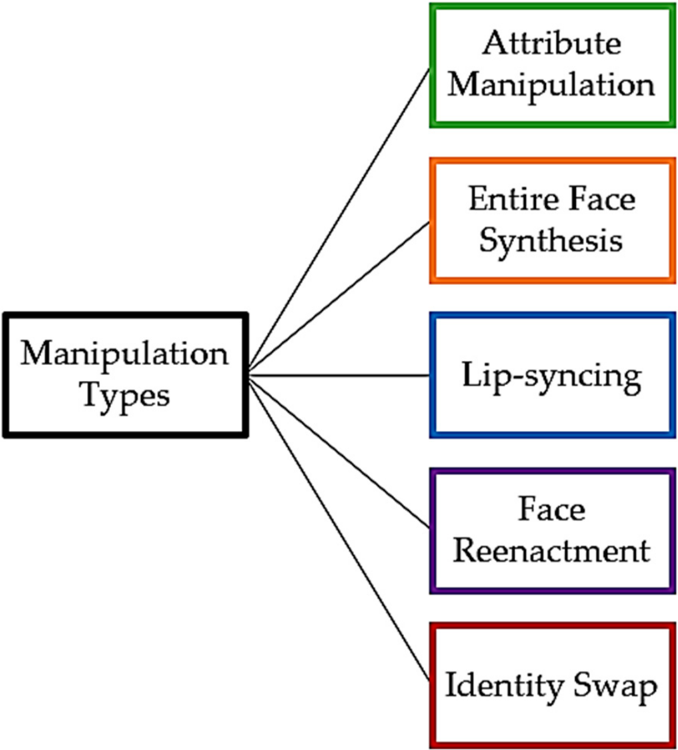
- The paper identifies five primary deepfake manipulation types: face synthesis, attribute manipulation, identity swap/face swapping, face reenactment, and lip-syncing.
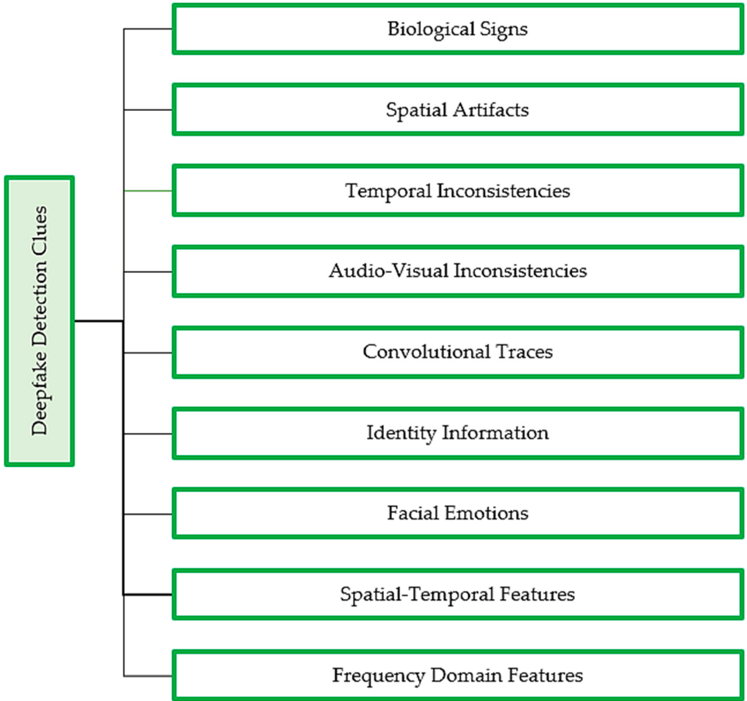
- Detection approaches are organized by clues: spatial artifacts, biological/physiological signs, audio-visual inconsistencies, convolutional traces, identity information, facial emotions, temporal inconsistencies, and spatial-temporal features.
- Reported detection performance examples include Zhao et al. with ACC = 99.8 on Celeb-DF and ACC = 92.1 on DFDC; Wang, J. et al. with ACC = 97.93 and AUC = 99.51 on FF++(HQ) and AUC = 99.80 on Celeb-DF; and Chen et al. with Celeb-DF AUC = 99.80 and FF++ AUC = 99.39.
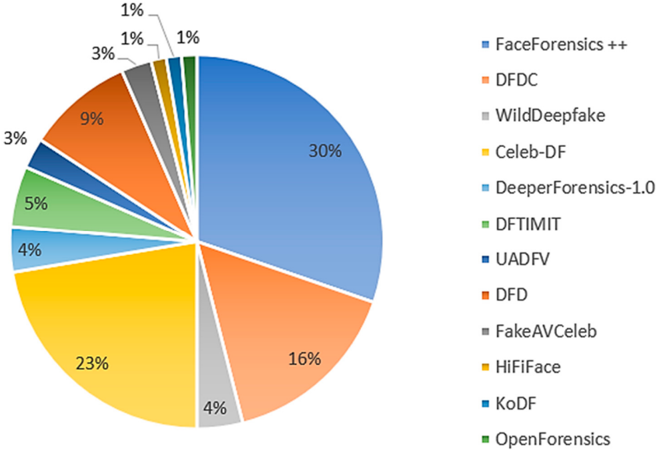
- Dataset examples include DFDC with over 100,000 total clips from 3426 paid actors, Celeb-DF with 590 real and 5639 fake videos, KoDF with 62,166 authentic and 175,776 fake videos, and ForgeryNet with 2.9 million images, 221,247 videos, and 15 manipulation methods.
Methods
- Design: narrative literature survey/review; the paper states that no new data were created or analyzed.
- Scope: covers deepfake manipulation types, generation techniques such as GANs and autoencoders, detection clues and deep learning models, existing datasets, and challenges/future research directions.
- Analysis: synthesizes existing knowledge and tabulates recent detection models with features, techniques, datasets, and intra-dataset performance (Table 2), plus key characteristics of prominent deepfake datasets (Table 3).
Limitations
- The paper states field-level challenges: real-time detection, generalization and robustness under compression/noise, lack of interpretability, privacy concerns, dataset quality and visual differences from online deepfakes, and adversarial perturbations.
- Text makes evident: as a survey, it provides no new experiments or empirical validation; reported performance numbers are compiled from cited works and not independently reproduced.
- No explicit limitations of the survey itself are stated in the paper.
Model-written summary. Check it against the paper before relying on it.
Integrity signals
Registry
Cites
Statistics
Figures

Verification
Claims the paper makes
3 Valid · 0 Not valid · 68 Not checked · 25 Own results and interpretations
Every source the paper cites for this claim was checked and supports it.
In the paper
“DeeperForensics-1.0 [126] is a significant dataset available for detecting deepfakes that contains 50,000 original clips and 10,000 forged ones.”
§ Review Deepfake Attacks: Generation, Detection, Datasets, Challenges, and Research Directions > 5. Datasets
What the sources say
- Supportedcites [126] Jiang, L., Li, R., Wu, W., Qian, C., and Loy, C.C. (2020, January 13–19). DeeperForensics-1.0: A Large-Scale Dataset for Real-World Face Forgery Detection. Proceedings of the IEEE/CVF Conference on Computer Vision and Pattern Recognition, Seattle, WA, USA. source
Section 3 (p. 3) of our copy states DeeperForensics-1.0 'consists of 60,000 videos with 17.6 million frames in total, including 50,000 original collected videos and 10,000 manipulated videos', which matches the claimed split exactly. The Abstract (p. 1) corroborates the 60,000-video total, and the Introduction (p. 1) repeats the dataset composition. (LLM, conf=0.95)
plain- Asserted: passes — The authors put it forward as true.
- Checkable: passes — It can be checked against evidence.
- Load-bearing: unclear — It is unclear whether the paper’s conclusions depend on it.
- Based: passes — The paper gives a reason why it holds.
- Supported
None of the sources cited for this claim have been checked yet.
In the paper
“There exist five primary types of deepfake manipulation, as shown in Figure 1.”
§ Review Deepfake Attacks: Generation, Detection, Datasets, Challenges, and Research Directions > 3.1. Deepfake Manipulation Types
What the sources say
- Not checked yetcites [32] Shi, Y., Liu, X., Wei, Y., Wu, Z., and Zuo, W. (2022, January 18–24). Retrieval-Based Spatially Adaptive Normalization for Semantic Image Synthesis. Proceedings of the 2022 IEEE/CVF Conference on Computer Vision and Pattern Recognition (CVPR), New Orleans, LA, USA. source
- Not checked yetcites [33] Liu, M., Ding, Y., Xia, M., Liu, X., Ding, E., Zuo, W., and Wen, S. (2019, January 15–20). STGAN: A Unified Selective Transfer Network for Arbitrary Image Attribute Editing. Proceedings of the 2019 IEEE/CVF Conference on Computer Vision and Pattern Recognition (CVPR), Long Beach, CA, USA. source
- Not checked yetcites [34] Li, L., Bao, J., Yang, H., Chen, D., and Wen, F. (2020). FaceShifter: Towards High Fidelity And Occlusion Aware Face Swapping. arXiv.
- Not checked yetcites [35] (2023, July 18). Robust and Real-Time Face Swapping Based on Face Segmentation and CANDIDE-3. Available online: https://www.springerprofessional.de/robust-and-real-time-face-swapping-based-on-face-segmentation-an/15986368.
plain- Asserted: passes — The authors put it forward as true.
- Checkable: passes — It can be checked against evidence.
- Load-bearing: unclear — It is unclear whether the paper’s conclusions depend on it.
- Based: passes — The paper gives a reason why it holds.
None of the sources cited for this claim have been checked yet.
In the paper
“Deepfakes can be used for entertainment, education, and research; however, they pose a range of significant problems across various domains, such as misinformation, political manipulation, propaganda, reputational damage, and fraud.”
§ Review Deepfake Attacks: Generation, Detection, Datasets, Challenges, and Research Directions > Abstract
What the sources say
- Not checked yetcites [1] Hancock, 2021, The Social Impact of Deepfakes, Cyberpsychol. Behav. Soc. Netw. source
- Not checked yetcites [2] Giansiracusa, N. (2021). How Algorithms Create and Prevent Fake News: Exploring the Impacts of Social Media, Deepfakes, GPT-3, and More, Apress. source
- Not checked yetcites [3] Fallis, 2021, The Epistemic Threat of Deepfakes, Philos. Technol. source
- Not checked yetcites [4] Karnouskos, 2020, Artificial Intelligence in Digital Media: The Era of Deepfakes, IEEE Trans. Technol. Soc. source
plainstates a cause- Asserted: passes — The authors put it forward as true.
- Checkable: passes — It can be checked against evidence.
- Load-bearing: passes — The paper’s conclusions depend on it.
- Based: passes — The paper gives a reason why it holds.
In the paper
“Moreover, there is RSGAN [46], which can encode the appearances of faces and hair into underlying latent space representations, enabling the image appearances to be modified by manipulating the representations in the latent spaces.”
§ Review Deepfake Attacks: Generation, Detection, Datasets, Challenges, and Research Directions > 3.2. Deepfake Generation Techniques
What the sources say
- Not checked yetcites [46] Natsume, R., Yatagawa, T., and Morishima, S. (2018, January 12). RSGAN: Face Swapping and Editing Using Face and Hair Representation in Latent Spaces. Proceedings of the ACM SIGGRAPH 2018 Posters, Vancouver, BC, Canada. source
plainstates a cause- Asserted: passes — The authors put it forward as true.
- Checkable: passes — It can be checked against evidence.
- Load-bearing: unclear — It is unclear whether the paper’s conclusions depend on it.
- Based: passes — The paper gives a reason why it holds.
A conclusion the paper draws from its own results — it cites no other source for it, so there is none to check. The quote shows it is in the paper.
In the paper
“By directing the model's focus toward relevant features and regions of the input data, attention mechanisms enhance the model's discriminative power and improve its overall accuracy.”
§ Review Deepfake Attacks: Generation, Detection, Datasets, Challenges, and Research Directions > 4.2. Deep Learning Models for Deepfake Detection
plainstates a cause- Asserted: passes — The authors put it forward as true.
- Checkable: passes — It can be checked against evidence.
- Load-bearing: unclear — It is unclear whether the paper’s conclusions depend on it.
- Based: passes — The paper gives a reason why it holds.
16 more claims
Create a free account to see all 96 claims and to verify the 83 references still open.
- Probably not a substantial claim. 66
- It may state two separate claims as one. 29
- The quote only partly states this claim. 1
Claims other papers make about this one
Each is checked against this paper’s own text: does it say what the citing paper says it does?
The source backs part of the claim, not all of it — or backs it for a different population, condition or comparison.
In the citing paper
“These refinements ensure superior detection performance in resource-constrained environments, making EfficientNetB4-Lite an ideal solution for deployment on edge devices without compromising performance [27].”
From FL-TENB4: A Federated-Learning-Enhanced Tiny EfficientNetB4-Lite Approach for Deepfake Detection in CCTV Environments (2025) · cites this paper as [27]
Experimental — accuracy not yet measuredThe source backs part of the claim, not all of it — or backs it for a different population, condition or comparison.
In the citing paper
“Conventional deep learning models often prioritize accuracy at the expense of computational feasibility, making them unsuitable for resource-limited edge devices.”
From FL-TENB4: A Federated-Learning-Enhanced Tiny EfficientNetB4-Lite Approach for Deepfake Detection in CCTV Environments (2025) · cites this paper as [27]
Experimental — accuracy not yet measuredThe cited source says what the claim attributes to it.
In the citing paper
“Deepfake generation involves the use of advanced generative models to imitate genuine content. This poses difficulties for standard methods that may have trouble adjusting to the complex patterns present in synthetic media (Naitali etal. 2023).”
From Deepfake video detection: challenges and opportunities (2024) · cites this paper as Naitali et al. 2023
Self-check
Percentages, sums and reported differences re-computed from the paper’s own numbers.
Each contradiction between two passages listed here was confirmed by an independent check.
Rated minor: it would not touch a result — a value no result rests on, a p-value that stays on the same side of the significance level, or a conflict that is clerical, resolved elsewhere in the paper, or outside its own findings.
In the paper
§ Review Deepfake Attacks: Generation, Detection, Datasets, Challenges, and Research Directions > 5. Datasets
“DeeperForensics-1.0 [126] is a significant dataset available for detecting deepfakes that contains 50,000 original clips and 10,000 forged ones.”
§ Review Deepfake Attacks: Generation, Detection, Datasets, Challenges, and Research Directions > 7. Conclusions
“| DeeperForensics-1.0 [126] | 2020 | 48,475 | 11,000 | DF-VAE [126] | Visual |”
Rated minor: it would not touch a result — a value no result rests on, a p-value that stays on the same side of the significance level, or a conflict that is clerical, resolved elsewhere in the paper, or outside its own findings.
In the paper
§ Review Deepfake Attacks: Generation, Detection, Datasets, Challenges, and Research Directions > 5. Datasets
“It includes 3000 edited videos in addition to 1000 original videos that were pulled from the YouTube-8M dataset.”
§ Review Deepfake Attacks: Generation, Detection, Datasets, Challenges, and Research Directions > 7. Conclusions
“| FaceForensics ++ [118] | 2019 | 1000 | 4000 | DeepFakes [119], Face2Face2 [37], FaceSwap [120], NeuralTextures [121], FaceShifter [34] | Visual |”
Citations
Cites
Deep Residual Learning for Image Recognition
He, K., Zhang, X., Ren, S., & Sun, J. (2016) · 2016 IEEE Conference on Computer Vision and Pattern Recognition (CVPR) · doi:10.1109/cvpr.2016.90 · Cited by 235,474
Very Deep Convolutional Networks for Large-Scale Image Recognition
Simonyan, K., & Zisserman, A. (2014) · arXiv · doi:10.48550/arxiv.1409.1556 · Cited by 114,148
Going deeper with convolutions
Szegedy, C., Liu, W., Jia, Y., Sermanet, P., Reed, S., Anguelov, D., Erhan, D., Vanhoucke, V., & Rabinovich, A. (2015) · 2015 IEEE Conference on Computer Vision and Pattern Recognition (CVPR) · doi:10.1109/cvpr.2015.7298594 · Cited by 48,562
An Image is Worth 16x16 Words: Transformers for Image Recognition at Scale
Dosovitskiy, A., Beyer, L., Kolesnikov, A., Weissenborn, D., Zhai, X., Unterthiner, T., Dehghani, M., Minderer, M., Heigold, G., Gelly, S., et al. (2020) · arXiv · doi:10.48550/arxiv.2010.11929 · Cited by 47,472
Swin Transformer: Hierarchical Vision Transformer using Shifted Windows
Liu, Z., Lin, Y., Cao, Y., Hu, H., Wei, Y., Zhang, Z., Lin, S., & Guo, B. (2021) · 2021 IEEE/CVF International Conference on Computer Vision (ICCV) · doi:10.1109/iccv48922.2021.00986 · Cited by 35,534
Unpaired image-to-image translation using cycle-consistent adversarial networks
Zhu, J.-Y., Park, T., Isola, P., & Efros, A. A. (2017) · 2017 IEEE International Conference on Computer Vision (ICCV) · doi:10.1109/iccv.2017.244 · Cited by 23,602
Xception: Deep Learning with Depthwise Separable Convolutions
Chollet, F. (2017) · 2017 IEEE Conference on Computer Vision and Pattern Recognition (CVPR) · doi:10.1109/cvpr.2017.195 · Cited by 20,380
Photo-Realistic Single Image Super-Resolution Using a Generative Adversarial Network
Ledig, C., Theis, L., Huszar, F., Caballero, J., Cunningham, A., Acosta, A., Aitken, A., Tejani, A., Totz, J., Wang, Z., et al. (2017) · 2017 IEEE Conference on Computer Vision and Pattern Recognition (CVPR) · doi:10.1109/cvpr.2017.19 · Cited by 12,696
A Style-Based Generator Architecture for Generative Adversarial Networks
Karras, T., Laine, S., & Aila, T. (2019) · 2019 IEEE/CVF Conference on Computer Vision and Pattern Recognition (CVPR) · doi:10.1109/cvpr.2019.00453 · Cited by 11,714
Analyzing and Improving the Image Quality of StyleGAN
Karras, T., Laine, S., Aittala, M., Hellsten, J., Lehtinen, J., & Aila, T. (2020) · 2020 IEEE/CVF Conference on Computer Vision and Pattern Recognition (CVPR) · doi:10.1109/cvpr42600.2020.00813 · Cited by 6,332
Analyzing and Improving the Image Quality of StyleGAN
Karras, T., Laine, S., Aittala, M., Hellsten, J., Lehtinen, J., & Aila, T. (2019) · arXiv · doi:10.48550/arxiv.1912.04958 · Cited by 6,332
Dynamic Routing Between Capsules
Sabour, S., Frosst, N., & Hinton, G. E. (2017) · arXiv · doi:10.48550/arxiv.1710.09829 · Cited by 4,167
StarGAN: Unified Generative Adversarial Networks for Multi-domain Image-to-Image Translation
Choi, Y., Choi, M., Kim, M., Ha, J.-W., Kim, S., & Choo, J. (2018) · 2018 IEEE/CVF Conference on Computer Vision and Pattern Recognition · doi:10.1109/cvpr.2018.00916 · Cited by 4,163
FaceForensics++: Learning to Detect Manipulated Facial Images
Rossler, A., Cozzolino, D., Verdoliva, L., Riess, C., Thies, J., & Niessner, M. (2019) · 2019 IEEE/CVF International Conference on Computer Vision (ICCV) · doi:10.1109/iccv.2019.00009 · Cited by 3,314
Unpaired Image-to-Image Translation using Cycle-Consistent Adversarial NetworksPreprint
Zhu, J.-Y., Park, T., Isola, P., et al. (2017) · arXiv (Cornell University) · doi:10.48550/arxiv.1703.10593 · Cited by 2,278
Celeb-DF: A Large-Scale Challenging Dataset for DeepFake Forensics
Li, Y., Yang, X., Sun, P., Qi, H., & Lyu, S. (2020) · 2020 IEEE/CVF Conference on Computer Vision and Pattern Recognition (CVPR) · doi:10.1109/cvpr42600.2020.00327 · Cited by 1,846
Face2Face: Real-Time Face Capture and Reenactment of RGB Videos
Thies, J., Zollhofer, M., Stamminger, M., Theobalt, C., & Niessner, M. (2016) · 2016 IEEE Conference on Computer Vision and Pattern Recognition (CVPR) · doi:10.1109/cvpr.2016.262 · Cited by 1,747
StarGAN v2: Diverse Image Synthesis for Multiple Domains
Choi, Y., Uh, Y., Yoo, J., & Ha, J.-W. (2020) · 2020 IEEE/CVF Conference on Computer Vision and Pattern Recognition (CVPR) · doi:10.1109/cvpr42600.2020.00821 · Cited by 1,663
Exposing Deep Fakes Using Inconsistent Head Poses
Yang, X., Li, Y., & Lyu, S. (2019) · ICASSP 2019 - 2019 IEEE International Conference on Acoustics, Speech and Signal Processing (ICASSP) · doi:10.1109/icassp.2019.8683164 · Cited by 1,196
In Ictu Oculi: Exposing AI Created Fake Videos by Detecting Eye Blinking
Li, Y., Chang, M.-C., & Lyu, S. (2018) · 2018 IEEE International Workshop on Information Forensics and Security (WIFS) · doi:10.1109/wifs.2018.8630787 · Cited by 1,089
Media Forensics and DeepFakes: An Overview
Verdoliva, L. (2020) · IEEE Journal of Selected Topics in Signal Processing · doi:10.1109/jstsp.2020.3002101 · Cited by 979
A Lip Sync Expert Is All You Need for Speech to Lip Generation In the Wild
Prajwal, K. R., Mukhopadhyay, R., Namboodiri, V. P., & Jawahar, C. V. (2020) · Proceedings of the 28th ACM International Conference on Multimedia · doi:10.1145/3394171.3413532 · Cited by 897
The Creation and Detection of Deepfakes: A Survey
Mirsky, Y., & Lee, W. (2022) · ACM Computing Surveys · doi:10.1145/3425780 · Cited by 863 · cited 1×
“The authors of [13] offered in their survey a technical background on the architecture used in deepfake creation that deals with two manipulation types: reenactment and replacement.”
BackgroundThe Creation and Detection of Deepfakes: A Survey
Mirsky, Y., & Lee, W. (2020) · arXiv · doi:10.48550/arxiv.2004.11138 · Cited by 863
AttGAN: Facial attribute editing by only changing what you want
He, Z., Zuo, W., Kan, M., Shan, S., & Chen, X. (2019) · IEEE Transactions on Image Processing · doi:10.1109/tip.2019.2916751 · Cited by 833 · cited 1×
“The five currently accessible architectures are GDWCT [67], StarGAN [68], AttGAN [41], StyleGAN [42], and StyleGAN2 [69].”
MethodExploiting Visual Artifacts to Expose Deepfakes and Face Manipulations
Matern, F., Riess, C., & Stamminger, M. (2019) · 2019 IEEE Winter Applications of Computer Vision Workshops (WACVW) · doi:10.1109/wacvw.2019.00020 · Cited by 824
FSGAN: Subject Agnostic Face Swapping and Reenactment
Nirkin, Y., Keller, Y., & Hassner, T. (2019) · 2019 IEEE/CVF International Conference on Computer Vision (ICCV) · doi:10.1109/iccv.2019.00728 · Cited by 706
DeeperForensics-1.0: A Large-Scale Dataset for Real-World Face Forgery Detection
Jiang, L., Li, R., Wu, W., Qian, C., & Loy, C. C. (2020) · 2020 IEEE/CVF Conference on Computer Vision and Pattern Recognition (CVPR) · doi:10.1109/cvpr42600.2020.00296 · Cited by 599
First Order Motion Model for Image Animation
Siarohin, A., Lathuilière, S., Tulyakov, S., Ricci, E., & Sebe, N. (2020) · arXiv · doi:10.48550/arxiv.2003.00196 · Cited by 585
Deepfake Detection: A Systematic Literature Review
Rana, M. S., Nobi, M. N., Murali, B., & Sung, A. H. (2022) · IEEE Access · doi:10.1109/access.2022.3154404 · Cited by 573 · cited 1×
“[8], the authors focused in their systematic review on deepfake detection-technology.”
BackgroundNeimark, D., Bar, O., Zohar, M., & Asselmann, D. (2021) · 2021 IEEE/CVF International Conference on Computer Vision Workshops (ICCVW) · doi:10.1109/iccvw54120.2021.00355 · Cited by 551
Masood, M., Nawaz, M., Malik, K. M., Javed, A., Irtaza, A., & Malik, H. (2023) · Applied Intelligence · doi:10.1007/s10489-022-03766-z · Cited by 543
Transfer learning from speaker verification to multispeaker text-to-speech synthesis
Jia, Y., Zhang, Y., Weiss, R. J., Wang, Q., Shen, J., Ren, F., Chen, Z., Nguyen, P., Pang, R., Moreno, I. L., et al. (2018) · arXiv · doi:10.48550/arxiv.1806.04558 · Cited by 519 · cited 1×
“], FSGAN [125], SV2TTS [134], Wav2Lip [132] Audio/Visual A variety of important datasets, summarized in Table 3, have been curated specifically for deepfake research, each addressing different aspects of the problem and contributing to the advancement of the field.”
BackgroundFakeCatcher: Detection of Synthetic Portrait Videos using Biological Signals
Ciftci, U. A., Demir, I., & Yin, L. (2024) · IEEE Transactions on Pattern Analysis and Machine Intelligence · doi:10.1109/tpami.2020.3009287 · Cited by 499
WildDeepfake: A Challenging Real-World Dataset for Deepfake Detection
Zi, B., Chang, M., Chen, J., Ma, X., & Jiang, Y.-G. (2020) · Proceedings of the 28th ACM International Conference on Multimedia · doi:10.1145/3394171.3413769 · Cited by 448
DeepFaceLab: Integrated, flexible and extensible face-swapping frameworkPreprint
Perov, I., Gao, D., Chervoniy, N., Liu, K., Marangonda, S., Umé, C., Dpfks, Facenheim, C. S., Rp, L., Jiang, J., et al. (2020) · arXiv (Cornell University) · doi:10.48550/arxiv.2005.05535 · Cited by 410
STGAN: A Unified Selective Transfer Network for Arbitrary Image Attribute Editing
Liu, M., Ding, Y., Xia, M., Liu, X., Ding, E., Zuo, W., & Wen, S. (2019) · 2019 IEEE/CVF Conference on Computer Vision and Pattern Recognition (CVPR) · doi:10.1109/cvpr.2019.00379 · Cited by 394
DeepFake Detection by Analyzing Convolutional Traces
Guarnera, L., Giudice, O., & Battiato, S. (2020) · 2020 IEEE/CVF Conference on Computer Vision and Pattern Recognition Workshops (CVPRW) · doi:10.1109/cvprw50498.2020.00341 · Cited by 374 · cited 1×
“Whereas L. Guarnera et al. [66] provided a method that uses an expectation maximization algorithm to extract a set of local features intended to simulate the convolutional patterns frequently found in photos.”
MethodExploring Temporal Coherence for More General Video Face Forgery Detection
Zheng, Y., Bao, J., Chen, D., Zeng, M., & Wen, F. (2021) · 2021 IEEE/CVF International Conference on Computer Vision (ICCV) · doi:10.1109/iccv48922.2021.01477 · Cited by 320
DeepFake Detection Based on Discrepancies Between Faces and Their Context
Nirkin, Y., Wolf, L., Keller, Y., & Hassner, T. (2022) · IEEE Transactions on Pattern Analysis and Machine Intelligence · doi:10.1109/tpami.2021.3093446 · Cited by 312 · cited 1×
“Similarly, Nirkin et al. [72] identified deepfakes by looking for identity-to-identify inaccuracies between two identity vectors that represent the inner face region and its outer context.”
BackgroundDeepFake Detection for Human Face Images and Videos: A Survey
Malik, A., Kuribayashi, M., Abdullahi, S. M., & Khan, A. N. (2022) · IEEE Access · doi:10.1109/access.2022.3151186 · Cited by 297
Ferrara, M., Franco, A., & Maltoni, D. (2014) · IEEE International Joint Conference on Biometrics · doi:10.1109/btas.2014.6996240 · Cited by 278
The Epistemic Threat of Deepfakes
Fallis, D. (2021) · Philosophy & Technology · doi:10.1007/s13347-020-00419-2 · Cited by 266 · cited 1×
“Deep-fakes can also be employed as tools for political manipulation, influence elections, and destabilize public trust in political institutions [3,4].”
BackgroundA Survey on Deepfake Video Detection
Yu, P., Xia, Z., Fei, J., & Lu, Y. (2021) · IET Biometrics · doi:10.1049/bme2.12031 · Cited by 253
Artificial intelligence in digital media: the era of deepfakes
Karnouskos, S. (2020) · IEEE Transactions on Technology and Society · doi:10.1109/tts.2020.3001312 · Cited by 239
FaceShifter: Towards High Fidelity And Occlusion Aware Face Swapping
Li, L., Bao, J., Yang, H., Chen, D., & Wen, F. (2019) · arXiv · doi:10.48550/arxiv.1912.13457 · Cited by 236
Zhuang, W., Chu, Q., Tan, Z., Liu, Q., Yuan, H., Miao, C., Luo, Z., & Yu, N. (2022) · Lecture notes in computer science · doi:10.1007/978-3-031-20065-6_23 · Cited by 224
The Social Impact of Deepfakes
Hancock, J. T., & Bailenson, J. N. (2021) · Cyberpsychology, Behavior, and Social Networking · doi:10.1089/cyber.2021.29208.jth · Cited by 214
AVoiD-DF: Audio-Visual Joint Learning for Detecting Deepfake
Yang, W., Zhou, X., Chen, Z., Guo, B., Ba, Z., Xia, Z., Cao, X., & Ren, K. (2023) · IEEE Transactions on Information Forensics and Security · doi:10.1109/tifs.2023.3262148 · Cited by 198
An improved dense cnn architecture for deepfake image detection
Patel, Y., Tanwar, S., Bhattacharya, P., Gupta, R., Alsuwian, T., Davidson, I. E., & Mazibuko, T. F. (2023) · IEEE Access · doi:10.1109/access.2023.3251417 · Cited by 196
Audio-driven Talking Face Video Generation with Learning-based Personalized Head PosePreprint
Yi, R., Ye, Z., Zhang, J., Bao, H., & Liu, Y. (2020) · arXiv (Cornell University) · doi:10.48550/arxiv.2002.10137 · Cited by 191
Analysis Survey on Deepfake detection and Recognition with Convolutional Neural Networks
Ahmed, S. R., Sonuc, E., Ahmed, M. R., & Duru, A. D. (2022) · 2022 International Congress on Human-Computer Interaction, Optimization and Robotic Applications (HORA) · doi:10.1109/hora55278.2022.9799858 · Cited by 187
Ilyas, H., Javed, A., & Malik, K. M. (2023) · Applied Soft Computing · doi:10.1016/j.asoc.2023.110124 · Cited by 186
ISTVT: Interpretable Spatial-Temporal Video Transformer for Deepfake Detection
Zhao, C., Wang, C., Hu, G., Chen, H., Liu, C., & Tang, J. (2023) · IEEE Transactions on Information Forensics and Security · doi:10.1109/tifs.2023.3239223 · Cited by 184
Protecting Celebrities from DeepFake with Identity Consistency Transformer
Dong, X., Bao, J., Chen, D., Zhang, T., Zhang, W., Yu, N., Chen, D., Wen, F., & Guo, B. (2022) · 2022 IEEE/CVF Conference on Computer Vision and Pattern Recognition (CVPR) · doi:10.1109/cvpr52688.2022.00925 · Cited by 181
ForgeryNet: A Versatile Benchmark for Comprehensive Forgery Analysis
He, Y., Gan, B., Chen, S., Zhou, Y., Yin, G., Song, L., Sheng, L., Shao, J., & Liu, Z. (2021) · 2021 IEEE/CVF Conference on Computer Vision and Pattern Recognition (CVPR) · doi:10.1109/cvpr46437.2021.00434 · Cited by 161
Image-To-Image Translation via Group-Wise Deep Whitening-And-Coloring Transformation
Cho, W., Choi, S., Park, D. K., Shin, I., & Choo, J. (2019) · 2019 IEEE/CVF Conference on Computer Vision and Pattern Recognition (CVPR) · doi:10.1109/cvpr.2019.01089 · Cited by 154 · cited 1×
“The five currently accessible architectures are GDWCT [67], StarGAN [68], AttGAN [41], StyleGAN [42], and StyleGAN2 [69].”
MethodA comprehensive overview of Deepfake: generation, detection, datasets, and opportunities
Seow, J. W., Lim, M. K., Phan, R. C. W., & Liu, J. K. (2022) · Neurocomputing · doi:10.1016/j.neucom.2022.09.135 · Cited by 149
Zhuang, W., Chu, Q., Tan, Z., Liu, Q., Yuan, H.-J., Miao, C.-T., Luo, Z., & Yu, N.-H. (2022) · European Conference on Computer Vision · doi:10.48550/arxiv.2210.12752 · Cited by 147
KoDF: A Large-scale Korean DeepFake Detection Dataset
Kwon, P., You, J., Nam, G., Park, S., & Chae, G. (2021) · 2021 IEEE/CVF International Conference on Computer Vision (ICCV) · doi:10.1109/iccv48922.2021.01057 · Cited by 145
Masked Relation Learning for DeepFake Detection
Yang, Z., Liang, J., Xu, Y., Zhang, X.-Y., & He, R. (2023) · IEEE Transactions on Information Forensics and Security · doi:10.1109/tifs.2023.3249566 · Cited by 143
RSGAN: face swapping and editing using face and hair representation in latent spaces
Natsume, R., Yatagawa, T., & Morishima, S. (2018) · ACM SIGGRAPH 2018 Posters · doi:10.1145/3230744.3230818 · Cited by 140
HifiFace: 3D Shape and Semantic Prior Guided High Fidelity Face Swapping
Wang, Y., Chen, X., Zhu, J., Chu, W., Tai, Y., Wang, C., Li, J., Wu, Y., Huang, F., & Ji, R. (2021) · Proceedings of the Thirtieth International Joint Conference on Artificial Intelligence · doi:10.24963/ijcai.2021/157 · Cited by 138
Yang, J., Xiao, S., Li, A., Lu, W. B., Gao, X., & Li, Y. (2021) · IEEE Transactions on Circuits and Systems for Video Technology · doi:10.1109/tcsvt.2021.3133859 · Cited by 128
FReeNet: Multi-Identity Face Reenactment
Zhang, J., Zeng, X., Wang, M., Pan, Y., Liu, L., Liu, Y., Ding, Y., & Fan, C. (2020) · 2020 IEEE/CVF Conference on Computer Vision and Pattern Recognition (CVPR) · doi:10.1109/cvpr42600.2020.00537 · Cited by 111
Deepfakes generation and detection: a short survey
Akhtar, Z. (2023) · Journal of Imaging · doi:10.3390/jimaging9010018 · Cited by 106
Audio-Visual Person-of-Interest DeepFake Detection
Cozzolino, D., Pianese, A., Nießner, M., & Verdoliva, L. (2023) · 2023 IEEE/CVF Conference on Computer Vision and Pattern Recognition Workshops (CVPRW) · doi:10.1109/cvprw59228.2023.00101 · Cited by 104
Whittaker, L., Mulcahy, R. F., Letheren, K., Kietzmann, J., & Russell‐Bennett, R. (2023) · Technovation · doi:10.1016/j.technovation.2023.102784 · Cited by 104
FakeLocator: Robust Localization of GAN-Based Face Manipulations
Huang, Y., Juefei-Xu, F., Guo, Q., Liu, Y., & Pu, G. (2022) · IEEE Transactions on Information Forensics and Security · doi:10.1109/tifs.2022.3141262 · Cited by 102
Le, T.-N., Nguyen, H. H., Yamagishi, J., & Echizen, I. (2021) · 2021 IEEE/CVF International Conference on Computer Vision (ICCV) · doi:10.1109/iccv48922.2021.00996 · Cited by 97
StarGAN v2: Diverse Image Synthesis for Multiple DomainsPreprint
Choi, Y., Uh, Y., Yoo, J., et al. (2019) · arXiv (Cornell University) · doi:10.48550/arxiv.1912.01865 · Cited by 96
MRE-Net: Multi-Rate Excitation Network for Deepfake Video Detection
Pang, G., Zhang, B., Teng, Z., Qi, Z., & Fan, J. (2023) · IEEE Transactions on Circuits and Systems for Video Technology · doi:10.1109/tcsvt.2023.3239607 · Cited by 87
Do Deepfakes Feel Emotions? A Semantic Approach to Detecting Deepfakes Via Emotional Inconsistencies
Hosler, B., Salvi, D., Murray, A., Antonacci, F., Bestagini, P., Tubaro, S., & Stamm, M. C. (2021) · 2021 IEEE/CVF Conference on Computer Vision and Pattern Recognition Workshops (CVPRW) · doi:10.1109/cvprw53098.2021.00112 · Cited by 78 · cited 1×
“Using the emotion inferred from the visage and vocalizations of the speaker, Hosler et al. [74] introduced an approach for identifying deepfakes.”
MethodDeepFake detection with multi-scale convolution and vision transformer
Lin, H., Huang, W., Luo, W., & Lü, W. (2022) · Digital Signal Processing · doi:10.1016/j.dsp.2022.103895 · Cited by 78
Handbook of Digital Face Manipulation and Detection: From DeepFakes to Morphing Attacks
(2022) · Advances in Computer Vision and Pattern Recognition · doi:10.1007/978-3-030-87664-7 · Cited by 72
Deepfake Speech Detection Through Emotion Recognition: A Semantic Approach
Conti, E., Salvi, D., Borrelli, C., Hosler, B., Bestagini, P., Antonacci, F., Sarti, A., Stamm, M. C., & Tubaro, S. (2022) · ICASSP 2022 - 2022 IEEE International Conference on Acoustics, Speech and Signal Processing (ICASSP) · doi:10.1109/icassp43922.2022.9747186 · Cited by 69 · cited 1×
“Leveraging the same high-level features, Conti et al. [75] focused on identifying deepfake speech tracks created using text-to-speech (TTS) algorithms that manipulate the emotional tone of the voice content.”
BackgroundSupervised Contrastive Learning for Generalizable and Explainable DeepFakes Detection
Xu, Y., Raja, K., & Pedersen, M. (2022) · 2022 IEEE/CVF Winter Conference on Applications of Computer Vision Workshops (WACVW) · doi:10.1109/wacvw54805.2022.00044 · Cited by 62
Augmented Multi-Scale Spatiotemporal Inconsistency Magnifier for Generalized DeepFake Detection
Yu, Y., Zhao, X., Ni, R., Yang, S., Zhao, Y., & Kot, A. C. (2023) · IEEE Transactions on Multimedia · doi:10.1109/tmm.2023.3237322 · Cited by 58
A facial geometry based detection model for face manipulation using CNN-LSTM architecture
Liang, P., Liu, G., Xiong, Z., Fan, H., Zhu, H., & Zhang, X. (2023) · Information Sciences · doi:10.1016/j.ins.2023.03.079 · Cited by 58
Forensic Symmetry for DeepFakes
Li, G., Zhao, X., & Cao, Y. (2023) · IEEE Transactions on Information Forensics and Security · doi:10.1109/tifs.2023.3235579 · Cited by 57
Deepfake Video Detection Based on MesoNet with Preprocessing Module
Xia, Z., Qiao, T., Xu, M., Wu, X., Han, L., & Chen, Y. (2022) · Symmetry · doi:10.3390/sym14050939 · Cited by 56
Watching the BiG artifacts: Exposing DeepFake videos via Bi-granularity artifacts
Chen, H., Li, Y., Lin, D., Li, B., & Wu, J. (2022) · Pattern Recognition · doi:10.1016/j.patcog.2022.109179 · Cited by 51
Motion Magnified 3-D Residual-in-Dense Network for DeepFake Detection
Mehra, A., Agarwal, A., Vatsa, M., & Singh, R. (2022) · IEEE Transactions on Biometrics Behavior and Identity Science · doi:10.1109/tbiom.2022.3201887 · Cited by 50
TI 2 Net: Temporal Identity Inconsistency Network for Deepfake Detection
Liu, B., Liu, B., Ding, M., Zhu, T., & Yu, X. (2023) · 2023 IEEE/CVF Winter Conference on Applications of Computer Vision (WACV) · doi:10.1109/wacv56688.2023.00467 · Cited by 50
Deferred Neural Rendering: Image Synthesis using Neural Textures
Thies, J., Zollhöfer, M., & Nießner, M. (2019) · arXiv (Cornell University) · doi:10.48550/arxiv.1904.12356 · Cited by 46
DeepFake Creation and Detection:A Survey
Swathi, P. S., & Saritha, S. K. (2021) · International Conference on Inventive Research in Computing Applications (ICIRCA) · doi:10.1109/icirca51532.2021.9544522 · Cited by 45
Giansiracusa, N. (2021) · doi:10.1007/978-1-4842-7155-1 · Cited by 42
Region-Aware Temporal Inconsistency Learning for DeepFake Video Detection
Gu, Z., Yao, T., Chen, Y., Yi, R., Ding, S., & Ma, L. (2022) · International Joint Conference on Artificial Intelligence · doi:10.24963/ijcai.2022/129 · Cited by 42
Retrieval-based Spatially Adaptive Normalization for Semantic Image Synthesis
Shi, Y., Liu, X., Wei, Y., Wu, Z., & Zuo, W. (2022) · 2022 IEEE/CVF Conference on Computer Vision and Pattern Recognition (CVPR) · doi:10.1109/cvpr52688.2022.01094 · Cited by 36
Deep Fake Generation and Detection: Issues, Challenges, and Solutions
Salman, S., Shamsi, J. A., & Qureshi, R. (2023) · IT Professional · doi:10.1109/mitp.2022.3230353 · Cited by 34
Face Forgery Detection Based on Facial Region Displacement Trajectory Series
Sun, Y., Zhang, Z., Echizen, I., Nguyen, H. H., Qiu, C., & Sun, L. (2023) · IEEE/CVF Winter Conference on Applications of Computer Vision Workshops (WACVW) · doi:10.1109/wacvw58289.2023.00070 · Cited by 30
Deepfake Detection using Inception-ResNet-V2 Network
Rajalaxmi, R. R., Sudharsana, P. P., Rithani, A. M., Preethika, S., Dhivakar, P., & Gothai, E. (2023) · International Conference on Computing Methodologies and Communication (ICCMC) · doi:10.1109/iccmc56507.2023.10083584 · Cited by 30
Watch Those Words: Video Falsification Detection Using Word-Conditioned Facial Motion
Agarwal, S., Hu, L., Ng, E., Darrell, T., Li, H., & Rohrbach, A. (2023) · 2023 IEEE/CVF Winter Conference on Applications of Computer Vision (WACV) · doi:10.1109/wacv56688.2023.00469 · Cited by 28
Benazzouza, S., Ridouani, M., Salahdine, F., & Hayar, A. M. (2022) · Sensors · doi:10.3390/s22176477 · Cited by 27
Self-citationArtificial Intelligence into Multimedia Deepfakes Creation and Detection
Khder, M. A., Shorman, S., Aldoseri, D. T., & Saeed, M. M. (2023) · 2023 International Conference on IT Innovation and Knowledge Discovery (ITIKD) · doi:10.1109/itikd56332.2023.10099744 · Cited by 27
Using Deep Learning to Detecting Deepfakes
Mallet, J., Dave, R., Seliya, N., & Vanamala, M. (2022) · 2022 9th International Conference on Soft Computing & Machine Intelligence (ISCMI) · doi:10.1109/iscmi56532.2022.10068449 · Cited by 26
A Survey on Deepfake Video Detection Techniques Using Deep Learning
Das, A., Viji, K. S. A., & Sebastian, L. (2022) · International Conference on Next Generation Intelligent Systems (ICNGIS) · doi:10.1109/icngis54955.2022.10079802 · Cited by 26
Deepfakes Detection Methods: A Literature Survey
Weerawardana, M., & Fernando, T. (2021) · 2021 10th International Conference on Information and Automation for Sustainability (ICIAfS) · doi:10.1109/iciafs52090.2021.9606067 · Cited by 23
A Threat of Deepfakes as a Weapon on Digital Platform and their Detection Methods
Khichi, M., & Yadav, R. K. (2021) · International Conference on Computing, Communication and Networking Technologies (ICCCNT) · doi:10.1109/icccnt51525.2021.9580031 · Cited by 22
Using cascade CNN-LSTM-FCNs to identify AI-altered video based on eye state sequence
Saealal, M. S., Ibrahim, M. Z., Mulvaney, D. J., Shapiai, M. I., & Fadilah, N. (2022) · PLoS ONE · doi:10.1371/journal.pone.0278989 · Cited by 22
Deepfake Video Detection Based on Improved CapsNet and Temporal–Spatial Features
Lu, T., Bao, Y., & Li, L. (2023) · Computers, materials & continua/Computers, materials & continua (Print) · doi:10.32604/cmc.2023.034963 · Cited by 19
Mover: Mask and Recovery based Facial Part Consistency Aware Method for Deepfake Video DetectionPreprint
Hu, J., Liao, X., Gao, D., Tsutsui, S., Wang, Q., Qin, Z., & Shou, M. Z. (2023) · arXiv (Cornell University) · doi:10.48550/arxiv.2303.01740 · Cited by 19
Deep Learning in Face Synthesis: A Survey on Deepfakes
Zhang, T., Deng, L., Zhang, L., & Dang, X. (2020) · 2020 IEEE 3rd International Conference on Computer and Communication Engineering Technology (CCET) · doi:10.1109/ccet50901.2020.9213159 · Cited by 18
Bita-Net: Bi-temporal Attention Network for Facial Video Forgery Detection
Ru, Y., Zhou, W., Liu, Y., Sun, J., & Li, Q. (2021) · IEEE International Joint Conference on Biometrics (IJCB) · doi:10.1109/ijcb52358.2021.9484408 · Cited by 18
Abbreviated View of Deepfake Videos Detection Techniques
Younus, M. A., & Hasan, T. M. (2020) · 2020 6th International Engineering Conference “Sustainable Technology and Development" (IEC) · doi:10.1109/iec49899.2020.9122916 · Cited by 17
Chaotic Compressive Spectrum Sensing Based on Chebyshev Map for Cognitive Radio Networks
Benazzouza, S., Ridouani, M., Salahdine, F., & Hayar, A. M. (2021) · Symmetry · doi:10.3390/sym13030429 · Cited by 17
Self-citationProtecting the trust and credibility of data by tracking forgery trace based on GANs
Xiao, S., Yang, J., & Lv, Z. (2022) · Digital Communications and Networks · doi:10.1016/j.dcan.2022.07.010 · Cited by 17
A comprehensive study on multimedia DeepFakes
Boutadjine, A., Harrag, F., Shaalan, K. F., & Karboua, S. (2023) · International Conference on Advances in Electronics, Control and Communication Systems (ICAECCS) · doi:10.1109/icaeccs56710.2023.10104814 · Cited by 17
Deepfake: An Endanger to Cyber Security
Sudhakar, K. V. S., & Shanthi, M. (2023) · International Conference on Sustainable Computing and Smart Systems (ICSCSS) · doi:10.1109/icscss57650.2023.10169246 · Cited by 17
Face Forgery Detection Based on the Improved Siamese Network
Wang, B., Li, Y., Wu, X., Ma, Y., Song, Z., & Wu, M.-K. (2022) · Security and Communication Networks · doi:10.1155/2022/5169873 · Cited by 16
A Novel Secure Cooperative Cognitive Radio Network Based on Chebyshev Map
Ridouani, M., Benazzouza, S., Salahdine, F., & Hayar, A. (2022) · Digital Signal Processing · doi:10.1016/j.dsp.2022.103482 · Cited by 14 · cited 1×
“In addition, this technology enables malicious actors to create and distribute non-consensual explicit content to harass and cause reputational damage or create convincing impersonations of individuals, deceiving others for financial or personal gains [5].”
BackgroundSelf-citationA Comprehensive Review on Fake Images/Videos Detection Techniques
Chauhan, R., Popli, R., & Kansal, I. (2022) · International Conference on Reliability, Infocom Technologies and Optimization (Trends and Future Directions) (ICRITO) · doi:10.1109/icrito56286.2022.9964871 · Cited by 14
Constructing Spatio-Temporal Graphs for Face Forgery Detection
Shang, Z., Xie, H., Yu, L., Zha, Z.-J., & Zhang, Y. (2023) · ACM Transactions on the Web · doi:10.1145/3580512 · Cited by 14
Custom Attribution Loss for Improving Generalization and Interpretability of Deepfake Detection
Korshunov, P., Jain, A., & Marcel, S. (2022) · IEEE International Conference on Acoustics Speech and Signal Processing · doi:10.1109/icassp43922.2022.9747628 · Cited by 13
A Multi-color Spatio-Temporal Approach For Detecting DeepFake
Waseem, S., Bakar, S. A. R. B. S. A., Omar, Z., Ahmed, B. A., & Baloch, S. (2022) · International Conference on Pattern Recognition Systems (ICPRS) · doi:10.1109/icprs54038.2022.9853853 · Cited by 11
A Comparative Analysis of Deep Fake Techniques
Chaudhary, S., Saifi, R., Chauhan, N., & Agarwal, R. (2021) · International Conference on Advances in Computing, Communication Control and Networking (ICAC3N) · doi:10.1109/icac3n53548.2021.9725392 · Cited by 10
GGViT:Multistream Vision Transformer Network in Face2Face Facial Reenactment Detection
Wu, H., Wang, P., Wang, X., Xiang, J., & Gong, R. (2022) · 2022 26th International Conference on Pattern Recognition (ICPR) · doi:10.1109/icpr56361.2022.9956243 · Cited by 10
Comparative Analysis of Deep Fake Detection Techniques
Alanazi, F. (2022) · International Conference on Computational Intelligence and Communication Networks (CICN) · doi:10.1109/cicn56167.2022.10008363 · Cited by 10
SWYNT: Swin Y-Net Transformers for Deepfake Detection
Khalid, F., Akbar, M. H., & Gul, S. (2023) · 2023 International Conference on Robotics and Automation in Industry (ICRAI) · doi:10.1109/icrai57502.2023.10089585 · Cited by 10
Multisemantic Path Neural Network for Deepfake Detection
Wu, N., Jin, X., Jiang, Q., Wang, P., Zhang, Y., Yao, S., & Zhou, W. (2022) · Security and Communication Networks · doi:10.1155/2022/4976848 · Cited by 9
A Survey of DeepFakes Generation and Detection
Lin, K., Han, W., Gu, Z., & Li, S. (2021) · IEEE International Conference on Data Science in Cyberspace · doi:10.1109/dsc53577.2021.00076 · Cited by 7
Robust and Real-Time Face Swapping Based on Face Segmentation and CANDIDE-3
Wang, H., Xie, D., & Wei, L. (2018) · Lecture Notes in Computer Science · doi:10.1007/978-3-319-97310-4_38 · Cited by 6
A bidirectional-LSTM method based on temporal features for deep fake face detection in videos
Pei, S., Wang, Y., Xiao, B., Pei, S., Xu, Y., Gao, Y., & Zheng, J. (2022) · International Conference on Information Technology and Intelligent Control (CITIC) · doi:10.1117/12.2653461 · Cited by 5
An Overview of Face Deep Forgery
Li, X., Guo, J., & Chen, J. (2021) · International Conference on Computer Engineering and Application (ICCEA) · doi:10.1109/iccea53728.2021.00078 · Cited by 4
Saealal, M. S., Ibrahim, M. Z., Shapiai, M. I., & Fadilah, N. (2023) · 2023 5th International Conference on Computer Communication and the Internet (ICCCI) · doi:10.1109/iccci59363.2023.10210096 · Cited by 1
DeepFakesON-Phys: DeepFakes Detection based on Heart Rate Estimation
Hernandez-Ortega, J., Tolosana, R., Fierrez, J., & Morales, A. (2020) · arXiv · doi:10.48550/arxiv.2010.00400
Research works printed but not linked: 10
- Kandari, M., Tripathi, V., and Pant, B. (2023, January 15–17). A Comprehensive Review of Media Forensics and Deepfake Detection Technique. Proceedings of the 2023 10th International Conference on Computing for Sustainable Global Development (INDIACom), New Delhi, India.
- Prajwal, K.R., Mukhopadhyay, R., Philip, J., Jha, A., Namboodiri, V., and Jawahar, C.V. (2019). Proceedings of the 27th ACM International Conference on Multimedia, Nice, France, 15 October 2019, Association for Computing Machinery.
- Hu, J., Liao, X., Gao, D., Tsutsui, S., Qin, Z., and Shou, M.Z. (2023). DeepfakeMAE: Facial Part Consistency Aware Masked Autoencoder for Deepfake Video Detection. arXiv.
- Wang, J., Wu, Z., Ouyang, W., Han, X., Chen, J., Lim, S.-N., and Jiang, Y.-G. (2022). Proceedings of the ICMR—International Conference on Multimedia Retrieval, Newark, NJ, USA, 27–30 June 2022, Association for Computing Machinery, Inc.
- Cai, Z., Stefanov, K., Dhall, A., and Hayat, M. (December, January 30). Do You Really Mean That? Content Driven Audio-Visual Deepfake Dataset and Multimodal Method for Temporal Forgery Localization: Anonymous Submission Paper ID 73. Proceedings of the International Conference on Digital Image Computing: Techniques and Applications, DICTA, Sydney, Australia.
- Tan, M., and Le, Q.V. (2020). EfficientNet: Rethinking Model Scaling for Convolutional Neural Networks, PMLR.
- Yan, Z., Sun, P., Lang, Y., Du, S., Zhang, S., and Wang, W. (2022). Landmark Enhanced Multimodal Graph Learning for Deepfake Video Detection. arXiv.
- Dolhansky, B., Bitton, J., Pflaum, B., Lu, J., Howes, R., Wang, M., and Ferrer, C.C. (2020). The DeepFake Detection Challenge (DFDC) Dataset. arXiv.
- Khalid, H., Tariq, S., and Woo, S.S. (2021). FakeAVCeleb: A Novel Audio-Video Multimodal Deepfake Dataset. arXiv.
- Korshunov, P., and Marcel, S. (2018). DeepFakes: A New Threat to Face Recognition? Assessment and Detection. arXiv.
Cited by
Deepfake video detection: challenges and opportunities
Kaur, A., Noori Hoshyar, A., Saikrishna, V., Firmin, S., & Xia, F. (2024) · Artificial Intelligence Review · doi:10.1007/s10462-024-10810-6 · Cited by 214
“This poses difficulties for standard methods that may have trouble adjusting to the complex patterns present in synthetic media (Naitali et al. 2023).”
A Holistic Review of Machine Learning Adversarial Attacks in IoT Networks
Khazane, H., Ridouani, M., Salahdine, F., & Kaabouch, N. (2024) · Future Internet · doi:10.3390/fi16010032 · Cited by 96
Self-citationBabaei, R., Cheng, S. S. M., Duan, R., & Zhao, S. (2025) · Journal of Sensor and Actuator Networks · doi:10.3390/jsan14010017 · Cited by 103
Video deepfake detection using a hybrid CNN-LSTM-Transformer model for identity verification
Πετμεζάς, Γ., Vanian, V., Konstantoudakis, K., Almaloglou, E. E. I., & Zarpalas, D. (2025) · Multimedia Tools and Applications · doi:10.1007/s11042-024-20548-6 · Cited by 90
Khan, A. A., Laghari, A. A., Inam, S. A., Ullah, S., Shahzad, M., & Syed, D. (2025) · Discover Computing · doi:10.1007/s10791-025-09550-0 · Cited by 98
Metadata
- Authors
- Naitali, A., Ridouani, M., Salahdine, F., & Kaabouch, N.
- Affiliations
- University of Hassan II Casablanca (MA)
- University of North Carolina at Charlotte (US)
- University of North Dakota (US)
- Corresponding author
- Naitali, Amal
- Kaabouch, Naima
- Venue
- Computers
- Publisher
- MDPI AG
- Published
- 2023-10-23
- Volume
- 12
- Issue
- 10
- Pages
- 216
- ISSN
- 2073-431X (ISSN-L)
- OpenAlex
- W4387874311
- Cited by
- 117
- References
- 114
- Citations by year
- 2026: 28 · 2025: 56 · 2024: 33
- FWCI
- 10.62
- Type
- journal article
- Language
- en
- Open access
- gold
- doi.org
- Licence
- Locations
- Computers (publishedVersion, cc-by)
- DOAJ (DOAJ: Directory of Open Access Journals) (submittedVersion, cc-by-sa)
- Topics
- Physical Sciences › Computer Science › Computer Vision and Pattern Recognition › Digital Media Forensic Detection
- Social Sciences › Sociology and Political Science › Misinformation and Its Impacts
- Physical Sciences › Computer Science › Computer Vision and Pattern Recognition › Generative Adversarial Networks and Image Synthesis
- Keywords
- deepfakes, deepfake detection, deepfake generation, deepfake datasets, misinformation, political manipulation, propaganda, reputational damage, fraud, synthetic media
About these checks
Registry, retraction, Cites and statistics results are computed, not judged, with one exception: a printed reference that no index lists is read once by a model before it counts as a citation error. Claims are extracted by a model and kept only when their quote appears verbatim in the text; each cited source is then checked, with a model’s help, for whether it says what the claim relies on. Those verdicts can be wrong — read the claim’s quote and the cited source before relying on one.
A language model drew the claims from the paper on 2026-10-07, under version 3 of the claim definition (model deepseek-v4.1-flash, prompt extract-v3).
A second model labelled each claim on 2026-10-07 (model jev-1.13-20260917, definition revision gold-guideline-v0.2).
Cited sources are checked with a language model’s help (qwen3.8-omni-flash).
Statistics and arithmetic are recomputed, not judged.
Confidence bands are shown only for fields calibrated on our annotated test set. None is calibrated yet, so no band is shown.
What counts as a claim ›How we measure confidence ›How we check this ›
Are you an author, or do you see a problem with this page? Request a review
Data sources
Bibliographic data: Semantic Scholar, OpenAlex, Crossref.
Contains information from the Semantic Scholar Academic Graph Datasets, made available under the ODC Attribution License (ODC-BY 1.0).
Semantic Scholar’s data is described in: Kinney, R., et al. (2023). The Semantic Scholar Open Data Platform. arXiv:2301.10140.
