

Comparison between an Emerging Point-of-Care Tool for TSH Evaluation and a Centralized Laboratory-Based Method in a Cohort of Patients from Southern Italy
Open accessThe DOI matches its Crossref record; 44 of the 44 references it cites were found in a registry or an index.
Abstract
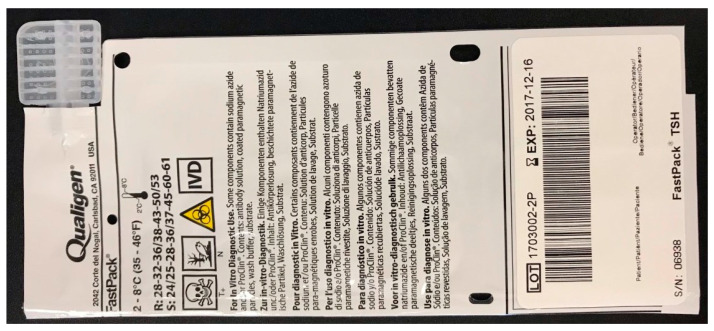
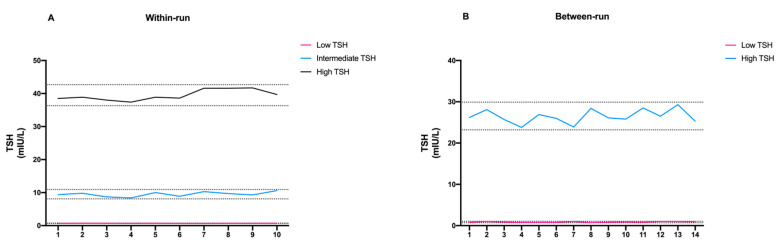
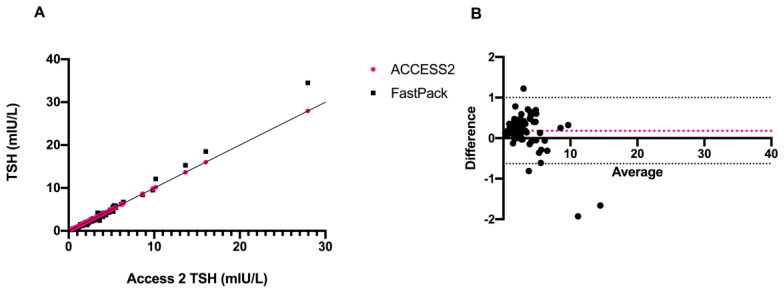
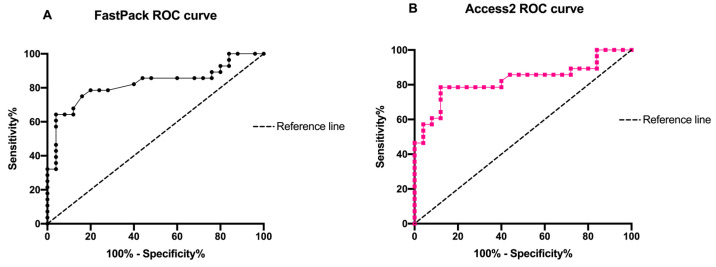
Endocrine and metabolic disorders are a common condition in Europe and worldwide, and, among these, thyroid dysfunction still remains a problem. The measurement of thyroid stimulating hormone (TSH) levels represents the first-line assay for the assessment of thyroid function. In the present study, we compared serum concentrations of TSH, measured using a commercially available point-of-care test (POCT) method (FastPack® IP) and an established “conventional” laboratory-based method (Beckmann Access 2) in a cohort of patients from Foggia in Southern Italy. A strong correlation (r = 0.994) was found between both methods and was also confirmed by receiver operating characteristic (ROC) curve analysis (0.82). The within-run coefficient of variation (CV) using FastPack® ranged from 4.03% and 8.57% at the TSH concentrations of 39.49 and 0.70 mIU/L, respectively. The between-run CV was 10.34% and 6.33% at the TSH concentrations of 0.87 and 26.55 mIU/L, respectively. The ratios of within- to between-assay CV were 0.83 and 1.06 at the TSH levels of 0.70 and 52.59 mIU/mL, respectively. In this study, we showed that serum TSH levels can be measured in a few minutes and at low-cost in terms of materials and equipment required. We observed that this approach is user-friendly, accurate, reproducible, and suitable for use in the clinic, while also meeting the criteria for effectiveness, impact, efficiency, and sustainability.
Overview
The claims and statistics of this paper haven’t been checked yet.
Free: it reads the open-access text and checks the first 5 claims that cite a source we can check. Create a free account to check every claim.
Integrity signals
Registry
Cites
Statistics
Figures
Verification
Claims the paper makes
The claims and statistics of this paper haven’t been checked yet.
Free: it reads the open-access text and checks the first 5 claims that cite a source we can check. Create a free account to check every claim.
Self-check
Percentages, sums and reported differences re-computed from the paper’s own numbers.
The self-check needs the paper’s full text.
Citations
Cites
Obesity: global epidemiology and pathogenesis
Blüher, M. (2019) · Nature Reviews Endocrinology · doi:10.1038/s41574-019-0176-8 · Cited by 5,126 · cited 1×
“The prevalence and incidence of certain diseases such as thyroid disorders [8,9], diabetes [3], obesity [10], hyperparathyroidism [11], osteoporosis [12], and vitamin D deficiency [13] have been defined in several screening programs and population-based studies.”
BackgroundZhou, B., Lu, Y., Hajifathalian, K., Bentham, J., Di Cesare, M., Danaei, G., Bixby, H., Cowan, M., Ali, M., Taddei, C., et al. (2016) · The Lancet · doi:10.1016/s0140-6736(16)00618-8 · Cited by 4,311
Hollowell, J. G., Staehling, N. W., Flanders, W. D., Hannon, W. H., Gunter, E. W., Spencer, C. A., & Braverman, L. E. (2002) · The Journal of Clinical Endocrinology & Metabolism · doi:10.1210/jc.87.2.489 · Cited by 4,279
Subclinical Thyroid Disease: Scientific Review and Guidelines for Diagnosis and Management
Surks, M. I., Ortiz, E., Daniels, G. H., Sawin, C. T., Col, N. F., Cobin, R. H., Franklyn, J. A., Hershman, J. M., Burman, K. D., Denke, M. A., et al. (2004) · JAMA · doi:10.1001/jama.291.2.228 · Cited by 1,800
Global epidemiology of hyperthyroidism and hypothyroidism
Taylor, P. N., Albrecht, D., Scholz, A., Gutierrez-Buey, G., Lazarus, J. H., Dayan, C. M., & Okosieme, O. E. (2018) · Nature Reviews Endocrinology · doi:10.1038/nrendo.2018.18 · Cited by 1,552 · cited 1×
“The prevalence and incidence of certain diseases such as thyroid disorders [8,9], diabetes [3], obesity [10], hyperparathyroidism [11], osteoporosis [12], and vitamin D deficiency [13] have been defined in several screening programs and population-based studies.”
BackgroundThe epidemiology of thyroid disease
Vanderpump, M. P. J. (2011) · British Medical Bulletin · doi:10.1093/bmb/ldr030 · Cited by 1,179 · cited 1×
“The prevalence and incidence of certain diseases such as thyroid disorders [8,9], diabetes [3], obesity [10], hyperparathyroidism [11], osteoporosis [12], and vitamin D deficiency [13] have been defined in several screening programs and population-based studies.”
BackgroundRodbard, D. (1974) · Clinical Chemistry · doi:10.1093/clinchem/20.10.1255 · Cited by 1,040 · cited 3×
“The quality control protocol, determined according to the NCCLS EP6- g i eli e [31,32], as base on (i) assessment of the within- and between-assay variation; (ii) parallelism on the dilution test; and (iii) the recovery test.”
MethodThe Incidence and Prevalence of Thyroid Dysfunction in Europe: A Meta-Analysis
Garmendia Madariaga, A., Santos Palacios, S., Guillén-Grima, F., & Galofré, J. C. (2014) · The Journal of Clinical Endocrinology & Metabolism · doi:10.1210/jc.2013-2409 · Cited by 800
Volumetrie der Schilddrüsenlappen mittels Real-time-Sonographie* 1
Brunn, J., Block, U., Ruf, G., Bos, I., Kunze, W. P., & Scriba, P. C. (2008) · DMW - Deutsche Medizinische Wochenschrift · doi:10.1055/s-2008-1070506 · Cited by 643 · cited 1×
“Thyroid volume was calculated according to the formula of the ellipsoid model (length × width × thickness multiplied by the correction factor π/6) for each lobe [34].”
MethodThe Disorders Induced by Iodine Deficiency
DELANGE, F. (1994) · Thyroid · doi:10.1089/thy.1994.4.107 · Cited by 638 · cited 1×
“Iodine deficiency, defined as a daily iodine intake inferior to 50–100 μg, is the most common cause of thyroid disorders and triggers the growth of the thyroid gland, leading to goiter and thyroid nodule formation and, if untreated, hypothyroidism [14].”
Background
Research works printed but not linked: 1
- Jameson J.L. Mandel S.J. Weetman A.P. Disorders of the thyroid gland Harrison’s Principles of Internal Medicine 17th ed. Fauci A.S. Kasper D.L. Longo D.L. Braunwald E. Hauser S.L. Jameson J.L. Loscalzo J. McGraw-Hill, Medical Pub. Division New York, NY, USA 2008
Cited by
Van Uytfanghe, K., Ehrenkranz, J., Halsall, D., Hoff, K., Loh, T. P., Spencer, C. A., Köhrle, J., & ATA Thyroid Function Tests Writing Group (2023) · Thyroid® · doi:10.1089/thy.2023.0169 · Cited by 100
“These are immunochromatographic (lateral flow) point-of-care semiquantitative TSH assays, 37,38 developed in the 1990s that can be used to screen for primary congenital hypothyroidism.”
BackgroundLaboratory Thyroid Tests: A Historical Perspective
Spencer, C. A. (2023) · Thyroid · doi:10.1089/thy.2022.0397 · Cited by 36
“71 Despite dramatic improvements in assay sensitivity and the use of the same human pituitary extract for standardization (MRC 80/558), current TSH methods differ in their specificity for detecting different TSH glycoisoforms, not all of which are bioactive.”
Elendu, C., Amaechi, D. C., Amaechi, E. C., Chima-Ogbuiyi, N. L., Afuh, R. N., Agbor, D. B. A., Abdi, M. A., Nwachukwu, N. O., Oderinde, O. O., Elendu, T. C., et al. (2024) · Medicine · doi:10.1097/md.0000000000037396 · Cited by 30
“[15,16] Thyroid storm’s atypical presentation, particularly in elderly patients or those with underlying medical conditions, poses a formidable challenge.”
BackgroundNewborn screening for primary congenital hypothyroidism: past, present and future
L., F. G., Lain, S. J., & Olivieri, A. (2025) · European Thyroid Journal · doi:10.1530/etj-24-0358 · Cited by 21
“Furthermore, an Italian study con fi rmed the robust performance of a different bedside test relative to the standard reference method, underscoring POCT ’ s potential for NBS (133).”
Shurbaji, S., Tamimi, F. A., Ghwairi, M. M. A., Chaar, D. E., Younes, S. N., Majdalawieh, A. F., Pintus, G., Al-Dewik, N. I. E., & Nasrallah, G. K. (2023) · Heliyon · doi:10.1016/j.heliyon.2023.e20589 · Cited by 16
“The measurement of thyroid-stimulating hormone (TSH) levels represents the first-line assay for assessing thyroid function [2].”
Background
Metadata
- Authors
- Di Cerbo, A., Quagliano, N., Napolitano, A., Pezzuto, F., Iannitti, T., & Di Cerbo, A.
- Affiliations
- Leonardo da Vinci Private Clinic, Via Nicola De Dominicis, 71121 Foggia, Italy
- Biometron Laboratory, Viale Aldo Moro, 122/128, 71011 Apricena, Italy
- Independent Researcher, Southampton SO16 0BS, UK
- School of Biosciences and Veterinary Medicine, University of Camerino, Via Circonvallazione 93/95, 62024 Matelica, Italy
- Corresponding author
- Iannitti, Tommaso
- Venue
- Diagnostics
- Publisher
- MDPI AG
- Published
- 2021-08-31
- Volume
- 11
- Issue
- 9
- Pages
- 1590
- ISSN
- 2075-4418 (ISSN-L)
- PMC
- PMC8471571
- OpenAlex
- W3196894288
- Cited by
- 14
- References
- 44
- Citations by year
- 2026: 1 · 2025: 4 · 2024: 2 · 2023: 5 · 2022: 2
- FWCI
- 1.41
- Type
- journal article
- Language
- en
- Open access
- gold
- doi.org
- Licence
- Locations
- Diagnostics (publishedVersion, cc-by)
- Europe PMC (PubMed Central) (publishedVersion, other-oa)
- PubMed Central (publishedVersion, cc-by)
- PubMed (publishedVersion)
- DOAJ (DOAJ: Directory of Open Access Journals) (submittedVersion, cc-by-sa)
- Unicam Scientific Publications (University of Camerino) (submittedVersion, cc-by)
- Topics
- Health Sciences › Health Professions › Medical Laboratory Technology › Clinical Laboratory Practices and Quality Control
- Health Sciences › Medicine › Endocrinology, Diabetes and Metabolism › Thyroid Disorders and Treatments
- Health Sciences › Medicine › Endocrinology, Diabetes and Metabolism › Thyroid Cancer Diagnosis and Treatment
- Keywords
- thyroid-stimulating hormone, point-of-care testing, assay agreement, assay precision, thyroid function tests, thyroid dysfunction, low-cost diagnostics
About these checks
Registry, retraction, Cites and statistics results are computed, not judged, with one exception: a printed reference that no index lists is read once by a model before it counts as a citation error. Claims are extracted by a model and kept only when their quote appears verbatim in the text; each cited source is then checked, with a model’s help, for whether it says what the claim relies on. Those verdicts can be wrong — read the claim’s quote and the cited source before relying on one.
Statistics and arithmetic are recomputed, not judged.
Confidence bands are shown only for fields calibrated on our annotated test set. None is calibrated yet, so no band is shown.
What counts as a claim ›How we measure confidence ›How we check this ›
Are you an author, or do you see a problem with this page? Request a review
Data sources
Bibliographic data: Semantic Scholar, OpenAlex, Crossref.
Contains information from the Semantic Scholar Academic Graph Datasets, made available under the ODC Attribution License (ODC-BY 1.0).
Semantic Scholar’s data is described in: Kinney, R., et al. (2023). The Semantic Scholar Open Data Platform. arXiv:2301.10140.
