

Project-Based Learning (PBL) as an Experiential Pedagogical Methodology in Engineering Education: A Review of the Literature
Open accessThe DOI matches its Crossref record; 68 of the 70 references it cites were found in a registry or an index.
Abstract
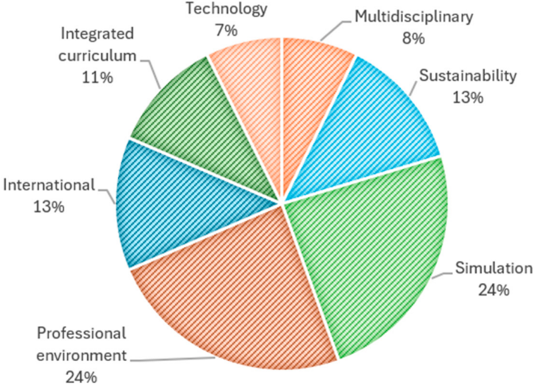
This systematic literature review explores how the implementation of project-based-learning (PBL) as an experiential pedagogical methodology in engineering education contributes to the development of real-world skills among students. The methodology applied was the PRISMA protocol with searches in two databases in a 24 year timeframe. The research reviewed 54 pieces to explore the contribution of PBL to seven pillars of a holistic pedagogical model comprising the following categories: technology, an integrated curriculum, an international focus, sustainability, a multidisciplinary focus, simulation, and professional environments. Varied PBL developments across these pillars reveal challenges, including aligning with real-world complexities and promoting interdisciplinary integration. Despite obstacles, PBL in engineering shows promise for enhancing students’ skills and channeling the added value of a holistic pedagogical model, despite significant differences in the number of experiences associated with each category. Limitations include restricted article access, emphasizing the need for open science promotion.
Overview
The claims and statistics of this paper haven’t been checked yet.
Free: it reads the open-access text and checks the first 5 claims that cite a source we can check. Create a free account to check every claim.
Integrity signals
Registry
Cites
Statistics
Figures



Verification
Claims the paper makes
The claims and statistics of this paper haven’t been checked yet.
Free: it reads the open-access text and checks the first 5 claims that cite a source we can check. Create a free account to check every claim.
Claims other papers make about this one
Each is checked against this paper’s own text: does it say what the citing paper says it does?
The source backs part of the claim, not all of it — or backs it for a different population, condition or comparison.
In the citing paper
“Despite these high-stakes implications, traditional instruction in Building Water Supply and Drainage Engineering has tended to emphasize technical calculations, design procedures, and code interpretation, with relatively limited attention to ethical responsibility, human-centered considerations, and system-level sustainability tradeoffs [17,21].”
From Integrating Sustainability and Ethical Responsibility into Building Water Supply and Drainage Engineering Education: A CDIO-Based Curriculum Reform (2026) · cites this paper as [17]
Experimental — accuracy not yet measuredThe source backs part of the claim, not all of it — or backs it for a different population, condition or comparison.
In the citing paper
“This finding aligns with prior research showing that project-based learning and CDIO-oriented curriculum design can effectively enhance professional responsibility and sustainability-related competencies when authentic engineering problems are used as learning contexts [13,17,34].”
From Integrating Sustainability and Ethical Responsibility into Building Water Supply and Drainage Engineering Education: A CDIO-Based Curriculum Reform (2026) · cites this paper as [17]
Experimental — accuracy not yet measuredThe source backs part of the claim, not all of it — or backs it for a different population, condition or comparison.
In the citing paper
“These approaches emphasize constructive alignment among learning outcomes, teaching activities, and assessment methods, while promoting active and experiential learning through project-based and design-oriented pedagogies [8,9,16,17].”
From Integrating Sustainability and Ethical Responsibility into Building Water Supply and Drainage Engineering Education: A CDIO-Based Curriculum Reform (2026) · cites this paper as [17]
Experimental — accuracy not yet measured
Self-check
Percentages, sums and reported differences re-computed from the paper’s own numbers.
The self-check needs the paper’s full text.
Citations
Cites
Web of Science (WoS) and Scopus: The Titans of Bibliographic Information in Today’s Academic World
Pranckutė, R. (2021) · Publications · doi:10.3390/publications9010012 · Cited by 2,696 · cited 1×
“Two databases were selected for their relevance in the field of education [23,24] and their worldwide reach as well as their allowing extracted data to be easily stored in CSV format, facilitating subsequent analysis: Web of Science and SCOPUS.”
MethodA review of project-based learning in higher education: Student outcomes and measures
Guo, P., Saab, N., Post, L. S., & Admiraal, W. (2020) · International Journal of Educational Research · doi:10.1016/j.ijer.2020.101586 · Cited by 1,309 · cited 1×
“In 2020, Guo, Saab, Post, and Admiraal [12] reviewed publications related to student outcomes and measures of problem-based learning experiences in higher education, analyzing the measuring tools that researchers used to assess students’ outcomes.”
BackgroundSystematic Literature Reviews in Engineering Education and Other Developing Interdisciplinary Fields
Borrego, M., Foster, M. J., & Froyd, J. E. (2014) · Journal of Engineering Education · doi:10.1002/jee.20038 · Cited by 620 · cited 2×
“The possibility of applying the snowball technique to citation searching was considered to expand our review; that is, we reviewed the works cited by already-identified sources, as suggested by Borrego, Foster, and Froyd [11].”
MethodCompetencies in Education for Sustainable Development: Exploring the Student Teachers’ Views
Cebrián, G., & Junyent, M. (2015) · Sustainability · doi:10.3390/su7032768 · Cited by 496 · cited 1×
“In the 21st century, in a globalized world, the education of future engineering professionals must train students in skills in line with the current reality, as well as in values and attitudes [1].”
BackgroundForms of implementation and challenges of PBL in engineering education: a review of literature
Chen, J., Kolmos, A., & Du, X. (2021) · European Journal of Engineering Education · doi:10.1080/03043797.2020.1718615 · Cited by 408 · cited 1×
“Chen, Kolmos, and Du [10] created a review of the forms of implementation and challenges of PBL in engineering education, differentiating the practice of PBL, the culture, and the individual and institutional level challenges.”
BackgroundLehmann, M., Christensen, P., Du, X., & Thrane, M. (2008) · European Journal of Engineering Education · doi:10.1080/03043790802088566 · Cited by 380 · cited 1×
“Benefiting from students’ intrinsic motivation and ownership of the learning process [8,9], PBL implementation varies from practice to practice, depending on the context, resources, and curriculum design.”
BackgroundPBL and CDIO: complementary models for engineering education development
Edström, K., & Kolmos, A. (2014) · European Journal of Engineering Education · doi:10.1080/03043797.2014.895703 · Cited by 276 · cited 1×
“Benefiting from students’ intrinsic motivation and ownership of the learning process [8,9], PBL implementation varies from practice to practice, depending on the context, resources, and curriculum design.”
BackgroundLand, S. M., & Zembal‐Saul, C. (2003) · Educational Technology Research and Development · doi:10.1007/bf02504544 · Cited by 162 · cited 1×
“…experiences developed in engineering according to the pillars of the holistic pedagogical model described in Figure 1 and connect the theoretical framework of PBL types with various current PBL implementations. framework, projects may demand students to apply and integrate knowledge subjects [18].”
BackgroundLucena, J., & Schneider, J. (2008) · European Journal of Engineering Education · doi:10.1080/03043790802088368 · Cited by 131 · cited 1×
“Technology when the project includes the use of an emerging or advanced technology, such as AI, by the students; Advancements in current technology allow the creation of complex scenarios, including those incorporating artificial intelligence (AI). development [20].”
BackgroundChua, K. J., & Islam, M. (2020) · International Journal of Mechanical Engineering Education · doi:10.1177/0306419019838335 · Cited by 119 · cited 1×
“The of them [42] presented what it In particular, it allowed combining theory and practice, allowing students to apply, in real-world-like situations, the knowledge acquired. called a hybrid project-based learning-flipped design, which requires students to learn by themselves in advance what they…”
Background
Research works printed but not linked: 12
- Kolmos, A., Fink, F.K., and Krogh, L. (2004). The Aalborg PBL Model—Progress, Diversity and Challenges, Aalborg University Press.
- Barrows, H.S., and Tamblyn, R.M. (1980). Problem-Based Learning: An Approach to Medical Education, Springer Publishing Company.
- Guerra, A., Ulseth, R., Jonhson, B., and Kolmos, A. (2017, January 18–21). Engineering grand challenges and the attributes of the global engineer. Proceedings of the 45th SEFI Annual Conference, Azores, Portugal.
- Kolb, D.A. (2014). Experiential Learning: Experience as the Source of Learning and Development, FT Press.
- Johnson, B., and Ulseth, R. (March, January 28). Developing the next generation of co-operative engineering education. Proceedings of the International Symposium on Project Approaches in Engineering Education 2018, Brasilia, Brazil.
- Reilly, G., Murphy, M., Nagy, B.V., and Jarvinen, H.-M. (2023, January 11–14). Exploring the Impact of Problem-Based Learning on Student Learning Outcomes: Findings from the PBL South Asia Project. Proceedings of the SEFI 2023—51st Annual Conference of the European Society for Engineering Education: Engineering Education for Sustainability, Dublin, Ireland.
- 2023, Student perception of the application of Project Based Learning as a strategy for Formative Research in Engineering, RISTI-Rev. Iber. Sist. E Tecnol. Inf., 2023, 478
- Vargas, 2020, A Project Based Learning Approach for Teaching Artificial Intelligence to Undergraduate Students, Int. J. Eng. Educ., 36, 1773
- 2021, Building Small Prototypes in a PBL Intervention for Learning Automatic Control Systems, Int. J. Eng. Educ., 37, 1274
- 2022, Collaborative Graphic Simulation Experience Through Project-Based Learning to Develop Spatial Abilities, Int. J. Eng. Educ., 38, 905
- Yusof, 2019, Design and practical experience in power electronics project based learning approach at UKM, Int. J. Innov. Creat. Change, 9, 287
- Giordani, D.S., and Moraes, E.J.C. (July, January 29). A PBL experience to simulate a business environment in a discipline of chemical engineering course. Proceedings of the 43rd Annual SEFI Conference, Orléans, France.
Cited by
Items 101–200 of 245
McKie, M. H., & Lunn, S. J. (2025) · IEEE Frontiers in Education Conference (FIE) · doi:10.1109/fie63693.2025.11328548 · Cited by 1
“…physics) exemplifies different educational environments: Computing often emphasizes digital learning and coding platforms [17], Physics centers around lab-based conceptual instruction [18], and Engineering integrates applied problem-solving, pro-totyping, and multidisciplinary collaboration [19].”
Rahmawati, M., & Sutriyani, W. (2025) · JURNAL PEMBELAJARAN DAN MATEMATIKA SIGMA (JPMS) · doi:10.36987/jpms.v11i2.7858
Carrillo, J. A. J. (2026) · Ibero Ciencias - Revista Científica y Académica · doi:10.63371/ic.v5.n1.a637
A Mobile Triage Robot for Natural Disaster Situations
Angamarca-Avendaño, D.-A., Zhañay-Salto, D.-A., & Cobos-Torres, J.-C. (2026) · Electronics · doi:10.3390/electronics15030559
Information Systems Curriculum Evolution in Construction Management Education
Foskett, F., Elias, C., & Issa, R. R. A. (2026) · ASCE International Conference on Computing in Civil Engineering (i3CE) · doi:10.1061/9780784486443.118
Choudhary, K., Isaksson, M., Roshan, M. C., & Pawako, S. (2025) · IEEE International Conference on Advanced Learning Technologies on Education & Research (ICALTER) · doi:10.1109/icalter69698.2025.11355024
“PBL encourages autonomy, creativity, and collaboration, helping students engage with complex challenges [7], [14].”
Aprendizaje basado en proyectos aplicado a la formación en Ingeniería Eléctrica
González, J. R. V., & Mancheno, C. F. A. (2026) · Sinergia Académica · doi:10.51736/sa911
Visual Programming Algorithms As An Educational Resource For Civil Engineering
Collao, J., Galant, F. L., José, A. L. G., & Jose, T. (2025) · doi:10.3311/euceet-013
Implementasi model microteaching biologi berbasis PjBL dan blended learning
Sadikin, A., Siburian, J., Saudagar, F., & Pratama, R. (2026) · Jurnal Penelitian Pendidikan IPA · doi:10.29303/jppipa.v12i1.13069 · Cited by 1
Ingale, S. M., Belli, R. S., & Vibhute, S. (2026) · Vidhyayana · doi:10.58213/0jfsge97
A Learning Framework for an IoT and Digital Transformation Course
Saaidin, S., & Kassim, M. (2025) · IEEE International Conference on Engineering Education (ICEED) · doi:10.1109/iceed66794.2025.11400176
Bracamontes, A. L., Romo, A. S., López, E. J., Verdugo, A. C., Tribolet, M. D. S. V., & Rochin, G. L. (2026) · LATAM Revista Latinoamericana de Ciencias Sociales y Humanidades · doi:10.56712/latam.v7i1.5413
Guan, X., Liang, X. J., & Guo, W. (2026) · Research Square · doi:10.21203/rs.3.rs-8936779/v1
Hakim, N. A., Hayati, D. K., Dewi, A. F., Sari, T. M., & Puspita, L. (2026) · JPBI (Jurnal Pendidikan Biologi Indonesia) · doi:10.22219/jpbi.v12i1.43249
Chancay, N. L. A., Leones, N. E. G., Villacis, K. E. M., Párraga, A. A. M., & Gómez, E. J. H. (2026) · Innovación Integral · doi:10.70577/c0cznr13
Project-Based and Active Learning in Lean Education
Liu, J., Aba, E., & Chen, C. (2026) · Journal of Management Research and Review · doi:10.65150/ep-jmrr/v2e3/2026-03
Affordable aerodynamic testing by repurposing legacy equipment for engineering education
Clover, J., Bernagozzi, M., & Fenercioğlu, İ. (2026) · International Journal of Mechanical Engineering Education · doi:10.1177/03064190261433246
Zhang, X., Roberts, J. G., Ebewele, E., & Parrish, A. (2026) · Applied Sciences · doi:10.3390/app16063044
Imparting System-Development Skills and Project Based Learning to First-Year Engineering Students
Ravikumar, C. P., Kendaganna Swamy, S., Subramanya, K. N., Rajasree, P. M., & Shruthi, P. (2026) · IETE Journal of Education · doi:10.1080/09747338.2026.2649138
Han, D., & Leung, M. T. C. (2025) · International Conference on Modern Educational Technology (ICMET) · doi:10.1109/icmet67594.2025.11451946
Chowdhury, S., Garrison, M. J., & Bithi, S. S. (2026) · ASEE Gulf Southwest Section Conference · doi:10.18260/1-2--58058
A Maturity-Based Engineering Learning Approach: Reflective, Ethical, and Adaptive
Namunbo, J., Simões, M. G., Michael, K., & Ribeiro, P. F. (2026) · IEEE Technology and Society Magazine · doi:10.1109/mts.2026.3674874
“Based on the recent findings of a systematic literature review in the last 24 years [14], it is evident that PBL serves as a suitable methodology for implementing a holistic pedagogical model within engineering education.”
Empowering Education and Training with Advanced AI and Affective Facial Analysis
Negrea, A. S., Bogdan, C., Modran, H. A., & Marin, N. A. (2026) · Lecture notes in networks and systems · doi:10.1007/978-3-032-18885-4_8
Open Auditorium—A human-centric extended reality blended learning tool
Isop, W. A. (2026) · Frontiers in Artificial Intelligence · doi:10.3389/frai.2026.1698599 · Cited by 1
TRANSFORMATIONS OF EDUCATION IN THE ERA OF MODERN TECHNOLOGIES
Vladlenov, D. (2026) · doi:10.46299/isg.p.2026.1.15
Cioc, C., Cioc, S., & Sojoudi, H. (2026) · ASEE Conference for Industry and Education Collaboration (CIEC) · doi:10.18260/1-2-1130-58305
An Experiential Learning Framework for Mobile Robot Control Education Using PID-Based Path Tracking
Muhida, R., Muhida, R., Adesta, E. Y. T., Riza, M., & Legowo, A. (2026) · Journal of Applied Science and Advanced Engineering · doi:10.59097/jasae.v4i1.89
“These approaches enhance students’ problem-solving abilities, critical thinking, and system integration skills by engaging them in real-world engineering challenges [12], [15].”
Maulida, S. D. P., & Ahmad, M. (2026) · Journal of Research in Instructional · doi:10.30862/jri.v6i1.859
“Through PjBL, students start to truly understand content because lessons are tied to hands-on activities and real-world situations they recognize (Lavado-Anguera et al., 2024) .”
Демченко, І. І., Тверезовська, Н., Сидорко, В., & Григоренко, Т. (2026) · Суспільство та національні інтереси. · doi:10.52058/3041-1572-2026-4(24)-302-316
Rifa’i (2026) · Al Qodiri Jurnal Pendidikan Sosial dan Keagamaan · doi:10.53515/alqodiri.v24i2.71
Extending the Pedagogical Lens: From Research-Based Learning to Hybrid Innovation Models
Restivo, M. T., Gfrerer, M., & Zvacek, S. M. (2026) · Lecture notes in networks and systems · doi:10.1007/978-3-032-18891-5_30
Keefektifan E-Modul Pembuatan Blok V terhadap Hasil Belajar Teknik Pemesinan Frais
Kurniawan, F., & Rohman, S. (2026) · Jurnal Pendidikan Teknik Mesin Undiksha · doi:10.23887/jptm.v14i1.112589
Santos, J. A. D., Nurdiyanto, H., Zubair, A. A., & Correia, D. D. S. (2026) · VOCATECH Vocational Education and Technology Journal · doi:10.38038/vocatech.v8i1.280
Polishchuk, S., & Horbatiuk, O. (2026) · Academic Visions · doi:10.66556/2786-586x.53.polishchuk-s
Yang, F. (2025) · International Conference on Information Education and Artificial Intelligence (ICIEAI) · doi:10.1145/3799457.3799664
Caguin, R. N. B., Mendoza, J. P. P., Pascual, K. R., & Tienzo, C. C. T. (2026) · International Journal of Research and Innovation in Social Science · doi:10.47772/ijriss.2026.100400517
Yu, L., Chen, Z., & Qin, Z. (2026) · PLoS ONE · doi:10.1371/journal.pone.0349114
“Instead, a well-designed evaluation system should emphasize students’ holistic performance throughout the problem-solving process, encompassing analytical thinking, self-regulated learning, teamwork proficiency, and the application of integrated knowledge [10].”
Benavides-Muñoz, H. M., Ayala-Chauvin, M. I., & Benavides-Ortega, L. M. (2026) · Sustainability · doi:10.3390/su18104964
Jiang, J., Zhang, R., Tao, S., Bao, Y.-D., Xiong, J.-L., & Sun, J. (2026) · International Conference on Educational and Information Technology · doi:10.1109/iceit68991.2026.11521755
“At the methodological level, Project-Based Learning [7-9] has been widely adopted, emphasizing problem-solving in real-world contexts.”
Introducing Engineering Students to Machine Learning via Hands-on Wind Turbine Experiments
Wulandana, R., Gardner, B., & Banerjee, S. (2026) · ASEE Middle Atlantic Section Spring Conference · doi:10.18260/1-2--58464
杨, 秋. (2026) · Creative Education Studies · doi:10.12677/ces.2026.145327
Jandieri, G. V., & Janelidze, I. (2026) · GEORGIAN SCIENTISTS · doi:10.52340/gs.2026.08.02.30
黄, 家. (2026) · Creative Education Studies · doi:10.12677/ces.2026.145376
Pelatihan Rancang Bangun Smart home Berbasis IoT Untuk Siswa SMAIT Al Auliya Balikpapan
Yanti, N., Rachman, F. Z., Lesmideyarti, D., Ihsan, I., Prasetyo, M. E., Sulistyo, T., & Dahlan, B. (2025) · Jurnal Sibermas (Sinergi Pemberdayaan Masyarakat) · doi:10.37905/sibermas.v14i3.34987
Fujs, D., Vavpotič, D., & Poženel, M. (2026) · Automated Software Engineering · doi:10.1007/s10515-026-00633-w
“This suggests that how useful teams find these Scrum events is closely linked to how engaged they are and how well they perform (Paasivaara et al. 2017; Lavado-Anguera et al. 2024).”
First-Year Engineering Design: Active Learning with Rockets, Simulation, and AI
Álvarez, J., Hidalgo, J., Díaz-Martínez, J.-G., Gutiérrez-Carmona, I., Cruz-Netro, Z. G., & Guevara-Chavez, L. F. (2026) · IEEE World Engineering Education Conference (EDUNINE) · doi:10.1109/edunine62390.2026.11546856
“Project-Based Learning (PBL) is widely acknowledged as a powerful pedagogical approach in engineering education, particularly for its capacity to foster both technical proficiency and transversal competencies [5].”
Jaime, M., Gustavo, M., & José, H. (2026) · IEEE World Engineering Education Conference (EDUNINE) · doi:10.1109/edunine62390.2026.11546821
“The instructional design employed in this study is the ADDIE model, which has been widely applied in diverse learning environments to structure educational experiences through its five phases: Analysis, Design, Development, Implementation, and Evaluation [18], [19].”
Díaz-Martínez, J.-G., Gutiérrez-Carmona, I., & Caneppele, F. D. L. (2026) · IEEE World Engineering Education Conference (EDUNINE) · doi:10.1109/edunine62390.2026.11547142
“Project-Based Learning (PBL) and the Design Thinking approach complement this strategy by promoting creativity, empathy, and collaborative problem-solving of complex challenges [3], [4].”
Practical Engineering Design: Hands-On Learning in an Undergraduate Embedded Systems Design Course
Moghadam, N. M. (2026) · Education Sciences · doi:10.3390/educsci16060915
The, A. H. (2026) · Journal of Thu Dau Mot University · doi:10.37550/tdmu.ejs/2026.02.727
Gabbay, F., Shvimer, S., & Grinshpun, A. (2026) · IEEE International Symposium on Circuits and Systems proceedings · doi:10.1109/iscas66217.2026.11562536
Enhancing Biotechnology Learning Through PRA-Driven Hydroponic Technology
Oktariyati, S., Safitri, Y., & Siregar, K. E. (2026) · Journal of Educational Management Research · doi:10.61987/jemr.v5i3.1183
“The visual documentation of the seed sowing process highlights the hands-on learning element, providing evidence that hydroponics can be used as an effective tool for active student participation and skill development (Lavado-Anguera et al., 2024).”
Yusof, M. N. M., Safizal, M., & Kassim, M. A. M. (2026) · International Journal of Research and Innovation in Social Science · doi:10.47772/ijriss.2026.100600246
Team Interaction as a Component of Modernizing the Professional Training of the Pre-service Computer
Юрченко, А. О., & Семеніхіна, О. В. (2026) · Izdevniecība “Baltija Publishing” eBooks · doi:10.30525/978-9934-26-696-6-3
Saprıatı, A., Puspitasari, M., Amastini, F., & HANDAYANI, M. (2026) · International Journal of Educational Practice and Policy · doi:10.66314/ijepp.v4i2.805
Alebrahim, F., Tawileh, W., & AL-Smadi, M. (2026) · IEEE Global Engineering Education Conference (EDUCON) · doi:10.1109/educon67543.2026.11574332
“Research shows that PBL increases students’ competence in systems thinking and strengthens their understanding of sustainability along technical and social dimensions [14], [15].”
Fierro-Radilla, A. N., Valera-Velazquez, R., Garcia-Suarez, D., Curiel-Enriquez, I. M., & Garduño-Hernández, E. (2026) · IEEE Global Engineering Education Conference (EDUCON) · doi:10.1109/educon67543.2026.11574246
“De los Ríos et al. [11] demonstrated that PBL enhances technical integration and teamwork, while Lavado-Anguera et al. [12] identified simulation, sustainability, and real-world relevance as pillars of effective engineering PBL. Rooted in constructivist and constructionist theories [13],…”
Holistic Edge AI: From ML Models to Hardware-Aware Deployment
Molina, R., Jovalekic, N., Escobar, M. G. B., Crespo, M. L., & Micco, L. D. (2026) · IEEE Global Engineering Education Conference (EDUCON) · doi:10.1109/educon67543.2026.11574254
“Within this context, experiential learning approaches, particularly learning-by-doing and project-based methodologies, have become essential in engineering education [13], [21], [22].”
Gaponov, I., Collier, O., Charitonidis, A., Tozadore, D. C., & Yan, Y. (2026) · IEEE Global Engineering Education Conference (EDUCON) · doi:10.1109/educon67543.2026.11574344
“Based on the constructivist principles, it promotes active learning by engaging students in authentic, complex problems that mirror real-world engineering challenges [5], [17].”
Nurhalisa, S., Aprianto, R., & Fitriyanto, S. (2026) · Indonesian Journal of Innovation and Educational Technology · doi:10.67434/ijiet.v1i1.2073
Irwansyah, I., Syahputri, I. W., & Syahputra, I. W. (2026) · Marketing Education Review · doi:10.1080/10528008.2026.2693702
Wang, E., Yang, J., Zhu, W., Liu, X., Chen, C., & Hou, Y. (2026) · Academic Journal of Education · doi:10.54097/5d6dbm03
“PBL has become one of the most widely adopted teaching approaches in engineering education [8,9].”
Balaev, P. A., Lebedeva, N. A., Belyu, L., & Fakhrieva, S. (2026) · International Conference on Technology Enhanced Learning in Higher Education (TELE) · doi:10.1109/tele71748.2026.11591418
“Lavado-Anguera S. and co-authors demonstrate that PBL supported by digital tools facilitates the development of collaborative and critical thinking [16]; students working in digital teams are more likely to generate non-standard solutions.”
Galuza, A. A., Savchenko, A. A., Lyubchyk, L. M., Akhiiezer, О., & Pogorelov, S. V. (2026) · Industry and Higher Education · doi:10.1177/09504222261469622 · Cited by 1
Salwa, A. E., Syahril, S., Indrawan, E., & Kassymova, G. K. (2026) · Jurnal Pendidikan Teknologi Kejuruan · doi:10.24036/jptk.v9i2.50323
“0 / the process(Abugri et al., 2026; Funa, 2026; Lavado-Anguera et al., 2024).”
Lince, R., & Husnaeni, H. (2026) · Jurnal Pendidikan Terapan · doi:10.61255/jupiter.v4i3.1130
“Project-Based Learning (PjBL) is a learning method based on practical experience (Lavado-Anguera et al., 2024), where students explore a topic through the investigation and completion of complex, relevant, and authentic projects (Boardman et al., 2024; Thomas, 2000; Yusri et al., 2024).”
El Proyecto SOL como Eje de Conciencia Histórica y Ciudadanía Técnica
Chico, G. G. (2026) · Estudios y Perspectivas Revista Científica y Académica · doi:10.61384/r.c.a..v6i3.2015
Integration of Companies' Electronic Resources into Engineering Educational Programs of Universities
Karstina, S. G. (2026) · Lecture notes in networks and systems · doi:10.1007/978-3-032-20381-6_46
Suyidno, S., Qamariah, Q., Mısbah, M., Mahtarı, S., & Rahman, N. F. A. (2026) · Jurnal Ilmiah Pendidikan Fisika Al-Biruni · doi:10.24042/jipfalbiruni.v15i1.30811
Basma, B., Patang, P., Suardi, S., Irfan, M., Darmawan, D., & Swandi, A. (2026) · F1000Research · doi:10.12688/f1000research.187948.1
Cordero, E. J. B., Astorga, J. J. M., Pirela, N. L. V., Jamett, A. C. D., Petit-Breuilh, X., & Alburjas, M. (2026) · LACCEI International Multi-Conference for Engineering, Education and Technology (LACCEI) · doi:10.18687/laccei2026.1.1.2752
Developing a 2-DOF robotic arm kit for embodied AI learning in middle school technology education
Kim, D., & Kim, S. (2026) · International Journal of Evaluation and Research in Education (IJERE) · doi:10.11591/ijere.v15i4.39254
Examining Student Proficiency and Perceptions of Engineering Design Projects
Poitras, G. J., Poitras, E., & Desjardins, S. L. (2026) · Proceedings of the Canadian Engineering Education Association (CEEA) · doi:10.24908/pceea.2026.21654
QFD for Innovation, Creativity, and Effective Engagement in Engineering Education
Ahmed, S., & Aman, M. (2026) · International Journal of Service Science Management Engineering and Technology · doi:10.4018/ijssmet.418231 · Cited by 1
MineDash-ABP: Prototipo didáctico de monitoreo de volquetes con ESP32, sensores y dashboard
Cahuana, H. M. C. (2026) · Journal of Humanities Titicaca · doi:10.70123/jht.159
Project-based learning as a tool for developing teamwork skills in IT students
SPIRINA, Y., Gorbunova, N., Popova, N., Kopbalina, S. S., Tursyngaliyeva, G., & Samoilova, I. (2026) · Frontiers in Education · doi:10.3389/feduc.2026.1913646
Solano-Barliza, A. D., & Aarón-Gonzalvez, M. (2026) · Lecture notes in educational technology · doi:10.1007/978-981-92-1792-2_9
Prado, C. P. R. D., Pérez, M. S. B., Herrera, V. M. D. C. A., & Vázquez, O. E. (2026) · Revista Educación y Sociedad · doi:10.53940/reys.v7i13.281
Project-Based Teaching in Software Architecture Education
Saay, S., Jörges, S., & Margaria, T. (2026) · IEEE Annual International Computer Software and Applications Conference (COMPSAC) · doi:10.1109/compsac69091.2026.00201
“Research shows that PBL not only improves academic outcomes and maintains students’ attention and engagement, but also supports the learning of both technical and soft skills that are essential for professional practice [3].”
Saraç, A., & Özdener, N. (2026) · Education Sciences · doi:10.3390/educsci16081330
“…motivation, creativity, and experiential learning while supporting project-based, problem-solving, and interdisciplinary learning activities (Bogdanovic et al., 2014; Charlton & Avramides, 2016; Guevara et al., 2026; Lavado-Anguera et al., 2024; Mäenpää et al., 2015; Osipov & Riliskis, 2013).”
A Project-Based Learning Approach to Seismic Testing and Damping in Structural Dynamics
Nasseri, S., Jonaidi, M., & Womack, R. (2026) · ASEE Annual Conference & Exposition · doi:10.18260/1-2--59107
Das, S. (2026) · ASEE Annual Conference & Exposition · doi:10.18260/1-2--60211
Guo, C., Tan, L., & Chun, W. (2026) · International Journal of Mechanical Engineering Education · doi:10.1177/03064190261478302
From Bash to Boards: Integrating Project-Based Learning in a Foundational Embedded Systems Course
Akbar, S., & El-Hamalawy, A. F. (2026) · ASEE Annual Conference & Exposition · doi:10.18260/1-2--59550
Kranov, Y., & Stewart, P. (2026) · ASEE Annual Conference & Exposition · doi:10.18260/1-2--61127
Tettegah, S. Y., & Larnyo, E. (2026) · ASEE Annual Conference & Exposition · doi:10.18260/1-2--59856
Kang, S. “., Bandara, N., Jackson, N., & Pleil, M. W. (2026) · ASEE Annual Conference & Exposition · doi:10.18260/1-2--59440
Фатуллаева, С. И. (2026) · Pedagogical Education · doi:10.62257/2712-9950-2026-7-8-276-282
A Structured Method for Designing Capture-the-Flag Challenges in Higher Education
Schmidt, H., Jörges, S., & Brunner, A. (2026) · Lecture notes in computer science · doi:10.1007/978-3-032-37218-5_21
Rizki, M. R. S., Suparta, M., & Abubakar, R. (2026) · Jurnal Ilmu Pendidikan dan Sains Islam Interdisipliner · doi:10.59944/jipsi.v5i1.797
“Artinya, peneliti membandingkan banyak pendapat penulis, hasil penelitian (Lavado-Anguera et al., 2024), dan literatur hadis yang masih berhubungan dengan tema penelitian supaya data yang didapat lebih terpercaya.”
Domingues, N., Costa, M. C., & Domingos, A. M. D. (2026) · Computer Applications in Engineering Education · doi:10.1002/cae.70258
“Computer‐based approaches have a long history in engineering education and engineering practice, including early efforts to facilitate computer programme exchange and broader visions of computer‐enabled engineering transformation [1, 2].”
Process Management on a Process Level
Nightingale, F., & Manzini, R. (2026) · doi:10.59490/mt.266.58
EDUCATIONAL FORENSIC METALLURGY AS A FRAMEWORK FOR FAILURE- BASED LEARNING IN ENGINEERING
Campanelli, L. C., Alves, M. V. S., & Reis, D. A. P. (2026) · Brazilian Journals Editora eBooks · doi:10.35587/brj.ed.978-65-6016-158-0_11
Daniel, N. C. (2026) · International Journal of Computer Information Systems and Industrial Management Applications · doi:10.70917/ijcisim-2026-5241
Gramatges, A. P., Brandão, A. L. T., Nelson, A., & Ricaurte, M. (2026) · Journal of Chemical Education · doi:10.1021/acs.jchemed.6c00376
Wang, J., & Li, P. (2026) · Frontiers in Psychology · doi:10.3389/fpsyg.2026.1790916
Metadata
- Authors
- Lavado-Anguera, S., Velasco-Quintana, P.-J., & Terrón-López, M.-J.
- Affiliations
- Universidad Europea de Madrid (ES)
- School of Architecture, Engineering and Design, Universidad Europea de Madrid, 28670 Villaviciosa de Odón, Madrid, Spain
- Venue
- Education Sciences
- Publisher
- MDPI AG
- Published
- 2024-06-07
- Volume
- 14
- Issue
- 6
- Pages
- 617
- ISSN
- 2227-7102 (ISSN-L)
- OpenAlex
- W4399428882
- Semantic Scholar
- 2ebb1cd401dc2725ec58c324448c3538fe456101
- Cited by
- 152
- References
- 70
- Citations by year
- 2026: 87 · 2025: 58 · 2024: 7
- FWCI
- 190.56
- Type
- journal article
- Language
- en
- Open access
- gold
- doi.org
- Licence
- Locations
- Education Sciences (publishedVersion, cc-by)
- ABACUS. Repositorio de Producción Científica (Universidad Europea) (submittedVersion, cc-by-nc-nd)
- DOAJ (DOAJ: Directory of Open Access Journals) (submittedVersion, cc-by-sa)
- Topics
- Social Sciences › Education › Problem and Project Based Learning
- Social Sciences › Education › Engineering Education and Pedagogy
- Physical Sciences › Engineering › Biomedical Engineering › Biomedical and Engineering Education
- Keywords
- project-based learning, engineering education, experiential learning, interdisciplinary integration, sustainability education, internationalization of education, simulation-based training, professional environment, practical skills, curriculum integration
About these checks
Registry, retraction, Cites and statistics results are computed, not judged, with one exception: a printed reference that no index lists is read once by a model before it counts as a citation error. Claims are extracted by a model and kept only when their quote appears verbatim in the text; each cited source is then checked, with a model’s help, for whether it says what the claim relies on. Those verdicts can be wrong — read the claim’s quote and the cited source before relying on one.
Statistics and arithmetic are recomputed, not judged.
Confidence bands are shown only for fields calibrated on our annotated test set. None is calibrated yet, so no band is shown.
What counts as a claim ›How we measure confidence ›How we check this ›
Are you an author, or do you see a problem with this page? Request a review
Data sources
Bibliographic data: Semantic Scholar, OpenAlex, Crossref.
Contains information from the Semantic Scholar Academic Graph Datasets, made available under the ODC Attribution License (ODC-BY 1.0).
Semantic Scholar’s data is described in: Kinney, R., et al. (2023). The Semantic Scholar Open Data Platform. arXiv:2301.10140.
