

The DOI matches its Crossref record; 82 of the 85 references it cites were found in a registry or an index, and 3 are not checked yet; none of the 46 sources its claims cite is checked for support yet.
The Relationship between Self-Esteem, Self-Efficacy, and Career Decision-Making Difficulties: Psychological Flourishing as a Mediator
Open accessAbstract
Well-being associated with optimism, social support, and self-esteem is positively correlated with career decision. In this perspective, a rather recent concept of flourishing as an integrative notion incorporating these different resources, positive affect, and positive experience is particularly relevant to better understand the relations and correlations between self-evaluation, well-being, and career decision-making difficulties. The present study then examines the relationship between these possible difficulties, self-esteem, self-efficacy, and flourishing. One hundred and seventy-two higher education students participated in the study and completed a four-part questionnaire with the Career Decision-Making Difficulties Questionnaire, the Flourishing Scale, the Rosenberg Self-esteem Scale, and the General Self-Efficacy Scale. The results highlight the mediation of psychological flourishing between personality dimensions—self-esteem and self-efficacy—and career decision difficulties and the fact that those who are most flourishing in their lives will also have the least difficulty in making a career decision. As for the practical implications, guidance counselors for students and young adults need to identify resources and difficulties they have to cope with. This study emphasizes the importance of guiding students in three areas: self-esteem, the perceived quality of social relations, and the meaning attributed to one’s existence. Finally, the contribution of positive psychology to career development will be discussed.
Checked 2026-11-11 · 3 references not checked yet
Overview
AI snapshot
Written from the paper’s full text.
TL;DR
This study tested whether psychological flourishing mediates the relationships between self-esteem, self-efficacy, and career decision-making difficulties among higher education students. It found that flourishing significantly mediated these links, while direct effects of self-esteem and self-efficacy on the three CDDQ dimensions were not significant in the mediation model.
Key findings
- H1 was supported by correlational results: career decision-making difficulties (general score and the three subscores—lack of readiness, lack of information, inconsistent information) were negatively correlated with self-esteem and self-efficacy, similar to Rossier et al.’s Swiss sample.
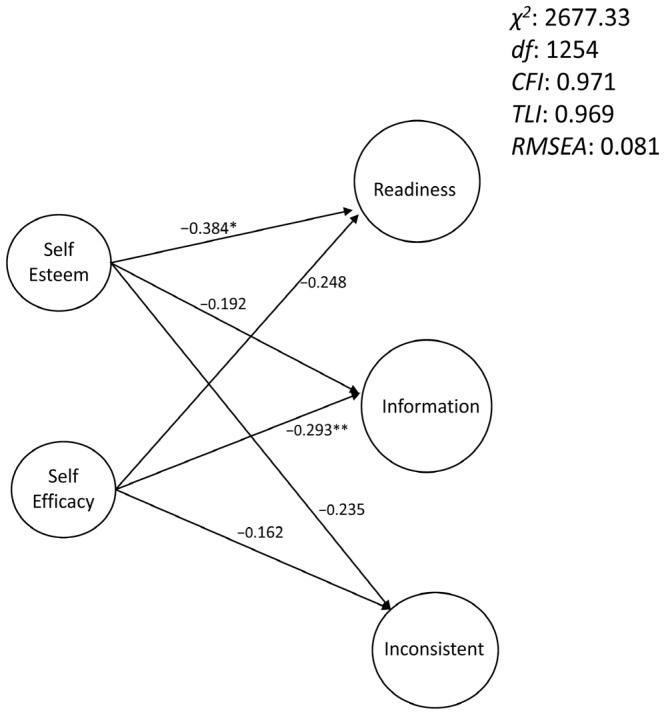
- The mediation of self-esteem through self-efficacy proposed by Rossier et al. was not confirmed: self-esteem had no significant direct effect on the three CDDQ dimensions, and indirect links through self-efficacy were also not significant. A simpler unmediated model showed direct effects of self-esteem on lack of readiness and of self-efficacy on lack of information.
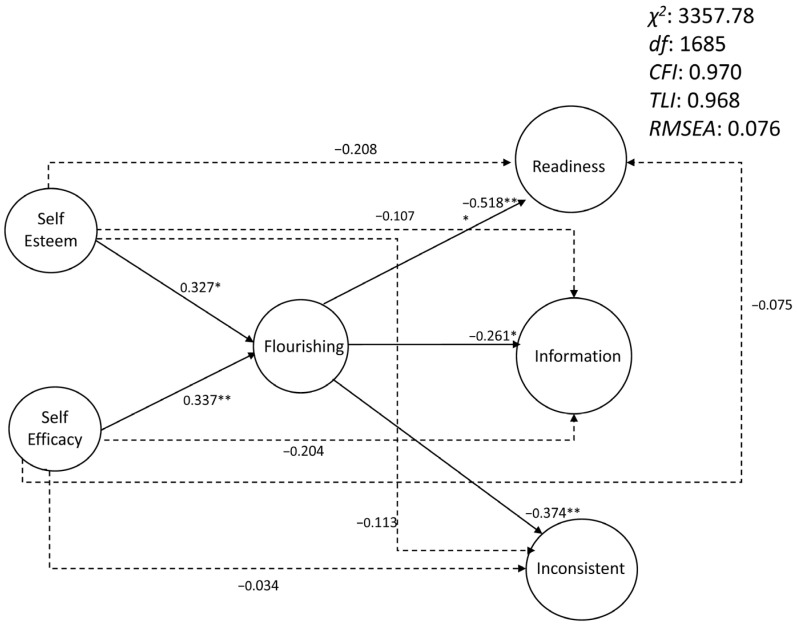
- H2 was confirmed: indirect effects between self-esteem and self-efficacy and all three career decision difficulties mediated by flourishing were significant. Self-esteem and self-efficacy were positively linked to flourishing (95% CIs [0.005, 0.648] and [0.080, 0.635]), and flourishing was negatively linked to lack of readiness [−0.653, −0.164], lack of information [−0.513, −0.067], and inconsistent information [−0.546, −0.96].
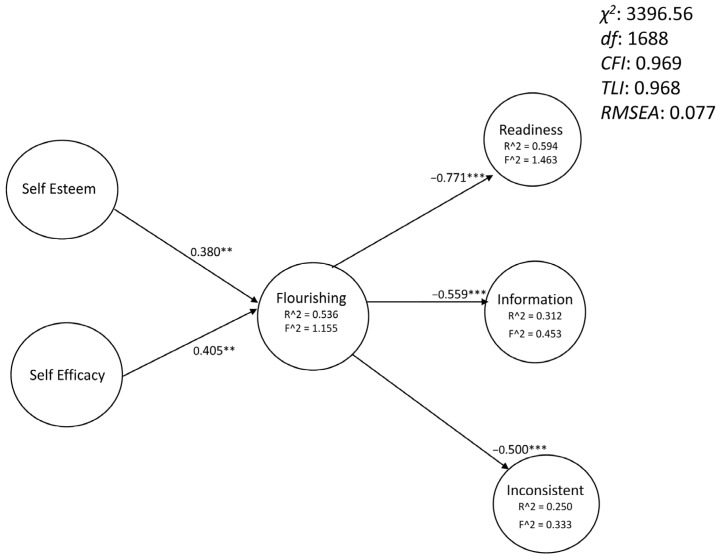
- Complementary PLS-SEM gave R² values of 0.377 for flourishing, 0.274 for readiness, 0.190 for information, and 0.178 for inconsistent information, indicating substantial to moderate effects.
Methods
- Participants were 172 higher education students (111 females [64.5%], 61 males [35.5%]; Mage = 23.88 years, SD = 4.29, range 18–41), mostly Luxembourgish (144) or French (28) nationality, at the University of Luxembourg and high schools offering higher academic education.
- They completed a four-part online questionnaire via LimeSurvey: the Career Decision-Making Difficulties Questionnaire (CDDQ), Flourishing Scale, Rosenberg Self-Esteem Scale, and General Self-Efficacy Scale. Only complete surveys were analyzed.
- Analyses used R packages Psych and Lavaan for descriptive/correlational statistics, confirmatory factor analyses, and structural equation modeling with polychoric correlation matrices and the DWLS estimator; bootstrapping tested direct and indirect effects. PLS-SEM with the cSEM package was used as a complementary analysis.
Limitations
- The paper states that the most important limitation is the number and characteristics of participants: 172 students from Luxembourg, the majority female. It also notes that the Luxembourg labor market is often perceived as specific, which may affect career projections and decisions, and that a larger sample could allow testing differential variables such as gender or type of study.
- Evident from the text: the design is observational and self-report, so causal direction cannot be established from the mediation models alone, even though the authors discuss mediation and an alternative inverted model.
- Evident from the text: the sample is limited to higher education students in Luxembourg/French contexts, restricting generalizability to other populations or labor markets.
Model-written summary. Check it against the paper before relying on it.
Integrity signals
Registry
Cites
Statistics
Figures
Verification
Claims the paper makes
19 Own result · 13 Check pending · 9 No full text of the sources · 8 Own interpretation · 7 Not checked yet · 6 Own method
A result the paper reports from its own data — it cites no other source for it, so there is none to check. The quote shows it is in the paper.
In the paper
“The links between self-esteem, self-efficacy, and flourishing are positive (respectively, 95% CI = [0.005, 0.648]; 95% CI = [0.080, 0.635]), and those between flourishing and decision difficulties are negative (lack of readiness: 95% CI = [−0.653, −0.164]; lack of information: 95% CI = [−0.513, −0.067]; difficulties related to Inconsistent Information: 95% CI = [−0.546, −0.96]).”
§ The Relationship between Self-Esteem, Self-Efficacy, and Career Decision-Making Difficulties: Psychological Flourishing as a Mediator > 3. Results > 3.3. Self-Esteem, Self-Efficacy, Career Decision-Making Difficulties, and Flourishing
plainstates an association- Asserted: passes — The authors put it forward as true.
- Checkable: passes — It can be checked against evidence.
- Load-bearing: passes — The paper’s conclusions depend on it.
- Based: passes — The paper gives a reason why it holds.
A result the paper reports from its own data — it cites no other source for it, so there is none to check. The quote shows it is in the paper.
In the paper
“The direct links between the three factors of career decision difficulties and self-esteem (lack of readiness: 95% CI = [−0.592, 0.174]; lack of information: 95% CI = [−0.399, 0.161]; difficulties related to inconsistent information: 95% CI = [−0.368, 0.225]) and self-efficacy (lack of readiness: 95% CI = [−0.470, 0.280]; lack of information: 95% CI = [−0.542, 0.077]; difficulties related to Incon”
§ The Relationship between Self-Esteem, Self-Efficacy, and Career Decision-Making Difficulties: Psychological Flourishing as a Mediator > 3. Results > 3.3. Self-Esteem, Self-Efficacy, Career Decision-Making Difficulties, and Flourishing
plain- Asserted: passes — The authors put it forward as true.
- Checkable: passes — It can be checked against evidence.
- Load-bearing: passes — The paper’s conclusions depend on it.
- Based: passes — The paper gives a reason why it holds.
A result the paper reports from its own data — it cites no other source for it, so there is none to check. The quote shows it is in the paper.
In the paper
“and the fact that those who are most flourishing in their lives will also have the least difficulty in making a career decision.”
§ The Relationship between Self-Esteem, Self-Efficacy, and Career Decision-Making Difficulties: Psychological Flourishing as a Mediator > Abstract
plainstates an association- Asserted: passes — The authors put it forward as true.
- Checkable: passes — It can be checked against evidence.
- Load-bearing: passes — The paper’s conclusions depend on it.
- Based: passes — The paper gives a reason why it holds.
A result the paper reports from its own data — it cites no other source for it, so there is none to check. The quote shows it is in the paper.
In the paper
“The indirect links through mediation of self-efficacy are also not significant (lack of readiness: 95% CI = [−0.592, 0.158]; lack of information: 95% CI = [−0.560, 0.014]; difficulties related to inconsistent information: 95% CI = [−0.416, 0.117]).”
- Also stated in: § 4. Discussion · plain
“Indeed, the links between self-esteem and career decision difficulties are not mediated by self-efficacy.”
§ The Relationship between Self-Esteem, Self-Efficacy, and Career Decision-Making Difficulties: Psychological Flourishing as a Mediator > 3. Results > 3.2. Self-Esteem, Self-Efficacy, and Career Decision-Making Difficulties
plain- Asserted: passes — The authors put it forward as true.
- Checkable: passes — It can be checked against evidence.
- Load-bearing: passes — The paper’s conclusions depend on it.
- Based: passes — The paper gives a reason why it holds.
- Also stated in: § 4. Discussion · plain
A result the paper reports from its own data — it cites no other source for it, so there is none to check. The quote shows it is in the paper.
In the paper
“In contrast, a simpler unmediated model shows direct effects of self-esteem on the dimension of lack of readiness and direct effects of self-efficacy on the dimension of lack of information.”
§ The Relationship between Self-Esteem, Self-Efficacy, and Career Decision-Making Difficulties: Psychological Flourishing as a Mediator > 3. Results > 3.2. Self-Esteem, Self-Efficacy, and Career Decision-Making Difficulties
plainstates a cause- Asserted: passes — The authors put it forward as true.
- Checkable: passes — It can be checked against evidence.
- Load-bearing: unclear — It is unclear whether the paper’s conclusions depend on it.
- Based: passes — The paper gives a reason why it holds.
A result the paper reports from its own data — it cites no other source for it, so there is none to check. The quote shows it is in the paper.
In the paper
“The links between self-esteem, self-efficacy, and flourishing are positive (respectively, 95% CI = [0.005, 0.648]; 95% CI = [0.080, 0.635]), and those between flourishing and decision difficulties are negative (lack of readiness: 95% CI = [−0.653, −0.164]; lack of information: 95% CI = [−0.513, −0.067]; difficulties related to Inconsistent Information: 95% CI = [−0.546, −0.96]).”
§ The Relationship between Self-Esteem, Self-Efficacy, and Career Decision-Making Difficulties: Psychological Flourishing as a Mediator > 3. Results > 3.3. Self-Esteem, Self-Efficacy, Career Decision-Making Difficulties, and Flourishing
plainstates an association- Asserted: passes — The authors put it forward as true.
- Checkable: passes — It can be checked against evidence.
- Load-bearing: passes — The paper’s conclusions depend on it.
- Based: passes — The paper gives a reason why it holds.
In the paper
“Only the correlation between the scores of self-esteem and self-efficacy is higher than in the previous study.”
§ The Relationship between Self-Esteem, Self-Efficacy, and Career Decision-Making Difficulties: Psychological Flourishing as a Mediator > 3. Results > 3.2. Self-Esteem, Self-Efficacy, and Career Decision-Making Difficulties
What the sources say
- Check pendingcites [8] Rossier, 2021, Validation of a French Version of the Career Decision-Making Difficulties Questionnaire: Relationships with Self-Esteem and Self-Efficacy, J. Career Dev. source
plainstates an association- Asserted: passes — The authors put it forward as true.
- Checkable: passes — It can be checked against evidence.
- Load-bearing: unclear — It is unclear whether the paper’s conclusions depend on it.
- Based: passes — The paper gives a reason why it holds.
A result the paper reports from its own data — it cites no other source for it, so there is none to check. The quote shows it is in the paper.
In the paper
“In contrast, the indirect effects between self-esteem and self-efficacy and the three career decision difficulties mediated by flourishing are significant.”
§ The Relationship between Self-Esteem, Self-Efficacy, and Career Decision-Making Difficulties: Psychological Flourishing as a Mediator > 3. Results > 3.3. Self-Esteem, Self-Efficacy, Career Decision-Making Difficulties, and Flourishing
plainstates an association- Asserted: passes — The authors put it forward as true.
- Checkable: passes — It can be checked against evidence.
- Load-bearing: passes — The paper’s conclusions depend on it.
- Based: passes — The paper gives a reason why it holds.
A result the paper reports from its own data — it cites no other source for it, so there is none to check. The quote shows it is in the paper.
In the paper
“The links between self-esteem, self-efficacy, and flourishing are positive (respectively, 95% CI = [0.005, 0.648]; 95% CI = [0.080, 0.635]), and those between flourishing and decision difficulties are negative (lack of readiness: 95% CI = [−0.653, −0.164]; lack of information: 95% CI = [−0.513, −0.067]; difficulties related to Inconsistent Information: 95% CI = [−0.546, −0.96]).”
§ The Relationship between Self-Esteem, Self-Efficacy, and Career Decision-Making Difficulties: Psychological Flourishing as a Mediator > 3. Results > 3.3. Self-Esteem, Self-Efficacy, Career Decision-Making Difficulties, and Flourishing
plainstates an association- Asserted: passes — The authors put it forward as true.
- Checkable: passes — It can be checked against evidence.
- Load-bearing: passes — The paper’s conclusions depend on it.
- Based: passes — The paper gives a reason why it holds.
A result the paper reports from its own data — it cites no other source for it, so there is none to check. The quote shows it is in the paper.
In the paper
“The results highlight the mediation of psychological flourishing between personality dimensions—self-esteem and self-efficacy—and career decision difficulties”
§ The Relationship between Self-Esteem, Self-Efficacy, and Career Decision-Making Difficulties: Psychological Flourishing as a Mediator > Abstract
plainstates a cause- Asserted: passes — The authors put it forward as true.
- Checkable: passes — It can be checked against evidence.
- Load-bearing: passes — The paper’s conclusions depend on it.
- Based: passes — The paper gives a reason why it holds.
- Rests on an assumption: The causal ordering in the mediation model is valid: self-esteem and self-efficacy influence psychological flourishing, which in turn influences career decision-making difficulties.
- Rests on an assumption: There are no unmeasured confounders of the relationships among self-esteem, self-efficacy, psychological flourishing, and career decision-making difficulties.
- It may state two separate claims as one. 16
- The quote only partly states this claim. 1
- Probably not a substantial claim. 19
A result the paper reports from its own data — it cites no other source for it, so there is none to check. The quote shows it is in the paper.
In the paper
“Using a PLS-SEM analysis, the results are confirmed with lower levels of variance explained for the variables in the model.”
§ The Relationship between Self-Esteem, Self-Efficacy, and Career Decision-Making Difficulties: Psychological Flourishing as a Mediator > 3. Results > 3.3. Self-Esteem, Self-Efficacy, Career Decision-Making Difficulties, and Flourishing
plain- Asserted: passes — The authors put it forward as true.
- Checkable: passes — It can be checked against evidence.
- Load-bearing: unclear — It is unclear whether the paper’s conclusions depend on it.
- Based: passes — The paper gives a reason why it holds.
It may state two separate claims as one.
In the paper
“Correlational results similar to those reported by these authors for their Swiss sample are found in the present study (see Table 2) and confirm its H1 hypothesis.”
§ The Relationship between Self-Esteem, Self-Efficacy, and Career Decision-Making Difficulties: Psychological Flourishing as a Mediator > 3. Results > 3.2. Self-Esteem, Self-Efficacy, and Career Decision-Making Difficulties
What the sources say
- Check pendingcites [8] Rossier, 2021, Validation of a French Version of the Career Decision-Making Difficulties Questionnaire: Relationships with Self-Esteem and Self-Efficacy, J. Career Dev. source
plainstates an association- Asserted: passes — The authors put it forward as true.
- Checkable: passes — It can be checked against evidence.
- Load-bearing: unclear — It is unclear whether the paper’s conclusions depend on it.
- Based: passes — The paper gives a reason why it holds.
It may state two separate claims as one.
In the paper
“With this analysis, the R2 values are as follows: Flourishing (0.377; f2:0.605), Readiness (0.274; f2:0.377), Information (0.190; f2:0.235), and Inconsistent (0.178; f2:0.216), indicating substantial to moderate effects [76].”
§ The Relationship between Self-Esteem, Self-Efficacy, and Career Decision-Making Difficulties: Psychological Flourishing as a Mediator > 3. Results > 3.3. Self-Esteem, Self-Efficacy, Career Decision-Making Difficulties, and Flourishing
What the sources say
- Not checked yetcites [76] Cohen, J. (1988). Statistical Power Analysis for the Behavioral Sciences, Lawrence Earlbaum Associates. [2nd ed.].
hedgedstates an association- Asserted: passes — The authors put it forward as true.
- Checkable: passes — It can be checked against evidence.
- Load-bearing: passes — The paper’s conclusions depend on it.
- Based: passes — The paper gives a reason why it holds.
It may state two separate claims as one.
A result the paper reports from its own data — it cites no other source for it, so there is none to check. The quote shows it is in the paper.
In the paper
“Indeed, although an inverted model in which the dependent variable would be flourishing could have been proposed, it turns out that the statistical analyses cannot validate this alternative structural proposal. The SEM analysis does not allow us to obtain a fit of the model for the data collected.”
§ The Relationship between Self-Esteem, Self-Efficacy, and Career Decision-Making Difficulties: Psychological Flourishing as a Mediator > 4. Discussion
plain- Asserted: passes — The authors put it forward as true.
- Checkable: passes — It can be checked against evidence.
- Load-bearing: passes — The paper’s conclusions depend on it.
- Based: passes — The paper gives a reason why it holds.
It may state two separate claims as one.
A result the paper reports from its own data — it cites no other source for it, so there is none to check. The quote shows it is in the paper.
In the paper
“Using another method of analysis (polychoric correlations and DWLS estimator), our results do not confirm these previous findings.”
§ The Relationship between Self-Esteem, Self-Efficacy, and Career Decision-Making Difficulties: Psychological Flourishing as a Mediator > 4. Discussion
plain- Asserted: passes — The authors put it forward as true.
- Checkable: passes — It can be checked against evidence.
- Load-bearing: passes — The paper’s conclusions depend on it.
- Based: passes — The paper gives a reason why it holds.
The quote only partly states this claim.
In the paper
“Later, in a paper presenting the validation of the French version of the CDDQ, Rossier et al. [8] showed that self-efficacy moderates the negative link between self-esteem and career decision difficulties.”
§ The Relationship between Self-Esteem, Self-Efficacy, and Career Decision-Making Difficulties: Psychological Flourishing as a Mediator > 1. Introduction > 1.2. Linking Career Decision-Making Difficulties, Self-Esteem, and Self-Efficacy
What the sources say
- Check pendingcites [8] Rossier, 2021, Validation of a French Version of the Career Decision-Making Difficulties Questionnaire: Relationships with Self-Esteem and Self-Efficacy, J. Career Dev. source
plainstates an association- Asserted: passes — The authors put it forward as true.
- Checkable: passes — It can be checked against evidence.
- Load-bearing: fails — The paper’s conclusions may not depend on it.
- Based: passes — The paper gives a reason why it holds.
Probably not a substantial claim. The paper’s conclusions may not depend on it.
A conclusion the paper draws from its own results — it cites no other source for it, so there is none to check. The quote shows it is in the paper.
In the paper
“These results confirm the H2 hypothesis of the present study.”
§ The Relationship between Self-Esteem, Self-Efficacy, and Career Decision-Making Difficulties: Psychological Flourishing as a Mediator > 3. Results > 3.3. Self-Esteem, Self-Efficacy, Career Decision-Making Difficulties, and Flourishing
plain- Asserted: passes — The authors put it forward as true.
- Checkable: passes — It can be checked against evidence.
- Load-bearing: passes — The paper’s conclusions depend on it.
- Based: passes — The paper gives a reason why it holds.
Probably not a substantial claim.
In the paper
“Positive affect, health, and well-being are thus essential conditions for career decision-making [9,11,41,46,49].”
§ The Relationship between Self-Esteem, Self-Efficacy, and Career Decision-Making Difficulties: Psychological Flourishing as a Mediator > 1. Introduction > 1.3. Examining the Relationship between Career Decision-Making Difficulties, Self-Esteem, Self-Efficacy, and Well-Being
What the sources say
- Not checked — no full text of the sourcecites [9] Saka, 2007, Emotional and Personality-Related Aspects of Persistent Career Decision-Making Difficulties, J. Vocat. Behav. source
- Not checked — no full text of the sourcecites [11] Walker, 2012, Career Thoughts, Indecision, and Depression: Implications for Mental Health Assessment in Career Counseling, J. Career Assess. source
- Not checked — no full text of the sourcecites [41] Andrews, 2011, Explaining Career Decision-Making Self-Efficacy: Personality, Cognitions, and Cultural Mistrust, Career Dev. Q. source
- Check pendingcites [46] Creed, 2018, Vocational Identity and Career Progress: The Intervening Variables of Career Calling and Willingness to Compromise, J. Career Dev. source
- Check pendingcites [49] Park, 2018, The Relationships of Self-Esteem, Future Time Perspective, Positive Affect, Social Support, and Career Decision: A Longitudinal Multilevel Study, Front. Psychol. source
plainstates a cause- Asserted: passes — The authors put it forward as true.
- Checkable: passes — It can be checked against evidence.
- Load-bearing: passes — The paper’s conclusions depend on it.
- Based: passes — The paper gives a reason why it holds.
It may state two separate claims as one.
A conclusion the paper draws from its own results — it cites no other source for it, so there is none to check. The quote shows it is in the paper.
In the paper
“In our area, it appears again that psychological flourishing is an illuminating concept for a better understanding of career decision-making difficulties.”
§ The Relationship between Self-Esteem, Self-Efficacy, and Career Decision-Making Difficulties: Psychological Flourishing as a Mediator > 1. Introduction > 1.4. Considering the Contribution of Positive Psychology
hedgedstates an association- Asserted: passes — The authors put it forward as true.
- Checkable: fails — It may be too vague to check against evidence.
- Load-bearing: passes — The paper’s conclusions depend on it.
- Based: passes — The paper gives a reason why it holds.
Probably not a substantial claim. It may be too vague to check against evidence.
In the paper
“The French version of this scale has been validated and used in several Canadian studies [67].”
§ The Relationship between Self-Esteem, Self-Efficacy, and Career Decision-Making Difficulties: Psychological Flourishing as a Mediator > 2. Materials and Methods > 2.2. Measures
What the sources say
- Not checked yetcites [67] Dumont, M., Schwarzer, R., and Jerusalem, M. (2023, August 02). French Adaptation of the General Self-Efficacy Scale. Available online: http://userpage.fu-berlin.de/~health/french.htm.
plain- Asserted: passes — The authors put it forward as true.
- Checkable: passes — It can be checked against evidence.
- Load-bearing: fails — The paper’s conclusions may not depend on it.
- Based: passes — The paper gives a reason why it holds.
Probably not a substantial claim. The paper’s conclusions may not depend on it. It may state two separate claims as one.
In the paper
“For example, Gati and Saka [59] showed internal consistency values of alpha = 0.91 for the full scale and the following values for each of the sub-dimensions respectively: alpha = 0.62 (lack of readiness), alpha = 0.88 (lack of information), and alpha = 0.87 (inconsistent information).”
§ The Relationship between Self-Esteem, Self-Efficacy, and Career Decision-Making Difficulties: Psychological Flourishing as a Mediator > 2. Materials and Methods > 2.2. Measures
What the sources say
- Not checked — no full text of the sourcecites [59] Gati, 2001, High school students’ career-related decision-making difficulties, J. Couns. Dev. source
plain- Asserted: passes — The authors put it forward as true.
- Checkable: passes — It can be checked against evidence.
- Load-bearing: unclear — It is unclear whether the paper’s conclusions depend on it.
- Based: passes — The paper gives a reason why it holds.
It may state two separate claims as one.
In the paper
“In samples from 23 nations, Cronbach’s alphas range from 0.76 to 0.90, with the majority in the 0.80.”
§ The Relationship between Self-Esteem, Self-Efficacy, and Career Decision-Making Difficulties: Psychological Flourishing as a Mediator > 2. Materials and Methods > 2.2. Measures
What the sources say
- Not checked yetcites [65] Weinman, J., Wright, S., and Johnston, M. (1995). Measures in Health Psychology: A User’s Portfolio. Causal and Control Beliefs, NFER-NELSON.
plain- Asserted: passes — The authors put it forward as true.
- Checkable: passes — It can be checked against evidence.
- Load-bearing: fails — The paper’s conclusions may not depend on it.
- Based: passes — The paper gives a reason why it holds.
Probably not a substantial claim. The paper’s conclusions may not depend on it.
A claim is checked only against the cited paper’s full text, never its abstract, and none is available for its sources.
In the paper
“In order to respect the level of measurement of the proposed constructs in the form of Likert-type scales, the analyses were based on polychoric correlation matrices [69] using the SEM diagonally weighted least squares (DWLS) estimator [70].”
§ The Relationship between Self-Esteem, Self-Efficacy, and Career Decision-Making Difficulties: Psychological Flourishing as a Mediator > 2. Materials and Methods > 2.3. Procedure
What the sources say
- Not checked — no full text of the sourcecites [69] Carroll, 1961, The nature of the data, or how to choose a correlation coefficient, Psychometrika source
- Not checked — no full text of the sourcecites [70] 1984, A general structural equation model with dichotomous, ordered categorical, and continuous latent variable indicators, Psychometrika source
plain- Asserted: passes — The authors put it forward as true.
- Checkable: passes — It can be checked against evidence.
- Load-bearing: passes — The paper’s conclusions depend on it.
- Based: passes — The paper gives a reason why it holds.
Probably not a substantial claim.
In the paper
“While indecision refers to the inability to make a career decision [2] that nevertheless seems to correspond to a normal, temporary developmental phase, indecisiveness refers to a personality trait [5,7,9,14].”
§ The Relationship between Self-Esteem, Self-Efficacy, and Career Decision-Making Difficulties: Psychological Flourishing as a Mediator > 1. Introduction > 1.1. Understanding Career Decision-Making Difficulties
What the sources say
- Not checked — no full text of the sourcecites [2] Gati, 1996, A taxonomy of difficulties in career decision making, J. Couns. Psychol. source
- Not checked — no full text of the sourcecites [5] Gati, 2010, From Career Decision-Making Styles to Career Decision-Making Profiles: A Multidimensional Approach, J. Vocat. Behav. source
- Check pendingcites [7] Palazzeschi, 2015, The Role of Personality in the Career Decision-Making Difficulties of Italian Young Adults, J. Career Assess. source
- Not checked — no full text of the sourcecites [9] Saka, 2007, Emotional and Personality-Related Aspects of Persistent Career Decision-Making Difficulties, J. Vocat. Behav. source
- Not checked — no full text of the sourcecites [14] Palazzeschi, 2013, Career indecision versus indecisiveness: Associations with personality traits and emotional intelligence, J. Career Assess. source
hedged- Asserted: passes — The authors put it forward as true.
- Checkable: passes — It can be checked against evidence.
- Load-bearing: fails — The paper’s conclusions may not depend on it.
- Based: passes — The paper gives a reason why it holds.
Probably not a substantial claim. The paper’s conclusions may not depend on it. It may state two separate claims as one.
In the paper
“The French version was used in the present study [64]. It has an internal consistency between alpha = 0.83 and 0.90 and a test-retest stability index of 0.84.”
§ The Relationship between Self-Esteem, Self-Efficacy, and Career Decision-Making Difficulties: Psychological Flourishing as a Mediator > 2. Materials and Methods > 2.2. Measures
What the sources say
- Not checked — no full text of the sourcecites [64] Vallieres, 1990, Traduction et validation canadienne-française de l’échelle de l’estime de soi de Rosenberg, Int. J. Psychol. source
plain- Asserted: passes — The authors put it forward as true.
- Checkable: passes — It can be checked against evidence.
- Load-bearing: fails — The paper’s conclusions may not depend on it.
- Based: passes — The paper gives a reason why it holds.
Probably not a substantial claim. The paper’s conclusions may not depend on it. It may state two separate claims as one.
In the paper
“Indeed, self-esteem could be considered a personality trait whereas subjective self-efficacy would be more contextual and dependent on expectations and adjustment [8,27].”
§ The Relationship between Self-Esteem, Self-Efficacy, and Career Decision-Making Difficulties: Psychological Flourishing as a Mediator > 4. Discussion
What the sources say
- Check pendingcites [8] Rossier, 2021, Validation of a French Version of the Career Decision-Making Difficulties Questionnaire: Relationships with Self-Esteem and Self-Efficacy, J. Career Dev. source
- Not checked — no full text of the sourcecites [27] Nota, L., and Rossier, J. (2015). Handbook of Life Design: From Practice to Theory and from Theory to Practice, Hogrefe. source
hedged- Asserted: passes — The authors put it forward as true.
- Checkable: passes — It can be checked against evidence.
- Load-bearing: fails — The paper’s conclusions may not depend on it.
- Based: passes — The paper gives a reason why it holds.
Probably not a substantial claim. The paper’s conclusions may not depend on it. It may state two separate claims as one.
In the paper
“The French version of this scale was used in the present study. It has good psychometric properties, and factor analyses have confirmed its unidimensional factor structure [63].”
§ The Relationship between Self-Esteem, Self-Efficacy, and Career Decision-Making Difficulties: Psychological Flourishing as a Mediator > 2. Materials and Methods > 2.2. Measures
What the sources say
- Not checked — no full text of the sourcecites [63] Villieux, 2016, Psychological flourishing: Validation of the French version of the Flourishing Scale and exploration of its relationships with personality traits, Personal. Individ. Differ. source
plain- Asserted: passes — The authors put it forward as true.
- Checkable: passes — It can be checked against evidence.
- Load-bearing: passes — The paper’s conclusions depend on it.
- Based: passes — The paper gives a reason why it holds.
It may state two separate claims as one.
In the paper
“This scale is one of the most widely used ones to measure this psychological construct, and it has an internal consistency of alpha = 0.88.”
§ The Relationship between Self-Esteem, Self-Efficacy, and Career Decision-Making Difficulties: Psychological Flourishing as a Mediator > 2. Materials and Methods > 2.2. Measures
What the sources say
- Not checked yetcites [28] Rosenberg, M. (1979). Conceiving the Self, Basic Books.
plain- Asserted: passes — The authors put it forward as true.
- Checkable: passes — It can be checked against evidence.
- Load-bearing: fails — The paper’s conclusions may not depend on it.
- Based: passes — The paper gives a reason why it holds.
Probably not a substantial claim. The paper’s conclusions may not depend on it.
In the paper
“The scale, composed of 8 items ranging from 1 (strongly disagree) to 7 (strongly agree), demonstrates very good psychometric qualities with a consistency of 0.87, temporal stability of 0.71, and inter-item correlations between 0.57 and 0.71.”
§ The Relationship between Self-Esteem, Self-Efficacy, and Career Decision-Making Difficulties: Psychological Flourishing as a Mediator > 2. Materials and Methods > 2.2. Measures
What the sources say
- Not checked — no full text of the sourcecites [62] Diener, E. (2009). The Science of Well-Being, Springer. source
boosted- Asserted: passes — The authors put it forward as true.
- Checkable: passes — It can be checked against evidence.
- Load-bearing: unclear — It is unclear whether the paper’s conclusions depend on it.
- Based: passes — The paper gives a reason why it holds.
It may state two separate claims as one.
In the paper
“The results obtained in their study further clarify the relationship between the three concepts by showing that “self-efficacy partially mediated the relationship between self-esteem and career decision-making difficulties” (p. 10).”
§ The Relationship between Self-Esteem, Self-Efficacy, and Career Decision-Making Difficulties: Psychological Flourishing as a Mediator > 1. Introduction > 1.2. Linking Career Decision-Making Difficulties, Self-Esteem, and Self-Efficacy
What the sources say
- Check pendingcites [8] Rossier, 2021, Validation of a French Version of the Career Decision-Making Difficulties Questionnaire: Relationships with Self-Esteem and Self-Efficacy, J. Career Dev. source
plainstates a cause- Asserted: passes — The authors put it forward as true.
- Checkable: passes — It can be checked against evidence.
- Load-bearing: fails — The paper’s conclusions may not depend on it.
- Based: passes — The paper gives a reason why it holds.
Probably not a substantial claim. The paper’s conclusions may not depend on it.
In the paper
“In their article, Rossier et al. [8] highlighted negative correlations between the general career decision difficulties score or the three subscores of this scale (lack of readiness, lack of information, and difficulties related to inconsistent information) and self-esteem and self-efficacy.”
§ The Relationship between Self-Esteem, Self-Efficacy, and Career Decision-Making Difficulties: Psychological Flourishing as a Mediator > 3. Results > 3.2. Self-Esteem, Self-Efficacy, and Career Decision-Making Difficulties
What the sources say
- Check pendingcites [8] Rossier, 2021, Validation of a French Version of the Career Decision-Making Difficulties Questionnaire: Relationships with Self-Esteem and Self-Efficacy, J. Career Dev. source
plainstates an association- Asserted: passes — The authors put it forward as true.
- Checkable: passes — It can be checked against evidence.
- Load-bearing: passes — The paper’s conclusions depend on it.
- Based: passes — The paper gives a reason why it holds.
Probably not a substantial claim.
What the paper did — it cites no source for this, so there is none to check. The quote shows it is in the paper.
In the paper
“None of the SEM analyses were based on composite scores, and the differential structural analyses of direct and indirect effects were performed using the bootstrapping method.”
§ The Relationship between Self-Esteem, Self-Efficacy, and Career Decision-Making Difficulties: Psychological Flourishing as a Mediator > 2. Materials and Methods > 2.3. Procedure
plain- Asserted: passes — The authors put it forward as true.
- Checkable: passes — It can be checked against evidence.
- Load-bearing: fails — The paper’s conclusions may not depend on it.
- Based: passes — The paper gives a reason why it holds.
Probably not a substantial claim. The paper’s conclusions may not depend on it. It may state two separate claims as one.
What the paper did — it cites no source for this, so there is none to check. The quote shows it is in the paper.
In the paper
“Additionally, the Luxembourg Agency for Research Integrity specified that according to Code de la santé publique, Article L1123-7, research does not require Research Ethics Committee (Les Comités de Protection des Personnes) approval if it is non- biomedical, non-interventional, and observational, and if does not collect personal health information. Therefore, CNR approval was not required.”
§ The Relationship between Self-Esteem, Self-Efficacy, and Career Decision-Making Difficulties: Psychological Flourishing as a Mediator > 2. Materials and Methods > 2.3. Procedure
plain- Asserted: passes — The authors put it forward as true.
- Checkable: passes — It can be checked against evidence.
- Load-bearing: fails — The paper’s conclusions may not depend on it.
- Based: passes — The paper gives a reason why it holds.
Probably not a substantial claim. The paper’s conclusions may not depend on it. It may state two separate claims as one.
In the paper
“Since 1996, Gati et al. [2] have pointed out that choosing a career is among the most complex and important decisions that individuals face in life.”
§ The Relationship between Self-Esteem, Self-Efficacy, and Career Decision-Making Difficulties: Psychological Flourishing as a Mediator > 1. Introduction
What the sources say
- Not checked — no full text of the sourcecites [2] Gati, 1996, A taxonomy of difficulties in career decision making, J. Couns. Psychol. source
plain- Asserted: passes — The authors put it forward as true.
- Checkable: fails — It may be too vague to check against evidence.
- Load-bearing: fails — The paper’s conclusions may not depend on it.
- Based: passes — The paper gives a reason why it holds.
Probably not a substantial claim. It may be too vague to check against evidence. The paper’s conclusions may not depend on it.
In the paper
“In their article, Rossier et al. [8] hypothesized and verified that the effects of self-esteem on career decision difficulties are partially mediated by self-efficacy.”
§ The Relationship between Self-Esteem, Self-Efficacy, and Career Decision-Making Difficulties: Psychological Flourishing as a Mediator > 4. Discussion
What the sources say
- Check pendingcites [8] Rossier, 2021, Validation of a French Version of the Career Decision-Making Difficulties Questionnaire: Relationships with Self-Esteem and Self-Efficacy, J. Career Dev. source
plainstates a cause- Asserted: passes — The authors put it forward as true.
- Checkable: passes — It can be checked against evidence.
- Load-bearing: fails — The paper’s conclusions may not depend on it.
- Based: passes — The paper gives a reason why it holds.
Probably not a substantial claim. The paper’s conclusions may not depend on it.
What the paper did — it cites no source for this, so there is none to check. The quote shows it is in the paper.
In the paper
“Only complete surveys were used for the analyses.”
§ The Relationship between Self-Esteem, Self-Efficacy, and Career Decision-Making Difficulties: Psychological Flourishing as a Mediator > 2. Materials and Methods > 2.3. Procedure
plain- Asserted: passes — The authors put it forward as true.
- Checkable: passes — It can be checked against evidence.
- Load-bearing: fails — The paper’s conclusions may not depend on it.
- Based: passes — The paper gives a reason why it holds.
Probably not a substantial claim. The paper’s conclusions may not depend on it.
In the paper
“The structural analysis of the CDDQ on a sample of Luxembourg students confirms the results recently highlighted by Rossier et al. [8] and reinforces their conclusions on the appropriateness of the Francophone version of this scale by adding a country not taken into account in their study.”
§ The Relationship between Self-Esteem, Self-Efficacy, and Career Decision-Making Difficulties: Psychological Flourishing as a Mediator > 4. Discussion
What the sources say
- Check pendingcites [8] Rossier, 2021, Validation of a French Version of the Career Decision-Making Difficulties Questionnaire: Relationships with Self-Esteem and Self-Efficacy, J. Career Dev. source
plain- Asserted: passes — The authors put it forward as true.
- Checkable: passes — It can be checked against evidence.
- Load-bearing: unclear — It is unclear whether the paper’s conclusions depend on it.
- Based: passes — The paper gives a reason why it holds.
It may state two separate claims as one.
In the paper
“The development of positive emotions is all the more interesting because, as Fredrickson [87] explains, they are beneficial both in the short term and in the longer term, as their favorable effect continues over time.”
§ The Relationship between Self-Esteem, Self-Efficacy, and Career Decision-Making Difficulties: Psychological Flourishing as a Mediator > 4. Discussion
What the sources say
- Not checked yetcites [87] Fredrickson, 2001, The Role of Positive Emotions in Positive Psychology, Am. Psychol. source
plainstates a cause- Asserted: passes — The authors put it forward as true.
- Checkable: passes — It can be checked against evidence.
- Load-bearing: fails — The paper’s conclusions may not depend on it.
- Based: passes — The paper gives a reason why it holds.
Probably not a substantial claim. The paper’s conclusions may not depend on it. It may state two separate claims as one.
What the paper did — it cites no source for this, so there is none to check. The quote shows it is in the paper.
In the paper
“Like any study, this one has its limitations. The most important one is the number and characteristics of the participants: 172 students from Luxembourg, the majority of them female.”
§ The Relationship between Self-Esteem, Self-Efficacy, and Career Decision-Making Difficulties: Psychological Flourishing as a Mediator > 4. Discussion
plain- Asserted: passes — The authors put it forward as true.
- Checkable: passes — It can be checked against evidence.
- Load-bearing: fails — The paper’s conclusions may not depend on it.
- Based: passes — The paper gives a reason why it holds.
Probably not a substantial claim. The paper’s conclusions may not depend on it.
The paper relies on this without support.
Participants in the study provided honest and accurate responses to the self-report questionnaires.
“The self-assessment questionnaires were administered via the LimeSurvey platform.”
The paper relies on this without support.
The causal ordering in the mediation model is valid: self-esteem and self-efficacy influence psychological flourishing, which in turn influences career decision-making difficulties.
“we hypothesize that the relationship between self-esteem and self-efficacy and the three career decision difficulties is mediated by flourishing (H2).”
The paper relies on this without support.
There are no unmeasured confounders of the relationships among self-esteem, self-efficacy, psychological flourishing, and career decision-making difficulties.
“we hypothesize that the relationship between self-esteem and self-efficacy and the three career decision difficulties is mediated by flourishing (H2).”
The paper relies on this without support.
The relationships among self-esteem, self-efficacy, flourishing, and career decision difficulties are causally ordered as modeled (self-esteem/self-efficacy → flourishing → difficulties), not merely correlational.
“The conclusion is that those who are most flourishing in their lives will also have the least difficulty in making career choices.”
Citations
Cites
Hu, L., & Bentler, P. M. (1999) · Structural Equation Modeling A Multidisciplinary Journal · doi:10.1080/10705519909540118 · Cited by 108,788
When to Use and How to Report the Results of PLS-SEM
Hair, J. F., Risher, J. J., Sarstedt, M., & Ringle, C. M. (2019) · European Business Review · doi:10.1108/ebr-11-2018-0203 · Cited by 27,541
Fredrickson, B. L. (2001) · American Psychologist · doi:10.1037//0003-066x.56.3.218 · Cited by 18,025
Positive psychology: An introduction.
Seligman, M. E. P., & Csikszentmihalyi, M. (2000) · American Psychologist · doi:10.1037/0003-066x.55.1.5 · Cited by 11,351
Toward a Unifying Social Cognitive Theory of Career and Academic Interest, Choice, and Performance.
Lent, R. W., Brown, S. D., & Hackett, G. (1994) · Journal of Vocational Behavior · doi:10.1006/jvbe.1994.1027 · Cited by 7,715
Perceived self-efficacy in cognitive development and functioning
Bandura, A. (1993) · Educational Psychologist · doi:10.1207/s15326985ep2802_3 · Cited by 7,655
The mental health continuum: from languishing to flourishing in life.
Keyes, C. L. M. (2002) · Journal of Health and Social Behavior · doi:10.2307/3090197 · Cited by 5,133 · cited 2×
“Thus, the rather recent concept of flourishing [55–57] as an integrative notion incorporating different components mentioned above is particularly relevant to better understand the relations and correlations between self-evaluation, well-being, and career decision-making.”
BackgroundNew well-being measures: Short scales to assess flourishing and positive and negative feelings
Diener, E., Wirtz, D., Tov, W., Kim-Prieto, C., Choi, D.-W., Oishi, S., & Biswas-Diener, R. (2010) · Social Indicators Research · doi:10.1007/s11205-009-9493-y · Cited by 4,980
Wolf, E. J., Harrington, K. M., Clark, S. L., & Miller, M. W. (2013) · Educational and Psychological Measurement · doi:10.1177/0013164413495237 · Cited by 3,931
Judge, T. A., & Bono, J. E. (2001) · Journal of Applied Psychology · doi:10.1037/0021-9010.86.1.80 · Cited by 3,436
Research works printed but not linked: 3
- Massoudi, 2008, Assessing the effects of career counseling: The influence of working alliance and individual characteristics, Prat. Psychol., 14, 117
- Kline, R. (2011). Principles and Practice of Structural Equation Modeling, Guilford Press. [3rd ed.].
- Wold, H.O.A., and Jöreskog, K.G. (1982). Systems under Indirect Observation, Elsevier.
Cited by
Sorted by citations
Active Gamification in the Emotional Well-Being and Social Skills of Primary Education Students
Carcelén‐Fraile, M. D. C. (2025) · Education Sciences · doi:10.3390/educsci15020212 · Cited by 37
Gender, Self-Efficacy, and Academic Performance: Evidence in Business Education Program
Moraga, A., Salvo-Garrido, S. I., & Ortiz-Cea, V. (2025) · Behavioral Sciences · doi:10.3390/bs15050563 · Cited by 32
Sadowski, I., Meilleur-Bédard, M., & Khoury, B. (2025) · Clinical Gerontologist · doi:10.1080/07317115.2025.2482089 · Cited by 17
He, M., Li, Y., Hu, H. Z., Yu, Z., Cai, C., Cheng, Y., Ma, L., & Liu, S. (2024) · Frontiers in Psychology · doi:10.3389/fpsyg.2024.1484708 · Cited by 15
Rachmawati, D., Sahid, S., & Mahmud, M. I. (2024) · Journal on Efficiency and Responsibility in Education and Science · doi:10.7160/eriesj.2024.170403 · Cited by 12
Zhou, D., Zhou, H., & Jiang, M. (2025) · Chinese Education & Society · doi:10.1080/10611932.2025.2465524 · Cited by 9
Global self-esteem and coping with stress by Polish students during the COVID-19 pandemic
Kupcewicz, E., Cybulska, A. M., Schneider-Matyka, D., Jastrzębski, P., Bentkowska, A., & Grochans, E. (2024) · Frontiers in Public Health · doi:10.3389/fpubh.2024.1419771 · Cited by 8
Geremias, R. L., Cavaco, L., & Sotomayor, A. M. (2025) · Administrative Sciences · doi:10.3390/admsci15030093 · Cited by 7
Abina, A., Kovačič, D., Prucnal, M., Kiratzouli, V., & Zidanšek, A. (2025) · Sustainability · doi:10.3390/su17020412 · Cited by 7
Fang, Y., Xu, T., Hong, S., Li, C., Sun, Q., Gou, H., & Wen, Z. (2025) · Frontiers in Psychology · doi:10.3389/fpsyg.2025.1693354 · Cited by 5
Du, B., Wang, J., Qian, Y., & Cheng, J. (2024) · Journal of Infrastructure Policy and Development · doi:10.24294/jipd.v8i8.8399 · Cited by 5
Hareebin, Y., Arbaoui, B., & O-manee, Y. (2024) · International Journal of Power Electronics and Drive Systems/International Journal of Electrical and Computer Engineering · doi:10.11591/ijece.v14i6.pp6699-6710 · Cited by 5
Nakakita, M., Oya, S., Kubota, N., Toyabe, T., & Nakatsuma, T. (2025) · European Journal of Investigation in Health Psychology and Education · doi:10.3390/ejihpe15050078 · Cited by 4
Chang, H., Yan, G., Guo, J., & Caifu, W. U. (2026) · Frontiers in Psychology · doi:10.3389/fpsyg.2026.1768003 · Cited by 4
Visual metaphors of self-worth and resilience among Caribbean youth community art therapy
Donald, K., Lin, C., Morgan, K., Butler, A., Bach, S., & García, E. (2025) · International Journal of Art Therapy · doi:10.1080/17454832.2025.2548222 · Cited by 3
Pengaruh keluarga dan efikasi diri dalam membuat keputusan karier: Mediasi identitas vokasi
Dwiyanthi, P. N., Rostiana, A., & Riasnugrahani, M. (2025) · Jurnal Psikologi Ulayat · doi:10.24854/jpu1038 · Cited by 3
Ticao, N. L. (2026) · Environment and Social Psychology · doi:10.59429/esp.v11i1.4301 · Cited by 3
Liu, S., Ping, Z., Fan, C., Mo, Y., & Wang, Y. (2026) · Frontiers in Psychology · doi:10.3389/fpsyg.2026.1710494 · Cited by 3
Lu, H., Ren, Z., Meng, X., Sun, J., & Wu, Y. (2026) · Journal of Youth and Adolescence · doi:10.1007/s10964-026-02338-5 · Cited by 3
Nisa, P., & Padmalia, M. (2024) · JMBI UNSRAT (Jurnal Ilmiah Manajemen Bisnis dan Inovasi Universitas Sam Ratulangi) · doi:10.35794/jmbi.v11i1.53071 · Cited by 3
Ntini, P., & Kappo-Abidemi, C. (2025) · International Journal of Learning Teaching and Educational Research · doi:10.26803/ijlter.24.3.36 · Cited by 3
Ishibashi, S., Tamura, K., Goma, A., Yamamoto, K., & Masumoto, K. (2025) · arXiv (Cornell University) · doi:10.48550/arxiv.2511.21164 · Cited by 3
The Development and Validation of the Postgraduate School Application Outcome Expectations Scale
Rowe-Johnson, M., Chavez, A., & Rice, A. J. (2025) · Journal of Career Assessment · doi:10.1177/10690727251329341 · Cited by 2
Desarrollo de las Competencias Socioemocionales para Trabajar la Democracia y la Paz
Nevado-Luna, J. M., Díaz, M. S. D. V., Sánchez, F. S., & Molano, A. H. (2025) · Revista Internacional de Educación para la Justicia Social · doi:10.15366/riejs2025.14.1.013 · Cited by 2
Putri, B. S., Oktafiani, R., Sabila, N. U., & Djoa, D. D. (2025) · Women Education and Social Welfare · doi:10.70211/wesw.v2i1.298 · Cited by 2
Nabayinda, J., Ssewamala, F. M., Kizito, S., Nabunya, P., Namatovu, P., Neilands, T. B., & McKay, M. M. (2025) · Children and Youth Services Review · doi:10.1016/j.childyouth.2025.108729 · Cited by 2
Zhou, H., Huang, L., Fu, Z., Li, L., Huang, Z., Zhang, J., Tang, M., Wang, X., Sui, W., & Zhuang, Y. (2026) · Frontiers in Medicine · doi:10.3389/fmed.2025.1644508 · Cited by 2
Musood, T., & Kaur, B. (2025) · MIER Journal of Educational Studies Trends & Practices · doi:10.52634/mier/2025/v15/i1/2820 · Cited by 2
Urban, B., & Ratsimanetrimanana, R. (2025) · Journal of Small Business & Entrepreneurship · doi:10.1080/08276331.2025.2498314 · Cited by 2
Women Seafarer Indecision: Staying or Leaving?
Hermawati, R., Dwiatmadja, C., Sugiarto, A., & Suharti, L. (2024) · Journal of Ecohumanism · doi:10.62754/joe.v3i8.5571 · Cited by 1
Furtado, C., & Lakshmipriya, E. (2025) · International Journal For Multidisciplinary Research · doi:10.36948/ijfmr.2025.v07i02.40910 · Cited by 1
THE INFLUENCE OF CAREER ANXIETY ON PSYCHOLOGICAL WELL-BEING OF UNIVERSITY STUDENTS FINAL LEVEL
Qamariyah, V., & Khair, N. (2024) · Living Sufism Journal of Sufism and Psychotherapy · doi:10.59005/ls.v3i2.578 · Cited by 1
Koo, H., Ishihara, K., Kanejima, Y., Nakatani, M., & Izawa, K. P. (2025) · Psychiatry International · doi:10.3390/psychiatryint6020062 · Cited by 1
Reflection in the mirror: from seeing “Yourself” to perceiving your “Employability”
Kertechian, K. S. (2025) · Current Psychology · doi:10.1007/s12144-025-08204-0 · Cited by 1
Sa’adun, N. F., Mahmud, M. I., & Mansor, A. Z. (2025) · International Journal of Academic Research in Business and Social Sciences · doi:10.6007/ijarbss/v15-i8/26332 · Cited by 1
Unlocking career choices: The role of Self-Efficacy Final-Year Students Decision Making
Hermawan, M. G., & Novita, M. P. (2025) · Psikoborneo Jurnal Ilmiah Psikologi · doi:10.30872/psikoborneo.v13i3.19395 · Cited by 1
Assessment of Disaster Management Competency and Response Self-Competency of Nurses
Çol, B. K., Başaran, A. G., Köse, B. G., Turan, D., Kuyumcu, Ö. B., & Bakir, N. K. (2025) · Gümüşhane Üniversitesi Sağlık Bilimleri Dergisi · doi:10.37989/gumussagbil.1727578 · Cited by 1
Zhao, X., Wang, Y., Duan, X., Wang, X., & Zhao, X. (2025) · International Journal for Educational and Vocational Guidance · doi:10.1007/s10775-025-09769-9 · Cited by 1
Hasan, A., Ismael, A., Zayed, M. S., Abdelwahed, M. M., Abdelwahed, A. S. K., Abubakr, M. T. A., Ragab, M. F. M., & Badran, M. M. (2025) · Cureus · doi:10.7759/cureus.95444 · Cited by 1
Rogowska, A. M., Mikłuszka, M., & Błońska, K. (2026) · Frontiers in Psychology · doi:10.3389/fpsyg.2025.1716671 · Cited by 1
Unearthing the Impact of Impostor Syndrome on Decision Self-Efficacy Among Nurse Managers
Kader, A. I. A. E., Atalla, A. D. G., Ali, R. M. N., Rahman, A. A. A. O. A., Mohammad, M. Z., Abdelbaky, M. M., & Mohamed, S. R. (2026) · SAGE Open Nursing · doi:10.1177/23779608251413343 · Cited by 1
Jiang, X. (2026) · Musicae Scientiae · doi:10.1177/10298649261419792 · Cited by 1
Yosef, Y., Rozzaqyah, F., Wisma, N., Pinesya, A., & Waty, J. D. R. (2026) · Bulletin of Counseling and Psychotherapy · doi:10.51214/002026081780000 · Cited by 1
Xu, K., Jiang, H., & Wang, H. (2026) · Frontiers in Public Health · doi:10.3389/fpubh.2025.1728139 · Cited by 1
Madurez Vocacional: Una Revisión Sistemática Usando las Directrices PRISMA (2021–2026)
Gaspar, D. E. S., Shupingahua, D. A. S., & Orbegoso, C. Z. (2026) · Revista Simón Rodríguez · doi:10.62319/simonrodriguez.v.6i11.155 · Cited by 1
Kurniawan, F., & Isdiati, E. H. (2025) · Nusantara Jurnal Pendidikan Indonesia · doi:10.62491/njpi.2025.v5i4-19 · Cited by 1
Tang, Y., Liang, X., & Su, X. (2026) · Frontiers in Psychology · doi:10.3389/fpsyg.2026.1824328 · Cited by 1
Tian, W., Fu, C., Qin, S., & Yan, H. (2026) · Teaching and Teacher Education · doi:10.1016/j.tate.2026.105759 · Cited by 1
Exploring Different Types of Career Anxiety Among Young Adults: A Latent Profile Analysis
Ciminli, A., & Aydın, B. (2026) · The Career Development Quarterly · doi:10.1002/cdq.70036 · Cited by 1
Mulyani, A. R., Sinring, A., & Amirullah, M. (2026) · Nusantara of Research Jurnal Hasil-hasil Penelitian Universitas Nusantara PGRI Kediri · doi:10.29407/nor.v13i1.28213 · Cited by 1
Analisis flourishing pada mahasiswa Prodi X Universitas Y di era kampus merdeka
Tari, I. D. A. E. P. D., & Adnyani, N. L. G. W. (2024) · Jurnal Psikologi Terapan dan Pendidikan · doi:10.26555/jptp.v6i1.27659 · Cited by 1
Meng, F. G., & Jaafar, W. M. W. (2024) · International Journal of Academic Research in Business and Social Sciences · doi:10.6007/ijarbss/v14-i7/22210
Jalil, N., & Jaafar, W. M. W. (2024) · International Journal of Academic Research in Business and Social Sciences · doi:10.6007/ijarbss/v14-i12/24266
Family Resilience and Psychological Well-Being in Dual Career Type Families: Children’s Perspective
Adenika, R., & Kaloeti, D. V. S. (2024) · doi:10.4108/eai.24-7-2024.2354295
Uncertain Futures: How Career Anxiety Affects The Self-Esteem Of Psychology Students
Mariano, E. L., Clemente, F., Ocular, F., Gallo, I. K., Herrera, J. R., Badere, M. P., Lim, P. G., & Calixterio, Y. L. (2025) · International Journal of Research Publication and Reviews · doi:10.55248/gengpi.6.0325.1135
VERZOSA, L. D., & Oliva, E. R. A. (2025) · International Journal For Multidisciplinary Research · doi:10.36948/ijfmr.2025.v07i02.39949
Qudsiyah, U., & Dasuki, A. (2025) · Suluh Jurnal Bimbingan dan Konseling · doi:10.33084/suluh.v10i2.9486
Imran, N. F. B., & Dasan, N. (2025) · Journal of Southeast Asia Psychology (SAPJ) · doi:10.51200/sapj.v13i1.5539
Isac, S., Niță, E., Sara-Andreea, C., Andreea-Mihaela, V., Mihaela Camelia, P. O. P. A., Isac, T., Mihai, M. M., Veronica, A. C., Martac, C., & Droc, G. (2025) · Romanian Journal of Military Medicine · doi:10.55453/rjmm.2025.128.5.3
Kim, E. J., & Kim, Y.-J. (2025) · Perspectives of science and education · doi:10.32744/pse.2025.5.35
Developing Careers During the Life Cycle: Unveiling the Pathways to Well-being
Zammitti, A., Russo, A., & Catania, C. (2025) · Springer eBooks · doi:10.1007/978-3-032-00025-5_17
Veronica, D., Zamralita, Z., & Putra, I. R. P. (2025) · AHKAM · doi:10.58578/ahkam.v4i4.8320
Pereira, V. A. P. (2024) · Portuguese National Funding Agency for Science, Research and Technology (RCAAP Project by FCT) · doi:10.34626/ykdx-sf91
Media, makt och känslorna bakom
Coblentz, P., & Eklund, R. (2023) · Diva portal (Dalarna University Library)
An Analysis of Nigerian TVET Graduates' Career Decision Self-Efficacy
Otu, M. S., & Sefotho, M. M. (2025) · Journal of Assessment and Research in Applied Counseling · doi:10.61838/kman.jarac.4453
Sánchez, F. P., Prada, M. J. M., Mosquera, S., Barrera, V. M., Castro, S. O., & Moreno, S. (2025) · Boletín Epidemiológico Distrital - Bed · doi:10.56085/bed.621
Claro, M. F. S. M. (2025) · Portuguese National Funding Agency for Science, Research and Technology (RCAAP Project by FCT)
Toplu, A., & Özdemir, A. (2026) · Uluslararası Türk Eğitim Bilimleri Dergisi · doi:10.46778/goputeb.1727142
Miller, J. (2026) · ScholarWorks (Walden University)
Predictors Associated with Career Uncertainty Among Bsais Students at Selected Lucs in Laguna
Yu, R. A. A., Vertudez, K. J. B., Chavez, R. R. C. D., Bayeta, J. B. ;. R., & Barcial, F. J. M. C. ;. D. (2026) · Iconic Research and Engineering Journals · doi:10.64388/irev9i10-1716134
KARİYER YOLCULUĞUNDA ÖZ YETERLİLİK VE KARARLILIK: ÜNİVERSİTE ÖĞRENCİLERİ ÜZERİNDE BİR ARAŞTIRMA
Mert, E., Ayla, A. V. C. I., & SERİNKAN, C. (2026) · Pamukkale University Journal of Social Sciences Institute · doi:10.30794/pausbed.1757421
MINDFULNESS AND FLOURISHING AMONG UNIVERSITY STUDENTS IN ZHEJIANG PROVINCE, CHINA: A MEDIATION STUDY
Zhu, Y., & Mohanan, S. A. (2026) · The EUrASEANs journal on global socio-economic dynamics · doi:10.35678/2539-5645.11.2.2026.217
Kuasit, U., & Ms, D. N.-S. (2026) · European Journal of Midwifery · doi:10.18332/ejm/219761
Hai, K. X., Dao, P. Q., & Le, D.-H. (2026) · Psychological Science and Education · doi:10.17759/pse.2026310217
Relationship between Indecisiveness and Self-Esteem Among Undergraduate University Students
Kausar, N., Aslam, K., Irshad, A., & Shabbir, L. (2026) · Research Journal for Social Affairs · doi:10.71317/rjsa.004.03(a).0846
Koçak, O., Kavi, E., Aslan, Y., Yanık, O., & Kırca, N. B. (2026) · The Educational and Developmental Psychologist · doi:10.1080/20590776.2026.2675286
Rashid, N. A. A. A., & Mahfar, M. (2026) · International Journal of Research and Innovation in Social Science · doi:10.47772/ijriss.2026.100500788
The Adolescent Flourishing Index (AFI): Validity Evidence with Youth Aging out of Foster Care
Moon, D. J., Ma, R., Spitzer, B., Cruce, A., Jeon, J., Lee, H., Luckenbaugh, S., Kang, X., Williams‐Butler, A., & Raghavan, R. (2026) · Youth · doi:10.3390/youth6020078
Vargelen, H., & İnan, K. (2026) · SSRN Electronic Journal · doi:10.2139/ssrn.6963218
Emotional intelligence and career maturity in high school students: a sequential mediation model
Zhou, H., Li, S., Tang, Y., Chen, J., Zhou, H., & Luo, T. (2026) · The Educational and Developmental Psychologist · doi:10.1080/20590776.2026.2693479
Um, B., Bardhoshi, G., & Choi, J. (2026) · Behavioral Sciences · doi:10.3390/bs16071132
Chollou, K. M., Babazadeh, T., Rostami, A. H., Arabnezhad, S., Mousavinezhad, F., & Tazekand, E. S. (2026) · BMC Health Services Research · doi:10.1186/s12913-026-15098-6
Rustanto, B., Kartika, T., Yuliani, D., Widiowati, D., Haryani, A., & Istyawan, A. (2026) · Journal of Counseling Education and Society · doi:10.29210/08jces683500
Ku, B., Lee, J. M., & Haegele, J. A. (2026) · Journal of Health Psychology · doi:10.1177/13591053261463113
РОЛЬ САМООЦІНКИ У ПРОЦЕСІ САМОРЕАЛІЗАЦІЇ ОСОБИСТОСТІ В УМОВАХ СУЧАСНИХ СОЦІОКУЛЬТУРНИХ ТРАНСФОРМАЦІЙ
Сорокіна, Л. М., Sprynska, Z. V., & Завʼялов, Д. (2026) · Перспективи та інновації науки · doi:10.52058/2786-4952-2026-6(64)-3824-3835
Digital addiction and anti-mattering: the serial mediation role of state hope and flourishing
Demirtaş, Z., Uylas, S., Arslan, S., Yılmaz, F., ÇELEBİ, C., Arslan, N., & UYLAS, S. D. (2026) · International Journal of Evaluation and Research in Education (IJERE) · doi:10.11591/ijere.v15i4.39198
Shin, K. (2026) · Syracuse University Libraries (Syracuse University)
Akhsania, K. N. (2026) · Asesment Journal Of Counseling Guidance · doi:10.59784/asesmentjournalofcounselingguidance.v4i1.143
Head, K., Quadd, A., Maione, M., Miller, I., Jensen, K., & Major, J. C. (2026) · ASEE Annual Conference & Exposition · doi:10.18260/1-2--60291
Ponrani, M. M. G., Kabeer, D. A., Vinolia, B., & Vinu, W. (2026) · Journal of Indian Association for Child and Adolescent Mental Health · doi:10.1177/09731342261476426
Li-ya, M., & Idris, I. B. (2026) · Journal of Advances in Humanities Research · doi:10.56868/jadhur.v5i2.351
MAKİNE ÖĞRENMESİ YAKLAŞIMIYLA KARİYER KARAR VERME GÜÇLÜKLERİNİN ÖNGÖRÜLMESİ
AYDEMİR, M. (2026) · Pamukkale University Journal of Social Sciences Institute · doi:10.30794/pausbed.1732977
Yazid, N. N. B. A., Kamsani, S. R., & Omar, Z. (2026) · doi:10.66669/cineforum.v66i3.1565
Fernanda, A. J., & Surjanti, J. (2026) · INFLUENCE International Journal of Science Review
Psychosocial Constructs in Career Development and Readiness Research: A Bibliometric Analysis
Sulong, N., Mahfar, M., & Zakaria, M. I. (2026) · International Journal of Research and Innovation in Social Science · doi:10.47772/ijriss.2026.101000118
Salutogenesis and Public Health
(2026) · Frontiers research topics · doi:10.3389/978-2-8325-9000-3
Metadata
- Authors
- Pignault, A., Rastoder, M., & Houssemand, C.
- Affiliations
- Laboratoire Lorrain de Psychologie et Neurosciences de la dynamique des comportements (FR)
- University of Luxembourg (LU)
- Corresponding author
- Pignault, Anne
- Venue
- European Journal of Investigation in Health, Psychology and Education
- Publisher
- MDPI AG
- Published
- 2023-08-23
- Volume
- 13
- Issue
- 9
- Pages
- 1553-1568
- ISSN
- 2174-8144 (ISSN-L)
- 2254-9625
- PMC
- PMC10529372
- OpenAlex
- W4386099344
- Cited by
- 98
- References
- 83
- Citations by year
- 2026: 44 · 2025: 40 · 2024: 13 · 2023: 1
- FWCI
- 20.27
- Type
- journal article
- Language
- en
- Open access
- gold
- doi.org
- Licence
- Locations
- European Journal of Investigation in Health Psychology and Education (publishedVersion, cc-by)
- PubMed Central (publishedVersion, cc-by)
- PubMed (publishedVersion)
- HAL (submittedVersion, other-oa)
- Dialnet (Universidad de la Rioja) (submittedVersion)
- Open Repository and Bibliography (University of Luxembourg) (submittedVersion, other-oa)
- DOAJ (DOAJ: Directory of Open Access Journals) (submittedVersion, cc-by-sa)
- Topics
- Social Sciences › Psychology › Applied Psychology › Career Development and Diversity
- Social Sciences › Education › Higher Education and Employability
- Social Sciences › Psychology › Social Psychology › Psychological Well-being and Life Satisfaction
- Keywords
- career decision-making difficulties, self-esteem, self-efficacy, psychological flourishing, mediation, university students, career development, positive psychology, social support, meaning in life, well-being
About these checks
Registry, retraction, Cites and statistics results are computed, not judged, with one exception: a printed reference that no index lists is read once by a model before it counts as a citation error. Claims are extracted by a model and kept only when their quote appears verbatim in the text; each cited source is then checked, with a model’s help, for whether it says what the claim relies on. Those verdicts can be wrong — read the claim’s quote and the cited source before relying on one.
A language model drew the claims from the paper on 2026-11-11, under version 3 of the claim definition (model deepseek-v4.1-flash, prompt extract-v3).
A second model labelled each claim on 2026-11-11 (model jev-1.13-20260917, definition revision gold-guideline-v0.2).
Statistics and arithmetic are recomputed, not judged.
Confidence bands are shown only for fields calibrated on our annotated test set. None is calibrated yet, so no band is shown.
What counts as a claim ›How we measure confidence ›How we check this ›
Are you an author, or do you see a problem with this page? Request a review
