

Physics-Informed Machine Learning for Intelligent Gas Turbine Digital Twins: A Review
Open accessThe DOI matches its Crossref record; 81 of the 81 references it cites were found in a registry or an index; none of the 314 sources its claims cite is checked for support yet.
Abstract
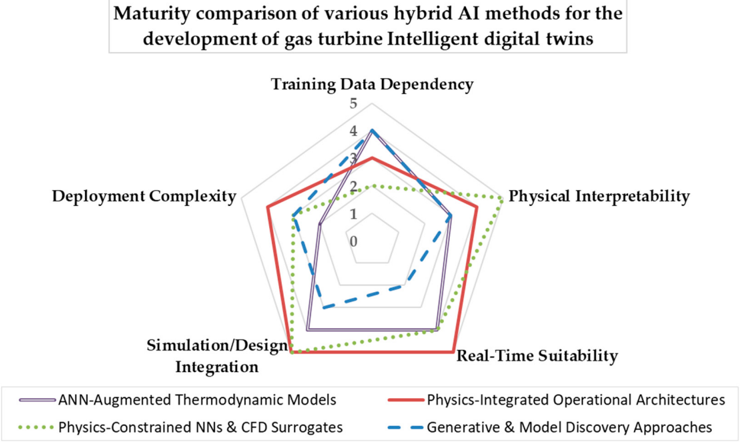
This review surveys recent progress in hybrid artificial intelligence (AI) approaches for gas turbine intelligent digital twins, with an emphasis on models that integrate physics-based simulations and machine learning. The main contribution is the introduction of a structured classification of hybrid AI methods tailored to gas turbine applications, the development of a novel comparative maturity framework, and the proposal of a layered roadmap for integration. The classification organizes hybrid AI approaches into four categories: (1) artificial neural network (ANN)-augmented thermodynamic models, (2) physics-integrated operational architectures, (3) physics-constrained neural networks (PcNNs) with computational fluid dynamics (CFD) surrogates, and (4) generative and model discovery approaches. The maturity framework evaluates these categories across five criteria: data dependency, interpretability, deployment complexity, workflow integration, and real-time capability. Industrial case studies—including General Electric (GE) Vernova’s SmartSignal, Siemens’ Autonomous Turbine Operation and Maintenance (ATOM), and the Electric Power Research Institute (EPRI) turbine digital twin—illustrate applications in real-time diagnostics, predictive maintenance, and performance optimization. Together, the classification and maturity framework provide the means for systematic assessment of hybrid AI methods in gas turbine intelligent digital twins. The review concludes by identifying key challenges and outlining a roadmap for the future development of scalable, interpretable, and operationally robust intelligent digital twins for gas turbines.
Overview
CoChat Summary
TL;DR
This review classifies hybrid AI methods for gas turbine intelligent digital twins into four categories and assesses their maturity across five criteria. It finds no single hybrid AI method is best for all applications, with physics-integrated operational architectures most mature and generative/model-discovery approaches least mature.
Key findings
- The review organizes hybrid AI into four categories: ANN-augmented thermodynamic models; physics-integrated operational architectures; physics-constrained neural networks with CFD surrogates; and generative and model discovery approaches.
- A maturity framework evaluates these categories across five criteria—data dependency, physical interpretability, deployment complexity, workflow compatibility, and real-time capability—using scores of 1–2 (low), 3 (medium), and 4–5 (high). Physics-integrated operational architectures are described as the most mature category, ANN-augmented thermodynamic models as entry-level, physics-constrained neural networks/CFD surrogates as a balanced middle ground, and generative/model-discovery methods as early-stage.
- Industrial case studies include EPRI’s Turbine Digital Twin, reported across approximately 25 units spanning four turbine types with data-to-calibrated-model turnaround as short as one day; GE Vernova’s SmartSignal, deployed across more than 7000 monitored assets with cumulative avoided losses exceeding USD 1.6 billion; and Siemens’ ATOM framework, applied to the SGT-A65.
- The comparative analysis concludes that no single hybrid AI method is best for all gas turbine digital twins; choice depends on the goal, available computational resources, and data quality.
Methods
- Design: a review that introduces a structured classification of hybrid AI methods tailored to gas turbine applications, a comparative maturity framework, and a layered roadmap for integration.
- Data or sample: literature and industrial case studies, including GE Vernova’s SmartSignal, Siemens’ ATOM, and the EPRI turbine digital twin, alongside academic and open-source frameworks.
- Main analysis: hybrid AI methods are categorized by the stage in the modeling architecture where physics and AI interact, then assessed across five maturity criteria using a scoring rubric and comparative tables/radar plot; advantages, limitations, and typical data/computational requirements are synthesized for each category.
Limitations
- The paper states that much reported progress relies on secondary sources, synthetic datasets, or simulation-based degradation models that may not fully represent actual operating conditions; the lack of widely adopted open benchmarks constrains direct comparison and reproducibility; generative and model discovery approaches remain low-maturity in gas turbine applications, with demonstrations largely confined to synthetic or small-scale test cases; and achieving fidelity, interpretability, and computational efficiency simultaneously remains challenging.
- The paper also states that realizing an intelligent digital twin that is interpretable, scalable, cyber-secure, and seamlessly integrated into industrial control and monitoring environments will require advances beyond the current state of the art.
- Evident from the text: this is a review rather than a primary experimental validation, and several industrial performance figures are vendor- or operator-reported (e.g., “reportedly,” “GE states”) without independent benchmarking in the paper.
Model-written summary. Check it against the paper before relying on it.
Integrity signals
Registry
Cites
Statistics
Figures
Verification
Claims the paper makes
0 Valid · 2 Not valid · 136 Not checked · 75 Own results and interpretations
None of the sources cited for this claim have been checked yet.
In the paper
“Hybrid frameworks, such as ANN-GPA combinations, have demonstrated improved sensitivity and robustness in degradation tracking [14,15], though they remain challenged by sparse data, limited fault representation, and the need to maintain alignment with physical laws [16][17][18][19][20][21][22][23].”
§ Physics-Informed Machine Learning for Intelligent Gas Turbine Digital Twins: A Review > 1. Introduction
What the sources say
- Not checked yetcites [14] Cerri, G.; Sandra, B.; Salvini, C. Models for simulation and diagnosis of energy plant components. In Proceedings of the ASME Power 2006, Atlanta, GA, USA, 2-6 May 2006. Paper No. PWR2006. source
- Not checked yetcites [15] Cerri, G.; Borghetti, S.; Salvini, C. Inverse Methodologies for Actual Status Recognition of Gas Turbine Components. In Proceedings of the ASME Power Conference, Orlando, FL, USA, 19-23 June 2005. Paper No. PWR2005-50033. source
boostedstates a cause- Asserted: passes — The authors put it forward as true.
- Checkable: passes — It can be checked against evidence.
- Load-bearing: passes — The paper’s conclusions depend on it.
- Based: passes — The paper gives a reason why it holds.
A check of a cited source is scheduled, or we don’t hold its full text yet; the claim is checked once it runs.
In the paper
“Earlier reviews have organized hybrid AI primarily by network type-for example, Physics-Informed Neural Networks (PINNs) and operator-learning frameworks [17,28,31,32]-by application area such as diagnostics and monitoring [19,39,40], or by the general level of physics integration [4,41].”
§ Physics-Informed Machine Learning for Intelligent Gas Turbine Digital Twins: A Review > 2. Hybrid AI Methodologies for Gas Turbine Applications: Description, Advantages and Limitations
What the sources say
- Not checked yetcites [17] Cuomo, S.; Di Cola, V.S.; Giampaolo, F.; Rozza, G.; Raissi, M.; Piccialli, F. Scientific machine learning through physics-informed neural networks: Where we are and what's next. J. Sci. Comput. 2022, 92, 88. [CrossRef] source
A check is scheduled.
- Not checked yetcites [28] Li, Z.; Kovachki, N.; Azizzadenesheli, K.; Liu, B.; Stuart, A.; Bhattacharya, K.; Anandkumar, A. Fourier neural operator for parametric partial differential equations. arXiv 2021, arXiv:2010.08895. [CrossRef] source
A check is scheduled.
- Not checked yetcites [31] Raissi, M.; Perdikaris, P.; Karniadakis, G.E. Physics-informed neural networks: A deep learning framework for solving forward and inverse problems involving nonlinear partial differential equations. J. Comput. Phys. 2019, 378, 686-707. [CrossRef] source
A check is scheduled.
- Not checked yetcites [32] Sirignano, J.; Spiliopoulos, K. DGM: A deep learning algorithm for solving partial differential equations. arXiv 2018, arXiv:1806.07366. [CrossRef] source
A check is scheduled.
- Not checked yetcites [19] Arias Chao, M.; Kulkarni, C.; Goebel, K.; Fink, O. Fusing physics-based and deep learning models for prognostics. Reliab. Eng. Syst. Saf. 2022, 217, 107961. [CrossRef] source
A check is scheduled.
- Not checked yetcites [39] Zobeiry, N.; Humfeld, K.D. A physics-informed machine learning approach for solving heat transfer equation in advanced manufacturing and engineering applications. Eng. Appl. Artif. Intell. 2021, 101, 104232. [CrossRef] source
A check is scheduled.
- Not checked yetcites [40] Wang, J.-X.; Wu, Z.; Zhong, M.-L.; Ya, S. Data-driven modeling of a forced convection system for super-real-time transient thermal performance prediction. Int. Commun. Heat Mass Transf. 2021, 126, 105387. [CrossRef] source
A check is scheduled.
- Not checked yetcites [4] Liu, Y.; Jiang, X.; Ge, X.; Wei, M. A Physics-Informed Machine Learning Approach for Performance Degradation Monitoring of Gas Turbines. In Proceedings of the 4th Asia Pacific Conference of Prognostics and Health Management (PHM-Asia Pacific), Tokyo, Japan, 11-14 September 2023. source
A check is scheduled.
- Not checked yetcites [41] Marinai, L.; Probert, D.; Singh, R. Prospects for aero gas-turbine diagnostics: A review. Appl. Energy 2004, 79, 109-126. [CrossRef] source
A check is scheduled.
plain- Asserted: passes — The authors put it forward as true.
- Checkable: passes — It can be checked against evidence.
- Load-bearing: passes — The paper’s conclusions depend on it.
- Based: passes — The paper gives a reason why it holds.
- Not checked yet
A conclusion the paper draws from its own results — it cites no other source for it, so there is none to check. The quote shows it is in the paper.
In the paper
“These capabilities are directly applicable to intelligent digital twins and their embedded sub-simulations, enhancing preventive and predictive maintenance strategies and component life assessments.”
§ Physics-Informed Machine Learning for Intelligent Gas Turbine Digital Twins: A Review > 1. Introduction
plainstates a cause- Asserted: passes — The authors put it forward as true.
- Checkable: passes — It can be checked against evidence.
- Load-bearing: passes — The paper’s conclusions depend on it.
- Based: passes — The paper gives a reason why it holds.
A check of a cited source is scheduled, or we don’t hold its full text yet; the claim is checked once it runs.
In the paper
“Architectures preserving physical invariants, such as Lagrangian Neural Networks (LNNs) and Graph Neural Networks (GNNs), extend inference to coupled thermofluid-structural systems [33][34][35][36][37][38].”
§ Physics-Informed Machine Learning for Intelligent Gas Turbine Digital Twins: A Review > 1. Introduction
What the sources say
- Not checked yetcites [33] Cranmer, M.; Greydanus, S.; Battaglia, P.; Spergel, D.; Ho, S. Lagrangian neural networks. arXiv 2020, arXiv:2003.04630. [CrossRef] source
A check is scheduled.
- Not checked yetcites [34] Sanchez-Gonzalez, A.; Pfaff, T.; Ying, R.; Leskovec, J.; Battaglia, P. Learning to simulate complex physics with graph networks. arXiv 2020, arXiv:2002.09405. source
A check is scheduled.
- Not checked yetcites [35] Sanchez-Gonzalez, A.; Heess, N.; Springenberg, J.T.; Merel, J.; Riedmiller, M.; Hadsell, R.; Battaglia, P.W. Graph networks as learnable physics engines for inference and control. arXiv 2018, arXiv:1806.01242. [CrossRef] source
A check is scheduled.
- Not checked yetcites [36] Gao, H.; Zahr, M.J.; Wang, J.-X. Physics-Informed Graph Neural Galerkin Networks: A Unified Framework for Solving PDE- Governed Forward and Inverse Problems. Comput. Methods Appl. Mech. Eng. 2022, 390, 114502. [CrossRef] source
A check is scheduled.
- Not checked yetcites [37] Jiang, C.; Li, Y.; He, Y.; Jiang, Y.; He, S. Physics-Informed Graph Convolutional Neural Networks for Simulating Natural Convection. Comput. Methods Appl. Mech. Eng. 2022, 398, 115280.
A check is scheduled.
- Not checked yetcites [38] Li, Q.; Li, X.; Chen, X.; Yao, W. A novel graph modeling method for GNN-based hypersonic aircraft flow field reconstruction. Eng. Appl. Comput. Fluid Mech. 2024, 18, 2394177. [CrossRef] source
A check is scheduled.
plainstates a cause- Asserted: passes — The authors put it forward as true.
- Checkable: passes — It can be checked against evidence.
- Load-bearing: unclear — It is unclear whether the paper’s conclusions depend on it.
- Based: passes — The paper gives a reason why it holds.
- Not checked yet
In the paper
“In coating and additive manufacturing, they predict transient temperature fields critical for microstructural integrity and the remaining useful life (RUL) of hot-section components [39].”
§ Physics-Informed Machine Learning for Intelligent Gas Turbine Digital Twins: A Review > 1. Introduction
What the sources say
- Not checked yetcites [39] Zobeiry, N.; Humfeld, K.D. A physics-informed machine learning approach for solving heat transfer equation in advanced manufacturing and engineering applications. Eng. Appl. Artif. Intell. 2021, 101, 104232. [CrossRef] source
plainstates a cause- Asserted: passes — The authors put it forward as true.
- Checkable: passes — It can be checked against evidence.
- Load-bearing: unclear — It is unclear whether the paper’s conclusions depend on it.
- Based: passes — The paper gives a reason why it holds.
93 more claims
Create a free account to see all 213 claims and to verify the 309 references still open.
- Probably not a substantial claim. 38
- It may state two separate claims as one. 90
Self-check
Percentages, sums and reported differences re-computed from the paper’s own numbers.
Each contradiction between two passages listed here was confirmed by an independent check.
Rated minor: it would not touch a result — a value no result rests on, a p-value that stays on the same side of the significance level, or a conflict that is clerical, resolved elsewhere in the paper, or outside its own findings.
In the paper
§ Physics-Informed Machine Learning for Intelligent Gas Turbine Digital Twins: A Review > 2.3. Physics-Constrained Neural Networks and CFD Surrogates
“Ref. [61] introduced a transformer-based surrogate for three-dimensional compressible flow prediction in axial compressors without mesh generation, enabling near-instantaneous aerodynamic predictions for early-stage design optimization.”
§ Physics-Informed Machine Learning for Intelligent Gas Turbine Digital Twins: A Review > References
“61. Wang, L.; Zhengchao, L. Data-driven product design evaluation method based on multi-stage artificial neural network. Appl. Soft Comput. 2021, 102, 107117. [CrossRef]”
Rated minor: it would not touch a result — a value no result rests on, a p-value that stays on the same side of the significance level, or a conflict that is clerical, resolved elsewhere in the paper, or outside its own findings.
In the paper
§ Physics-Informed Machine Learning for Intelligent Gas Turbine Digital Twins: A Review > EPRI Turbine Digital Twin [56] NPSS thermodynamic modules with AI-based virtual sensors
“ref. [54] demonstrated a PINNs enabled intelligent digital twin that accurately predicted hidden variables such as turbine inlet temperature (TIT) and specific fuel consumption (SFC) under sensor uncertainty”
§ Physics-Informed Machine Learning for Intelligent Gas Turbine Digital Twins: A Review > References
“54. Mumali, F. Artificial neural network-based decision support systems in manufacturing processes: A systematic literature review. Comput. Ind. Eng. 2022, 169, 107964. [CrossRef]”
Rated minor: it would not touch a result — a value no result rests on, a p-value that stays on the same side of the significance level, or a conflict that is clerical, resolved elsewhere in the paper, or outside its own findings.
In the paper
§ Physics-Informed Machine Learning for Intelligent Gas Turbine Digital Twins: A Review > EPRI Turbine Digital Twin [56] NPSS thermodynamic modules with AI-based virtual sensors
“[55] implemented an artificial neural network (ANN) surrogate-based architecture for combined heat and power (CHP) gas turbines, enabling real-time modeling of degradation, load sharing, and control.”
§ Physics-Informed Machine Learning for Intelligent Gas Turbine Digital Twins: A Review > References
“55. Goyal, R.K.; Kaushal, S.; Sangaiah, A.K. The utility-based non-linear fuzzy AHP optimization model for network selection in heterogeneous wireless networks. Appl. Soft Comput. 2018, 67, 800-811. [CrossRef]”
Rated minor: it would not touch a result — a value no result rests on, a p-value that stays on the same side of the significance level, or a conflict that is clerical, resolved elsewhere in the paper, or outside its own findings.
In the paper
§ Physics-Informed Machine Learning for Intelligent Gas Turbine Digital Twins: A Review > 4.3.3. Robustness and Uncertainty Layer
“Frequencydomain transformations such as FFT, order tracking, cepstrum, and envelope analysis have been applied to turbomachinery diagnostics and prognostics [80].”
§ Physics-Informed Machine Learning for Intelligent Gas Turbine Digital Twins: A Review > References
“80. Karpenko, M.; Ževžikov, P.; Stosiak, M.; Skačkauskas, P.; Borucka, A.; Delembovskyi, M. Vibration Research on Centrifugal Loop Dryer Machines Used in Plastic Recycling Processes. Machines 2024, 12, 29. [CrossRef]”
Rated minor: it would not touch a result — a value no result rests on, a p-value that stays on the same side of the significance level, or a conflict that is clerical, resolved elsewhere in the paper, or outside its own findings.
In the paper
§ Physics-Informed Machine Learning for Intelligent Gas Turbine Digital Twins: A Review > 2.1. ANN-Augmented Thermodynamic Models
“Distributed ANN-based gas path analysis (GPA) frameworks employing classification, auto-associative, and approximation networks have also been proposed to isolate and quantify multiple simultaneous faults, demonstrating robust identification, localization, and severity estimation under nonlinear and noisy conditions, and outperforming conventional GPA approaches [46][47][48]53].”
§ Physics-Informed Machine Learning for Intelligent Gas Turbine Digital Twins: A Review > References
“48. Wang, K.; Tan, R.; Peng, Q.; Wang, F.; Shao, P.; Gao, Z. A holistic method of complex product development based on a neural network-aided technological evolution system. Adv. Eng. Inform. 2021, 48, 101265. [CrossRef]”
Citations
Cites
Raissi, M., Perdikaris, P., & Karniadakis, G. E. (2019) · Journal of Computational Physics · doi:10.1016/j.jcp.2018.10.045 · Cited by 20,384
Dropout as a bayesian approximation: Representing model uncertainty in deep learning
Gal, Y., & Ghahramani, Z. (2015) · arXiv · doi:10.48550/arxiv.1506.02142 · Cited by 7,865
Discovering governing equations from data by sparse identification of nonlinear dynamical systems
Brunton, S. L., Proctor, J. L., & Kutz, J. N. (2016) · Proceedings of the National Academy of Sciences · doi:10.1073/pnas.1517384113 · Cited by 4,796
Simple and Scalable Predictive Uncertainty Estimation using Deep Ensembles
Lakshminarayanan, B., Pritzel, A., & Blundell, C. (2016) · arXiv · doi:10.48550/arxiv.1612.01474 · Cited by 3,666
Learning nonlinear operators via DeepONet based on the universal approximation theorem of operators
Lu, L., Jin, P., Pang, G., Zhang, Z., & Karniadakis, G. E. (2021) · Nature Machine Intelligence · doi:10.1038/s42256-021-00302-5 · Cited by 3,418
A review of uncertainty quantification in deep learning: Techniques, applications and challenges
Abdar, M., Pourpanah, F., Hussain, S., Rezazadegan, D., Liu, L., Ghavamzadeh, M., Fieguth, P., Cao, X., Khosravi, A., Acharya, U. R., et al. (2021) · Information Fusion · doi:10.1016/j.inffus.2021.05.008 · Cited by 3,111
Scientific Machine Learning Through Physics–Informed Neural Networks: Where we are and What’s Next
Cuomo, S., Di Cola, V. S., Giampaolo, F., Rozza, G., Raissi, M., & Piccialli, F. (2022) · Journal of Scientific Computing · doi:10.1007/s10915-022-01939-z · Cited by 2,784
DGM: A deep learning algorithm for solving partial differential equations
Sirignano, J., & Spiliopoulos, K. (2018) · Journal of Computational Physics · doi:10.1016/j.jcp.2018.08.029 · Cited by 2,208
Neural ordinary differential equations
Chen, R. T. Q., Rubanova, Y., Bettencourt, J., & Duvenaud, D. (2018) · arXiv · doi:10.48550/arxiv.1806.07366 · Cited by 2,097
Jin, X., Cai, S., Li, H., & Karniadakis, G. E. (2021) · Journal of Computational Physics · doi:10.1016/j.jcp.2020.109951 · Cited by 1,210
Research works printed but not linked: 6
- Farhat, H. Models for Gas-Turbine Performance Deterioration Predictions for Optimum Operation Management. Ph.D. Thesis, Università degli Studi Roma Tre, Rome, Italy, 2024.
- Genrup, M. Theory for Turbomachinery Degradation and Monitoring Tools. Licentiate Thesis, Lund University, Lund, Sweden, 2003.
- Enríquez-Zárate, J.; Trujillo, L.; Larac, S.; Castelli, M.; Z-Flores, E.; Munoz, L.; Popovic, L. Automatic modeling of a gas turbine using genetic programming: An experimental study. Appl. Soft Comput. 2017, 52, 123-135. [CrossRef]
- Rishikesh, A.; Ahmed, R.; Gaitonde, D.V. DiscretizationNet: A machine-learning-based solver for Navier-Stokes equations using finite volume discretization. Comput. Methods Appl. Mech. Eng. 2023, 413, 116123.
- Jiang, C.; Li, Y.; He, Y.; Jiang, Y.; He, S. Physics-Informed Graph Convolutional Neural Networks for Simulating Natural Convection. Comput. Methods Appl. Mech. Eng. 2022, 398, 115280.
- Joly, R.B.; Ogaji, S.O.T.; Singh, R.; Probert, S.D. Gas-turbine diagnostics using artificial neural networks for a high bypass ratio military turbofan engine. Appl. Energy 2003, 76, 523-535. [CrossRef]
Cited by
Paolini, D., Dini, P., Elhanashi, A., & Saponara, S. (2026) · Electronics · doi:10.3390/electronics15020476 · Cited by 39
Soudagar, M. E. M., Rao, B. M., Mohanavel, V., Ayyar, M., Maranan, R., Venkatesh, R. T., Gnanasekaran, L., Shanmugapriya, D., & Santhamoorthy, M. (2026) · Renewable and Sustainable Energy Reviews · doi:10.1016/j.rser.2026.116756 · Cited by 18
Jôrgensen, B. N., & Ma, Z. G. (2025) · Electronics · doi:10.3390/electronics14244881 · Cited by 13
AI-Driven Digital Twins in Sustainable Manufacturing: A Critical Review
Omigbodun, F. T. (2026) · Sustainability · doi:10.3390/su18115785 · Cited by 9
Tang, R., Wu, L. J., Wang, Z., Zhu, L., Sun, A., Ru, Q., & Ju, B. (2026) · Digital twins and applications. · doi:10.1049/dgt2.70042 · Cited by 8
Soori, M., & Azizi, A. (2026) · Journal of Complex and Multiphysics Engineering Systems · doi:10.56578/jcmes010302 · Cited by 5
Hussein, H. A., Abuhatira, A., & Matthews, J. (2026) · Measurement Energy · doi:10.1016/j.meaene.2026.100099 · Cited by 4
Bekhiti, B., Hariche, K., Guessoum, A., & Sharkawy, A. (2026) · Machines · doi:10.3390/machines14020169 · Cited by 4
Ataee, S., & Ameri, M. (2026) · ENGINEERING Energy · doi:10.1007/s11708-026-1049-1 · Cited by 3
Overview on Predictive Maintenance Techniques for Turbomachinery
Dini, P., Nardi, D., & Saponara, S. (2026) · Machines · doi:10.3390/machines14040396 · Cited by 3
Braun, C., Raible, J., & Huber, M. F. (2026) · Journal of Intelligent Manufacturing · doi:10.1007/s10845-026-02930-3 · Cited by 2
Hybrid digital twin-driven anomaly detection in IoT telemetry using LSTM autoencoder.
Фауре, Е. В., Розломій, І., & Naumenko, S. (2026) · CEUR Workshop Proceedings · doi:10.5281/zenodo.21155694 · Cited by 2
Darwish, S., El-Habrouk, M., Abdel-Khalik, A. S., & Hamdy, R. A. (2026) · Machine Learning and Knowledge Extraction · doi:10.3390/make8080245 · Cited by 2
“Their accuracy is highly sensitive to data quality, noise, and operating condition changes [17,32].”
Sadeq, A. M., Homod, R. Z., Alhasnawi, B. N., Rashid, F. L., Togun, H., Hasan, H. A., Hussein, A. K., & Al-Obaidi, M. A. A. (2026) · Applied Energy · doi:10.1016/j.apenergy.2026.128575 · Cited by 1
Singh, S. K., & Singh, A. K. (2026) · Physica Scripta · doi:10.1088/1402-4896/ae7edc · Cited by 1
Aljumaili, M. J., Abdalwahhab, H. A., Jaaf, H. J. M. A., Abdulrehman, M. A., Abbas, A. S., & Yousif, D. A. (2025) · Instrumentation Mesure Métrologie · doi:10.18280/i2m.240603 · Cited by 1
Ediba, O. E., & Bamaiyi, O. E. (2026) · International Journal of Research and Review · doi:10.52403/ijrr.20260340 · Cited by 1
Machine Learning-Based Performance Prognostics of Gas Turbines: A Review of Recent Advances
Hanachi, H. (2026) · IEEE Conference on Prognostics and Health Management · doi:10.1109/icphm69567.2026.11585330 · Cited by 1
“Furthermore, the absence of explicit physical constraints may result in degradation predictions that violate known thermodynamic behavior [17].”
A Bibliometric Review and Visualization of Research Progress in Computational Modeling for Biofuels
Ahmad, R. S., Fayyaz, H., Hashmi, J., Quraishi, K. S., Aleem, W., & Qamar, S. (2026) · Applied Research · doi:10.1002/appl.70198
Benbouzid, M. (2026) · Energy and AI · doi:10.1016/j.egyai.2026.100926
Eluri, K., Vaganan, H. M., & Elumalai, K. (2026) · Intelligent geoengineering. · doi:10.1016/j.ige.2026.09.001
Babu, A. V. S. (2026) · Proceedings of the Institution of Mechanical Engineers Part C Journal of Mechanical Engineering Science · doi:10.1177/09544062261469000
“22,23 Implementation challenges and industrial barriers Figure 3 demonstrates that there exist several significant interconnected barriers in applying DT technologies to processes and mechanical engineering systems.”
Shahbazi, A. A., & Esfahanian, V. (2026) · Aerospace Science and Technology · doi:10.1016/j.ast.2026.113289
Salilew, W. M., Zhang, Q., Gong, J., Wang, T., Liu, Y., Lemma, . A., Gilani, S. I. U.-H., & Fu, Y.-F. (2026) · Engineering Applications of Artificial Intelligence · doi:10.1016/j.engappai.2026.116621
Hugo, M. Á., Rubio, C. A. N., García-Barajas, M. G., Díaz-Tato, L., Álvarez, Y. C., Ríos-Moreno, J. G., Araiza, J. L. R., & Trejo-Perea, M. (2026) · AI · doi:10.3390/ai7110443
Dharmalingam, V., Ramaligam, D., & Mahalakshmi, D. (2026) · SSRN Electronic Journal · doi:10.2139/ssrn.7488607
Tathavadekar, V., Erceg, A., & Silveira, P. P. (2026) · Literary Horizons Review · doi:10.64229/aqjkmm23
Jianhong, C. H. E. N., Bao, Y., ZHANG, H. K., & ZHONG, Y. (2026) · Energy · doi:10.1016/j.energy.2026.141964
Khakpour, M., bani-asadi, H. R., & Forghani, M. (2026) · Machine learning for computational science and engineering · doi:10.1007/s44379-026-00100-z
“Recent review work also emphasizes hybrid physics-informed and data-driven models for gas-turbine digital twins [23].”
The coupled application of GIS digital Twin and AI reinforcement learning
Xia, Z. (2025) · Applied Artificial Intelligence Research · doi:10.65455/d792e032
“…analyzes the coupling mechanism and adaptability of the two, conducts application practice in combination with actual scenarios, and finally sorts out the existing challenges and proposes development paths, providing a reference for the integrated application of technologies in related fields [2] .”
Nketiah, T., Oladipupo, G. O., & Owusu-Agyemang, Y. (2026) · International Journal of Innovative Research in Engineering & Multidisciplinary Physical Sciences · doi:10.37082/ijirmps.v14.i2.232988
“The incorporation of AI surrogates into physics-integrated operational architectures facilitates real-time performance optimization and hidden state inference, enabling digital twins to attain both precision and adaptability in dynamic environments (Farhat & Altarawneh, 2025).”
Hu, Y., Zhang, L., Gong, S., & Wang, Z. (2026) · Aerospace · doi:10.3390/aerospace13040331
Revolutionizing gas turbine performance analysis with deep learning powered digital twin
Shah, B. S. M. I., Ishak, A. J., Hassan, M. K., & Norsahperi, N. M. H. (2026) · e-Prime – Nexus of Electrical Electronic and Intelligent Engineering · doi:10.1016/j.eprime.2026.201178
Karkadakattil, A. (2026) · Journal of Intelligent Manufacturing and Special Equipment · doi:10.1108/jimse-04-2026-0016
Vychuzhanin, V., & Vychuzhanin, A. (2026) · doi:10.67324/978-617-8714-33-8-356
Development of a Digital Twin for the Gas Turbine Generator Unit Startup System
Nie, Y., Zhao, Z., Fan, X., De, S., Zeng, Q., Yang, J., Lai, Y., & Song, X. (2026) · Processes · doi:10.3390/pr14142370
Research on Innovative Teaching of Core Courses for Professional Degree Graduate Students
Lu, C., Hu, J., Zhang, Z., Jing, Y., Zhang, T., Liang, X., & Jiang, D. (2026) · Journal of Artificial Intelligence and Information · doi:10.66069/ojspub.1137260806
A physics knowledge-guided stage-wise hybrid algorithm for rapid gas turbine performance prediction
Yu, B., Xie, D., 赵玉柱, & Zhang, H. (2026) · Journal of Physics Conference Series · doi:10.1088/1742-6596/3298/1/012041
“Identifying and quantifying such degradation or fault provides valuable insights into the health condition of GTs, enabling effective performance assessment, early fault detection, and optimized maintenance strategies [2].”
Zhou, Z., Zhai, Z., Sheng, M., Liu, J., & Yu, D. (2026) · Energy · doi:10.1016/j.energy.2026.142776
Farhan, H. (2026) · Journal of Engineering and High Technology · doi:10.55942/jeht.v2i2.2367
“…twins, they rank hybrid approaches by data dependency, interpretability, deployment complexity, workflow integration, and real-time capability (Farhat & Altarawneh, 2025); for wind turbines, they report that twins remain mostly component-level and that standardized datasets and benchmarks are…”
Mehralian, F., & Bolat, F. Ç. (2026) · Actuators · doi:10.3390/act15110605
Intelligent hybrid systems and digital twins: fusing physics and data for society 5.0 manufacturing
Chandan, P. B., & Krishna, D. V. (2026) · Australian Journal of Multi-Disciplinary Engineering · doi:10.1080/14488388.2026.2766729
Metadata
- Authors
- Farhat, H., & Altarawneh, A.
- Affiliations
- Tennessee Technological University (US)
- Corresponding author
- Farhat, Hiyam
- Venue
- Energies
- Publisher
- MDPI AG
- Published
- 2025-10-20
- Volume
- 18
- Issue
- 20
- Pages
- 5523
- ISSN
- 1996-1073 (ISSN-L)
- OpenAlex
- W4415350822
- Cited by
- 42
- References
- 75
- Citations by year
- 2026: 39 · 2025: 3
- FWCI
- 8.95
- Type
- journal article
- Language
- en
- Open access
- gold
- doi.org
- Licence
- Locations
- Energies (publishedVersion, cc-by)
- Preprints.org (submittedVersion, cc-by)
- DOAJ (DOAJ: Directory of Open Access Journals) (submittedVersion)
- Topics
- Physical Sciences › Physics and Astronomy › Statistical and Nonlinear Physics › Model Reduction and Neural Networks
- Physical Sciences › Engineering › Aerospace Engineering › Turbomachinery Performance and Optimization
- Physical Sciences › Engineering › Control and Systems Engineering › Fault Detection and Control Systems
- Keywords
- gas turbines, digital twin, physics-informed machine learning, hybrid AI models, physics-constrained neural networks, artificial neural networks, generative models, model discovery, maturity framework, real-time diagnosis, predictive maintenance, performance optimization, thermodynamic modeling, interpretability
About these checks
Registry, retraction, Cites and statistics results are computed, not judged, with one exception: a printed reference that no index lists is read once by a model before it counts as a citation error. Claims are extracted by a model and kept only when their quote appears verbatim in the text; each cited source is then checked, with a model’s help, for whether it says what the claim relies on. Those verdicts can be wrong — read the claim’s quote and the cited source before relying on one.
A language model drew the claims from the paper on 2026-11-29, under version 3 of the claim definition (model deepseek-v4.1-flash, prompt extract-v3).
A second model labelled each claim on 2026-11-29 (model jev-1.13-20260917, definition revision gold-guideline-v0.2).
Statistics and arithmetic are recomputed, not judged.
Confidence bands are shown only for fields calibrated on our annotated test set. None is calibrated yet, so no band is shown.
What counts as a claim ›How we measure confidence ›How we check this ›
Are you an author, or do you see a problem with this page? Request a review
Data sources
Bibliographic data: Semantic Scholar, OpenAlex, Crossref.
Contains information from the Semantic Scholar Academic Graph Datasets, made available under the ODC Attribution License (ODC-BY 1.0).
Semantic Scholar’s data is described in: Kinney, R., et al. (2023). The Semantic Scholar Open Data Platform. arXiv:2301.10140.
