

Machine Learning for Energy Management in Buildings: A Systematic Review on Real-World Applications
Open accessThe DOI matches its Crossref record; 170 of the 171 references it cites were found in a registry or an index, and 1 are not checked yet; none of the 374 sources its claims cite is checked for support yet.
Abstract
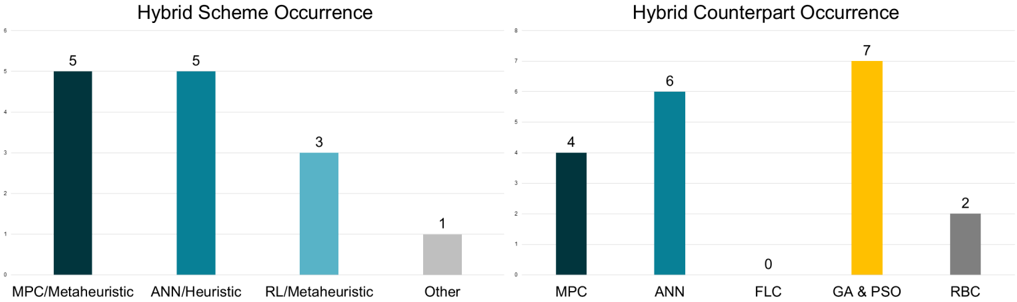
Machine learning (ML) is becoming a key enabler in building energy management systems (BEMS), yet most existing reviews focus on simulations and fail to reflect the realities of real-world deployment. In response to this limitation, the present work aims to present a systematic review dedicated entirely to experimental, field-tested applications of ML in BEMS, covering systems such as Heating, Ventilation & Air-conditioning (HVAC), Renewable Energy Systems (RES), Energy Storage Systems (ESS), Ground Heat Pumps (GHP), Domestic Hot Water (DHW), Electric Vehicle Charging (EVCS), and Lighting Systems (LS). A total of 73 real-world deployments are analyzed, featuring techniques like Model Predictive Control (MPC), Artificial Neural Networks (ANNs), Reinforcement Learning (RL), Fuzzy Logic Control (FLC), metaheuristics, and hybrid approaches. In order to cover both methodological and practical aspects, and properly identify trends and potential challenges in the field, current review uses a unified framework: On the methodological side, it examines key-attributes such as algorithm design, agent architectures, data requirements, baselines, and performance metrics. From a practical standpoint, the study focuses on building typologies, deployment architectures, zones scalability, climate, location, and experimental duration. In this context, the current effort offers a holistic overview of the scientific landscape, outlining key trends and challenges in real-world machine learning applications for BEMS research. By focusing exclusively on real-world implementations, this study offers an evidence-based understanding of the strengths, limitations, and future potential of ML in building energy control—providing actionable insights for researchers, practitioners, and policymakers working toward smarter, grid-responsive buildings. Findings reveal a maturing field with clear trends: MPC remains the most deployment-ready, ANNs provide efficient forecasting capabilities, RL is gaining traction through safer offline–online learning strategies, FLC offers simplicity and interpretability, and hybrid methods show strong performance in multi-energy setups.
Checked 2026-11-24 · 1 reference not checked yet
Overview
CoChat Summary
TL;DR
This systematic review synthesizes 73 real-world, field-tested machine-learning applications for building energy management systems from 2015–2025, covering HVAC, RES, ESS, GHP, DHW, EVCS, and lighting. It finds MPC most deployment-ready, ANNs effective for forecasting, RL increasingly used with offline-online safety strategies, FLC valued for interpretability, and hybrids strong in multi-energy setups.
Key findings
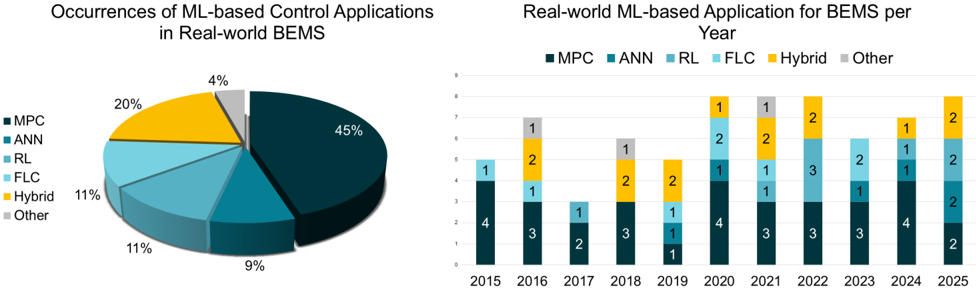
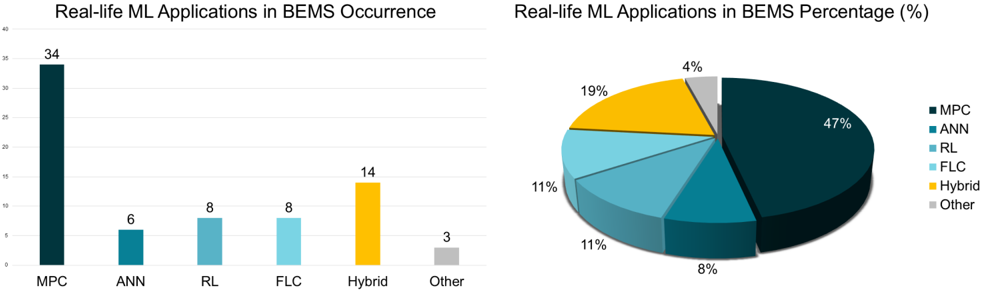
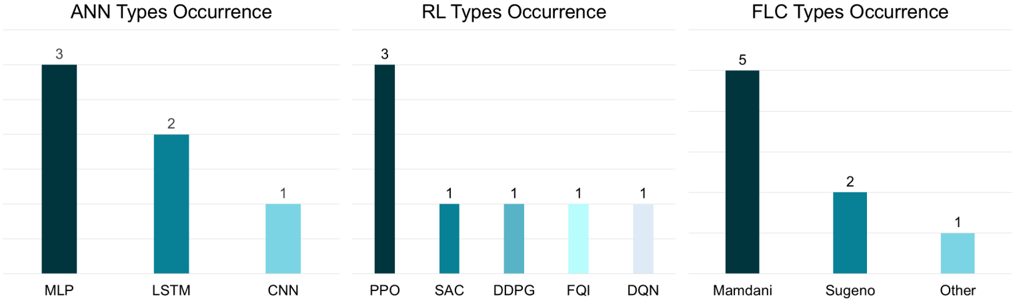
- Across the reviewed real-world deployments, Table 7 reports MPC 35, ANN 6, RL 8, FLC 8, hybrid 14, and other 3 applications; MPC is described as most frequent and deployment-ready, while RL remains limited by safety and data requirements.
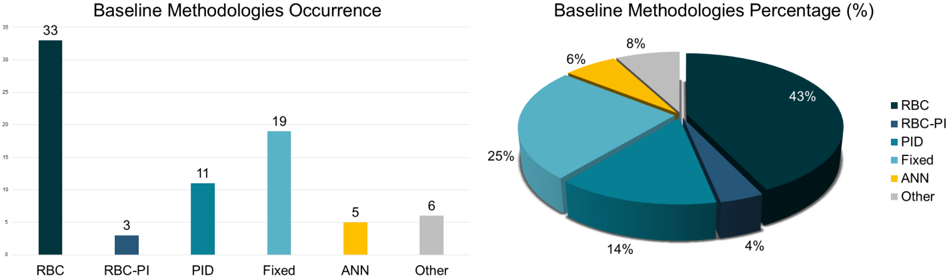
- Reported energy/cost savings vary by baseline: HVAC deployments often achieve 15–45%; office MPC 17–45%; residential 19–35%; campus/multi-building 10–30% cost reductions; gains are 20–50% against weak RBC/static baselines but typically below 10% against optimal or centralized MPC.
- Temporal design converges on 5–15 min control intervals; MPC dominant forecast horizon is 24–48 h with 5–30 min timestep, RL 5–60 min, and FLC 1–30 min.
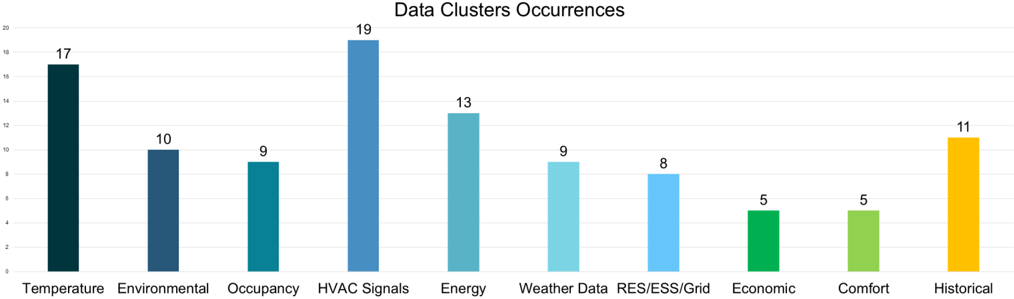
- A common data hierarchy emerges: temperature/weather are nearly universal; occupancy/CO₂ add comfort intelligence; forecasts enable proactive control; DER and price signals enable flexibility and grid interaction.
Methods
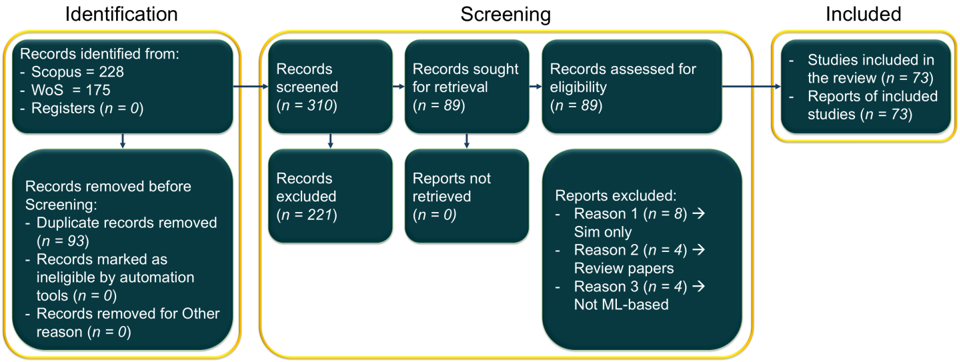
- PRISMA-guided systematic review; Scopus and Web of Science search from January 2015 to March 2025; English journal and full conference papers; included only ML-based control/optimization tested in real buildings (field pilot, living lab, or long-term experimental setup); simulation-only studies excluded unless directly benchmarked with field measurements; at least 10 citations required except relaxed for 2025.
- Extracted methodological attributes (algorithm, agent architecture, forecast horizon/timestep, data, baseline, performance metrics) and practical attributes (implementation type, equipment, building typology, zone scalability, location/climate, experimental period); synthesis is descriptive quantitative, using simple relative frequencies, with no formal meta-analysis, imputation, or weighting.
Limitations
- The paper states a formal meta-analysis was not possible because studies varied widely in building types, control goals, time horizons, and evaluation metrics; synthesis is descriptive only, with no imputation or weighting.
- The paper states the evidence base is biased toward academic/lab/office testbeds; residential, small commercial, multi-building portfolios, multi-agent coordination, and long-term RL validation remain underexplored; standardized evaluation, baselines, and transferable models are lacking.
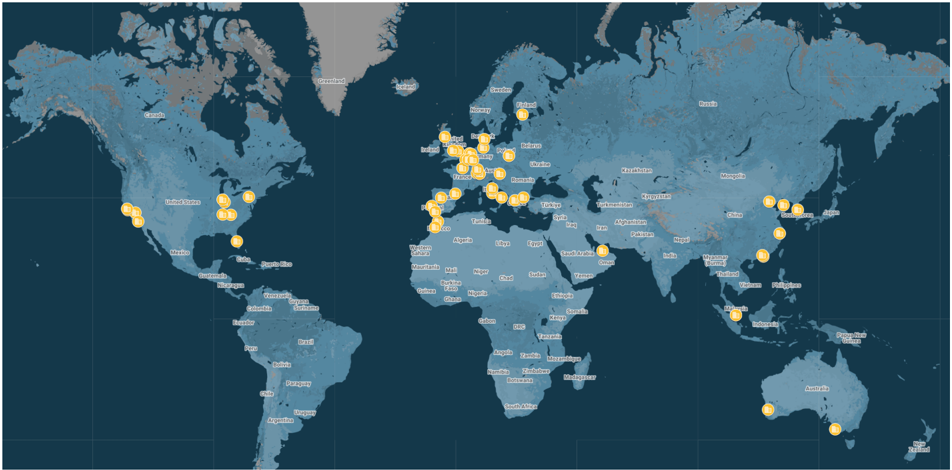
- Evident from the text: geographic/climate concentration in Europe, Asia, and North America; the citation threshold may favor older/high-impact studies; Table 7 method counts sum to 74 while the abstract says 73 studies.
Model-written summary. Check it against the paper before relying on it.
Integrity signals
Registry
Cites
Statistics
Figures
Verification
Claims the paper makes
0 Valid · 7 Not valid · 162 Not checked · 188 Own results and interpretations
A result the paper states — it cites no source for it, so there is none to check. The quote shows it is in the paper.
In the paper
“Seventy three studies are systematically selected, each representing an ML-based approach validated under real operational conditions in actual building testbeds.”
§ Machine Learning for Energy Management in Buildings: A Systematic Review on Real-World Applications > 1.3. Contribution and Novelty
plain- Asserted: passes — The authors put it forward as true.
- Checkable: passes — It can be checked against evidence.
- Load-bearing: passes — The paper’s conclusions depend on it.
- Based: passes — The paper gives a reason why it holds.
- Rests on an assumption not shown here.
A result the paper states — it cites no source for it, so there is none to check. The quote shows it is in the paper.
In the paper
“RL is gaining traction through safer offlineonline learning strategies”
§ Machine Learning for Energy Management in Buildings: A Systematic Review on Real-World Applications > Abstract
plainstates an association- Asserted: passes — The authors put it forward as true.
- Checkable: passes — It can be checked against evidence.
- Load-bearing: passes — The paper’s conclusions depend on it.
- Based: passes — The paper gives a reason why it holds.
- Rests on an assumption not shown here.
A result the paper states — it cites no source for it, so there is none to check. The quote shows it is in the paper.
In the paper
“The final dataset comprises real-life applications.”
§ Machine Learning for Energy Management in Buildings: A Systematic Review on Real-World Applications > 1. Article Search and Retrieval:
plain- Asserted: passes — The authors put it forward as true.
- Checkable: passes — It can be checked against evidence.
- Load-bearing: passes — The paper’s conclusions depend on it.
- Based: passes — The paper gives a reason why it holds.
A result the paper reports from its own data — it cites no other source for it, so there is none to check. The quote shows it is in the paper.
In the paper
“A total of 73 real-world deployments are analyzed”
- Also stated in: § 1.3. Contribution and Novelty · plain
“Seventy three studies are systematically selected”
- Also stated in: § 2.1. Methodological Clarifications · plain
“curated set of 73 real-world studies included in the current review”
§ Machine Learning for Energy Management in Buildings: A Systematic Review on Real-World Applications > Abstract
plain- Asserted: passes — The authors put it forward as true.
- Checkable: passes — It can be checked against evidence.
- Load-bearing: passes — The paper’s conclusions depend on it.
- Based: passes — The paper gives a reason why it holds.
- Rests on an assumption not shown here.
- Also stated in: § 1.3. Contribution and Novelty · plain
A result the paper states — it cites no source for it, so there is none to check. The quote shows it is in the paper.
In the paper
“hybrid methods show strong performance in multi-energy setups”
§ Machine Learning for Energy Management in Buildings: A Systematic Review on Real-World Applications > Abstract
boostedstates an association- Asserted: passes — The authors put it forward as true.
- Checkable: passes — It can be checked against evidence.
- Load-bearing: passes — The paper’s conclusions depend on it.
- Based: passes — The paper gives a reason why it holds.
- Rests on an assumption not shown here.
211 more claims
Create a free account to see all 357 claims and to verify the 374 references still open.
- It may state two separate claims as one. 118
- Probably not a substantial claim. 28
- The quote only partly states this claim. 2
Self-check
Percentages, sums and reported differences re-computed from the paper’s own numbers.
Each contradiction between two passages listed here was confirmed by an independent check.
Rated minor: it would not touch a result — a value no result rests on, a p-value that stays on the same side of the significance level, or a conflict that is clerical, resolved elsewhere in the paper, or outside its own findings.
In the paper
“Results showed heating rates increased fourfold with occupancy (0.015→0.042 • C/min)”
§ Machine Learning for Energy Management in Buildings: A Systematic Review on Real-World Applications > Additional information
Reported 4 · recomputed 2.8
Rated minor: it would not touch a result — a value no result rests on, a p-value that stays on the same side of the significance level, or a conflict that is clerical, resolved elsewhere in the paper, or outside its own findings.
In the paper
§ Machine Learning for Energy Management in Buildings: A Systematic Review on Real-World Applications > 8. Conclusions
“| [136] | 2017 | FQI | Single | 24 h/1 h | RBC | RES/DWH/GHP | Resident | - | Kortrijk (BE) | Winter (4 M) |”
§ Machine Learning for Energy Management in Buildings: A Systematic Review on Real-World Applications > Additional information
“In six Dutch homes with smart heat pumps and PV, the policy (24 h horizon, 1 h grid, 5 min actions) was retrained hourly from field data.”
Rated minor: it would not touch a result — a value no result rests on, a p-value that stays on the same side of the significance level, or a conflict that is clerical, resolved elsewhere in the paper, or outside its own findings.
In the paper
§ Machine Learning for Energy Management in Buildings: A Systematic Review on Real-World Applications > 8. Conclusions
“| Hybrid | 14 | MPC/GA ANN/GA | | 3 | 24 h | 1∼15 m | RBC Fixed | HVAC RES ESS | Office/Lab Resident/Lab | 1∼10+ | EU Asia | 2 D∼9 W |”
§ Machine Learning for Energy Management in Buildings: A Systematic Review on Real-World Applications > 8. Conclusions
“| [152] | 2016 | RL/ACO | Single | 48 h/5 m | RBC | HVAC/RES/DHW | Residents | 1 | Amersfoort (NL) | Winter (3.5 M) |”
Rated minor: it would not touch a result — a value no result rests on, a p-value that stays on the same side of the significance level, or a conflict that is clerical, resolved elsewhere in the paper, or outside its own findings.
In the paper
§ Machine Learning for Energy Management in Buildings: A Systematic Review on Real-World Applications > 8. Conclusions
“| MPC | 35 | Classical Data-driven | | 2 | 24∼48 h | 5∼30 m | RBC PID | HVAC TSS | Office Academic | 1∼20 | EU Asia | 1 D∼1 Y |”
§ Machine Learning for Energy Management in Buildings: A Systematic Review on Real-World Applications > 8. Conclusions
“| [106] | | Economic (MILP) | Single | 1 w/15 m | Manual | HVAC/TSS | Academic | 500 | Stanford (US) | Mixed (3.5 M) |”
Rated minor: it would not touch a result — a value no result rests on, a p-value that stays on the same side of the significance level, or a conflict that is clerical, resolved elsewhere in the paper, or outside its own findings.
In the paper
§ Machine Learning for Energy Management in Buildings: A Systematic Review on Real-World Applications > 8. Conclusions
“| [118] | | Data-driven (QP) | Single | 24 h/10 m | RBC | HVAC | Resident/Lab | 2 | Dübendorf (CH) | Mixed (120 D) |”
§ Machine Learning for Energy Management in Buildings: A Systematic Review on Real-World Applications > Additional information
“used ARMAX, Random Forest, and ICNN models to control HVAC panels with a 6-7 h horizon and 30 min timestep”
4 more findings
Create a free account to see every finding of this check.
Citations
Cites
A review on buildings energy information: Trends, end-uses, fuels and drivers
González-Torres, M., Pérez-Lombard, L., Coronel, J. F., Maestre, I. R., & Yan, D. (2022) · Energy Reports · doi:10.1016/j.egyr.2021.11.280 · Cited by 1,036
All you need to know about model predictive control for buildings
Drgoňa, J., Arroyo, J., Cupeiro Figueroa, I., Blum, D., Arendt, K., Kim, D., Ollé, E. P., Oravec, J., Wetter, M., Vrabie, D. L., et al. (2020) · Annual Reviews in Control · doi:10.1016/j.arcontrol.2020.09.001 · Cited by 1,020
Applications of artificial neural-networks for energy systems
Kalogirou, S. A. (2000) · Applied Energy · doi:10.1016/s0306-2619(00)00005-2 · Cited by 933
Energy storage systems: a review
Mitali, J., Dhinakaran, S., & Mohamad, A. A. (2022) · Energy Storage and Saving · doi:10.1016/j.enss.2022.07.002 · Cited by 911
Shaikh, P. H., Nor, N. B. M., Nallagownden, P., Elamvazuthi, I., & Ibrahim, T. (2014) · Renewable and Sustainable Energy Reviews · doi:10.1016/j.rser.2014.03.027 · Cited by 866
Overview of energy storage in renewable energy systems
Ould Amrouche, S., Rekioua, D., Rekioua, T., & Bacha, S. (2016) · International Journal of Hydrogen Energy · doi:10.1016/j.ijhydene.2016.06.243 · Cited by 793
General review of ground-source heat pump systems for heating and cooling of buildings
Sârbu, I., & Sebarchievici, C. (2013) · Energy and Buildings · doi:10.1016/j.enbuild.2013.11.068 · Cited by 716
A review on modeling and simulation of building energy systems
Harish, V. S. K. V., & Kumar, A. (2016) · Renewable and Sustainable Energy Reviews · doi:10.1016/j.rser.2015.12.040 · Cited by 691
Intelligent Edge Computing for IoT-Based Energy Management in Smart Cities
Liu, Y., Yang, C., Jiang, L., Xie, S., & Zhang, Y. (2019) · IEEE Network · doi:10.1109/mnet.2019.1800254 · Cited by 595
Acharige, S. S. G., Haque, M. E., Arif, M. T., Hosseinzadeh, N., Hasan, K. N., & Oo, A. M. T. (2023) · IEEE Access · doi:10.1109/access.2023.3267164 · Cited by 590
Cited by
Michailidis, P., Minelli, F., Çoban, H. H., Michailidis, I., & Kosmatopoulos, E. B. (2026) · Infrastructures · doi:10.3390/infrastructures11070240 · Cited by 7
Self-citationKurucan, M., Gençal, M. C., Michailidis, P., & Minelli, F. (2026) · Sustainability · doi:10.3390/su18052615 · Cited by 4
Self-citationAhmed, S., Ansari, J. A., Memon, M., Shaikh, M. F., Ali, Q., Shaikh, A. M., Ahmed, A., & Minelli, F. (2026) · Frontiers in Energy Research · doi:10.3389/fenrg.2026.1832115 · Cited by 2
Self-citationMichailidis, P., Michailidis, I., Minelli, F., Çoban, H. H., & Kosmatopoulos, E. B. (2026) · Eng—Advances in Engineering · doi:10.3390/eng7090438 · Cited by 1
Self-citationBenakcha, Y., Labat, M., Hazyuk, I., & Ginestet, S. (2026) · Energy and Buildings · doi:10.1016/j.enbuild.2026.118233 · Cited by 1
Metadata
- Authors
- Michailidis, P., Minelli, F., Michailidis, I., Kurucan, M., Coban, H. H., & Kosmatopoulos, E.
- Affiliations
- Democritus University of Thrace (GR)
- University of Naples Federico II (IT)
- Adana Science and Technology University (TR)
- Department of Electrical and Electronics Engineering, Bartin University, 74100 Bartın, Türkiye
- Corresponding author
- Michailidis, Panagiotis
- ORCID
- Venue
- Energies
- Publisher
- MDPI AG
- Published
- 2025-12-31
- Volume
- 19
- Issue
- 1
- Pages
- 219
- ISSN
- 1996-1073 (ISSN-L)
- OpenAlex
- W7117727181
- Cited by
- 26
- References
- 169
- Citations by year
- 2026: 26
- FWCI
- 1.79
- Type
- journal article
- Language
- en
- Open access
- gold
- doi.org
- Licence
- Locations
- Energies (publishedVersion, cc-by)
- Duraspace of Bartin University (Bartin University) (submittedVersion, cc-by-nc-nd)
- DOAJ (DOAJ: Directory of Open Access Journals) (submittedVersion)
- Funders
- Hellenic Foundation for Research and Innovation (16880)
- Topics
- Physical Sciences › Engineering › Building and Construction › Building Energy and Comfort Optimization
- Physical Sciences › Engineering › Electrical and Electronic Engineering › Smart Grid Energy Management
- Physical Sciences › Engineering › Electrical and Electronic Engineering › Integrated Energy Systems Optimization
- Keywords
- building energy management systems, machine learning applications, HVAC control, renewable energy systems, energy storage systems, ground source heat pump, domestic hot water, electric vehicle charging, lighting systems, model predictive control, artificial neural networks, reinforcement learning, fuzzy logic control, metaheuristic optimization, hybrid control
About these checks
Registry, retraction, Cites and statistics results are computed, not judged, with one exception: a printed reference that no index lists is read once by a model before it counts as a citation error. Claims are extracted by a model and kept only when their quote appears verbatim in the text; each cited source is then checked, with a model’s help, for whether it says what the claim relies on. Those verdicts can be wrong — read the claim’s quote and the cited source before relying on one.
A language model drew the claims from the paper on 2026-11-24, under version 3 of the claim definition (model deepseek-v4.1-flash, prompt extract-v3).
A second model labelled each claim on 2026-11-24 (model jev-1.13-20260917, definition revision gold-guideline-v0.2).
Statistics and arithmetic are recomputed, not judged.
Confidence bands are shown only for fields calibrated on our annotated test set. None is calibrated yet, so no band is shown.
What counts as a claim ›How we measure confidence ›How we check this ›
Are you an author, or do you see a problem with this page? Request a review
How to cite
Cite CoChat for the checks on this page, and the paper for its own findings.
- This page
- CoChat. (2026). Citation check: Machine Learning for Energy Management in Buildings: A Systematic Review on Real-World Applications. https://app.cochat.ai/papers/10.3390/en19010219
- The paper
- Michailidis, P., Minelli, F., Michailidis, I., Kurucan, M., Coban, H. H., & Kosmatopoulos, E. (2025). Machine Learning for Energy Management in Buildings: A Systematic Review on Real-World Applications. Energies. https://doi.org/10.3390/en19010219
Data sources
Bibliographic data: Semantic Scholar, OpenAlex, Crossref.
Contains information from the Semantic Scholar Academic Graph Datasets, made available under the ODC Attribution License (ODC-BY 1.0).
Semantic Scholar’s data is described in: Kinney, R., et al. (2023). The Semantic Scholar Open Data Platform. arXiv:2301.10140.
