

Machine Learning for Energy Management in Buildings: A Systematic Review on Real-World Applications
Open accessThe DOI matches its Crossref record; 170 of the 171 references it cites were found in a registry or an index, and 1 are not checked yet; none of the 374 sources its claims cite is checked for support yet.
Abstract
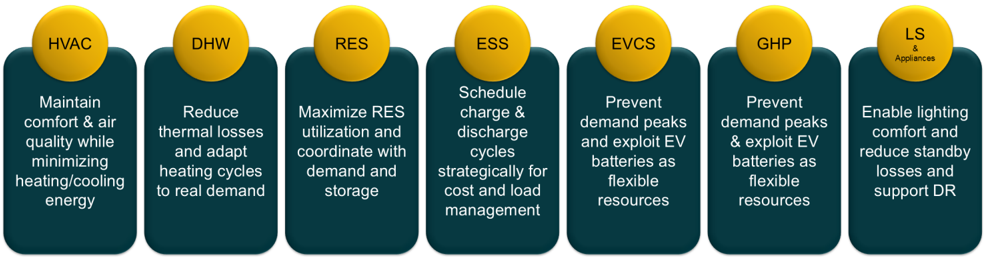
Machine learning (ML) is becoming a key enabler in building energy management systems (BEMS), yet most existing reviews focus on simulations and fail to reflect the realities of real-world deployment. In response to this limitation, the present work aims to present a systematic review dedicated entirely to experimental, field-tested applications of ML in BEMS, covering systems such as Heating, Ventilation & Air-conditioning (HVAC), Renewable Energy Systems (RES), Energy Storage Systems (ESS), Ground Heat Pumps (GHP), Domestic Hot Water (DHW), Electric Vehicle Charging (EVCS), and Lighting Systems (LS). A total of 73 real-world deployments are analyzed, featuring techniques like Model Predictive Control (MPC), Artificial Neural Networks (ANNs), Reinforcement Learning (RL), Fuzzy Logic Control (FLC), metaheuristics, and hybrid approaches. In order to cover both methodological and practical aspects, and properly identify trends and potential challenges in the field, current review uses a unified framework: On the methodological side, it examines key-attributes such as algorithm design, agent architectures, data requirements, baselines, and performance metrics. From a practical standpoint, the study focuses on building typologies, deployment architectures, zones scalability, climate, location, and experimental duration. In this context, the current effort offers a holistic overview of the scientific landscape, outlining key trends and challenges in real-world machine learning applications for BEMS research. By focusing exclusively on real-world implementations, this study offers an evidence-based understanding of the strengths, limitations, and future potential of ML in building energy control—providing actionable insights for researchers, practitioners, and policymakers working toward smarter, grid-responsive buildings. Findings reveal a maturing field with clear trends: MPC remains the most deployment-ready, ANNs provide efficient forecasting capabilities, RL is gaining traction through safer offline–online learning strategies, FLC offers simplicity and interpretability, and hybrid methods show strong performance in multi-energy setups.
Checked 2026-11-24 · 1 reference not checked yet
Overview
CoChat Summary
TL;DR
This systematic review synthesizes 73 real-world, field-tested machine-learning applications for building energy management systems from 2015–2025, covering HVAC, RES, ESS, GHP, DHW, EVCS, and lighting. It finds MPC most deployment-ready, ANNs effective for forecasting, RL increasingly used with offline-online safety strategies, FLC valued for interpretability, and hybrids strong in multi-energy setups.
Key findings
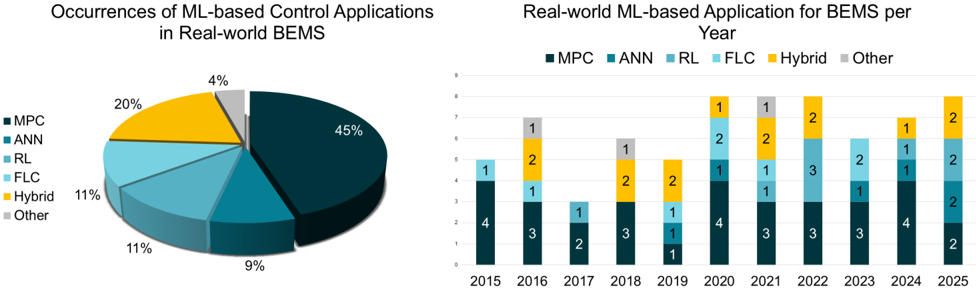
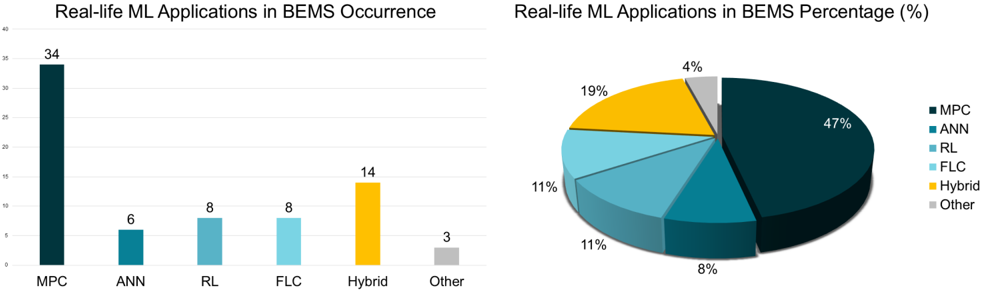
- Across the reviewed real-world deployments, Table 7 reports MPC 35, ANN 6, RL 8, FLC 8, hybrid 14, and other 3 applications; MPC is described as most frequent and deployment-ready, while RL remains limited by safety and data requirements.
- Reported energy/cost savings vary by baseline: HVAC deployments often achieve 15–45%; office MPC 17–45%; residential 19–35%; campus/multi-building 10–30% cost reductions; gains are 20–50% against weak RBC/static baselines but typically below 10% against optimal or centralized MPC.
- Temporal design converges on 5–15 min control intervals; MPC dominant forecast horizon is 24–48 h with 5–30 min timestep, RL 5–60 min, and FLC 1–30 min.
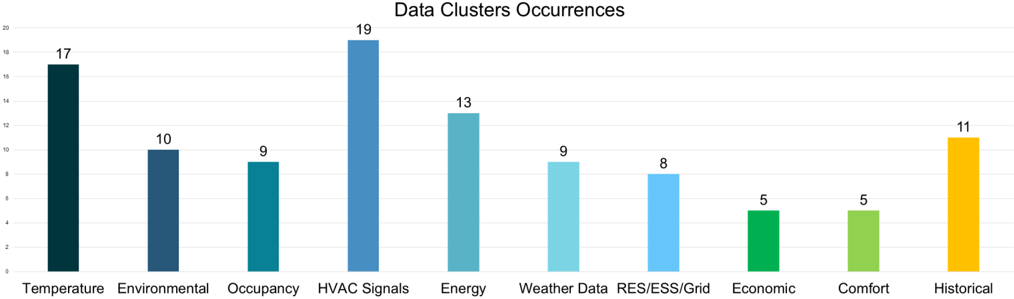
- A common data hierarchy emerges: temperature/weather are nearly universal; occupancy/CO₂ add comfort intelligence; forecasts enable proactive control; DER and price signals enable flexibility and grid interaction.
Methods
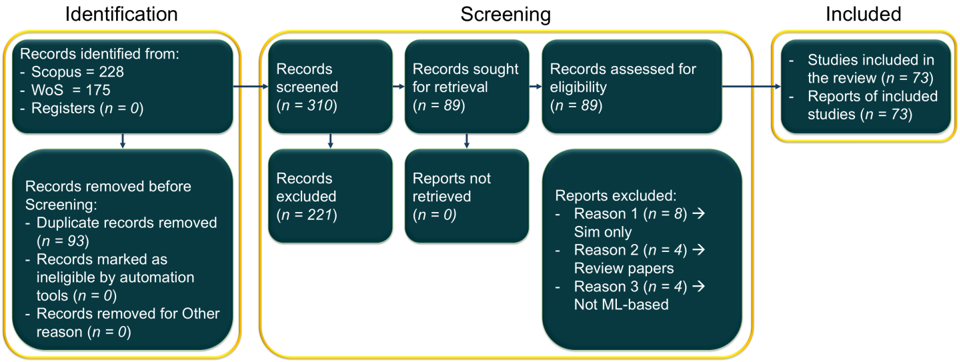
- PRISMA-guided systematic review; Scopus and Web of Science search from January 2015 to March 2025; English journal and full conference papers; included only ML-based control/optimization tested in real buildings (field pilot, living lab, or long-term experimental setup); simulation-only studies excluded unless directly benchmarked with field measurements; at least 10 citations required except relaxed for 2025.
- Extracted methodological attributes (algorithm, agent architecture, forecast horizon/timestep, data, baseline, performance metrics) and practical attributes (implementation type, equipment, building typology, zone scalability, location/climate, experimental period); synthesis is descriptive quantitative, using simple relative frequencies, with no formal meta-analysis, imputation, or weighting.
Limitations
- The paper states a formal meta-analysis was not possible because studies varied widely in building types, control goals, time horizons, and evaluation metrics; synthesis is descriptive only, with no imputation or weighting.
- The paper states the evidence base is biased toward academic/lab/office testbeds; residential, small commercial, multi-building portfolios, multi-agent coordination, and long-term RL validation remain underexplored; standardized evaluation, baselines, and transferable models are lacking.
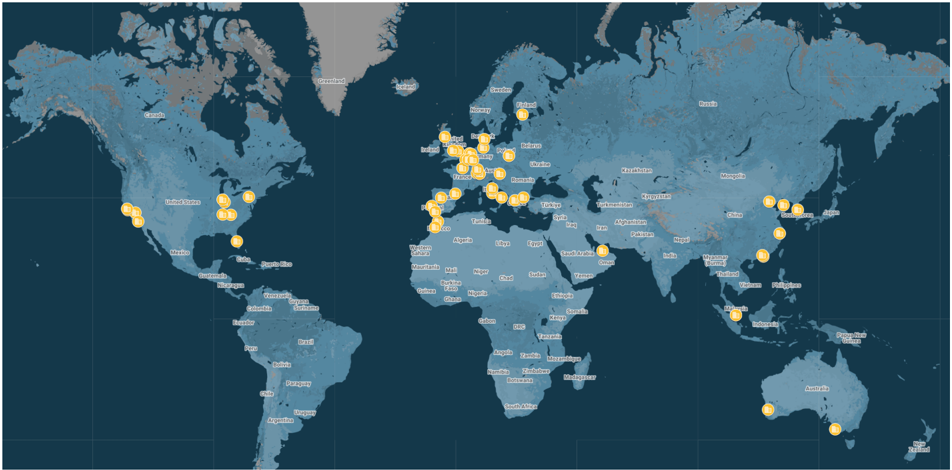
- Evident from the text: geographic/climate concentration in Europe, Asia, and North America; the citation threshold may favor older/high-impact studies; Table 7 method counts sum to 74 while the abstract says 73 studies.
Model-written summary. Check it against the paper before relying on it.
Integrity signals
Registry
Cites
Statistics
Figures
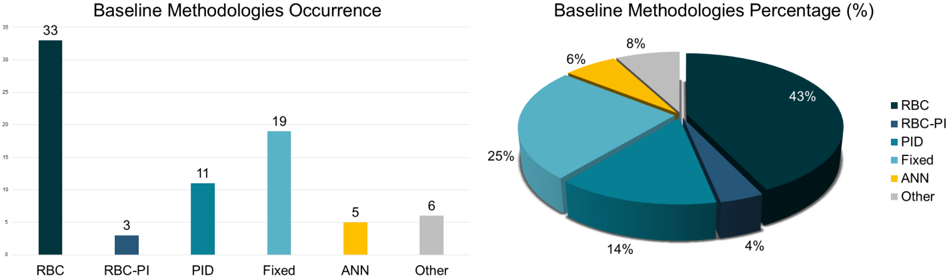
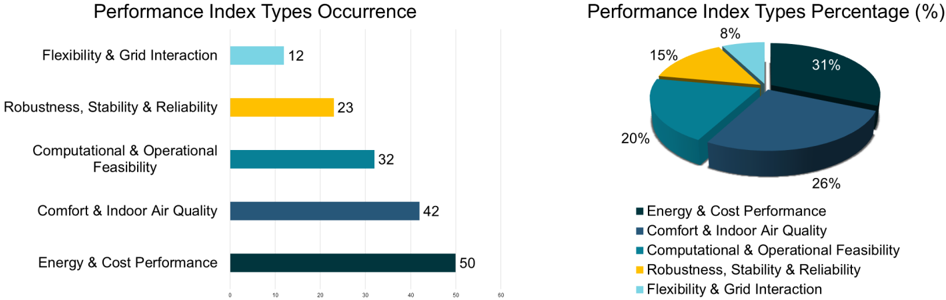
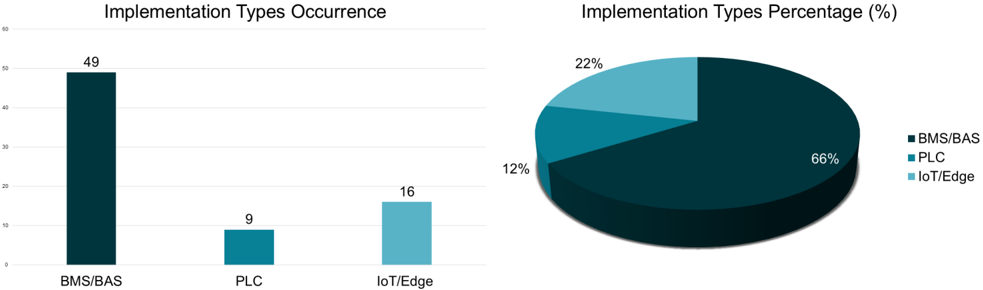
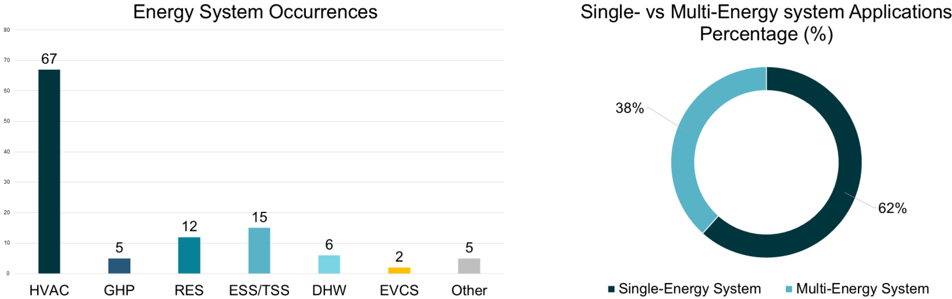
Verification
Claims the paper makes
0 Valid · 7 Not valid · 162 Not checked · 188 Own results and interpretations
A result the paper states — it cites no source for it, so there is none to check. The quote shows it is in the paper.
In the paper
“Seventy three studies are systematically selected, each representing an ML-based approach validated under real operational conditions in actual building testbeds.”
§ Machine Learning for Energy Management in Buildings: A Systematic Review on Real-World Applications > 1.3. Contribution and Novelty
plain- Asserted: passes — The authors put it forward as true.
- Checkable: passes — It can be checked against evidence.
- Load-bearing: passes — The paper’s conclusions depend on it.
- Based: passes — The paper gives a reason why it holds.
- Rests on an assumption not shown here.
A result the paper states — it cites no source for it, so there is none to check. The quote shows it is in the paper.
In the paper
“RL is gaining traction through safer offlineonline learning strategies”
§ Machine Learning for Energy Management in Buildings: A Systematic Review on Real-World Applications > Abstract
plainstates an association- Asserted: passes — The authors put it forward as true.
- Checkable: passes — It can be checked against evidence.
- Load-bearing: passes — The paper’s conclusions depend on it.
- Based: passes — The paper gives a reason why it holds.
- Rests on an assumption not shown here.
A result the paper states — it cites no source for it, so there is none to check. The quote shows it is in the paper.
In the paper
“The final dataset comprises real-life applications.”
§ Machine Learning for Energy Management in Buildings: A Systematic Review on Real-World Applications > 1. Article Search and Retrieval:
plain- Asserted: passes — The authors put it forward as true.
- Checkable: passes — It can be checked against evidence.
- Load-bearing: passes — The paper’s conclusions depend on it.
- Based: passes — The paper gives a reason why it holds.
A result the paper reports from its own data — it cites no other source for it, so there is none to check. The quote shows it is in the paper.
In the paper
“A total of 73 real-world deployments are analyzed”
- Also stated in: § 1.3. Contribution and Novelty · plain
“Seventy three studies are systematically selected”
- Also stated in: § 2.1. Methodological Clarifications · plain
“curated set of 73 real-world studies included in the current review”
§ Machine Learning for Energy Management in Buildings: A Systematic Review on Real-World Applications > Abstract
plain- Asserted: passes — The authors put it forward as true.
- Checkable: passes — It can be checked against evidence.
- Load-bearing: passes — The paper’s conclusions depend on it.
- Based: passes — The paper gives a reason why it holds.
- Rests on an assumption not shown here.
- Also stated in: § 1.3. Contribution and Novelty · plain
A result the paper states — it cites no source for it, so there is none to check. The quote shows it is in the paper.
In the paper
“hybrid methods show strong performance in multi-energy setups”
§ Machine Learning for Energy Management in Buildings: A Systematic Review on Real-World Applications > Abstract
boostedstates an association- Asserted: passes — The authors put it forward as true.
- Checkable: passes — It can be checked against evidence.
- Load-bearing: passes — The paper’s conclusions depend on it.
- Based: passes — The paper gives a reason why it holds.
- Rests on an assumption not shown here.
211 more claims
Create a free account to see all 357 claims and to verify the 374 references still open.
- It may state two separate claims as one. 118
- Probably not a substantial claim. 28
- The quote only partly states this claim. 2
Self-check
Percentages, sums and reported differences re-computed from the paper’s own numbers.
Each contradiction between two passages listed here was confirmed by an independent check.
Rated minor: it would not touch a result — a value no result rests on, a p-value that stays on the same side of the significance level, or a conflict that is clerical, resolved elsewhere in the paper, or outside its own findings.
In the paper
“Results showed heating rates increased fourfold with occupancy (0.015→0.042 • C/min)”
§ Machine Learning for Energy Management in Buildings: A Systematic Review on Real-World Applications > Additional information
Reported 4 · recomputed 2.8
Rated minor: it would not touch a result — a value no result rests on, a p-value that stays on the same side of the significance level, or a conflict that is clerical, resolved elsewhere in the paper, or outside its own findings.
In the paper
§ Machine Learning for Energy Management in Buildings: A Systematic Review on Real-World Applications > 8. Conclusions
“| [136] | 2017 | FQI | Single | 24 h/1 h | RBC | RES/DWH/GHP | Resident | - | Kortrijk (BE) | Winter (4 M) |”
§ Machine Learning for Energy Management in Buildings: A Systematic Review on Real-World Applications > Additional information
“In six Dutch homes with smart heat pumps and PV, the policy (24 h horizon, 1 h grid, 5 min actions) was retrained hourly from field data.”
Rated minor: it would not touch a result — a value no result rests on, a p-value that stays on the same side of the significance level, or a conflict that is clerical, resolved elsewhere in the paper, or outside its own findings.
In the paper
§ Machine Learning for Energy Management in Buildings: A Systematic Review on Real-World Applications > 8. Conclusions
“| Hybrid | 14 | MPC/GA ANN/GA | | 3 | 24 h | 1∼15 m | RBC Fixed | HVAC RES ESS | Office/Lab Resident/Lab | 1∼10+ | EU Asia | 2 D∼9 W |”
§ Machine Learning for Energy Management in Buildings: A Systematic Review on Real-World Applications > 8. Conclusions
“| [152] | 2016 | RL/ACO | Single | 48 h/5 m | RBC | HVAC/RES/DHW | Residents | 1 | Amersfoort (NL) | Winter (3.5 M) |”
Rated minor: it would not touch a result — a value no result rests on, a p-value that stays on the same side of the significance level, or a conflict that is clerical, resolved elsewhere in the paper, or outside its own findings.
In the paper
§ Machine Learning for Energy Management in Buildings: A Systematic Review on Real-World Applications > 8. Conclusions
“| MPC | 35 | Classical Data-driven | | 2 | 24∼48 h | 5∼30 m | RBC PID | HVAC TSS | Office Academic | 1∼20 | EU Asia | 1 D∼1 Y |”
§ Machine Learning for Energy Management in Buildings: A Systematic Review on Real-World Applications > 8. Conclusions
“| [106] | | Economic (MILP) | Single | 1 w/15 m | Manual | HVAC/TSS | Academic | 500 | Stanford (US) | Mixed (3.5 M) |”
Rated minor: it would not touch a result — a value no result rests on, a p-value that stays on the same side of the significance level, or a conflict that is clerical, resolved elsewhere in the paper, or outside its own findings.
In the paper
§ Machine Learning for Energy Management in Buildings: A Systematic Review on Real-World Applications > 8. Conclusions
“| [118] | | Data-driven (QP) | Single | 24 h/10 m | RBC | HVAC | Resident/Lab | 2 | Dübendorf (CH) | Mixed (120 D) |”
§ Machine Learning for Energy Management in Buildings: A Systematic Review on Real-World Applications > Additional information
“used ARMAX, Random Forest, and ICNN models to control HVAC panels with a 6-7 h horizon and 30 min timestep”
4 more findings
Create a free account to see every finding of this check.
Citations
Cites
A review on buildings energy information: Trends, end-uses, fuels and drivers
González-Torres, M., Pérez-Lombard, L., Coronel, J. F., Maestre, I. R., & Yan, D. (2022) · Energy Reports · doi:10.1016/j.egyr.2021.11.280 · Cited by 1,036
All you need to know about model predictive control for buildings
Drgoňa, J., Arroyo, J., Cupeiro Figueroa, I., Blum, D., Arendt, K., Kim, D., Ollé, E. P., Oravec, J., Wetter, M., Vrabie, D. L., et al. (2020) · Annual Reviews in Control · doi:10.1016/j.arcontrol.2020.09.001 · Cited by 1,020
Applications of artificial neural-networks for energy systems
Kalogirou, S. A. (2000) · Applied Energy · doi:10.1016/s0306-2619(00)00005-2 · Cited by 933
Energy storage systems: a review
Mitali, J., Dhinakaran, S., & Mohamad, A. A. (2022) · Energy Storage and Saving · doi:10.1016/j.enss.2022.07.002 · Cited by 911
Shaikh, P. H., Nor, N. B. M., Nallagownden, P., Elamvazuthi, I., & Ibrahim, T. (2014) · Renewable and Sustainable Energy Reviews · doi:10.1016/j.rser.2014.03.027 · Cited by 866
Overview of energy storage in renewable energy systems
Ould Amrouche, S., Rekioua, D., Rekioua, T., & Bacha, S. (2016) · International Journal of Hydrogen Energy · doi:10.1016/j.ijhydene.2016.06.243 · Cited by 793
General review of ground-source heat pump systems for heating and cooling of buildings
Sârbu, I., & Sebarchievici, C. (2013) · Energy and Buildings · doi:10.1016/j.enbuild.2013.11.068 · Cited by 716
A review on modeling and simulation of building energy systems
Harish, V. S. K. V., & Kumar, A. (2016) · Renewable and Sustainable Energy Reviews · doi:10.1016/j.rser.2015.12.040 · Cited by 691
Intelligent Edge Computing for IoT-Based Energy Management in Smart Cities
Liu, Y., Yang, C., Jiang, L., Xie, S., & Zhang, Y. (2019) · IEEE Network · doi:10.1109/mnet.2019.1800254 · Cited by 595
Acharige, S. S. G., Haque, M. E., Arif, M. T., Hosseinzadeh, N., Hasan, K. N., & Oo, A. M. T. (2023) · IEEE Access · doi:10.1109/access.2023.3267164 · Cited by 590
Building energy load forecasting using Deep Neural Networks
Marino, D. L., Amarasinghe, K., & Manic, M. (2016) · IECON 2016 - 42nd Annual Conference of the IEEE Industrial Electronics Society · doi:10.1109/iecon.2016.7793413 · Cited by 522
Kouvaritakis, B., & Cannon, M. (2016) · Advanced Textbooks in Control and Signal Processing · doi:10.1007/978-3-319-24853-0 · Cited by 515
Gradient boosting machine for modeling the energy consumption of commercial buildings
Touzani, S., Granderson, J., & Fernandes, S. (2018) · Energy and Buildings · doi:10.1016/j.enbuild.2017.11.039 · Cited by 503
Neural networks based predictive control for thermal comfort and energy savings in public buildings
Ferreira, P. M., Ruano, A. E., Silva, S., & Conceição, E. Z. E. (2012) · Energy and Buildings · doi:10.1016/j.enbuild.2012.08.002 · Cited by 445
A review on hybrid renewable energy systems
Shivarama Krishna, K., & Sathish Kumar, K. (2015) · Renewable and Sustainable Energy Reviews · doi:10.1016/j.rser.2015.07.187 · Cited by 420
Yang, S., Wan, M. P., Chen, W., Ng, B. F., & Dubey, S. (2020) · Applied Energy · doi:10.1016/j.apenergy.2020.115147 · Cited by 403
Rahman, I., Vasant, P. M., Singh, B. S. M., Abdullah-Al-Wadud, M., & Adnan, N. (2016) · Renewable and Sustainable Energy Reviews · doi:10.1016/j.rser.2015.12.353 · Cited by 399
Prediction of building energy consumption by using artificial neural networks
Ekici, B. B., & Aksoy, U. T. (2009) · Advances in Engineering Software · doi:10.1016/j.advengsoft.2008.05.003 · Cited by 390
Genetic-Algorithm-Based Optimization Approach for Energy Management
Arabali, A., Ghofrani, M., Etezadi-Amoli, M., Fadali, M. S., & Baghzouz, Y. (2013) · IEEE Transactions on Power Delivery · doi:10.1109/tpwrd.2012.2219598 · Cited by 388
Sturzenegger, D., Gyalistras, D., Morari, M., & Smith, R. S. (2016) · IEEE Transactions on Control Systems Technology · doi:10.1109/tcst.2015.2415411 · Cited by 387
Zhang, Z., Chong, A., Pan, Y., Zhang, C., & Lam, K. P. (2019) · Energy and Buildings · doi:10.1016/j.enbuild.2019.07.029 · Cited by 339
Smarra, F., Jain, A., de Rubeis, T., Ambrosini, D., D’Innocenzo, A., & Mangharam, R. (2018) · Applied Energy · doi:10.1016/j.apenergy.2018.02.126 · Cited by 338
Intelligent building energy management system using rule sets
Doukas, H., Patlitzianas, K. D., Iatropoulos, K., & Psarras, J. (2007) · Building and Environment · doi:10.1016/j.buildenv.2006.10.024 · Cited by 335
Using machine learning techniques for occupancy-prediction-based cooling control in office buildings
Peng, Y., Rysanek, A., Nagy, Z., & Schlüter, A. (2018) · Applied Energy · doi:10.1016/j.apenergy.2017.12.002 · Cited by 332
Modeling and predicting building's energy use with artificial neural networks: Methods and results
Karatasou, S., Santamouris, M., & Geros, V. (2006) · Energy and Buildings · doi:10.1016/j.enbuild.2005.11.005 · Cited by 332
The performance of occupancy-based lighting control systems: A review
Guo, X., Tiller, D. K., Henze, G. P., & Waters, C. (2010) · Lighting Research & Technology · doi:10.1177/1477153510376225 · Cited by 282
Aguilar, J., Garces-Jimenez, A., R-Moreno, M. D., & García, R. (2021) · Renewable and Sustainable Energy Reviews · doi:10.1016/j.rser.2021.111530 · Cited by 278
Study on deep reinforcement learning techniques for building energy consumption forecasting
Liu, T., Tan, Z., Xu, C., Chen, H., & Li, Z. (2020) · Energy and Buildings · doi:10.1016/j.enbuild.2019.109675 · Cited by 274
Model-Based Predictive Control: A Practical Approach
Rossiter, J. A. (2017) · CRC Press eBooks · doi:10.1201/9781315272610 · Cited by 265
Optimal and rule-based control strategies for energy flexibility in buildings with PV
Salpakari, J., & Lund, P. (2016) · Applied Energy · doi:10.1016/j.apenergy.2015.10.036 · Cited by 263
Applications of artificial neural network based battery management systems: A literature review
Kurucan, M., Özbaltan, M., Yetgin, Z., & Alkaya, A. (2024) · Renewable and Sustainable Energy Reviews · doi:10.1016/j.rser.2023.114262 · Cited by 256
Self-citationBuilding Energy Management Systems: The Age of Intelligent and Adaptive Buildings
Manic, M., Wijayasekara, D., Amarasinghe, K., & Rodriguez-Andina, J. J. (2016) · IEEE Industrial Electronics Magazine · doi:10.1109/mie.2015.2513749 · Cited by 249
Péan, T. Q., Salom, J., & Costa-Castelló, R. (2019) · Journal of Process Control · doi:10.1016/j.jprocont.2018.03.006 · Cited by 225
De Coninck, R., & Helsen, L. (2016) · Energy and Buildings · doi:10.1016/j.enbuild.2015.11.014 · Cited by 220
Jazizadeh, F., Ghahramani, A., Becerik-Gerber, B., Kichkaylo, T., & Orosz, M. (2014) · Energy and Buildings · doi:10.1016/j.enbuild.2013.11.066 · Cited by 219
Sustainable and energy-efficient domestic hot water systems: A review
Pomianowski, M. Z., Johra, H., Marszal-Pomianowska, A., & Zhang, C. (2020) · Renewable and Sustainable Energy Reviews · doi:10.1016/j.rser.2020.109900 · Cited by 212
A review of ground investigations for ground source heat pump (GSHP) systems
Luo, J., Rohn, J., Xiang, W., Bertermann, D., & Blum, P. (2016) · Energy and Buildings · doi:10.1016/j.enbuild.2016.02.038 · Cited by 203
HVAC system optimization—in-building section
Lu, L., Cai, W., Xie, L., Li, S., & Soh, Y. C. (2005) · Energy and Buildings · doi:10.1016/j.enbuild.2003.12.007 · Cited by 202
Aftab, M., Chen, C., Chau, C.-K., & Rahwan, T. (2017) · Energy and Buildings · doi:10.1016/j.enbuild.2017.07.077 · Cited by 201
Field demonstration and implementation analysis of model predictive control in an office HVAC system
Blum, D., Wang, Z., Weyandt, C., Kim, D., Wetter, M., Hong, T., & Piette, M. A. (2022) · Applied Energy · doi:10.1016/j.apenergy.2022.119104 · Cited by 200
An Efficient Deep Learning Framework for Intelligent Energy Management in IoT Networks
Han, T., Muhammad, K., Hussain, T., Lloret, J., & Baik, S. W. (2021) · IEEE Internet of Things Journal · doi:10.1109/jiot.2020.3013306 · Cited by 189
Applications of reinforcement learning for building energy efficiency control: A review
Fu, Q., Han, Z., Chen, J., Lu, Y., Wu, H., & Wang, Y. (2022) · Journal of Building Engineering · doi:10.1016/j.jobe.2022.104165 · Cited by 188
Optimisation of building form for solar energy utilisation using constrained evolutionary algorithms
Kämpf, J. H., & Robinson, D. (2009) · Energy and Buildings · doi:10.1016/j.enbuild.2009.11.019 · Cited by 187
IoT Based Architecture for Model Predictive Control of HVAC Systems in Smart Buildings
Carli, R., Cavone, G., Ben Othman, S., & Dotoli, M. (2020) · Sensors · doi:10.3390/s20030781 · Cited by 179
Shen, R., Zhong, S., Wen, X., An, Q., Zheng, R., Yang, L., & Zhao, J. (2022) · Applied Energy · doi:10.1016/j.apenergy.2022.118724 · Cited by 168
Temperature Control of a Commercial Building With Model Predictive Control Techniques
Mantovani, G., & Ferrarini, L. (2015) · IEEE Transactions on Industrial Electronics · doi:10.1109/tie.2014.2387095 · Cited by 141
Stochastic Model Predictive Control for Building Climate Control
Oldewurtel, F., Jones, C. N., Parisio, A., & Morari, M. (2014) · IEEE Transactions on Control Systems Technology · doi:10.1109/tcst.2013.2272178 · Cited by 135
Baniasadi, A., Habibi, D., Al-Saedi, W., Masoum, M. A. S., Das, C. K., & Mousavi, N. (2020) · Journal of Energy Storage · doi:10.1016/j.est.2019.101186 · Cited by 135
Clausen, A., Arendt, K., Johansen, A., Sangogboye, F. C., Kjærgaard, M. B., Veje, C. T., & Jørgensen, B. N. (2021) · Energy Informatics · doi:10.1186/s42162-021-00153-9 · Cited by 134
Peng, Y., Nagy, Z., & Schlüter, A. (2019) · Building and Environment · doi:10.1016/j.buildenv.2019.01.036 · Cited by 132
A review of optimization based tools for design and control of building energy systems
Barber, K. A., & Krarti, M. (2022) · Renewable and Sustainable Energy Reviews · doi:10.1016/j.rser.2022.112359 · Cited by 131
Economic MPC and real-time decision making with application to large-scale HVAC energy systems
Rawlings, J. B., Patel, N. R., Risbeck, M. J., Maravelias, C. T., Wenzel, M. J., & Turney, R. D. (2018) · Computers & Chemical Engineering · doi:10.1016/j.compchemeng.2017.10.038 · Cited by 129
An adaptive fuzzy logic system for residential energy management in smart grid environments
Keshtkar, A., & Arzanpour, S. (2016) · Applied Energy · doi:10.1016/j.apenergy.2016.11.028 · Cited by 129
Realistic pathways to decarbonization of building energy systems
Garimella, S., Lockyear, K. T., Pharis, D., Chawa, O. E., Hughes, M. T., & Kini, G. (2022) · Joule · doi:10.1016/j.joule.2022.04.003 · Cited by 129
Drgoňa, J., Picard, D., & Helsen, L. (2020) · Journal of Process Control · doi:10.1016/j.jprocont.2020.02.007 · Cited by 128
Alam, M. M., Rahman, M. H., Ahmed, M. F., Chowdhury, M. Z., & Jang, Y. M. (2022) · Scientific Reports · doi:10.1038/s41598-022-19147-y · Cited by 125
Economic model predictive control for demand flexibility of a residential building
Finck, C., Li, R., & Zeiler, W. (2019) · Energy · doi:10.1016/j.energy.2019.03.171 · Cited by 124
Optimal design method for building energy systems using genetic algorithms
Ooka, R., & Komamura, K. (2009) · Building and Environment · doi:10.1016/j.buildenv.2008.07.006 · Cited by 122
Png, E., Srinivasan, S., Bekiroglu, K., Chaoyang, J., Su, R., & Poolla, K. (2019) · Applied Energy · doi:10.1016/j.apenergy.2019.01.229 · Cited by 121
Energy Optimization Using a Case-Based Reasoning Strategy
González-Briones, A., Prieto, J., De La Prieta, F., Herrera-Viedma, E., & Corchado, J. (2018) · Sensors · doi:10.3390/s18030865 · Cited by 120
EMS: An Energy Management Scheme for Green IoT Environments
Said, O., Al-Makhadmeh, Z., & Tolba, A. K. R. (2020) · IEEE Access · doi:10.1109/access.2020.2976641 · Cited by 120
Experimental study of occupancy-based control of HVAC zones
Goyal, S., Barooah, P., & Middelkoop, T. (2015) · Applied Energy · doi:10.1016/j.apenergy.2014.11.064 · Cited by 118
Optimal exergy control of building HVAC system
Razmara, M., Maasoumy, M., Shahbakhti, M., & Robinett, R. D. (2015) · Applied Energy · doi:10.1016/j.apenergy.2015.07.051 · Cited by 115
Zhang, K., Prakash, A., Paul, L., Blum, D., Alstone, P., Zoellick, J., Brown, R., & Pritoni, M. (2022) · Advances in Applied Energy · doi:10.1016/j.adapen.2022.100099 · Cited by 114
Lei, Y., Zhan, S., Ono, E., Peng, Y., Zhang, Z., Hasama, T., & Chong, A. (2022) · Applied Energy · doi:10.1016/j.apenergy.2022.119742 · Cited by 112
Silvestri, A., Coraci, D., Brandi, S., Capozzoli, A., Borkowski, E., Köhler, J., Wu, D., Zeilinger, M. N., & Schlueter, A. (2024) · Applied Energy · doi:10.1016/j.apenergy.2024.123447 · Cited by 112
Touzani, S., Prakash, A. K., Wang, Z., Agarwal, S., Pritoni, M., Kiran, M., Brown, R., & Granderson, J. (2021) · Applied Energy · doi:10.1016/j.apenergy.2021.117733 · Cited by 109
Fadzli Haniff, M., Selamat, H., Yusof, R., Buyamin, S., & Sham Ismail, F. (2013) · Renewable and Sustainable Energy Reviews · doi:10.1016/j.rser.2013.06.041 · Cited by 107
Li, W., Zhang, J., & Zhao, T. (2019) · Energy and Buildings · doi:10.1016/j.enbuild.2019.05.050 · Cited by 105
Model Predictive Control Home Energy Management and Optimization Strategy with Demand Response
Godina, R., Rodrigues, E., Pouresmaeil, E., Matias, J., & Catalão, J. (2018) · Applied Sciences · doi:10.3390/app8030408 · Cited by 104
Experimental implementation of whole building MPC with zone based thermal comfort adjustments
Hilliard, T., Swan, L., & Qin, Z. (2017) · Building and Environment · doi:10.1016/j.buildenv.2017.09.003 · Cited by 103
Vrettos, E., Kara, E. C., MacDonald, J., Andersson, G., & Callaway, D. S. (2018) · IEEE Transactions on Smart Grid · doi:10.1109/tsg.2016.2628897 · Cited by 102
Khabbazi, A. J., Pergantis, E. N., Premer, L. D. R., Papageorgiou, P., Lee, A. H., Braun, J. E., Henze, G. P., & Kircher, K. J. (2025) · Applied Energy · doi:10.1016/j.apenergy.2025.126459 · Cited by 98
Kwak, Y., Huh, J.-H., & Jang, C. (2015) · Applied Energy · doi:10.1016/j.apenergy.2015.05.096 · Cited by 97
Rochd, A., Benazzouz, A., Abdelmoula, I. A., Raihani, A., Ghennioui, A., Naimi, Z., & Ikken, B. (2021) · Energy Reports · doi:10.1016/j.egyr.2021.07.084 · Cited by 97
Yang, S., Wan, M. P., Chen, W., Ng, B. F., & Dubey, S. (2021) · Applied Energy · doi:10.1016/j.apenergy.2021.116648 · Cited by 96
Bünning, F., Huber, B., Schalbetter, A., Aboudonia, A., Hudoba de Badyn, M., Heer, P., Smith, R. S., & Lygeros, J. (2022) · Applied Energy · doi:10.1016/j.apenergy.2021.118491 · Cited by 96
Finck, C., Li, R., & Zeiler, W. (2020) · Applied Energy · doi:10.1016/j.apenergy.2020.114671 · Cited by 96
Javed, A., Larijani, H., Ahmadinia, A., Emmanuel, R., Mannion, M., & Gibson, D. (2016) · IEEE Internet of Things Journal · doi:10.1109/jiot.2016.2627403 · Cited by 96
Implementation of model predictive control in a large-sized, low-energy office building
Freund, S., & Schmitz, G. (2021) · Building and Environment · doi:10.1016/j.buildenv.2021.107830 · Cited by 94
Chen, X., Wang, Q., & Srebric, J. (2016) · Applied Energy · doi:10.1016/j.apenergy.2015.11.065 · Cited by 93
System optimization for HVAC energy management using the robust evolutionary algorithm
Fong, K. F., Hanby, V. I., & Chow, T. T. (2008) · Applied Thermal Engineering · doi:10.1016/j.applthermaleng.2008.11.019 · Cited by 92
Yang, S., Wan, M. P., Ng, B. F., Dubey, S., Henze, G. P., Chen, W., & Baskaran, K. (2020) · Applied Energy · doi:10.1016/j.apenergy.2019.113920 · Cited by 91
Artificial Intelligence Approaches to Energy Management in HVAC Systems: A Systematic Review
Aghili, S. A., Rezaei, A. H. M., Tafazzoli, M., Khanzadi, M., & Rahbar, M. (2025) · Buildings · doi:10.3390/buildings15071008 · Cited by 88
Villano, F., Mauro, G. M., & Pedace, A. (2024) · Thermo · doi:10.3390/thermo4010008 · Cited by 87
Efficient building energy management using distributed model predictive control
Scherer, H. F., Pasamontes, M., Guzmán, J. L., Álvarez, J. D., Camponogara, E., & Normey-Rico, J. E. (2014) · Journal of Process Control · doi:10.1016/j.jprocont.2013.09.024 · Cited by 85
Fuzzy logic control of air-conditioning system in residential buildings
Attia, A. E., Rezeka, S. F., & Saleh, A. M. (2015) · Alexandria Engineering Journal · doi:10.1016/j.aej.2015.03.023 · Cited by 85
Field test of Model Predictive Control in residential buildings for utility cost savings
Wang, D., Chen, Y., Wang, W., Gao, C., & Wang, Z. (2023) · Energy and Buildings · doi:10.1016/j.enbuild.2023.113026 · Cited by 84
Ulpiani, G., Borgognoni, M., Romagnoli, A., & Di Perna, C. (2016) · Energy and Buildings · doi:10.1016/j.enbuild.2015.12.027 · Cited by 82
Zupančič, J., Filipič, B., & Gams, M. (2020) · Energy · doi:10.1016/j.energy.2020.117769 · Cited by 80
Comprehensive review and state of play in the use of photovoltaics in buildings
Bonomo, P., Frontini, F., Loonen, R., & Reinders, A. H. M. E. (2024) · Energy and Buildings · doi:10.1016/j.enbuild.2024.114737 · Cited by 80
Seyam, S. (2018) · InTech eBooks · doi:10.5772/intechopen.78942 · Cited by 76
Michailidis, P., Michailidis, I., & Kosmatopoulos, E. (2025) · Energies · doi:10.3390/en18071724 · Cited by 75
Self-citationWang, X., & Dong, B. (2023) · Energy and Buildings · doi:10.1016/j.enbuild.2023.113088 · Cited by 75
Real-world implementation of a cloud-based MPC for HVAC control in educational buildings
Taheri, S., Amiri, A. J., & Razban, A. (2024) · Energy Conversion and Management · doi:10.1016/j.enconman.2024.118270 · Cited by 72
Generalizable occupant-driven optimization model for domestic hot water production in NZEB
Kazmi, H., D’Oca, S., Delmastro, C., Lodeweyckx, S., & Corgnati, S. P. (2016) · Applied Energy · doi:10.1016/j.apenergy.2016.04.108 · Cited by 71
D’Agostino, D., Minelli, F., & Minichiello, F. (2023) · Energy and Buildings · doi:10.1016/j.enbuild.2023.112841 · Cited by 71
Self-citationMichailidis, I. T., Schild, T., Sangi, R., Michailidis, P., Korkas, C., Fütterer, J., Müller, D., & Kosmatopoulos, E. B. (2018) · Applied Energy · doi:10.1016/j.apenergy.2017.11.046 · Cited by 67
Self-citationImproving energy flexibility and PV self-consumption for a tropical net zero energy office building
Zhan, S., Dong, B., & Chong, A. (2023) · Energy and Buildings · doi:10.1016/j.enbuild.2022.112606 · Cited by 64
Model Predictive Control for Smart Buildings: Applications and Innovations in Energy Management
Michailidis, P., Michailidis, I., Minelli, F., Coban, H. H., & Kosmatopoulos, E. (2025) · Buildings · doi:10.3390/buildings15183298 · Cited by 64
Self-citationA Brief Review of the IoT-Based Energy Management System in the Smart Industry
Bagdadee, A. H., Zhang, L., & Remus, M. S. H. (2020) · Advances in intelligent systems and computing · doi:10.1007/978-981-15-0199-9_38 · Cited by 62
Wei, Z., & Calautit, J. K. (2024) · Applied Energy · doi:10.1016/j.apenergy.2024.122750 · Cited by 60
Distributed model predictive control of buildings and energy hubs
Lefebure, N., Khosravi, M., Hudoba de Badyn, M., Bünning, F., Lygeros, J., Jones, C., & Smith, R. S. (2022) · Energy and Buildings · doi:10.1016/j.enbuild.2021.111806 · Cited by 58
Model-Free HVAC Control in Buildings: A Review
Michailidis, P., Michailidis, I., Vamvakas, D., & Kosmatopoulos, E. (2023) · Energies · doi:10.3390/en16207124 · Cited by 57
Self-citationLahlouh, I., Rerhrhaye, F., Elakkary, A., & Sefiani, N. (2020) · Heliyon · doi:10.1016/j.heliyon.2020.e04645 · Cited by 56
A decentralized algorithm for optimal distribution in HVAC systems
Dai, Y., Jiang, Z., Shen, Q., Chen, P., Wang, S., & Jiang, Y. (2015) · Building and Environment · doi:10.1016/j.buildenv.2015.09.007 · Cited by 56
Thermal Comfort and Energy Efficiency: Challenges, Barriers, and Step towards Sustainability
Niza, I. L., da Luz, I. M., Bueno, A. M., & Broday, E. E. (2022) · Smart Cities · doi:10.3390/smartcities5040086 · Cited by 54
Predicting energy performances of buildings' envelope wall materials via the random forest algorithm
Hussien, A. A., Khan, W., Hussain, A. J., Liatsis, P., Al-Shamma'a, A. I., & Al‐Jumeily, D. (2023) · Journal of Building Engineering · doi:10.1016/j.jobe.2023.106263 · Cited by 54
Fuzzy logic-based advanced on–off control for thermal comfort in residential buildings
Kang, C.-S., Hyun, C.-H., & Park, M. (2015) · Applied Energy · doi:10.1016/j.apenergy.2015.05.119 · Cited by 53
Field demonstration of predictive heating control for an all-electric house in a cold climate
Pergantis, E. N., Priyadarshan, Theeb, N. A., Dhillon, P., Ore, J. P., Ziviani, D., Groll, E. A., & Kircher, K. J. (2024) · Applied Energy · doi:10.1016/j.apenergy.2024.122820 · Cited by 53
Yue, B., Su, B., Xiao, F., Li, A., Li, K., Li, S., Yan, R., Lian, Q., Li, A., Li, Y., et al. (2023) · Energy and Buildings · doi:10.1016/j.enbuild.2023.113286 · Cited by 53
Michailidis, P., Michailidis, I., Gkelios, S., & Kosmatopoulos, E. (2024) · Energies · doi:10.3390/en17030570 · Cited by 51
Self-citationDe Somer, O., Soares, A., Vanthournout, K., Spiessens, F., Kuijpers, T., & Vossen, K. (2017) · 2017 IEEE PES Innovative Smart Grid Technologies Conference Europe (ISGT-Europe) · doi:10.1109/isgteurope.2017.8260152 · Cited by 51
Joe, J., Karava, P., Hou, X., Xiao, Y., & Hu, J. (2018) · Energy and Buildings · doi:10.1016/j.enbuild.2018.06.068 · Cited by 47
Development of sustainable energy options for buildings in a sustainable society
Balta, M. T., Dinçer, İ., & Hepbaşlı, A. (2011) · Sustainable Cities and Society · doi:10.1016/j.scs.2011.02.003 · Cited by 46
Model predictive control based real-time energy management for a hybrid energy storage system
(2020) · CSEE Journal of Power and Energy Systems · doi:10.17775/cseejpes.2020.02180 · Cited by 46
Tang, H. T., Li, B., Zhang, Y., Pan, J., & Wang, S. (2024) · Renewable Energy · doi:10.1016/j.renene.2024.122047 · Cited by 42
Simulation and Optimization of Solar Domestic Hot Water Systems
Mabrouki, J., Azrour, M., Boubekraoui, A., & Hajjaji, S. E. (2022) · International Journal of Social Ecology and Sustainable Development · doi:10.4018/ijsesd.315309 · Cited by 41
Artificial Intelligence in Buildings: A Review of the Application of Fuzzy Logic
Kolokotsa, D. D. (2007) · Advances in Building Energy Research · doi:10.1080/17512549.2007.9687268 · Cited by 40
Du, Y., Li, F., Kurte, K., Munk, J., & Zandi, H. (2022) · IEEE Power and Energy Magazine · doi:10.1109/mpe.2022.3150825 · Cited by 39
A Fuzzy-Based Building Energy Management System for Energy Efficiency
Hernández, J. L., Sanz, R., Corredera, Á., Palomar, R., & Lacave, I. (2018) · Buildings · doi:10.3390/buildings8020014 · Cited by 35
An Embedded Deep Learning NILM System: A Year-Long Field Study in Real Houses
Mari, S., Bucci, G., Ciancetta, F., Fiorucci, E., & Fioravanti, A. (2023) · IEEE Transactions on Instrumentation and Measurement · doi:10.1109/tim.2023.3328085 · Cited by 34
Chojecki, A., Rodak, M., Ambroziak, A., & Borkowski, P. (2020) · IET Smart Grid · doi:10.1049/iet-stg.2019.0005 · Cited by 33
Ruddick, J., Ceusters, G., Van Kriekinge, G., Genov, E., De Cauwer, C., Coosemans, T., & Messagie, M. (2024) · Energy and AI · doi:10.1016/j.egyai.2024.100448 · Cited by 33
Silvestri, A., Coraci, D., Brandi, S., Capozzoli, A., & Schlueter, A. (2025) · Energy and Buildings · doi:10.1016/j.enbuild.2025.115511 · Cited by 33
Kong, D., Yu, H. Z., Yang, Y., Gu, T., Fu, Y., Ye, Y., Xi, W., & Zhang, Z. (2024) · Applied Energy · doi:10.1016/j.apenergy.2024.124971 · Cited by 33
Deep reinforcement learning control for non-stationary building energy management
Naug, A., Quinones-Grueiro, M., & Biswas, G. (2022) · Energy and Buildings · doi:10.1016/j.enbuild.2022.112584 · Cited by 32
A review of control systems for energy and comfort management in buildings
Merabti, S., Draoui, B., & Bounaama, F. (2016) · International Conference on Modelling, Identification and Control · doi:10.1109/icmic.2016.7804161 · Cited by 31
Data-driven predictive control for demand side management: Theoretical and experimental results
Yin, M., Cai, H., Gattiglio, A., Khayatian, F., Smith, R. S., & Heer, P. (2024) · Applied Energy · doi:10.1016/j.apenergy.2023.122101 · Cited by 30
Evaluation of buildings in real conditions of use: Current situation
Vásquez-Hernández, A., & Restrepo Álvarez, M. F. (2017) · Journal of Building Engineering · doi:10.1016/j.jobe.2017.04.019 · Cited by 29
Rule-Based Model for Smart Building Supervision and Management
Tamani, N., Ahvar, S., Santos, G., Istasse, B., Praça, I., Brun, E., Ghamri-Doudane, Y. M., Crespi, N., & Bécue, A. (2018) · IEEE International Conference on Services Computing · doi:10.1109/scc.2018.00009 · Cited by 27
Review and Evaluation of Multi-Agent Control Applications for Energy Management in Buildings
Michailidis, P., Michailidis, I., & Kosmatopoulos, E. (2024) · Energies · doi:10.3390/en17194835 · Cited by 26
Self-citationChojecki, A., Ambroziak, A., & Borkowski, P. (2023) · Energies · doi:10.3390/en16072967 · Cited by 25
Zhu, J., Tian, Z., Niu, J., Lu, Y., Cheng, B., & Zhou, H. (2025) · Building Simulation · doi:10.1007/s12273-025-1275-1 · Cited by 24
Evaluating Reinforcement Learning Algorithms in Residential Energy Saving and Comfort Management
Lazaridis, C. R., Michailidis, I., Karatzinis, G. D., Michailidis, P., & Kosmatopoulos, E. B. (2024) · Energies · doi:10.3390/en17030581 · Cited by 24
Self-citationUsing Ground-Source Heat Pump Systems for Heating/Cooling of Buildings
Sârbu, I., & Sebarchievici, C. (2016) · InTech eBooks · doi:10.5772/61372 · Cited by 24
Heidari, A., Girardin, L., Dorsaz, C., & Maréchal, F. (2025) · Applied Energy · doi:10.1016/j.apenergy.2024.124815 · Cited by 23
Wu, Y., Mäki, A., Jokisalo, J., Kosonen, R., Kilpeläinen, S., Salo, S., Liu, H., & Li, B. (2021) · Journal of Building Engineering · doi:10.1016/j.jobe.2020.101855 · Cited by 23
The Energy Efficiency Prediction Method Based on Gradient Boosting Regression Tree
Ma, H., Yang, X., Mao, J., & Zheng, H. (2018) · IEEE Conference on Energy Internet and Energy System Integration (EI2) · doi:10.1109/ei2.2018.8581904 · Cited by 22
D’Agostino, D., Minelli, F., Minichiello, F., & Musella, M. (2024) · Energies · doi:10.3390/en17040855 · Cited by 21
Self-citationLeveraging distributed AI for multi-occupancy prediction in Cognitive Buildings
Khan, I., Cicirelli, F., Greco, E., Guerrieri, A., Mastroianni, C., Scarcello, L., Spezzano, G., & Vinci, A. (2024) · Internet of Things · doi:10.1016/j.iot.2024.101181 · Cited by 21
Abuimara, T., Hobson, B. W., Gunay, B., & O’Brien, W. (2022) · Building Services Engineering Research and Technology · doi:10.1177/01436244211069655 · Cited by 19
Massana, J., Burgas, L., Herraiz, S., Colomer, J., & Pous, C. (2022) · Journal of Cleaner Production · doi:10.1016/j.jclepro.2022.134996 · Cited by 18
Assessing the efficiency of hybrid energy facilities for electric vehicle charging
Çoban, H. H., & Lewicki, W. (2023) · Scientific Papers of Silesian University of Technology Organization and Management Series · doi:10.29119/1641-3466.2023.184.4 · Cited by 18
Building Energy Management Systems
Yang, T., Clements-Croome, D., & Marson, M. (2017) · Encyclopedia of Sustainable Technologies · doi:10.1016/b978-0-12-409548-9.10199-x · Cited by 17
A Nonintrusive Load Monitoring Method for Office Buildings Based on Random Forest
Ling, Z., Tao, Q., Zheng, J., Xiong, P., Liu, M., Xiao, Z., & Gang, W. (2021) · Buildings · doi:10.3390/buildings11100449 · Cited by 16
Embedding autonomy in large-scale IoT ecosystems using CAO and L4G-CAO
Michailidis, I., Kapoutsis, A. C., Korkas, C. D., Michailidis, P., Alexandridou, K., Ravanis, C., & Kosmatopoulos, E. B. (2021) · Discover Internet of Things · doi:10.1007/s43926-021-00003-w · Cited by 16
Self-citationEnabling Optimal Energy Management with Minimal IoT Requirements: A Legacy A/C Case Study
Michailidis, P., Pelitaris, P., Korkas, C., Michailidis, I., Baldi, S., & Kosmatopoulos, E. (2021) · Energies · doi:10.3390/en14237910 · Cited by 16
Self-citationBalancing Energy Efficiency with Indoor Comfort Using Smart Control Agents: A Simulative Case Study
Michailidis, I., Sangi, R., Michailidis, P., Schild, T., Fütterer, J. P., Mueller, D., & Kosmatopoulos, E. B. (2020) · Energies · doi:10.3390/en13236228 · Cited by 16
Self-citationKurucan, M., Michailidis, P., Michailidis, I., & Minelli, F. (2025) · Energies · doi:10.3390/en18174537 · Cited by 14
Self-citationSadeghian Broujeny, R., Madani, K., Chebira, A., Amarger, V., & Hurtard, L. (2021) · Energies · doi:10.3390/en14040998 · Cited by 14
Klanatsky, P., Veynandt, F., Heschl, C., Stelzer, R., Zogas, P., Siokas, G., & Balomenos, A. (2025) · Energy and Buildings · doi:10.1016/j.enbuild.2025.115590 · Cited by 13
Battery Energy Management System Using Edge-Driven Fuzzy Logic
Habib, M., Bollin, E., & Wang, Q. (2023) · Energies · doi:10.3390/en16083539 · Cited by 13
Energy Disaggregation Using Multi-Objective Genetic Algorithm Designed Neural Networks
Laouali, I. H., Gomes, I. L. R., Ruano, M. G., Bennani, S. D., Fadili, H. E., & Ruano, A. E. (2022) · Energies · doi:10.3390/en15239073 · Cited by 12
Real-time ventilation control for indoor CO2 management using occupant information
Bae, K. W., Choi, E. J., Choi, Y. J., Yun, J. Y., Yun, G. Y., Moon, H. J., & Moon, J. W. (2025) · Building and Environment · doi:10.1016/j.buildenv.2025.113568 · Cited by 12
Experimental validation of neural network-based prediction of natural ventilation bulk airflow rate
Simões, J. C., & Carrilho da Graça, G. (2025) · Energy and Buildings · doi:10.1016/j.enbuild.2025.115871 · Cited by 11
Sadeghian Broujeny, R., Madani, K., Chebira, A., Amarger, V., & Hurtard, L. (2020) · Sensors · doi:10.3390/s20041071 · Cited by 11
Implementing artificial neural networks in energy building applications — A review
Georgiou, G. S., Christodoulides, P., & Kalogirou, S. A. (2018) · 2018 IEEE International Energy Conference (ENERGYCON) · doi:10.1109/energycon.2018.8398847 · Cited by 10
Berseneff, B., Perrin, M., Tran, Q. T., Brault, P., Mermilliod, N., Hadjsaïd, N., Delaplagne, T., Martín, N., & Crouzevialle, B. (2014) · IEEE Instrumentation & Measurement Magazine · doi:10.1109/mim.2014.6810044 · Cited by 10
Towards autonomous energy management: machine learning for effective auditing and optimization
Ashraf, S., Zarie, M. M., & Abdellatif, S. O. (2025) · Scientific Reports · doi:10.1038/s41598-025-24513-7 · Cited by 10
Zheng, R., & Lei, L. (2025) · Journal of Building Engineering · doi:10.1016/j.jobe.2025.112120 · Cited by 9
Ghadi, Y. Y., Rasul, M. G., & Khan, M. M. K. (2014) · Energy Procedia · doi:10.1016/j.egypro.2014.11.1110 · Cited by 9
Smart Lighting Control Systems
Imam, M. H. T., Afshari, S., & Mishra, S. (2017) · Advances in industrial control · doi:10.1007/978-3-319-68462-8_9 · Cited by 8
Gao, J., Lv, Y., Feng, L., Sui, J., & Jin, H. (2025) · Applied Energy · doi:10.1016/j.apenergy.2025.126660 · Cited by 7
Production and Use of Electric Vehicle Batteries
Çoban, H. H. (2022) · Advances in computer and electrical engineering book series · doi:10.4018/978-1-6684-4974-5.ch014 · Cited by 6
HVAC-Aware Occupancy Scheduling
Lim, B., Van den Briel, M., Thiebaux, S., Backhaus, S., & Bent, R. (2015) · Proceedings of the AAAI Conference on Artificial Intelligence · doi:10.1609/aaai.v29i1.9236 · Cited by 6
Smart Thermostat Development and Validation on an Environmental Chamber Using Surrogate Modelling
Zouloumis, L., Πλόσκας, Ν., Taousanidis, N., & Panaras, G. (2025) · Energies · doi:10.3390/en18133433 · Cited by 4
Are Genetic Algorithms Really the Best Choice in Building Energy Optimization?
(2017) · Proceedings of the 2017 Symposium on Simulation for Architecture and Urban Design (SimAUD 2017) · doi:10.22360/simaud.2017.simaud.006 · Cited by 2
An Extensive Analysis of Machine Learning Applications in HVAC
Khoa, B. Q., Nguyen, H.-T., Anh, D. B. H., Khanh, N. H., & Toai, N. V. (2025) · International Journal of Multidisciplinary Research and Growth Evaluation · doi:10.54660/.ijmrge.2025.6.1.1006-1028 · Cited by 1
Khabbazi, A. J., Pergantis, E. N., Premer, L. D. R., Papageorgiou, P., Lee, A. H., Braun, J. E., Henze, G. P., & Kircher, K. J. (2025) · arXiv · doi:10.48550/arxiv.2503.05022
Aftab, M., Chen, C., Chau, C.-K., & Rahwan, T. (2017) · arXiv · doi:10.48550/arxiv.1708.05208
Cited by
Michailidis, P., Minelli, F., Çoban, H. H., Michailidis, I., & Kosmatopoulos, E. B. (2026) · Infrastructures · doi:10.3390/infrastructures11070240 · Cited by 7
Self-citationKurucan, M., Gençal, M. C., Michailidis, P., & Minelli, F. (2026) · Sustainability · doi:10.3390/su18052615 · Cited by 4
Self-citationAhmed, S., Ansari, J. A., Memon, M., Shaikh, M. F., Ali, Q., Shaikh, A. M., Ahmed, A., & Minelli, F. (2026) · Frontiers in Energy Research · doi:10.3389/fenrg.2026.1832115 · Cited by 2
Self-citationMichailidis, P., Michailidis, I., Minelli, F., Çoban, H. H., & Kosmatopoulos, E. B. (2026) · Eng—Advances in Engineering · doi:10.3390/eng7090438 · Cited by 1
Self-citationBenakcha, Y., Labat, M., Hazyuk, I., & Ginestet, S. (2026) · Energy and Buildings · doi:10.1016/j.enbuild.2026.118233 · Cited by 1
Metadata
- Authors
- Michailidis, P., Minelli, F., Michailidis, I., Kurucan, M., Coban, H. H., & Kosmatopoulos, E.
- Affiliations
- Democritus University of Thrace (GR)
- University of Naples Federico II (IT)
- Adana Science and Technology University (TR)
- Department of Electrical and Electronics Engineering, Bartin University, 74100 Bartın, Türkiye
- Corresponding author
- Michailidis, Panagiotis
- ORCID
- Venue
- Energies
- Publisher
- MDPI AG
- Published
- 2025-12-31
- Volume
- 19
- Issue
- 1
- Pages
- 219
- ISSN
- 1996-1073 (ISSN-L)
- OpenAlex
- W7117727181
- Cited by
- 26
- References
- 169
- Citations by year
- 2026: 26
- FWCI
- 1.79
- Type
- journal article
- Language
- en
- Open access
- gold
- doi.org
- Licence
- Locations
- Energies (publishedVersion, cc-by)
- Duraspace of Bartin University (Bartin University) (submittedVersion, cc-by-nc-nd)
- DOAJ (DOAJ: Directory of Open Access Journals) (submittedVersion)
- Funders
- Hellenic Foundation for Research and Innovation (16880)
- Topics
- Physical Sciences › Engineering › Building and Construction › Building Energy and Comfort Optimization
- Physical Sciences › Engineering › Electrical and Electronic Engineering › Smart Grid Energy Management
- Physical Sciences › Engineering › Electrical and Electronic Engineering › Integrated Energy Systems Optimization
- Keywords
- building energy management systems, machine learning applications, HVAC control, renewable energy systems, energy storage systems, ground source heat pump, domestic hot water, electric vehicle charging, lighting systems, model predictive control, artificial neural networks, reinforcement learning, fuzzy logic control, metaheuristic optimization, hybrid control
About these checks
Registry, retraction, Cites and statistics results are computed, not judged, with one exception: a printed reference that no index lists is read once by a model before it counts as a citation error. Claims are extracted by a model and kept only when their quote appears verbatim in the text; each cited source is then checked, with a model’s help, for whether it says what the claim relies on. Those verdicts can be wrong — read the claim’s quote and the cited source before relying on one.
A language model drew the claims from the paper on 2026-11-24, under version 3 of the claim definition (model deepseek-v4.1-flash, prompt extract-v3).
A second model labelled each claim on 2026-11-24 (model jev-1.13-20260917, definition revision gold-guideline-v0.2).
Statistics and arithmetic are recomputed, not judged.
Confidence bands are shown only for fields calibrated on our annotated test set. None is calibrated yet, so no band is shown.
What counts as a claim ›How we measure confidence ›How we check this ›
Are you an author, or do you see a problem with this page? Request a review
Data sources
Bibliographic data: Semantic Scholar, OpenAlex, Crossref.
Contains information from the Semantic Scholar Academic Graph Datasets, made available under the ODC Attribution License (ODC-BY 1.0).
Semantic Scholar’s data is described in: Kinney, R., et al. (2023). The Semantic Scholar Open Data Platform. arXiv:2301.10140.
