

Understanding Electric Vehicle Range and Charging Needs: Interactions Between Ambient Temperature, Commute Patterns, and State-of-Charge Usage
Open accessThe DOI matches its Crossref record; 19 of the 19 references it cites were found in a registry or an index; 3 of the 25 sources its claims cite were checked for support.
Abstract
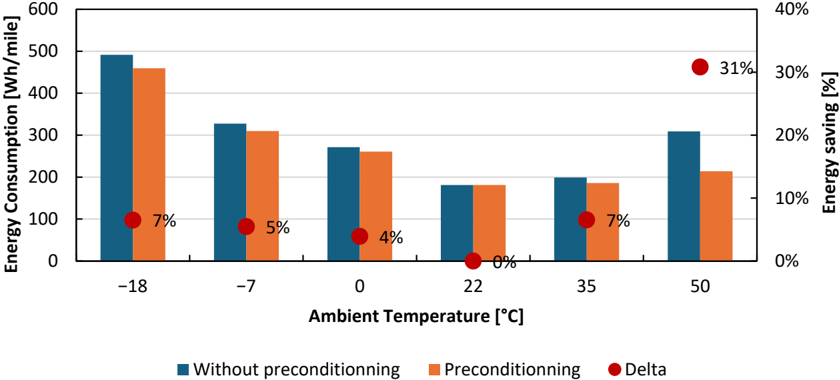
Electric vehicle (EV) performance can vary substantially under real-world operating conditions, particularly due to ambient temperature effects on energy consumption, battery behavior, and thermal management requirements. This study quantifies how weather conditions, daily driving patterns, and State-of-Charge (SOC) usage strategies jointly influence EV driving range, charging frequency, and overall energy efficiency. A detailed and experimentally validated Autonomie vehicle model is developed, integrating a powertrain, a mono-zonal cabin model, and a battery electro-thermal model. Three battery sizes (200-, 300-, and 400-mile homologated ranges) are assessed across five commute profiles (20–200 miles) and six ambient temperatures (−18 °C to 50 °C), including scenarios with and without preconditioning. Results show that extreme temperatures could significantly decrease the maximum achievable range by up to 55% in cold conditions (−18 °C) and 40% in hot conditions (50 °C), relative to moderate conditions. Larger battery packs retain a greater fraction of their nominal range under thermal stress, while smaller packs experience sharper relative penalties due to the higher contribution of thermal loads to total energy demand. The analysis further demonstrates that limiting operation to partial SOC windows (e.g., 80–20%), a common real-world practice, significantly reduces achievable range and increases charging frequency, particularly in cold weather. Thermal preconditioning while plugged in is shown to mitigate these effects for short trips, reducing energy consumption by up to 31% in hot conditions and 7% in cold conditions. The findings demonstrate how climate, SOC usage behavior, and thermal management jointly shape the practical driving capability of EVs, highlighting the importance of efficient thermal management and realistic user charging strategies for ensuring reliable EV operation across diverse climatic scenarios.
Overview
CoChat Summary
TL;DR
Using an experimentally validated Autonomie model of a compact BEV in three battery sizes, this study quantifies how ambient temperature, commute distance, battery capacity, SOC window, and thermal preconditioning jointly affect energy consumption, usable range, and charging frequency. Extreme temperatures cut achievable range by up to ~55–65% in cold and ~40% in heat, with partial SOC operation (80–20%) and preconditioning each materially shifting practical range and charging needs.
Key findings
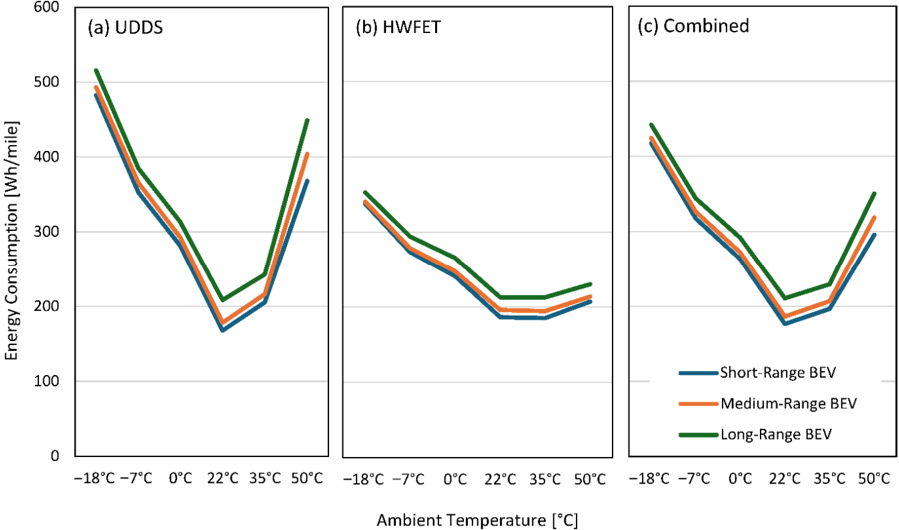
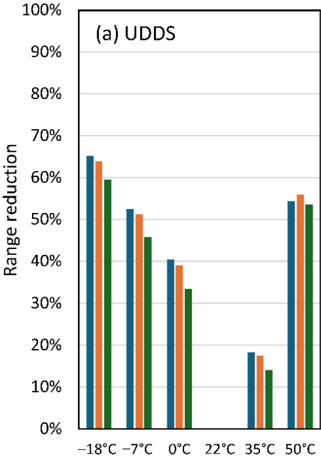
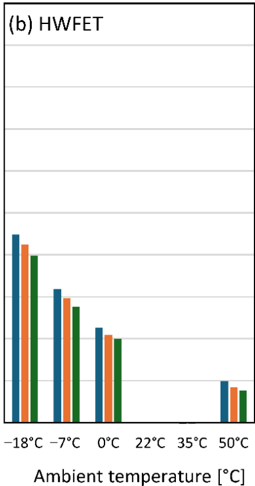
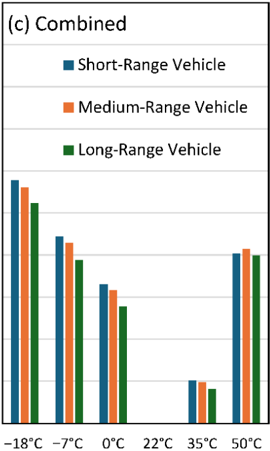
- Extreme cold dominates: at −18 °C, total energy consumption rose ~128% over the 22 °C baseline, with range reductions of ~64% under urban (UDDS) and ~42% under highway (HWFET) driving for the 300-mile BEV; combined-cycle reductions were ~58% (short-range), 56% (medium), and 52% (long). At 50 °C, consumption increased up to 71%, with combined-cycle range reduction converging to ~40% across all three configurations.
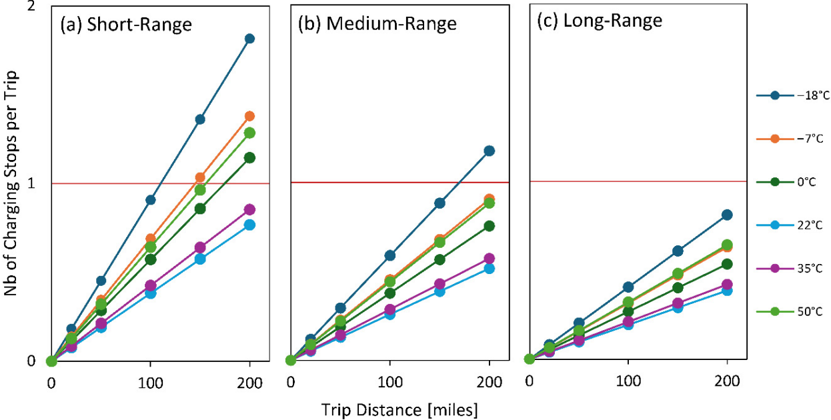
- Larger packs dilute thermal penalties: the short-range (200-mile) BEV fell to ~110 miles at −18 °C under full depletion, while the 400-mile BEV completed all modeled commutes without recharging across the temperature spectrum; the 300-mile BEV needed one intermediate charge only at −18 °C.
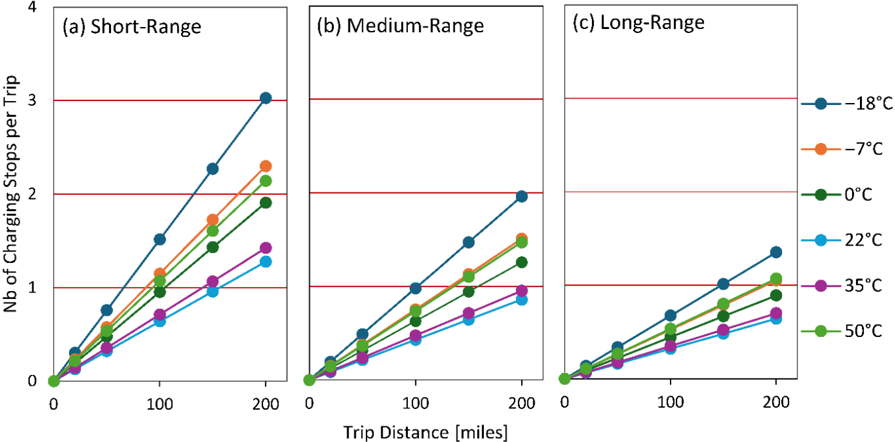
- Partial SOC use (80–20%) removes ~40% of usable energy, cutting trip distance before recharge by roughly one-third; for the short-range BEV at 22 °C this allowed ~130–150 miles on a single charge, dropping to ~85 miles at −7 °C and below 25% of nominal range at −18 °C.
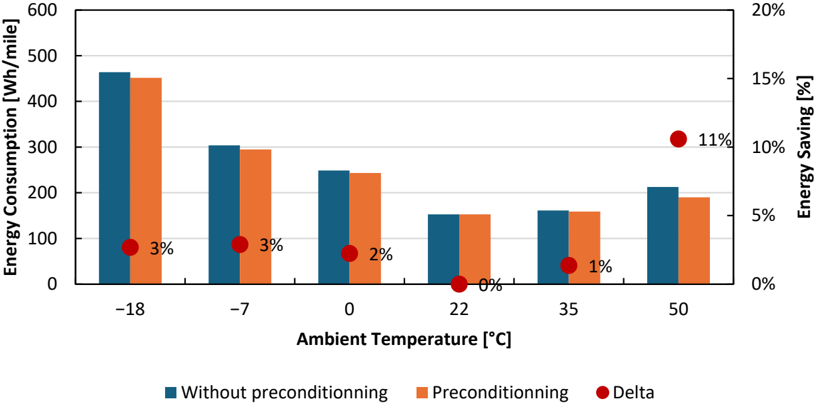
- Preconditioning while plugged in reduced energy consumption by up to 7% at −18 °C and 31% at 50 °C for 20-mile UDDS trips, but only 3–11% for 100-mile trips as propulsion energy dominated.
Methods
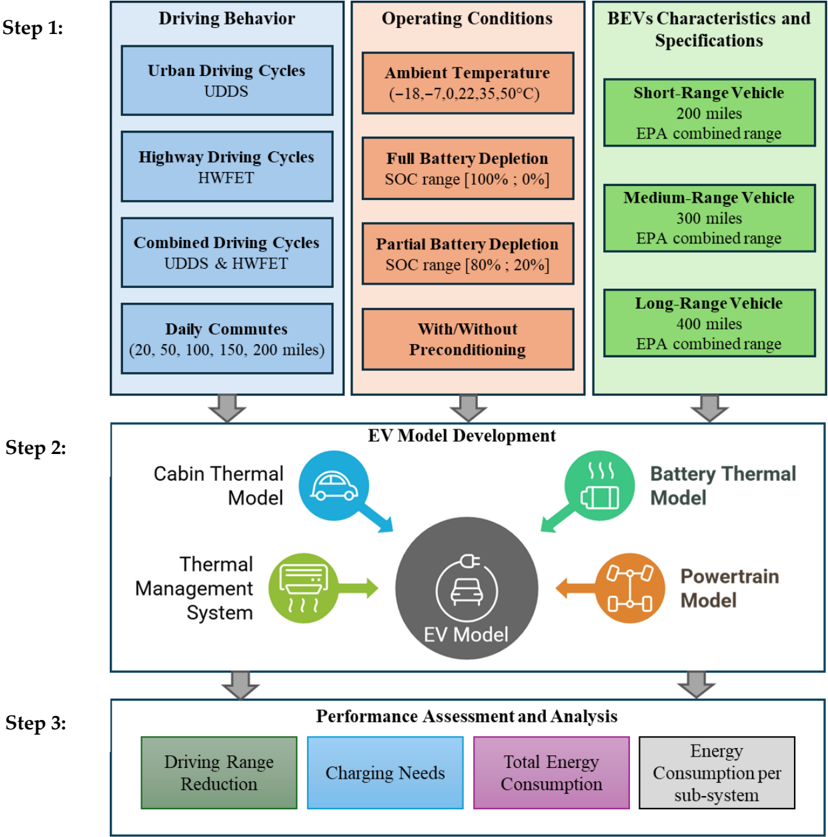
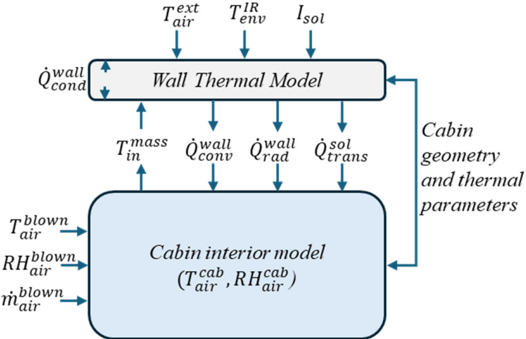
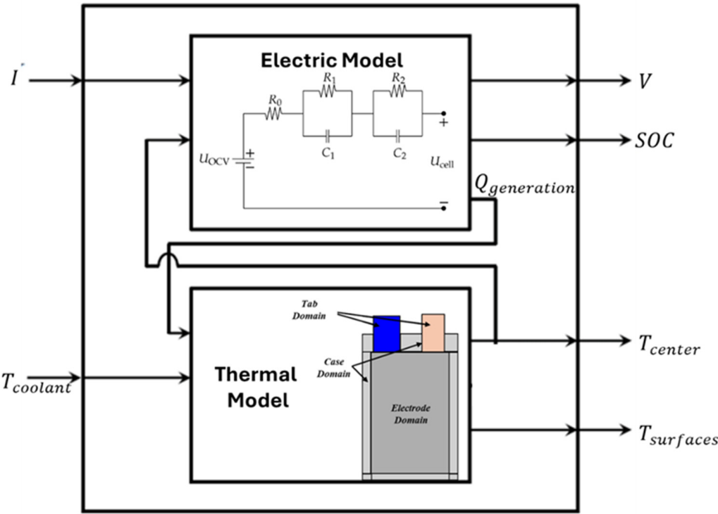
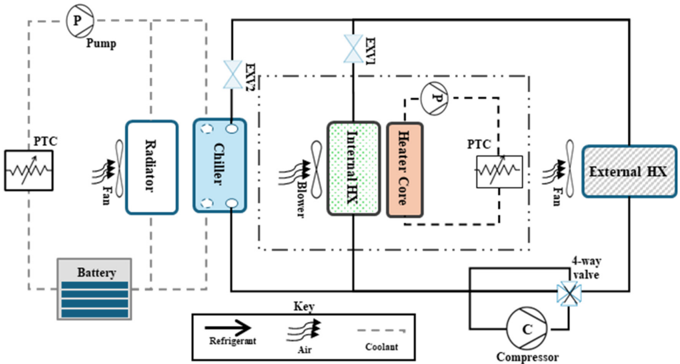
- Simulation study using a modular Autonomie model coupling powertrain, a mono-zonal cabin thermal model, a 2D electro-thermal pouch-cell battery model, and a TMS (reversible heat pump, PTC, chiller, radiator), previously validated against experimental data for production EVs (Nissan Leaf, Chevrolet Bolt, Tesla Model 3) and calibrated to ±8% on TMS power.
- Three compact-class BEV configurations (200-, 300-, 400-mile EPA range; 46/72/109 kWh) evaluated across six ambient temperatures (−18, −7, 0, 22, 35, 50 °C), five commute distances (20, 50, 100, 150, 200+ miles), two SOC windows (100–0% and 80–20%), and with/without preconditioning.
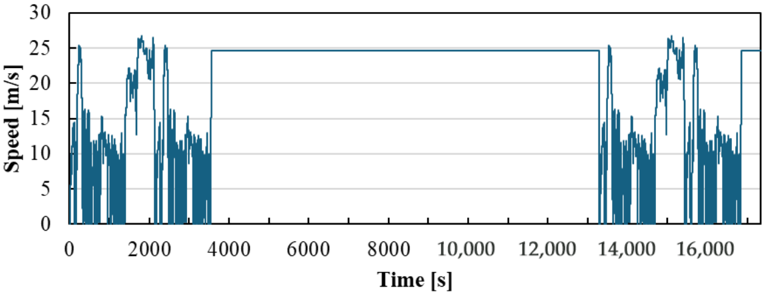
- Range and consumption assessed via the SAE J1634 Multi-Cycle Test (UDDS–HWFET–UDDS plus SOC-dependent constant-speed cycles), with a weighted UDDS consumption (first-cycle weight K1) and 55/45 city/highway combination; the EPA 0.7 adjustment factor was not applied because thermal losses were explicitly modeled.
Limitations
- Stated by the paper: total trip time including charging (and fast-charging taper above 80% SOC) was not evaluated and is flagged as future work; the study uses a fresh battery pack only, so State-of-Health degradation is not modeled; wind effects were excluded; and results rest on a single compact-class vehicle model rather than real-world usage datasets across regions and user groups.
- Evident from the text: all results are simulation-based (no new experimental campaign), and the analysis is limited to light-duty BEVs, with fleet-, grid-, and medium/heavy-duty extensions left to future work.
Model-written summary. Check it against the paper before relying on it.
Integrity signals
Registry
Cites
Statistics
Figures


Verification
Claims the paper makes
1 Valid · 9 Not valid · 16 Not checked · 168 Own results and interpretations
The cited sources support only part of this claim — read each source’s verdict below.
In the paper
“Multiple studies have demonstrated that ambient temperature significantly influences EV energy consumption and driving range [8][9][10][11].”
§ Understanding Electric Vehicle Range and Charging Needs: Interactions Between Ambient Temperature, Commute Patterns, and State-of-Charge Usage > 2.1. Temperature Effects on EV Energy Consumption and Range
What the sources say
- Supportedcites [8] Senol, M.; Bayram, I.S.; Naderi, Y.; Galloway, S. Electric Vehicles Under Low Temperatures: A Review on Battery Performance, Charging Needs, and Power Grid Impacts. IEEE Access 2023, 11, 39879-39912. [CrossRef] source
The review's Section C 'Reduced Driving Range' states that 'High or low ambient temperatures cause a noticeable decrease in the distance a vehicle can travel before recharging due to using HVAC,' and quantifies it with several cited studies (Canadian work showing 1.1 km loss per 1°C drop and 20% range loss at −7°C vs 20°C; Nissan Leaf and Mitsubishi i-MiEV figures). Section B 'Additional Demand for EV Cabin Thermal Comfort' reports the ambient-temperature/energy-demand correlations (e.g. y = −4.78×T + 82.3 worst case, and the preheating study showing total energy consumption up 33% urban / 13% highway), and the Problem Statement notes EV performance 'significantly degrades' under low or high temperatures. As a review pooling many such studies, it supports the broad background claim, including the 'multiple studies' framing. (LLM, conf=0.90)
- Partly supportedcites [9] Ramsey, D.; Bouscayrol, A.; Boulon, L.; Desreveaux, A.; Vaudrey, A. Flexible Simulation of an Electric Vehicle to Estimate the Impact of Thermal Comfort on the Energy Consumption. IEEE Trans. Transp. Electrif. 2022, 8, 2288-2298. [CrossRef] sourceExperimental — accuracy not yet measured
Ramsey et al. (2022) support the energy-consumption half with their own results: Section IV-A/IV-B show overall consumption rising from 120 Wh/km at 20 °C to 418 Wh/km at very low ambient temperature on the urban cycle (a 248% yearly variation in Regina's climate, −30 °C to 30 °C), i.e. ambient conditions strongly affect a BEV's energy use via the HVAC subsystem. The driving-range half is not this paper's own finding — the Introduction reports 'reductions of 50% to 70% of the driving range under extreme cold conditions' only as the result of others' real-driving studies [10] and [12], and the paper's own work is a simulation of a single vehicle, quantifying Wh/km rather than range. So the source demonstrates the energy-consumption influence but merely relays the range claim attributed to it here. (LLM, conf=0.78)
- Not checked yetcites [10] Basciotti, D.; Dvorak, D.; Gellai, I. A novel methodology for evaluating the impact of energy efficiency measures on the cabin thermal comfort of electric vehicles. Energies 2020, 13, 3872. [CrossRef] source
- Supportedcites [11] Steinstraeter, M.; Heinrich, T.; Lienkamp, M. Effect of low temperature on electric vehicle range. World Electr. Veh. J. 2021, 12, 115. [CrossRef] source
The Abstract of Steinstraeter et al. (2021) states that BEVs suffer 'sharply decreased driving range at low temperatures', quantifying a range decrease of up to 31.9% from heating and 21.7% from limited recuperation (~50% combined). The Introduction reviews several independent studies on the same point (Taggart [18]: up to 45% higher consumption at -10 °C; Delos Reyes et al. [19]: up to 70% range loss at -26 °C; Horrein et al. [13], Michaelides [20], Ramsey et al. [14]), and Section 5.1 shows heating energy share increasing as ambient temperature falls. Our copy therefore clearly treats ambient temperature as a significant influence on EV energy consumption and driving range, supporting the broad background statement attributed here. (LLM, conf=0.90)
boostedstates an association- Asserted: passes — The authors put it forward as true.
- Checkable: passes — It can be checked against evidence.
- Load-bearing: passes — The paper’s conclusions depend on it.
- Based: passes — The paper gives a reason why it holds.
- Supported
A result the paper states — it cites no source for it, so there is none to check. The quote shows it is in the paper.
In the paper
“Larger battery packs retain a greater fraction of their nominal range under thermal stress, while smaller packs experience sharper relative penalties due to the higher contribution of thermal loads to total energy demand.”
§ Understanding Electric Vehicle Range and Charging Needs: Interactions Between Ambient Temperature, Commute Patterns, and State-of-Charge Usage > Abstract
plainstates a cause- Asserted: passes — The authors put it forward as true.
- Checkable: passes — It can be checked against evidence.
- Load-bearing: passes — The paper’s conclusions depend on it.
- Based: passes — The paper gives a reason why it holds.
The paper states this without a source or data behind it here, so there is nothing to check it against. The quote shows it is in the paper.
In the paper
“Thermal preconditioning while plugged in is shown to mitigate these effects for short trips, reducing energy consumption by up to 31% in hot conditions and 7% in cold conditions.”
§ Understanding Electric Vehicle Range and Charging Needs: Interactions Between Ambient Temperature, Commute Patterns, and State-of-Charge Usage > Abstract
plainstates a cause- Asserted: passes — The authors put it forward as true.
- Checkable: passes — It can be checked against evidence.
- Load-bearing: passes — The paper’s conclusions depend on it.
- Based: unclear — It is unclear why the paper says it holds.
A result the paper states — it cites no source for it, so there is none to check. The quote shows it is in the paper.
In the paper
“Larger battery packs retain a greater fraction of their nominal range under thermal stress, while smaller packs experience sharper relative penalties due to the higher contribution of thermal loads to total energy demand.”
§ Understanding Electric Vehicle Range and Charging Needs: Interactions Between Ambient Temperature, Commute Patterns, and State-of-Charge Usage > Abstract
plainstates a cause- Asserted: passes — The authors put it forward as true.
- Checkable: passes — It can be checked against evidence.
- Load-bearing: passes — The paper’s conclusions depend on it.
- Based: passes — The paper gives a reason why it holds.
A result the paper states — it cites no source for it, so there is none to check. The quote shows it is in the paper.
In the paper
“High-temperature operation also leads to notable degradation, with range reductions of approximately 55%”
§ Understanding Electric Vehicle Range and Charging Needs: Interactions Between Ambient Temperature, Commute Patterns, and State-of-Charge Usage > Range Reduction (%) = abs Range T Re f erence -Range T ambient
plainstates a cause- Asserted: passes — The authors put it forward as true.
- Checkable: passes — It can be checked against evidence.
- Load-bearing: passes — The paper’s conclusions depend on it.
- Based: passes — The paper gives a reason why it holds.
100 more claims
Create a free account to see all 194 claims and to verify the 22 references still open.
- It may state two separate claims as one. 68
- The quote only partly states this claim. 3
- Probably not a substantial claim. 25
Self-check
Percentages, sums and reported differences re-computed from the paper’s own numbers.
Each contradiction between two passages listed here was confirmed by an independent check.
Rated major: it would touch a result — a value a result rests on, reported and recomputed p-values on opposite sides of the significance level, two passages that conflict with no sign which is right, or a cited work retracted before this paper was published.
In the paper
§ Understanding Electric Vehicle Range and Charging Needs: Interactions Between Ambient Temperature, Commute Patterns, and State-of-Charge Usage > 4.3.2. Partial Battery Depletion (80-20% SOC)
“For the short-range BEV, the 22 • C baseline provided the most favorable conditions, enabling trips of up to roughly 150 miles on a single charge before reaching the 20% SOC threshold.”
§ Understanding Electric Vehicle Range and Charging Needs: Interactions Between Ambient Temperature, Commute Patterns, and State-of-Charge Usage > 5. Conclusions
“For the short-range BEV, 22 • C operation allowed 130-mile trips on a single charge”
Rated major: it would touch a result — a value a result rests on, reported and recomputed p-values on opposite sides of the significance level, two passages that conflict with no sign which is right, or a cited work retracted before this paper was published.
In the paper
§ Understanding Electric Vehicle Range and Charging Needs: Interactions Between Ambient Temperature, Commute Patterns, and State-of-Charge Usage > 4.1.2. Impact on Energy Consumption Split Under Summer Conditions
“The short-range EV covered 236 miles at 50 • C, a nearly 13% reduction from its nominal range”
§ Understanding Electric Vehicle Range and Charging Needs: Interactions Between Ambient Temperature, Commute Patterns, and State-of-Charge Usage > 4.3.1. Full Battery Depletion (100-0% SOC)
“the short-range BEV (200-mile nominal range)”
Rated major: it would touch a result — a value a result rests on, reported and recomputed p-values on opposite sides of the significance level, two passages that conflict with no sign which is right, or a cited work retracted before this paper was published.
In the paper
§ Understanding Electric Vehicle Range and Charging Needs: Interactions Between Ambient Temperature, Commute Patterns, and State-of-Charge Usage > 4.3.2. Partial Battery Depletion (80-20% SOC)
“by -7 • C, the vehicle required a recharge after approximately 85 miles.”
§ Understanding Electric Vehicle Range and Charging Needs: Interactions Between Ambient Temperature, Commute Patterns, and State-of-Charge Usage > 5. Conclusions
“cold conditions compressed this to 50 miles at -7 • C”
Rated major: it would touch a result — a value a result rests on, reported and recomputed p-values on opposite sides of the significance level, two passages that conflict with no sign which is right, or a cited work retracted before this paper was published.
In the paper
§ Understanding Electric Vehicle Range and Charging Needs: Interactions Between Ambient Temperature, Commute Patterns, and State-of-Charge Usage > 5. Conclusions
“Steady state 537.4 213.1 257.7 344.4 251.6 0.0 92.8 0.0”
§ Understanding Electric Vehicle Range and Charging Needs: Interactions Between Ambient Temperature, Commute Patterns, and State-of-Charge Usage > 5. Conclusions
“| | | | Total Energy Capacity | 46; 72; 109 kWh * |”
Rated minor: it would not touch a result — a value no result rests on, a p-value that stays on the same side of the significance level, or a conflict that is clerical, resolved elsewhere in the paper, or outside its own findings.
In the paper
§ Understanding Electric Vehicle Range and Charging Needs: Interactions Between Ambient Temperature, Commute Patterns, and State-of-Charge Usage > 5. Conclusions
“Figure 12.Number of charging stops per trip as a function of ambient temperature and commute distance for three different BEVs: (a) short, (b) medium, and (c) long range under full-depletion scenario [80-20%].”
§ Understanding Electric Vehicle Range and Charging Needs: Interactions Between Ambient Temperature, Commute Patterns, and State-of-Charge Usage > 4.3.2. Partial Battery Depletion (80-20% SOC)
“## 4.3.2. Partial Battery Depletion (80-20% SOC)”
1 more finding
Create a free account to see every finding of this check.
Citations
Cites
Yuksel, T., & Michalek, J. J. (2015) · Environmental Science & Technology · doi:10.1021/es505621s · Cited by 380
Hao, X., Wang, H., Lin, Z., & Ouyang, M. (2020) · Journal of Cleaner Production · doi:10.1016/j.jclepro.2019.119403 · Cited by 279
Al-Wreikat, Y., Serrano, C., & Sodré, J. R. (2022) · Energy · doi:10.1016/j.energy.2021.122028 · Cited by 220
Iora, P., & Tribioli, L. (2019) · World Electric Vehicle Journal · doi:10.3390/wevj10010002 · Cited by 158
Passenger-aware reinforcement learning for efficient and robust energy management of fuel cell buses
Jia, C., Liu, W., Chau, K. T., He, H., Zhou, J., & Niu, S. (2026) · eTransportation · doi:10.1016/j.etran.2025.100537 · Cited by 154
Review of Thermal Management Technology for Electric Vehicles
Dan, D., Zhao, Y., Wei, M., & Wang, X. (2023) · Energies · doi:10.3390/en16124693 · Cited by 135
Effect of Low Temperature on Electric Vehicle Range
Steinstraeter, M., Heinrich, T., & Lienkamp, M. (2021) · World Electric Vehicle Journal · doi:10.3390/wevj12030115 · Cited by 122
Senol, M., Bayram, I. S., Naderi, Y., & Galloway, S. (2023) · IEEE Access · doi:10.1109/access.2023.3268615 · Cited by 110
Ramsey, D., Bouscayrol, A., Boulon, L., Desreveaux, A., & Vaudrey, A. (2022) · IEEE Transactions on Transportation Electrification · doi:10.1109/tte.2022.3144526 · Cited by 39
Research on electric vehicle range under cold condition
Zhao, C., Li, Y., Yang, Y. J., Wan, S., Yu, F., Yu, C. C., Deng, C., Zhou, A., & Shen, X. (2022) · Advances in Mechanical Engineering · doi:10.1177/16878132221087083 · Cited by 34
Haddad, R. A., Mansour, C., Kim, N., Seo, J., Stutenberg, K. M., & Nemer, M. (2025) · Energy Conversion and Management · doi:10.1016/j.enconman.2025.119706 · Cited by 28
Self-citationBasciotti, D., Dvorak, D., & Gellai, I. (2020) · Energies · doi:10.3390/en13153872 · Cited by 25
Cabin Thermal Needs: Modeling and Assumption Analysis
Brèque, F., & Nemer, M. (2017) · Linköping electronic conference proceedings · doi:10.3384/ecp17132771 · Cited by 23
Self-citationImpacts of Electric Vehicle Charging under Cold Weather on Power Networks
Bayram, I. S. (2021) · 2021 56th International Universities Power Engineering Conference (UPEC) · doi:10.1109/upec50034.2021.9548276 · Cited by 15
Armenta-Déu, C., & Giorgi, B. (2023) · Future Transportation · doi:10.3390/futuretransp3020037 · Cited by 13
Thermal Energy Management in Vehicles
Lemort, V., Olivier, G., & de Pelsemaeker, G. (2023) · doi:10.1002/9781119251767 · Cited by 6
Modeling and control of heat pump system for battery electric buses
Haddad, R. A., Basma, H., & Mansour, C. (2022) · Proceedings of the Institution of Mechanical Engineers, Part D: Journal of Automobile Engineering · doi:10.1177/09544070211069465 · Cited by 4
Self-citationAl Haddad, R., Mansour, C., Kim, N., Seo, J., & Nemer, M. (2024) · SAE Technical Paper Series · doi:10.4271/2024-01-2403 · Cited by 4
Self-citation(2019) · HAL
Self-citation
Research works printed but not linked: 1
- SAE Standard J1634_202104; SAE International Recommended Practice, Battery Electric Vehicle Energy Consumption and Range Test Procedure. SAE International: Warrendale, PA, USA, 2021. [CrossRef]
Cited by
Zhang, Y., Yu, D., & Gao, L. (2026) · Socio-Economic Planning Sciences · doi:10.1016/j.seps.2026.102589
Tür, M. R., Şenyapar, H. N. D., Bayındır, R., & Suvak, M. (2026) · doi:10.1109/icsmartgrid70882.2026.11680675
Li, G., Bai, L., Wang, K., Jing, X., Zhang, K., & Wang, T. (2026) · Physics and Chemistry of the Earth Parts A/B/C · doi:10.1016/j.pce.2026.104621
Metadata
- Authors
- Mansour, C., Benoit, M., Al Haddad, R., Kim, N., Nemer, M., Zuniga, N., & Auld, J.
- Affiliations
- Argonne National Laboratory (US)
- Center for Energy, Environment, and Processes, Ecole des Mines de Paris, 21 All. des Marronniers, 78000 Versailles, France
- École Nationale Supérieure des Mines de Paris (FR)
- Vehicle and Mobility Systems Department, Argonne National Laboratory, 9700 S Cass Ave, Lemont, IL 60439, USA
- Corresponding author
- Mansour, Charbel
- Venue
- Energies
- Publisher
- MDPI AG
- Published
- 2026-01-29
- Volume
- 19
- Issue
- 3
- Pages
- 709
- ISSN
- 1996-1073 (ISSN-L)
- OpenAlex
- W7126059575
- Cited by
- 3
- References
- 19
- Citations by year
- 2026: 3
- FWCI
- 3.09
- Type
- journal article
- Language
- en
- Open access
- gold
- doi.org
- Licence
- Locations
- Energies (publishedVersion, cc-by)
- HAL (submittedVersion, cc-by)
- DOAJ (DOAJ: Directory of Open Access Journals) (submittedVersion)
- Funders
- the U.S. Department of Energy (DOE) Vehicle Technologies Office
- Topics
- Physical Sciences › Engineering › Electrical and Electronic Engineering › Electric Vehicles and Infrastructure
- Physical Sciences › Engineering › Automotive Engineering › Electric and Hybrid Vehicle Technologies
- Physical Sciences › Engineering › Automotive Engineering › Battery Modeling and Management
- Keywords
- electric vehicle range, ambient temperature effects, battery thermal management, charging frequency, commuting patterns, energy consumption, charging strategies
About these checks
Registry, retraction, Cites and statistics results are computed, not judged, with one exception: a printed reference that no index lists is read once by a model before it counts as a citation error. Claims are extracted by a model and kept only when their quote appears verbatim in the text; each cited source is then checked, with a model’s help, for whether it says what the claim relies on. Those verdicts can be wrong — read the claim’s quote and the cited source before relying on one.
The claim verdicts this report counts are experimental: their accuracy is not yet measured.
A language model drew the claims from the paper on 2026-11-26, under version 3 of the claim definition (model deepseek-v4.1-flash, prompt extract-v3).
A second model labelled each claim on 2026-11-26 (model jev-1.13-20260917, definition revision gold-guideline-v0.2).
Cited sources are checked with a language model’s help (qwen3.8-omni-flash).
Statistics and arithmetic are recomputed, not judged.
Confidence bands are shown only for fields calibrated on our annotated test set. None is calibrated yet, so no band is shown.
What counts as a claim ›How we measure confidence ›How we check this ›
Are you an author, or do you see a problem with this page? Request a review
Data sources
Bibliographic data: Semantic Scholar, OpenAlex, Crossref.
Contains information from the Semantic Scholar Academic Graph Datasets, made available under the ODC Attribution License (ODC-BY 1.0).
Semantic Scholar’s data is described in: Kinney, R., et al. (2023). The Semantic Scholar Open Data Platform. arXiv:2301.10140.
