

Traditional and New Microorganisms in Lactic Acid Fermentation of Food
Open accessThe DOI matches its Crossref record; 144 of the 150 references it cites were found in a registry or an index; none of the 90 sources its claims cite is checked for support yet.
Abstract
Lactic acid fermentation is one of the oldest and most commonly used methods of bioconservation. This process is widely used for food preservation and also for a production technique that relies on the metabolism of lactic acid bacteria (LAB) to convert carbohydrates into lactic acid. This fermentation imparts unique flavors and texture of foods, extends their shelf life, and can offer health benefits. There are both traditional and new microorganisms involved in the lactic acid fermentation of food. The current review outlines the issues of fermented foods. Based on traditional fermentation methods, a broad panorama of various food products is presented, with the microorganisms involved. The methods of both traditional fermentation (spontaneous and back-slopping) as well as the importance and application of starter cultures in mass food production are presented. Currently, based on the results of scientific research, the health-promoting effect of fermented foods is becoming more and more important. This is due to the presence of probiotic microorganisms that are naturally presented or may be added to them, as starter cultures or additives, and from the presence of prebiotics and postbiotics. New innovative methods of using probiotic microorganisms open up new and broad perspectives for fermented functional foods.
Overview
CoChat Summary
TL;DR
This narrative review surveys traditional and novel microorganisms in lactic acid fermentation of foods, covering dairy, plant, bakery, meat/fish, and oriental products, and the shift from spontaneous/back-slopping fermentation to starter cultures and probiotics. It concludes that probiotic LAB and starter cultures can improve preservation, safety, and health-promoting properties, though strain selection and food-matrix viability remain key challenges.
Key findings
- Lactic acid fermentation is ancient and widespread; the review cites Tamang (2010) estimating more than 5,000 fermented food products are consumed worldwide, and notes 261 LAB species grouped in 26 genera.
- Traditional fermentations rely on spontaneous microbiota or back-slopping; commercial starter cultures improve control, safety, and standardization, but may limit microbial biodiversity and regional sensory uniqueness.
- LAB dominate across food categories: dairy (yoghurt, kefir, cheese), plant foods (sauerkraut, table olives, juices), sourdough bakery, meat/fish, and oriental products (tarhana, boza, stinky tofu, natto, miso, kimchi, etc.). Reported examples include native LAB in fruits/vegetables at 2.0–4.0 log CFU g⁻¹, LAB counts in fermented fish up to 9.5 log CFU g⁻¹, and sauerkraut made with 2.3–3.0% salt reaching final pH 3.5–3.8.
- Probiotics are presented as novel microorganisms for lactic acid fermentation; probiotic food products must have high cell concentrations (≥10⁶ CFU mL⁻¹, or 10⁸–10¹¹ CFU per day) and maintain viability through shelf life and gastrointestinal passage, with benefits being strain-specific.
Methods
- Narrative review; no systematic search strategy, meta-analysis, or primary experimental data are described.
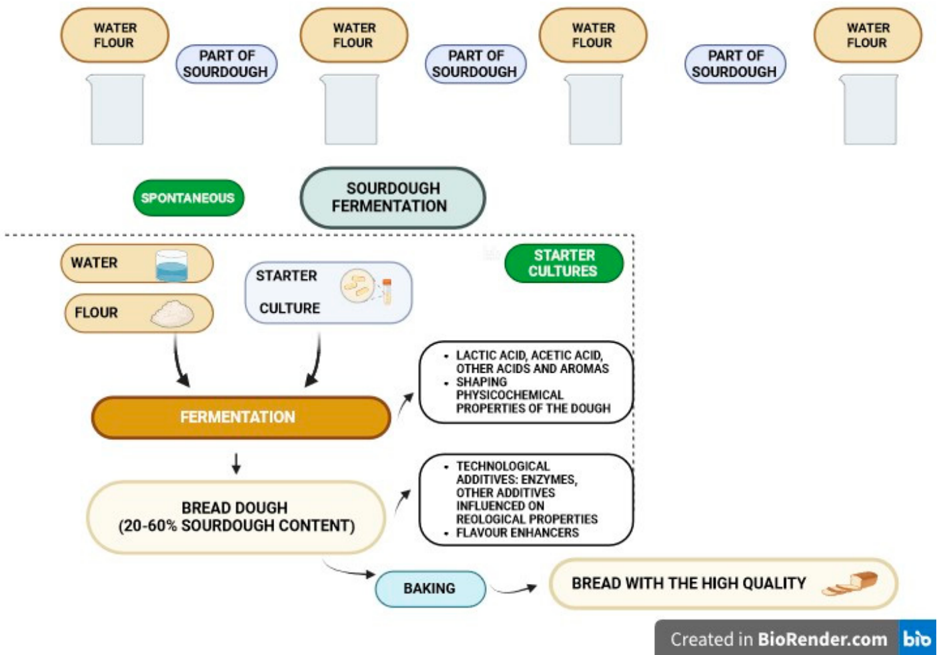
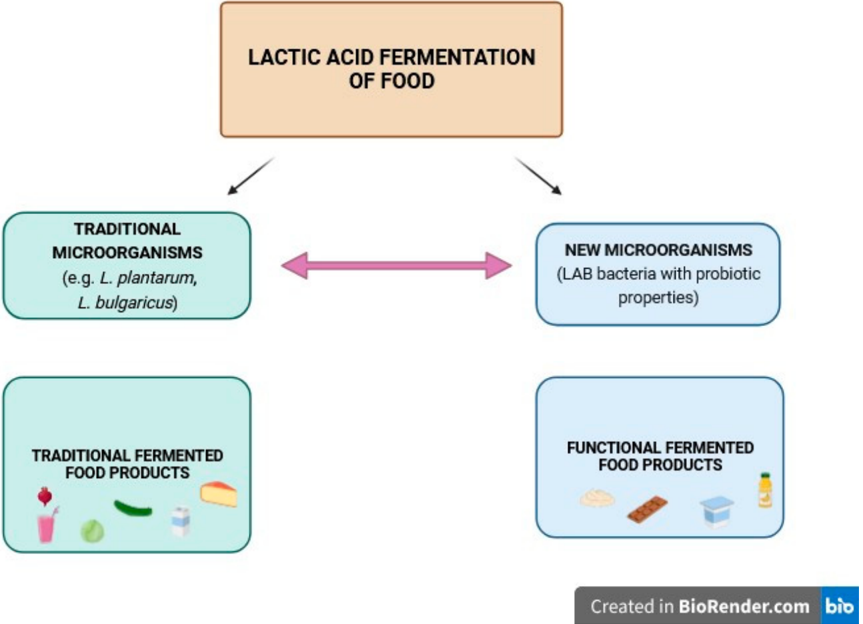
- Synthesizes literature on traditional and new microorganisms in lactic acid fermentation, organized by history, food category, starter cultures, and probiotics; includes two BioRender figures.
- Draws on cited secondary studies and examples, including analyses of 168 research papers on fermented fish and 80 European fermented meat products.
Limitations
- The paper states no limitations.
- Evident from the text: it is a narrative review without reported systematic search, inclusion/exclusion criteria, or quality assessment, so conclusions synthesize heterogeneous studies.
- Evident from the text: broad scope across many food matrices and regions, with no primary data or quantitative synthesis; health-benefit claims generally reference other studies rather than new trials.
Model-written summary. Check it against the paper before relying on it.
Integrity signals
Registry
Cites
Statistics
Figures
Verification
Claims the paper makes
0 Valid · 0 Not valid · 69 Not checked · 4 Own results and interpretations
None of the sources cited for this claim have been checked yet.
In the paper
“Some authors reported that the application of some LAB strains (Levl.brevis, Lacp.plantarum, P. pentosaceus, and Pediococcus acidilactici) in baked bread showed significantly reduced acrylamide content [69,70].”
§ Traditional and New Microorganisms in Lactic Acid Fermentation of Food > 3.3. Bakery Products
What the sources say
- Not checked yetcites [69] Ben Taher, I.; Chouaibi, M.; Jaunbergs, J.; Bartkevics, V.; Hassouna, M. Assessment of lactic acid bacteria application for the reduction of acrylamide formation in bread. LWT-Food Sci. Technol. 2018, 92, 435-441. [CrossRef] source
- Not checked yetcites [70] Esfahani, B.N.; Kadivar, M.; Shahedi, M.; Soleimanian-Zad, S. Reduction of acrylamide in whole-wheat bread by combining lactobacilli and yeast fermentation. Food Addit. Contam. Part A 2017, 34, 1904-1914. [CrossRef] source
hedgedstates a cause- Asserted: passes — The authors put it forward as true.
- Checkable: passes — It can be checked against evidence.
- Load-bearing: unclear — It is unclear whether the paper’s conclusions depend on it.
- Based: passes — The paper gives a reason why it holds.
In the paper
“The natural and safe preservatives of traditional dairy products are ensured by LAB-produced antimicrobial peptides called bacteriocins [19].”
§ Traditional and New Microorganisms in Lactic Acid Fermentation of Food > 3.1. Dairy Products
What the sources say
- Not checked yetcites [19] de Souza, E.L.; de Oliveira, K.; de Oliveira, M.E. Influence of lactic acid bacteria metabolites on physical and chemical food properties. Curr. Opin. Food Sci. 2023, 49, 100981. [CrossRef] source
plainstates a cause- Asserted: passes — The authors put it forward as true.
- Checkable: passes — It can be checked against evidence.
- Load-bearing: unclear — It is unclear whether the paper’s conclusions depend on it.
- Based: passes — The paper gives a reason why it holds.
In the paper
“Starter cultures are selected by considering features, such as hetero-and homofermentation, probiotic properties, acid tolerance, organic acid production, temperature range, salt tolerance, oleuropein separation ability, flavor devel-opment, and bacteriocin production, in order to dominate the natural microbiota [24].”
§ Traditional and New Microorganisms in Lactic Acid Fermentation of Food > 3.1. Dairy Products
What the sources say
- Not checked yetcites [24] Montet, D.; Ray, R.C.; Zakhia-Rozis, N. Lactic Acid Fermentation of Vegetables and Fruits. In Microorganisms and Fermentation of Traditional Foods; CRC Press: Boca Raton, FL, USA, 2014; pp. 118-150.
plainstates a cause- Asserted: passes — The authors put it forward as true.
- Checkable: passes — It can be checked against evidence.
- Load-bearing: unclear — It is unclear whether the paper’s conclusions depend on it.
- Based: passes — The paper gives a reason why it holds.
In the paper
“However, the implementation of empirical and artisanal techniques often leads to inconsistent food products [21].”
§ Traditional and New Microorganisms in Lactic Acid Fermentation of Food > 3.1. Dairy Products
What the sources say
- Not checked yetcites [21] Skowron, K.; Budzy ńska, A.; Grudlewska-Buda, K.; Wiktorczyk-Kapischke, N.; Andrzejewska, M.; Wałecka-Zacharska, E.; Gospodarek-Komkowska, E. Two Faces of Fermented Foods-The Benefits and Threats of Its Consumption. Front. Microbiol. 2022, 13, 845166. [CrossRef] [PubMed] source
plainstates a cause- Asserted: passes — The authors put it forward as true.
- Checkable: passes — It can be checked against evidence.
- Load-bearing: unclear — It is unclear whether the paper’s conclusions depend on it.
- Based: passes — The paper gives a reason why it holds.
In the paper
“Exopolysaccharides influence interactions with milk proteins and micelles, resulting in improvements in casein network firmness and ability to bind water [27].”
§ Traditional and New Microorganisms in Lactic Acid Fermentation of Food > 3.1. Dairy Products
What the sources say
- Not checked yetcites [27] Abarquero, D.; Renes, E.; Fresno, J.M.; Tornadijo, M.E. Study of exopolysaccharides from lactic acid bacteria and their industrial applications: A review. Int. J. Food Sci. Technol. 2022, 57, 16-26. [CrossRef] source
plainstates a cause- Asserted: passes — The authors put it forward as true.
- Checkable: passes — It can be checked against evidence.
- Load-bearing: unclear — It is unclear whether the paper’s conclusions depend on it.
- Based: passes — The paper gives a reason why it holds.
27 more claims
Create a free account to see all 73 claims and to verify the 90 references still open.
- It may state two separate claims as one. 37
- Probably not a substantial claim. 9
Citations
Cites
Hill (2014) · doi:10.1038/nrgastro.2014.66 · Cited by 9,592 · cited 1×
“The term “probiotic microorganisms” is defined as “live microorganisms that, when administered in adequate amounts, confer a health benefit on the host” [125].”
The State of World Fisheries and Aquaculture 2022
(2022) · FAO eBooks · doi:10.4060/cc0461en · Cited by 5,689
Zheng, J., Wittouck, S., Salvetti, E., Franz, C. M. A. P., Harris, H. M. B., Mattarelli, P., O’Toole, P. W., Pot, B., Vandamme, P., Walter, J., et al. (2020) · International Journal of Systematic and Evolutionary Microbiology · doi:10.1099/ijsem.0.004107 · Cited by 3,313 · cited 2×
“The genus Lactobacillus , which has recently been divided into 23 new genera, is one of the more than 70 bacterial species that have been isolated from sourdough fermentation [17,55].”
Lactic acid bacteria as functional starter cultures for the food fermentation industry
Leroy, F., & De Vuyst, L. (2004) · Trends in Food Science & Technology · doi:10.1016/j.tifs.2003.09.004 · Cited by 1,852 · cited 1×
“Moreover, the wide use of commercially selected starter cultures may lead to the disappearance of certain wild strains, leading to the loss of genetic material [40].”
Bacillus As Potential Probiotics: Status, Concerns, and Future Perspectives
Elshaghabee, F. M. F., Rokana, N., Gulhane, R. D., Sharma, C., & Panwar, H. (2017) · Frontiers in Microbiology · doi:10.3389/fmicb.2017.01490 · Cited by 940
Recent advances in cheese microbiology
Beresford, T. P., Fitzsimons, N. A., Brennan, N. L., & Cogan, T. M. (2001) · International Dairy Journal · doi:10.1016/s0958-6946(01)00056-5 · Cited by 823 · cited 2×
“The most-often used starter bacteria are members of the genera Lactococcus , Lactobacillus , Streptococcus , Leuconostoc , and Enter-coccus [39].”
Review: Diversity of Microorganisms in Global Fermented Foods and Beverages
Tamang, J. P., Watanabe, K., & Holzapfel, W. H. (2016) · Frontiers in Microbiology · doi:10.3389/fmicb.2016.00377 · Cited by 816
Probiotic species in the modulation of gut microbiota: An overview
Azad, M. A. K., Sarker, M., Li, T., & Yin, J. (2018) · BioMed Research International · doi:10.1155/2018/9478630 · Cited by 803 · cited 1×
“In addition to Lactobacillus and Bifidobacterium , other significant and prevalent probiotic microorganisms include Lactococcus , Streptococcus , Enterococcus , Propionibacterium , and Saccharomyces yeasts [128,129].”
Dimidi, E., Cox, S., Rossi, M., & Whelan, K. (2019) · Nutrients · doi:10.3390/nu11081806 · Cited by 801 · cited 1×
“The fermentation techniques include balance of ingredients, temperature, and time control, which can be different from one region to another and result in regional specialties [96].”
Fermented foods in a global age: east meets West
Tamang, J. P., Cotter, P. D., Endo, A., Han, N. S., Kort, R., Liu, S. Q., Mayo, B., Westerik, N., & Hutkins, R. (2020) · Comprehensive Reviews in Food Science and Food Safety · doi:10.1111/1541-4337.12520 · Cited by 719
Research works printed but not linked: 13
- Tamang, J.P., Kailasapathy, K., Eds.; CRC Press: New York, NY, USA, 2010; pp. 41-84. [CrossRef]
- Frias, J., Martinez-Villaluenga, C., Peñas, E., Eds.; Academic Press: Cambridge, MA, USA, 2017; pp. 557-576. [CrossRef]
- Montet, D.; Ray, R.C.; Zakhia-Rozis, N. Lactic Acid Fermentation of Vegetables and Fruits. In Microorganisms and Fermentation of Traditional Foods; CRC Press: Boca Raton, FL, USA, 2014; pp. 118-150.
- Mojka, K. Charakterystyka mlecznych napojów fermentowanych. Probl. Hig. Epidemiol. 2013, 94, 722-729.
- Joseph, R.; Bachhawat, A.K. Yeasts: Production and Commercial Uses. In Encyclopedia of Food Microbiology, 2nd ed.; ˙Içinde, C.A., Batt, M.L.T., Eds.; Academic Press: Cambridge, MA, USA, 2014; pp. 823-830. [CrossRef]
- Kesenkaş, H.; Gürsoy, O.; Özbaş, H. Chapter 14-Kefir. In Fermented Foods in Health and Disease Prevention;
- Frias, ˙I.J., Martinez- Villaluenga, C., Peñas, E., Eds.; Academic Press: Cambridge, MA, USA, 2017; pp. 339-361. [CrossRef]
- John, W.F., Ed.; Academic Press: Cambridge, MA, USA, 2011; pp. 533-543. ISBN 9780123744074.
- Randazzo, C.L.; Rajendram, R.; Caggia, C. Lactic Acid Bacteria in Table Olive Fermentations in Olives and Olive Oil in Health and Disease; Preedy, V.R., Watson, R.R., Eds.; Academic Press: Singapore, 2010; pp. 369-376.
- Holzapfel, W., Ed.; Woodhead Publishing: Sawston, UK, 2015; pp. 357-376. [CrossRef]
- Ruddle, K.; Rosma, A.; Singh, A.; Ann, A.; Raj, A.; Gupta, A.; Kumar, A.; Thilakaratne, B.M.K.; Neopany, B.; Angchok, D.; et al. Indigenous Fermented Foods in Fermented Meat Products, Fish and Fish Products, Alkaline Fermented Foods, Tea, and Other Related Products; CRC Press: New York, NY, USA, 2015; pp. 645-713.
- Lennart Svensson, U., Desselberger, H.B., and Greenberg, M.K.E. (2016). Viral Gastroenteritis, Academic Press.
- Putta, S.; Yarla, N.S.; Lakkappa, D.B.; Imandi, S.B.; Malla, R.R.; Chaitanya, A.K.; Chari, B.P.V.; Saka, S.; Vechalapu, R.R.; Kamal, M.A.; et al. Chapter 2-Probiotics: Supplements, Food, Pharmaceutical Industry. In Therapeutic, Probiotic, and Unconventional Foods; Grumezescu, A.M., Holban, A.M., Eds.; Academic Press: Cambridge, MA, USA, 2018. 146.
Cited by
Anumudu, C. K., Miri, T., & Onyeaka, H. (2024) · Foods · doi:10.3390/foods13233714 · Cited by 248
“…of fermentation and highly contribute to the development of flavors, aromas, and textures within a wide range of fermented foods and beverages [36]. a crucial role in the development of aroma in a wide range of fermented foods [11] The oxidation of lipids in fermented foods leads to the…”
InfluentialMafe, A. N., Edo, G. I., Makia, R. S., Joshua, O. A., Akpoghelie, P. O., Gaaz, T. S., Jikah, A. N., Yousif, E., Isoje, E. F., Igbuku, U. A., et al. (2024) · Food Chemistry Advances · doi:10.1016/j.focha.2024.100852 · Cited by 235
Sawant, S. S., Park, H.-Y., Sim, E.-Y., Kim, H.-S., & Choi, H.-S. (2025) · Fermentation · doi:10.3390/fermentation11010015 · Cited by 198
The Impact of Physicochemical Conditions on Lactic Acid Bacteria Survival in Food Products
Sionek, B., Szydłowska, A., Trząskowska, M., & Kołożyn‐Krajewska, D. (2024) · Fermentation · doi:10.3390/fermentation10060298 · Cited by 187
Self-citationLactic Acid Fermentation in the Food Industry and Bio-Preservation of Food
Aguirre-García, Y. L., Nery‐Flores, S. D., Campos‐Múzquiz, L. G., Flores‐Gallegos, A. C., Palomo‐Ligas, L., Ascacio‐Valdés, J. A., Sepúlveda, L., & Rodríguez-Herrera, R. (2024) · Fermentation · doi:10.3390/fermentation10030168 · Cited by 133
Metadata
- Authors
- Sionek, B., Szydłowska, A., Küçükgöz, K., & Kołożyn-Krajewska, D.
- Affiliations
- Warsaw University of Life Sciences (PL)
- Department of Food Gastronomy and Food Hygiene, Institute of Human Nutrition Sciences, Warsaw University of Life Sciences (WULS), Nowoursynowska St.159C, 02-776 Warsaw, Poland
- Corresponding author
- Szydłowska, Aleksandra
- Venue
- Fermentation
- Publisher
- MDPI AG
- Published
- 2023-12-14
- Volume
- 9
- Issue
- 12
- Pages
- 1019
- ISSN
- 2311-5637 (ISSN-L)
- OpenAlex
- W4389735997
- Cited by
- 185
- References
- 144
- Citations by year
- 2026: 78 · 2025: 73 · 2024: 33 · 2023: 1
- FWCI
- 18.03
- Type
- journal article
- Language
- en
- Open access
- gold
- doi.org
- Licence
- Locations
- Fermentation (publishedVersion, cc-by)
- DOAJ (DOAJ: Directory of Open Access Journals) (submittedVersion)
- Topics
- Life Sciences › Agricultural and Biological Sciences › Food Science › Probiotics and Fermented Foods
- Life Sciences › Agricultural and Biological Sciences › Food Science › Fermentation and Sensory Analysis
- Life Sciences › Agricultural and Biological Sciences › Food Science › Food Nutrient Composition and Product Development
- Keywords
- lactic acid fermentation, lactic acid bacteria, fermented foods, starter cultures, probiotics, prebiotics, postbiotics, functional foods, food preservation, backslopping, health-promoting properties
About these checks
Registry, retraction, Cites and statistics results are computed, not judged, with one exception: a printed reference that no index lists is read once by a model before it counts as a citation error. Claims are extracted by a model and kept only when their quote appears verbatim in the text; each cited source is then checked, with a model’s help, for whether it says what the claim relies on. Those verdicts can be wrong — read the claim’s quote and the cited source before relying on one.
A language model drew the claims from the paper on 2026-11-24, under version 3 of the claim definition (model deepseek-v4.1-flash, prompt extract-v3).
A second model labelled each claim on 2026-11-24 (model jev-1.13-20260917, definition revision gold-guideline-v0.2).
Statistics and arithmetic are recomputed, not judged.
Confidence bands are shown only for fields calibrated on our annotated test set. None is calibrated yet, so no band is shown.
What counts as a claim ›How we measure confidence ›How we check this ›
Are you an author, or do you see a problem with this page? Request a review
Data sources
Bibliographic data: Semantic Scholar, OpenAlex, Crossref.
Contains information from the Semantic Scholar Academic Graph Datasets, made available under the ODC Attribution License (ODC-BY 1.0).
Semantic Scholar’s data is described in: Kinney, R., et al. (2023). The Semantic Scholar Open Data Platform. arXiv:2301.10140.
