

Valorization of Fruit Waste for Bioactive Compounds and Their Applications in the Food Industry
Open accessThe DOI matches its Crossref record; 211 of the 225 references it cites were found in a registry or an index; 28 of the 143 sources its claims cite were checked for support.
Abstract
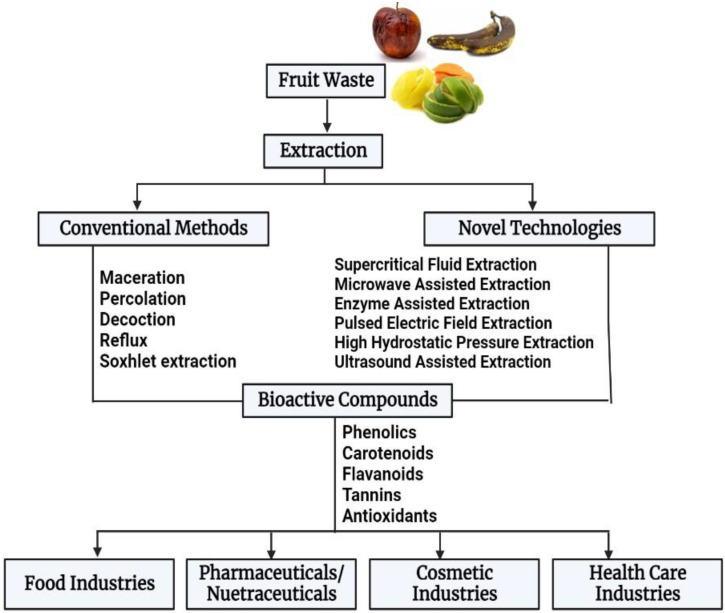
The fruit production and processing sectors produce tremendous amounts of by-products and waste that cause significant economic losses and an undesirable impact on the environment. The effective utilization of these fruit wastes can help to reduce the carbon footprint and greenhouse gas emissions, thereby achieving sustainable development goals. These by-products contain a variety of bioactive compounds, such as dietary fiber, flavonoids, phenolic compounds, antioxidants, polysaccharides, and several other health-promoting nutrients and phytochemicals. These bioactive compounds can be extracted and used as value-added products in different industrial applications. The bioactive components extracted can be used in developing nutraceutical products, functional foods, or food additives. This review provides a comprehensive review of the recent developments in fruit waste valorization techniques and their application in food industries. The various extraction techniques, including conventional and emerging methods, have been discussed. The antioxidant and antimicrobial activities of the active compounds extracted and isolated from fruit waste have been described. The most important food industrial application of bioactive compounds extracted from fruit waste (FW) has been provided. Finally, challenges, future direction, and concluding remarks on the topic are summarized.
Overview
CoChat Summary
TL;DR
This review summarizes valorization of fruit waste as a source of bioactive compounds and their food-industry applications, covering conventional and emerging extraction methods. It reports that fruit and vegetable waste is substantial and that peels, seeds, pomace, and other by-products contain phenolic compounds, dietary fiber, carotenoids, and antimicrobial/antioxidant constituents useful for fortification and preservation.
Key findings
- Fruit and vegetable waste is large: about 46% of produced fruits and vegetables (1400 million tons) are wasted; fruit peel waste accounts for 15–60% of fruit waste; mango and orange 30–50%, pineapple 40–50%, and banana 20%; common fruits account for 25–57 million tons of waste annually.
- By-products are rich in bioactives: apple peels can contain up to 3300 mg/100 g dry matter phenolics; mango peels have total phenolics roughly 13–47% higher than flesh and 32% higher than seeds; papaya peels about 1.2 times higher than seeds; apple pomace has 15% soluble and 36% insoluble dietary fiber; grape pomace total dietary fiber is around 78% (9.5% soluble, 68% insoluble); mango peels total dietary fiber is 40–72%.
- Extraction techniques discussed include Soxhlet, maceration, supercritical fluid extraction, microwave-assisted extraction, enzyme-assisted extraction, pulsed electric field extraction, high-pressure/pressurized liquid extraction, and ultrasound-assisted extraction; novel methods are described as faster, more selective, and less solvent-intensive, but with higher cost and scale-up challenges.
- Food applications include apple pomace up to 30% in baked/extruded snacks; mango peel powder up to 20% in biscuits and up to 30% in cookies; apple pomace 2–8% in beef patties (up to 6% acceptable); 1% apple pomace in yogurt; lemon fiber 2–6% lowered cholesterol and saturated fatty acids in low-fat beef burgers; orange peel as a fat replacer reduced peroxide levels by >90%; grape seed extracts at 40 and 60 mg delayed lipid oxidation in cooked chicken for 14 days. Antimicrobial examples: elderberry skin/seed extracts gave an inhibition zone of almost 20 mm against *Bacillus cereus*; mandarin by-product extracts gave zones of 16.1 and 17 mm; muscadine grape polyphenols reduced *Staphylococcus aureus* viability by nearly 5 log10 CFU/mL over 6 h.
Methods
- This is a review; electronic searches were conducted mainly in PubMed, Google Scholar, Scopus, and ScienceDirect using broad terms such as valorization, fruit waste utilization, fruit by-products, extraction techniques, and bioactive components.
- The search returned 300 scholarly items, including research articles, reviews, books, patents, and other publicly accessible internet sources; about 200 items published after 2000 were shortlisted, and articles published before 2015 were also chosen due to scarcity of contemporary studies; selected articles were thoroughly studied and critically analyzed, and the review was written based on PRISMA guidelines.
- No primary experimental design or new data are reported; the paper synthesizes existing literature.
Limitations
- Stated: bioactive components can degrade quickly, and extraction parameters such as pressure, temperature, light, and pH can cause losses (e.g., a 22% reduction in phenolic content was reported in strawberries); extraction and isolation methods remain lab-intensive and lengthy; novel technologies have higher cost and difficulties in scaling up to industrial standards; fruit and vegetable waste is perishable, dispersed, and often a complex mixture that increases extraction cost; in vivo analysis is needed to validate bioactivity, stability, safety, and bioavailability; further research is needed to determine best extraction procedures for food fortification and other applications.
- Evident: as a narrative review, the findings depend on the selected literature and no systematic meta-analysis or primary validation is reported; the paper also notes that in many antimicrobial studies the principal components responsible for activity have not been evaluated.
Model-written summary. Check it against the paper before relying on it.
Integrity signals
Registry
Cites
Statistics
Figures
Verification
Claims the paper makes
24 Valid · 6 Not valid · 83 Not checked · 21 Own results and interpretations
The cited sources support only part of this claim — read each source’s verdict below.
In the paper
“The polarity/ionic strength of various solvents in use, along with the usage of heat and/or mixing, are the key factors influencing the effectiveness of conventional extraction processes [87].”
§ Valorization of Fruit Waste for Bioactive Compounds and Their Applications in the Food Industry > 5. Extraction Techniques > 5.1. Conventional Methods
What the sources say
- Partly supportedcites [87] Zhang Q.-W. Lin L.-G. Ye W.-C. Techniques for extraction and isolation of natural products: A comprehensive review Chin. Med. 2018 13 1 26 10.1186/s13020-018-0177-x 29692864 PMC5905184 sourceExperimental — accuracy not yet measured
The Extraction section (page not provided) identifies solvent polarity and temperature as factors affecting extraction efficiency. It does not identify mixing as a key factor in conventional extraction, and its discussion of ionic strength concerns ion-exchange chromatography under Separation methods, not extraction. (LLM, conf=0.88)
plainstates a cause- Asserted: passes — The authors put it forward as true.
- Checkable: passes — It can be checked against evidence.
- Load-bearing: unclear — It is unclear whether the paper’s conclusions depend on it.
- Based: passes — The paper gives a reason why it holds.
- Partly supported
The cited sources support only part of this claim — read each source’s verdict below.
In the paper
“According to reports, tomato seeds contain a variety of bioactive substances, including bioactive peptides, flavonoids, carotenoids, pectin, and vitamins (tocopherol) [36].”
§ Valorization of Fruit Waste for Bioactive Compounds and Their Applications in the Food Industry > 4. Bioactive Compounds from Fruit Waste
What the sources say
- Partly supportedcites [36] Kumar M. Tomar M. Bhuyan D.J. Punia S. Grasso S. Sa A.G.A. Carciofi B.A.M. Arrutia F. Changan S. Radha Tomato (Solanum lycopersicum L.) seed: A review on bioactives and biomedical activities Biomed Pharm. 2021 142 112018 10.1016/j.biopha.2021.112018 34449317 sourceExperimental — accuracy not yet measured
Section 2 identifies flavonoids and carotenoids in tomato seeds, and the Introduction identifies α- and γ-tocopherols. The review also discusses bioactive peptides produced from tomato seed proteins, but the passages do not establish that unprocessed seeds contain those peptides. No passage found supports pectin as a tomato-seed constituent. (LLM, conf=0.86)
plain- Asserted: passes — The authors put it forward as true.
- Checkable: passes — It can be checked against evidence.
- Load-bearing: unclear — It is unclear whether the paper’s conclusions depend on it.
- Based: passes — The paper gives a reason why it holds.
- Partly supported
The cited sources that could be checked couldn’t confirm or dispute this claim.
In the paper
“Several studies have also reported the antibacterial effectiveness of grape extracts against lactic acid bacteria, foodborne pathogens, and wine-rotting yeasts [202,203,204,205,206,207].”
§ Valorization of Fruit Waste for Bioactive Compounds and Their Applications in the Food Industry > 7. Application of Bioactive Compounds in the Food Industry > 7.2. Food Preservation
What the sources say
- Could not verifycites [202] Brown J.C. Huang G. Haley-Zitlin V. Jiang X. Antibacterial effects of grape extracts on Helicobacter pylori Appl. Environ. Microbiol. 2009 75 848 852 10.1128/AEM.01595-08 19047390 PMC2632137 sourceExperimental — accuracy not yet measured
The paper’s results (p. 848–852) report inhibition of Helicobacter pylori by grape extracts, but do not address the organisms named in the citing sentence. Searches for lactic acid bacteria, foodborne pathogens, and wine-spoilage yeasts found no passage establishing effectiveness against those groups. (LLM, conf=0.78)
- Not checked — no full text of the sourcecites [203] Baydar N.G. Özkan G. Sağdiç O. Total phenolic contents and antibacterial activities of grape (Vitis vinifera L.) extracts Food Control 2004 15 335 339 10.1016/S0956-7135(03)00083-5 source
- Not checked — no full text of the sourcecites [204] Jayaprakash G. Selvi T. Sakariah K. Antibacterial and antioxidant activities of grape (Vitis vinifera) seed extract Food Res. Int. 2003 36 117 122 10.1016/S0963-9969(02)00116-3 source
- Not checked — no full text of the sourcecites [205] Pastorkova E. Zakova T. Landa P. Novakova J. Vadlejch J. Kokoska Growth inhibitory effect of grape phenolics against wine spoilage yeasts and acetic acid bacteria Int. J. Food Microbiol. 2013 161 209 213 10.1016/j.ijfoodmicro.2012.12.018 23334100 source
- Not checked — no full text of the sourcecites [206] Perumalla A. Hettiarachchy N.S. Green tea and grape seed extracts—Potential applications in food safety and quality Food Res. Int. 2011 44 827 839 10.1016/j.foodres.2011.01.022 source
- Not checked — no full text of the sourcecites [207] Katalinić V. Možina S.S. Skroza D. Generalić I. Abramovič H. Miloš M. Ljubenkov I. Piskernik S. Pezo I. Terpinc P. Polyphenolic profile, antioxidant properties and antimicrobial activity of grape skin extracts of 14 Vitis vinifera varieties grown in Dalmatia (Croatia) Food Chem. 2010 119 715 723 10.1016/j.foodchem.2009.07.019 source
plainstates a cause- Asserted: passes — The authors put it forward as true.
- Checkable: passes — It can be checked against evidence.
- Load-bearing: passes — The paper’s conclusions depend on it.
- Based: passes — The paper gives a reason why it holds.
- Could not verify
The cited sources support only part of this claim — read each source’s verdict below.
In the paper
“These fruit wastes can pose major environmental challenges, such as water and soil pollution, the greenhouse effect, eutrophication, global warming, and other health problems if not effectively handled due to their high biodegradability and fermentability [17].”
§ Valorization of Fruit Waste for Bioactive Compounds and Their Applications in the Food Industry > 3. Fruit Loss and Processing Waste
What the sources say
- Partly supportedcites [17] de Medeiros V.P.B. Pimentel T.C. Varandas R.C.R. Dos Santos S.A. de Souza Pedrosa G.T. da Costa Sassi C.F. da Conceicao M.M. Magnani M. Exploiting the use of agro-industrial residues from fruit and vegetables as alternative microalgae culture medium Food Res. Int. 2020 137 109722 10.1016/j.foodres.2020.109722 33233291 sourceExperimental — accuracy not yet measured
The Introduction says fruit and vegetable residues are an environmental problem because of their high fermentability and biodegradability, and that they can contribute to greenhouse-gas emissions and landfill discharge contamination. It also mentions reducing soil contaminants through composting. It does not specifically link these wastes to water pollution, eutrophication, or health problems; global warming is implied by greenhouse-gas emissions rather than stated separately. (LLM, conf=0.87)
plainstates a cause- Asserted: passes — The authors put it forward as true.
- Checkable: passes — It can be checked against evidence.
- Load-bearing: passes — The paper’s conclusions depend on it.
- Based: passes — The paper gives a reason why it holds.
- Partly supported
Every source the paper cites for this claim was checked and supports it.
In the paper
“Onion peel is reported to be rich source of flavonoids, including athocyanins, kaempferol, and quercetin derivatives (quercetin diglucoside, quercetin aglycone, and quercetin 4-O-glucoside) [23,24].”
§ Valorization of Fruit Waste for Bioactive Compounds and Their Applications in the Food Industry > 4. Bioactive Compounds from Fruit Waste
What the sources say
- Supportedcites [23] Shabir I. Pandey V.K. Dar A.H. Pandiselvam R. Manzoor S. Mir S.A. Shams R. Dash K.K. Fayaz U. Khan S.A. Nutritional Profile, Phytochemical Compounds, Biological Activities, and Utilisation of Onion Peel for Food Applications: A Review Sustainability 2022 14 11958 10.3390/su141911958 source
The Composition/Nutritional Profile section (p. 2) describes onion peel as a rich source of flavonoids. The Plant secondary metabolites section (p. 2) names anthocyanins, kaempferol, quercetin diglucoside, quercetin aglycone, and quercetin 4-O-glucoside among onion flavonoids, noting that the latter compounds are abundant in the outer layer. (LLM, conf=0.94)
- Supportedcites [24] Kumar M. Barbhai M.D. Hasan M. Punia S. Dhumal S. Rais N. Chandran D. Pandiselvam R. Kothakota A. Tomar M. Onion (Allium cepa L.) peels: A review on bioactive compounds and biomedical activities Biomed. Pharmacother. 2022 146 112498 10.1016/j.biopha.2021.112498 34953395 source
Section 2 describes onion peel as rich in flavonoids and identifies anthocyanins in onion skins. It also lists kaempferol, quercetin 3,4′-diglucoside, quercetin aglycone, and quercetin 4′-O-glucoside. The reported concentrations vary by onion variety, but the claim does not assert that all varieties contain equal amounts. (LLM, conf=0.93)
plain- Asserted: passes — The authors put it forward as true.
- Checkable: passes — It can be checked against evidence.
- Load-bearing: unclear — It is unclear whether the paper’s conclusions depend on it.
- Based: passes — The paper gives a reason why it holds.
- Supported
51 more claims · 8 with their cited sources checked
Create a free account to see all 134 claims and to verify the 8 references still open.
- Probably not a substantial claim. 35
- It may state two separate claims as one. 53
- The quote only partly states this claim. 1
Self-check
Percentages, sums and reported differences re-computed from the paper’s own numbers.
Each contradiction between two passages listed here was confirmed by an independent check.
Rated minor: it would not touch a result — a value no result rests on, a p-value that stays on the same side of the significance level, or a conflict that is clerical, resolved elsewhere in the paper, or outside its own findings.
In the paper
§ Valorization of Fruit Waste for Bioactive Compounds and Their Applications in the Food Industry > 7. Application of Bioactive Compounds in the Food Industry > 7.1. Food Fortification
“A study developed beef patties with 2–8% apple pomace as a beef substitute [175].”
§ Valorization of Fruit Waste for Bioactive Compounds and Their Applications in the Food Industry > References
“175. Younis K. Ahmad S. Quality evaluation of buffalo meat patties incorporated with apple pomace powder Buffalo Bull. 2018 37 389 401”
Rated minor: it would not touch a result — a value no result rests on, a p-value that stays on the same side of the significance level, or a conflict that is clerical, resolved elsewhere in the paper, or outside its own findings.
In the paper
§ Valorization of Fruit Waste for Bioactive Compounds and Their Applications in the Food Industry > 7. Application of Bioactive Compounds in the Food Industry > 7.1. Food Fortification
“Similarly, the addition of 3% pomace to stirred yogurt caused a noticeably lower level of syneresis and an increase in the matrix’s stiffness, cohesion, and viscosity [178].”
§ Valorization of Fruit Waste for Bioactive Compounds and Their Applications in the Food Industry > References
“178. Wang J. Mukhtar H. Ma L. Pang Q. Wang X. VHH Antibodies: Reagents for Mycotoxin Detection in Food Products Sensor 2018 18 485 10.3390/s18020485 29415506 PMC5855929”
Rated minor: it would not touch a result — a value no result rests on, a p-value that stays on the same side of the significance level, or a conflict that is clerical, resolved elsewhere in the paper, or outside its own findings.
In the paper
§ Valorization of Fruit Waste for Bioactive Compounds and Their Applications in the Food Industry > 7. Application of Bioactive Compounds in the Food Industry > 7.1. Food Fortification
“Similarly, it was reported that red grape pomace could enhance the color stability and acceptability of pork burgers by reducing lipid oxidation. When the percentage of fruit pomace replacement exceeded 6%, a decrease in hardness and cohesiveness was found [176].”
§ Valorization of Fruit Waste for Bioactive Compounds and Their Applications in the Food Industry > References
“176. Younis K. Ahmad S. Ahmad S. Waste utilization of apple pomace as a source of functional ingredient in buffalo meat sausage Cogent Food Agric. 2015 1 1119397 10.1080/23311932.2015.1119397”
Citations
Cites
Items 201–211 of 211
Guil‐Guerrero, J. L., Ramos, L., Moreno, C., Zúñiga‐Paredes, J. C., Carlosama‐Yepez, M., & Ruales, P. (2016) · Agronomy Journal · doi:10.2134/agronj2015.0555 · Cited by 22
Kiwifruit actinidin digests salivary amylase but not gastric lipase
Martin, H., Cordiner, S. B., & McGhie, T. K. (2017) · Food & Function · doi:10.1039/c7fo00914c · Cited by 21
ANTIOXIDANT AND ANTIPROLIFERATIVE PROPERTIES OF HOT PEPPER (CAPSICUM ANNUUML.) SEEDS
Jeon, G.-U., Choi, Y. M., Lee, S.-M., Kim, Y., OH, M., Jeong, H., & Lee, J. (2011) · Journal of Food Biochemistry · doi:10.1111/j.1745-4514.2011.00571.x · Cited by 20
Study of the supercritical extraction of Pterodon fruits (Fabaceae)
Favareto, R., Teixeira, M. B., Soares, F. A. L., Belisário, C. M., Corazza, M. L., & Cardozo‐Filho, L. (2017) · The Journal of Supercritical Fluids · doi:10.1016/j.supflu.2017.05.028 · Cited by 20 · cited 1×
“SFE can be used to extract alkaloids, such as Pyrrolidine [92], caffeine [93], Olchicine [94], and Vinblastine [95], essential oils [96], terpenes [97], flavonoids [98], and phenolic compounds [99].”
Quantification of total phenolic compound and in vitro antioxidant potential of fruit peel extracts.
Marina, Z., & Noriham, A. (2014) · International Food Research Journal · Cited by 19
Phytochemical profile and thin layer chromatographic studies of Daucus Carota peel extracts
John, S., Priyadarshini, S., Monica, S. J., & Arumugam, P. (2017) · International Journal of Food Sciences and Nutrition · Cited by 19
Aliboudhar, H., & Tigrine‐Kordjani, N. (2014) · Natural Product Research · doi:10.1080/14786419.2014.927872 · Cited by 18 · cited 1×
“Reflux or solid–liquid extraction • Uses less solvent and has a shorter extraction time • Easy • High repeatability • Not suitable for volatile and heat-sensitive compounds Essential oils, flavonoids, and polyphenols [25,67,68]”
(2013) · Cited by 8
Selim, K. A., Ismaael, O. H., & Abdel Bary, M. S. (2019) · SDRP Journal of Food Science & Technology · doi:10.25177/jfst.4.7.ra.564 · Cited by 7
Sanz-Puig, M., Pina-Pérez, M. C., Sáenz, J., et al. (2015) · TECNALIA Publications (Fundación TECNALIA Research & Innovation) · doi:10.2376/0003-925x-66-4 · Cited by 4
Sanz-Puig, M., Pina-Pérez, M. C., García-Sáenz, J. Á., Marañón, I., Rodrigo, D., & Martínez, A. (2015) · Archiv für Lebensmittelhygiene · doi:10.31083/0003-925x-66-4 · Cited by 4
Research works printed but not linked: 9
- Caipang C.M.A. Mabuhay-Omar J. Gonzales-Plasus M.M. Plant and fruit waste products as phytogenic feed additives in aquaculture Aquac. Aquar. Conserv. Legis. 2019 12 261 268
- Rathore S.K. Bhatt S. Dhyani S. Jain A. Preliminary phytochemical screening of medicinal plant Ziziphus mauritiana Lam. fruits Int. J. Curr. Pharm. Res. 2012 4 160 162
- Leela C. Shashank B. Suresh D. Phytochemical screening of secondary metabolites of euphorbia Neriifolia linn Glob. J. Res. Med. Plants Indig. Med. 2013 2 292
- Kumar P. Effect of temperature and time intervals on the solvent extraction of essential oil from azadirachta indica (neem) leaf powder by using soxhlet extraction method World J. Pharm. Res. 2018 8 939 946
- Danalache F. Mata P. Alves V.D. Moldão-Martins M. Enzyme-assisted extraction of fruit juices Fruit Juices Elsevier Amsterdam, The Netherlands 2018 183 200
- del Castillo M.D. Iriondo-DeHond A. Martinez-Saez N. Fernandez-Gomez B. Iriondo-DeHond M. Zhou J.-R. Applications of recovered compounds in food products Handbook of Coffee Processing By-Products Elsevier Amsterdam, The Netherlands 2017 171 194
- Fakhlaei R. Khoo H.E. Chiaw Mei Sia W. Yim H.S. Extraction And Evaluation of Antioxidant Potential in Rambutan Rind as Food Waste Carpathian J. Food Sci. Technol. 2015 7 35 44
- Younis K. Ahmad S. Quality evaluation of buffalo meat patties incorporated with apple pomace powder Buffalo Bull. 2018 37 389 401
- Anna B. Vizma N. Dmitry B. Anti-Helicobacter activity of certain food plant extracts and juices and their composition in vitro Food Nutr. Sci. 2011 2011 868 877
Cited by
Emerging Trends in Green Extraction Techniques for Bioactive Natural Products
Usman, M., Nakagawa, M., & Cheng, S. (2023) · Processes · doi:10.3390/pr11123444 · Cited by 210
Green Extraction Techniques of Bioactive Compounds: A State-of-the-Art Review
Martins, R., Barbosa, A., Advinha, B., Sales, H., Pontes, R., & Nunes, J. (2023) · Processes · doi:10.3390/pr11082255 · Cited by 204
“This method is inexpensive and very suitable for thermolabile compounds since the temperature can be adjusted accordingly [41].”
BackgroundMethodAït‐Kaddour, A., Hassoun, A., Tarchi, I., Loudiyi, M., Boukria, O., Cahyana, Y., Özoğul, F., & Khwaldia, K. (2024) · The Science of The Total Environment · doi:10.1016/j.scitotenv.2024.176872 · Cited by 165
Salehi, M., & Rashidinejad, A. (2024) · International Journal of Biological Macromolecules · doi:10.1016/j.ijbiomac.2024.138855 · Cited by 119
The high-value and sustainable utilization of grape pomace: A review
Wang, C., You, Y., Huang, W., & Zhan, J. (2024) · Food Chemistry: X · doi:10.1016/j.fochx.2024.101845 · Cited by 85
Metadata
- Authors
- Nirmal, N., Khanashyam, A., Mundanat, A., Shah, K., Babu, K., Thorakkattu, P., Al-Asmari, F., & Pandiselvam, R.
- Affiliations
- Mahidol University (TH)
- Central Coastal Agricultural Research Institute (IN)
- National Institute of Food Technology Entrepreneurship and Management (IN)
- Sargento Foods, 305 Pine Street, Elkhart Lake, WI 53020, USA
- Kansas State University (US)
- Department of Food Science and Nutrition, College of Agriculture and Food Sciences, King Faisal University, P.O. Box 400, Al-Ahsa 31982, Saudi Arabia
- Central Plantation Crops Research Institute (IN)
- Corresponding author
- Nirmal, Nilesh
- Pandiselvam, Ravi
- Venue
- Foods
- Publisher
- MDPI AG
- Published
- 2023-01-27
- Volume
- 12
- Issue
- 3
- Pages
- 556
- ISSN
- 2304-8158 (ISSN-L)
- PMC
- PMC9914274
- OpenAlex
- W4318485290
- Semantic Scholar
- bc641512fdf2663faade0ba81041803b8a55198a
- Cited by
- 305
- References
- 225
- Citations by year
- 2026: 96 · 2025: 115 · 2024: 73 · 2023: 21
- FWCI
- 6.04
- Type
- journal article
- Language
- en
- Open access
- gold
- doi.org
- Licence
- Locations
- Foods (publishedVersion, cc-by)
- PubMed Central (publishedVersion, cc-by)
- PubMed (publishedVersion)
- DOAJ (DOAJ: Directory of Open Access Journals) (submittedVersion, cc-by-sa)
- Funders
- Mahidol University (MRC-IM-06/2565)
- Topics
- Health Sciences › Medicine › Biochemistry (medical) › Phytochemicals and Antioxidant Activities
- Life Sciences › Agricultural and Biological Sciences › Food Science › Agricultural and Biological Research
- Health Sciences › Nursing › Nutrition and Dietetics › Food Science and Nutritional Studies
- Keywords
- fruit waste valorization, bioactive compounds, fruit by-products, phenolic compounds, flavonoids, dietary fiber, polysaccharides, antioxidant activity, antimicrobial activity, extraction methods, nutraceuticals, functional foods, food additives, sustainable food production
About these checks
Registry, retraction, Cites and statistics results are computed, not judged, with one exception: a printed reference that no index lists is read once by a model before it counts as a citation error. Claims are extracted by a model and kept only when their quote appears verbatim in the text; each cited source is then checked, with a model’s help, for whether it says what the claim relies on. Those verdicts can be wrong — read the claim’s quote and the cited source before relying on one.
The claim verdicts this report counts are experimental: their accuracy is not yet measured.
A language model drew the claims from the paper on 2026-10-10, under version 3 of the claim definition (model deepseek-v4.1-flash, prompt extract-v3).
A second model labelled each claim on 2026-10-10 (model jev-1.13-20260917, definition revision gold-guideline-v0.2).
Cited sources are checked with a language model’s help (gpt-6-sol).
Statistics and arithmetic are recomputed, not judged.
Confidence bands are shown only for fields calibrated on our annotated test set. None is calibrated yet, so no band is shown.
What counts as a claim ›How we measure confidence ›How we check this ›
Are you an author, or do you see a problem with this page? Request a review
Data sources
Bibliographic data: Semantic Scholar, OpenAlex, Crossref.
Contains information from the Semantic Scholar Academic Graph Datasets, made available under the ODC Attribution License (ODC-BY 1.0).
Semantic Scholar’s data is described in: Kinney, R., et al. (2023). The Semantic Scholar Open Data Platform. arXiv:2301.10140.
