

The DOI matches its Crossref record.
Revisiting Fruit Allergy: Prevalence across the Globe, Diagnosis, and Current Management
Abstract
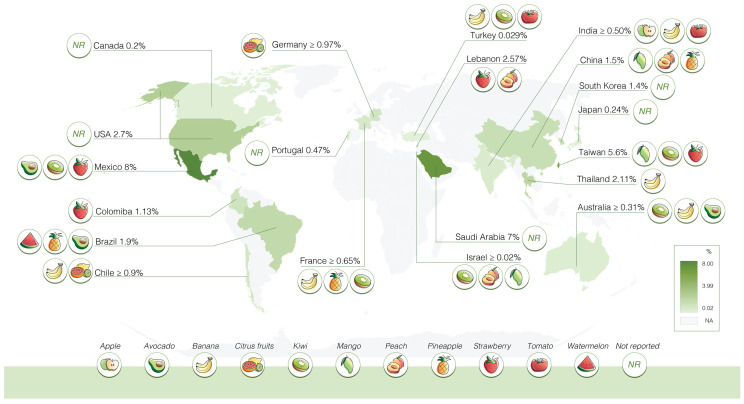
Fruit allergies manifest with a diverse array of clinical presentations, ranging from localized contact allergies and oral allergy syndrome to the potential for severe systemic reactions including anaphylaxis. The scope of population-level prevalence studies remains limited, largely derived from single-center or hospital-based investigations. In this comprehensive review, we conducted a systematic literature search spanning the years 2009 to 2023, with full acknowledgment of potential analytical biases, to provide a global overview of fruit allergy prevalence. The primary mechanistic underpinning of fruit allergies stems from cross-reactivity between aeroallergens and food allergens, a consequence of structurally similar epitopes—a phenomenon recognized as pollen food allergy syndrome (PFAS). In the era of molecular allergology, numerous studies have dissected allergen components with substantial clinical relevance. Within this review, we explore important allergenic molecules found in plant-based foods, scrutinize pertinent cross-reactivity patterns, and offer insights into management recommendations. Additionally, we compare guideline recommendations to enhance clinical understanding and inform decision making.
Overview
The claims and statistics of this paper haven’t been checked yet.
Run the check — free, no account needed. It reads the open-access text and checks the sources it cites.
Integrity signals
Registry
Cites
Statistics
Figures
Verification
Claims the paper makes
The claims and statistics of this paper haven’t been checked yet.
Run the check — free, no account needed. It reads the open-access text and checks the sources it cites.
Claims other papers make about this one
Each is checked against this paper’s own text: does it say what the citing paper says it does?
In the citing paper
“In Mediterranean countries, LTPs play a significant role in PFAS, with peaches (which contain the Pru p 3 LTP) being a major trigger, alongside other fruits like apricots, plums, and nectarines, which are staples of the local diet [54,55].”
From Pollen–Food Allergy Syndrome: Allergens, Clinical Insights, Diagnostic and Therapeutic Challenges (2024) · cites this paper as [55]
In the citing paper
“Profilin-related PFAS is particularly common in areas with high exposure to pollen from birch, grass, or ragweed, such as Northern and Central Europe or North America, where it can affect up to 30% of profilin-sensitized patients [55,134].”
From Pollen–Food Allergy Syndrome: Allergens, Clinical Insights, Diagnostic and Therapeutic Challenges (2024) · cites this paper as [55]
Self-check
Percentages, sums and reported differences re-computed from the paper’s own numbers.
The self-check needs the paper’s full text.
Citations
Cites
No references could be resolved yet.
Research works printed but not linked: 92
- Li, 2022, Prevalence, clinical presentation, and associated atopic diseases of pediatric fruit and vegetable allergy: A population-based study, Pediatr. Neonatol., 63, 520, 10.1016/j.pedneo.2022.03.019 · DOI
- Unhapipatpong, 2022, Adult IgE-mediated food allergy is on the rise: A review of phenotypes, pathophysiologic mechanisms, diagnosis, and advances in management, Asian Pac. J. Allergy Immunol., 40, 308
- Popescu, 2015, Cross-reactivity between aeroallergens and food allergens, World J. Methodol., 5, 31, 10.5662/wjm.v5.i2.31 · DOI · Paper page
- Webber, 2010, Oral allergy syndrome: A clinical, diagnostic, and therapeutic challenge, Ann. Allergy Asthma Immunol., 104, 101, 10.1016/j.anai.2009.11.007 · DOI
- 2015, Fruit and vegetable allergy, Chem. Immunol. Allergy, 101, 162, 10.1159/000375469 · DOI
- Feng, 2023, Prevalence of self-reported food allergy among adults in Jiangxi, China, World Allergy Organ. J., 16, 100773, 10.1016/j.waojou.2023.100773 · DOI
- Feng, 2022, Prevalence of parent-reported food allergy among children in China: A population-based cross-sectional survey, Front. Immunol., 13, 982660, 10.3389/fimmu.2022.982660 · DOI
- Sha, 2019, A cross-sectional study of the prevalence of food allergies among children younger than ages 14 years in a Beijing urban region, Allergy Asthma Proc., 40, e1, 10.2500/aap.2019.40.4193 · DOI
- Zeng, 2015, Food allergy and related risk factors in 2540 preschool children: An epidemiological survey in Guangdong Province, southern China, World J. Pediatr., 11, 219, 10.1007/s12519-015-0030-6 · DOI
- Kaneko, 2021, Food allergy in nursery children of Kawasaki city, Japan, Asian Pac. J. Allergy Immunol., 39, 117
- Lee, 2017, A Retrospective Study of Korean Adults with Food Allergy: Differences in Phenotypes and Causes, Allergy Asthma Immunol. Res., 9, 534, 10.4168/aair.2017.9.6.534 · DOI
- Kim, 2017, Prevalence of Immediate-Type Food Allergy in Korean Schoolchildren in 2015: A Nationwide, Population-based Study, Allergy Asthma Immunol. Res., 9, 410, 10.4168/aair.2017.9.5.410 · DOI
- Su, 2023, Rising prevalence of food allergies in Taiwan: An epidemiological study, J. Microbiol. Immunol. Infect., 56, 863, 10.1016/j.jmii.2023.04.008 · DOI
- Mahesh, 2016, Prevalence of food sensitization and probable food allergy among adults in India: The EuroPrevall INCO study, Allergy, 71, 1010, 10.1111/all.12868 · DOI
- Ahanchian, 2016, Epidemiological survey of pediatric food allergy in Mashhad in Northeast Iran, Electron. Physician, 8, 1727, 10.19082/1727 · DOI
- Nachshon, 2019, The Prevalence of Food Allergy in Young Israeli Adults, J. Allergy Clin. Immunol. Pract., 7, 2782, 10.1016/j.jaip.2019.05.046 · DOI
- Irani, 2015, Prevalence of Self-Reported Food Allergy in Lebanon: A Middle-Eastern Taste, Int. Sch. Res. Not., 2015, 639796
- Alotiby, 2022, Prevalence of Food Allergy and Common Food Allergen Among Saudi Adults in Makkah Region, Saudi Arabia, J. Asthma Allergy, 15, 1851, 10.2147/JAA.S394526 · DOI
- Akarsu, 2021, IgE mediated food allergy in Turkey: Different spectrum, similar outcome, Turk. J. Pediatr., 63, 554, 10.24953/turkjped.2021.04.002 · DOI
- Kaya, 2013, Prevalence of confirmed IgE-mediated food allergy among adolescents in Turkey, Pediatr. Allergy Immunol., 24, 456, 10.1111/pai.12097 · DOI
- Tamazouzt, S., Adel-Patient, K., Deschildre, A., Roduit, C., Charles, M.A., de Lauzon-Guillain, B., and Divaret-Chauveau, A. (2022). Prevalence of Food Allergy in France up to 5.5 Years of Age: Results from the ELFE Cohort. Nutrients, 14. · DOI
- Brandstetter, 2022, Food allergy in infants assessed in two German birth cohorts 10 years after the EuroPrevall Study, Pediatr. Allergy Immunol., 33, e13689, 10.1111/pai.13689 · DOI
- Rodrigues, 2020, Prevalence and clinical features of adverse food reactions in Portuguese adolescents, World Allergy Organ. J., 13, 100453, 10.1016/j.waojou.2020.100453 · DOI
- Rodrigues, 2016, Prevalence and clinical features of adverse food reactions in Portuguese adults, Allergy Asthma Clin. Immunol., 12, 36, 10.1186/s13223-016-0139-8 · DOI
- Sasaki, 2018, Prevalence of clinic-defined food allergy in early adolescence: The SchoolNuts study, J. Allergy Clin. Immunol., 141, 391, 10.1016/j.jaci.2017.05.041 · DOI
- Singer, 2021, Prevalence of Physician-Reported Food Allergy in Canadian Children, J. Allergy Clin. Immunol. Pract., 9, 193, 10.1016/j.jaip.2020.07.039 · DOI
- 2019, Self-reported hypersensitivity and allergy to foods amongst Mexican adolescents: Prevalence and associated factors, Allergol. Immunopathol., 47, 246, 10.1016/j.aller.2018.09.004 · DOI
- Ontiveros, 2016, Parent-reported prevalence of food allergy in Mexican schoolchildren: A population-based study, Allergol. Immunopathol., 44, 563, 10.1016/j.aller.2016.03.003 · DOI
- 2016, Self-reported prevalence and risk factors associated with food hypersensitivity in Mexican young adults, Ann. Allergy Asthma Immunol., 116, 523, 10.1016/j.anai.2016.03.010 · DOI
- Verrill, 2015, Prevalence of self-reported food allergy in U.S. adults: 2001, 2006, and 2010, Allergy Asthma Proc., 36, 458, 10.2500/aap.2015.36.3895 · DOI
- Antunes, 2022, Prevalence of reported food allergies in Brazilian preschoolers living in a small Brazilian city, Allergy Asthma Clin. Immunol., 18, 74, 10.1186/s13223-022-00710-1 · DOI
- Silva, 2016, Adult Food Allergy Prevalence: Reducing Questionnaire Bias, Int. Arch. Allergy Immunol., 171, 261, 10.1159/000453036 · DOI
- Linn, 2014, Prevalence of parent-reported immediate hypersensitivity food allergy in Chilean school-aged children, Allergol. Immunopathol., 42, 527, 10.1016/j.aller.2013.09.006 · DOI
- Beltrán-Cárdenas, C.E., Granda-Restrepo, D.M., Franco-Aguilar, A., Lopez-Teros, V., Arvizu-Flores, A.A., Cárdenas-Torres, F.I., Ontiveros, N., Cabrera-Chávez, F., and Arámburo-Gálvez, J.G. (2021). Prevalence of Food-Hypersensitivity and Food-Dependent Anaphylaxis in Colombian Schoolchildren by Parent-Report. Medicina, 57. · DOI
- Burney, 2014, The prevalence and distribution of food sensitization in European adults, Allergy, 69, 365, 10.1111/all.12341 · DOI
- Julanon, N., Thiravetyan, B., Unhapipatpong, C., Xanthavanij, N., Krikeerati, T., Thongngarm, T., Wongsa, C., Songnuan, W., Naiyanetr, P., and Sompornrattanaphan, M. (2023). Not Just a Banana: The Extent of Fruit Cross-Reactivity and Reaction Severity in Adults with Banana Allergy. Foods, 12. · DOI
- Walter, 2020, Adult-onset IgE-mediated food allergy at a Winnipeg allergy clinic: A case series, Allergy Asthma Clin. Immunol., 16, 85, 10.1186/s13223-020-00483-5 · DOI
- Alessandri, 2020, Molecular approach to a patient’s tailored diagnosis of the oral allergy syndrome, Clin. Transl. Allergy, 10, 22, 10.1186/s13601-020-00329-8 · DOI · Paper page
- 2015, Oral allergy syndrome in children, Int. Dent. J., 65, 164, 10.1111/idj.12164 · DOI
- Suriyamoorthy, 2022, Comprehensive Review on Banana Fruit Allergy: Pathogenesis, Diagnosis, Management, and Potential Modification of Allergens through Food Processing, Plant Foods Hum. Nutr., 77, 159, 10.1007/s11130-022-00976-1 · DOI
- Thongkhom, 2020, Banana anaphylaxis in Thailand: Case series, Asia Pac. Allergy, 10, e4, 10.5415/apallergy.2020.10.e4 · DOI
- Gabrielli, 2021, Fruit-Induced Anaphylaxis: Clinical Presentation and Management, J. Allergy Clin. Immunol. Pract., 9, 2825, 10.1016/j.jaip.2021.02.055 · DOI
- Srisuwatchari, 2023, Food-Dependent Exercise-Induced Anaphylaxis: A Distinct Form of Food Allergy—An Updated Review of Diagnostic Approaches and Treatments, Foods, 12, 3768, 10.3390/foods12203768 · DOI
- Kulthanan, 2022, Food-Dependent Exercise-Induced Wheals, Angioedema, and Anaphylaxis: A Systematic Review, J. Allergy Clin. Immunol. Pract., 10, 2280, 10.1016/j.jaip.2022.06.008 · DOI
- Inomata, 2020, Gibberellin-regulated protein allergy: Clinical features and cross-reactivity, Allergol. Int., 69, 11, 10.1016/j.alit.2019.10.007 · DOI · Paper page
- Iizuka, 2022, Gibberellin-regulated proteins: Emergent allergens, Front. Allergy, 3, 877553, 10.3389/falgy.2022.877553 · DOI · Paper page
- 2021, Profilins and Food-Dependent Exercise-Induced Anaphylaxis, J. Investig. Allergol. Clin. Immunol., 31, 349, 10.18176/jiaci.0650 · DOI · Paper page
- Santos, 2023, The Molecular Allergology User’s Guide version 2.0 is freely available!, Allergy, 78, 1139, 10.1111/all.15643 · DOI
- Benito, 2003, Clinically relevant peach allergy is related to peach lipid transfer protein, Pru p 3, in the Spanish population, J. Allergy Clin. Immunol., 112, 789, 10.1016/S0091-6749(03)02016-5 · DOI
- Brehler, 1997, “Latex-fruit syndrome”: Frequency of cross-reacting IgE antibodies, Allergy, 52, 404, 10.1111/j.1398-9995.1997.tb01019.x · DOI
- Sompornrattanaphan, 2019, Severe anaphylaxis after pelvic examination: A case report of dual latex and chlorhexidine allergies, Allergy Asthma Clin. Immunol., 15, 19, 10.1186/s13223-019-0335-4 · DOI
- Kovaltchouk, 2023, Food protein-induced enterocolitis syndrome in an infant triggered by prunes, Allergy Asthma Clin. Immunol., 19, 33, 10.1186/s13223-023-00787-2 · DOI
- Labrosse, R., Graham, F., and Caubet, J.C. (2020). Non-IgE-Mediated Gastrointestinal Food Allergies in Children: An Update. Nutrients, 12. · DOI
- Sohn, 2017, Fixed Food Eruption Caused by Actinidia arguta (Hardy Kiwi): A Case Report and Literature Review, Allergy Asthma Immunol. Res., 9, 182, 10.4168/aair.2017.9.2.182 · DOI
- Sicherer, 2001, Clinical implications of cross-reactive food allergens, J. Allergy Clin. Immunol., 108, 881, 10.1067/mai.2001.118515 · DOI
- Hauser, 2010, Panallergens and their impact on the allergic patient, Allergy Asthma Clin. Immunol., 6, 1, 10.1186/1710-1492-6-1 · DOI · Paper page
- Dramburg, 2023, EAACI Molecular Allergology User’s Guide 2.0, Pediatr. Allergy Immunol., 34, e13854, 10.1111/pai.13854 · DOI · Paper page
- Vieths, 1997, Allergenic cross-reactivity, food allergy and pollen, Environ. Toxicol. Pharmacol., 4, 61, 10.1016/S1382-6689(97)10043-6 · DOI
- Sankian, 2005, Sequence homology: A poor predictive value for profilins cross-reactivity, Clin. Mol. Allergy, 3, 13, 10.1186/1476-7961-3-13 · DOI
- Tordesillas, 2010, Characterization of IgE epitopes of Cuc m 2, the major melon allergen, and their role in cross-reactivity with pollen profilins, Clin. Exp. Allergy, 40, 174, 10.1111/j.1365-2222.2009.03401.x · DOI
- Maeda, 2010, Correlation of oral allergy syndrome due to plant-derived foods with pollen sensitization in Japan, Ann. Allergy Asthma Immunol., 104, 205, 10.1016/j.anai.2009.11.049 · DOI
- Egger, 2006, Pollen-food syndromes associated with weed pollinosis: An update from the molecular point of view, Allergy, 61, 461, 10.1111/j.1398-9995.2006.00994.x · DOI
- Blanco, 2003, Latex-fruit syndrome, Curr. Allergy Asthma Rep., 3, 47, 10.1007/s11882-003-0012-y · DOI
- Kolek, F., Plaza, M.D.P., Leier-Wirtz, V., Friedmann, A., Traidl-Hoffmann, C., and Damialis, A. (2021). Earlier Flowering of Betula pendula Roth in Augsburg, Germany, Due to Higher Temperature, NO2 and Urbanity, and Relationship with Betula spp. Pollen Season. Int. J. Environ. Res. Public. Health, 18. · DOI
- Lo, 2019, Pollen calendars and maps of allergenic pollen in North America, Aerobiologia, 35, 613, 10.1007/s10453-019-09601-2 · DOI
- Blankestijn, 2017, Sensitization to PR-10 proteins is indicative of distinctive sensitization patterns in adults with a suspected food allergy, Clin. Transl. Allergy, 7, 42, 10.1186/s13601-017-0177-4 · DOI
- Scala, E., Alessandri, C., Palazzo, P., Pomponi, D., Liso, M., Bernardi, M.L., Ferrara, R., Zennaro, D., Santoro, M., and Rasi, C. (2011). IgE recognition patterns of profilin, PR-10, and tropomyosin panallergens tested in 3,113 allergic patients by allergen microarray-based technology. PLoS ONE, 6. · DOI
- Kim, 2018, Oral Allergy Syndrome in Birch Pollen-Sensitized Patients from a Korean University Hospital, J. Korean Med. Sci., 33, e218, 10.3346/jkms.2018.33.e218 · DOI
- Ehrenberg, 2020, Characterization of a 7 kDa pollen allergen belonging to the gibberellin-regulated protein family from three Cupressaceae species, Clin. Exp. Allergy, 50, 964, 10.1111/cea.13675 · DOI
- Albert, 2023, Lipid transfer protein syndrome in a Northern European patient: An unusual case report, Front. Med., 10, 1049477, 10.3389/fmed.2023.1049477 · DOI
- Mota, 2018, Anaphylaxis caused by lipid transfer proteins: An unpredictable clinical syndrome, Allergol. Immunopathol., 46, 565, 10.1016/j.aller.2018.04.002 · DOI · Paper page
- Hedden, 2015, A Century of Gibberellin Research, J. Plant Growth Regul., 34, 740, 10.1007/s00344-015-9546-1 · DOI
- Senechal, 2018, A new allergen family involved in pollen food-associated syndrome: Snakin/gibberellin-regulated proteins, J. Allergy Clin. Immunol., 141, 411, 10.1016/j.jaci.2017.06.041 · DOI · Paper page
- Iizuka, 2021, Gibberellin-regulated protein sensitization in Japanese cedar (Cryptomeria japonica) pollen allergic Japanese cohorts, Allergy, 76, 2297, 10.1111/all.14816 · DOI
- Wagner, 2002, The latex-fruit syndrome, Biochem. Soc. Trans., 30, 935, 10.1042/bst0300935 · DOI
- Radauer, 2011, Latex-allergic patients sensitized to the major allergen hevein and hevein-like domains of class I chitinases show no increased frequency of latex-associated plant food allergy, Mol. Immunol., 48, 600, 10.1016/j.molimm.2010.10.019 · DOI
- Kim, 1999, Prevalence of food allergy in 137 latex-allergic patients, Allergy Asthma Proc., 20, 95, 10.2500/108854199778612572 · DOI
- Breiteneder, 2004, Thaumatin-like proteins—A new family of pollen and fruit allergens, Allergy, 59, 479, 10.1046/j.1398-9995.2003.00421.x · DOI
- Townsend, 2023, Food-dependent exercise-induced anaphylaxis to orange, with possible underlying thaumatin-like protein allergy, Ann. Allergy Asthma Immunol., 130, 669, 10.1016/j.anai.2023.01.036 · DOI
- Izumi, E., Hidaka, S., Hiroi, A., Kinugasa, S., Yano, E., Zaima, N., and Moriyama, T. (2021). Thaumatin-Like Protein (Pru av 2) Is a Cherry Allergen That Triggers Percutaneous Sensitization in Mice. Foods, 10. · DOI
- Park, 2021, Fruit Intake to Prevent and Control Hypertension and Diabetes, Korean J. Fam. Med., 42, 9, 10.4082/kjfm.20.0225 · DOI
- Skypala, 2022, BSACI guideline for the diagnosis and management of pollen food syndrome in the UK, Clin. Exp. Allergy, 52, 1018, 10.1111/cea.14208 · DOI
- Skypala, 2022, The Challenges of Managing Multiple Food Allergies and Consequent Food Aversions, J. Allergy Clin. Immunol. Pract., 10, 35, 10.1016/j.jaip.2021.10.044 · DOI
- Ma, 2003, A survey on the management of pollen-food allergy syndrome in allergy practices, J. Allergy Clin. Immunol., 112, 784, 10.1016/S0091-6749(03)02008-6 · DOI
- Sampson, 2014, Food allergy: A practice parameter update-2014, J. Allergy Clin. Immunol., 134, 1016, 10.1016/j.jaci.2014.05.013 · DOI · Paper page
- Kim, 2019, Clinical Manifestations and Risk Factors of Anaphylaxis in Pollen-Food Allergy Syndrome, Yonsei Med. J., 60, 960, 10.3349/ymj.2019.60.10.960 · DOI · Paper page
- Navarro, 2019, Oral immunotherapy with peach juice in patients allergic to LTPs, Allergy Asthma Clin. Immunol., 15, 60, 10.1186/s13223-019-0374-x · DOI
- Nadal, 2009, Randomized double-blind, placebo-controlled trial of sublingual immunotherapy with a Pru p 3 quantified peach extract, Allergy, 64, 876, 10.1111/j.1398-9995.2008.01921.x · DOI
- Kopac, 2012, Continuous apple consumption induces oral tolerance in birch-pollen-associated apple allergy, Allergy, 67, 280, 10.1111/j.1398-9995.2011.02744.x · DOI
- Morales, C.I.H., Henao, C.M.G., and Villa, R.C. (2015, January 13–16). Omalizumab in the treatment of latex fruit syndrome. Proceedings of the 11th Congress of the Latin American Association of Immunology, Medellin, Colombia.
- Sakamoto, 2023, Omalizumab is effective for a patient with pollen-food allergy syndrome who experienced intractable lip edema, Auris Nasus Larynx, 50, 805, 10.1016/j.anl.2022.12.001 · DOI · Paper page
- Nishie, 2021, Successful treatment of a patient with adult food allergy and severe asthma using omalizumab, Asia Pac. Allergy, 11, e27, 10.5415/apallergy.2021.11.e27 · DOI
Cited by
Sorted by citations
Pollen–Food Allergy Syndrome: Allergens, Clinical Insights, Diagnostic and Therapeutic Challenges
Haidar, L., Bănărescu, C. F., Uța, C., Moldovan, S. I., Zimbru, E.-L., Zimbru, R.-I., Ciurariu, E., Georgescu, M., & Panaitescu, C. (2024) · Applied Sciences · doi:10.3390/app15010066 · Cited by 21
Metadata
- Authors
- Krikeerati, T., Rodsaward, P., Nawiboonwong, J., Pinyopornpanish, K., Phusawang, S., & Sompornrattanaphan, M.
- Venue
- Foods
- Publisher
- MDPI AG
- Published
- 2023-11-10
- Volume
- 12
- Issue
- 22
- Pages
- 4083
- ISSN
- 2304-8158
- PMC
- PMC10670478
- Cited by
- 34
- References
- 0
- Language
- en
About these checks
Registry, retraction, Cites and statistics results are computed, not judged, with one exception: a printed reference that no index lists is read once by a model before it counts as a citation error. Claims are extracted by a model and kept only when their quote appears verbatim in the text; each cited source is then checked, with a model’s help, for whether it says what the claim relies on. Those verdicts can be wrong — read the claim’s quote and the cited source before relying on one.
Statistics and arithmetic are recomputed, not judged.
Confidence bands are shown only for fields calibrated on our annotated test set. None is calibrated yet, so no band is shown.
What counts as a claim ›How we measure confidence ›How we check this ›
Are you an author, or do you see a problem with this page? Request a review
How to cite
Cite CoChat for the checks on this page, and the paper for its own findings.
- This page
- CoChat. (2026). Citation check: Revisiting Fruit Allergy: Prevalence across the Globe, Diagnosis, and Current Management. https://app.cochat.ai/papers/10.3390/foods12224083
- The paper
- Krikeerati, T., Rodsaward, P., Nawiboonwong, J., Pinyopornpanish, K., Phusawang, S., & Sompornrattanaphan, M. (2023). Revisiting Fruit Allergy: Prevalence across the Globe, Diagnosis, and Current Management. Foods. https://doi.org/10.3390/foods12224083
