

Intermittent Fasting: Myths, Fakes and Truth on This Dietary Regimen Approach
Open accessPublished version of a preprint
The DOI matches its Crossref record; 190 of the 191 references it cites were found in a registry or an index, and 1 are not checked yet.
Abstract
Intermittent fasting (IF) has been indicated as a valuable alternative to the classical caloric restriction dietary regimen for lowering body weight and preventing obesity-related complications, such as metabolic syndrome and type II diabetes. However, is it effective? In this review article, we analyzed over 50 clinical studies in which IF, conducted by alternate day fasting (ADF) or time-restricted feeding (TRF), was compared with the caloric restriction approach. We evaluated the different roles of IF in treating and preventing human disorders such as metabolic syndrome, type II diabetes, and some types of cancer, as well as the usefulness of IF in reducing body weight and cardiovascular risk factors such as hypertension. Furthermore, we explored the cellular pathways targeted by IF to exert their beneficial effects by activating effector proteins that modulate cell functions and resistance to oxidative stress. In contrast, we investigated concerns regarding human health related to the adoption of IF dietary regimens, highlighting the profound debate surrounding weight loss regimens. We examined and compared several clinical trials to formulate an updated concept regarding IF and its therapeutic potential.
Overview
The claims and statistics of this paper haven’t been checked yet.
Free: it reads the open-access text and checks the first 5 claims that cite a source we can check. Create a free account to check every claim.
Integrity signals
Registry
Cites
Statistics
Figures
Verification
Claims the paper makes
The claims and statistics of this paper haven’t been checked yet.
Free: it reads the open-access text and checks the first 5 claims that cite a source we can check. Create a free account to check every claim.
Claims other papers make about this one
Each is checked against this paper’s own text: does it say what the citing paper says it does?
The source backs part of the claim, not all of it — or backs it for a different population, condition or comparison.
In the citing paper
“Decreased adherence to dietary protocols exert a influence on this phenomenon [94].”
From Comparing caloric restriction regimens for effective weight management in adults: a systematic review and network meta-analysis (2024) · cites this paper as [94]
Experimental — accuracy not yet measured
Self-check
Percentages, sums and reported differences re-computed from the paper’s own numbers.
The self-check needs the paper’s full text.
Citations
Cites
SF-36 health survey: Manual and interpretation guide
Ware, J. (2003) · Medical Entomology and Zoology · Cited by 11,424
Beck, A. T., Steer, R. A., & Brown, G. (2011) · PsycTESTS Dataset · doi:10.1037/t00742-000 · Cited by 7,535
2013 AHA/ACC/TOS Guideline for the Management of Overweight and Obesity in Adults
Jensen, M. D., Ryan, D. H., Apovian, C. M., Ard, J. D., Comuzzie, A. G., Donato, K. A., Hu, F. B., Hubbard, V. S., Jakicic, J. M., Kushner, R. F., et al. (2014) · Journal of the American College of Cardiology · doi:10.1016/j.jacc.2013.11.004 · Cited by 4,058 · cited 1×
“This latter therapy, which has been used for over 10 years, is the gold-standard therapy for weight reduction in patients with obesity [58].”
Jensen, M. D., Ryan, D. H., Apovian, C. M., Ard, J. D., Comuzzie, A. G., Donato, K. A., Hu, F. B., Hubbard, V. S., Jakicic, J. M., Kushner, R. F., et al. (2014) · Circulation · doi:10.1161/01.cir.0000437739.71477.ee · Cited by 2,735
The Effect of Retarded Growth Upon the Length of Life Span and Upon the Ultimate Body Size
McCay, C. M., Crowell, M. F., & Maynard, L. A. (1935) · The Journal of Nutrition · doi:10.1093/jn/10.1.63 · Cited by 2,264 · cited 1×
“The pioneering work of McCay on the effect of CR demonstrated a significant impact on longevity and lifespan [54,55].”
Comparison of Weight-Loss Diets with Different Compositions of Fat, Protein, and Carbohydrates
Sacks, F. M., Bray, G. A., Carey, V. J., Smith, S. R., Ryan, D. H., Anton, S. D., McManus, K., Champagne, C. M., Bishop, L. M., Laranjo, N., et al. (2009) · New England Journal of Medicine · doi:10.1056/nejmoa0804748 · Cited by 1,966 · cited 1×
“Accordingly, it has been observed that adherence to continuous CR declines after approximately 1 month of intervention and continues to decrease afterward [7,60,61].”
Dansinger, M. L., Gleason, J. A., Griffith, J. L., Selker, H. P., & Schaefer, E. J. (2005) · JAMA · doi:10.1001/jama.293.1.43 · Cited by 1,726 · cited 2×
“In fact, it has been established that adherence to CR, in which a reduction of 20–40% of caloric intake occurs, sharply declines over a long period of time, and many people acquire noticeable weight by the year’s end [7,8].”
mTOR is a key modulator of ageing and age-related disease
Johnson, S. C., Rabinovitch, P. S., & Kaeberlein, M. (2013) · Nature · doi:10.1038/nature11861 · Cited by 1,676 · cited 1×
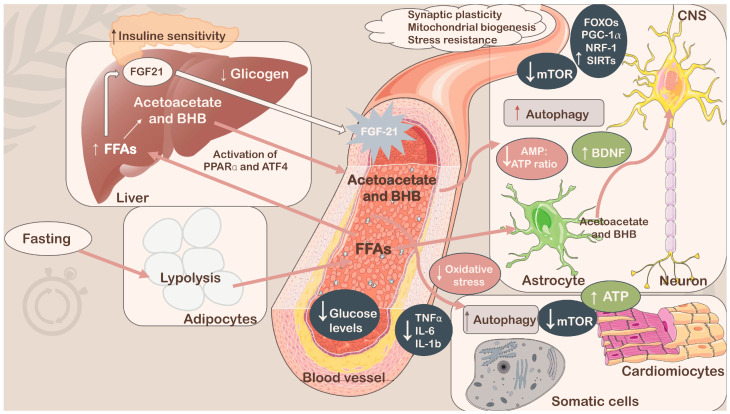
“Moreover, the mTOR pathway becomes less active during Moreover, the mTOR pathway becomes less active during fasting because of decreased glucose levels, which trigger autophagy [205]. fasting because of decreased glucose levels, which trigger autophagy [205].”
Effects of intermittent fasting on health, aging, and disease
de Cabo, R., & Mattson, M. P. (2019) · New England Journal of Medicine · doi:10.1056/nejmra1905136 · Cited by 1,605 · cited 7×
“IF can stimulate autophagic processes, leading to the removal of oxidatively injured cells [1].”
InfluentialSutton, E. F., Beyl, R., Early, K. S., Cefalu, W. T., Ravussin, E., & Peterson, C. M. (2018) · Cell Metabolism · doi:10.1016/j.cmet.2018.04.010 · Cited by 1,531 · cited 1×
“This study was the first randomized controlled experiment to demonstrate the benefits of IF for human weight loss and food intake [108].”
Research works printed but not linked: 3
- Jack H.A. The Gandhi Reader: A Sourcebook of His Life and Writings Grove Press New York, NY, USA 1994
- Stella A. SCRITTI DI ALDO CAPITINI Ann. Della Sc. Norm. Super. Pisa. Cl. Lett. E Filos. 1975 5 379 412
- Higgins J.P.T. Green S. Cochrane Handbook for Systematic Reviews of Interventions Wiley Hoboken, NJ, USA 2011
Cited by
Reytor-González, C., Simancas-Racines, D., Román-Galeano, N. M., Annunziata, G., Galasso, M., Zambrano-Villacres, R., Verde, L., Muscogiuri, G., Frias-Toral, E., & Barrea, L. (2025) · Nutrients · doi:10.3390/nu17132135 · Cited by 88
“In contrast, IF encompasses various patterns, including alternate-day fasting, the 5:2 diet (five days of normal eating and two non-consecutive days of reduced caloric intake), and periodic fasting, where fasting occurs for extended periods intermittently [161–163].”
Xie, Y., Gu, Y., Li, Z., He, B., & Zhang, L. (2024) · Nutrients · doi:10.3390/nu16173007 · Cited by 62
“Unlike calorie restriction, intermittent fasting offers flexibility in food selection, integrating seamlessly with existing dietary regimes and presenting a viable, low-maintenance approach to health improvement [30].”
BackgroundCui, T., Sun, Y., Ye, W., Liu, Y., & Korivi, M. (2025) · Journal of the International Society of Sports Nutrition · doi:10.1080/15502783.2025.2481127 · Cited by 37
“However, practicing CR (20–40% decrease in daily energy intake) is difficult, and may increase the risk of malnutrition over a period of time [12,13].”
Huang, J., Li, Y., Chen, M., Cai, Z., Cai, Z., & Jiang, Z. (2024) · International Journal of Behavioral Nutrition and Physical Activity · doi:10.1186/s12966-024-01657-9 · Cited by 25
“Decreased adherence to dietary protocols exert a influence on this phenomenon [94].”
BackgroundAremu, S. O., Akute, B., Aremu, D. O., Zando, C., Aremu, D. E., Nwachukwu, O. J., Omosebi, M. O., Akute, V. O., Oluwole, S. T., Barkhadle, A. A., et al. (2025) · Discover Public Health · doi:10.1186/s12982-025-00818-w · Cited by 22
“This strategy recognizes that no single dietary pattern works for everyone, as individuals vary significantly in their responses to food [58–60].”
Metadata
- Authors
- Brogi, S., Tabanelli, R., Puca, S., & Calderone, V.
- Affiliations
- University of Pisa (IT)
- Corresponding author
- Brogi, Simone
- Venue
- Foods
- Publisher
- MDPI AG
- Published
- 2024-06-21
- Volume
- 13
- Issue
- 13
- Pages
- 1960
- ISSN
- 2304-8158 (ISSN-L)
- PMC
- PMC11241639
- OpenAlex
- W4399890745
- Semantic Scholar
- e38ee7b3e9a272e6e5171e5507b5589a8c450f4e
- Cited by
- 26
- References
- 191
- Citations by year
- 2026: 9 · 2025: 14 · 2024: 3
- FWCI
- 1.48
- Type
- journal article
- Language
- en
- Open access
- gold
- doi.org
- Licence
- Locations
- Foods (publishedVersion, cc-by)
- Preprints.org (acceptedVersion, cc-by)
- PubMed Central (publishedVersion, cc-by)
- PubMed (publishedVersion)
- CINECA IRIS Institutial research information system (University of Pisa) (submittedVersion, cc-by)
- DOAJ (DOAJ: Directory of Open Access Journals) (submittedVersion)
- Topics
- Health Sciences › Medicine › Physiology (medical) › Dietary Effects on Health
- Health Sciences › Medicine › Physiology (medical) › Diet and metabolism studies
- Health Sciences › Medicine › Public Health, Environmental and Occupational Health › Nutritional Studies and Diet
- Keywords
- intermittent fasting, alternate-day fasting, time-restricted feeding, caloric restriction, weight loss, obesity, metabolic syndrome, type 2 diabetes, cancer, hypertension, cardiovascular risk factors, oxidative stress, cellular signaling pathways
About these checks
Registry, retraction, Cites and statistics results are computed, not judged, with one exception: a printed reference that no index lists is read once by a model before it counts as a citation error. Claims are extracted by a model and kept only when their quote appears verbatim in the text; each cited source is then checked, with a model’s help, for whether it says what the claim relies on. Those verdicts can be wrong — read the claim’s quote and the cited source before relying on one.
Statistics and arithmetic are recomputed, not judged.
Confidence bands are shown only for fields calibrated on our annotated test set. None is calibrated yet, so no band is shown.
What counts as a claim ›How we measure confidence ›How we check this ›
Are you an author, or do you see a problem with this page? Request a review
Data sources
Bibliographic data: Semantic Scholar, OpenAlex, Crossref.
Contains information from the Semantic Scholar Academic Graph Datasets, made available under the ODC Attribution License (ODC-BY 1.0).
Semantic Scholar’s data is described in: Kinney, R., et al. (2023). The Semantic Scholar Open Data Platform. arXiv:2301.10140.
