

Determination of L-Theanine and Caffeine Contents in Tea Infusions with Different Fermentation Degrees and Brewing Conditions Using the Chromatographic Method
Open accessThe DOI matches its Crossref record; 65 of the 65 references it cites were found in a registry or an index.
Abstract
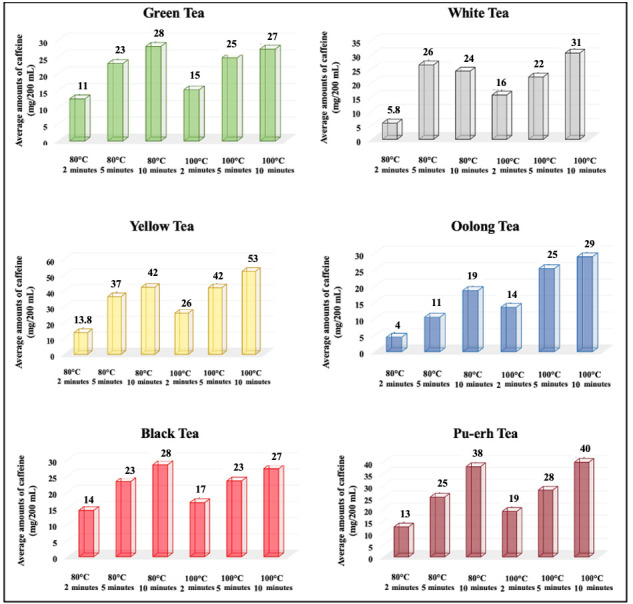
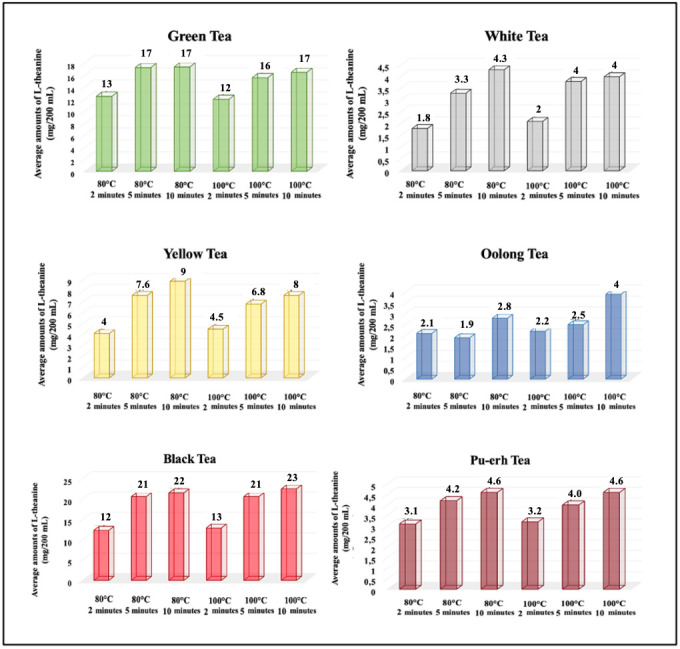
This study aimed to determine the caffeine and L-theanine contents in tea infusions prepared under varying fermentation degrees, brewing conditions (temperature and time), and serving methods (tea bag/loose-leaf). Infusions of six tea types (green, white, yellow, oolong, black, and Pu-erh) and various serving forms of green, white, and black tea were brewed at 80 °C and 100 °C for 2, 5, and 10 min. Contents were analyzed using reversed-phase high-performance liquid chromatography. Caffeine levels were highest in black and yellow tea (14 ± 1.0 mg/200 mL and 13.8 ± 0.2 mg/200 mL, respectively), both of which were significantly higher than the levels in green, white, and oolong tea (11 ± 2.1 mg/200 mL; 5.8 ± 0.7 mg/200 mL; and 4 ± 1.6 mg/200 mL, respectively; p < 0.001), whereas Pu-erh tea (13 ± 2.9 mg/200 mL) had caffeine levels comparable to that of black tea (p > 0.05). L-Theanine levels were highest in black and green tea (12.3 ± 2.8 mg/200 mL and 12.5 ± 2.5 mg/200 mL, respectively), and these levels were significantly higher than those in the other tea types (p < 0.001). Brewing temperature only affected caffeine levels n, whereas L-oolong tea (4.4 → 13.5 mg/200 mL, p < 0.05); theanine remained stable (p > 0.05). Longer brewing times significantly raised both components (e.g., yellow tea caffeine levels rose to 53 ± 16.9 mg/200 mL at 10 min; p < 0.05). In black tea, cup-sized bags yielded higher caffeine levels (39 ± 9.9 mg/200 mL) than loose-leaf (24 ± 7.2 mg/200 mL) and teapot bags (p < 0.001). Serving method had no effect on green and white teas (p > 0.05). In conclusion, fermentation rate, brewing conditions, and serving method were found to influence the caffeine and L-theanine levels of tea infusions.
Overview
The claims and statistics of this paper haven’t been checked yet.
Free: it reads the open-access text and checks the first 5 claims that cite a source we can check. Create a free account to check every claim.
Integrity signals
Registry
Cites
Statistics
Figures
Verification
Claims the paper makes
The claims and statistics of this paper haven’t been checked yet.
Free: it reads the open-access text and checks the first 5 claims that cite a source we can check. Create a free account to check every claim.
Claims other papers make about this one
Each is checked against this paper’s own text: does it say what the citing paper says it does?
The cited source says what the claim attributes to it.
In the citing paper
“While tea is the major source of L-theanine in the human diet, a standard 200 mL cup of commercially available green or black tea typically contains only around 8–25 mg of L-theanine, depending on the type of tea, manufacturing and preparation methods used (47, 48).”
From Effects of L-theanine on cognition, mood and sleep: evidence from human trials (2026) · cites this paper as [47]
Self-check
Percentages, sums and reported differences re-computed from the paper’s own numbers.
The self-check needs the paper’s full text.
Citations
Cites
Zuo, Y. (2002) · Talanta · doi:10.1016/s0039-9140(02)00030-9 · Cited by 630 · cited 3×
“High caffeine levels have been reported in some studies and very low L-theanine levels in some samples [42].”
InfluentialBeverage caffeine intakes in the U.S.
Mitchell, D. C., Knight, C. A., Hockenberry, J., Teplansky, R., & Hartman, T. J. (2014) · Food and Chemical Toxicology · doi:10.1016/j.fct.2013.10.042 · Cited by 565 · cited 1×
“Low doses can positively affect cognitive performance and attention; however, when taken in high amounts, it can lead to negative consequences, including anxiety, insomnia, and cardiovascular disorders [9,13].”
Total Phenol, Catechin, and Caffeine Contents of Teas Commonly Consumed in the United Kingdom
Khokhar, S., & Magnusdottir, S. G. M. (2002) · Journal of Agricultural and Food Chemistry · doi:10.1021/jf010153l · Cited by 533 · cited 4×
“Similarly, it has been reported in the literature that caffeine levels increased in parallel with the temperature in infusions prepared at 60 ◦ C, 80 ◦ C, and 100 ◦ C for 5 min [44].”
InfluentialChemistry and Biological Activities of Processed Camellia sinensis Teas: A Comprehensive Review
Zhang, L., Ho, C., Zhou, J., Santos, J. S., Armstrong, L., & Granato, D. (2019) · Comprehensive Reviews in Food Science and Food Safety · doi:10.1111/1541-4337.12479 · Cited by 509 · cited 1×
“However, low L-theanine levels in some green teas and high levels in some black teas suggest that environmental and agricultural factors other than processing are also influential [6,38].”
Perva-Uzunalić, A., Škerget, M., Knez, Ž., Weinreich, B., Otto, F., & Grüner, S. (2006) · Food Chemistry · doi:10.1016/j.foodchem.2005.03.015 · Cited by 474 · cited 1×
“Previous studies have demonstrated that multiple extractions with hot water ( ≥ 90 ◦ C) are necessary to fully extract caffeine and re-lated xanthines [44,63].”
Factors Affecting the Caffeine and Polyphenol Contents of Black and Green Tea Infusions
Astill, C., Birch, M. R., Dacombe, C., Humphrey, P. G., & Martin, P. T. (2001) · Journal of Agricultural and Food Chemistry · doi:10.1021/jf010759+ · Cited by 421 · cited 3×
“Similarly, in the literature, caffeine concentration increased with brewing time in high-temperature constant water brews; however, this increase slowed down past 3–5 min [64,65].”
Tea and its consumption: Benefits and risks
Hayat, K., Iqbal, H., Malik, U., Bilal, U., & Mushtaq, S. (2015) · Critical Reviews in Food Science and Nutrition · doi:10.1080/10408398.2012.678949 · Cited by 405
Lin, Y.-L., Juan, I.-M., Chen, Y.-L., Liang, Y.-C., & Lin, J.-K. (1996) · Journal of Agricultural and Food Chemistry · doi:10.1021/jf950652k · Cited by 331 · cited 2×
“However, most of the black tea samples analyzed in this study were from Turkey and had shorter brewing times (2–10 min), which may have caused the lower values [46,58].”
Zeng, L., Watanabe, N., & Yang, Z. (2019) · Critical Reviews in Food Science and Nutrition · doi:10.1080/10408398.2018.1506907 · Cited by 330 · cited 3×
“Tea, obtained from the fresh leaves of the Camellia sinensis (L.) O. Kuntze plant belonging to the Theaceae family, is the second most consumed beverage worldwide after water [1].”
Zhao, C.-N., Tang, G.-Y., Cao, S.-Y., Xu, X.-Y., Gan, R.-Y., Liu, Q., Mao, Q.-Q., Shang, A., & Li, H.-B. (2019) · Antioxidants · doi:10.3390/antiox8070215 · Cited by 316
Impact of caffeine and coffee on our health
Mejia, E. G. D., & Ramirez-Mares, M. V. (2014) · Trends in Endocrinology & Metabolism · doi:10.1016/j.tem.2014.07.003 · Cited by 298 · cited 1×
“Its effects may vary according to age, sex, nutritional status, and amount of consumption [12].”
Flavonoids and Other Polyphenols in Consumer Brews of Tea and Other Caffeinated Beverages
Lakenbrink, C., Lapczynski, S., Maiwald, B., & Engelhardt, U. H. (2000) · Journal of Agricultural and Food Chemistry · doi:10.1021/jf9908042 · Cited by 286 · cited 1×
“Generally, higher temperatures and longer brewing times increase the extraction of these components but may also cause degradation of some polyphenols [19–21].”
Characterisation of white tea – Comparison to green and black tea
Hilal, Y., & Engelhardt, U. (2007) · Journal für Verbraucherschutz und Lebensmittelsicherheit · doi:10.1007/s00003-007-0250-3 · Cited by 267 · cited 2×
“Some studies have reported that white teas contain higher caffeine levels than green teas [43,49], whereas green teas generally have higher L-theanine levels [50].”
Kim, Y., Goodner, K. L., Park, J.-D., Choi, J., & Talcott, S. T. (2011) · Food Chemistry · doi:10.1016/j.foodchem.2011.05.012 · Cited by 257 · cited 1×
“In the literature, the findings on the caffeine content of Pu-erh teas are contradictory; some studies have indicated that the long fermentation process does not affect the caffeine level, whereas others have reported that the caffeine level decreases during this process [60,61].”
Wang, Y., Kan, Z., Thompson, H. J., Ling, T., Ho, C.-T., Li, D., & Wan, X. (2019) · Journal of Agricultural and Food Chemistry · doi:10.1021/acs.jafc.8b05140 · Cited by 252 · cited 2×
“In the literature, the number of studies simultaneously investigating six different tea types is highly limited [40,41].”
InfluentialAlcázar, A., Ballesteros, O., Jurado, J. M., Pablos, F., Martín, M. J., Vilches, J. L., & Navalón, A. (2007) · Journal of Agricultural and Food Chemistry · doi:10.1021/jf070601a · Cited by 250 · cited 2×
“Regarding L-theanine, some sources have indicated that green and white teas have higher levels, whereas Keenan et al. (2011) emphasized black teas [6,24,27,49].”
Potential Bioactive Components and Health Promotional Benefits of Tea ( Camellia sinensis )
Samanta, S. (2020) · Journal of the American Nutrition Association · doi:10.1080/07315724.2020.1827082 · Cited by 230 · cited 1×
“Conversely, L-theanine levels may decrease due to oxidative degradation [35–37].”
Green tea preparation and its influence on the content of bioactive compounds
Komes, D., Horžić, D., Belščak, A., Ganić, K. K., & Vulić, I. (2010) · Food Research International · doi:10.1016/j.foodres.2009.09.022 · Cited by 219 · cited 4×
“Furthermore, parameters, including the brewing temperature, duration, tea–water ratio, and mode of consumption, significantly influence the tea composition [6,17,47].”
InfluentialL‐Theanine: properties, synthesis and isolation from tea
Vuong, Q. V., Bowyer, M. C., & Roach, P. D. (2011) · Journal of the Science of Food and Agriculture · doi:10.1002/jsfa.4373 · Cited by 218 · cited 1×
“It may positively contribute to cognitive performance by increasing attention span [14,15].”
L-Theanine, Unique Amino Acid of Tea, and Its Metabolism, Health Effects, and Safety
Türközü, D., & Şanlier, N. (2017) · Critical Reviews in Food Science and Nutrition · doi:10.1080/10408398.2015.1016141 · Cited by 207 · cited 1×
“Depending on the processing techniques applied, six main types of tea are produced, including black, green, white, yellow, oolong, and Pu-erh [2,3].”
Jiang, H., Yu, F., Qin, L., Zhang, N., Cao, Q., Schwab, W., Li, D., & Song, C. (2019) · Journal of Food Composition and Analysis · doi:10.1016/j.jfca.2019.01.005 · Cited by 201
Caffeine as a factor influencing the functioning of the human body-friend or foe?
Rodak, K., Kokot, I., & Kratz, E. M. (2021) · Nutrients · doi:10.3390/nu13093088 · Cited by 188 · cited 2×
“Low doses can positively affect cognitive performance and attention; however, when taken in high amounts, it can lead to negative consequences, including anxiety, insomnia, and cardiovascular disorders [9,13].”
Fernández, P. L., Martín, M. J., González, A. G., & Pablos, F. (2000) · The Analyst · doi:10.1039/a909219f · Cited by 185 · cited 1×
“In the literature, black teas generally contain the highest caffeine levels (25.7–34.2 mg/g), mostly with samples obtained from production regions, such as China, India, Japan, and Sri Lanka [42,44,45,56,57].”
InfluentialFlavor Characteristics of Seven Grades of Black Tea Produced in Turkey
Alasalvar, C., Topal, B., Serpen, A., Bahar, B., Pelvan, E., & Gökmen, V. (2012) · Journal of Agricultural and Food Chemistry · doi:10.1021/jf301498p · Cited by 181 · cited 1×
“…content of Turkish black teas and align with the high values of 24.2 ± 5.7 mg/200 mL reported by Keenan et al. Although green teas contain higher L-theanine levels in some sources, black teas emerged with higher levels in this study and were consistent with the findings in the literature [6,54,59].”
InfluentialZhao, J., Li, P., Xia, T., & Wan, X. (2020) · Critical Reviews in Biotechnology · doi:10.1080/07388551.2020.1752617 · Cited by 181 · cited 2×
“Metabolomic studies have revealed that L-theanine, caffeine, and catechin levels substantially vary in different tea types [11].”
Yi, T., Zhu, L., Peng, W.-L., He, X.-C., Chen, H.-L., Li, J., Yu, T., Liang, Z.-T., Zhao, Z.-Z., & Chen, H.-B. (2015) · LWT - Food Science and Technology · doi:10.1016/j.lwt.2015.01.003 · Cited by 170 · cited 1×
“Yi et al. (2015) identified green tea as the species with the highest caffeine content [48].”
Hot vs. cold water steeping of different teas: Do they affect antioxidant activity?
Venditti, E., Bacchetti, T., Tiano, L., Carloni, P., Greci, L., & Damiani, E. (2009) · Food Chemistry · doi:10.1016/j.foodchem.2009.09.049 · Cited by 167 · cited 1×
“The prevalence of hot infusion as a serving method and variables, including brewing time, temperature, and consumption form, can affect the bioactive content of tea [17,39].”
Determination of amino acids in white, green, black, oolong, pu-erh teas and tea products
Horanni, R., & Engelhardt, U. H. (2013) · Journal of Food Composition and Analysis · doi:10.1016/j.jfca.2013.03.005 · Cited by 160 · cited 5×
“For example, in studies by Boros et al. (2016) and Horrani et al. (2013), L-theanine levels were extremely low in Pu-erh teas, whereas a significant variation was noted in green teas [4,47].”
InfluentialQi, D., Miao, A., Cao, J., Wang, W., Chen, W., Pang, S., He, X., & Ma, C. (2018) · Food Chemistry · doi:10.1016/j.foodchem.2018.05.080 · Cited by 159 · cited 1×
“Tea from the leaves of the C. sinensis plant is divided into six main types according to the processing steps; withering, curling, fermentation, stabilization, and drying steps determine the chemical profile of the tea [1,34].”
Pérez-Burillo, S., Giménez, R., Rufián‐Henares, J. Á., & Pastoriza, S. (2017) · Food Chemistry · doi:10.1016/j.foodchem.2017.12.056 · Cited by 156 · cited 2×
“Generally, higher temperatures and longer brewing times increase the extraction of these components but may also cause degradation of some polyphenols [19–21].”
Camfield, D. A., Stough, C., Farrimond, J., & Scholey, A. B. (2014) · Nutrition Reviews · doi:10.1111/nure.12120 · Cited by 155 · cited 1×
“L-theanine and caffeine are two prominent bioactive components that are associated with the formation of these effects [8].”
Syu, K.-Y., Lin, C.-L., Huang, H.-C., & Lin, J.-K. (2008) · Journal of Agricultural and Food Chemistry · doi:10.1021/jf801795m · Cited by 154
Saklar, S., Ertaş, E., Özdemir, İ. S., & Karadeniz, B. (2015) · Journal of Food Science and Technology · doi:10.1007/s13197-015-1746-y · Cited by 135 · cited 2×
“For example, Turkish green teas reach the highest caffeine level after 3 min of brewing at 85 ◦ C, with no significant difference at longer times [65].”
Theanine metabolism and transport in tea plants ( Camellia sinensis L.): advances and perspectives
Lin, S., Chen, Z., Chen, T., Deng, W., Wan, X., & Zhang, Z. (2022) · Critical Reviews in Biotechnology · doi:10.1080/07388551.2022.2036692 · Cited by 127
Varietal Differences in the Total and Enantiomeric Composition of Theanine in Tea
Ekborg-Ott, K. H., Taylor, A., & Armstrong, D. W. (1997) · Journal of Agricultural and Food Chemistry · doi:10.1021/jf960432m · Cited by 126 · cited 2×
“In the literature, oolong teas are characterized by varying caffeine and L-theanine levels, resulting from their fermentation rates ranging from 10% to 80% [4,47,54].”
InfluentialSano, T., Horie, H., Matsunaga, A., & Hirono, Y. (2018) · Journal of the Science of Food and Agriculture · doi:10.1002/jsfa.9112 · Cited by 103 · cited 1×
“However, environmental factors, including the region where it is grown, climate, and harvest time, may cause changes in the caffeine level [16].”
Yang, X. R., Ye, C. X., Xu, J., & Jiang, Y. M. (2006) · Food Chemistry · doi:10.1016/j.foodchem.2005.11.021 · Cited by 98
Fu, Z., Chen, L., Zhou, S., Hong, Y., Zhang, X., & Chen, H. (2023) · Food Chemistry · doi:10.1016/j.foodchem.2023.137000 · Cited by 82
Dou, Q. P. (2019) · Nutrients · doi:10.3390/nu11040929 · Cited by 80 · cited 1×
“Current evidence has suggested that tea can exert protective effects against inflammatory, cardiovascular, gastrointestinal, diabetic, and neurodegenerative diseases, as well as some types of cancer and neurological disorders, including depression and cognitive decline [7].”
Paiva, L. S., Rego, C., Lima, E., Marcone, M. F., & Baptista, J. (2021) · Antioxidants · doi:10.3390/antiox10020183 · Cited by 73 · cited 1×
“Some studies have reported that white teas contain higher caffeine levels than green teas [43,49], whereas green teas generally have higher L-theanine levels [50].”
How much theanine in a cup of tea? Effects of tea type and method of preparation
Keenan, E. K., Finnie, M. D. A., Jones, P. S., Rogers, P. J., & Priestley, C. M. (2011) · Food Chemistry · doi:10.1016/j.foodchem.2010.08.071 · Cited by 68
Theanine and caffeine content of infusions prepared from commercial tea samples
Csupor, D., Boros, K., & Jedlinszki, N. (2016) · Pharmacognosy Magazine · doi:10.4103/0973-1296.176061 · Cited by 68
Thippeswamy, R., Gouda, K. G. M., Rao, D. H., Martin, A., & Gowda, L. R. (2006) · Journal of Agricultural and Food Chemistry · doi:10.1021/jf061715+ · Cited by 68 · cited 1×
“It has been shown that L-theanine levels can vary depending on the tea source and processing steps [26].”
Zhou, P., Zhao, F., Chen, M., Ye, N., Lin, Q., Ouyang, L.-Q., Cai, X., Meng, P., Gong, X., & Wang, Y. (2019) · Journal of Food Composition and Analysis · doi:10.1016/j.jfca.2019.05.007 · Cited by 61 · cited 1×
“Some studies have reported that white teas contain higher caffeine levels than green teas [43,49], whereas green teas generally have higher L-theanine levels [50].”
Sarı, F., & Velioğlu, Y. (2013) · European Food Research and Technology · doi:10.1007/s00217-013-1984-z · Cited by 59 · cited 2×
“Conversely, regarding L-theanine, most studies have demonstrated that prolonged fermentation significantly reduces the content of this component [27,37].”
Kowalska, J., Marzec, A., Domian, E., Galus, S., Ciurzyńska, A., Brzezińska, R., & Kowalska, H. (2021) · Molecules · doi:10.3390/molecules26164773 · Cited by 56
A simple HPLC Method for the Determination of Caffeine Content in Tea and Coffee
Pokhrel, P., Shrestha, S., Rijal, S. K., & Rai, K. P. (2016) · Journal of Food Science and Technology Nepal · doi:10.3126/jfstn.v9i0.16200 · Cited by 47 · cited 1×
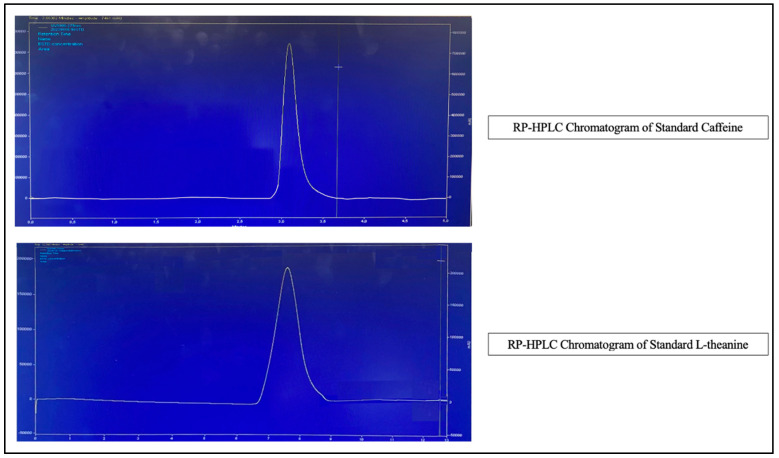
“The method was adapted from Shrestha et al. (2016) [31].”
Fan, F., Zhou, S., Qian, H., Zong, B., Huang, C., Zhu, R., Guo, H., & Gong, S. (2022) · Molecules · doi:10.3390/molecules27030940 · Cited by 47
Analysis of theanine in tea leaves by HPLC with fluorescence detection
Ying, Y., Ho, J. W., Chen, Z. Y., & Wang, J. (2005) · Journal of Liquid Chromatography & Related Technologies · doi:10.1081/jlc-200048894 · Cited by 45 · cited 3×
“Conversely, regarding L-theanine, most studies have demonstrated that prolonged fermentation significantly reduces the content of this component [27,37].”
Xu, L., Xia, G., Luo, Z., & Liu, S. (2018) · LWT · doi:10.1016/j.lwt.2018.12.008 · Cited by 45 · cited 1×
“Depending on the processing techniques applied, six main types of tea are produced, including black, green, white, yellow, oolong, and Pu-erh [2,3].”
Preparation of decaffeinated and high caffeine powders from green tea
Vuong, Q. V., Golding, J. B., Nguyen, M. H., & Roach, P. D. (2012) · Powder Technology · doi:10.1016/j.powtec.2012.09.002 · Cited by 44 · cited 1×
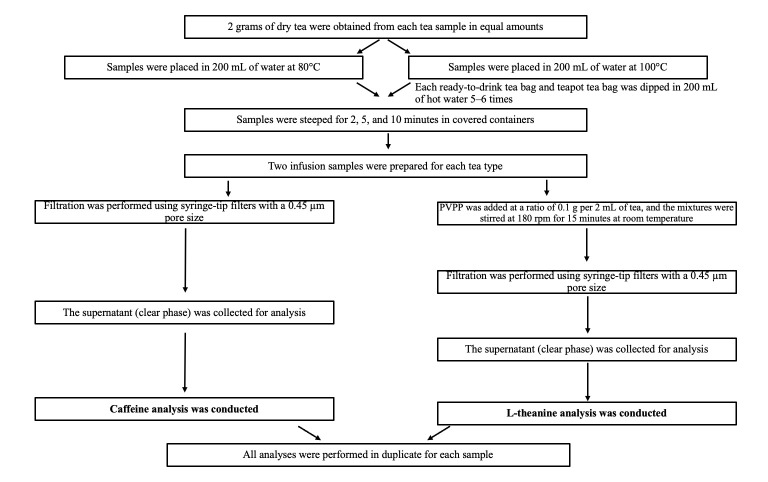
“Each sample was separately brewed at two different temperatures (80 ◦ C and 100 ◦ C) and three different times (2, 5, and 10 min) [21,22,28–30].”
Wang, Y., Yang, X., Li, K., Li, C., Li, L., Li, J., Huang, H., He, Y., Ye, C., & Song, X. (2010) · International Journal of Food Science & Technology · doi:10.1111/j.1365-2621.2010.02266.x · Cited by 43 · cited 1×
“In the literature, black teas generally contain the highest caffeine levels (25.7–34.2 mg/g), mostly with samples obtained from production regions, such as China, India, Japan, and Sri Lanka [42,44,45,56,57].”
InfluentialSuteerapataranon, S., Butsoongnern, J., Punturat, P., Jorpalit, W., & Thanomsilp, C. (2008) · Food Chemistry · doi:10.1016/j.foodchem.2008.11.013 · Cited by 38 · cited 3×
“Brewing time affects the amount of caffeine in the tea infusions [57].”
InfluentialProduction and Polyphenolic Composition of Tea
Ho, K. K. H. Y., Haufe, T. C., Ferruzzi, M. G., & Neilson, A. P. (2018) · Nutrition Today · doi:10.1097/nt.0000000000000304 · Cited by 35 · cited 1×
“…with the literature, oolong teas exhibited the lowest caffeine levels in this study; it is believed that this difference may be due to the fact that the products used in the sample do not adequately reflect the fermentation rates and the limited variety of teas available in the Turkish market [55].”
Polat, A., Kalcıoğlu, Z., & Müezzinoğlu, N. (2022) · International Journal of Gastronomy and Food Science · doi:10.1016/j.ijgfs.2022.100559 · Cited by 34 · cited 2×
“Therefore, optimizing the brewing conditions plays a significant role in maximizing the health effects of tea [22,23].”
Modelling the kinetics of tea and coffee infusion
Stapley, A. G. F. (2002) · Journal of the Science of Food and Agriculture · doi:10.1002/jsfa.1250 · Cited by 31
Kaczyński, P., Iwaniuk, P., Jankowska, M., Orywal, K., Socha, K., Perkowski, M., Farhan, J. A., & Łozowicka, B. (2024) · Chemosphere · doi:10.1016/j.chemosphere.2024.143550 · Cited by 30 · cited 1×
“Conversely, brewing parameters, including the brewing time, temperature, water ratio, degree of leaf break-down, stirring, and milk addition, are also determinants of caffeine and L-theanine levels in infusions [6,17,18].”
Comparison of the main compounds in Fuding white tea infusions from various tea types
Pan, J., Jiang, Y., Lv, Y., Li, M., Zhang, S., Liu, J., Zhu, Y., & Zhang, H. (2018) · Food Science and Biotechnology · doi:10.1007/s10068-018-0384-3 · Cited by 24 · cited 1×
“In the study by Pan et al. (2018), the caffeine content increased as the temperature increased in white tea infusions, whereas L-theanine levels moderately increased in some samples and decreased in others in the 90–100 ◦ C range [62].”
Deng, S., Zhou, X., Dong, H., Xu, Y., Gao, Y., Wang, B., & Liu, X. (2022) · Foods · doi:10.3390/foods11152285 · Cited by 24 · cited 1×
“In the literature, the findings on the caffeine content of Pu-erh teas are contradictory; some studies have indicated that the long fermentation process does not affect the caffeine level, whereas others have reported that the caffeine level decreases during this process [60,61].”
The cognitive-enhancing outcomes of caffeine and L-theanine: a systematic review
Anas Sohail, A., Ortiz, F., Varghese, T., Fabara, S. P., Batth, A. S., Sandesara, D. P., Sabir, A., Khurana, M., Datta, S., & Patel, U. K. (2021) · Cureus · doi:10.7759/cureus.20828 · Cited by 23 · cited 2×
“A receptors [10].”
POLYPHENOLS, ALKALOIDS AND ANTIOXIDANT ACTIVITY OF DIFFERENT GRADES TURKISH BLACK TEA
Erol, N. T., & Velioğlu, Y. S. (2010) · Bursa Uludag University - AVESIS · Cited by 23
Xu, Y., Yang, L., Lei, Y.-S., Ju, R.-N., Miao, S.-G., & Jin, S. (2022) · Tree Physiology · doi:10.1093/treephys/tpac016 · Cited by 20 · cited 1×
“Regarding L-theanine, yellow teas are generally reported to contain lower levels than green teas [52].”
Understanding standard deviations and standard errors
Hess, A. S., & Hess, J. R. (2016) · Transfusion · doi:10.1111/trf.13625 · Cited by 14 · cited 1×
“The SE was preferred particularly in cases where comparisons of means were the primary focus, in accordance with statistical consultation [33].”
Henríquez‐Aedo, K., Mario Vega, H., & Aranda, M. (2013) · Journal of the Chilean Chemical Society · doi:10.4067/s0717-97072013000400057 · Cited by 10 · cited 1×
“The method was adapted from Henríquez-Aedo et al. (2013) [32].”
Araslanova, K., Nastos, J. M., Sommerfeld, J., Megill, W., Struck, A., & Shirtcliffe, N. J. (2022) · Open Chemistry · doi:10.1515/chem-2022-0158 · Cited by 2 · cited 1×
“Therefore, optimizing the brewing conditions plays a significant role in maximizing the health effects of tea [22,23].”
Cited by
Zhao, S.-J., Tan, Y., Xie, H., Huang, C., Wang, F., & Xiao, X. (2025) · Nutrition & Metabolism · doi:10.1186/s12986-025-01047-3 · Cited by 10
“L-Theanine is a special amino acid found in tea, which is similar in chemical structure to the brain-active substances glutamine and glutamic acid [13].”
Baek, J. Y., Lee, J. Y., Han, S. O., & Hyeon, J. E. (2026) · Biotechnology and Bioprocess Engineering · doi:10.1007/s12257-026-00280-8 · Cited by 1
“L-theanine decreases sharply with increasing fermentation (green > oolong > black > pu-erh), resulting in a rising caffeine/theanine ratio, which amplifies the relative stimulatory effect of caffeine [23 , 77 ].”
Effects of L-theanine on cognition, mood and sleep: evidence from human trials
Cotter, J., & Kilpatrick, H. E. (2026) · Frontiers in Nutrition · doi:10.3389/fnut.2026.1922819
“While tea is the major source of L-theanine in the human diet, a standard 200mL cup of commercially available green or black tea typically contains only around 8–25mg of L-theanine, depending on the type of tea, manufacturing and preparation methods used (47, 48).”
Unveiling Fermentation Effects on the Functional Composition of Taiwanese Native Teas
Hung, W., Kuo, C.-C., Lu, J.-J., Yang, F.-S., Cheng, Y.-L., Sung, Y.-J., Chiou, C.-S., Huang, H.-H., Su, T., Tsai, H.-T., et al. (2026) · Molecules · doi:10.3390/molecules31010171
Derbyshire, E., Aslam, N., & Bond, T. (2026) · Food and Nutrition Sciences · doi:10.4236/fns.2026.172013 · Cited by 1
Metadata
- Authors
- Ayakdaş, G., & Ağagündüz, D.
- Affiliations
- Acıbadem University (TR)
- Gazi University (TR)
- Corresponding author
- Ağagündüz, Duygu
- Venue
- Foods
- Publisher
- MDPI AG
- Published
- 2025-06-30
- Volume
- 14
- Issue
- 13
- Pages
- 2313
- ISSN
- 2304-8158 (ISSN-L)
- PMC
- PMC12248710
- OpenAlex
- W4411823129
- Cited by
- 12
- References
- 64
- Citations by year
- 2026: 11 · 2025: 1
- FWCI
- 7.93
- Type
- journal article
- Language
- en
- Open access
- gold
- doi.org
- Licence
- Locations
- Foods (publishedVersion, cc-by)
- PubMed Central (publishedVersion, cc-by)
- PubMed (publishedVersion)
- DOAJ (DOAJ: Directory of Open Access Journals) (submittedVersion, cc-by-sa)
- Funders
- Scientific Research Projects Coordination Unit (BAP) of Gazi University (TYL-2023-8792)
- Topics
- Life Sciences › Agricultural and Biological Sciences › Food Science › Tea Polyphenols and Effects
- Health Sciences › Medicine › Pharmacology (medical) › Coffee research and impacts
- Life Sciences › Agricultural and Biological Sciences › Food Science › Food Nutrient Composition and Product Development
- Keywords
- theanine, caffeine, tea infusion, brewing temperature, brewing time, tea bags, green tea, black tea, oolong tea, Pu-erh tea, tea types, tea polyphenols, tea catechins, tea flavonoids, tea alkaloids
About these checks
Registry, retraction, Cites and statistics results are computed, not judged, with one exception: a printed reference that no index lists is read once by a model before it counts as a citation error. Claims are extracted by a model and kept only when their quote appears verbatim in the text; each cited source is then checked, with a model’s help, for whether it says what the claim relies on. Those verdicts can be wrong — read the claim’s quote and the cited source before relying on one.
Statistics and arithmetic are recomputed, not judged.
Confidence bands are shown only for fields calibrated on our annotated test set. None is calibrated yet, so no band is shown.
What counts as a claim ›How we measure confidence ›How we check this ›
Are you an author, or do you see a problem with this page? Request a review
Data sources
Bibliographic data: Semantic Scholar, OpenAlex, Crossref.
Contains information from the Semantic Scholar Academic Graph Datasets, made available under the ODC Attribution License (ODC-BY 1.0).
Semantic Scholar’s data is described in: Kinney, R., et al. (2023). The Semantic Scholar Open Data Platform. arXiv:2301.10140.
