

The DOI matches its Crossref record; 116 of the 120 references it cites were found in a registry or an index.
The Impact of the COVID-19 Pandemic on Burnout, Compassion Fatigue, and Compassion Satisfaction in Healthcare Personnel: A Systematic Review of the Literature Published during the First Year of the Pandemic
Open accessAbstract
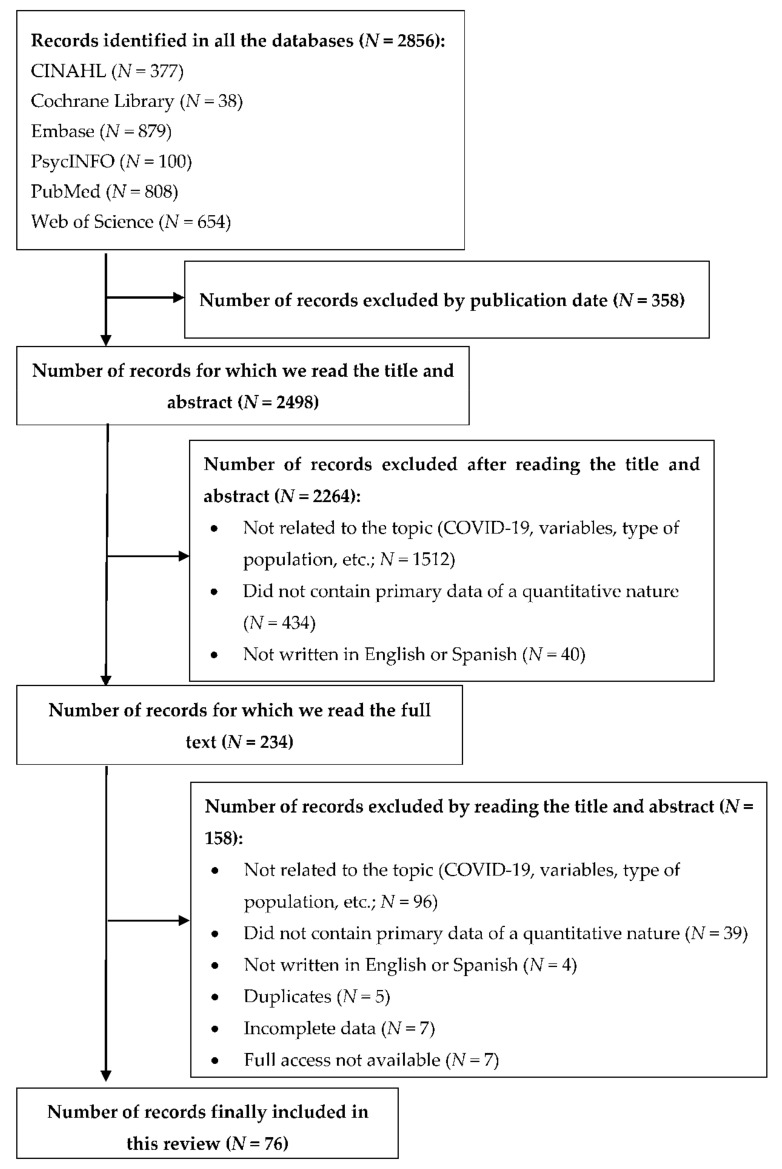
This literature review aimed to determine the level of burnout, compassion fatigue, and compassion satisfaction, as well as their associated risks and protective factors, in healthcare professionals during the first year of the COVID-19 pandemic. We reviewed 2858 records obtained from the CINAHL, Cochrane Library, Embase, PsycINFO, PubMed, and Web of Science databases, and finally included 76 in this review. The main results we found showed an increase in the rate of burnout, dimensions of emotional exhaustion, depersonalization, and compassion fatigue; a reduction in personal accomplishment; and levels of compassion satisfaction similar to those before the pandemic. The main risk factors associated with burnout were anxiety, depression, and insomnia, along with some sociodemographic variables such as being a woman or a nurse or working directly with COVID-19 patients. Comparable results were found for compassion fatigue, but information regarding compassion satisfaction was lacking. The main protective factors were resilience and social support.
Overview
The claims and statistics of this paper haven’t been checked yet.
Run the check — free, no account needed. It reads the open-access text and checks the sources it cites.
Integrity signals
Registry
Cites
Statistics
Figures
Verification
Claims the paper makes
The claims and statistics of this paper haven’t been checked yet.
Run the check — free, no account needed. It reads the open-access text and checks the sources it cites.
Claims other papers make about this one
Each is checked against this paper’s own text: does it say what the citing paper says it does?
The source backs part of the claim, not all of it — or backs it for a different population, condition or comparison.
In the citing paper
“This burden appears to have peaked during the most demanding periods of the COVID-19 pandemic”
From What do we really know about addressing burnout among healthcare workers? Maybe less than we think (2026) · cites this paper as [7]
Experimental — accuracy not yet measuredThe cited source says what the claim attributes to it.
In the citing paper
“although burnout in the healthcare field was already a long-standing issue before the pandemic.6,7”
From What do we really know about addressing burnout among healthcare workers? Maybe less than we think (2026) · cites this paper as [7]
The cited source says what the claim attributes to it.
In the citing paper
“A systematic review of research published in the first year of the pandemic found evidence for increased levels of burnout, emotional exhaustion, depersonalization and compassion fatigue among health care workers, with nurses, women and those working directly with COVID‐19 patients most impacted.”
From 2024 Alzheimer's disease facts and figures (2024) · cites this paper as [820]
Self-check
Percentages, sums and reported differences re-computed from the paper’s own numbers.
The self-check needs the paper’s full text.
Citations
Cites
1 retracted
Panagioti, M., Geraghty, K., Johnson, J., Zhou, A. Y., Panagopoulou, E. P., Chew-Graham, C. A., Peters, D. H., Hodkinson, A., Riley, R. A., & Esmail, A. (2018) · JAMA Internal Medicine · doi:10.1001/jamainternmed.2018.3713 · Cited by 1,059
RetractedPRISMA-P Group, Moher, D., Shamseer, L., Clarke, M., Ghersi, D., Liberati, A., Petticrew, M., Shekelle, P., & Stewart, L. A. (2015) · Systematic Reviews · doi:10.1186/2046-4053-4-1 · Cited by 26,223 · cited 2×
“Although several systematic reviews have recently been published on the impact of the COVID-19 pandemic on the mental health of healthcare professionals [4,30,31], very few of them specifically included dimensions of professional quality of life such as burnout [32–35], only one considered indirect trauma [36] and, to…”
BackgroundFreudenberger, H. J. (1974) · Journal of Social Issues · doi:10.1111/j.1540-4560.1974.tb00706.x · Cited by 5,463
Mental health and the COVID-19 pandemic
Pfefferbaum, B., & North, C. S. (2020) · New England Journal of Medicine · doi:10.1056/nejmp2008017 · Cited by 4,378 · cited 1×
“Among several potentially harmful factors for the health of professionals, some authors have highlighted the lack of access to adequate protective equipment [1], exhaustion resulting from wearing personal protective equipment throughout the working day, the feeling of having inadequate support [2,3], long working hour…”
BackgroundCOVID-19 and mental health: A review of the existing literature
Rajkumar, R. P. (2020) · Asian Journal of Psychiatry · doi:10.1016/j.ajp.2020.102066 · Cited by 3,574 · cited 2×
“Among several potentially harmful factors for the health of professionals, some authors have highlighted the lack of access to adequate protective equipment [1], exhaustion resulting from wearing personal protective equipment throughout the working day, the feeling of having inadequate support [2,3], long working hour…”
BackgroundPrevalence of Burnout Among Physicians: A Systematic Review
Rotenstein, L. S., Torre, M., Ramos, M. A., Rosales, R. C., Guille, C., Sen, S., & Mata, D. A. (2018) · JAMA · doi:10.1001/jama.2018.12777 · Cited by 1,904 · cited 2×
“However, for certain professional profiles such as healthcare professionals in the oncology area, elevated levels of emotional exhaustion and depersonalization had already been identified prior to the pandemic [116].”
BackgroundHealthcare staff wellbeing, burnout, and patient safety: a systematic review
Hall, L. H., Johnson, J., Watt, I., Tsipa, A., & O’Connor, D. B. (2016) · PLOS ONE · doi:10.1371/journal.pone.0159015 · Cited by 1,683 · cited 2×
“Indeed, the first two risk factors have already been recorded elsewhere in the literature [111,119].”
BackgroundResultCompassion fatigue: Psychotherapists’ chronic lack of self care.
Figley, C. R. (2002) · Journal of Clinical Psychology · doi:10.1002/jclp.10090 · Cited by 1,614
Li, Z., Ge, J., Yang, M., Feng, J., Qiao, M., Jiang, R., Bi, J., Zhan, G., Xu, X., Wang, L., et al. (2020) · Brain Behavior and Immunity · doi:10.1016/j.bbi.2020.03.007 · Cited by 1,223 · cited 4×
“Some studies indicated high scores as a consequence of the pandemic on the personal accomplishment subscale [75,78], although these were lower in other studies [7,39,52,60,84].”
BackgroundResultInfluentialHu, D., Kong, Y., Li, W., Han, Q., Zhang, X., Zhu, L. X., Wan, S. W., Liu, Z., Shen, Q., Yang, J., et al. (2020) · EClinicalMedicine · doi:10.1016/j.eclinm.2020.100424 · Cited by 936 · cited 2×
“Hu et al. (2020) [70] To assess mental health (burnout, anxiety, depression, and fear) and its associated factors among frontline nurses caring for COVID-19 patients in Wuhan, China.”
Background
Research works printed but not linked: 1
- Figley, C.R. (1995). Compassion Fatigue: Coping with Secondary Traumatic Stress Disorder in Those Who Treat the Traumatized, Routledge.
Cited by
Sorted by citations
2024 Alzheimer's disease facts and figures
(2024) · Alzheimer's & Dementia · doi:10.1002/alz.13809 · Cited by 2,536
Poon, E. G., Lemak, C. H., Rojas, J. C., Guptill, J., & Classen, D. C. (2025) · Journal of the American Medical Informatics Association · doi:10.1093/jamia/ocaf065 · Cited by 194
Third-party evaluators perceive AI as more compassionate than expert humans
Ovsyannikova, D., de Mello, V. O., & Inzlicht, M. (2025) · Communications Psychology · doi:10.1038/s44271-024-00182-6 · Cited by 159
Compassion fatigue in healthcare providers: a scoping review
Garnett, A., Hui, L., Oleynikov, C., & Boamah, S. A. (2023) · BMC Health Services Research · doi:10.1186/s12913-023-10356-3 · Cited by 114
“Burnout and secondary trauma are suggested to be mediated by compassion satisfaction—the pleasure that comes from helping behavior [11, 12].”
BackgroundPatterns in Physician Burnout in a Stable-Linked Cohort
Ortega, M. V., Hidrue, M. K., Lehrhoff, S. R., Ellis, D. B., Sisodia, R. C., Curry, W. T., Carmen, M. G. D., & Wasfy, J. H. (2023) · JAMA Network Open · doi:10.1001/jamanetworkopen.2023.36745 · Cited by 100
Metadata
- Authors
- Lluch, C., Galiana, L., Doménech, P., & Sansó, N.
- Affiliations
- Universitat de València (ES)
- Valencian International University (ES)
- Health Research Institute of the Balearic Islands (ES)
- Corresponding author
- Sansó, Noemí
- Venue
- Healthcare
- Publisher
- MDPI AG
- Published
- 2022-02-13
- Volume
- 10
- Issue
- 2
- Pages
- 364
- ISSN
- 2227-9032 (ISSN-L)
- PMC
- PMC8872521
- OpenAlex
- W4213375660
- Cited by
- 281
- References
- 120
- Citations by year
- 2026: 24 · 2025: 62 · 2024: 79 · 2023: 76 · 2022: 40
- FWCI
- 10.74
- Type
- journal article
- Language
- en
- Open access
- gold
- doi.org
- Licence
- Locations
- Healthcare (publishedVersion, cc-by)
- PubMed Central (publishedVersion, cc-by)
- PubMed (publishedVersion)
- Repository of Digital Objects for Teaching Research and Culture (University of Valencia) (submittedVersion, cc-by-nc)
- DOAJ (DOAJ: Directory of Open Access Journals) (submittedVersion, cc-by-sa)
- Funders
- Ministry of Science and Innovation / State Research Agency /FEDER (RTI2018-094089-I00)
- Topics
- Social Sciences › Psychology › Clinical Psychology › COVID-19 and Mental Health
- Health Sciences › Health Professions › General Health Professions › Healthcare professionals’ stress and burnout
- Health Sciences › Medicine › Public Health, Environmental and Occupational Health › Occupational Health and Burnout
- Keywords
- COVID-19 pandemic, burnout, compassion fatigue, compassion satisfaction, healthcare workers, emotional exhaustion, depersonalization, personal accomplishment, risk factors, protective factors, resilience, social support, anxiety, depression, insomnia, nurses
About these checks
Registry, retraction, Cites and statistics results are computed, not judged, with one exception: a printed reference that no index lists is read once by a model before it counts as a citation error. Claims are extracted by a model and kept only when their quote appears verbatim in the text; each cited source is then checked, with a model’s help, for whether it says what the claim relies on. Those verdicts can be wrong — read the claim’s quote and the cited source before relying on one.
Statistics and arithmetic are recomputed, not judged.
Confidence bands are shown only for fields calibrated on our annotated test set. None is calibrated yet, so no band is shown.
What counts as a claim ›How we measure confidence ›How we check this ›
Are you an author, or do you see a problem with this page? Request a review
