

The DOI matches its Crossref record; 116 of the 120 references it cites were found in a registry or an index.
The Impact of the COVID-19 Pandemic on Burnout, Compassion Fatigue, and Compassion Satisfaction in Healthcare Personnel: A Systematic Review of the Literature Published during the First Year of the Pandemic
Open accessAbstract
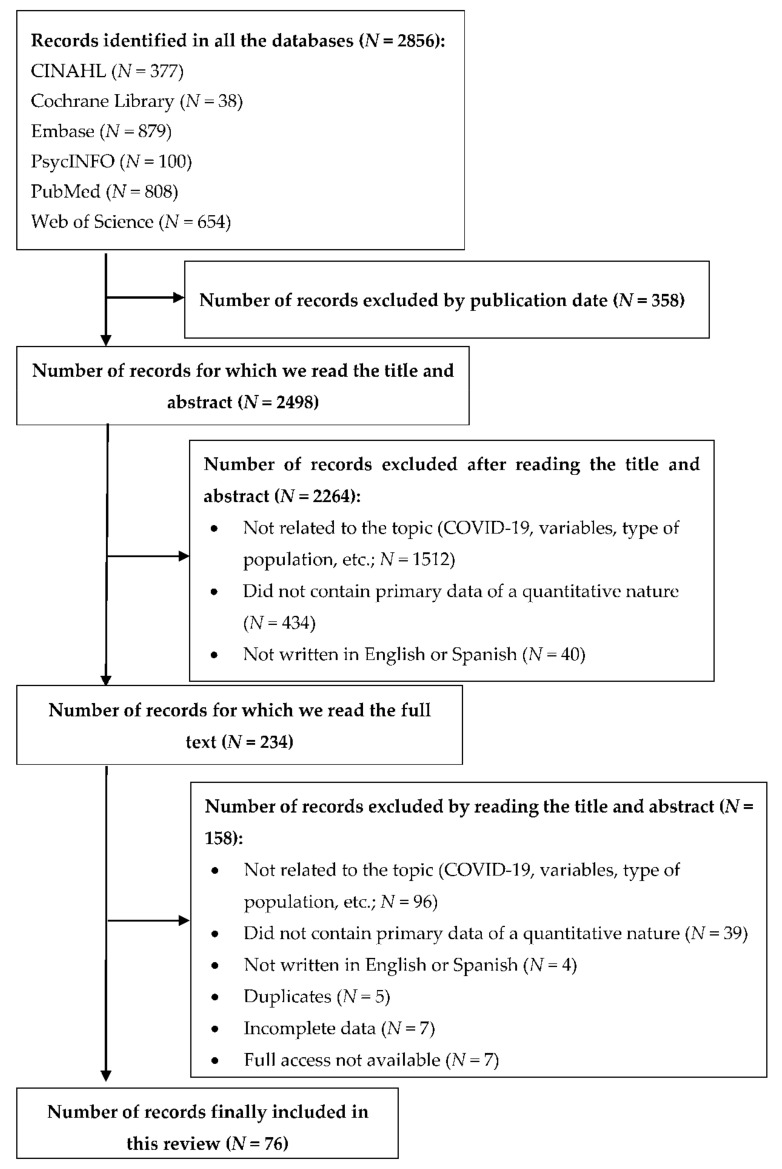
This literature review aimed to determine the level of burnout, compassion fatigue, and compassion satisfaction, as well as their associated risks and protective factors, in healthcare professionals during the first year of the COVID-19 pandemic. We reviewed 2858 records obtained from the CINAHL, Cochrane Library, Embase, PsycINFO, PubMed, and Web of Science databases, and finally included 76 in this review. The main results we found showed an increase in the rate of burnout, dimensions of emotional exhaustion, depersonalization, and compassion fatigue; a reduction in personal accomplishment; and levels of compassion satisfaction similar to those before the pandemic. The main risk factors associated with burnout were anxiety, depression, and insomnia, along with some sociodemographic variables such as being a woman or a nurse or working directly with COVID-19 patients. Comparable results were found for compassion fatigue, but information regarding compassion satisfaction was lacking. The main protective factors were resilience and social support.
Overview
The claims and statistics of this paper haven’t been checked yet.
Run the check — free, no account needed. It reads the open-access text and checks the sources it cites.
Integrity signals
Registry
Cites
Statistics
Figures
Verification
Claims the paper makes
The claims and statistics of this paper haven’t been checked yet.
Run the check — free, no account needed. It reads the open-access text and checks the sources it cites.
Claims other papers make about this one
Each is checked against this paper’s own text: does it say what the citing paper says it does?
The source backs part of the claim, not all of it — or backs it for a different population, condition or comparison.
In the citing paper
“This burden appears to have peaked during the most demanding periods of the COVID-19 pandemic”
From What do we really know about addressing burnout among healthcare workers? Maybe less than we think (2026) · cites this paper as [7]
Experimental — accuracy not yet measuredThe cited source says what the claim attributes to it.
In the citing paper
“although burnout in the healthcare field was already a long-standing issue before the pandemic.6,7”
From What do we really know about addressing burnout among healthcare workers? Maybe less than we think (2026) · cites this paper as [7]
The cited source says what the claim attributes to it.
In the citing paper
“A systematic review of research published in the first year of the pandemic found evidence for increased levels of burnout, emotional exhaustion, depersonalization and compassion fatigue among health care workers, with nurses, women and those working directly with COVID‐19 patients most impacted.”
From 2024 Alzheimer's disease facts and figures (2024) · cites this paper as [820]
Self-check
Percentages, sums and reported differences re-computed from the paper’s own numbers.
The self-check needs the paper’s full text.
Citations
Cites
1 retracted
Panagioti, M., Geraghty, K., Johnson, J., Zhou, A. Y., Panagopoulou, E. P., Chew-Graham, C. A., Peters, D. H., Hodkinson, A., Riley, R. A., & Esmail, A. (2018) · JAMA Internal Medicine · doi:10.1001/jamainternmed.2018.3713 · Cited by 1,059
RetractedPRISMA-P Group, Moher, D., Shamseer, L., Clarke, M., Ghersi, D., Liberati, A., Petticrew, M., Shekelle, P., & Stewart, L. A. (2015) · Systematic Reviews · doi:10.1186/2046-4053-4-1 · Cited by 26,223 · cited 2×
“Although several systematic reviews have recently been published on the impact of the COVID-19 pandemic on the mental health of healthcare professionals [4,30,31], very few of them specifically included dimensions of professional quality of life such as burnout [32–35], only one considered indirect trauma [36] and, to…”
BackgroundFreudenberger, H. J. (1974) · Journal of Social Issues · doi:10.1111/j.1540-4560.1974.tb00706.x · Cited by 5,463
Mental health and the COVID-19 pandemic
Pfefferbaum, B., & North, C. S. (2020) · New England Journal of Medicine · doi:10.1056/nejmp2008017 · Cited by 4,378 · cited 1×
“Among several potentially harmful factors for the health of professionals, some authors have highlighted the lack of access to adequate protective equipment [1], exhaustion resulting from wearing personal protective equipment throughout the working day, the feeling of having inadequate support [2,3], long working hour…”
BackgroundCOVID-19 and mental health: A review of the existing literature
Rajkumar, R. P. (2020) · Asian Journal of Psychiatry · doi:10.1016/j.ajp.2020.102066 · Cited by 3,574 · cited 2×
“Among several potentially harmful factors for the health of professionals, some authors have highlighted the lack of access to adequate protective equipment [1], exhaustion resulting from wearing personal protective equipment throughout the working day, the feeling of having inadequate support [2,3], long working hour…”
BackgroundPrevalence of Burnout Among Physicians: A Systematic Review
Rotenstein, L. S., Torre, M., Ramos, M. A., Rosales, R. C., Guille, C., Sen, S., & Mata, D. A. (2018) · JAMA · doi:10.1001/jama.2018.12777 · Cited by 1,904 · cited 2×
“However, for certain professional profiles such as healthcare professionals in the oncology area, elevated levels of emotional exhaustion and depersonalization had already been identified prior to the pandemic [116].”
BackgroundHealthcare staff wellbeing, burnout, and patient safety: a systematic review
Hall, L. H., Johnson, J., Watt, I., Tsipa, A., & O’Connor, D. B. (2016) · PLOS ONE · doi:10.1371/journal.pone.0159015 · Cited by 1,683 · cited 2×
“Indeed, the first two risk factors have already been recorded elsewhere in the literature [111,119].”
BackgroundResultCompassion fatigue: Psychotherapists’ chronic lack of self care.
Figley, C. R. (2002) · Journal of Clinical Psychology · doi:10.1002/jclp.10090 · Cited by 1,614
Li, Z., Ge, J., Yang, M., Feng, J., Qiao, M., Jiang, R., Bi, J., Zhan, G., Xu, X., Wang, L., et al. (2020) · Brain Behavior and Immunity · doi:10.1016/j.bbi.2020.03.007 · Cited by 1,223 · cited 4×
“Some studies indicated high scores as a consequence of the pandemic on the personal accomplishment subscale [75,78], although these were lower in other studies [7,39,52,60,84].”
BackgroundResultInfluentialHu, D., Kong, Y., Li, W., Han, Q., Zhang, X., Zhu, L. X., Wan, S. W., Liu, Z., Shen, Q., Yang, J., et al. (2020) · EClinicalMedicine · doi:10.1016/j.eclinm.2020.100424 · Cited by 936 · cited 2×
“Hu et al. (2020) [70] To assess mental health (burnout, anxiety, depression, and fear) and its associated factors among frontline nurses caring for COVID-19 patients in Wuhan, China.”
Background
Research works printed but not linked: 1
- Figley, C.R. (1995). Compassion Fatigue: Coping with Secondary Traumatic Stress Disorder in Those Who Treat the Traumatized, Routledge.
Cited by
Sorted by citations
2024 Alzheimer's disease facts and figures
(2024) · Alzheimer's & Dementia · doi:10.1002/alz.13809 · Cited by 2,536
Poon, E. G., Lemak, C. H., Rojas, J. C., Guptill, J., & Classen, D. C. (2025) · Journal of the American Medical Informatics Association · doi:10.1093/jamia/ocaf065 · Cited by 194
Third-party evaluators perceive AI as more compassionate than expert humans
Ovsyannikova, D., de Mello, V. O., & Inzlicht, M. (2025) · Communications Psychology · doi:10.1038/s44271-024-00182-6 · Cited by 159
Compassion fatigue in healthcare providers: a scoping review
Garnett, A., Hui, L., Oleynikov, C., & Boamah, S. A. (2023) · BMC Health Services Research · doi:10.1186/s12913-023-10356-3 · Cited by 114
“Burnout and secondary trauma are suggested to be mediated by compassion satisfaction—the pleasure that comes from helping behavior [11, 12].”
BackgroundPatterns in Physician Burnout in a Stable-Linked Cohort
Ortega, M. V., Hidrue, M. K., Lehrhoff, S. R., Ellis, D. B., Sisodia, R. C., Curry, W. T., Carmen, M. G. D., & Wasfy, J. H. (2023) · JAMA Network Open · doi:10.1001/jamanetworkopen.2023.36745 · Cited by 100
Sadeh‐Sharvit, S., Camp, T. D., Horton, S. E., Hefner, J. D., Berry, J. M., Grossman, E., & Hollon, S. D. (2023) · Journal of Medical Internet Research · doi:10.2196/46781 · Cited by 129
“Additionally, the therapists in community-based centers face unprecedented documentation and administrative burden [5,6], leading to frontline mental health workers’ work-life imbalance and compassion fatigue [7,8].”
Aiken, L. H., Sermeus, W., McKee, M., Lasater, K. B., Sloane, D. M., Pogue, C. A., Kohnen, D., Dello, S., Maier, C. B., Drennan, J., et al. (2024) · BMJ Open · doi:10.1136/bmjopen-2023-079931 · Cited by 104
Claponea, R., Pop, L., Iorga, M., & Iurcov, R. (2022) · Healthcare · doi:10.3390/healthcare10060979 · Cited by 47
Fixing the health workforce crisis in Europe: retention must be the priority
Zapata, T., Muscat, N. A., McKee, M., & Kluge, H. H. P. (2023) · BMJ · doi:10.1136/bmj.p947 · Cited by 48
Bégin, C., Berthod, J., Martinez, L. Z., & Truchon, M. (2022) · Journal of Technology in Behavioral Science · doi:10.1007/s41347-022-00267-1 · Cited by 41
Alqarni, T., Alghamdi, A. E., Alzahrani, A., Abumelha, K., Alqurashi, Z., & Alsaleh, A. (2022) · PLoS ONE · doi:10.1371/journal.pone.0267578 · Cited by 38
“A systematic review on all studies assessing burnout during the first year of the pandemic showed general trend of worsening in burnout rates compared to pre-pandemic rates [8].”
BackgroundBeck, E., & Daniels, J. (2023) · Psychology, Health & Medicine · doi:10.1080/13548506.2022.2092762 · Cited by 36
“During and beyond the pandemic, lack of adequate protection and high pressure on UK NHS personnel has been widely reported (Lluch et al., 2022).”
BackgroundAlruwaili, A. N., Alruwaili, M. M., Ramadan, O. M. E., Elsharkawy, N. B., Abdelaziz, E. M., Ali, S. I., & Shaban, M. (2024) · Geriatric Nursing · doi:10.1016/j.gerinurse.2024.05.024 · Cited by 44
Barnard, N. B., Rothmann, S., Beer, L. T. D., & Lubbe, W. (2023) · Frontiers in Psychology · doi:10.3389/fpsyg.2023.1119063 · Cited by 38
“The above-mentioned job demands, associated with a lack of job resources, can lead to an increased likelihood of burnout in emergency nurses (McDermid et al., 2020; Lluch et al., 2022), especially if they lack work capabilities.”
BackgroundKuriyama, A., Sakuraya, M., Kinjo, M., Santanda, T., Yoshino, T., Ouchi, K., Suyama, S., Yoshino, S., Saito, S., Yokoyama, T., et al. (2022) · Annals of the American Thoracic Society · doi:10.1513/annalsats.202201-029oc · Cited by 31
Zhang, Y., Wu, C., Ma, J., Liu, F., Shen, C., Sun, J., Ma, Z., Hu, W., & Lang, H. (2024) · BMC Nursing · doi:10.1186/s12912-024-01867-3 · Cited by 33
“Burnout was identified as one of strongest predictor of depressive symptoms [29, 30].”
BackgroundChatham, A. A., Petruzzi, L. J., Patel, S., Brode, W. M., Cook, R., Garza, B. W., Garay, R., Mercer, T., & Valdez, C. R. (2023) · Qualitative Health Research · doi:10.1177/10497323231213825 · Cited by 26
“Consequently, HCPs ’ professional quality of life has been adversely affected, as evidenced by heightened levels of compassion fatigue, burnout, and secondary traumatic stress (Alanazi et al., 2022; Braquehais et al., 2020; Koontalay et al., 2021; Lluch et al., 2022).”
BackgroundHospital Outdoor Spaces as Respite Areas for Healthcare Staff During the COVID-19 Pandemic
Iqbal, S. A., & Abubakar, I. R. (2022) · HERD Health Environments Research & Design Journal · doi:10.1177/19375867221111530 · Cited by 26
“…intense levels of anxiety, stress, burnout, and mental breakdowns with significant implications on their psychological and physical well-being and the healthcare they provide (Akova et al., 2022; Lluch et al., 2022; Luo et al., 2020; Spoorthy et al., 2020; Vizheh et al., 2020; Zhou et al., 2022).”
Backgroundde Cordova, P. B., Reilly, L. L., Pogorzelska‐Maziarz, M., Gerolamo, A. M., Grafova, I. B., Vasquez, A., & Johansen, M. L. (2024) · Journal of Advanced Nursing · doi:10.1111/jan.16061 · Cited by 27
Rapisarda, F., Vallarino, M., Brousseau‐Paradis, C., Benedictis, L. D., Corbière, M., Villotti, P., Cavallini, E., Briand, C., Cailhol, L., & LESAGE, A. D. (2022) · International Journal of Environmental Research and Public Health · doi:10.3390/ijerph19073806 · Cited by 24
“Two meta-analyses, the first including 13 cross-sectional studies and a total of 33,062 participants in the first stage of the pandemic [9], and the latter including 76 studies [10], provided evidence that a high proportion of healthcare professionals have experienced levels of clinical mental health symptoms (such as…”
BackgroundYi, L., Cai, J., Shuai, T., Herrera, M., Gu, L., & Tian, X. (2024) · BMC Nursing · doi:10.1186/s12912-024-02173-8 · Cited by 29
“Research suggests that health-care professionals working in high-stress environments like pandemics experience more psychological distress [71, 72].”
BackgroundSilveira, S., Godara, M., & Singer, T. (2023) · Journal of Medical Internet Research · doi:10.2196/45027 · Cited by 23
“Alternatively, decreasing levels of empathy and compassion might be explained by an increase in compassion fatigue during the ongoing COVID-19 pandemic [29].”
A review on the efficacy of artificial intelligence for managing anxiety disorders
Das, K. P., & Gavade, P. (2024) · Frontiers in Artificial Intelligence · doi:10.3389/frai.2024.1435895 · Cited by 25
Platania, S., Gruttadauria, S. V., & Morando, M. (2022) · European Journal of Investigation in Health Psychology and Education · doi:10.3390/ejihpe12090089 · Cited by 19
“[84,85] with a sample of 5445 physicians, for example, suggested that resilience is inversely associated with burnout symptoms, but that at the same time burnout is also experienced among those with adequate and good levels of resilience.”
BackgroundBoss, H., MacInnis, C., Simon, R., Jackson, J., Lahtinen, M., & Sinclair, S. (2024) · BMC Emergency Medicine · doi:10.1186/s12873-024-01040-8 · Cited by 18
“Finally, data collection occurred during the COVID-19 pandemic and as such future studies outside the context of a pandemic are needed to verify and extend our results [33].”
BackgroundDominguez-Rodriguez, A., Martínez-Arriaga, R. J., Herdoiza-Arroyo, P. E., Bautista-Valerio, E., de la Rosa-Gómez, A., Castellanos Vargas, R. O., Lacomba-Trejo, L., Mateu-Mollá, J., Lupercio Ramírez, M. D. J., Figueroa González, J. A., et al. (2022) · International Journal of Environmental Research and Public Health · doi:10.3390/ijerph191912749 · Cited by 18
“The COVID-19 pandemic constitutes a new and a general social health challenge, where healthcare workers are especially affected, presenting an increase in emotional symptoms, stress, burnout, and compassion fatigue [5,6].”
BackgroundSpányik, A., Simon, D., Rigó, A., Griffiths, M. D., & Demetrovics, Z. (2023) · PLoS ONE · doi:10.1371/journal.pone.0291650 · Cited by 20
“According to a literature review examining the mental health effects of COVID-19 pandemic on HCWs, only 5% of studies examined CS and reported medium to high levels of CS among HCWs [38].”
BackgroundKabunga, A., Kigongo, E., Tumwesigye, R., Udho, S., Musinguzi, M., Acup, W., Auma, A. G., Akello, A. R., Okalo, P., Nabaziwa, J., et al. (2024) · PLOS Global Public Health · doi:10.1371/journal.pgph.0003388 · Cited by 18
“Although systematic reviews have been conducted on the impact of the COVID-19 pandemic on the mental health of healthcare professionals, few have examined dimensions of quality of life such as compassion fatigue in health professions [16], specifically in Sub-Saharan Africa.”
BackgroundHigh workload and under-appreciation lead to burnout and low job satisfaction among radiographers
Kennedy, E., Ryan, M., England, A., Sarkodie, B. D., Khine, R., & McEntee, M. F. (2024) · Radiography · doi:10.1016/j.radi.2024.11.019 · Cited by 30
Antão, H. S., Sacadura‐Leite, E., Correia, A. I., & Figueira, M. L. (2022) · Frontiers in Psychology · doi:10.3389/fpsyg.2022.942727 · Cited by 18
“Additionally to these, burnout research that took place during the pandemic, identified other risk factors as decreased social support, low family and colleagues’ readiness to cope with COVID-19 outbreak, working in the frontline, being a resident, experiencing the loss of patients, increased workload, shifts lasting…”
BackgroundCompassion fatigue and moral sensitivity in midwives in COVID-19
Doğan, R. A., Hüseyinoğlu, S., & Yazıcı, S. (2023) · Nursing Ethics · doi:10.1177/09697330221146224 · Cited by 16
“Although there were no studies examining the compassion fatigue of midwives in the COVID-19 pandemic in the literature review, studies examining nurses and health workers were found.(20,21,36,48) In the systematic review of Lluch et al.”
BackgroundDoubova, S. V., Bhadelia, A., Pérez-Morán, D., Martínez-Vega, I. P., García-Cervantes, N., & Knaul, F. M. (2023) · BMJ Open · doi:10.1136/bmjopen-2023-075691 · Cited by 20
Matos, M., McEwan, K., Kanovský, M., Halamová, J., Steindl, S. R., Ferreira, N. B., Linharelhos, M., Rijo, D., Asano, K., Vilas, S. P., et al. (2023) · International Journal of Environmental Research and Public Health · doi:10.3390/ijerph20031845 · Cited by 21
“This could potentially be related to elevated burnout and compassionate fatigue in healthcare workers as the pandemic continued [68,69].”
BackgroundAnxiety, Depression and Burnout Levels of Nurses Working in COVID-19 Intensive Care Units
Karadağ, S., & Çiçek, B. (2023) · OMEGA - Journal of Death and Dying · doi:10.1177/00302228231156313 · Cited by 16
“In systematic reviews, it has been stated that anxiety and depression are among the main risk factors for burnout (Lluch et al., 2022), that health professionals with anxiety and depression experience higher levels of burnout (Soares et al., 2022); and that nurses working in intensive care units…”
Mentoring in Nursing through Narrative Stories Across the World
Gantz, N. R., & Hafsteinsdøttir, T. B. (2023) · Springer eBooks · doi:10.1007/978-3-031-25204-4 · Cited by 14
Compassionomics: The Science and Practice of Caring
Laíns, I., Johnson, T. J., & Johnson, M. W. (2023) · American Journal of Ophthalmology · doi:10.1016/j.ajo.2023.10.006 · Cited by 19
Zhang, Y., He, H., Yang, C., Wang, X., Luo, J., Xiao, J., Fu, B., Chen, Y., & Ma, C. (2023) · Frontiers in Public Health · doi:10.3389/fpubh.2023.1269594 · Cited by 14
O’Malley, C. I., Moody, C. M., Foster, A., & Turner, P. V. (2022) · Journal of the American Association for Laboratory Animal Science · doi:10.30802/aalas-jaalas-22-000078 · Cited by 14
Quantifying Compassion Fatigue in Ancillary and Clinical Staff in an Adult Emergency Department
Bales, M., DeAlmeida, K., Oei, C. E., Hampton, D., & Bohr, N. L. (2022) · Western Journal of Emergency Medicine · doi:10.5811/westjem.2022.8.57733 · Cited by 15
The COVID-19 burnout scale: development and initial validation
Galanis, P., Katsiroumpa, A., Sourtzi, P., Siskou, O. C., Konstantakopoulou, O., & Καϊτελίδου, Δ. (2023) · Journal of Mental Health · doi:10.1080/09638237.2023.2245914 · Cited by 14
Burnout in Academic Medicine: A Peripandemic Assessment
Wisniewska, I., & Holt, G. R. (2023) · The Permanente Journal · doi:10.7812/tpp/23.042 · Cited by 13
Dixit, P., Srivastava, S. P., Tiwari, S. K., Chauhan, S., & Bishnoi, R. K. (2024) · Industrial Psychiatry Journal · doi:10.4103/ipj.ipj_45_23 · Cited by 14
“[18] A study done in Australia reported about 60.0% of midwives were experiencing moderate to high levels of emotional exhaustion, 30.3% scored low personal accomplishment, and 30.3% were experiencing depersonalization associated with burnout.”
InfluentialSocial Interventions in the Family in the Post-COVID Pandemic Period
Pavlíková, M., Maturkanič, P., Akimjak, A., Mazur, S., & Timor, T. (2023) · Journal of Education Culture and Society · doi:10.15503/jecs2023.1.106.123 · Cited by 13
Giusti, E. M., Veronesi, G., Callegari, C., Castelnuovo, G., Iacoviello, L., & Ferrario, M. (2022) · International Journal of Environmental Research and Public Health · doi:10.3390/ijerph19159541 · Cited by 11
Ageel, M., & Shbeer, A. M. (2022) · Journal of Healthcare Leadership · doi:10.2147/jhl.s383575 · Cited by 13
“Compared with before and after the COVID-19 pandemic, studies suggest that healthcare professionals had high scores for compassion fatigue, while other studies reported the levels of CS were within average or high and similar to those from before the COVID-19 pandemic.(9)”
BackgroundResultCompassion fatigue among frontline healthcare workers during the covid-19 pandemic in Tunisia
Omri, N., Ezzi, O., Ammar, A., Benzarti, W., Loghmari, D., Toulgui, E., Abdelkarim, A. B., Boukadida, A., Njah, M., & Mahjoub, M. (2022) · PLoS ONE · doi:10.1371/journal.pone.0276455 · Cited by 13
“This finding underlines the need for organizationally focused interventions with structural changes, as well as strategies to improve the work environment [38].”
BackgroundDesai, K. R., O’Malley, P. A., & Culin, E. V. (2024) · PLoS ONE · doi:10.1371/journal.pone.0304093 · Cited by 12
“HCWs are significantly affected by SRDs, with increasing prevalence over time [2–4].”
BackgroundShaqiqi, W., & El-Soud, F. A. A. (2024) · Applied Nursing Research · doi:10.1016/j.apnr.2024.151844 · Cited by 12
Comparcini, D., Simonetti, V., Totaro, M., Apicella, A., Galli, F., Toccaceli, A., Lorenzo, A. D., Tafuri, S., Cicolini, G., & Tomietto, M. (2025) · Journal of Advanced Nursing · doi:10.1111/jan.16796 · Cited by 11
Zábó, V., Lehoczki, A., Buda, A., Varga, P., Fekete, M., Fazekas‐Pongor, V., Moizs, M., Giovannetti, G., Loscalzo, Y., Giannini, M., et al. (2025) · GeroScience · doi:10.1007/s11357-025-01780-w · Cited by 18
Liao, M.-H., Lai, Y.-C., & Lin, C. (2022) · International Journal of Environmental Research and Public Health · doi:10.3390/ijerph192316114 · Cited by 12
“reviewed 75 studies and found that female gender, nursing, and the workplace attending to COVID-19 patients were the critical factors that influenced personal quality of life during the pandemic [34].”
BackgroundBeyond Burnout: Nurses’ Perspectives on Chronic Suffering During and After the COVID-19 Pandemic
Powell, M. A., Oyesanya, T. O., Scott, S. D., Allen, D. H., & Walton, A. (2024) · Global Qualitative Nursing Research · doi:10.1177/23333936241271271 · Cited by 11
“Nurses in this study who related to these concepts suggested they would have taken action if they had understood sooner; their actions could lead to behaviors that act as protective factors, like resiliency (Lluch et al., 2022).”
BackgroundMitchell, L. M., Anand, A., Muke, S. S., Hollon, S. D., Joshi, U., Khan, A., Haney, J. R., Shrivastava, R., Singh, A., Singla, D. R., et al. (2024) · BMJ Public Health · doi:10.1136/bmjph-2024-001257 · Cited by 14
Compassion fatigue in healthcare providers during the COVID-19 pandemic: a scoping review protocol
Hui, L., Garnett, A., Oleynikov, C., & Boamah, S. A. (2023) · BMJ Open · doi:10.1136/bmjopen-2022-069843 · Cited by 11
Dong, Q., Yang, Y., Ma, M., Ou, W., Lv, G., Huang, M. H., Li, Y., Lu, Y., Fan, A., Ju, Y., et al. (2023) · Psychiatry Research · doi:10.1016/j.psychres.2023.115406 · Cited by 12
Healthcare resilience: bibliometric and network analysis
Raut, S., Hossain, N. U. I., & Fazio, S. A. (2025) · Enterprise Information Systems · doi:10.1080/17517575.2025.2464752 · Cited by 9
Porkodi, S., & Pundhir, D. S. (2025) · Quality & Quantity · doi:10.1007/s11135-025-02187-7 · Cited by 9
“Previous studies have explored related factors such as burnout, compassion fatigue, compassion satisfaction (van Mol et al. 2015; Lluch et al. 2022), burnout and well-being (Johnson et al. 2017; Selič-Zupančič et al. 2023), stress (Friganović et al. 2019), and job satisfaction (Lu et al. 2019;…”
Almadani, A. H., Alenezi, S., Algazlan, M. S., AlRabiah, E. S., Alharbi, R. A., Alkhamis, A. S., & Temsah, M.-H. A. (2023) · Healthcare · doi:10.3390/healthcare11152136 · Cited by 15
“Moreover, the results from our research demonstrated that greater STS correlates with increased levels of BO, which is consistent with a systematic review conducted to evaluate the impact of the COVID-19 pandemic on CF [18].”
BackgroundResultKogan, C. S., García‐Pacheco, J. Á., Rebello, T. J., Montoya, M. I., Robles, R., Khoury, B. A., Kulygina, M. A., Matsumoto, C., Huang, J., Medina‐Mora, M. E., et al. (2023) · The International Journal of Neuropsychopharmacology · doi:10.1093/ijnp/pyad046 · Cited by 11
“Increased rates of mental health symptoms among health-care workers have been associated with concomitantly higher rates of burnout and compassion fatigue during the pandemic (Lluch et al., 2022).”
BackgroundLooking Toward the Future of Integrated Care: History, Developments, and Opportunities
Manderscheid, R. W., & Ward, A. (2024) · The Journal of Behavioral Health Services & Research · doi:10.1007/s11414-024-09894-3 · Cited by 9
Pawłowicz, E., Forycka, J., Harendarz, K., Stanisławska, M., Makówka, A., & Nowicki, M. P. (2022) · Journal of Nephrology · doi:10.1007/s40620-022-01418-6 · Cited by 9
Western Journal of Emergency Medicine
Lam, J. (2022) · Western Journal of Emergency Medicine · doi:10.5811/westjem.2022.8.59370 · Cited by 9
Anderson, D. L., Rayner, G., & Duckworth, J. E. (2024) · International Emergency Nursing · doi:10.1016/j.ienj.2023.101400 · Cited by 14
D’Antoni, F., Matiz, A., & Crescentini, C. (2025) · Healthcare · doi:10.3390/healthcare13020092 · Cited by 11
Rahman, A., Duan, Y., Symonds‐Brown, H., Salma, J., & Estabrooks, C. A. (2025) · Journal of Applied Gerontology · doi:10.1177/07334648251328400 · Cited by 9
“…many studies frequently reported severe staff shortages, sustained stress, low compassion satisfaction, high compassion fatigue, and serious levels of burnout among healthcare workers (Galanis et al., 2021; Garnett et al., 2023; Lluch et al., 2022; Richert & Zucchero, 2023; Sexton et al., 2022).”
Covid-19 Pandemisinde Sağlık Personelinin Tükenmişlik Durumunun İncelenmesi
ARSLAN, Ü., ÇAĞATAY, A., & SAVAŞ, A. Y. (2023) · Süleyman Demirel Üniversitesi Vizyoner Dergisi · doi:10.21076/vizyoner.1133729 · Cited by 9
Gertler, J., Dale, L. P., Tracy, N. A., Dorsett, J., Sambuco, N., Guastello, A. D., Allen, B. R., Cuffe, S. P., & Mathews, C. A. (2023) · Frontiers in Psychiatry · doi:10.3389/fpsyt.2023.1163579 · Cited by 8
Patrick, A., & Pryor, R. J. (2023) · Antimicrobial Stewardship & Healthcare Epidemiology · doi:10.1017/ash.2023.191 · Cited by 9
Naert, M. N., Pruitt, C., Sarosi, A., Berkin, J. A., Stone, J. L., & Weintraub, A. S. (2023) · American Journal of Obstetrics & Gynecology MFM · doi:10.1016/j.ajogmf.2023.100989 · Cited by 9
Cavallari, E., Setti, I., Curcuruto, M., & Sommovigo, V. (2025) · Behavioral Sciences · doi:10.3390/bs15040478 · Cited by 7
“However, as operational disruptions began to ease, emotional fatigue and compassion depletion became the dominant concerns (Lluch et al., 2022; Sexton et al., 2022).”
Mukherjee, S., Rintamaki, L. S., Shucard, J. L., Wei, Z., Carlasare, L. E., & Sinsky, C. A. (2022) · IEEE Access · doi:10.1109/access.2022.3217770 · Cited by 7
“As a result, evidence is mounting that a significant psychological toll is incurred by frontline physicians [22], [23], who experience high stress, anxiety, depression, compassion fatigue and burnout sustained from working with COVID-19 patients [24], [25].”
BackgroundAlsaeed, D., Al-Ozairi, A., Alsarraf, H., Albarrak, F., & Al‐Ozairi, E. (2023) · Frontiers in Public Health · doi:10.3389/fpubh.2023.1048283 · Cited by 9
Arnal, A. C. I., Galiana, L., Sánchez‐Ruiz, J., & Sansó, N. (2023) · Healthcare · doi:10.3390/healthcare12010004 · Cited by 7
“When it comes to gender, many studies have put forward that being a woman is related to the professional quality of life [51], showing that women experience more exhaustion [25,52,53] and compassion fatigue [54,55].”
BackgroundSelf-citationCompassionate Care: A Qualitative Exploration of Nurses’ Inner Resources in the Face of Burnout
Flowers, S.-L. D., Guillén-Solà, M., Sansó, N., & Galiana, L. (2024) · Nursing Reports · doi:10.3390/nursrep14010006 · Cited by 8
“This situation has been exacerbated by the global COVID-19 pandemic, which has left an already overloaded workforce under further pressures [9].”
BackgroundSelf-citationRahimi‐Ardabili, H., Magrabi, F., Sanderson, B. J., Schuler, T., & Coiera, E. W. (2024) · BMC Health Services Research · doi:10.1186/s12913-024-11499-7 · Cited by 7
“The global consequences of COVID-19 on health systems are measured in loss or impairment of lives [2], healthcare professional burnout [3], reduced services, and delayed care [4, 5].”
BackgroundAntolí-Jover, A. M., Gázquez‐López, M., Río, P. B.-D., Pérez‐Morente, M. Á., Salvador, A. M., & Álvarez‐Serrano, M. A. (2024) · Nursing Reports · doi:10.3390/nursrep14040294 · Cited by 15
Selçuk, K. T., Avcı, D., & Ataç, M. (2022) · Journal of Workplace Behavioral Health · doi:10.1080/15555240.2022.2078724 · Cited by 8
The impact of COVID-19 on relative health outcomes among healthcare workers in Canada
Tiagi, R. (2022) · Healthcare Management Forum · doi:10.1177/08404704221112288 · Cited by 7
“Therefore, healthcare workers can be impacted emotionally and psychologically by their patients’ traumatic histories and incidents, resulting in compassion fatigue.(21) Reports and studies on vicarious trauma during the COVID-19 pandemic have highlighted its prevalence across a broad spectrumof healthcareworkers, from…”
BackgroundPoghosyan, L., Liu, J., Schlak, A. E., Courtwright, S. E., Flandrick, K., Nantsupawat, A., & Martsolf, G. R. (2023) · INQUIRY The Journal of Health Care Organization Provision and Financing · doi:10.1177/00469580231219108 · Cited by 7
Enablers and Barriers of Compassionate Care From a Nurses' Perspective: A Scoping Review
van den Berg, N. M., van der Wal‐Huisman, H., van Leeuwen, B. L., Paans, W., & Schroevers, M. J. (2025) · Scandinavian Journal of Caring Sciences · doi:10.1111/scs.13319 · Cited by 8
Surawattanasakul, V., Siviroj, P., Kiratipaisarl, W., Sirikul, W., Phetsayanavin, V., Pholvivat, C., Auernaruemonsuk, N., & Lamlert, C. (2025) · BMC Public Health · doi:10.1186/s12889-025-23172-7 · Cited by 6
“[15, 16].”
Okan, N., Zengin, F. O., Okan, Y. T., & Şahi̇n, Y. (2025) · Nursing in Critical Care · doi:10.1111/nicc.70079 · Cited by 6
Supke, M., Schaubruch, L. M., Cohrdes, C., Kausmann, C., Schäfer, S. K., & Lieb, K. (2025) · BMC Public Health · doi:10.1186/s12889-025-25285-5 · Cited by 7
“Both perceived social support [45, 52, 55, 57, 58, 61, 63] and received social support [44, 48, 49, 53, 55, 59, 60] were examined in seven reviews each, with all reviews reporting favorable associations.”
InfluentialConsorte, M., Morotti, E., Nanni, F., Giannandrea, A., Benini, S., & Martoni, M. (2026) · Healthcare · doi:10.3390/healthcare14010130 · Cited by 6
“This exposes nurses to the risk of developing an increasing degree of compassion fatigue [5–7], which can negatively affect not only their health, but also the quality of care provided [8,9].”
Eliciting empathetic drives to prosocial behavior during stressful events
Grignoli, N., Filipponi, C., & Petrocchi, S. (2022) · Frontiers in Psychology · doi:10.3389/fpsyg.2022.963544 · Cited by 10
Gillis, K., van Diermen, L., Lips, D., Lahaye, H., Witte, M. D., Wiele, L. V., Roelant, E., Hockley, J., & Bogaert, P. V. (2023) · International Journal of Nursing Studies · doi:10.1016/j.ijnurstu.2023.104654 · Cited by 6
Burke, B., Miller, E. N., Clear, B., & Weiner, S. G. (2024) · Drug and Alcohol Dependence · doi:10.1016/j.drugalcdep.2024.111118 · Cited by 6
Relationship Between Emotional Intelligence, Self-Compassion and Wellbeing in Ambulance Staff
Parker, B., Ashton, A., Fletcher, I. J., & Eccles, F. J. R. (2024) · International Journal of Paramedicine · doi:10.56068/jnud3075 · Cited by 8
Manzari, Z. S., Mafi, M. H., Nasiri, Z., Asgari, M., & Ghaderi, M. S. (2024) · The Open Public Health Journal · doi:10.2174/0118749445294293240614054311 · Cited by 6
Compassion fatigue and satisfaction among pharmacists: Prevalence and associated factors
Salihu, E. Y., Tewogbola, P. O., Joseph, D. T., Ofuokwu-Oduniyi, J., & Chewning, B. A. (2025) · Research in Social and Administrative Pharmacy · doi:10.1016/j.sapharm.2025.04.003 · Cited by 6
Compassion Fatigue and Risk Factors in Nurses in The Covid-19 Pandemic
Uslu, E., & Kendirkıran, G. (2022) · Etkili Hemşirelik Dergisi · doi:10.46483/deuhfed.1010957 · Cited by 7
Torres, K. A., Glaros, C., Henry, M., Reed, K. E., Moss, M. M., & Tietbohl, C. K. (2023) · The Arts in Psychotherapy · doi:10.1016/j.aip.2023.102021 · Cited by 6
Huang, C. L.-C. (2023) · World Journal of Psychiatry · doi:10.5498/wjp.v13.i4.131 · Cited by 6
Heavner, S. F., Stuenkel, M., Sellers, R. R., McCallus, R., Dean, K. D., Wilson, C. A., Shuffler, M. L., Britt, T. W., Taylor, S. S., Benedum, M., et al. (2023) · International Journal of Environmental Research and Public Health · doi:10.3390/ijerph20115953 · Cited by 6
The Effect of Burnout Experienced by Nurses in Retirement Homes on Human Resources Economics
Leskovic, L., Gričar, S., Folgieri, R., Šugar, V., & Bojnec, Š. (2024) · Economies · doi:10.3390/economies12020033 · Cited by 6
Risk factors of burnout among physicians (results of public survey)
Mingazov, A. F., Lukomskiy, I. S., Хабибуллина, Л. Р., & Khomyakov, E. A. (2022) · Koloproktologia · doi:10.33878/2073-7556-2022-21-4-60-67 · Cited by 6
Formica, V., Piccinni, A., Saraff, G., Zafar, A., Mayer, G., Hummel, S., Schultz, J., Losada, R., Muñoz, E. S., Domínguez, L. M., et al. (2024) · Journal of Public Health · doi:10.1007/s10389-024-02298-9 · Cited by 5
“As noted by Lluch in 2022 (Lluch et al. 2022), burnout levels among healthcare professionals increased from medium–high to high during the pandemic, while compassion fatigue went from medium to high.”
Liska, H., Bentzoni, M., Donovan, C., Gaibel, B., Hueth, A., Johnson, A. L., Shepler, M., Roybal, D., & Mealer, M. L. (2024) · Journal of Healthcare Management · doi:10.1097/jhm-d-23-00123 · Cited by 5
“The second is that compassion satisfaction is possible even in the face of traumatic or distress-related events, as is the case with the experiences of the healthcare workforce during the COVID-19 pandemic (Lluch et al., 2022).”
Mazur, L. M., Lee, N., Baernholdt, M., Epstein, E. G., Meltzer-Brody, S. E., Bissram, J., & Adapa, K. (2025) · Workplace Health & Safety · doi:10.1177/21650799251333072 · Cited by 6
“This finding is to some degree surprising in comparison to previous studies measuring related concepts (Lluch et al., 2022).”
Professional Coaching to Reduce Physician Burnout: A Randomized Clinical Trial
Khalili, J., Miotto, K. A., Wang, T. S., Mafi, J. N., Kyababchyan, E., Sanford, J., Elashoff, D. A., Brook, J. K., Adebambo, Y. V., Smith, P.-A. I., et al. (2025) · Journal of General Internal Medicine · doi:10.1007/s11606-025-09653-w · Cited by 10
Metadata
- Authors
- Lluch, C., Galiana, L., Doménech, P., & Sansó, N.
- Affiliations
- Universitat de València (ES)
- Valencian International University (ES)
- Health Research Institute of the Balearic Islands (ES)
- Corresponding author
- Sansó, Noemí
- Venue
- Healthcare
- Publisher
- MDPI AG
- Published
- 2022-02-13
- Volume
- 10
- Issue
- 2
- Pages
- 364
- ISSN
- 2227-9032 (ISSN-L)
- PMC
- PMC8872521
- OpenAlex
- W4213375660
- Cited by
- 281
- References
- 120
- Citations by year
- 2026: 24 · 2025: 62 · 2024: 79 · 2023: 76 · 2022: 40
- FWCI
- 10.74
- Type
- journal article
- Language
- en
- Open access
- gold
- doi.org
- Licence
- Locations
- Healthcare (publishedVersion, cc-by)
- PubMed Central (publishedVersion, cc-by)
- PubMed (publishedVersion)
- Repository of Digital Objects for Teaching Research and Culture (University of Valencia) (submittedVersion, cc-by-nc)
- DOAJ (DOAJ: Directory of Open Access Journals) (submittedVersion, cc-by-sa)
- Funders
- Ministry of Science and Innovation / State Research Agency /FEDER (RTI2018-094089-I00)
- Topics
- Social Sciences › Psychology › Clinical Psychology › COVID-19 and Mental Health
- Health Sciences › Health Professions › General Health Professions › Healthcare professionals’ stress and burnout
- Health Sciences › Medicine › Public Health, Environmental and Occupational Health › Occupational Health and Burnout
- Keywords
- COVID-19 pandemic, burnout, compassion fatigue, compassion satisfaction, healthcare workers, emotional exhaustion, depersonalization, personal accomplishment, risk factors, protective factors, resilience, social support, anxiety, depression, insomnia, nurses
About these checks
Registry, retraction, Cites and statistics results are computed, not judged, with one exception: a printed reference that no index lists is read once by a model before it counts as a citation error. Claims are extracted by a model and kept only when their quote appears verbatim in the text; each cited source is then checked, with a model’s help, for whether it says what the claim relies on. Those verdicts can be wrong — read the claim’s quote and the cited source before relying on one.
Statistics and arithmetic are recomputed, not judged.
Confidence bands are shown only for fields calibrated on our annotated test set. None is calibrated yet, so no band is shown.
What counts as a claim ›How we measure confidence ›How we check this ›
Are you an author, or do you see a problem with this page? Request a review
