

The DOI matches its Crossref record; 42 of the 43 references it cites were found in a registry or an index, and 1 are not checked yet.
Investigating Students’ Perceptions towards Artificial Intelligence in Medical Education
Open accessAbstract
Implementing a reform in medical education requires students' awareness regarding the importance of artificial intelligence (AI) in modern medical practice. The objective of this study was to investigate students' perceptions of AI in medical education. A cross-sectional survey was conducted from June 2021 to November 2021 using an online questionnaire to collect data from medical students in the Faculty of Medicine at Kuwait University, Kuwait. The response rate for the survey was 51%, with a sample size of 352. Most students (349 (99.1%)) agreed that AI would play an important role in healthcare. More than half of the students (213 (60.5%)) understood the basic principles of AI, and (329 (93.4%)) students showed comfort with AI terminology. Many students (329 (83.5%)) believed that learning about AI would benefit their careers, and (289 (82.1%)) believed that medical students should receive AI teaching or training. The study revealed that most students had positive perceptions of AI. Undoubtedly, the role of AI in the future of medicine will be significant, and AI-based medical practice is required. There was a strong consensus that AI will not replace doctors but will drastically transform healthcare practices.
Overview
The claims and statistics of this paper haven’t been checked yet.
Run the check — free, no account needed. It reads the open-access text and checks the sources it cites.
Integrity signals
Registry
Cites
Statistics
Figures
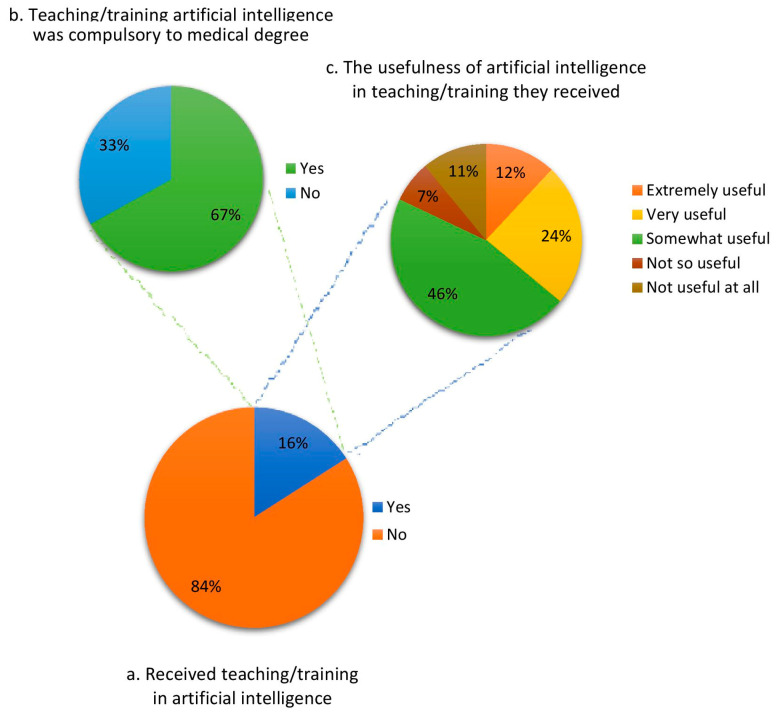
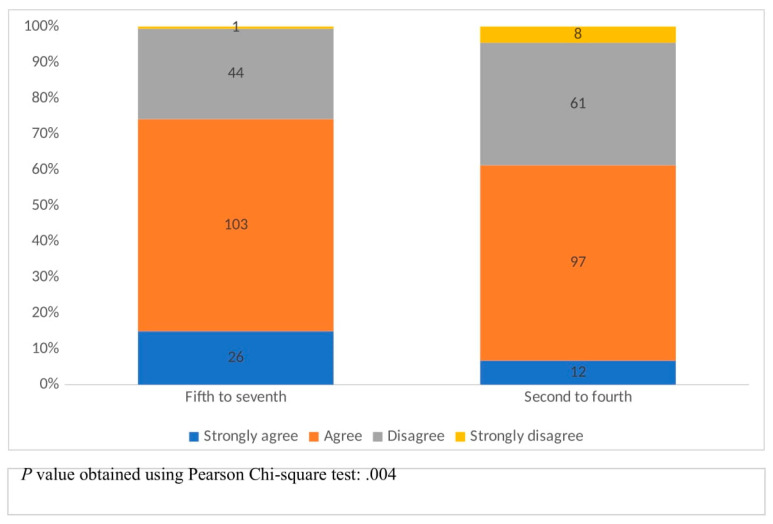
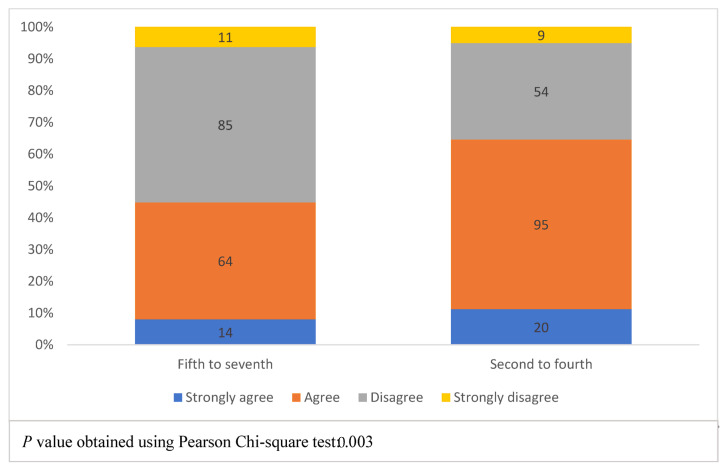
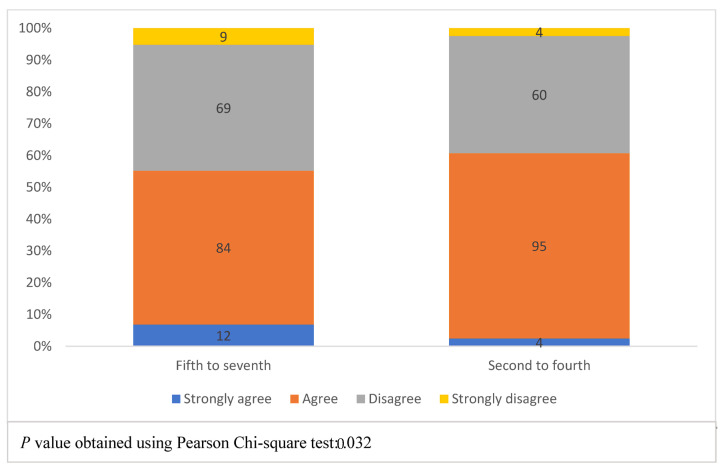
Verification
Claims the paper makes
The claims and statistics of this paper haven’t been checked yet.
Run the check — free, no account needed. It reads the open-access text and checks the sources it cites.
Self-check
Percentages, sums and reported differences re-computed from the paper’s own numbers.
The self-check needs the paper’s full text.
Citations
Cites
Rajkomar, A., Dean, J., & Kohane, I. (2019) · New England Journal of Medicine · doi:10.1056/nejmra1814259 · Cited by 4,579
Large language models encode clinical knowledge
Singhal, K., Azizi, S., Tu, T., Mahdavi, S. S., Wei, J., Chung, H. W., Scales, N., Tanwani, A., Cole-Lewis, H., Pfohl, S., et al. (2023) · Nature · doi:10.1038/s41586-023-06291-2 · Cited by 4,083
Large Language Models Encode Clinical Knowledge
Singhal, K., Azizi, S., Tu, T., Mahdavi, S. S., Wei, J., Chung, H. W., Scales, N., Tanwani, A., Cole-Lewis, H., Pfohl, S., et al. (2022) · arXiv · doi:10.48550/arxiv.2212.13138 · Cited by 4,083
The potential for artificial intelligence in healthcare
Davenport, T., & Kalakota, R. (2019) · Future Healthcare Journal · doi:10.7861/futurehosp.6-2-94 · Cited by 3,800
Sallam, M. (2023) · Healthcare · doi:10.3390/healthcare11060887 · Cited by 3,126
Sallam, M. (2023) · doi:10.1101/2023.02.19.23286155 · Cited by 3,123 · cited 4×
“Moreover, ethical issues, bias, and limited knowledge are some concerns regarding ChatGPT [18].”
BackgroundInfluentialBenefits, Limits, and Risks of GPT-4 as an AI Chatbot for Medicine
Lee, P., Bubeck, S., & Petro, J. (2023) · New England Journal of Medicine · doi:10.1056/nejmsr2214184 · Cited by 1,738
Artificial Intelligence and Deep Learning in Ophthalmology
Ting, D. S. W., Pasquale, L. R., Peng, L., Campbell, J. P., Lee, A., Raman, R., Tan, G. S. W., Schmetterer, L. F., Keane, P. A., & Wong, T. Y. (2018) · Springer eBooks · doi:10.1007/978-3-030-64573-1_200 · Cited by 1,660
Artificial intelligence and deep learning in ophthalmology
Ting, D. S. W., Pasquale, L. R., Peng, L., Campbell, J. P., Lee, A. Y., Raman, R., Tan, G. S. W., Schmetterer, L., Keane, P. A., & Wong, T. Y. (2019) · British Journal of Ophthalmology · doi:10.1136/bjophthalmol-2018-313173 · Cited by 1,554
Overview of artificial intelligence in medicine
Amisha, Malik, P., Pathania, M., & Rathaur, V. K. (2019) · Journal of Family Medicine and Primary Care · doi:10.4103/jfmpc.jfmpc_440_19 · Cited by 1,106 · cited 2×
“In the literature, many studies have been reported on the use of AI applications in diverse medical specialties, most dominantly in the diagnostic radiology [4,6], pathology [7], cardiovascular medicine [8], ophthalmology [9], dentistry [3], and dermatology [10].”
BackgroundArtificial Intelligence and Business Value: a Literature Review
Enholm, I. M., Papagiannidis, E., Mikalef, P., & Krogstie, J. (2022) · Information Systems Frontiers · doi:10.1007/s10796-021-10186-w · Cited by 1,046 · cited 1×
“AI interprets external data, learns from it, and uses this learning to achieve specific goals and tasks [1].”
BackgroundMedical students' attitude towards artificial intelligence: a multicentre survey
Pinto dos Santos, D., Giese, D., Brodehl, S., Chon, S. H., Staab, W., Kleinert, R., Maintz, D., & Baeßler, B. (2019) · European Radiology · doi:10.1007/s00330-018-5601-1 · Cited by 754
Introducing artificial intelligence training in medical education
Paranjape, K., Schinkel, M., Nannan Panday, R., Car, J., & Nanayakkara, P. (2019) · JMIR Medical Education · doi:10.2196/16048 · Cited by 634
Medical Education Must Move From the Information Age to the Age of Artificial Intelligence
Wartman, S. A., & Combs, C. D. (2018) · Academic Medicine · doi:10.1097/acm.0000000000002044 · Cited by 585
Sit, C., Srinivasan, R., Amlani, A., Muthuswamy, K., Azam, A., Monzon, L., & Poon, D. S. (2020) · Insights into Imaging · doi:10.1186/s13244-019-0830-7 · Cited by 507
Artificial intelligence in medical education
Masters, K. (2019) · Medical Teacher · doi:10.1080/0142159x.2019.1595557 · Cited by 469
Physician Confidence in Artificial Intelligence: An Online Mobile Survey
Oh, S., Kim, J. H., Choi, S.-W., Lee, H. J., Hong, J., & Kwon, S. H. (2019) · Journal of Medical Internet Research · doi:10.2196/12422 · Cited by 387
Karaca, O., Çalışkan, S. A., & Demir, K. (2021) · BMC Medical Education · doi:10.1186/s12909-021-02546-6 · Cited by 377
Artificial intelligence in medical education: a cross-sectional needs assessment
Civaner, M. M., Uncu, Y., Bulut, F., Chalil, E. G., & Tatli, A. (2022) · BMC Medical Education · doi:10.1186/s12909-022-03852-3 · Cited by 363
Gong, B., Nugent, J. P., Guest, W., Parker, W., Chang, P. J., Khosa, F., & Nicolaou, S. (2019) · Academic Radiology · doi:10.1016/j.acra.2018.10.007 · Cited by 325
Artificial Intelligence in Undergraduate Medical Education: A Scoping Review
Lee, J., Wu, A. S., Li, D., & Kulasegaram, K. (. (2021) · Academic Medicine · doi:10.1097/acm.0000000000004291 · Cited by 324
An Introduction to Machine Learning
Rebala, G., Ravi, A., & Churiwala, S. (2019) · Springer eBooks · doi:10.1007/978-3-030-15729-6 · Cited by 289
Artificial intelligence in healthcare: opportunities and risk for future
Sunarti, S., Fadzlul Rahman, F., Naufal, M., Risky, M., Febriyanto, K., & Masnina, R. (2021) · Gaceta Sanitaria · doi:10.1016/j.gaceta.2020.12.019 · Cited by 274
Almaiah, M. A., Alfaisal, R., Salloum, S. A., Hajjej, F., Thabit, S., El-Qirem, F. A., Lutfi, A., Alrawad, M., Mulhem, A. A. A., Alkhdour, T., et al. (2022) · Electronics · doi:10.3390/electronics11223662 · Cited by 255
The rise of artificial intelligence and the uncertain future for physicians
Krittanawong, C. (2017) · European Journal of Internal Medicine · doi:10.1016/j.ejim.2017.06.017 · Cited by 210
What should medical students know about artificial intelligence in medicine?
Park, S. H., Do, K.-H., Kim, S., Park, J. H., & Lim, Y.-S. (2019) · Journal of Educational Evaluation for Health Professions · doi:10.3352/jeehp.2019.16.18 · Cited by 196
Martín Noguerol, T., Paulano-Godino, F., Martín-Valdivia, M. T., Menias, C. O., & Luna, A. (2019) · Journal of the American College of Radiology · doi:10.1016/j.jacr.2019.05.047 · Cited by 175
Medical Student Perspectives on the Impact of Artificial Intelligence on the Practice of Medicine
Park, C. J., Yi, P. H., & Siegel, E. L. (2021) · Current Problems in Diagnostic Radiology · doi:10.1067/j.cpradiol.2020.06.011 · Cited by 167
van Hoek, J., Huber, A. T., Leichtle, A. B., Härmä, K., Hilt, D., von Tengg‐Kobligk, H., Heverhagen, J. T., & Poellinger, A. (2019) · European Journal of Radiology · doi:10.1016/j.ejrad.2019.108742 · Cited by 124
Bichel‐Findlay, J., Koch, S., Mantas, J., Syed-Abdul, S., Al-Shorbaji, N., Ammenwerth, E., Baum, A., Borycki, E. M., Demiris, G., Hasman, A., et al. (2022) · International Journal of Medical Informatics · doi:10.1016/j.ijmedinf.2022.104908 · Cited by 122
Self-citationWang, C., Yang, F.-C., Nguyễn, V. T., & Thi Minh Nhut, V. O. (2022) · Micromachines · doi:10.3390/mi13081208 · Cited by 115
Shuaib, A., Arian, H., & Shuaib, A. S. (2020) · International Journal of General Medicine · doi:10.2147/ijgm.s268093 · Cited by 104
Attitudes towards artificial intelligence within dermatology: an international online survey
Polesie, S., Gillstedt, M., Kittler, H., Lallas, A., Tschandl, P., Zalaudek, I., & Paoli, J. (2020) · British Journal of Dermatology · doi:10.1111/bjd.18875 · Cited by 93
A primer in artificial intelligence in cardiovascular medicine
Benjamins, J. W., Hendriks, T., Knuuti, J. M., Juárez‐Orozco, L. E., & van der Harst, P. (2019) · Netherlands Heart Journal · doi:10.1007/s12471-019-1286-6 · Cited by 75
Medical Students’ Knowledge and Attitude Towards Artificial Intelligence: An Online Survey
Al Saad, M. M., Shehadeh, A., Alanazi, S., Alenezi, M., Abu alez, A., Eid, H., Alfaouri, M. S., Aldawsari, S., & Alenezi, R. (2022) · The Open Public Health Journal · doi:10.2174/18749445-v15-e2203290 · Cited by 60
Artificial intelligence in pathology: an overview
Moxley-Wyles, B., Colling, R. T., & Verrill, C. L. (2020) · Diagnostic histopathology · doi:10.1016/j.mpdhp.2020.08.004 · Cited by 45
Balancing risks and benefits of artificial intelligence in the health sector
Goodman, K. W., Zandi, D., Reis, A. A., & Vayena, E. (2020) · Bulletin of the World Health Organization · doi:10.2471/blt.20.253823 · Cited by 42
How Artificial Intelligence Will Change Medicine
Wallis, C. (2019) · Nature · doi:10.1038/d41586-019-03845-1 · Cited by 41
Optimal Design for Compliant Mechanism Flexure Hinges: Bridge-Type
Wang, C., Yang, F.-C., Nguyễn, V. T., Nguyen, Q. M., Huynh, N. T., & Huynh, T. T. (2021) · Micromachines · doi:10.3390/mi12111304 · Cited by 39
Artificial Intelligence and Deep Learning: The Future of Medicine and Medical Practice.
Girija, S. M., Paul, K., Kumar, S., & Ganguly, N. K. (2019) · PubMed · Cited by 36
A systematic review of artificial intelligence in education in the arab world
Alzahrani, A. (2022) · Revista Amazonia Investiga · doi:10.34069/ai/2022.54.06.28 · Cited by 33
(2021) · Journal of applied linguistics and language research · Cited by 29
Research works printed but not linked: 2
- Elsevier (2022, June 25). Description—Artificial Intelligence in Medicine. Available online: https://www.elsevier.com/journals/artificial-intelligence-in-medicine/0933-3657/subscribe.
- Edward, H., Shortliffe, J.J.C., and Chiang, M.F. (2021). Biomedical Informatics: Computer Applications in Health Care and Biomedicine, Springer Nature. [5th ed.].
Cited by
Sorted by citations
A scoping review of artificial intelligence in medical education: BEME Guide No. 84
Gordon, M., Daniel, M., Ajiboye, A., Uraiby, H., Xu, N. Y., Bartlett, R., Hanson, J., Haas, M., Spadafore, M., Grafton-Clarke, C., et al. (2024) · Medical Teacher · doi:10.1080/0142159x.2024.2314198 · Cited by 679
Bekbolatova, M., Mayer, J., Ong, C. W., & Toma, M. (2024) · Healthcare · doi:10.3390/healthcare12020125 · Cited by 450
Students' perceptions of using ChatGPT in a physics class as a virtual tutor
Ding, L., Li, T., Jiang, S., & Gapud, A. (2023) · International Journal of Educational Technology in Higher Education · doi:10.1186/s41239-023-00434-1 · Cited by 208
A Primer on Generative Artificial Intelligence
Kalota, F. (2024) · Education Sciences · doi:10.3390/educsci14020172 · Cited by 225
Amiri, H., Peiravi, S., rezazadeh shojaee, S. S., Rouhparvarzamin, M., Nateghi, M. N., Etemadi, M. H., ShojaeiBaghini, M., Musaie, F., Anvari, M. H., & Asadi Anar, M. (2024) · BMC Medical Education · doi:10.1186/s12909-024-05406-1 · Cited by 149
“…including the U.S.A [18], Germany [19, 20], Lebanon [21], Pakistan [22], Canada [23], The U.K. [24], United Arab Emirates [25], Nigeria [26], Turkey [27, 28], Spain [29] Saudi Arabia [30], India [31–33], Egypt [34], Peru [35], Nepal [36], Kuwait [37], Syria [38], and multiple countries [39].”
Background
Metadata
- Authors
- Buabbas, A. J., Miskin, B., Alnaqi, A. A., Ayed, A. K., Shehab, A. A., Syed-Abdul, S., & Uddin, M.
- Affiliations
- Kuwait University (KW)
- Ministry of Health (KW)
- Mubarak Al Kabeer Hospital (KW)
- Taipei Medical University (TW)
- King Saud bin Abdulaziz University for Health Sciences (SA)
- Corresponding author
- Buabbas, Ali Jasem
- Venue
- Healthcare
- Publisher
- MDPI AG
- Published
- 2023-05-01
- Volume
- 11
- Issue
- 9
- Pages
- 1298
- ISSN
- 2227-9032 (ISSN-L)
- PMC
- PMC10178742
- OpenAlex
- W4367625612
- Cited by
- 152
- References
- 40
- Citations by year
- 2026: 36 · 2025: 62 · 2024: 49 · 2023: 5
- FWCI
- 6.05
- Type
- journal article
- Language
- en
- Open access
- gold
- doi.org
- Licence
- Locations
- Healthcare (publishedVersion, cc-by)
- Research Square (acceptedVersion, cc-by)
- PubMed Central (publishedVersion, cc-by)
- PubMed (publishedVersion)
- Topics
- Health Sciences › Medicine › Health Informatics › Artificial Intelligence in Healthcare and Education
- Social Sciences › Education › Innovations in Medical Education
- Social Sciences › Education › Artificial Intelligence in Education
- Keywords
- artificial intelligence, medical education, medical students, student perceptions, AI literacy, artificial intelligence in healthcare, future of medicine
About these checks
Registry, retraction, Cites and statistics results are computed, not judged, with one exception: a printed reference that no index lists is read once by a model before it counts as a citation error. Claims are extracted by a model and kept only when their quote appears verbatim in the text; each cited source is then checked, with a model’s help, for whether it says what the claim relies on. Those verdicts can be wrong — read the claim’s quote and the cited source before relying on one.
Statistics and arithmetic are recomputed, not judged.
Confidence bands are shown only for fields calibrated on our annotated test set. None is calibrated yet, so no band is shown.
What counts as a claim ›How we measure confidence ›How we check this ›
Are you an author, or do you see a problem with this page? Request a review
