

The DOI matches its Crossref record; 39 of the 39 references it cites were found in a registry or an index.
Developing an AI-Assisted Educational Chatbot for Radiotherapy Using the IBM Watson Assistant Platform
Open accessAbstract
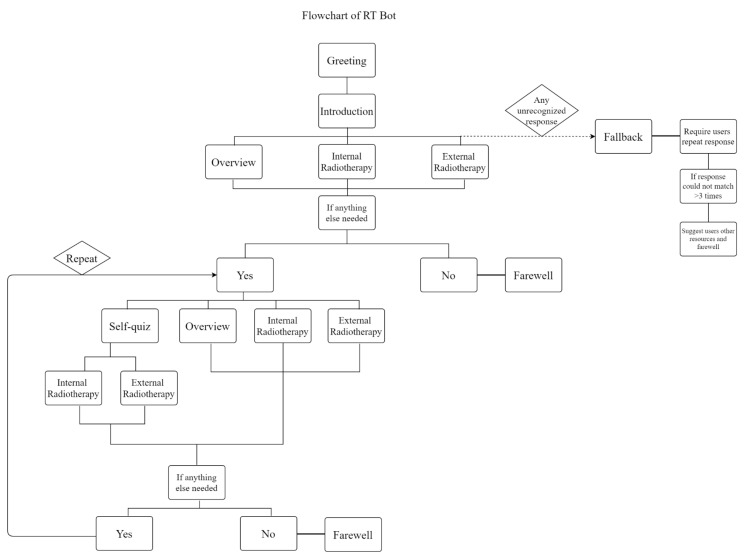
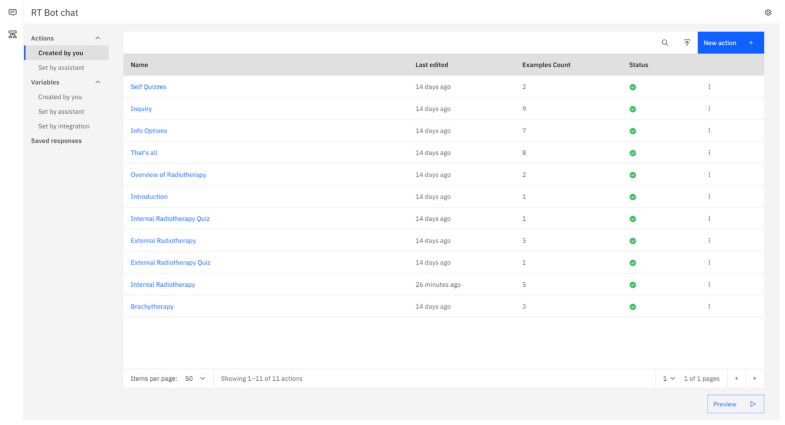
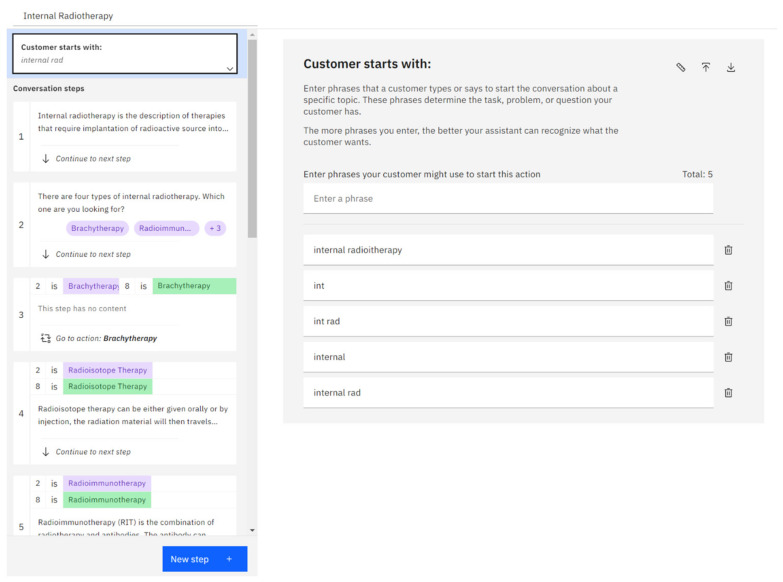
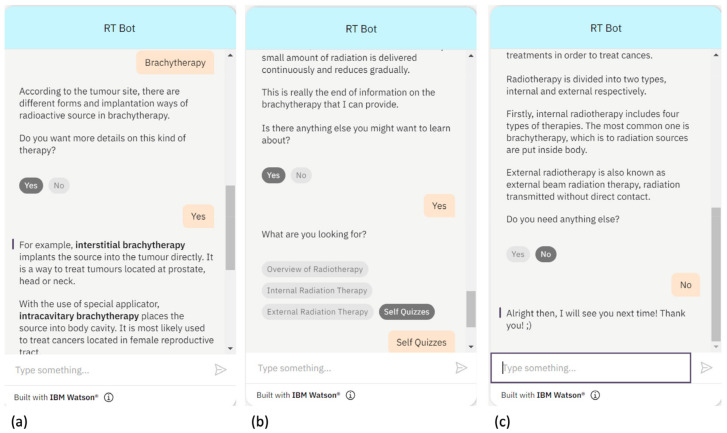
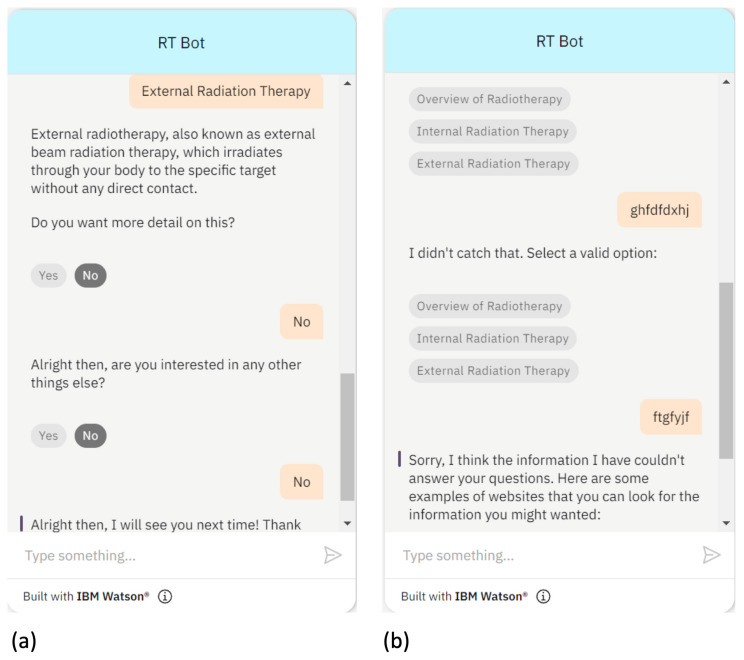
Objectives: This study aims to make radiotherapy knowledge regarding healthcare accessible to the general public by developing an AI-powered chatbot. The interactive nature of the chatbot is expected to facilitate better understanding of information on radiotherapy through communication with users. Methods: Using the IBM Watson Assistant platform on IBM Cloud, the chatbot was constructed following a pre-designed flowchart that outlines the conversation flow. This approach ensured the development of the chatbot with a clear mindset and allowed for effective tracking of the conversation. The chatbot is equipped to furnish users with information and quizzes on radiotherapy to assess their understanding of the subject. Results: By adopting a question-and-answer approach, the chatbot can engage in human-like communication with users seeking information about radiotherapy. As some users may feel anxious and struggle to articulate their queries, the chatbot is designed to be user-friendly and reassuring, providing a list of questions for the user to choose from. Feedback on the chatbot’s content was mostly positive, despite a few limitations. The chatbot performed well and successfully conveyed knowledge as intended. Conclusions: There is a need to enhance the chatbot’s conversation approach to improve user interaction. Including translation capabilities to cater to individuals with different first languages would also be advantageous. Lastly, the newly launched ChatGPT could potentially be developed into a medical chatbot to facilitate knowledge transfer.
Overview
The claims and statistics of this paper haven’t been checked yet.
Run the check — free, no account needed. It reads the open-access text and checks the sources it cites.
Integrity signals
Registry
Cites
Statistics
Figures
Verification
Claims the paper makes
The claims and statistics of this paper haven’t been checked yet.
Run the check — free, no account needed. It reads the open-access text and checks the sources it cites.
Claims other papers make about this one
Each is checked against this paper’s own text: does it say what the citing paper says it does?
The check wasn’t confident either way, so it gives no verdict — never disputed.
In the citing paper
“Additionally, with the rapid advancements in nursing research and the advent of new diseases and medications, nursing professionals are challenged to quickly adapt to evolving medical knowledge, make accurate decisions in real-case scenarios, and master complex nursing skills (1, 17, 26–28).”
From Digital affordances of AI chatbots in nursing education: a systematic review of learning gains and gaps in the evidence (2026) · cites this paper as [27]
Experimental — accuracy not yet measured
Self-check
Percentages, sums and reported differences re-computed from the paper’s own numbers.
The self-check needs the paper’s full text.
Citations
Cites
ChatGPT for Good? On Opportunities and Challenges of Large Language Models for Education
Kasneci, E., Seßler, K., Küchemann, S., Bannert, M., Dementieva, D., Fischer, F., Gasser, U., Groh, G., Günnemann, S., Hüllermeier, E., et al. (2023) · doi:10.35542/osf.io/5er8f · Cited by 7,552
ChatGPT for good? On opportunities and challenges of large language models for education
Kasneci, E., Sessler, K., Küchemann, S., Bannert, M., Dementieva, D., Fischer, F., Gasser, U., Groh, G., Günnemann, S., Hüllermeier, E., et al. (2023) · Learning and Individual Differences · doi:10.1016/j.lindif.2023.102274 · Cited by 7,326 · cited 1×
“OpenAI recently launched a generative language model tool called ChatGPT, which uses a new type of AI algorithm known as LLM [40].”
MethodLiu, P., Yuan, W., Fu, J., Jiang, Z., Hayashi, H., & Neubig, G. (2023) · ACM Computing Surveys · doi:10.1145/3560815 · Cited by 4,361 · cited 1×
“In addition, the chatbot built on the IBM Watson Assistant platform is AI-assisted and utilizes machine learning capabilities such as NLP [29–31].”
MethodLiu, P., Yuan, W., Fu, J., Jiang, Z., Hayashi, H., & Neubig, G. (2021) · arXiv · doi:10.48550/arxiv.2107.13586 · Cited by 4,352 · cited 1×
“In addition, the chatbot built on the IBM Watson Assistant platform is AI-assisted and utilizes machine learning capabilities such as NLP [29–31].”
MethodCancer and Radiation Therapy: Current Advances and Future Directions
Baskar, R., Lee, K. A., Yeo, R., & Yeoh, K. (2012) · International Journal of Medical Sciences · doi:10.7150/ijms.3635 · Cited by 3,123
Natural language processing: an introduction
Nadkarni, P. M., Lucila Ohno-machado, A., & Chapman, W. W. (2011) · Journal of the American Medical Informatics Association · doi:10.1136/amiajnl-2011-000464 · Cited by 2,127
Advances in natural language processing
Hirschberg, J., & Manning, C. D. (2015) · Science · doi:10.1126/science.aaa8685 · Cited by 1,712
Rapp, A., Curti, L., & Boldi, A. (2021) · International Journal of Human-Computer Studies · doi:10.1016/j.ijhcs.2021.102630 · Cited by 733
Estimating the demand for radiotherapy from the evidence: A review of changes from 2003 to 2012
Barton, M. B., Jacob, S., Shafiq, J., Wong, K. K. Y., Thompson, S. R., Hanna, T. P., & Delaney, G. P. (2014) · Radiotherapy and Oncology · doi:10.1016/j.radonc.2014.03.024 · Cited by 542
Should Machines Express Sympathy and Empathy? Experiments with a Health Advice Chatbot
Liu, B., & Sundar, S. S. (2018) · Cyberpsychology, Behavior, and Social Networking · doi:10.1089/cyber.2018.0110 · Cited by 447
Advances in Radiotherapy and Implications for the Next Century: A Historical Perspective
Connell, P. P., & Hellmän, S. (2009) · Cancer Research · doi:10.1158/0008-5472.can-07-6871 · Cited by 313
The Future of AI in Medicine: A Perspective from a Chatbot
King, M. R. (2023) · Annals of Biomedical Engineering · doi:10.1007/s10439-022-03121-w · Cited by 299
Morris, R. R., Kouddous, K., Kshirsagar, R., & Schueller, S. M. (2018) · Journal of Medical Internet Research · doi:10.2196/10148 · Cited by 273
Impact of ChatGPT on medical chatbots as a disruptive technology
Chow, J. C. L., Sanders, L., & Li, K. (2023) · Frontiers in Artificial Intelligence · doi:10.3389/frai.2023.1166014 · Cited by 206
Current status of brachytherapy in cancer treatment – short overview
Skowronek, J. (2017) · Journal of Contemporary Brachytherapy · doi:10.5114/jcb.2017.72607 · Cited by 202
Machine Learning in Healthcare Communication
Siddique, S., & Chow, J. C. L. (2021) · Encyclopedia · doi:10.3390/encyclopedia1010021 · Cited by 201
Jiang, Y., Yang, X., & Zheng, T. (2022) · Computers in Human Behavior · doi:10.1016/j.chb.2022.107485 · Cited by 189
Chatbot-based heathcare service with a knowledge base for cloud computing
Chung, K., & Park, R. C. (2018) · Cluster Computing · doi:10.1007/s10586-018-2334-5 · Cited by 187
Implementation of a Chat Bot System using AI and NLP
Lalwani, T., Bhalotia, S., Pal, A., Bisen, S., & Rathod, V. S. (2018) · International Journal of Innovative Research in Computer Science & Technology · doi:10.21276/ijircst.2018.6.3.2 · Cited by 184
Chatbot Using a Knowledge in Database: Human-to-Machine Conversation Modeling
Setiaji, B., & Wibowo, F. W. (2016) · International Conference on Intelligent Systems, Modelling and Simulation · doi:10.1109/isms.2016.53 · Cited by 134
Tsai, W. S., Lun, D., Carcioppolo, N., & Chuan, C. (2021) · Psychology and Marketing · doi:10.1002/mar.21556 · Cited by 130
Technical Aspects of Developing Chatbots for Medical Applications: Scoping Review
Safi, Z., Abd-Alrazaq, A. A., Khalifa, M., & Househ, M. S. (2020) · Journal of Medical Internet Research · doi:10.2196/19127 · Cited by 129
Modern Chatbot Systems: A Technical Review
Lokman, A. S., & Ameedeen, M. A. (2018) · Advances in intelligent systems and computing · doi:10.1007/978-3-030-02683-7_75 · Cited by 122
Tanderup, K., Ménard, C. M., Polgár, C., Lindegaard, J. C., Kirisits, C., & Pötter, R. (2016) · Advanced Drug Delivery Reviews · doi:10.1016/j.addr.2016.09.002 · Cited by 109
Healthcare ex Machina: Are conversational agents ready for prime time in oncology?
Bibault, J.-E., Chaix, B., Nectoux, P., Pienkowski, A., Guillemasé, A., & Brouard, B. (2019) · Clinical and Translational Radiation Oncology · doi:10.1016/j.ctro.2019.04.002 · Cited by 84 · cited 1×
“Bibault et al. [20] delved into the use of chatbots in cancer treatment, uncovering their capacity to facilitate bidirectional information exchange with patients.”
BackgroundNanaware, R. (2018) · Cited by 75
The Emergence of Artificial Intelligence within Radiation Oncology Treatment Planning
Netherton, T., Cardenas, C. E., Rhee, D. J., Court, L. E., & Beadle, B. M. (2020) · Oncology · doi:10.1159/000512172 · Cited by 59
Design of an Educational Chatbot Using Artificial Intelligence in Radiotherapy
Chow, J. C. L., Sanders, L., & Li, K. (2023) · AI · doi:10.3390/ai4010015 · Cited by 56
Advances in Automated Treatment Planning
Nguyen, D. T. D., Lin, M., Sher, D. J., Lu, W., Jia, X., & Jiang, S. B. (2022) · Seminars in Radiation Oncology · doi:10.1016/j.semradonc.2022.06.004 · Cited by 53
An Intelligent Behaviour Shown by Chatbot System
Sharma, V., Goyal, M., & Malik, D. (2017) · International Journal of New Technology and Research · Cited by 50
Development Of Clinical Radiotherapy Since 1896
Holsti, L. R. (1995) · Acta Oncologica · doi:10.3109/02841869509127225 · Cited by 45
CHATBOTS FOR EDUCATION - TRENDS, BENEFITS AND CHALLENGES
Georgescu, A. A. (2018) · eLearning and Software for Education · doi:10.12753/2066-026x-18-097 · Cited by 42
Brachytherapy: A Comprehensive Review
Lim, Y. K., & Kim, D. (2021) · Progress in Medical Physics · doi:10.14316/pmp.2021.32.2.25 · Cited by 39
Rebelo, N., Sanders, L., Li, K., & Chow, J. C. L. (2022) · JMIR Formative Research · doi:10.2196/39443 · Cited by 39
The Rise of AI Chatbots in Hearing Health Care
Swanepoel, D. W., Manchaiah, V. K. C., & Wasmann, J.-W. A. (2023) · The Hearing Journal · doi:10.1097/01.hj.0000927336.03567.3e · Cited by 26
An AI-assisted chatbot for radiation safety education in radiotherapy
Kovacek, D., & Chow, J. C. L. (2021) · IOP SciNotes · doi:10.1088/2633-1357/ac1f88 · Cited by 24
Röntgen and the discovery of X-rays
Mould, R. F. (1995) · British Journal of Radiology · doi:10.1259/0007-1285-68-815-1145 · Cited by 19
Establishing the Hallmarks of a Convincing Chatbot-Human Dialogue
Kirakowski, J., O'Donnell, P. J., & Yiu, A. (2009) · Human-Computer Interaction · doi:10.5772/7741 · Cited by 17
Developing Cognitive Bots Using the IBM Watson Engine
Sabharwal, N., Barua, S., Anand, N., & Aggarwal, P. (2019) · Apress eBooks · doi:10.1007/978-1-4842-5555-1 · Cited by 13
Research works printed but not linked: 3
- Chow, J.C. (2021). Artificial Intelligence in Medicine, Springer International Publishing.
- Augello, A., Gentile, M., Weideveld, L., and Dignum, F. (2016). Intelligent Interactive Multimedia Systems and Services 2016, Springer.
- Clarizia, F., Colace, F., Lombardi, M., Pascale, F., and Santaniello, D. (2018). International Symposium on Cyberspace Safety and Security 2018, Springer.
Cited by
Sorted by citations
Industrial applications of large language models
Raza, M., Jahangir, Z., Riaz, M. B., Saeed, M. J., & Sattar, M. A. (2025) · Scientific Reports · doi:10.1038/s41598-025-98483-1 · Cited by 234
Quantum Computing and Machine Learning in Medical Decision-Making: A Comprehensive Review
Chow, J. C. L. (2025) · Algorithms · doi:10.3390/a18030156 · Cited by 122
Chow, J. C. L., Wong, V., & Li, K. (2024) · BioMedInformatics · doi:10.3390/biomedinformatics4010047 · Cited by 101
Chow, J. C. L., & Li, K. (2025) · Information · doi:10.3390/info16070549 · Cited by 84
Self-citationThe Potential Applications and Challenges of ChatGPT in the Medical Field
Mu, Y., & He, D. (2024) · International Journal of General Medicine · doi:10.2147/ijgm.s456659 · Cited by 84
Metadata
- Authors
- Chow, J. C. L., Wong, V., Sanders, L., & Li, K.
- Affiliations
- University Health Network (CA)
- Toronto Metropolitan University (CA)
- York University (CA)
- University of Toronto (CA)
- Corresponding author
- Chow, James C. L.
- Venue
- Healthcare
- Publisher
- MDPI AG
- Published
- 2023-08-29
- Volume
- 11
- Issue
- 17
- Pages
- 2417
- ISSN
- 2227-9032 (ISSN-L)
- PMC
- PMC10487627
- OpenAlex
- W4386256552
- Cited by
- 60
- References
- 37
- Citations by year
- 2026: 9 · 2025: 20 · 2024: 29 · 2023: 2
- FWCI
- 2.39
- Type
- journal article
- Language
- en
- Open access
- gold
- doi.org
- Licence
- Locations
- Healthcare (publishedVersion, cc-by)
- PubMed Central (publishedVersion, cc-by)
- PubMed (publishedVersion)
- TSpace (University of Toronto) (submittedVersion, cc-by)
- Funders
- Canadian Institutes of Health Research Planning and Dissemination Grant—Institute Community Support (CIHR PCS–168296)
- Topics
- Health Sciences › Medicine › Health Informatics › Artificial Intelligence in Healthcare and Education
- Social Sciences › Business, Management and Accounting › Marketing › AI in Service Interactions
- Physical Sciences › Computer Science › Artificial Intelligence › Speech and dialogue systems
- Keywords
- radiotherapy, educational chatbots, conversational AI, public health education, patient information, user interaction, ChatGPT, multilingual translation
About these checks
Registry, retraction, Cites and statistics results are computed, not judged, with one exception: a printed reference that no index lists is read once by a model before it counts as a citation error. Claims are extracted by a model and kept only when their quote appears verbatim in the text; each cited source is then checked, with a model’s help, for whether it says what the claim relies on. Those verdicts can be wrong — read the claim’s quote and the cited source before relying on one.
Statistics and arithmetic are recomputed, not judged.
Confidence bands are shown only for fields calibrated on our annotated test set. None is calibrated yet, so no band is shown.
What counts as a claim ›How we measure confidence ›How we check this ›
Are you an author, or do you see a problem with this page? Request a review
