

Exploring Factors Influencing Caregiver Burden: A Systematic Review of Family Caregivers of Older Adults with Chronic Illness in Local Communities
Open accessThe DOI matches its Crossref record; 38 of the 38 references it cites were found in a registry or an index.
Abstract
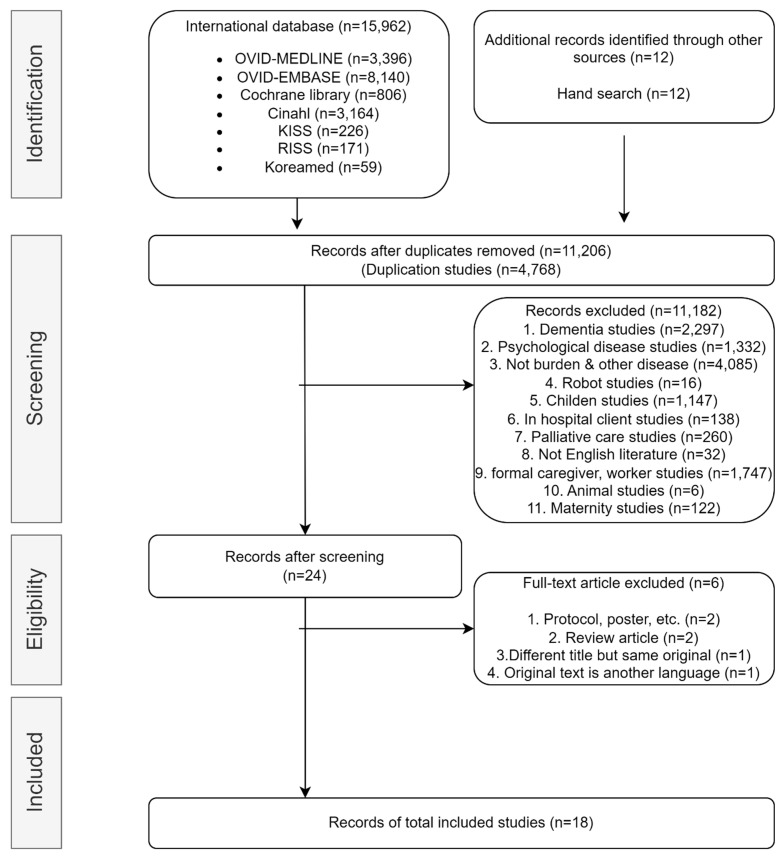
This study aimed to systematically review and analyze factors contributing to caregiver burden among family caregivers of older adults with chronic illnesses in local communities. Specific objectives included exploring the characteristics of older adults with chronic illness and caregiver burden through an extensive literature review and identifying factors influencing caregiver burden in this population. Using Korean (RISS, KISS, and KoreaMed) and international (EMBASE, MEDLINE, CINAHL, and the Cochrane Library) databases, this study employed systematic search methods to identify relevant literature. The inclusion and exclusion criteria were systematically applied in accordance with the PRISMA guidelines, focusing on studies that addressed caregiver burden among family caregivers of older adults with chronic illnesses in local communities. Following the database search, 15,962 articles were identified. After eliminating duplicates and applying the selection criteria, 18 studies were included in this review. These studies, representing various countries, contribute to a diverse dataset covering caregiver and care-recipient characteristics, including age, sex, chronic conditions, and various caregiver burden assessment tools. This systematic review provides a comprehensive understanding of the factors that influence caregiver burden among family caregivers of older adults with chronic illness in local communities. These findings emphasize the need for integrated nursing interventions and community efforts to address the welfare concerns of this population and support their caregivers.
Overview
The claims and statistics of this paper haven’t been checked yet.
Free: it reads the open-access text and checks the first 5 claims that cite a source we can check. Create a free account to check every claim.
Integrity signals
Registry
Cites
Statistics
Figures
Verification
Claims the paper makes
The claims and statistics of this paper haven’t been checked yet.
Free: it reads the open-access text and checks the first 5 claims that cite a source we can check. Create a free account to check every claim.
Claims other papers make about this one
Each is checked against this paper’s own text: does it say what the citing paper says it does?
The source backs part of the claim, not all of it — or backs it for a different population, condition or comparison.
In the citing paper
“Caregiver characteristics such as gender, age, educational level, monthly income, employment status, daily caregiving hours, caregiving duration, relationship with the care recipient, and cohabitation status have been linked to burden levels18–23.”
From Examining burden among caregivers of community-dwelling older adults in Lebanon (2025) · cites this paper as [22]
Experimental — accuracy not yet measuredThe cited source says what the claim attributes to it.
In the citing paper
“Regarding care recipient factors, previous studies indicated that age, gender, educational level, the presence of neuropsychiatric symptoms, and the degree of impairment in physical and daily functioning were the factors that predicted burden18,21,22.”
From Examining burden among caregivers of community-dwelling older adults in Lebanon (2025) · cites this paper as [22]
The cited source says what the claim attributes to it.
In the citing paper
“The negative association found between subjective caregiver burden and social support is consistent with findings from a meta-analysis and a systematic review on informal caregivers of older adults22,25, both of which identified social support as a significant predictor of reduced subjective burden.”
From Examining burden among caregivers of community-dwelling older adults in Lebanon (2025) · cites this paper as [22]
Self-check
Percentages, sums and reported differences re-computed from the paper’s own numbers.
The self-check needs the paper’s full text.
Citations
Cites
Relatives of the Impaired Elderly: Correlates of Feelings of Burden
Zarit, S. H., Reever, K. E., & Bach-Peterson, J. (1980) · The Gerontologist · doi:10.1093/geront/20.6.649 · Cited by 5,810
Social Ties and Susceptibility to the Common Cold
Cohen, S. (1997) · JAMA: The Journal of the American Medical Association · doi:10.1001/jama.1997.03540480040036 · Cited by 1,238
Social Ties and Susceptibility to the Common Cold
Heeler, R. M. (1997) · JAMA: The Journal of the American Medical Association · doi:10.1001/jama.1997.03550150035019 · Cited by 1,236
Rechel, B., Grundy, E., Robine, J.-M., Cylus, J., Mackenbach, J. P., Knai, C., & McKee, M. (2013) · The Lancet · doi:10.1016/s0140-6736(12)62087-x · Cited by 592 · cited 1×
“Older people experience certain health problems, such as cancer, hip fracture, stroke, and dementia, at higher rates than younger people and are more likely to have comorbid conditions that lead to higher care and support needs [3].”
BackgroundOrnstein, K., & Gaugler, J. E. (2012) · International Psychogeriatrics · doi:10.1017/s1041610212000737 · Cited by 294
Ong, H. L., Vaingankar, J. A., Abdin, E., Sambasivam, R., Fauziana, R., Tan, M.-E., Chong, S. A., Goveas, R. R., Chiam, P. C., & Subramaniam, M. (2018) · BMC Psychiatry · doi:10.1186/s12888-018-1616-z · Cited by 277 · cited 1×
“Ong, 2018 [31] Caregivers with a higher level of social support experience a lower level of burden.”
BackgroundCoping With Specific Stressors in Alzheimer's Disease Caregiving
Williamson, G. M., & Schulz, R. (1993) · The Gerontologist · doi:10.1093/geront/33.6.747 · Cited by 206 · cited 1×
“Mental impairment in older people has also been found to be a strong factor in caregiver burden [34,37,38,41], and cognitive impairment in older people has been reported to be more burdensome than physical impairment [42,43].”
BackgroundZhong, Y., Wang, J., & Nicholas, S. (2020) · BMC Geriatrics · doi:10.1186/s12877-019-1403-9 · Cited by 145 · cited 3×
“To identify the various negative effects of caregiving, this study examines the concepts of depression, stress, caregiver burden, and exhaustion [6,7,9,10].”
BackgroundHooley, P. J. D., Butler, G., & Howlett, J. G. (2005) · Congestive Heart Failure · doi:10.1111/j.1527-5299.2005.03620.x · Cited by 134
Burden and Gender inequalities around Informal Care
Carbó, G. F. C., & García-Orellán, R. (2020) · Investigación y Educación en Enfermería · doi:10.17533/udea.iee.v38n1e10 · Cited by 121
Research works printed but not linked: 14
- Jone M. Effects of the Characteristics of the Elderly and Family Caregivers on the Caregiving Stresses Korea Contents Assoc. 2014 14 274 282
- Kwon J.D. The Determinant Model of Caregiver Burden In Caring for the Demented Elderly in Korea Health Soc. Welf. Rev. 1994 14 1 16
- Kim M.J. Associated Factors Caused by Falls of Older People in Community-Dwelling Unpublished Master’s Dissertation Ewha Womans University Seoul, Republic of Korea 2004
- Ma B.S. A Study on the People in Charge of the Demented: Especially People in the Day Care Center or Short Stay Service Unpublished Master’s Thesis Ewha Womans University Seoul, Republic of Korea 1998
- Rhee K.O. A study on caregiving burden among family caregivers of impaired elderly J. Korean Gerontol. Soc. 2000 20 215 228
- Kim H.M. A Study on the Burden of the People Supporting the Dementia Elderly-Since Operation of the Dementia Elderly Daycare Centers Unpublished Master’s Thesis MYONGJI University Seoul, Republic of Korea 2005
- Hong D.I. A study on the Caregiving Burden of Elderly Primary Caregivers Using Day Shelters Unpublished Master’s Thesis Pyeongtaek University Pyeongtaek, Republic of Korea 2002
- Yoon H.S. Who Care for the Elderly? Family Responsibility vs. Social Responsibility Korean J. Fam. Law 2000 14 201 226
- Woo K.H. The Subjective Experience of Caregiving and Social Support for Family Caregivers of the Elderly with Dementia Korean J. Soc. Welf. Stud. 1997 10 383 413
- Yoon H.S. Cha H.B. Cho S.H. The Impact of Social Support on the Family Caregivers’ Burden and Depression Korean Gerontol. Soc. 2000 20 1 19
- Yang O.N. A Study on Stress of the Aged and Their Supporters and Coping strategies Unpublished Master’s Thesis Ewha Womans University Seoul, Republic of Korea 1995
- Lee Y.O. Factors Affecting Caregiving Burden for Elderly Caregivers of Stroke Survivors Unpublished Master’s Thesis Daejeon University Daejeon, Republic of Korea 2002
- Lee H.J. Influencing Factors and Caregiving burden among primary caregiver for Demented Elderly Korean J. Care Work. 2006 2 33 60
- Kim Y.J. Choi H.K. A Study on the burden, gratification, and family support of in-home dementia caregiver Korean Gerontol. Soc. 1993 13 63 83
Cited by
Caregiver burden and quality of life in palliative care: cross-sectional study
Shefeek, S. K., Joy, T. M., Olickal, J. J., Nezrin, M. A., George, A., & Thankappan, K. R. (2024) · BMJ Supportive & Palliative Care · doi:10.1136/spcare-2024-005220 · Cited by 21
Haroen, H., Juniarti, N., Sari, C. W. M., Sari, S. P., Arovah, N. I., Pardosi, J. F., & Wibowo, D. A. (2025) · Journal of Multidisciplinary Healthcare · doi:10.2147/jmdh.s533067 · Cited by 20
Lee, M. M.-S., Yeoh, E., & Wong, E. L. (2025) · JMIR Aging · doi:10.2196/68061 · Cited by 15
“Although several studies have identified caregiver burden as a significant risk factor for burnout and poor mental health outcomes among family caregivers [11,13,14], stronger filial piety may lead to lower caregiver burden [15,16].”
The Burden of Informal Caregiving for Adults with Musculoskeletal Conditions: A Systematic Review
Legese, N., Das, N., Watts, J. J., Robinson, S., Chen, G., & Gao, L. (2025) · PharmacoEconomics · doi:10.1007/s40273-025-01523-x · Cited by 14
“Studies show that informal caregivers tend to have poorer physical, mental, and social health compared with non-carers [8, 10–12].”
Noorollahi, Z., Shahshahani, M. S., Farajzadegan, Z., & Keshvari, M. (2025) · BMC Family Practice · doi:10.1186/s12875-025-03097-1 · Cited by 13
“In fact, it is a bridge that fills the gap between the patient’s needs and the health service’s side [19].”
Yaqoob, E., Khan, S., Sahitia, N., Ullah, Z. B., Zaidi, D. A., Khan, S. A., Chaurasia, B. K., & Javed, S. (2025) · Annals of Medicine and Surgery · doi:10.1097/ms9.0000000000003254 · Cited by 11
Nguyen, T. T. T., Than, T. H. N., Nguyen, T. C., Vu, L. D. T., Truong, K. T., Thai, T. T., Schofield, P. E., & Nguyen, T. A. (2025) · Global Health Action · doi:10.1080/16549716.2025.2526929 · Cited by 12
“…criteria: 1) the presence of a serious chronic illness, such as metastatic cancer, which could contribute to increased stress and burden [25,26]; 2) vision or hearing impairments, which might hinder the interview process; or 3) cognitive impairment, defined as a Mini-Cog score of less than…”
Smith, M. L., Southerland, J. L., Neelamegam, M., Han, G., Lee, S., Kew, C. L., Bacsu, J.-D., Couch, E., Kim, S., Brown, M. J., et al. (2025) · Frontiers in Public Health · doi:10.3389/fpubh.2025.1615187 · Cited by 11
Self-citationSchwind, B., Visscher, R. M. S., Haslbeck, J. W., Falkenstein, T., Riewoldt, C., Griese, L., Behrisch, B., Metzing, S., & Nagl‐Cupal, M. (2025) · Frontiers in Public Health · doi:10.3389/fpubh.2025.1619672 · Cited by 10
Gherman, A., Stoicescu, E. R., Levai, C. M., Popoiu, C. M., & Hațegan, O. A. (2025) · Healthcare · doi:10.3390/healthcare13192442 · Cited by 10
“Chronic diseases place a considerable burden not only on patients but also on the family members who assume the role of caregivers [1,2].”
Hart, D. M., Leggins, B., Sanches, C., Guterman, E. L., & Chiong, W. (2025) · The Gerontologist · doi:10.1093/geront/gnaf092 · Cited by 8
Muñoz-Alicea, Á., & Suarez-Gomez, W. (2025) · Frontiers in Public Health · doi:10.3389/fpubh.2025.1610733 · Cited by 9
Hongwei, Y., Juan, W., Hui, J., Zhongjian, L., Xuechun, L., Yaqiong, A., Mingyue, Z., Ruan, L., & Xiaoqian, W. (2026) · Quality of Life Research · doi:10.1007/s11136-026-04236-6 · Cited by 10
Examining burden among caregivers of community-dwelling older adults in Lebanon
Barakat, Z., Sacre, H., Khatib, S., Hajj, A., Bou Malham, C., Haddad, C., Akel, M., M. Zeenny, R., Abou Abbas, L., Barakat, M., et al. (2025) · Scientific Reports · doi:10.1038/s41598-025-05626-5 · Cited by 7
Improving Respite Outcomes for Caregivers: Who Benefits and Under What Conditions?
Coleman, M. E., Godfrey, D. A., Thompson, A. D., Sparks, C., & Utz, R. (2025) · Journal of Applied Gerontology · doi:10.1177/07334648251324270 · Cited by 5
“…to distinct mental health challenges (Dilworth et al., 2020; Hengelaar et al., 2023; Xiong et al., 2020), while the stresses of caregiving also differ wildly by the circumstances of the caregiving role — stages of disease, prior experience with the care recipient, and more (Choi et al., 2024).”
“We are a club none of us wanted to join”: exploring brain tumor online discussion forum content
Muasher-Kerwin, C., Hughes, M. C., Foster, M. L., & Econie, S. M. (2025) · Supportive Care in Cancer · doi:10.1007/s00520-025-09545-z · Cited by 5
“These findings are consistent with studies emphasizing the economic and emotional burden on caregivers [31, 32].”
LI, J., Alavi, ., & Shaari, A. A. H. (2025) · Health & Social Care in the Community · doi:10.1155/hsc/5109659 · Cited by 5
“A recent systematic review by Choi et al. [25] examined caregiver burden in the context of family caregivers for older adults with chronic illnesses.”
InfluentialLin, T., Luo, S., Zhuang, C., Xiao, H., Ding, X., & Li, S. (2025) · Clinical ophthalmology · doi:10.2147/opth.s533237 · Cited by 5
Cichoń, J., Homa, M., Płaszewska‐Żywko, L., & Kózka, M. (2025) · Journal of Clinical Medicine · doi:10.3390/jcm14176294 · Cited by 5
“This finding is consistent with the literature on care-giving in other populations, such as caregivers of older adults with chronic illness [50] and caregivers of stroke survivors [51].”
AL-Ghammari, A., Min, G., Sinawi, H. A., Harthi, H. H. A., Yin, Y., Niu, S., Shan, E., & Li, X. (2025) · BMC Geriatrics · doi:10.1186/s12877-025-06677-z · Cited by 5
“Studies indicate that those caregivers who report a poor health status tend to experience greater levels of burden [48].”
Family Caregiver Burden in Providing Home Healthcare for Migrant Older Adults: A Scoping Review
Al‐Hamad, A., Yasin, Y. M., Yasin, L., & Kumar, S. S. (2026) · Family Sciences · doi:10.3390/famsci2010002 · Cited by 5
“Functional limitations and behavioral symptoms together with caregiver depression, anxiety, and financial strain can compound daily workload and further intensify burden(Choi et al., 2024; Li et al., 2025).”
Territories of mourning: Addressing submerged problems of grief through multidisciplinary care
Marano, G., & Mazza, M. (2025) · World Journal of Clinical Cases · doi:10.12998/wjcc.v13.i16.98271 · Cited by 4
“In this sense, the caregiver experiences their stress as devoid of any possibility of resolution, which only increases their perceived level of stress[9].”
Rawi, S. B. M., Rafi’i, M. R., Ibrahim, R. B., Ahmad, N., Sutan, R., & Devarajooh, C. (2025) · BMC Health Services Research · doi:10.1186/s12913-025-12944-x · Cited by 4
“Ageing caregivers may face declining functional capacity, leading to increased difficulty in managing caregiving tasks and greater emotional and physical strain [33, 34].”
Lafuenti, L., Belella, D., Paola, R. D., Sani, L., Massaroni, V., Malta, E., Vannuccini, S., Ricciotti, M. A., Meloni, E., Dispenza, S., et al. (2025) · OMEGA - Journal of Death and Dying · doi:10.1177/00302228251363091 · Cited by 4
Interventions for reducing caregiver burden in chronic dyspnea: a meta-analysis
Liu, F., Zhang, H., Li, S., Wang, X., Long, X., & Liu, Y. (2025) · Frontiers in Public Health · doi:10.3389/fpubh.2025.1659063 · Cited by 4
Understanding Work-Family Conflict Among Women Who Provide Informal Care: An Exploratory Research
Bayrakçı, E., UZUNBACAK, H. H., Erhan, T., Eryılmaz, İ., & Akçakanat, T. (2025) · Gender Issues · doi:10.1007/s12147-025-09394-4 · Cited by 4
“…traditional care paradigm, women bear the majority of unpaid caregiving responsibilities, accounting for approximately 80% of informal caregivers world-wide—a trend similarly observed across Europe, where women aged 45–60 have emerged as the primary providers of informal care (Choi et al., 2024).”
Ghorbani, A., Salami, M., & Rajabi, M. M. (2025) · BMC Palliative Care · doi:10.1186/s12904-025-01731-4 · Cited by 4
Agadi, S., & Uthayya, S. A. (2025) · Journal of Family Medicine and Primary Care · doi:10.4103/jfmpc.jfmpc_890_24 · Cited by 3
Salarvand, S., Varmeziyar, S., Beiranvand, A., & Aghaali, M. (2025) · BMC Geriatrics · doi:10.1186/s12877-025-06711-0 · Cited by 3
“Educational community services are being applied to ameliorate the care-giving burden among family caregivers of persons with chronic conditions [24].”
Urinary incontinence and its impact on caregiver burden in the oldest-old: a cross-sectional study
Beler, M., & Özdeş, A. A. (2026) · BMC Nursing · doi:10.1186/s12912-026-04508-z · Cited by 3
Wu, Z., Yan, Y., Cai, H., Qi, S., Xu, M., Wang, T., & Jiang, Y. (2025) · International Urology and Nephrology · doi:10.1007/s11255-025-04396-3 · Cited by 3
“Migrant populations often experience limited familial and social network support, which can reduce access to caregiving and emotional resources during illness, ultimately weakening their confidence in managing the disease [27].”
Lin, Y., Chen, H., & Su, B.-Y. (2025) · Brain Injury · doi:10.1080/02699052.2025.2513613 · Cited by 3
“…(12), those experiencing economic hardship, defined in this study as being unemployed or having insufficient household income to meet basic needs (17), and those providing care for more than eight hours per day (15), are more likely to experience psychological distress and poorer mental health,…”
Double care burden, women's participation, and household welfare in Indonesia
Asrofi, D. A. N., Pratomo, D. S., Pangestuty, F. W., Tasmilah, & Ayyubi, M. S. A. (2026) · Development Studies Research · doi:10.1080/21665095.2026.2688100 · Cited by 3
Top Ten Tips Palliative Care Clinicians Should Know About Rheumatology
Herndon, S., Kimball, J., Ross, L., Homann, S., Faison, M. N., Lee, Y.-L. A., Marks, A. D., Weinmann, S. C., Maheswaranathan, M., Leverenz, D. L., et al. (2025) · Journal of Palliative Medicine · doi:10.1089/jpm.2024.0520 · Cited by 3
Psikoedukasi Merupakan Strategi Efektif dalam Mendukung Caregiver Pasien Kronis
Simbolon, C. N. N. B., Nuraini, T., Allenidekania, A., & Gayatri, D. (2025) · Jurnal Penelitian Kesehatan "SUARA FORIKES" (Journal of Health Research "Forikes Voice") · doi:10.33846/sf16248 · Cited by 3
Iskandar, S., Rekawati, E., & Kuntarti, K. (2025) · Indonesian Journal of Global Health Research · doi:10.37287/ijghr.v7i2.5375 · Cited by 2
“These negative effects have been described in terms of burden, strain, and stress (Choi JY, et al. 2024).”
Lopez, J., Snyder, S., Orozco, T., Foulke, H., Orejuela, M., Farriss, A., Rivera-Rivera, N., Eliazar-Macke, N. D., Motta‐Valencia, K., & Freytes, I. M. (2025) · Healthcare · doi:10.3390/healthcare13243202 · Cited by 3
“There is ample evidence about the negative impact of caregiver burden [7,11,12].”
Guo, X., Jiang, Y., & Zhang, M. (2025) · Frontiers in Medicine · doi:10.3389/fmed.2025.1706346 · Cited by 2
Digital Support for Family Caregivers: Potential and Challenges of a Hypothetical AI Care Companion
Schwedler, L., Ostermann, T., Ehlers, J. P., & Hohenberg, G. (2026) · Healthcare · doi:10.3390/healthcare14050586 · Cited by 2
“At the same time, caregiving involves significant physical demands, such as lifting, mobilizing, repetitive movements, disturbed sleep, and prolonged fatigue, which may negatively affect musculoskeletal health and overall physical well-being [4,7,13].”
InfluentialHayat, S. Z., Saad, M., Bukhari, S. R., & Nazi, N. (2026) · BMC Geriatrics · doi:10.1186/s12877-026-07351-8 · Cited by 2
Consensus‐Based Safety Recommendations for Informal Home Care: A Mixed Methods Study
Abed, N., Neves, V. R., Matarredona, V., Ortola, D. M., García, V. F., Knežević, B., Sousa, P. J. D. S., Strametz, R., Guilabert, M., & Mira, J. J. (2026) · Research in Nursing & Health · doi:10.1002/nur.70074 · Cited by 2
“…addressed specific issues in isolation, such as identifying the main risk factors for medication errors in the home care setting (Dionisi et al. 2022; Mager 2007), examining caregiver burden (Choi et al. 2024), or analyzing environmental hazards in home care settings (Polivka et al. 2015).”
Setyoadi, S., Ismail, D. D. S. L., Hayati, Y. S., Efendi, F., & Haryanto, J. (2026) · Nurse Media Journal of Nursing · doi:10.14710/nmjn.v16i1.73159 · Cited by 2
“In the current study, burden was found to negatively affect caregivers’ belief in their competence, confirming that unmitigated stress undermines a caregiver’s resilience and efficacy ( Choi et al., 2024).”
Karami, M., Nazari, F., Hashemi, N., & Dehkordi, L. M. (2026) · Health Science Reports · doi:10.1002/hsr2.72302 · Cited by 2
“Caring for patients with MCCs is associated with increased caregiver burden [19, 20] and diminished quality of life (QoL) among caregivers [19, 21].”
Metin, T., Uğur, Ö., Korkut, Y., Özer, Ş., & Budak, S. (2026) · BMC Palliative Care · doi:10.1186/s12904-026-02126-9 · Cited by 2
“Although advanced treatment options have extended the life expectancy of individuals with cancer, they have also led to an increase in the duration and intensity of care [2].”
Testoni, I., Rigo, M., Pizzolato, L., Frenda, A., & Vincenzo, C. D. (2026) · Palliative & Supportive Care · doi:10.1017/s147895152610282x · Cited by 2
“This existential thrust mirrors research on identity disruption in chronic contexts (Stawnychy et al. 2021; Choi et al. 2024).”
Carreira, C., Ramos, A., Mateus, M. J., Pinto, P., Ali, A. M., Fekih‐Romdhane, F., Yıldırım, S., Yıldırım, M., & Laranjeira, C. (2026) · Healthcare · doi:10.3390/healthcare14152312 · Cited by 2
“This process may entail a weakening of affective dimensions due to the predominance of instrumen-https tal functions [44].”
Tse, M. Y. M., Ng, S. S. M., LOU, V. W. Q., Lo, R. S. K., Cheung, D. S. K., Lee, P. H., Tang, A. S. K., To, K. P., & Tse, P. P.-S. (2025) · Pain Management · doi:10.1080/17581869.2025.2467614 · Cited by 1
Baik, D., Allen, L. A., Coats, H., Matlock, D. D., & Jankowski, C. M. (2025) · Research in Gerontological Nursing · doi:10.3928/19404921-20251125-01 · Cited by 1
Family Caregiver Burden in Home-Based Long-Term Care: A Biopsychosocial Perspective
Dye, H. (2025) · Journal of Aging and Long-Term Care · doi:10.51819/jaltc.2025.1781618 · Cited by 1
Fatigue Among Caregivers of Hospitalized Patients
Mitrou, E., Avramopoulou, L., Alefragkis, D., Tsami, A., & Polikandrioti, M. (2026) · Clinics and Practice · doi:10.3390/clinpract16010022 · Cited by 2
“Extended caregiving hours reduce opportunities for rest, resulting in physical and emotional sustained exhaustion and diminished coping capacity [31–33].”
Umar, M., Munir, M. F., & Majeed, S. (2026) · Pakistan Armed Forces Medical Journal · doi:10.51253/pafmj.v76isuppl-1.12709 · Cited by 1
Nguyen, H., Corbett, K., Vervaecke, D., Ivanovski, N., Shirazi, S., Yadollahi, S., Shrestha, H. L., Slavescu, I., Zarandi Baghini, B., Medvedyuk, S., et al. (2026) · JMIR Aging · doi:10.2196/80595 · Cited by 1
“These negative impacts of caregiving grow more severe with increasing duration of the caregiver role with higher client care needs, especially if these include responsive behaviors, mental health issues, or sleep disorders [1,21,25-27].”
Caregiver burden and related factors on caregivers of the elderly with chronic diseases
Lan, N. T. H., Ly, H. T., & Sen, H. T. N. (2026) · Frontiers of Nursing · doi:10.2478/fon-2026-0012 · Cited by 1
Koh, W., Lau, J., Ang, C., Yee, C. M., Ho, S., & Tan, K. (2026) · Palliative Medicine · doi:10.1177/02692163261428948 · Cited by 1
“42 On the other hand, caregiver-related factors (Domain 2) attribute caregiver burden to more psycho-social reasons, such as poorer psychological wellbeing, 43,44 highlighting the crucial role of family caregivers’ psychological wellbeing in their caregiving journey.”
Lin, S., Yauk, J., Liu, J., Frick, K. D., Liu, Y., Haley, W. E., Dou, X., & Meng, H. (2026) · Journal of Applied Gerontology · doi:10.1177/07334648261436868 · Cited by 1
Küçükceran, H., Demirbaş, N., & Yavuz, B. B. (2026) · BMC Family Practice · doi:10.1186/s12875-026-03328-z · Cited by 1
Yang, X., Done, N., Cunnington, M. C., Gao, Y., Dettling, T., Pfefferkorn, J., Young-Xu, L., Duh, M. S., & Wolters, P. L. (2026) · Neurology and Therapy · doi:10.1007/s40120-026-00934-y · Cited by 1
“This high level of burden is especially nota‑ ble considering the diversity of caregiver rela‑ tionships in our sample, in contrast to studies of Alzheimer’s caregivers, where spousal caregivers predominated (54% were spouses vs. 19% in the NF1‑PN sample) [19, 26, 27].”
Sharif, L., Altwaim, L., Alsharif, R., Alzahrani, M., Alghamdi, M., Qashqari, R., Qusti, S. N., El-Ashry, A. M., & Mahsoon, A. N. (2026) · BMC Psychiatry · doi:10.1186/s12888-026-08127-5 · Cited by 1
“Caregivers who share a household with individuals with substance use disorders are likely to experience more continuous exposure to behavioural challenges, caregiving responsibilities, and emotional strain, which may intensify perceived burden [39, 40].”
Benito-Rincón, C., Pérez-Cardona, L. M., García-García, L., Fernándes-Pires, J., Jiménez‐Gonzalo, L., Martín‐María, N., & Losada‐Baltar, A. (2026) · Journal of Applied Gerontology · doi:10.1177/07334648261445733 · Cited by 1
Oh, S., Lee, J., Kim, H. J., Kang, D., & Cho, J. (2026) · Annals of General Psychiatry · doi:10.1186/s12991-026-00670-5 · Cited by 1
“In this context, understanding how mental health risks vary by disease type and caregiving role is essential for designing targeted interventions [4, 5].”
Seelia Peter, A., Prabhu, M. M., Bhandary, P. V., Ritchie, L., Bhandary, R. P., Mayya, S. S., Noronha, J. A., Chakrabarty, J., Jathanna, R. D., & Devi, E. S. (2026) · Journal of Elder Abuse & Neglect · doi:10.1080/08946566.2026.2673894 · Cited by 2
“Caregiver stress (Smith et al., 2025), limited resources (Choi et al., 2024; Li et al., 2025; Su et al., 2025), and the increasing demands associated with advanced dementia care (Tay et al., 2025; Tran et al., 2025) have been consistently identified as contributors to abuse risk.”
Thennavan, S., & Selvamani, Y. (2026) · Journal of Gerontological Social Work · doi:10.1080/01634372.2026.2681756 · Cited by 1
Tyagi, P., & Chen, J. (2026) · The Journals of Gerontology Series B · doi:10.1093/geronb/gbag109 · Cited by 1
Li, R., Huo, J., Ping, J., Wan, J., Ren, X., Zhu, S., Luo, A., & Jiang, T. (2026) · ALPHA PSYCHIATRY · doi:10.31083/ap48228 · Cited by 1
“Globally, individuals aged 20–49 are typically at a life stage where economic and family responsibilities converge, often facing challenges such as occupational stress, fast-paced lifestyles, and shifting social roles [34,35,36,37,38].”
Rethinking caregiving for older persons in the context of climate change
Ayalon, L., & Pillemer, K. A. (2026) · Public Policy & Aging Report · doi:10.1093/ppar/prag020 · Cited by 1
Okobi, O. E., Bolaji, O. O., Okunromade, O., & Anats, C. J. (2024) · Archives of Current Research International · doi:10.9734/acri/2024/v24i7840 · Cited by 1
Wangliu, Y., & Li, X. (2025) · Current Psychology · doi:10.1007/s12144-025-07603-7 · Cited by 1
“Within the Chinese context, spouses are essential providers of care for individuals facing challenges with activities of daily living (ADLs) (Choi et al., 2024).”
Han, E., Park, Y., Kim, H., & Park, M. (2025) · Journal of Korean Gerontological Nursing · doi:10.17079/jkgn.2024.00584 · Cited by 1
Beyond silence: Addressing mental health challenges and hopeful pathways for older adults
Saraç, E. (2025) · World Journal of Psychiatry · doi:10.5498/wjp.v15.i12.113462 · Cited by 1
“Depression and anxiety are associated with slower physical recovery, worsened functional status, higher disability, and greater dependence on caregiving[13].”
Lee, W. L., Silahudin, S., Azmi, A. C., & Loh, J. Q. (2025) · Journal of Applied Gerontology · doi:10.1177/07334648251318781
“Caregivers experience challenges due to the negative impacts of caregiving burden such as lower quality of life and poorer mental and physical health (Choi et al., 2024).”
The caregiver burden of idiopathic inflammatory myopathies
Brady, P., Hernandez, R. S., Salter, A. R., Hua, C., Wilson, L., Lubinus, M., Hu, Y.-P., Nandakumar, D., Bhashyam, A. R., & Bhai, S. F. (2025) · Quality of Life Research · doi:10.1007/s11136-025-03953-8
“CB has been studied in many diseases and has been associated with various demographic features of both caregivers and patients as well as with many factors related to health and disease [ 27 ].”
Biomarcadores sinápticos asociados a GAP-43 según presencia o ausencia de beta amiloide cerebral
Tirado, A. G. (2025) · Neurología Argentina · doi:10.1016/j.neuarg.2025.04.003
BAKIM VERENLERİN BAKIM VERME YÜKÜNÜN DEĞERLENDİRİLMESİ
Akarsu, T. (2025) · Tıbbi Sosyal Hizmet Dergisi · doi:10.46218/tshd.1622920
Vutharkar, P. M., & George, A. (2025) · International Journal For Multidisciplinary Research · doi:10.36948/ijfmr.2025.v07i03.48667
The Effect of Cognitive Impairments in Parkinson’s Disease on Caregiver Burden
Kıcıklar, S. (2025) · IBAD Sosyal Bilimler Dergisi · doi:10.21733/ibad.1700404 · Cited by 1
Negrón, J. B., Lopez-Olivo, M. A., Carmona, L., Christensen, R., Ingegnoli, F., Zamora, N. V., González-López, L., Strand, V., Goel, N., Westrich‐Robertson, T., et al. (2025) · Rheumatology International · doi:10.1007/s00296-025-05943-y
Simon-Uriah, P. A., Ohaeri, B. M., OSENI, R. E., Frank, M. D., Onwukwe, N. A., & Otobo, E. N. (2025) · doi:10.9734/ajrnh/2025/v8i1216
Schlag, K. E., Yu, X., Snih, S. A., & Pappadis, M. R. (2025) · International Journal of Environmental Research and Public Health · doi:10.3390/ijerph22091374
“In line with stress process frameworks [17,18] and extant studies linking caregiving intensity and tasks to caregiver distress [27,50], participants in our study who perceived significantly higher stress (i.e., Elevated Burden & Health Risk class ) also had a greater probability of assisting a…”
Ciências da Saúde: Abordagens Interdisciplinares e Inovações Científicas - Vol. 3
Praxedes, M. F. D. S., Junior, F. F. D. C., & Pereira, W. F. (2025) · Editora Científica Digital eBooks · doi:10.37885/978-65-83998-20-0
Dalir, Z., Nedaei, B., & Arian, M. (2025) · Iranian Journal of Nursing and Midwifery Research · doi:10.4103/ijnmr.ijnmr_393_23
“[14] Since chronic diseases can affect different dimensions of caregivers’ lives [15] and nurses are in a position to design interventions to help caregivers that can guarantee psychological well‑being for caregivers.”
Evaluation of the Burden of Caregiving of Individuals Caring for Cancer Patients
Küçükkendirci, H., Hacılar, E., Yüksek, Ş. B., Şahin, T. K., Demir, L. S., Durduran, Y., & Uyar, M. (2025) · Clinical and Experimental Health Sciences · doi:10.33808/clinexphealthsci.1633846
Vara-Horna, A., Asencios-Gonzalez, Z. B., & Rodríguez-Espartal, N. (2025) · Journal of Social and Personal Relationships · doi:10.1177/02654075251395808
“Notably, the literature highlights the ambivalence of social support: while in some cases it alleviates caregiver burden (Del-Pino-Casado et al., 2018), in others — such as elder care or chronic illness — it exacerbates stress and overload (Almulla, 2024; Choi et al., 2024; Leung et al., 2020).”
Li, X., Cadena, J. M. F., Trajera, S. M., & Ching, G. S. (2025) · International Journal of Basic and Applied Sciences · doi:10.14419/fhvg4c74
Wen, Y. F., & Zhuang, W. (2025) · Research Square · doi:10.21203/rs.3.rs-8005404/v1
Son, E. G. (2025) · Asia-pacific Journal of Convergent Research Interchange · doi:10.47116/apjcri.2025.11.07
Resilience and its determinants among family caregivers of palliative care patients in Nepal
Gajmer, R. K., Baral, K. P., Acharya, P. K., Bista, K., Prajapati, R., Thapa, J., & Gongal, R. N. (2025) · BMC Palliative Care · doi:10.1186/s12904-025-01967-0
“The World Health Organization has classified Nepal as having isolated palliative [9–12]care services (Level 3a) (WHO 2024), facing unique challenges due to cultural diversity, limited healthcare infrastructure, and socioeconomic disparities [11–13].”
Rosado, J., & Sanchez, E. (2025) · Econstor (Econstor)
Alptekin, F. B., Karaağaç, H., Burhan, H. Ş., & Kara, T. (2025) · Psychiatry Psychology and Law · doi:10.1080/13218719.2025.2546313
“This observation aligns with existing literature regarding caregivers of both physical and psychiatric patients (Cham et al., 2022; Choi et al., 2024; Peng et al., 2022; Rahmani et al., 2022).”
Amyotrofik Lateral Sklerozlu Hasta Yakınlarının Evde Bakıma Yönelik Bakım Verme Yükünün Belirlenmesi
Kurnaz, E., & Yurt, S. (2025) · Halk Sağlığı Hemşireliği Dergisi · doi:10.54061/jphn.1704280
Exploring caregivers’ perceptions of post-stroke fatigue: a qualitative study in Saudi Arabia
Alahmari, W. S., Alamri, S., Aldayel, A., Alshiban, E., Alasmari, B., Alkhlaiwi, L., Alqabbani, S. F., Almuwais, A., Alotaibi, M. H., & Albasha, N. (2026) · Disability and Rehabilitation · doi:10.1080/09638288.2025.2608749
“Caregiving hours increased, disrupting caregivers’ sleep, self-care, and work, with physical and psychological strain frequently reported [45,47,48].”
Sobrecarga del cuidador y funcionamiento ejecutivo en cuidadores primarios
Asitimbay, A. E. G. (2025) · Revista Científica y Arbitrada de Psicología NUNA YACHAY · doi:10.56124/nuna-yachay.v7i14.029
Migration and Health: A Human Rights Perspective - Conference Insights and Beyond
Goral, M., Rodriguez, N., & Townes, J. (2026) · Frontiers research topics · doi:10.3389/978-2-8325-7217-7
Informal caregivers’ perspectives on caring for elderly people in Romania: a qualitative study
Lungu, D. A., Ionescu-Corbu, A., Pennucci, F., & Tibu, F. (2026) · BMC Health Services Research · doi:10.1186/s12913-026-14085-1
Teixeira, A. L. S., de Abreu, R. A. F., de Sá, H. D. C., Gomides, E. N., Sanches, J. M. T., Escobar, N. D., Mayor, M. D. S. S., & de Paiva, M. J. M. (2026) · Cadernos Cajuína · doi:10.52641/cadcajv11i2.2011
Pérez, Y. J. L., Herrera, J. L. H., López, E. O., Guzmán, I. R. R., & Zuluaga, X. E. F. (2026) · Nursing Reports · doi:10.3390/nursrep16020073
“Regarding caregiver characteristics, the systematic review by Choi et al. [19] showed that, globally, those who informally care for people with chronic diseases are mostly women, aged between 18 and 80, who are related to the person being cared for as a child or spouse.”
Quality of Life of and Its Predictors Among Caregivers of Children With Developmental Disorders
Waqar, S., Ali, H., Ali, E., Niaz, A., & Roshan, R. (2026) · Journal of Autism and Developmental Disorders · doi:10.1007/s10803-026-07269-5
Cannabis Use Among Caregivers of Older Adults: A Systematic Literature Review
Jagasia, K., Malyan, H. H., Kim, J., Kabakibi, M. N., Moore, A. A., & Nguyen, A. L. (2026) · Sage Open Aging · doi:10.1177/30495334261426511
“As the need for caregivers increases due to an aging global population (Choi et al., 2024) and barriers remain to access support, caregivers will consider cannabis to cope with stress especially given perceived benefits of use.”
A ROS-Based Multi-Modal Architecture for Fall Detection and Response with a Social Robot
Zoughalian, K., Tarakli, I., Htet, A. K., Bamforth, J., Jiménez-Rodríguez, A., Marchang, J., & Nuovo, A. G. D. (2026) · IEEE/SICE International Symposium on System Integration (SII) · doi:10.1109/sii64115.2026.11404566
“However, delivering continuous human supervision is often impractical due to workforce shortages, caregiver fatigue, and the financial burden of 24/7 monitoring [6].”
Valiuškienė, G. (2025) · Lithuanian University of Health Sciences
Shetty, P., Musaina, D. Z., Alva, N., Dr. Veena, K. M., Shenoy, P., & Prabhu, R. V. (2026) · International Journal of Drug Delivery Technology · doi:10.25258/ijddt.16.1.42
Metadata
- Authors
- Choi, J. Y., Lee, S. H., & Yu, S.
- Affiliations
- Gachon University (KR)
- CHA University (KR)
- Corresponding author
- Lee, Seon Heui
- Yu, Soyoung
- Venue
- Healthcare
- Publisher
- MDPI AG
- Published
- 2024-05-13
- Volume
- 12
- Issue
- 10
- Pages
- 1002
- ISSN
- 2227-9032 (ISSN-L)
- PMC
- PMC11121359
- OpenAlex
- W4396853775
- Semantic Scholar
- 50e9845b45d04bf0468bbea642013a23ff7f9580
- Cited by
- 121
- References
- 38
- Citations by year
- 2026: 67 · 2025: 52 · 2024: 2
- FWCI
- 12.86
- Type
- journal article
- Language
- en
- Open access
- gold
- doi.org
- Licence
- Locations
- Healthcare (publishedVersion, cc-by)
- PubMed Central (publishedVersion, cc-by)
- PubMed (publishedVersion)
- Funders
- Gachon University Research Fund 2023 (GCU-202303870001)
- Topics
- Health Sciences › Nursing › Research and Theory › Nursing care and research
- Social Sciences › Sociology and Political Science › Intergenerational Family Dynamics and Caregiving
- Social Sciences › Life-span and Life-course Studies › Aging, Elder Care, and Social Issues
- Keywords
- caregiver burden, family caregivers, older adults, chronic disease, community-based care, caregiver characteristics, nursing interventions, caregiver support
About these checks
Registry, retraction, Cites and statistics results are computed, not judged, with one exception: a printed reference that no index lists is read once by a model before it counts as a citation error. Claims are extracted by a model and kept only when their quote appears verbatim in the text; each cited source is then checked, with a model’s help, for whether it says what the claim relies on. Those verdicts can be wrong — read the claim’s quote and the cited source before relying on one.
Statistics and arithmetic are recomputed, not judged.
Confidence bands are shown only for fields calibrated on our annotated test set. None is calibrated yet, so no band is shown.
What counts as a claim ›How we measure confidence ›How we check this ›
Are you an author, or do you see a problem with this page? Request a review
Data sources
Bibliographic data: Semantic Scholar, OpenAlex, Crossref.
Contains information from the Semantic Scholar Academic Graph Datasets, made available under the ODC Attribution License (ODC-BY 1.0).
Semantic Scholar’s data is described in: Kinney, R., et al. (2023). The Semantic Scholar Open Data Platform. arXiv:2301.10140.
