

Exploring Factors Influencing Caregiver Burden: A Systematic Review of Family Caregivers of Older Adults with Chronic Illness in Local Communities
Open accessThe DOI matches its Crossref record; 38 of the 38 references it cites were found in a registry or an index.
Abstract
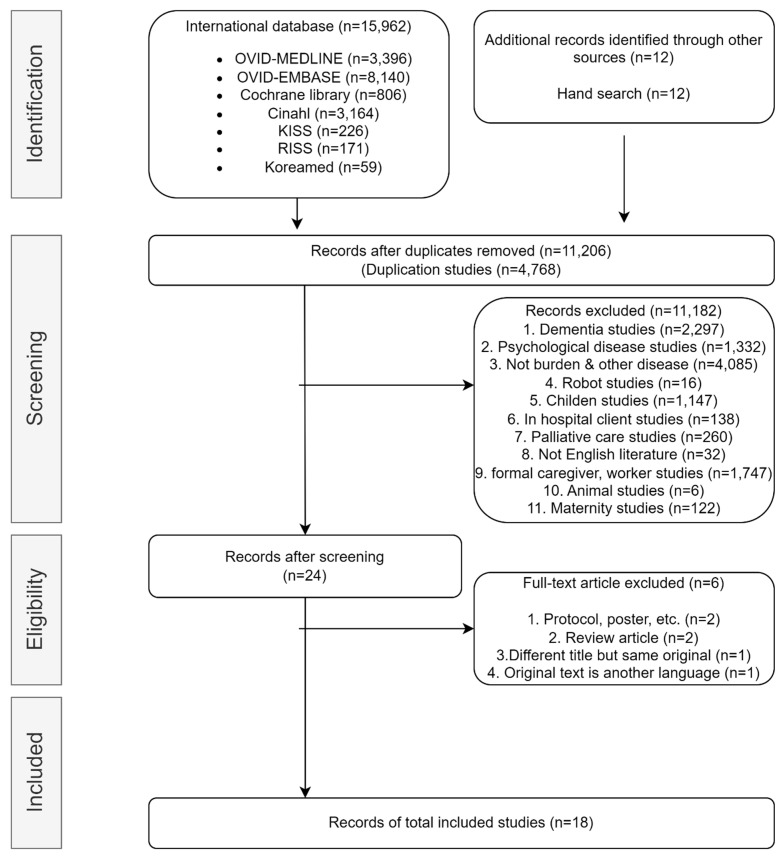
This study aimed to systematically review and analyze factors contributing to caregiver burden among family caregivers of older adults with chronic illnesses in local communities. Specific objectives included exploring the characteristics of older adults with chronic illness and caregiver burden through an extensive literature review and identifying factors influencing caregiver burden in this population. Using Korean (RISS, KISS, and KoreaMed) and international (EMBASE, MEDLINE, CINAHL, and the Cochrane Library) databases, this study employed systematic search methods to identify relevant literature. The inclusion and exclusion criteria were systematically applied in accordance with the PRISMA guidelines, focusing on studies that addressed caregiver burden among family caregivers of older adults with chronic illnesses in local communities. Following the database search, 15,962 articles were identified. After eliminating duplicates and applying the selection criteria, 18 studies were included in this review. These studies, representing various countries, contribute to a diverse dataset covering caregiver and care-recipient characteristics, including age, sex, chronic conditions, and various caregiver burden assessment tools. This systematic review provides a comprehensive understanding of the factors that influence caregiver burden among family caregivers of older adults with chronic illness in local communities. These findings emphasize the need for integrated nursing interventions and community efforts to address the welfare concerns of this population and support their caregivers.
Overview
The claims and statistics of this paper haven’t been checked yet.
Free: it reads the open-access text and checks the first 5 claims that cite a source we can check. Create a free account to check every claim.
Integrity signals
Registry
Cites
Statistics
Figures
Verification
Claims the paper makes
The claims and statistics of this paper haven’t been checked yet.
Free: it reads the open-access text and checks the first 5 claims that cite a source we can check. Create a free account to check every claim.
Claims other papers make about this one
Each is checked against this paper’s own text: does it say what the citing paper says it does?
The source backs part of the claim, not all of it — or backs it for a different population, condition or comparison.
In the citing paper
“Caregiver characteristics such as gender, age, educational level, monthly income, employment status, daily caregiving hours, caregiving duration, relationship with the care recipient, and cohabitation status have been linked to burden levels18–23.”
From Examining burden among caregivers of community-dwelling older adults in Lebanon (2025) · cites this paper as [22]
Experimental — accuracy not yet measuredThe cited source says what the claim attributes to it.
In the citing paper
“Regarding care recipient factors, previous studies indicated that age, gender, educational level, the presence of neuropsychiatric symptoms, and the degree of impairment in physical and daily functioning were the factors that predicted burden18,21,22.”
From Examining burden among caregivers of community-dwelling older adults in Lebanon (2025) · cites this paper as [22]
The cited source says what the claim attributes to it.
In the citing paper
“The negative association found between subjective caregiver burden and social support is consistent with findings from a meta-analysis and a systematic review on informal caregivers of older adults22,25, both of which identified social support as a significant predictor of reduced subjective burden.”
From Examining burden among caregivers of community-dwelling older adults in Lebanon (2025) · cites this paper as [22]
Self-check
Percentages, sums and reported differences re-computed from the paper’s own numbers.
The self-check needs the paper’s full text.
Citations
Cites
Relatives of the Impaired Elderly: Correlates of Feelings of Burden
Zarit, S. H., Reever, K. E., & Bach-Peterson, J. (1980) · The Gerontologist · doi:10.1093/geront/20.6.649 · Cited by 5,810
Social Ties and Susceptibility to the Common Cold
Cohen, S. (1997) · JAMA: The Journal of the American Medical Association · doi:10.1001/jama.1997.03540480040036 · Cited by 1,238
Social Ties and Susceptibility to the Common Cold
Heeler, R. M. (1997) · JAMA: The Journal of the American Medical Association · doi:10.1001/jama.1997.03550150035019 · Cited by 1,236
Rechel, B., Grundy, E., Robine, J.-M., Cylus, J., Mackenbach, J. P., Knai, C., & McKee, M. (2013) · The Lancet · doi:10.1016/s0140-6736(12)62087-x · Cited by 592 · cited 1×
“Older people experience certain health problems, such as cancer, hip fracture, stroke, and dementia, at higher rates than younger people and are more likely to have comorbid conditions that lead to higher care and support needs [3].”
BackgroundOrnstein, K., & Gaugler, J. E. (2012) · International Psychogeriatrics · doi:10.1017/s1041610212000737 · Cited by 294
Ong, H. L., Vaingankar, J. A., Abdin, E., Sambasivam, R., Fauziana, R., Tan, M.-E., Chong, S. A., Goveas, R. R., Chiam, P. C., & Subramaniam, M. (2018) · BMC Psychiatry · doi:10.1186/s12888-018-1616-z · Cited by 277 · cited 1×
“Ong, 2018 [31] Caregivers with a higher level of social support experience a lower level of burden.”
BackgroundCoping With Specific Stressors in Alzheimer's Disease Caregiving
Williamson, G. M., & Schulz, R. (1993) · The Gerontologist · doi:10.1093/geront/33.6.747 · Cited by 206 · cited 1×
“Mental impairment in older people has also been found to be a strong factor in caregiver burden [34,37,38,41], and cognitive impairment in older people has been reported to be more burdensome than physical impairment [42,43].”
BackgroundZhong, Y., Wang, J., & Nicholas, S. (2020) · BMC Geriatrics · doi:10.1186/s12877-019-1403-9 · Cited by 145 · cited 3×
“To identify the various negative effects of caregiving, this study examines the concepts of depression, stress, caregiver burden, and exhaustion [6,7,9,10].”
BackgroundHooley, P. J. D., Butler, G., & Howlett, J. G. (2005) · Congestive Heart Failure · doi:10.1111/j.1527-5299.2005.03620.x · Cited by 134
Burden and Gender inequalities around Informal Care
Carbó, G. F. C., & García-Orellán, R. (2020) · Investigación y Educación en Enfermería · doi:10.17533/udea.iee.v38n1e10 · Cited by 121
Caregivers of Chronically Ill Elderly: Perceived Burden
Faison, K. J., Faria, S. H., & Frank, D. (1999) · Journal of Community Health Nursing · doi:10.1207/s15327655jchn1604_4 · Cited by 113 · cited 3×
“Faison, 1999 [18] A significant correlation was observed between incontinence and caregiver burden.”
BackgroundInfluentialCost and burden of informal caregiving of dependent older people in a rural Indian community
Brinda, E. M., Rajkumar, A. P., Enemark, U., Attermann, J., & Jacob, K. (2014) · BMC Health Services Research · doi:10.1186/1472-6963-14-207 · Cited by 111 · cited 3×
“Brinda, 2014 [25] Time spent on helping ADL and on supervision increased the caregiver’s burden.”
BackgroundCaregivers Burden of Older Adults with Chronic Illnesses in the Community: A Cross-Sectional Study
Limpawattana, P., Theeranut, A., Chindaprasirt, J., Sawanyawisuth, K., & Pimporm, J. (2012) · Journal of Community Health · doi:10.1007/s10900-012-9576-6 · Cited by 107 · cited 4×
“Limpawattana, 2013 [30] Duration of care had a positive relationship with ZBI scores.”
BackgroundInfluentialNeuropsychiatric issues after stroke: Clinical significance and therapeutic implications
Zhang, S., Xu, M. Y., Liu, Z., Feng, J., & Ma, Y. (2020) · World Journal of Psychiatry · doi:10.5498/wjp.v10.i6.125 · Cited by 98
Multimorbidity, Function, and Cognition in Aging
Kadambi, S. G., Abdallah, M. M., & Loh, K. P. (2020) · Clinics in Geriatric Medicine · doi:10.1016/j.cger.2020.06.002 · Cited by 88 · cited 1×
“Cancer, heart disease, cerebrovascular disease, diabetes, and chronic lower respiratory disease are the top five leading causes of death in Korea, indicating that decline in function due to aging and active management of chronic diseases are becoming critical issues [5].”
BackgroundChan, E.-Y., Glass, G., Chua, K.-C., Ali, N., & Lim, W.-S. (2018) · The Journal of nutrition, health and aging · doi:10.1007/s12603-018-1098-1 · Cited by 83
Iecovich, E. (2008) · Journal of Applied Gerontology · doi:10.1177/0733464808315289 · Cited by 77 · cited 1×
“Support (family, social) Iecovich, 2008 [23] Caregiver burden increased according to the availability of formal community-based services.”
BackgroundKristianingrum, N. D., Ramadhani, D. A., Hayati, Y. S., & Setyoadi, S. (2021) · Journal of Public Health Research · doi:10.4081/jphr.2021.2227 · Cited by 61
Caregiver Burden, Health Status, and Learned Resourcefulness of Older Caregivers
Chen, M.-C., Chen, K.-M., & Chu, T.-P. (2015) · Western Journal of Nursing Research · doi:10.1177/0193945914525280 · Cited by 60
Burden and associated factors for caregivers of the elderly in a developing country
Sabzwari, S. R., Badini, A. M., Fatmi, Z., & Shah, S. (2016) · Eastern Mediterranean Health Journal · doi:10.26719/2016.22.6.394 · Cited by 56 · cited 4×
“Sabzwari, 2016 [32] The higher the physical and cognitive dependence, the greater the burden on the caregiver.”
BackgroundInfluentialMlenzana, N. B., Frantz, J. M., Rhoda, A. J., & Eide, A. H. (2013) · African Journal of Disability · doi:10.4102/ajod.v2i1.22 · Cited by 53 · cited 1×
“The inclusion criteria were delineated based on the PIO framework, wherein “P” denotes the population, “I” signifies the intervention of interest, and “O” represents the outcome, as elucidated in the corresponding abstract [13].”
BackgroundGonzález, A. M. R., Rodriguez, E. M., & Clavería, A. (2021) · Journal of Clinical Nursing · doi:10.1111/jocn.15683 · Cited by 51
Lu, N., Liu, J., & Lou, V. W. Q. (2015) · Archives of Gerontology and Geriatrics · doi:10.1016/j.archger.2015.07.002 · Cited by 46 · cited 3×
“Lu, 2015 [15] The higher the level of education, the higher the level of developmental burden.”
BackgroundInfluentialThe burden perceived by informal caregivers of the elderly in Saudi Arabia
Alshammari, S., Alzahrani, A., Alabduljabbar, K., Aldaghri, A., Alhusainy, Y., Khan, M., Alshuwaier, R., & Kariz, I. (2017) · Journal of Family and Community Medicine · doi:10.4103/jfcm.jfcm_117_16 · Cited by 45
Kavga, A., Kalemikerakis, I., Faros, A., Milaka, M., Tsekoura, D., Skoulatou, M., Tsatsou, I., & Govina, O. (2021) · International Journal of Environmental Research and Public Health · doi:10.3390/ijerph18147298 · Cited by 43 · cited 3×
“To identify the various negative effects of caregiving, this study examines the concepts of depression, stress, caregiver burden, and exhaustion [6,7,9,10].”
BackgroundFreeman, S., Kurosawa, H., Ebihara, S., & Kohzuki, M. (2009) · Archives of Gerontology and Geriatrics · doi:10.1016/j.archger.2009.04.008 · Cited by 37 · cited 4×
“Freeman, 2008 [29] Employed caregivers experienced less burden than unemployed caregivers.”
BackgroundInfluentialCaregiving burden among informal caregivers of African American cancer survivors
Schwartz, K., Beebe-Dimmer, J., Hastert, T. A., Ruterbusch, J. J., Mantey, J., Harper, F., Thompson, H., Pandolfi, S., & Schwartz, A. G. (2021) · Journal of Cancer Survivorship · doi:10.1007/s11764-020-00956-x · Cited by 37 · cited 5×
“Schwartz, 2020 [20] High CGBs have been reported at educational levels above 4-year college degrees.”
BackgroundInfluentialSchandl, A. R., Ringborg, C. H., Mälberg, K., Johar, A. M., & Lagergren, P. (2022) · Acta Oncologica · doi:10.1080/0284186x.2022.2119098 · Cited by 32 · cited 1×
“Schandl, 2022 [19] Younger family caregivers were more likely to have a higher burden on caregivers.”
BackgroundKim, E. K., & Park, H. (2019) · Korean Journal of Adult Nursing · doi:10.7475/kjan.2019.31.4.351 · Cited by 31 · cited 1×
“The inability to perform activities of daily living has been reported to increase the burden on family caregivers of a wide range of patients, including those with dementia and stroke [55].”
BackgroundKo, Y. K., & Yu, S. (2018) · Japan Journal of Nursing Science · doi:10.1111/jjns.12223 · Cited by 25 · cited 1×
“In the initial phase of a systematic review, formulating a research question is paramount, as it marks the commencement of the PIO process [14].”
BackgroundSelf-citationZarit, S. H., Reever, K. E., & Bach-Peterson, J. (2015) · PsycTESTS Dataset · doi:10.1037/t06571-000 · Cited by 22 · cited 1×
“Further modifications resulted in the creation of a brief 12-item version and a concise 4-item screening version [33].”
BackgroundUnnikrishnan, B., Rathi, P., Saxena, P. P., Aggarwal, A., Shekhar, S., Bansal, S., Naidu, B. V., & Menon, S. (2019) · SAGE Open · doi:10.1177/2158244019876287 · Cited by 21 · cited 3×
“Unnikrishnan, 2019 [22] Caregivers of patients who were of older age had moderate to severe burden.”
BackgroundInfluentialChoi, J. Y., & Sok, S. R. (2012) · Journal of Hospice and Palliative Nursing · doi:10.1097/njh.0b013e31826bfb4c · Cited by 13 · cited 2×
“Choi, 2010 [28] There were significant correlations between family support and caregiving burden.”
BackgroundSelf-citationLee, Y., & Young, Y. I. (2005) · 한국노년학 · Cited by 10
Determinants of Care Burden of Caregiver in Patients with Dementia
Kim, J. M., Seon, S. I., & Yoon, J. (2001) · 신경정신의학 · Cited by 10
Sook, Y. H., & 류삼희 (2007) · 한국노년학 · Cited by 4
Analysis of Research Trends about Burden of Caring for Senile Dementia Patients in Korea
유승연 (2018) · Health & Welfare · doi:10.23948/kshw.2018.12.20.4.29 · Cited by 3 · cited 1×
“Caregiver burden was found to be negatively correlated with positive concepts, such as caregiver social support, and positively correlated with negative concepts, such as depression and distress [11].”
BackgroundLee, H. (2007) · Korean Journal of Family Social Work · doi:10.16975/kjfsw.2007..19.002 · Cited by 1 · cited 2×
“There is a need for research that differentiates the caregiving experiences of family caregivers according to the type and severity of geriatric illnesses to reduce the burden on family caregivers [54].”
Background
Research works printed but not linked: 14
- Jone M. Effects of the Characteristics of the Elderly and Family Caregivers on the Caregiving Stresses Korea Contents Assoc. 2014 14 274 282
- Kwon J.D. The Determinant Model of Caregiver Burden In Caring for the Demented Elderly in Korea Health Soc. Welf. Rev. 1994 14 1 16
- Kim M.J. Associated Factors Caused by Falls of Older People in Community-Dwelling Unpublished Master’s Dissertation Ewha Womans University Seoul, Republic of Korea 2004
- Ma B.S. A Study on the People in Charge of the Demented: Especially People in the Day Care Center or Short Stay Service Unpublished Master’s Thesis Ewha Womans University Seoul, Republic of Korea 1998
- Rhee K.O. A study on caregiving burden among family caregivers of impaired elderly J. Korean Gerontol. Soc. 2000 20 215 228
- Kim H.M. A Study on the Burden of the People Supporting the Dementia Elderly-Since Operation of the Dementia Elderly Daycare Centers Unpublished Master’s Thesis MYONGJI University Seoul, Republic of Korea 2005
- Hong D.I. A study on the Caregiving Burden of Elderly Primary Caregivers Using Day Shelters Unpublished Master’s Thesis Pyeongtaek University Pyeongtaek, Republic of Korea 2002
- Yoon H.S. Who Care for the Elderly? Family Responsibility vs. Social Responsibility Korean J. Fam. Law 2000 14 201 226
- Woo K.H. The Subjective Experience of Caregiving and Social Support for Family Caregivers of the Elderly with Dementia Korean J. Soc. Welf. Stud. 1997 10 383 413
- Yoon H.S. Cha H.B. Cho S.H. The Impact of Social Support on the Family Caregivers’ Burden and Depression Korean Gerontol. Soc. 2000 20 1 19
- Yang O.N. A Study on Stress of the Aged and Their Supporters and Coping strategies Unpublished Master’s Thesis Ewha Womans University Seoul, Republic of Korea 1995
- Lee Y.O. Factors Affecting Caregiving Burden for Elderly Caregivers of Stroke Survivors Unpublished Master’s Thesis Daejeon University Daejeon, Republic of Korea 2002
- Lee H.J. Influencing Factors and Caregiving burden among primary caregiver for Demented Elderly Korean J. Care Work. 2006 2 33 60
- Kim Y.J. Choi H.K. A Study on the burden, gratification, and family support of in-home dementia caregiver Korean Gerontol. Soc. 1993 13 63 83
Cited by
Caregiver burden and quality of life in palliative care: cross-sectional study
Shefeek, S. K., Joy, T. M., Olickal, J. J., Nezrin, M. A., George, A., & Thankappan, K. R. (2024) · BMJ Supportive & Palliative Care · doi:10.1136/spcare-2024-005220 · Cited by 21
Haroen, H., Juniarti, N., Sari, C. W. M., Sari, S. P., Arovah, N. I., Pardosi, J. F., & Wibowo, D. A. (2025) · Journal of Multidisciplinary Healthcare · doi:10.2147/jmdh.s533067 · Cited by 20
Lee, M. M.-S., Yeoh, E., & Wong, E. L. (2025) · JMIR Aging · doi:10.2196/68061 · Cited by 15
“Although several studies have identified caregiver burden as a significant risk factor for burnout and poor mental health outcomes among family caregivers [11,13,14], stronger filial piety may lead to lower caregiver burden [15,16].”
The Burden of Informal Caregiving for Adults with Musculoskeletal Conditions: A Systematic Review
Legese, N., Das, N., Watts, J. J., Robinson, S., Chen, G., & Gao, L. (2025) · PharmacoEconomics · doi:10.1007/s40273-025-01523-x · Cited by 14
“Studies show that informal caregivers tend to have poorer physical, mental, and social health compared with non-carers [8, 10–12].”
Noorollahi, Z., Shahshahani, M. S., Farajzadegan, Z., & Keshvari, M. (2025) · BMC Family Practice · doi:10.1186/s12875-025-03097-1 · Cited by 13
“In fact, it is a bridge that fills the gap between the patient’s needs and the health service’s side [19].”
Metadata
- Authors
- Choi, J. Y., Lee, S. H., & Yu, S.
- Affiliations
- Gachon University (KR)
- CHA University (KR)
- Corresponding author
- Lee, Seon Heui
- Yu, Soyoung
- Venue
- Healthcare
- Publisher
- MDPI AG
- Published
- 2024-05-13
- Volume
- 12
- Issue
- 10
- Pages
- 1002
- ISSN
- 2227-9032 (ISSN-L)
- PMC
- PMC11121359
- OpenAlex
- W4396853775
- Semantic Scholar
- 50e9845b45d04bf0468bbea642013a23ff7f9580
- Cited by
- 121
- References
- 38
- Citations by year
- 2026: 67 · 2025: 52 · 2024: 2
- FWCI
- 12.86
- Type
- journal article
- Language
- en
- Open access
- gold
- doi.org
- Licence
- Locations
- Healthcare (publishedVersion, cc-by)
- PubMed Central (publishedVersion, cc-by)
- PubMed (publishedVersion)
- Funders
- Gachon University Research Fund 2023 (GCU-202303870001)
- Topics
- Health Sciences › Nursing › Research and Theory › Nursing care and research
- Social Sciences › Sociology and Political Science › Intergenerational Family Dynamics and Caregiving
- Social Sciences › Life-span and Life-course Studies › Aging, Elder Care, and Social Issues
- Keywords
- caregiver burden, family caregivers, older adults, chronic disease, community-based care, caregiver characteristics, nursing interventions, caregiver support
About these checks
Registry, retraction, Cites and statistics results are computed, not judged, with one exception: a printed reference that no index lists is read once by a model before it counts as a citation error. Claims are extracted by a model and kept only when their quote appears verbatim in the text; each cited source is then checked, with a model’s help, for whether it says what the claim relies on. Those verdicts can be wrong — read the claim’s quote and the cited source before relying on one.
Statistics and arithmetic are recomputed, not judged.
Confidence bands are shown only for fields calibrated on our annotated test set. None is calibrated yet, so no band is shown.
What counts as a claim ›How we measure confidence ›How we check this ›
Are you an author, or do you see a problem with this page? Request a review
Data sources
Bibliographic data: Semantic Scholar, OpenAlex, Crossref.
Contains information from the Semantic Scholar Academic Graph Datasets, made available under the ODC Attribution License (ODC-BY 1.0).
Semantic Scholar’s data is described in: Kinney, R., et al. (2023). The Semantic Scholar Open Data Platform. arXiv:2301.10140.
