

Understanding Psychosocial Barriers to Healthcare Technology Adoption: A Review of TAM Technology Acceptance Model and Unified Theory of Acceptance and Use of Technology and UTAUT Frameworks
Open accessPublished version of a preprint
The DOI matches its Crossref record; 42 of the 42 references it cites were found in a registry or an index.
Abstract
Background: Leveraging healthcare technology improves human development and well-being. However, adoption is frequently delayed by behavioural and psychological barriers, such as perceived usefulness, trust, and organisational readiness. This review examines the suitability of the Unified Theory of Acceptance and Use of Technology (UTAUT) and the Technology Acceptance Model (TAM) frameworks in healthcare settings, focusing on behavioural, educational, and psychological factors that influence technology adoption. Methods: A total of 20 peer-reviewed articles from 2019 to 2024 were examined. Results: The review identified significant organisational and psychological obstacles, including a lack of trust, inadequate training, and organisational support. While the UTAUT provided a more comprehensive viewpoint, it needed to be modified to include context-specific factors, including trust, facilitating circumstances, and educational interventions. Meanwhile, the TAM’s emphasis on perceived usefulness and ease of use was shown to be insufficient for dealing with complex healthcare situations. Conclusions: Interventions targeting stakeholders’ organisational and psychological preparation and educational strategies are essential to overcoming resistance and enhancing trust. Future research should look into integrative frameworks incorporating behavioural, psychological, and instructional tactics to improve the use of technology in healthcare.
Overview
The claims and statistics of this paper haven’t been checked yet.
Free: it reads the open-access text and checks the first 5 claims that cite a source we can check. Create a free account to check every claim.
Integrity signals
Registry
Cites
Statistics
Figures
Verification
Claims the paper makes
The claims and statistics of this paper haven’t been checked yet.
Free: it reads the open-access text and checks the first 5 claims that cite a source we can check. Create a free account to check every claim.
Self-check
Percentages, sums and reported differences re-computed from the paper’s own numbers.
The self-check needs the paper’s full text.
Citations
Cites
User Acceptance of Information Technology: Toward A Unified View1
Venkatesh, V., Morris, M. G., Davis, G. B., & Davis, F. D. (2003) · MIS Quarterly · doi:10.2307/30036540 · Cited by 45,035 · cited 4×
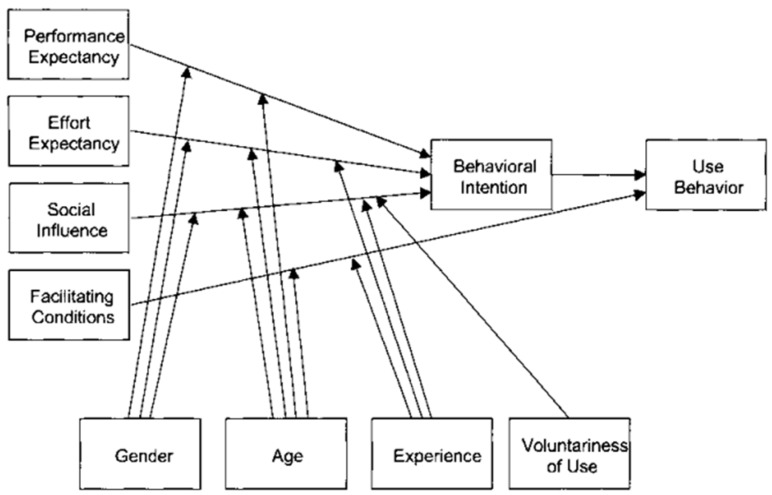
“According to Venkatesh et al. (2003) [21], the UTAUT may explain as much as 70% of the variation in intention.”
InfluentialUser Acceptance of Computer Technology: A Comparison of Two Theoretical Models
Davis, F. D., Bagozzi, R. P., & Warshaw, P. R. (1989) · Management Science · doi:10.1287/mnsc.35.8.982 · Cited by 25,709 · cited 2×
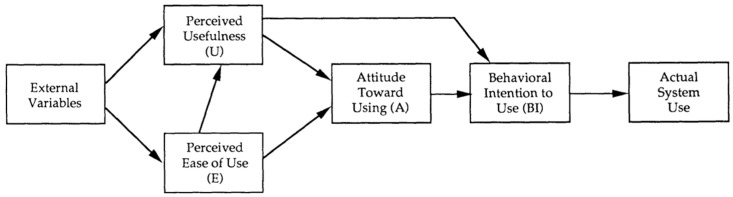
“The TAM was developed in 1989 by Fred Davis and adopted from the Theory of Reasoned Action (TRA) [18].”
Technology acceptance model: a literature review from 1986 to 2013
Marangunić, N., & Granić, A. (2015) · Universal Access in the Information Society · doi:10.1007/s10209-014-0348-1 · Cited by 2,458
Dwivedi, Y. K., Rana, N. P., Jeyaraj, A., Clement, M., & Williams, M. D. (2019) · Information Systems Frontiers · doi:10.1007/s10796-017-9774-y · Cited by 2,137 · cited 1×
“This consolidates the current theoretical viewpoints and enhances research on individual acceptance. made the UTAUT one of the most popular These improvements have made the UTAUT one of the most popular theoretical frameworks in IT/IS research [23]. theoretical frameworks in IT/IS research [23].”
The rise of artificial intelligence in healthcare applications
Bohr, A., & Memarzadeh, K. (2020) · Artificial Intelligence in Healthcare · doi:10.1016/b978-0-12-818438-7.00002-2 · Cited by 1,636 · cited 1×
“As is widely known, the healthcare industry has long struggled with a labour shortage [1,2].”
Kamal, S. A., Shafiq, M., & Kakria, P. (2020) · Technology in Society · doi:10.1016/j.techsoc.2019.101212 · Cited by 894 · cited 2×
“Furthermore, it is commonly used in studies investigating the interaction between technology and individual behaviours and intentions [19].”
Impact of Trust and Privacy Concerns on Technology Acceptance in Healthcare: An Indian Perspective
Dhagarra, D., Goswami, M., & Kumar, G. (2020) · International Journal of Medical Informatics · doi:10.1016/j.ijmedinf.2020.104164 · Cited by 436 · cited 4×
“Dhagarra et al. (2020) [13] investigated the effect of trust and privacy issues on the acceptance of technology in healthcare from an Indian viewpoint.”
InfluentialSchaper, L. K., & Pervan, G. P. (2007) · International Journal of Medical Informatics · doi:10.1016/j.ijmedinf.2006.05.028 · Cited by 371
Mackey, T. K., Kuo, T.-T., Gummadi, B., Clauson, K. A., Church, G., Grishin, D., Obbad, K., Barkovich, R., & Palombini, M. (2019) · BMC Medicine · doi:10.1186/s12916-019-1296-7 · Cited by 318 · cited 1×
“The healthcare industry faces one of the most serious problems in terms of technology adoption because people find it very difficult to adapt to new technologies despite the industry being the most important for people’s health [17].”
Technology Acceptance Models in Health Informatics: TAM and UTAUT
Elske, A. (2019) · Studies in Health Technology and Informatics · doi:10.3233/shti190111 · Cited by 296
Research works printed but not linked: 1
- Christian M. Gularso K. Utomo P. Yulita H. Wibowo S. Sunarno S. Melati R. Generation YZ’s E-Healthcare Use Factors Distribution in COVID-19’s Third Year: A UTAUT Modeling J. Distrib. Sci. 2023 21 117 129 10.15722/jds.21.07.202307.117 · doi:10.15722/jds.21.07.202307.117
Cited by
Items 201–300 of 476
Taveira, É., Dutra, I., & Rêgo, S. (2026) · JMIR Formative Research · doi:10.2196/88760
“This aligns with the technology acceptance model [50].”
Employees' Perceptions of AI Technology Adoption in Swedish Tech Organizations
Yunita, P. (2025) · DiVA (Digitala Vetenskapliga Arkivet) · doi:10.13140/rg.2.2.28157.47840
Qin, Y. (2024) · ORCA Online Research @Cardiff (Cardiff University)
AN INTEGRATED FRAMEWORK FOR AI ADOPTION AND RESISTANCE IN HEALTHCARE
Kaja, R., Neville, K., Treacy, S., & Woodworth, S. (2025) · AIS Electronic Library (AISeL)
A Novel Method for Objective Assessment of EMR Adoption Among Healthcare Professionals
Gurpur, P. B., Phillips, S. J., & Raghurama, G. P. (2025) · Academic Medicine & Surgery · doi:10.62186/001c.143911
Sait, S. A., & Vijesh, P. V. (2025) · Journal of Emerging Markets and Management · doi:10.63385/jemm.v1i2.159
“These well-established frameworks make clear how and why businesses embrace new technology in different ways and at different rates [10] .”
Comparative Analysis on the Security of Gmail Accounts with and without Multifactor Authentication
Lacorte, K. C., Yumang, J. M. K., Bagon, J. N., Francisco, R., Jr., & Madriaga, P. V. (2025) · doi:10.47760/oajmr.2025.v01i07.003
Ghani, A. A., Cheah, W.-H., Aung, M., Jusoh, N. M., Rebuan, H. M. A., & Ibrahim, M. S. (2025) · The Nigerian Health Journal · doi:10.71637/tnhj.v25i3.1132 · Cited by 1
Comparative analysis on the Security of Gmail Accounts with and without Multifactor Authentication
Lacorte, K. C., Yumang, J. M. K., Bagon, J. N., & Fransisco, R., Jr. (2025) · Pantao (International Journal of the Humanities and Social Sciences) · doi:10.69651/pijhss0404556
Exploring Customer Behavior and Fraud Vulnerability in E-Commerce
Chimezie, O. A. (2025) · Portuguese National Funding Agency for Science, Research and Technology (RCAAP Project by FCT)
The impact of digital marketing on business growth of local and medium enterprises (SMEs) in Nepal
Bhujel, S. (2025) · Theseus (Ammattikorkeakoulujen)
A Proposed Framework for the Adoption of Digital Payments in Rural Areas
Rahim, N. M., Miskon, S., Abdullah, N. S., & Ali, N. M. (2025) · International Journal of Academic Research in Business and Social Sciences · doi:10.6007/ijarbss/v15-i12/27292
Automation and AI in Corporate Financial Management : adoption and strategic insights
Vasankari, P. (2025) · Theseus (Ammattikorkeakoulujen)
Setiawaty, E., Hartoyo, H., Nurmalina, R., & Yuliati, L. N. (2025) · Telehealth and Medicine Today · doi:10.30953/thmt.v10.615
Uygulamada modern yönetim teknikleri: Organize sanayi bölgelerinde teknoloji kabul modeli yaklaşımı
Çil, U. (2025) · Business And Management Studies An International Journal · doi:10.15295/bmij.v13i4.2632
wu, M., Mazlan, N. H., Nasir, N. N. A. M., & Adnan, W. H. (2025) · Environment and Social Psychology · doi:10.59429/esp.v10i12.4115
A Technology Accessibility Index (TAI) to Select Appropriate Technologies for Mining Sites
Park, S., Yi, H., & Park, J. (2025) · Journal of the Korean Society of Mineral and Energy Resources Engineers · doi:10.32390/ksmer.2025.62.6.641
Ssenoga, D., Walugembe, A., Alinda, K., & Mubiru, P. (2026) · International Journal of Energy Sector Management · doi:10.1108/ijesm-06-2025-0025
Kalulu, J. C., & Wang, M. (2026) · International Journal for Equity in Health · doi:10.1186/s12939-025-02750-6
“This notion is especially true in low-resource environments, where distrust in data governance can supersede technical barriers as a primary deterrent to adoption [29].”
InfluentialAzmi, F. L., Rahimah, A., Kusumawati, A., & Sartika, T. (2026) · Cogent Business & Management · doi:10.1080/23311975.2026.2620159
Kutval, Y. (2026) · Cumhuriyet Üniversitesi İktisadi ve İdari Bilimler Dergisi · doi:10.37880/cumuiibf.1816688
Ncube, M. M., & Ngulube, P. (2026) · Public Library Quarterly · doi:10.1080/01616846.2026.2618444
Curiello, S., Chapman, A. P., & Wyatt, J. C. (2026) · Journal of Medical Internet Research · doi:10.2196/92392
Syahdat, M. G., Riza, F., & Dewi, Y. K. (2026) · Journal Research of Social Science Economics and Management · doi:10.59141/jrssem.v5i6.1292
“This model explains that technology acceptance is highly dependent on perceived ease of use (PEOU) and perceived usefulness (PU) (Katebi et al., 2022; Lee et al., 2025; Na et al., 2022; Widuri, 2022).”
Exploring service user attitudes towards mental health technologies
Fitzpatrick, P. J., Dhondt, N., Thuery, G., O’Brien, D., Ledden, K., Young, G. W., Gillan, C. M., Harkin, A., & Kelly, J. R. (2026) · Irish Journal of Psychological Medicine · doi:10.1017/ipm.2026.10170
“…acceptance frameworks such as the Technology Acceptance Model (TAM) and the Unified Theory of Acceptance and Use of Technology (UTAUT), user uptake is shaped by factors including perceived usefulness, ease of use, trust, social influence, and accessibility (Alojail, 2024, Lee et al. 2025).”
Zheng, J., & He, W. (2026) · Journal of the American Medical Directors Association · doi:10.1016/j.jamda.2025.106101
Leung, J., Tam, S. L., Nagji, A., Foohey, S., & Fayyaz, J. (2026) · Canadian Journal of Emergency Medicine · doi:10.1007/s43678-025-01083-1
Beyond UTAUT-2: towards contextually grounded models of technology adoption in special education
Hasanah, U., Dewi, R., Zainudin, M., & Rahma, A. (2026) · Disability and Rehabilitation Assistive Technology · doi:10.1080/17483107.2026.2633595
Wu, H., Zhou, Z., Shi, L., Liu, M., & Zhang, X. (2026) · Frontiers in Public Health · doi:10.3389/fpubh.2026.1961112
Damayanti, R., & Irawati, I. (2026) · Indonesian Journal on Computing (Indo-JC) · doi:10.21108/indojc.v10i2.9800
Consumer Perception of Smart Home Technologies
Jane, J., Kristi, I., Ramadhan, M. B. D. A., & Sarjono, H. (2025) · International Conference on ICT for Smart Society (ICISS) · doi:10.1109/iciss66954.2025.11389344
“TAM and UTAUT frameworks [18],[19] show that perceived usefulness and ease of use [24],[25],[27] increase adoption, with simplicity and guided interfaces reducing barriers [28].”
Bahçekapılı, E., & Emirzeoğlu, İ. (2026) · SSRN Electronic Journal · doi:10.2139/ssrn.6301414
Gol, S., & Çubukçu, C. (2026) · The Eurasia Proceedings of Science Technology Engineering and Mathematics · doi:10.55549/epstem.1393
(2026) · International Journal of Education Learning and Pedagogical Sciences (INJELPS) · doi:10.63498/injelps10
A Data-Driven Framework for Phased User Migration in Enterprise System Modernization
Penumatcha, A. K., & Duraisingh, I. (2026) · International Conference on Mobile Computing and Sustainable Informatics (ICMCSI) · doi:10.1109/icmcsi67283.2026.11412918
“…perceived usefulness and ease of use and social influence and facilitating conditions but shows that user characteristics and readiness levels differ substantially between groups which demands customized implementation strategies to handle specific adoption challenges for various user groups[12].”
Impact of Cloud Computing on Organization’s Profitability
Bakare, S. A. (2026) · ScholarWorks (Walden University)
Olaniyan, O. A. (2026) · Tampere University Institutional Repository (Tampere University)
Meldgård, L. M., Øllgaard, J. A., Palinko, O., Lee, M.-Y., & Clemmensen, T. (2026) · International Journal of Human-Computer Interaction · doi:10.1080/10447318.2026.2635680
Borzanović, A., Klašnja-Milićević, A., Papić-Blagojević, N., & Ivanović, M. D. (2026) · Journal of Continuing Education in the Health Professions · doi:10.1097/ceh.0000000000000640
Rahman, S., & Zhang, Y. (2026) · Journal of Marketing Communications · doi:10.1080/13527266.2026.2638790
ЦИФРОВА АДАПТАЦІЯ ОСОБИСТОСТІ ДО СИСТЕМИ НЕВИЗНАЧЕНОСТІ: РІВНІ СУБ’ЄКТНОСТІ ТА СВОБОДИ
Ронжес, О., & Кряж, І. (2026) · Перспективи та інновації науки · doi:10.52058/2786-4952-2026-2(60)-3542-3556
From copper stills to virtual thrills: exploring augmented and virtual reality in distillery tourism
Capps, D., & Alimohammadirokni, M. (2026) · Journal of Hospitality and Tourism Insights · doi:10.1108/jhti-08-2025-0918
Ayesha, A. D., Ahlan, A. R., & Ibrahim, N. M. (2026) · International Journal of Research and Innovation in Applied Science · doi:10.51584/ijrias.2026.110200065
Ndlovu, P., Nyide, C. J., & Ncube, T. (2026) · International Journal of Hospitality and Tourism Systems · doi:10.21863/ijhts/2026.19.1.009
Mendieta, J. A. L., Cardozo, J. M. G., & Álvarez, E. G. P. (2026) · Minerva Digital Library (Universidad EAN)
User Acceptance of Social Chatbots in Emotional Companionship Services: An AIDUA-Based Perspective
Li, W., Ye, X., He, X., & Zhou, Y. (2026) · International Journal of Human-Computer Interaction · doi:10.1080/10447318.2026.2645438
Bussick, E., Dzandu, M. D., & Cha, J. (2026) · Procedia Computer Science · doi:10.1016/j.procs.2026.03.104
Valix, C. A. (2026) · International Journal For Multidisciplinary Research · doi:10.36948/ijfmr.2026.v08i02.72530
Khatib, M. M. E., Hammadi, A. A., Zerehi, A., & Alnaqbi, M. (2025) · International Journal of Business Analytics and Security (IJBAS) · doi:10.54489/ijbas.v5i1.557
Gallo, V., Romero, L., Pérez, A., & Marcillo, F. (2026) · Impact Research Journal · doi:10.63380/irj.v4n1.2026.303
Dijn, M. D., Bilican, S., Brône, G., Cox, A., Dancet, E. A. F., de Lhoneux, M., Dobbels, F., Irfan, M., Lahousse, K., Meex, B., et al. (2026) · Lirias
Alamsyah, F. D., & Sunitiyoso, Y. (2026) · MORFAI JOURNAL · doi:10.5281/zenodo.19436181
Schlégl, Á. T., Ostojić, M., Unterfrauner, I., Ciolli, G., Megaloikonomos, P. D., Igoumenou, V. G., Mercurio, M., Stark, T., Kordić, D., Dietvorst, M., et al. (2026) · JMIR Medical Education · doi:10.2196/79418
“Here, digital competence reflects effort expectancy; workplace and gross domestic product (GDP) proxy facilitating conditions [35,36].”
Digital health workforce maturity
Hovenga, E. J. S. (2026) · Elsevier eBooks · doi:10.1016/b978-0-443-44073-1.00024-9
Chatbots for academic services in Higher Education: Students’ perceptions and acceptance
do Nascimento, T. D. L. E. C. S. (2025) · Repositório do ISCTE-IUL
Primary school teachers’ experiences of teaching mathematics, incorporating smartboards
Madzikanda, S., & Mahlaba, S. C. (2026) · African Journal of Teacher Education and Development · doi:10.4102/ajoted.v5i1.127
Mastour, H., Moghadasin, M., Çalışkan, S. A., Keshavarz, F., Shadravan, M. M., & Sohrabi, S. (2026) · Computers in Human Behavior Reports · doi:10.1016/j.chbr.2026.101069
ReprodutHIVa: development and validation of an app for self-care for women living with HIV/AIDS
Rocha, K. A. D. A., de Almeida, A. L. C. A., Moura, V. P., Alves, D., Gir, E., & Reis, R. K. (2026) · Revista Latino-Americana de Enfermagem · doi:10.1590/1518-8345.7959.4825
Rocha, K. A. D. A., de Almeida, A. L. C. A., Moura, V. P., Alves, D., Gir, E., & Reis, R. K. (2026) · Revista Latino-Americana de Enfermagem · doi:10.1590/1518-8345.7959.4824
Rocha, K. A. D. A., de Almeida, A. L. C. A., Moura, V. P., Alves, D., Gir, E., & Reis, R. K. (2026) · Revista Latino-Americana de Enfermagem · doi:10.1590/1518-8345.7959.4826
Rahmawati, A., Zhang, S., & Arsyad, A. M. (2026) · Ceddi Journal of Information System and Technology (JST) · doi:10.56134/jst.v5i1.163
Destiwati, R., Harahap, J., & Mulyanti, D. (2025) · International Conference on Artificial Intelligence, Blockchain, Cloud Computing, and Data Analytics (ICoABCD) · doi:10.1109/icoabcd67551.2025.11470729
“Cronbach's Alpha coefficient is a good internal coefficient with a value >0.70 for measuring instrument reliability [27].”
InfluentialBranding in the Age of IoT: Building Trust and Driving Consumer Adoption
Emon, M. M. H. (2026) · IGI Global eBooks · doi:10.4018/979-8-3373-3441-7.ch001
Digital Literacy as a Foundation for Remote Work Readiness in Africa: A Systematic Review
Alli, A. O., Alabi, O. A., Oose, M. O., & Oyeyinka, R. (2026) · International Journal of Research and Innovation in Social Science · doi:10.47772/ijriss.2026.100300534
The Application of Behavioral Therapy Theory in Behavioral Counseling: A Literature Review
Devi, M. K., Purwoko, B., & Habsy, B. A. (2026) · Jurnal Indonesia Sosial Sains · doi:10.59141/jiss.v7i4.2293
Os, A. C. B.-V., Sabarinath, S., Ragula, U. B. R., Ramanathan, S., Mohan, R., & Ramesh, M. V. (2026) · IEEE Access · doi:10.1109/access.2026.3685285
“The models are ‘‘not robust enough’’ for institutional contexts because they ignore the role of organizational rules, policies, and supervision [19] and require being ‘‘modified to include context-specific factors’’ [18], [74].”
Perceived Risk and Behavioural Intention to Adopt E-Government in Dubai, United Arab Emirates
Alhammadi, I. S. Y. S. (2026) · CLOK (University of Central Lancashire) · doi:10.17030/uclan.thesis.00059087
Kannan, M. K. M., R, J., Kadeswaran, S., Soundra Rajan, D., & -, C. L. K. S. (2026) · ShodhKosh Journal of Visual and Performing Arts · doi:10.29121/shodhkosh.v7.i5s.2026.7417
When choice becomes an illusion: rethinking AI adoption in human decision-making
Hani, I. B., Mrayyan, N. E., AlNuaimi, F., Alakbari, S., AlNuaimi, M., & Alhammadi, A. (2026) · Journal of Decision System · doi:10.1080/12460125.2026.2660241
Yang, R., Wibowo, S., & Alford, S. (2026) · Behaviour and Information Technology · doi:10.1080/0144929x.2026.2666285
Constructing Information Systems: Technology Frames and Career Interest Among Middle School Students
Noteboom, C., & Chintalapudi, S. M. (2026) · Journal of the Association for Information Systems
AI-Assisted Speech Documentation in Nursing: Identifying User Groups via Latent Class AnalysisPreprint
Ferizaj, D., Neumann, S., Burkhardt-Herdtle, C., Rau, A., Perotti, L., Ratajczak, N., Schwabe, K., Lahmann, N., & Strube‐Lahmann, S. (2026) · Research Square · doi:10.21203/rs.3.rs-9557939/v1
Birhanu, T. E., Vlahu‐Gjorgievska, E., & Win, K. T. (2026) · BMC Medical Informatics and Decision Making · doi:10.1186/s12911-026-03554-6
“This finding is also consistent with the UTAUT framework, which identifies perceived accuracy, perceived privacy protection, and perceived convenience as central constructs that influence both behavioral intention and actual use [43, 44].”
Alshammri, M. R., Aldosari, M., Alshehri, R. A., Almasari, G., Alabdulrahman, R., Alarfaj, R., Alrashed, A., Al-walah, M. A., Alotiabi, M. M., & Hussein, G. (2026) · medRxiv · doi:10.64898/2026.05.06.26352604
E-logistics adoption and its influence on customer satisfaction in retail
Ahmad, D., & Aamir, T. (2026) · Theseus (Ammattikorkeakoulujen)
Liang, J., Zhuang, J., Zhuang, J., & Ku, H. B. (2026) · Healthcare · doi:10.3390/healthcare14101311
“A more comprehensive understanding of individuals’ application or intention to use the technology should also incorporate their consideration of factors from external social systems into their evaluation and use of the technology [21].”
InfluentialMedical students’ intention to adopt electronic health records to improve the quality of healthcare
Ibrahim, G. J. P., & Adomah-Afari, A. (2026) · International Journal of Health Care Quality Assurance · doi:10.1108/ijhcqa-01-2026-0027
Digital Management System for Student Training in Educational Dental Clinics
Muneem, A. S. A., Mahmoud, I. S., & Mahmood, M. S. (2026) · Journal of Applied Science Engineering Technology and Education · doi:10.35877/454ri.asci4406
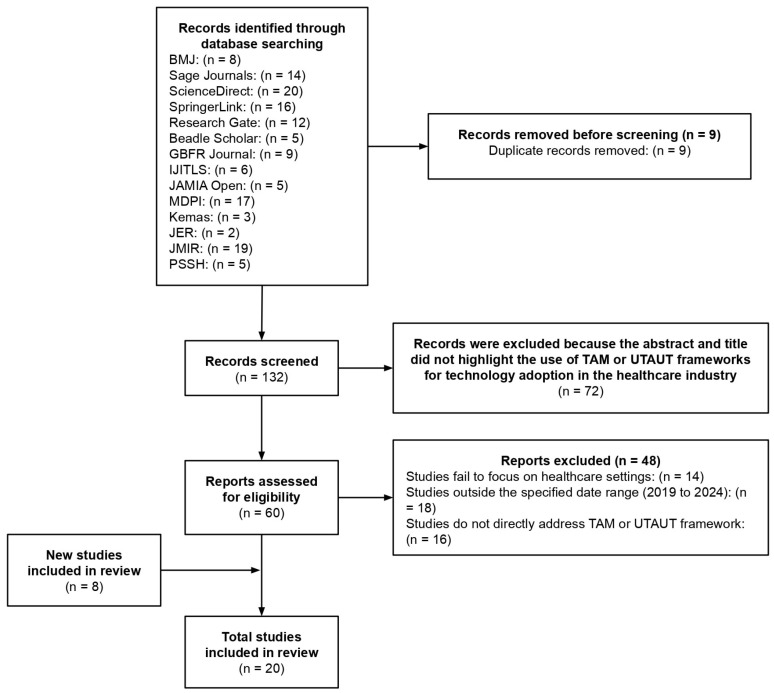
“Perhaps the weak institutional support for digital technologies in (Lee et al., 2025) 20 articles were reviewed for the period after 2019.”
Alzubi, M. M. S., Alwaely, S. A., Yaghi, S. A. E. R., Haddad, N. M. B., Ismail, A. N., Darawsheh, S. R., & Alzoubi, M. (2026) · Research Square · doi:10.21203/rs.3.rs-9367638/v1
Sarna, A., Finkelstein, A., Malcolmson, C., Potashner, R., Pitch, N., Forestieri, A., Cooper, M., Feng, Y., Patel, A., Schechter, T., et al. (2026) · JMIR Medical Informatics · doi:10.2196/93346
“The survey consisted of three parts: (1) demographic information about the respondent, (2) an abbreviated version of the technology acceptance model (TAM) questionnaire, and (3) specific questions related to the impact on transfusion-related practices [16-18].”
Szakadáti, T., & Balogh, G. (2026) · Vezetéstudomány / Budapest Management Review · doi:10.14267/veztud.2026.05.02
Matsunaga, L. H., Holzapfel, N., Timko, P., Jarzebski, M. P., & Xu, A. (2026) · Journal of Psychology and AI · doi:10.1080/29974100.2026.2751195
., A., & Jain, A. K. (2026) · International Journal of Humanities and Education Research · doi:10.33545/26649799.2026.v8.i5a.408
Sides, T. (2026) · Open Research Online (The Open University) · doi:10.21954/ou.ro.00109947
Nkoloma, M., Gombachika, H. S. H., Mikeka, C., & Maluwa, A. A. (2026) · Research Square · doi:10.21203/rs.3.rs-9377177/v1
Brandis, S. J., & Denney, M. (2026) · Disability and Rehabilitation Assistive Technology · doi:10.1080/17483107.2026.2674844
“…adaptations to be made to fit an occupational therapy context. in hindsight, the UtaUt model may have been more suitable to use in this study [34]. this research is the first study to explore occupational therapists’ perceptions and knowledge of using smartwatches for falls detection which…”
Putri, F. A., & Marlini, M. (2026) · Journal of Multidisciplinary Science MIKAILALSYS · doi:10.58578/mikailalsys.v4i2.10216
Febriyanti, R. W., Rahmadini, F. I., & Putra, E. P. (2026) · doi:10.1109/icoict71118.2026.11664780
“…Toward Using (0.559), and Perceived Ease of Use (0.535) show strong explanatory power, while the low 𝑅 2 = 0.146 for Actual System Use aligns with prior TAM literature indicating that behavioral intention consistently predicts actual usage less accurately due to external situational factors [20].”
InfluentialDavins, M., Cano, M., Carrión, C., Valero, P., Bonjorn, M., Vlad, I., Ortuño, F. M., Lopez, R., Ara, J., Mòdol, J. M., et al. (2026) · doi:10.2196/preprints.101984
محمد, و. م. س. (2026) · Comprehensive Journal of Science · doi:10.65405/49t2m284
Lubis, M., Chairany, P., Muttaqin, A. N., & Lubis, A. R. (2026) · Computers · doi:10.3390/computers15060334
“Moreover, TAM is a model for guiding the optimization of implementation strategies based on consideration of both technical and social factors in fl uencing adoption [51,52].”
Mawardi, I. K., Laksana, R. P., Uddin, B., & Hidayah, Q. H. (2026) · Jurnal Impresi Indonesia · doi:10.58344/jii.v5i5.7775
Chaerunnisa, I. B., & Bangsa, M. T. A. (2026) · RIGGS Journal of Artificial Intelligence and Digital Business · doi:10.31004/riggs.v5i2.8738
Podcasting amongt Media Students in Delhi: An Analytical Study of Adoption and Future Scope
Singh, P., & Sarina (2026) · International Conference on Computing for Sustainable Global Development · doi:10.23919/indiacom70271.2026.11526038
“[15] The Diffusion of Innovation Theory describe about how new ideas or technologies spread and talk about various categories to find out how podcasting spread among media students and it also tries to bring out the role IoT which include smartphones, wearables, smart speaker while accelerating…”
Modi, M. B. (2025) · University Of Wales Trinity Saint David Research Repository (University of Wales Trinity Saint David) · doi:10.82227/repository.uwtsd.ac.uk.00004256
Batiha, I. M., Momani, S., Aziz, N. H. A., Hamzah, N. A. A., Othman, K. R., & Sheimat, A. (2026) · Journal of Mathematics · doi:10.1155/jom/9385200
Prpic, N., Lulić, I., Bozic, L. K., Starešinić, M., Lulić, D., Tonković, D., Henigsberg, N., Kocman, I. B., Erceg, G., & Saric, J. (2026) · Healthcare · doi:10.3390/healthcare14111520
“Neither self-reported technological literacy nor engagement with educational materials was associated with adoption patterns, indicating that commonly proposed predictors of technology uptake may not fully explain variability in high-acuity clinical settings [22,23].”
The role of perceived competence in remote cochlear implant aftercare: a mixed-methods study
Werminghaus, M., Thyson, S., Sieverding, N., Breitenbach, E., Richter, J. G., & Klenzner, T. (2026) · Frontiers in Digital Health · doi:10.3389/fdgth.2026.1803067
Tiarasati, T., Misnaniarti, M., & Syakurah, R. A. (2026) · Journal La Medihealtico · doi:10.37899/journallamedihealtico.v7i2.3259
Metadata
- Authors
- Lee, A. T., Ramasamy, R. K., & Subbarao, A.
- Affiliations
- Multimedia University (MY)
- Corresponding author
- Ramasamy, R Kanesaraj
- Venue
- Healthcare
- Publisher
- MDPI AG
- Published
- 2025-01-27
- Volume
- 13
- Issue
- 3
- Pages
- 250
- ISSN
- 2227-9032 (ISSN-L)
- PMC
- PMC11816427
- OpenAlex
- W4406873496
- Cited by
- 241
- References
- 40
- Citations by year
- 2026: 160 · 2025: 81
- FWCI
- 60.43
- Type
- journal article
- Language
- en
- Open access
- gold
- doi.org
- Licence
- Locations
- Healthcare (publishedVersion, cc-by)
- Preprints.org (acceptedVersion, cc-by)
- PubMed Central (publishedVersion, cc-by)
- PubMed (publishedVersion)
- Siti Hasmah Digital Library-MMU Institutiona Repository (Multimedia University) (acceptedVersion)
- Funders
- Telekom Research & Development Sdn Bhd (TM R&D) (RDTC/241124)
- Topics
- Social Sciences › Decision Sciences › Information Systems and Management › Technology Adoption and User Behaviour
- Health Sciences › Health Professions › Health Information Management › Electronic Health Records Systems
- Health Sciences › Health Professions › Health Information Management › Health, Technology, Consumer Behavior
- Keywords
- health technology adoption, technology acceptance model, UTAUT, Unified Theory of Acceptance and Use of Technology, psychosocial barriers, trust in technology, perceived usefulness, perceived ease of use, organizational readiness, employee training, organizational support, resistance to technology
About these checks
Registry, retraction, Cites and statistics results are computed, not judged, with one exception: a printed reference that no index lists is read once by a model before it counts as a citation error. Claims are extracted by a model and kept only when their quote appears verbatim in the text; each cited source is then checked, with a model’s help, for whether it says what the claim relies on. Those verdicts can be wrong — read the claim’s quote and the cited source before relying on one.
Statistics and arithmetic are recomputed, not judged.
Confidence bands are shown only for fields calibrated on our annotated test set. None is calibrated yet, so no band is shown.
What counts as a claim ›How we measure confidence ›How we check this ›
Are you an author, or do you see a problem with this page? Request a review
Data sources
Bibliographic data: Semantic Scholar, OpenAlex, Crossref.
Contains information from the Semantic Scholar Academic Graph Datasets, made available under the ODC Attribution License (ODC-BY 1.0).
Semantic Scholar’s data is described in: Kinney, R., et al. (2023). The Semantic Scholar Open Data Platform. arXiv:2301.10140.
