

Private Dental Practitioners' Experience in a Dental Practice-Based Research Network: A Qualitative Evaluation
Open accessThe DOI matches its Crossref record; 31 of the 31 references it cites were found in a registry or an index; 10 of the 14 sources its claims cite were checked for support.
Abstract
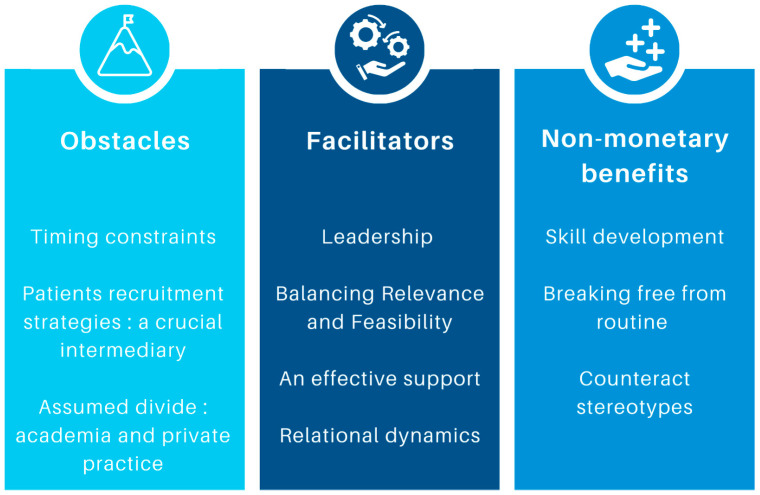
Our study investigated practitioner perspectives in DPBRNs to identify strategies for improving investigator recruitment, training, and data quality. Qualitative semi-structured interviews with private dental practitioners revealed obstacles including time constraints, difficulties in patient recruitment, and a perceived disconnect between academia and private practice; and facilitators such as strong leadership, logistical support, and a collaborative research environment.
Overview
CoChat Summary
TL;DR
This qualitative study explored seven French private dentists’ experiences participating in the RECOL dental practice-based research network through the RESTO DATA observational study. It identified obstacles to participation, facilitators of engagement, and personal benefits, with non-financial gains appearing more important than compensation.
Key findings
- Three major themes emerged: (1) obstacles, including time constraints, difficulties in patient recruitment, and a perceived disconnect between academia and private practice; (2) facilitators, such as strong leadership, logistical support, and a collaborative research environment; and (3) personal benefits, including skill development, breaking professional routines, and counteracting stereotypes about private practitioners in research.
- Participants reported improved clinical skills and confidence; one participant noted, “I realized that I was looking for a lot less” (Participant C) when checking dental restorations.
- Although financial compensation or continuing professional development credits are frequently cited as motivators for research participation, these “were not significant concerns” for participants; the RESTO DATA study did not provide compensation to investigators.
- Data saturation was achieved with seven participants, defined as the last two interviews generating no new themes or relevant information.
Methods
- Qualitative design adhering to the Standards for Reporting Qualitative Research (SRQR); semi-structured interviews were conducted with private dental practitioners who had participated in the RESTO DATA DPBRN observational study within the RECOL network.
- Seven participants were sampled using maximum variation and convenience sampling; interviews occurred between March 2022 and February 2023, conducted by a single researcher in person or by telephone.
- Thematic analysis followed Braun and Clarke’s six-phase framework within a constructivist paradigm; two researchers coded data, with iterative constant comparison and MaxQDA 2022 used to facilitate coding.
Limitations
- Stated: difficulty in data collection, particularly regarding interview conditions and time allocated, may have impacted the richness and depth of data; the sample size of seven, while sufficient for data saturation, may limit generalizability; and some researchers were involved in the network under study, so influence on interpretation cannot be entirely excluded despite reflexive practices.
- Stated: findings are specific to participation in a DPBRN observational study (RESTO DATA); perceptions may differ for more complex designs such as randomized controlled trials or longitudinal studies, and across medical specialties.
- No additional limitations are evident from the text beyond those stated.
Model-written summary. Check it against the paper before relying on it.
Integrity signals
Registry
Cites
Statistics
Figures
Verification
Claims the paper makes
6 Valid · 2 Not valid · 5 Not checked · 65 Own results and interpretations
The cited sources support only part of this claim — read each source’s verdict below.
In the paper
“Our findings are consistent with previous literature which highlights time constraints, logistical challenges, and a perceived lack of relevance as key obstacles [28,29].”
§ Private Dental Practitioners’ Experience in a Dental Practice-Based Research Network: A Qualitative Evaluation > 4. Discussion
What the sources say
- Partly supportedcites [28] Demarco F.F. Correa M.B. Cenci M.S. Burke F.J.T. Opdam N.J.M. Faria-E-Silva A.L. Practice based research in dentistry: An alternative to deal with clinical questions Braz. Oral Res. 2020 34 e071 10.1590/1807-3107bor-2020.vol34.0071 32785489 sourceExperimental — accuracy not yet measured
The Discussion identifies funding limits and a gap between researchers’ questions and practitioners’ needs; it also reports that practitioners found some research topics not useful. The Surveys section says shorter questionnaires improve response rates and in-person delivery requires more staff. These passages support relevance and some practical barriers, but do not establish time constraints as a key obstacle to participation in practice-based research generally. (LLM, conf=0.82)
- Partly supportedcites [29] Afeef M. Redican C. Bernabé E. Willingness of general dental practices in South East London to engage with research Prim. Health Care Res. Dev. 2019 20 e118 10.1017/S1463423618000944 32799989 PMC6691998 sourceExperimental — accuracy not yet measured
The Results and Discussion identify lack of time and NHS bureaucracy as barriers to research participation, supporting the time-constraint and logistical-challenge parts of the claim. The Discussion reports that dentists in a previous study found research topics not very useful to clinical practice, but this paper does not identify perceived lack of relevance as a key obstacle to participation. (LLM, conf=0.86)
plain- Asserted: passes — The authors put it forward as true.
- Checkable: passes — It can be checked against evidence.
- Load-bearing: unclear — It is unclear whether the paper’s conclusions depend on it.
- Based: passes — The paper gives a reason why it holds.
- Partly supported
The cited sources support only part of this claim — read each source’s verdict below.
In the paper
“It is clear that recruiting practitioners is a persistent challenge for DPBRNs. Without them, no research project can succeed [26,27].”
§ Private Dental Practitioners’ Experience in a Dental Practice-Based Research Network: A Qualitative Evaluation > 4. Discussion
What the sources say
- Partly supportedcites [26] Funkhouser E. Vellala K. Baltuck C. Cacciato R. Durand E. McEdward D. Sowell E. Theisen S.E. Gilbert G.H. National Dental PBRN Collaborative Group Survey Methods to Optimize Response Rate in the National Dental Practice-Based Research Network Eval. Health Prof. 2017 40 332 358 10.1177/0163278715625738 26755526 PMC5002250 sourceExperimental — accuracy not yet measured
The Abstract says surveys of health professionals typically have low and declining response rates, and describes efforts to recruit dental-network members to a survey. The Method and Discussion distinguish those survey participants from practitioners enrolling in the network; the paper does not establish that recruiting practitioners into DPBRNs is a persistent challenge. No page numbers are available in our copy. (LLM, conf=0.78)
- Partly supportedcites [27] Funkhouser E. Mungia R. Laws R. Nyongesa D.B. Gillespie S. Leo M.C. McBurnie M.A. Gilbert G.H. National Dental PBRN Collaborative Group Participation Rates in 11 National Dental Practice-Based Research Network Surveys 2014–2022 Eval. Health Prof. 2025 48 242 255 10.1177/01632787241259186 38843535 PMC11829272 sourceExperimental — accuracy not yet measured
The Discussion reports that participation among practitioners in one dental practice-based research network declined over eight years, supporting concern about recruiting them for surveys. The Methods clarify that these practitioners were already network members, and the Results say recruitment goals were met for every study. The paper therefore does not establish that recruiting practitioners into DPBRNs is a persistent challenge across networks. (LLM, conf=0.82)
boosted- Asserted: passes — The authors put it forward as true.
- Checkable: passes — It can be checked against evidence.
- Load-bearing: unclear — It is unclear whether the paper’s conclusions depend on it.
- Based: passes — The paper gives a reason why it holds.
- Partly supported
The cited sources support only part of this claim — read each source’s verdict below.
In the paper
“Interestingly, while financial compensation or credits for continuum education are often cited as a motivator for research participation [28,29], which was not a significant concern for our participants.”
§ Private Dental Practitioners’ Experience in a Dental Practice-Based Research Network: A Qualitative Evaluation > 4. Discussion
What the sources say
- Supportedcites [28] Demarco F.F. Correa M.B. Cenci M.S. Burke F.J.T. Opdam N.J.M. Faria-E-Silva A.L. Practice based research in dentistry: An alternative to deal with clinical questions Braz. Oral Res. 2020 34 e071 10.1590/1807-3107bor-2020.vol34.0071 32785489 source
The Discussion (page not provided) identifies financial reimbursement and continuing-education credits as incentives likely to increase practitioners’ engagement in practice-based research. The statement about the citing authors’ own participants is not attributed to this source. (LLM, conf=0.91)
- Partly supportedcites [29] Afeef M. Redican C. Bernabé E. Willingness of general dental practices in South East London to engage with research Prim. Health Care Res. Dev. 2019 20 e118 10.1017/S1463423618000944 32799989 PMC6691998 sourceExperimental — accuracy not yet measured
The Discussion (page unavailable) suggests that provision for lost earnings or protected time could help dentists overcome a time barrier to research participation. This gives limited support for financial compensation as a motivator, but the paper does not identify continuing-education credits as one. The statement about the citing authors’ own participants is not attributed to this source. (LLM, conf=0.78)
plainn = 7- Asserted: passes — The authors put it forward as true.
- Checkable: passes — It can be checked against evidence.
- Load-bearing: passes — The paper’s conclusions depend on it.
- Based: passes — The paper gives a reason why it holds.
- Supported
A result the paper reports from its own data — it cites no other source for it, so there is none to check. The quote shows it is in the paper.
In the paper
“Some participants also expressed that taking part in research allowed them to challenge themselves and broaden their perspectives by doing things outside their usual routine, ‘working the brain a bit for things other than everyday stuff’ (Participant G).”
§ Private Dental Practitioners’ Experience in a Dental Practice-Based Research Network: A Qualitative Evaluation > 3. Results > 3.3. Theme 3: Personal Gains from DPBRN Participation
plainstates a cause- Asserted: passes — The authors put it forward as true.
- Checkable: passes — It can be checked against evidence.
- Load-bearing: unclear — It is unclear whether the paper’s conclusions depend on it.
- Based: passes — The paper gives a reason why it holds.
A result the paper reports from its own data — it cites no other source for it, so there is none to check. The quote shows it is in the paper.
In the paper
“Some respondents indeed found that the research did not significantly impact their daily routine, as they already spent a lot of time with their patients during consultations.”
§ Private Dental Practitioners’ Experience in a Dental Practice-Based Research Network: A Qualitative Evaluation > 3. Results > 3.1. Theme 1: Obstacles to Participating in a DPBRN
plain- Asserted: passes — The authors put it forward as true.
- Checkable: passes — It can be checked against evidence.
- Load-bearing: unclear — It is unclear whether the paper’s conclusions depend on it.
- Based: passes — The paper gives a reason why it holds.
17 more claims
Create a free account to see all 78 claims and every source verdict.
- Probably not a substantial claim. 33
- It may state two separate claims as one. 35
- The quote only partly states this claim. 1
Self-check
Percentages, sums and reported differences re-computed from the paper’s own numbers.
Each contradiction between two passages listed here was confirmed by an independent check.
Rated minor: it would not touch a result — a value no result rests on, a p-value that stays on the same side of the significance level, or a conflict that is clerical, resolved elsewhere in the paper, or outside its own findings.
In the paper
§ Private Dental Practitioners’ Experience in a Dental Practice-Based Research Network: A Qualitative Evaluation > 2. Materials and Methods > 2.3. Sampling Strategy
“Participants were selected from private dental practitioners who took part in the study RESTO DATA DPBRN (15), an observational clinical study within the RECOL network conducted by 40 private practitioners, from different age groups practicing in both urban and rural regions across France.”
§ Private Dental Practitioners’ Experience in a Dental Practice-Based Research Network: A Qualitative Evaluation > References
“15. Gordan V.V. Garvan C.W. Heft M.W. Fellows J.L. Qvist V. Rindal D.B. Gilbert G.H. Restorative Treatment Thresholds for Interproximal Primary Caries Based on Radiographic Images: Findings from The Dental PBRN Gen. Dent. 2009 57 654 19906618 PMC2819355”
Citations
Cites
Using thematic analysis in psychology
Braun, V., & Clarke, V. (2006) · Qualitative Research in Psychology · doi:10.1191/1478088706qp063oa · Cited by 194,414
Standards for Reporting Qualitative Research: A Synthesis of Recommendations
O’Brien, B. C., Harris, I. B., Beckman, T. J., Reed, D. A., & Cook, D. A. (2014) · Academic Medicine · doi:10.1097/acm.0000000000000388 · Cited by 12,211
Oral diseases: a global public health challenge
Peres, M. A., Macpherson, L. M. D., Weyant, R. J., Daly, B., Venturelli, R., Mathur, M. R., Listl, S., Celeste, R. K., Guarnizo-Herreño, C. C., Kearns, C., et al. (2019) · The Lancet · doi:10.1016/s0140-6736(19)31146-8 · Cited by 4,054 · cited 1×
“Improving the involvement of dental surgeons in PRBNs is crucial because, as key public health actors, oral health professionals also help reduce inequalities in access to care and support the inclusion of oral health in broader health policy frameworks [33].”
Green, L. A., & Hickner, J. (2006) · The Journal of the American Board of Family Medicine · doi:10.3122/jabfm.19.1.1 · Cited by 187 · cited 2×
“A total of seven participants, representing a variety of professional backgrounds and experiences, were interviewed [Table 1].”
The creation and development of the dental practice-based research network
Gilbert, G. H., Williams, O. D., Rindal, D. B., Pihlstrom, D. J., Benjamin, P. L., & Wallace, M. C. (2008) · The Journal of the American Dental Association · doi:10.14219/jada.archive.2008.0024 · Cited by 131 · cited 1×
“In the United States, the National Dental Practice-Based Research Network (NDPBRN), established in the 2000s [12], has conducted numerous studies involving diverse dentists, practice settings, and patient demographics [13].”
Gilbert, G. H., Williams, O. D., Korelitz, J. J., Fellows, J. L., Gordan, V. V., Makhija, S. K., Meyerowitz, C., Oates, T. W., Rindal, D. B., Benjamin, P. L., et al. (2013) · Journal of Dentistry · doi:10.1016/j.jdent.2013.04.002 · Cited by 126 · cited 1×
“In the United States, the National Dental Practice-Based Research Network (NDPBRN), established in the 2000s [12], has conducted numerous studies involving diverse dentists, practice settings, and patient demographics [13].”
Evidence-Based Dentistry: Two Decades and Beyond
Chiappelli, F. (2018) · Journal of Evidence Based Dental Practice · doi:10.1016/j.jebdp.2018.05.001 · Cited by 97 · cited 1×
“This is why the need for evidence-based practice in dentistry is equally critical [9].”
Gordan, V. V., GARVAN, C. W., Heft, M. W., Fellows, J. L., Qvist, V., Rindal, D. B., & Gilbert, G. H. (2009) · General dentistry · Cited by 90
Survey Methods to Optimize Response Rate in the National Dental Practice-Based Research Network
Funkhouser, E., Vellala, K., Baltuck, C., Cacciato, R., Durand, E., McEdward, D., Sowell, E., Theisen, S. E., Gilbert, G. H., & National Dental PBRN Collaborative Group (2017) · Evaluation & the Health Professions · doi:10.1177/0163278715625738 · Cited by 82
Medical education practice-based research networks: Facilitating collaborative research
Schwartz, A., Young, R. L., Hicks, P. J., & LEARN, F. A. (2014) · Medical Teacher · doi:10.3109/0142159x.2014.970991 · Cited by 79 · cited 1×
“This approach can improve clinical care and encourage practitioners to participate in research studies [32].”
Voices from Left of the Dial: Reflections of Practice-based Researchers
Fagnan, L. J., Handley, M. A., Rollins, N., & Jw, M. (2010) · The Journal of the American Board of Family Medicine · doi:10.3122/jabfm.2010.04.090189 · Cited by 31 · cited 3×
“However, challenges such as time constraints, high workloads, and concerns about data privacy can hinder participation [6,7].”
Yawn, B. P., Pace, W., Dietrich, A., Bertram, S., Kurland, M., Graham, D., Huff, J., Rocca, L., & Wollan, P. (2010) · The Journal of the American Board of Family Medicine · doi:10.3122/jabfm.2010.04.090246 · Cited by 27 · cited 2×
“Participants identified several key factors that facilitated their participation in the RESTO DATA DPBRN study [Table 4].”
Thandi, M., Wong, S. T., Aponte-Hao, S., Grandy, M., Mangin, D. A., Singer, A. G., & Williamson, T. S. (2021) · BMC Family Practice · doi:10.1186/s12875-021-01573-y · Cited by 23 · cited 2×
“Factors that facilitate participation include minimal disruption to workflow, access to training, and the ability to apply findings directly to clinical practice [4,5].”
The prevalence of questionable occlusal caries
Makhija, S. K., Gilbert, G. H., Funkhouser, E. M., Bader, J. D., Gordan, V. V., Rindal, D. B., Bauer, M. R., Pihlstrom, D. J., & Qvist, V. (2012) · The Journal of the American Dental Association · doi:10.14219/jada.archive.2012.0097 · Cited by 23
Mungia, R., Funkhouser, E., Buchberg Trejo, M. K., Cohen, R., Reyes, S. C., Cochran, D. L., Makhija, S. K., Meyerowitz, C., Rindal, B. D., Gordan, V. V., et al. (2018) · The Journal of the American Board of Family Medicine · doi:10.3122/jabfm.2018.06.180019 · Cited by 21 · cited 1×
“Keeping dentists motivated and balancing research with private practice responsibilities are also significant hurdles [19,20].”
Dental Practice-Based Research Networks (D-PBRN) worldwide: a scoping review.
Canceill, T., Monsarrat, P., Faure-Clement, E., Tohme, M., Vergnes, J.-N., & Grosgogeat, B. (2021) · Journal of Dentistry · doi:10.1016/j.jdent.2020.103523 · Cited by 20 · cited 1×
“A recent global mapping of DPBRNs shows that their activity and related publications have increased significantly over the past two decades [11].”
Self-citationPatel, P. B., Hemmeger, H. M., Kozak, M. A., Gernant, S. A., & Snyder, M. E. (2015) · Journal of the American Pharmacists Association · doi:10.1331/japha.2015.14244 · Cited by 19 · cited 1×
“However, challenges such as time constraints, high workloads, and concerns about data privacy can hinder participation [6,7].”
Practice based research in dentistry: An alternative to deal with clinical questions
DEMARCO, F. F., CORREA, M. B., CENCI, M. S., BURKE, F. J. T., OPDAM, N. J. M., & FARIA-E-SILVA, A. L. (2020) · Brazilian Oral Research · doi:10.1590/1807-3107bor-2020.vol34.0071 · Cited by 19 · cited 4×
“Interestingly, while financial compensation or credits for continuum education are often cited as a motivator for research participation [28,29], which was not a significant concern for our participants.”
InfluentialPractice-based research networks: the view from the office.
Niebauer, L., & Pa, N. (1994) · PubMed · Cited by 17
Needs for re-intervention on restored teeth in adults: a practice-based study
Decup, F., Dantony, E., Chevalier, C., David, A., Garyga, V., Tohmé, M., Gueyffier, F., Nony, P., Maucort‐Boulch, D., & Grosgogeat, B. (2021) · Clinical Oral Investigations · doi:10.1007/s00784-021-04058-5 · Cited by 16
Self-citationMariño, R., Priede, A., King, M., Adams, G. G., Sicari, M., & Morgan, M. (2022) · BMC Endocrine Disorders · doi:10.1186/s12902-022-01100-9 · Cited by 13 · cited 1×
“For example, the iDENTify study [8] demonstrated how dentists can effectively screen patients for undiagnosed type 2 diabetes and prediabetes during routine dental visits, highlighting their potential to contribute to systemic disease management.”
Laboratories of primary care: practice-based research networks in Canada.
Jones, C. H. (2006) · PubMed · Cited by 11
The views of dentists on their participation in a primary care-based research trial
Hopper, L., Aspinall, A., Mackie, I. C., & Blinkhorn, F. A. (2008) · British Dental Journal · doi:10.1038/sj.bdj.2008.584 · Cited by 10 · cited 2×
“These findings resonate with those of Hopper et al., who noted that a supportive research environment and clear communication with academic researchers are essential for sustained engagement [31].”
Leadership in practice-based research: The National Dental PBRN
Gordan, V. V., Makhija, S. K., Rindal, D. B., Meyerowitz, C., Fellows, J. L., Ziegenfuss, J. Y., Cochran, D. L., Hudak, S. A., & Gilbert, G. H. (2019) · Journal of Dentistry · doi:10.1016/j.jdent.2019.05.009 · Cited by 9
Pouquet, M., Decarreaux, D., Domenico, L. D., Sabbatini, C. E., Prévot-Monsacre, P., Fourié, T., Villarroel, P. M. S., Priet, S., Blanché, H., Sébaoun, J.-M., et al. (2024) · Scientific Reports · doi:10.1038/s41598-024-55477-9 · Cited by 9 · cited 1×
“Today, RECOL DPBRN comprises over a thousand members, primarily private practice dentists, and has carried out surveys, usability trials, retrospective analyses, and prospective studies [16–18].”
Self-citationMocquot, C., Vergnes, J., Laupie, J., Volgenant, C. M. C., de Soet, J. J., Seux, D., Muller‐Bolla, M., Kopperud, S. E., Staxrud, F., Grosgogeat, B., et al. (2022) · Journal of Dentistry · doi:10.1016/j.jdent.2022.104244 · Cited by 9 · cited 1×
“Today, RECOL DPBRN comprises over a thousand members, primarily private practice dentists, and has carried out surveys, usability trials, retrospective analyses, and prospective studies [16–18].”
Self-citationThe silent exclusion: rethinking eligibility and generalizability in clinical trials
Jensen, J. S., Johansen, N. D., Mathioudakis, A. G., Biering‐Sørensen, T., & Sivapalan, P. (2025) · The Lancet Regional Health - Western Pacific · doi:10.1016/j.lanwpc.2025.101605 · Cited by 7
Creating a research network of general dental practitioners: lessons learned from a pilot project.
Makansi, N., Bedos, C. P., & Allison, P. J. (2010) · PubMed · Cited by 6
Participation Rates in 11 National Dental Practice-Based Research Network Surveys 2014–2022
Funkhouser, E., Mungia, R., Laws, R., Nyongesa, D. B., Gillespie, S., Leo, M. C., McBurnie, M. A., Gilbert, G. H., & National Dental PBRN Collaborative Group (2025) · Evaluation & the Health Professions · doi:10.1177/01632787241259186 · Cited by 5
Practice-based research in dentistry: Exploring methodologies, benefits, and challenges
Mungia, R., Funkhouser, E., Lobbezoo, F., Verhoeff, M. C., Gilbert, G. H., & National Dental PBRN Collaborative Group (2025) · Journal of Oral Rehabilitation · doi:10.1111/joor.13843 · Cited by 4
Willingness of general dental practices in South East London to engage with research
Afeef, M., Redican, C., & Bernabé, E. (2019) · Primary Health Care Research & Development · doi:10.1017/s1463423618000944 · Cited by 1 · cited 3×
“Interestingly, while financial compensation or credits for continuum education are often cited as a motivator for research participation [28,29], which was not a significant concern for our participants.”
Research works printed but not linked: 2
- Green J. Thorogood N. Qualitative Methods for Health Research 1st ed. SAGE Publications Ltd. London, UK 2004
- Patton M.Q. Qualitative Evaluation and Research Methods 2nd ed. Sage Publications, Inc. Thousand Oaks, CA, USA 1990
Metadata
- Authors
- Szönyi, V., Grosgogeat, B., Decup, F., Vergnes, J.-N., & Collignon, A.-M.
- Affiliations
- Lyon 1 Université (FR)
- Inserm (FR)
- Université Toulouse III - Paul Sabatier (FR)
- Corresponding author
- Collignon, Anne-Margaux
- Venue
- Healthcare
- Publisher
- MDPI AG
- Published
- 2026-04-08
- Volume
- 14
- Issue
- 8
- Pages
- 979
- ISSN
- 2227-9032 (ISSN-L)
- PMC
- PMC13115664
- OpenAlex
- W7152733405
- Cited by
- 0
- References
- 26
- FWCI
- 0.00
- Type
- journal article
- Language
- en
- Open access
- gold
- doi.org
- Licence
- Locations
- Healthcare (publishedVersion, cc-by)
- PubMed (publishedVersion)
- PubMed Central (publishedVersion, cc-by)
- Topics
- Health Sciences › Health Professions › General Health Professions › Dental Education, Practice, Research
- Health Sciences › Medicine › Public Health, Environmental and Occupational Health › Health and Medical Research Impacts
- Health Sciences › Health Professions › General Health Professions › Health Sciences Research and Education
- Keywords
- dental practice-based research network, private dental practitioners, dentists' perspectives, barriers to research participation, patient recruitment, academia-practice gap, research incentives, continuing professional development, research training
About these checks
Registry, retraction, Cites and statistics results are computed, not judged, with one exception: a printed reference that no index lists is read once by a model before it counts as a citation error. Claims are extracted by a model and kept only when their quote appears verbatim in the text; each cited source is then checked, with a model’s help, for whether it says what the claim relies on. Those verdicts can be wrong — read the claim’s quote and the cited source before relying on one.
The claim verdicts this report counts are experimental: their accuracy is not yet measured.
A language model drew the claims from the paper on 2026-10-10, under version 3 of the claim definition (model deepseek-v4.1-flash, prompt extract-v3).
A second model labelled each claim on 2026-10-10 (model jev-1.13-20260917, definition revision gold-guideline-v0.2).
Cited sources are checked with a language model’s help (gpt-6-sol).
Statistics and arithmetic are recomputed, not judged.
Confidence bands are shown only for fields calibrated on our annotated test set. None is calibrated yet, so no band is shown.
What counts as a claim ›How we measure confidence ›How we check this ›
Are you an author, or do you see a problem with this page? Request a review
Data sources
Bibliographic data: Semantic Scholar, OpenAlex, Crossref.
Contains information from the Semantic Scholar Academic Graph Datasets, made available under the ODC Attribution License (ODC-BY 1.0).
Semantic Scholar’s data is described in: Kinney, R., et al. (2023). The Semantic Scholar Open Data Platform. arXiv:2301.10140.
