

Phthalates and Their Impacts on Human Health
Open accessThe DOI matches its Crossref record; 43 of the 43 references it cites were found in a registry or an index.
Abstract
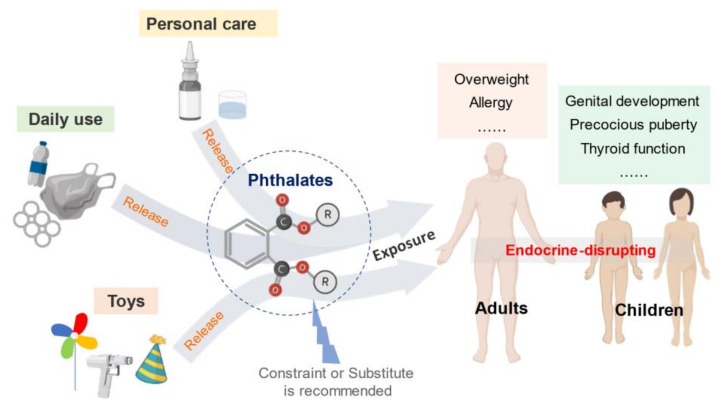
Phthalates are a series of widely used chemicals that demonstrate to be endocrine disruptors and are detrimental to human health. Phthalates can be found in most products that have contact with plastics during producing, packaging, or delivering. Despite the short half-lives in tissues, chronic exposure to phthalates will adversely influence the endocrine system and functioning of multiple organs, which has negative long-term impacts on the success of pregnancy, child growth and development, and reproductive systems in both young children and adolescents. Several countries have established restrictions and regulations on some types of phthalates; however, we think that more countries should establish constraints or substitute measures for phthalates to reduce health risks. This article aims to summarize the adverse impacts of phthalates on human health, analyze the toxicity mechanism, assess the risks, and finally provide feasible strategies to reduce exposure of the public to phthalates.
Overview
The claims and statistics of this paper haven’t been checked yet.
Free: it reads the open-access text and checks the first 5 claims that cite a source we can check. Create a free account to check every claim.
Integrity signals
Registry
Cites
Statistics
Figures
Verification
Claims the paper makes
The claims and statistics of this paper haven’t been checked yet.
Free: it reads the open-access text and checks the first 5 claims that cite a source we can check. Create a free account to check every claim.
Claims other papers make about this one
Each is checked against this paper’s own text: does it say what the citing paper says it does?
The source backs part of the claim, not all of it — or backs it for a different population, condition or comparison.
In the citing paper
“Phthalates disrupt normal biological processes through their ability to mimic hormones in the body, primarily estrogen (63).”
From The dark side of beauty: an in-depth analysis of the health hazards and toxicological impact of synthetic cosmetics and personal care products (2024) · cites this paper as [63]
Experimental — accuracy not yet measured
Self-check
Percentages, sums and reported differences re-computed from the paper’s own numbers.
The self-check needs the paper’s full text.
Citations
Cites
Phthalates: Toxicology and exposure
Heudorf, U., Mersch-Sundermann, V., & Angerer, J. (2007) · International Journal of Hygiene and Environmental Health · doi:10.1016/j.ijheh.2007.07.011 · Cited by 1,489
Toxic Pollutants from Plastic Waste- A Review
Verma, R., Vinoda, K. S., Papireddy, M., & Gowda, A. N. S. (2016) · Procedia Environmental Sciences · doi:10.1016/j.proenv.2016.07.069 · Cited by 1,052
A Review of Biomonitoring of Phthalate Exposures
Wang, Y., Zhu, H., & Kannan, K. (2019) · Toxics · doi:10.3390/toxics7020021 · Cited by 822
Self-citationPhthalates impact human health: Epidemiological evidences and plausible mechanism of action
Benjamin, S., Masai, E., Kamimura, N., Takahashi, K., Anderson, R. C., & Faisal, P. A. (2017) · Journal of Hazardous Materials · doi:10.1016/j.jhazmat.2017.06.036 · Cited by 747
Metabolism of phthalates in humans
Frederiksen, H., Skakkebaek, N. E., & Andersson, A. (2007) · Molecular Nutrition & Food Research · doi:10.1002/mnfr.200600243 · Cited by 652 · cited 2×
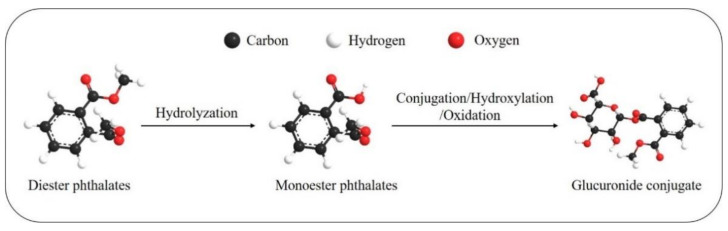
“The second step is conjugation to form the hydrophilic glucuronide conjugate, which is catalyzed by the enzyme uridine 5′-diphosphoglucuronyl transferase [14].”
BackgroundMethodReproductive and Developmental Toxicity of Phthalates
Lyche, J. L., Gutleb, A. C., Bergman, Å., Eriksen, G. S., Murk, A. J., Ropstad, E., Saunders, M., & Skaare, J. U. (2009) · Journal of Toxicology and Environmental Health, Part B · doi:10.1080/10937400903094091 · Cited by 607
Koch, H. M., Bolt, H. M., Preuss, R., & Angerer, J. (2005) · Archives of Toxicology · doi:10.1007/s00204-004-0642-4 · Cited by 557
Phthalates: metabolism and exposure
Wittassek, M., & Angerer, J. (2008) · International Journal of Andrology · doi:10.1111/j.1365-2605.2007.00837.x · Cited by 354
Reproducibility of urinary phthalate metabolites in first morning urine samples.
Hoppin, J. A., Brock, J. W., Davis, B. J., & Baird, D. D. (2002) · Environmental Health Perspectives · doi:10.1289/ehp.02110515 · Cited by 334
Jurewicz, J., & Hanke, W. (2011) · International Journal of Occupational Medicine and Environmental Health · doi:10.2478/s13382-011-0022-2 · Cited by 320
Phthalate Concentrations and Dietary Exposure from Food Purchased in New York State
Schecter, A., Lorber, M., Guo, Y., Wu, Q., Yun, S. H., Kannan, K., Hommel, M., Imran, N., Hynan, L. S., Cheng, D., et al. (2013) · Environmental Health Perspectives · doi:10.1289/ehp.1206367 · Cited by 312
Minireview: Endocrine disruptors: Past lessons and future directions
Schug, T. T., Johnson, A. F., Birnbaum, L. S., Colborn, T., Guillette, L. J., Crews, D. P., Collins, T., Soto, A. M., vom Saal, F. S., McLachlan, J. A., et al. (2016) · Molecular Endocrinology · doi:10.1210/me.2016-1096 · Cited by 282 · cited 1×
“These substances have been identified as endocrine-disrupting chemicals (EDCs) which interfere with normal hormonal actions [3,4].”
BackgroundPhthalate exposure and long-term epigenomic consequences: a review
Dutta, S., Haggerty, D. K., Rappolee, D. A., & Ruden, D. M. (2020) · Frontiers in Genetics · doi:10.3389/fgene.2020.00405 · Cited by 212 · cited 1×
“Phthalates are also found to cross the placenta-blood barrier, which is the major exposure route of the fetus [12].”
BackgroundGrindler, N. M., Vanderlinden, L., Karthikraj, R., Kannan, K., Teal, S., Polotsky, A. J., Powell, T. L., Yang, I. V., & Jansson, T. (2018) · Scientific Reports · doi:10.1038/s41598-018-24505-w · Cited by 177
Phthalate Exposure and Risk Assessment in California Child Care Facilities
Gaspar, F. W., Castorina, R., Maddalena, R. L., Nishioka, M. G., McKone, T. E., & Bradman, A. (2014) · Environmental Science & Technology · doi:10.1021/es501189t · Cited by 175
Phthalates contamination in China: Status, trends and human exposure-with an emphasis on oral intake
Wang, W., Leung, A. O. W., Chu, L. H., & Wong, M. H. (2018) · Environmental Pollution · doi:10.1016/j.envpol.2018.02.088 · Cited by 173
Koch, H. M., Wittassek, M., Brüning, T., Angerer, J., & Heudorf, U. (2011) · International Journal of Hygiene and Environmental Health · doi:10.1016/j.ijheh.2011.01.009 · Cited by 164
Xu, Z., Xiong, X., Zhao, Y., Xiang, W., & Wu, C. (2019) · Journal of Hazardous Materials · doi:10.1016/j.jhazmat.2019.121282 · Cited by 160
Lioy, P. J., Hauser, R. B., Gennings, C., Koch, H. M., Mirkes, P. E., Schwetz, B. A., & Kortenkamp, A. (2015) · Journal of Exposure Science & Environmental Epidemiology · doi:10.1038/jes.2015.33 · Cited by 158
Endocrine Disrupting Chemicals and Thyroid Cancer: An Overview
Alsen, M., Sinclair, C. F., Cooke, P. V., Ziadkhanpour, K., Genden, E. M., & van Gerwen, M. A. G. (2021) · Toxics · doi:10.3390/toxics9010014 · Cited by 158
Human Elimination of Phthalate Compounds: Blood, Urine, and Sweat (BUS) Study
Genuis, S. J., Beesoon, S., Lobo, R. A., & Birkholz, D. (2012) · The Scientific World Journal · doi:10.1100/2012/615068 · Cited by 154
Hartmann, C., Uhl, M., Weiss, S., Koch, H. M., Scharf, S., & König, J. S. (2015) · International Journal of Hygiene and Environmental Health · doi:10.1016/j.ijheh.2015.04.002 · Cited by 123
Vernet, C., Pin, I., Giorgis-Allemand, L., Philippat, C., Benmerad, M., Quentin, J., Calafat, A. M., Ye, X., Annesi-Maesano, I., Siroux, V., et al. (2017) · Environmental Health Perspectives · doi:10.1289/ehp1015 · Cited by 111
Phthalate Exposure in Girls During Early Puberty
Chou, Y.-Y., Huang, P., Lee, C., Wu, M.-H., & Lin, S.-J. (2009) · Journal of Pediatric Endocrinology and Metabolism · doi:10.1515/jpem.2009.22.1.69 · Cited by 109
Phthalate exposure and childhood overweight and obesity: Urinary metabolomic evidence
Xia, B., Zhu, Q., Zhao, Y., Ge, W., Zhao, Y., Song, Q., Zhou, Y., Shi, H., & Zhang, Y. (2018) · Environment International · doi:10.1016/j.envint.2018.09.001 · Cited by 104
The Association of Bisphenol A and Phthalates with Risk of Breast Cancer: A Meta-Analysis
Liu, G., Cai, W., Liu, H., Jiang, H., Bi, Y., & Wang, H. (2021) · International Journal of Environmental Research and Public Health · doi:10.3390/ijerph18052375 · Cited by 91
Søeborg, T., Frederiksen, H., & Andersson, A. M. (2012) · International Journal of Andrology · doi:10.1111/j.1365-2605.2011.01240.x · Cited by 90
Chen, C., Jiang, S. S., Chang, I., Wen, H., Sun, C.-W., & Wang, S. (2018) · Environmental Research · doi:10.1016/j.envres.2018.01.009 · Cited by 86
Ecological and health issues of plastic waste
Cook, C. R., & Halden, R. U. (2020) · Plastic Waste and Recycling · doi:10.1016/b978-0-12-817880-5.00020-7 · Cited by 83 · cited 1×
“, cosmetic packaging), and synthetic clothing [1,2].”
Non-dietary exposure to phthalates for pre-school children in kindergarten in Beijing, China
Wang, L., Wu, Z., Gong, M., Xu, Y., & Zhang, Y. (2019) · Building and Environment · doi:10.1016/j.buildenv.2019.106438 · Cited by 71
Li, N., Ying, G., Hong, H., Tsang, P. E., & Deng, W. (2020) · Environmental Pollution · doi:10.1016/j.envpol.2020.116394 · Cited by 66
Zhang, Y., Huang, B., Thomsen, M., Sabel, C. E., Hess, F., Hu, W., & Tian, K. (2018) · The Science of The Total Environment · doi:10.1016/j.scitotenv.2018.06.112 · Cited by 62
Jia, S., Sankaran, G., Wang, B., Shang, H., Tan, S. T., Yap, H. M., Shen, J., Gutiérrez, R. A., Fang, W., Liu, M., et al. (2019) · Chemosphere · doi:10.1016/j.chemosphere.2019.02.120 · Cited by 58
Bastiaensen, M., Gys, C., Colles, A., Malarvannan, G., Verheyen, V. J., Koppen, G., Govarts, E., Bruckers, L. M., Morrens, B., Franken, C., et al. (2021) · Environmental Pollution · doi:10.1016/j.envpol.2021.116724 · Cited by 54
Park, C.-B., Kim, G., Kim, Y. J., On, J., Park, C.-G., Kwon, Y. S., Pyo, H., Yeom, D.-H., & Cho, S. (2020) · Environmental Pollution · doi:10.1016/j.envpol.2020.114362 · Cited by 52
Phthalates: toxicology and food safety - a review
Mikula, P., Svobodová, Z., & Smutná, M. (2005) · Czech Journal of Food Sciences · doi:10.17221/3394-cjfs · Cited by 48
Tindula, G. N., Murphy, S. K., Grenier, C., Huang, Z., Huen, K., Escudero‐Fung, M., Bradman, A., Eskenazi, B., Hoyo, C., & Holland, N. (2018) · Epigenomics · doi:10.2217/epi-2017-0178 · Cited by 46
Ke, M., Ye, Y., Zhang, Z., Gillings, M. R., Qu, Q., Xu, N., Xu, L., Lu, T., Wang, J., & Qian, H. (2021) · The Science of The Total Environment · doi:10.1016/j.scitotenv.2021.145156 · Cited by 46
Self-citationBerman, Y. E., Doherty, D. A., Main, K. M., Frederiksen, H. W., Hickey, M., Keelan, J. A., Newnham, J. P., & Hart, R. J. (2021) · International Journal of Environmental Research and Public Health · doi:10.3390/ijerph18094725 · Cited by 38
Capela, D., & Mhaouty‐Kodja, S. (2020) · Chemosphere · doi:10.1016/j.chemosphere.2020.128191 · Cited by 36
Mutsuga, M., WAKUI, C., Kawamura, Y., & Maitani, T. (2002) · Food Additives & Contaminants · doi:10.1080/02652030210151886 · Cited by 24
[Cumulative risk assessment of phthalates exposure in preschool children].
Gao, H. J., Huang, K., Wu, X., Cai, X., Han, Y., Zhu, P., Hao, J., & Tao, F. (2019) · PubMed · doi:10.3760/cma.j.issn.0254-6450.2019.05.018 · Cited by 6
[Dietary intake and risk assessment of diethylhexyl phthalate in Chinese populations].
Sui, H., Jiang, D., Wu, P., Zhang, L., Liu, Z., & Yang, D. (2015) · PubMed · Cited by 4
Research works printed but not linked: 1
- Commission Regulation (EU) 2018/2005 Official Journal of the European Union. 17 December 2018 Available online: https://eur-lex.europa.eu/legal-content/EN/TXT/PDF/?uri=CELEX:32018R2005&from=EN (accessed on 4 June 2020)
Cited by
The world of plastic waste: A review
Nayanathara Thathsarani Pilapitiya, P. G. C., & Ratnayake, A. S. (2024) · Cleaner Materials · doi:10.1016/j.clema.2024.100220 · Cited by 1,034
Saxena, V. (2025) · Water, Air, & Soil Pollution · doi:10.1007/s11270-024-07702-4 · Cited by 492
The Minderoo-Monaco Commission on Plastics and Human Health
Landrigan, P. J., Raps, H., Cropper, M., Bald, C., Brunner, M., Canonizado, E. M., Charles, D., Chiles, T. C., Donohue, M. J., Enck, J., et al. (2023) · Annals of Global Health · doi:10.5334/aogh.4056 · Cited by 471
Mori, R. (2023) · RSC Sustainability · doi:10.1039/d2su00014h · Cited by 335
Mineral commodity summaries 2023
(2023) · doi:10.3133/mcs2023 · Cited by 331
Metadata
- Authors
- Wang, Y., & Qian, H.
- Affiliations
- Zhejiang University of Technology (CN)
- Corresponding author
- Qian, Haifeng
- Venue
- Healthcare
- Publisher
- MDPI AG
- Published
- 2021-05-18
- Volume
- 9
- Issue
- 5
- Pages
- 603
- ISSN
- 2227-9032 (ISSN-L)
- PMC
- PMC8157593
- OpenAlex
- W3163027615
- Cited by
- 633
- References
- 43
- Citations by year
- 2026: 123 · 2025: 188 · 2024: 159 · 2023: 115 · 2022: 40 · 2021: 8
- FWCI
- 7.70
- Type
- journal article
- Language
- en
- Open access
- gold
- doi.org
- Licence
- Locations
- Healthcare (publishedVersion, cc-by)
- PubMed Central (publishedVersion, cc-by)
- PubMed (publishedVersion)
- DOAJ (DOAJ: Directory of Open Access Journals) (submittedVersion, cc-by-sa)
- Funders
- National Natural Science Foundation of China (21777144)
- Topics
- Physical Sciences › Environmental Science › Health, Toxicology and Mutagenesis › Effects and risks of endocrine disrupting chemicals
- Physical Sciences › Environmental Science › Health, Toxicology and Mutagenesis › Toxic Organic Pollutants Impact
- Life Sciences › Pharmacology, Toxicology and Pharmaceutics › Toxicology › Pesticide Exposure and Toxicity
- Keywords
- phthalates, endocrine disruptors, human health effects, long-term exposure, reproductive toxicity, developmental toxicity, pregnancy outcomes, polymer additives, toxicity mechanisms, exposure reduction strategies
About these checks
Registry, retraction, Cites and statistics results are computed, not judged, with one exception: a printed reference that no index lists is read once by a model before it counts as a citation error. Claims are extracted by a model and kept only when their quote appears verbatim in the text; each cited source is then checked, with a model’s help, for whether it says what the claim relies on. Those verdicts can be wrong — read the claim’s quote and the cited source before relying on one.
Statistics and arithmetic are recomputed, not judged.
Confidence bands are shown only for fields calibrated on our annotated test set. None is calibrated yet, so no band is shown.
What counts as a claim ›How we measure confidence ›How we check this ›
Are you an author, or do you see a problem with this page? Request a review
Data sources
Bibliographic data: Semantic Scholar, OpenAlex, Crossref.
Contains information from the Semantic Scholar Academic Graph Datasets, made available under the ODC Attribution License (ODC-BY 1.0).
Semantic Scholar’s data is described in: Kinney, R., et al. (2023). The Semantic Scholar Open Data Platform. arXiv:2301.10140.
