

Associations between Personality Traits, Intolerance of Uncertainty, Coping Strategies, and Stress in Italian Frontline and Non-Frontline HCWs during the COVID-19 Pandemic—A Multi-Group Path-Analysis
Open accessThe DOI matches its Crossref record; 115 of the 117 references it cites were found in a registry or an index; 12 of the 55 sources its claims cite were checked for support.
Abstract
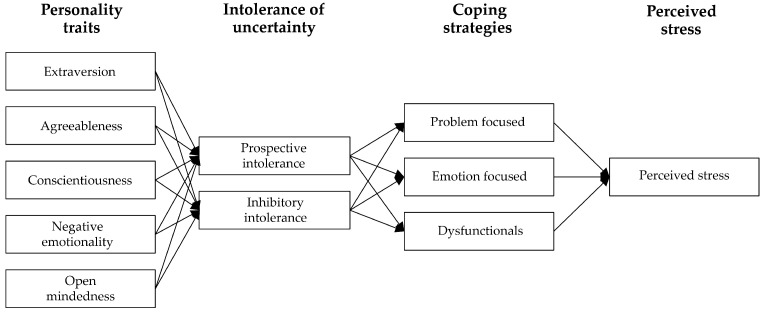
The COVID-19 pandemic represented a very difficult physical and psychological challenge for the general population and even more for healthcare workers (HCWs). The main aim of the present study is to test whether there were significant differences between frontline and non-frontline Italian HCWs concerning (a) personality traits, intolerance of uncertainty, coping strategies and perceived stress, and (b) the models of their associations. A total of 682 Italian HCWs completed a self-report questionnaire: 280 employed in COVID-19 wards and 402 in other wards. The analysis of variance omnibus test revealed significant differences between the two groups only for perceived stress, which was higher among the frontline. The multi-group path analysis revealed significant differences in the structure of the associations between the two groups of HCWs, specifically concerning the relations between: personality traits and intolerance of uncertainty; intolerance of uncertainty and coping strategies. Regarding the relation between coping strategies and stress no difference was identified between the two groups. In both of them, emotionally focused coping was negatively related with perceived stress, whereas dysfunctional coping was positively related with stress. These results could be useful in planning actions aiming to reduce stress and improve the effectiveness of HCWs’ interventions. Training programs aimed to provide HCWs with a skillset to tackle uncertain and stressful circumstances could represent an appropriate support to develop a preventive approach during outbreaks.
Overview
CoChat Summary
## TL;DR
This study of 682 Italian doctors and nurses found that frontline HCWs reported higher perceived stress than non-frontline HCWs, but the two groups did not differ in personality traits, intolerance of uncertainty, or coping strategies. A multi-group path analysis showed that the structure of associations differed by frontline status, especially for links between personality traits and intolerance of uncertainty and between intolerance of uncertainty and coping strategies.
## Key findings
- The sample included 682 Italian HCWs: 280 worked in COVID-19 wards (frontline) and 402 worked in other wards; 41.06% were frontline and 58.94% non-frontline.
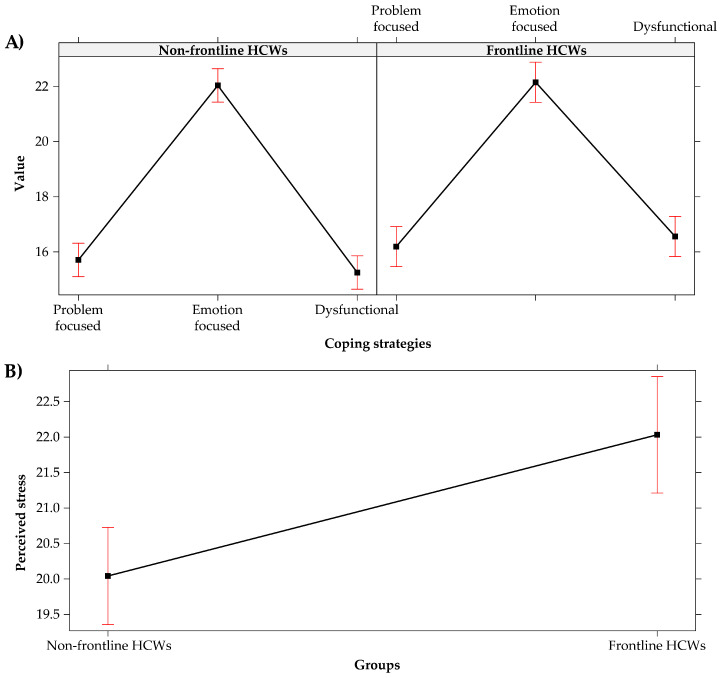
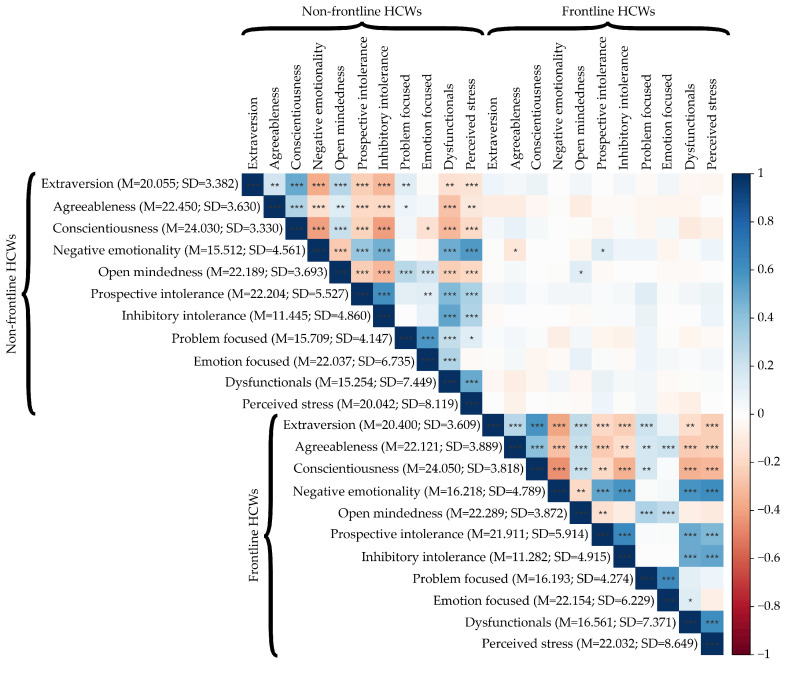
- Frontline HCWs had higher perceived stress than non-frontline HCWs: M = 22.032 (SD = 8.649) vs M = 20.042 (SD = 8.119), with a significant difference, F(1, 680) = 9.394, p = 0.002, Cohen’s d = 0.240.
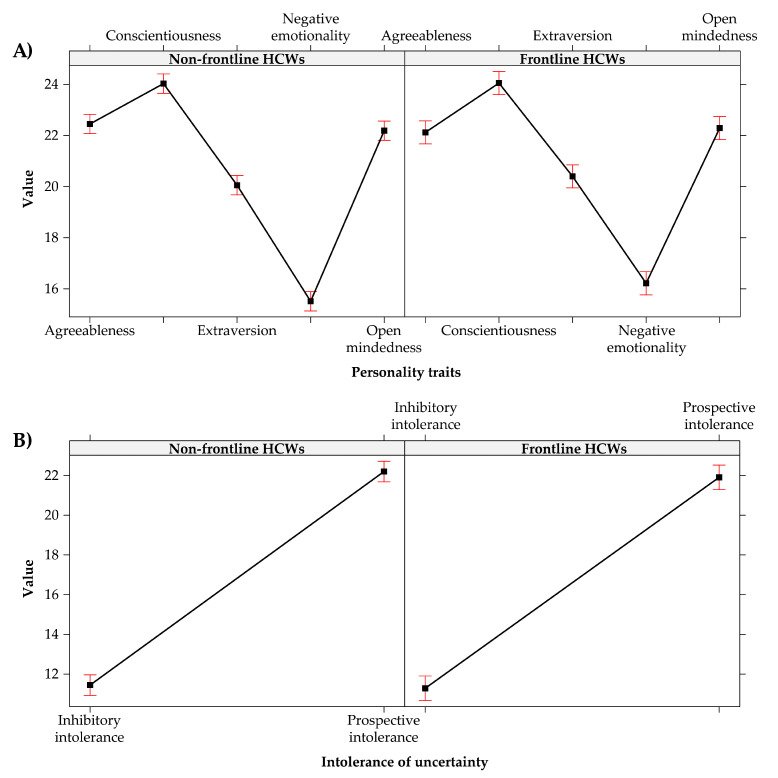
- No significant group differences were found for personality traits, intolerance of uncertainty, or coping strategies.
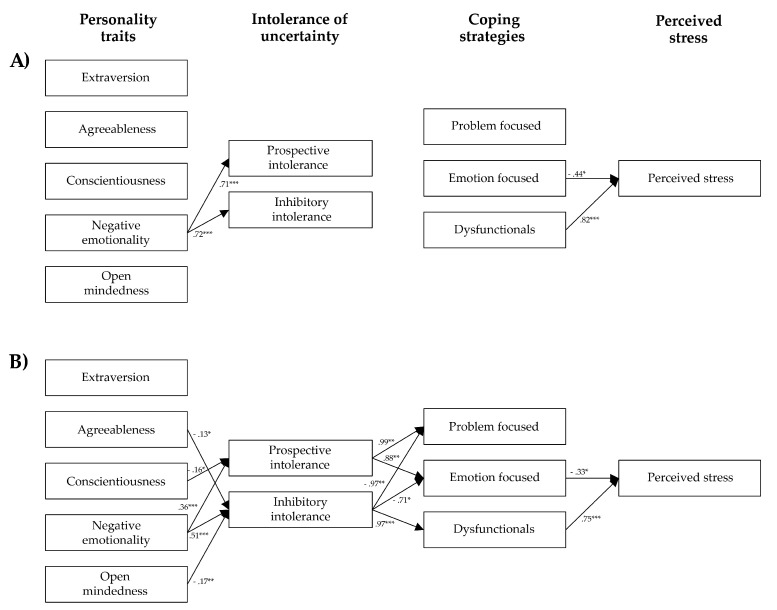
- In both groups, emotion-focused coping was negatively related to perceived stress, while dysfunctional coping was positively related to stress; problem-focused coping was not related to stress reduction.
- In the path model, neuroticism/negative emotionality was positively related to both prospective and inhibitory intolerance of uncertainty in both groups, but other trait–uncertainty links appeared only in the non-frontline group: conscientiousness was negatively related to prospective intolerance, and agreeableness and open-mindedness were negatively related to inhibitory intolerance.
## Methods
- Cross-sectional online survey of Italian HCWs (nurses and physicians) conducted from May 15 to July 30, 2020, during the first wave of COVID-19; snowball sampling was used.
- Measures included the BFI-2-S (personality traits), IUS-12 (intolerance of uncertainty), Brief-COPE (coping strategies), and IPSS-10 (perceived stress), plus demographic and work-related questions.
- Analysis used descriptive statistics, linear mixed models/linear models to compare frontline vs non-frontline groups, and a multi-group path analysis in lavaan with a DWLS estimator.
## Limitations
- The paper states that the study used self-report measures, a non-probabilistic sample, and a cross-sectional design, which may introduce bias and limit causal inference.
- The authors note that patient severity was not specified, and several variables were not considered, including years of service, age, medical specialization, and gender.
- Evident from the text: doctors and nurses were not randomly assigned to workplaces, so frontline vs non-frontline differences may reflect pre-existing workplace selection rather than exposure alone.
Model-written summary. Check it against the paper before relying on it.
Integrity signals
Registry
Cites
Statistics
Figures
Verification
Claims the paper makes
3 Valid · 0 Not valid · 15 Not checked · 48 Own results and interpretations
The cited sources support only part of this claim — read each source’s verdict below.
In the paper
“Consistently with the results of many studies on the psychological impact of past pandemics on health professionals [14,15,16], the literature published until now about COVID-19 revealed that HCWs are at particular risk of adverse psychological outcomes, i.e., of developing more severe mental symptoms, including stress, anxiety, depression, distress, insomnia, emotional exhaustion, burnout, as wel”
§ Associations between Personality Traits, Intolerance of Uncertainty, Coping Strategies, and Stress in Italian Frontline and Non-Frontline HCWs during the COVID-19 Pandemic—A Multi-Group Path-Analysis > 1. Introduction
What the sources say
- Supportedcites [14] Chong M.Y. Wang W.C. Hsieh W.C. Lee C.Y. Chiu N.M. Yeh W.C. Huang T.L. Wen J.H. Chen C.L. Psychological impact of severe acute respiratory syndrome on health workers in a tertiary hospital Br. J. Psychiatry 2004 185 127 133 10.1192/bjp.185.2.127 15286063 source
The cited paper is a study of the psychological impact of the SARS outbreak on health workers, matching the citing sentence’s reference to studies of past outbreaks. Its Psychiatric morbidity section (p. 5) reports anxiety, depression, stress and a high rate of psychiatric symptoms. The sentence attributes the COVID-19 findings to later literature, not to this SARS study. (LLM, conf=0.94)
- Not checked yetcites [15] Lee A.M. Wong J.G. McAlonan G.M. Cheung V. Cheung C. Sham P.C. Chu C.M. Wong P.C. Tsang K. Chua S.E. Stress and psychological distress among SARS survivors 1 year after the outbreak Can. J. Psychiatry 2007 52 233 240 10.1177/070674370705200405 17500304 source
- Not checked yetcites [16] Wu P. Fang Y. Guan Z. Fan B. Kong J. Yao Z. Liu X. Fuller C.J. Susser E. Lu J. The psychological impact of the SARS epidemic on hospital employees in China: Exposure, risk perception, and altruistic acceptance of risk Can. J. Psychiatry 2009 54 302 311 10.1177/070674370905400504 19497162 PMC3780353 source
- Partly supportedcites [17] Cabarkapa S. Nadjidai S.E. Murgier J. Ng C.H. The psychological impact of COVID-19 and other viral epidemics on frontline healthcare workers and ways to address it: A rapid systematic review Brain Behav. Immun. Health 2020 100144 10.1016/j.bbih.2020.100144 32959031 PMC7494453 sourceExperimental — accuracy not yet measured
The Results section (page unavailable) reports COVID-19-related stress, anxiety, depression, distress, insomnia and burnout among HCWs, including comparisons showing higher symptoms in HCWs than in non-HCWs. It reports post-traumatic stress symptoms during COVID-19, but the explicit PTSD diagnoses cited are from earlier outbreaks; it does not specifically report emotional exhaustion. Those distinctions limit support for the full list as stated. (LLM, conf=0.84)
- Partly supportedcites [18] Ahn M.H. Shin Y.W. Kim J.H. Kim H.J. Lee K.U. Chung S. High Work-related Stress and Anxiety Response to COVID-19 among Healthcare Workers in South Korea SAVE Study 2020 10.31234/osf.io/9nxth PMC8544732 34478401 sourceExperimental — accuracy not yet measured
The Introduction (page not provided) reports depression, anxiety, and stress among healthcare workers during COVID-19, and the Discussion reports elevated symptoms among nursing professionals. The Introduction links insomnia, burnout, and post-traumatic stress disorder to earlier outbreaks, not specifically to COVID-19; the paper does not establish emotional exhaustion as a COVID-19 outcome. (LLM, conf=0.87)
- Partly supportedcites [19] Barello S. Palamenghi L. Graffigna G. Burnout and somatic symptoms among frontline healthcare professionals at the peak of the Italian COVID-19 pandemic Psychiatry Res. 2020 290 113129 10.1016/j.psychres.2020.113129 32485487 PMC7255285 sourceExperimental — accuracy not yet measured
The Methods and findings section (page not available) reports elevated emotional exhaustion, burnout measures, and difficulty falling asleep among frontline Italian healthcare workers. The Discussions section describes substantial psychological pressure and risk of negative health consequences. The paper does not establish the full listed range of outcomes—including anxiety, depression, and post-traumatic stress disorder—or findings for HCWs generally. (LLM, conf=0.88)
- Partly supportedcites [20] Ricci-Cabello I. Meneses-Echavez J.F. Serrano-Ripoll M.J. Fraile-Navarro D. Fiol-Roque M.A. Moreno G.P. Castro A. Ruiz-Pérez I. Campos R.Z. Gonçalves-Bradley D. Impact of viral epidemic outbreaks on mental health of healthcare workers: A rapid systematic review and meta-analysis J. Affect. Disord. 2020 277 347 357 10.2139/ssrn.3569883 32861835 PMC7443314 sourceExperimental — accuracy not yet measured
The Results (Prevalence of mental health problems; page unavailable) report stress, anxiety, depression, burnout and PTSD among frontline healthcare workers during viral outbreaks; the study-characteristics table also lists insomnia. About half the reviewed studies concerned COVID-19, but the reported prevalence combines outbreaks, and the copy does not specifically report emotional exhaustion or establish the full list of outcomes for COVID-19 alone. (LLM, conf=0.86)
- Partly supportedcites [21] Du J. Dong L. Wang T. Yuan C. Fu R. Zhang L. Bo L. Zhang M. Yin Y. Qin J. Psychological symptoms among frontline healthcare workers during COVID-19 outbreak in Wuhan Gen. Hosp. Psychiatry 2020 67 144 145 10.1016/j.genhosppsych.2020.03.011 32381270 PMC7194721 sourceExperimental — accuracy not yet measured
The discussion reports moderate to severe stress and elevated anxiety and depression among frontline healthcare workers in Wuhan, and identifies them as a high-risk group for depression and anxiety. The results also report poor sleep quality, but our copy does not establish insomnia, emotional exhaustion, burnout, or post-traumatic stress disorder; its findings concern frontline workers in Wuhan rather than healthcare workers generally. (LLM, conf=0.88)
- Partly supportedcites [22] Giusti E.M. Pedroli E. D’Aniello G.E. Badiale C.S. Pietrabissa G. Manna G. Badiale M.S. Riva G. Castelnuovo G. Molinari E. The psychological impact of the COVID-19 outbreak on health professionals: A cross-sectional study Front. Psychol. 2020 11 1684 10.3389/fpsyg.2020.01684 32754102 PMC7366071 sourceExperimental — accuracy not yet measured
The Results and Discussion report anxiety, depression, stress, emotional exhaustion, burnout, and post-traumatic stress symptoms among health professionals during COVID-19; the Discussion also reports a review finding insomnia in this population. The paper does not establish that participants had post-traumatic stress disorder: it reports post-traumatic stress scores and symptoms, not PTSD diagnoses. (LLM, conf=0.85)
- Not checked yetcites [23] Guo J. Liao L. Wang B. Li X. Guo L. Tong Z. Guan Q. Zhou M. Wu Y. Zhang J. Psychological effects of COVID-19 on hospital staff: A national cross-sectional survey in mainland China Vasc. Investig. Ther. 2021 4 6 11 Available online: https://www.vitonline.org/article.asp?issn=2589-9686;year=2021;volume=4;issue=1;spage=6;epage=11;aulast=Guo (accessed on 23 July 2021) 10.4103/VIT-2 source
boostedstates an association- Asserted: passes — The authors put it forward as true.
- Checkable: passes — It can be checked against evidence.
- Load-bearing: passes — The paper’s conclusions depend on it.
- Based: passes — The paper gives a reason why it holds.
- Supported
A result the paper reports from its own data — it cites no other source for it, so there is none to check. The quote shows it is in the paper.
In the paper
“Regarding the relation between coping strategies and stress no difference was identified between the two groups.”
- Also stated in: § 1.3. Current Study · plain
“Regarding the relations between coping strategies and stress, no difference was identified.”
§ Associations between Personality Traits, Intolerance of Uncertainty, Coping Strategies, and Stress in Italian Frontline and Non-Frontline HCWs during the COVID-19 Pandemic—A Multi-Group Path-Analysis > Abstract The COVID-19 pandemic represented a very difficult physical and psychological challenge for the general population and even more for healthcare workers (HCWs). The main aim of the present study is to test whether there were significant differences between frontline and non-frontline Italian HCWs concerning (a) personality traits, intolerance of uncertainty, coping strategies and perceived stress, and (b) the models of their associations. A total of 682 Italian HCWs completed a self-report questionnaire: 280 employed in COVID-19 wards and 402 in other wards. The analysis of variance omnibus test revealed significant differences between the two groups only for perceived stress, which was higher among the frontline. The multi-group path analysis revealed significant differences in the structure of the associations between the two groups of HCWs, specifically concerning the relations between: personality traits and intolerance of uncertainty; intolerance of uncertainty and coping strategies. Regarding the relation between coping strategies and stress no difference was identified between the two groups. In both of them, emotionally focused coping was negatively related with perceived stress, whereas dysfunctional coping was positively related with stress. These results could be useful in planning actions aiming to reduce stress and improve the effectiveness of HCWs’ interventions. Training programs aimed to provide HCWs with a skillset to tackle uncertain and stressful circumstances could represent an appropriate support to develop a preventive approach during outbreaks.
plain- Asserted: passes — The authors put it forward as true.
- Checkable: passes — It can be checked against evidence.
- Load-bearing: passes — The paper’s conclusions depend on it.
- Based: passes — The paper gives a reason why it holds.
- Also stated in: § 1.3. Current Study · plain
A result the paper reports from its own data — it cites no other source for it, so there is none to check. The quote shows it is in the paper.
In the paper
“The multi-group path analysis revealed significant differences in the structure of the associations between the two groups of HCWs, specifically concerning the relations between: personality traits and intolerance of uncertainty; intolerance of uncertainty and coping strategies.”
- Also stated in: § 1.3. Current Study · plain
“The analyses revealed significant differences both in the levels of perceived stress, which were higher in the frontline HCWs than in the non-frontline, and in the structure of the associations between the two groups, specifically concerning the relations between: personality traits and intolerance of uncertainty; intolerance of uncertainty and coping strategies.”
§ Associations between Personality Traits, Intolerance of Uncertainty, Coping Strategies, and Stress in Italian Frontline and Non-Frontline HCWs during the COVID-19 Pandemic—A Multi-Group Path-Analysis > Abstract The COVID-19 pandemic represented a very difficult physical and psychological challenge for the general population and even more for healthcare workers (HCWs). The main aim of the present study is to test whether there were significant differences between frontline and non-frontline Italian HCWs concerning (a) personality traits, intolerance of uncertainty, coping strategies and perceived stress, and (b) the models of their associations. A total of 682 Italian HCWs completed a self-report questionnaire: 280 employed in COVID-19 wards and 402 in other wards. The analysis of variance omnibus test revealed significant differences between the two groups only for perceived stress, which was higher among the frontline. The multi-group path analysis revealed significant differences in the structure of the associations between the two groups of HCWs, specifically concerning the relations between: personality traits and intolerance of uncertainty; intolerance of uncertainty and coping strategies. Regarding the relation between coping strategies and stress no difference was identified between the two groups. In both of them, emotionally focused coping was negatively related with perceived stress, whereas dysfunctional coping was positively related with stress. These results could be useful in planning actions aiming to reduce stress and improve the effectiveness of HCWs’ interventions. Training programs aimed to provide HCWs with a skillset to tackle uncertain and stressful circumstances could represent an appropriate support to develop a preventive approach during outbreaks.
plainstates an association- Asserted: passes — The authors put it forward as true.
- Checkable: passes — It can be checked against evidence.
- Load-bearing: passes — The paper’s conclusions depend on it.
- Based: passes — The paper gives a reason why it holds.
- Also stated in: § 1.3. Current Study · plain
A result the paper reports from its own data — it cites no other source for it, so there is none to check. The quote shows it is in the paper.
In the paper
“The Chi-squared difference test between the multi-group unconstrained and constrained models revealed significant differences (see Table 2) between Italian frontline and non-frontline HCWs concerning the associations (structure of the relations) among personality traits, intolerance of uncertainty, coping strategies, and perceived stress.”
§ Associations between Personality Traits, Intolerance of Uncertainty, Coping Strategies, and Stress in Italian Frontline and Non-Frontline HCWs during the COVID-19 Pandemic—A Multi-Group Path-Analysis > 3. Results > 3.3. Multi-Group Path-Analysis
plainstates an association- Asserted: passes — The authors put it forward as true.
- Checkable: passes — It can be checked against evidence.
- Load-bearing: passes — The paper’s conclusions depend on it.
- Based: passes — The paper gives a reason why it holds.
A result the paper reports from its own data — it cites no other source for it, so there is none to check. The quote shows it is in the paper.
In the paper
“in the non-frontline one, while prospective intolerance of uncertainty was positively related to problem and emotion focused coping strategies (i.e., the more prospective intolerance of uncertainty, the more problem and emotion focused coping strategies)”
§ Associations between Personality Traits, Intolerance of Uncertainty, Coping Strategies, and Stress in Italian Frontline and Non-Frontline HCWs during the COVID-19 Pandemic—A Multi-Group Path-Analysis > 3. Results > 3.3. Multi-Group Path-Analysis
plainstates an association- Asserted: passes — The authors put it forward as true.
- Checkable: passes — It can be checked against evidence.
- Load-bearing: passes — The paper’s conclusions depend on it.
- Based: passes — The paper gives a reason why it holds.
22 more claims
Create a free account to see all 66 claims and to verify the 43 references still open.
- Probably not a substantial claim. 26
- It may state two separate claims as one. 21
- The quote only partly states this claim. 1
Claims other papers make about this one
Each is checked against this paper’s own text: does it say what the citing paper says it does?
The cited source says what the claim attributes to it.
In the citing paper
“In this scenario, stress related to the pandemic was affected by both dispositional and behavioral dimensions, and namely by variables like personality factors, intolerance to uncertainty, and coping strategies [16,17,18].”
From Impact of Stress during COVID-19 Pandemic in Italy: A Study on Dispositional and Behavioral Dimensions for Supporting Evidence-Based Targeted Strategies (2024) · cites this paper as [16]
Statistics that don’t add up
Each reported p-value recomputed from its test statistic and degrees of freedom, each partial η² from its F, and each ratio, mean difference or B printed with a p checked against its own confidence interval.
Rated minor: it would not touch a result — a value no result rests on, a p-value that stays on the same side of the significance level, or a conflict that is clerical, resolved elsewhere in the paper, or outside its own findings.
In the paper
“F(1, 1360) = 2.253, p = 0.106”
§ Associations between Personality Traits, Intolerance of Uncertainty, Coping Strategies, and Stress in Italian Frontline and Non-Frontline HCWs during the COVID-19 Pandemic—A Multi-Group Path-Analysis > 3. Results > 3.2. Analysis of Variance
Reported p = .106 · recomputed p = .134
Statistics recomputed
Every reported test result, recomputed from its test statistic and degrees of freedom. A result shows as not adding up only once an independent check has confirmed it.
- Doesn’t add upF(1, 1360) = 2.253reported p = .106 · recomputed p = .134
“F(1, 1360) = 2.253, p = .106”
- ConsistentF(4, 2720) = 1.664reported p = .155 · recomputed p = .156
“F(4, 2720) = 1.664, p = .155”
- ConsistentF(1, 680) = 0.131reported p = .718 · recomputed p = .718
“F(1, 680) = 0.131, p = .718”
- ConsistentF(1, 680) = 9.394reported p = .002 · recomputed p = .002
“F(1, 680) = 9.394, p = .002”
Self-check
Percentages, sums and reported differences re-computed from the paper’s own numbers.
Each contradiction between two passages listed here was confirmed by an independent check.
Rated minor: it would not touch a result — a value no result rests on, a p-value that stays on the same side of the significance level, or a conflict that is clerical, resolved elsewhere in the paper, or outside its own findings.
In the paper
§ Associations between Personality Traits, Intolerance of Uncertainty, Coping Strategies, and Stress in Italian Frontline and Non-Frontline HCWs during the COVID-19 Pandemic—A Multi-Group Path-Analysis > 2. Methods > 2.2. Measures
“We considered (throughout the article) as fit indexes the comparative fit index (CFI), the TLI, the RMSEA, and the SRMR, with CFI and TLI ≥ 0.90, RMSEA ≤ 0.08, and SRMR ≤ 0.06 as threshold values [85].”
§ Associations between Personality Traits, Intolerance of Uncertainty, Coping Strategies, and Stress in Italian Frontline and Non-Frontline HCWs during the COVID-19 Pandemic—A Multi-Group Path-Analysis > 2. Methods > 2.2. Measures
“The CFA outcomes supported the hypothesized structure: all standardized factor loadings resulted statistically significant (with values between 0.420 and 0.914), and the goodness of fit indexes acceptable (CFI = 0.911; TLI = 0.902; RMSEA = 0.079; SRMR = 0.088).”
Citations
Cites
A Global Measure of Perceived Stress
Cohen, S., Kamarck, T., & Mermelstein, R. (1983) · Journal of Health and Social Behavior · doi:10.2307/2136404 · Cited by 32,807 · cited 1×
“Although its original version consists of 14 items [92], the most commonly used is that consisting of”
Methodlavaan : An R Package for Structural Equation Modeling
Rosseel, Y. (2012) · Journal of Statistical Software · doi:10.18637/jss.v048.i02 · Cited by 27,955 · cited 1×
“A multi-group path-analysis was performed, using lavaan R software package [97], in order to test whether having worked in a dedicated COVID ward or not during the first wave of the pandemic in Italy would have determined differences in the associations (i.”
MethodAssessing coping strategies: A theoretically based approach.
Carver, C. S., Scheier, M. F., & Weintraub, J. K. (1989) · Journal of Personality and Social Psychology · doi:10.1037/0022-3514.56.2.267 · Cited by 11,507 · cited 1×
“The Italian HCWs’ coping strategies were evaluated using the Brief-COPE [66]; it is the short version of the original COPE (Coping Orientation to Problems Experienced) inventory [65].”
MethodJudgment under Uncertainty: Heuristics and Biases
(1982) · doi:10.1017/cbo9780511809477 · Cited by 8,240
Lai, J., Ma, S., Wang, Y., Cai, Z., Hu, J., Wei, N., Wu, J., Du, H., Chen, T., Li, R., et al. (2020) · JAMA Network Open · doi:10.1001/jamanetworkopen.2020.3976 · Cited by 8,015 · cited 1×
“Specifically, during the outbreak in 2020, both Italian [100,101] and Chinese [21] frontline HCWs reported high levels of perceived stress and were more exposed to psychological burden than second line HCWs in terms of anxiety, depression, insomnia, and distress [25].”
BackgroundYou want to measure coping but your protocol’ too long: Consider the brief cope
Carver, C. S. (1997) · International Journal of Behavioral Medicine · doi:10.1207/s15327558ijbm0401_6 · Cited by 7,361 · cited 8×
“In order to assess the goodness of fit indexes of the factor structure of the Italian version of the Brief-COPE scale, we performed a Confirmatory Factor Analysis (CFA).”
BackgroundMethodInfluentialAn Analysis of Coping in a Middle-Aged Community Sample
Folkman, S., & Lazarus, R. S. (1980) · Journal of Health and Social Behavior · doi:10.2307/2136617 · Cited by 6,328 · cited 1×
“, aiming to reduce or manage emotions related to the stressful situation) [63,64]; approach, (i.”
BackgroundJudgment Under Uncertainty: Heuristics and Biases.
Shafer, G. R., Kahnerman, D., Slovic, P., & Tversky, A. (1984) · Journal of the American Statistical Association · doi:10.2307/2288362 · Cited by 5,657
The structure of phenotypic personality traits.
Goldberg, L. R. (1993) · American Psychologist · doi:10.1037/0003-066x.48.1.26 · Cited by 4,816
(1988) · Cited by 4,111
Research works printed but not linked: 4
- Taylor S. The Psychology of Pandemics: Preparing for the Next Global Outbreak of Infectious Disease Cambridge Scholars Publishing Newcastle, UK 2019
- Lazarus R.S. Folkman S. Stress, Appraisal, and Coping Springer Publishing Company New York, NY, USA 1984
- Lazarus R.S. Psychological Stress and the Coping Process McGraw-Hill New York, NY, USA 1996
- Ruckmani V.S. Psychological perspective of uncertainty The Opportunities of Uncertainties: Flexibility and Adaptation Needed in Current Climate Shahana A.M. Sivakumar A. Parthiban V. Lulu Publication Raleigh, NC, USA 2021 Volume 1 1 9
Cited by
Frontline physician burnout during the COVID-19 pandemic: national survey findings
Melnikow, J., Padovani, A., & Miller, M. (2022) · BMC Health Services Research · doi:10.1186/s12913-022-07728-6 · Cited by 101
Temsah, M.-H. A., Alenezi, S., Alarabi, M., Aljamaan, F., Alhasan, K. A., Assiri, R., Bassrawi, R. K., Alshahrani, F. S., Alhaboob, A. A. N., Alaraj, A., et al. (2022) · International Journal of Environmental Research and Public Health · doi:10.3390/ijerph19041944 · Cited by 58
“As demonstrated in other HCWs’ samples [33,38], a higher intolerance of uncertainty is associated with higher stress.”
BackgroundResultInfluentialYe, H., Chen, C., Chen, S., Jiang, N., Cai, Z., Liu, Y., Li, Y., Huang, Y., Yu, W., You, R., et al. (2023) · Child Psychiatry & Human Development · doi:10.1007/s10578-023-01603-z · Cited by 38
Menaldi, S. L., Raharjanti, N. W., Wahid, M. H., Ramadianto, A. S., Nugrahadi, N. R., Adhiguna, G. M. Y. P., & Kusumoningrum, D. A. (2023) · PLoS ONE · doi:10.1371/journal.pone.0280313 · Cited by 34
A systematic review and meta-analysis of neuroticism and anxiety during the COVID-19 pandemic
Regzedmaa, E., Ganbat, M., Sambuunyam, M., Tsogoo, S., Radnaa, O., Lkhagvasuren, N., & Zuunnast, K. (2024) · Frontiers in Psychiatry · doi:10.3389/fpsyt.2023.1281268 · Cited by 36
Effects of chronic stress on smartphone addiction: A moderated mediation model
Qiu, H., Lü, H., Pei, J., Zhang, Y., Ma, Y., Xing, C., Wang, X., & Zhu, X. (2023) · Frontiers in Public Health · doi:10.3389/fpubh.2023.1048210 · Cited by 20
“A study on COVID19 found that different personality traits have different intolerance of uncertainty, which affects the intensity of perceived stress (30).”
BackgroundItalian validation of the situational Brief Cope Scale (I-Brief Cope)
Bongelli, R., Fermani, A., Canestrari, C., Riccioni, I., Muzi, M., Bertolazzi, A., & Burro, R. (2022) · PLoS ONE · doi:10.1371/journal.pone.0278486 · Cited by 22
“Even though, the Brief COPE has been translated also into Italian [60] and used in different contexts and with different population samples (patients [61–63]; general population [6]; healthcare workers [64,65], also during the Covid-19 pandemic (healthcare workers [25,26,66,67]; patients [68], general population [69–7…”
MethodSelf-citationCabello‐Toscano, M. R., Vaqué‐Alcázar, L., Cattaneo, G., Sánchez, J. S., Bayes‐Marin, I., Abellaneda‐Pérez, K., Macià, D., Mulet‐Pons, L., Portellano‐Ortiz, C., Fullana, M. A., et al. (2022) · Biological Psychiatry Cognitive Neuroscience and Neuroimaging · doi:10.1016/j.bpsc.2022.08.005 · Cited by 20
“Third, many other variables including individual dispositional factors, health- and family-related issues, and environmental and cultural aspects possibly affecting the investigated outcome were not considered here [see Discussion in (75)].”
BackgroundGraffeo, M. T., Albano, G., Salerno, L., Blasi, M. D., & Coco, G. L. (2022) · Psych · doi:10.3390/psych4020023 · Cited by 13
Lau, G. R., Kasturiratna, K. T. A. S., Goh, A. Y. H., Tong, E. M. W., & Hartanto, A. (2026) · Computers in Human Behavior Reports · doi:10.1016/j.chbr.2026.101186 · Cited by 19
The Robust Italian Validation of the Coping Humor Scale (RI-CHS) for Adult Health Care Workers
Burro, R., Fermani, A., Bongelli, R., Riccioni, I., Muzi, M., Bertolazzi, A., & Canestrari, C. (2022) · International Journal of Environmental Research and Public Health · doi:10.3390/ijerph19052522 · Cited by 7
“Despite the strong psychological impact of COVID-19 outbreak among Italian HCWs [55,60], up to now, only one study has been carried out on how Italian HCWs use coping humor [35].”
BackgroundSelf-citationDamghanian, H., Hedayati, S., Farhadinejad, M., & Rastgar, A. A. (2023) · Heliyon · doi:10.1016/j.heliyon.2023.e21445 · Cited by 7
“Therefore, direct contact with clients and money has increased the risk of employee contamination [60 – 62].”
BackgroundGesi, C., Cirnigliaro, G., Achilli, F., Cerioli, M., Cafaro, R., Boscacci, M., & Dell’Osso, B. M. (2023) · Journal of Clinical Medicine · doi:10.3390/jcm12051862 · Cited by 5
Elsayes, H. A., Zewiel, M. A. A., salamony, A. A. W. E., Ghoneim, N. I. A., Mohammed, A. M. S., Almadani, N. A., Alharbi, J. N., Abdeldafie, S. Y., Alsharif, F. H., & El-Refaay, S. M. M. (2023) · Perspectives In Psychiatric Care · doi:10.1155/2023/7281075 · Cited by 5
Sergi, M. R., Picconi, L., Fermani, A., Bongelli, R., Lezzi, S., Saggino, A., & Tommasi, M. (2023) · Societies · doi:10.3390/soc13070163 · Cited by 4
Self-citationSanz‐García, A., Liébana, S., García‐Vera, M. P., Sanz, J., Altungy, P., de Marina, A. G., Navarro‐McCarthy, A., & Marqueses, J. M. S. (2025) · Psicothema · doi:10.70478/psicothema.2025.37.06 · Cited by 6
Yang, X., Wang, L., Liu, X., Chen, M., Zheng, Y., Ma, S., Yuan, J., & Wang, H. (2025) · Frontiers in Psychology · doi:10.3389/fpsyg.2025.1628451 · Cited by 3
Believing Processes during the COVID-19 Pandemic: A Qualitative Analysis
Wagner‐Skacel, J., Tietz, S., Fleischmann, E., Fellendorf, F. T., Bengesser, S., Lenger, M., Reininghaus, E. Z., Mairinger, M., Körner, C., Pieh, C., et al. (2022) · International Journal of Environmental Research and Public Health · doi:10.3390/ijerph191911997 · Cited by 3
“The uncertainty combined with emotional and cognitive modifications and individual abilities as personality traits lead to high levels of psychological stress in these times [28].”
BackgroundKarami, Z., & Moradi, O. (2022) · Shenakht Journal of Psychology and Psychiatry · doi:10.32598/shenakht.9.4.16 · Cited by 2
Messner, W. (2023) · Journal of International Management · doi:10.1016/j.intman.2023.101056 · Cited by 3
Mevissen, F. E. F., van Deursen, B., Voeten, H. A. C. M., & Watzeels, A. (2023) · Journal of Public Health Research · doi:10.1177/22799036231208325 · Cited by 2
“30,33 The ever-changing protocols and policies were one of the strongest and most often mentioned complains of the contact tracers.”
BackgroundRiccioni, I., Bertolazzi, A., & Bongelli, R. (2024) · Language and Dialogue · doi:10.1075/ld.00173.ric · Cited by 1
Self-citationPlatania, G. A., Varrasi, S., Guerrera, C. S., Boccaccio, F. M., Torre, V., Vezzosi, V. F., Pirrone, C., & Castellano, S. (2024) · International Journal of Environmental Research and Public Health · doi:10.3390/ijerph21030330 · Cited by 1
“It should be remarked that, according to the literature, those with higher intolerance to uncertainty also experienced higher levels of stress [56], neuroticism, extraversion, and conscientiousness [16].”
BackgroundBirch, M., Inhaber, J., & Ashbaugh, A. R. (2024) · Anxiety Stress & Coping · doi:10.1080/10615806.2024.2423436 · Cited by 4
Connery, T., Doyle, M., Murphy, M. F., & Setti, A. (2025) · PLoS ONE · doi:10.1371/journal.pone.0323721 · Cited by 3
“For non-frontline workers, problem-focused coping positively correlated with extraversion, agreeableness and openness, while emotion-focused coping was positively associated with openness, and negatively associated with conscientiousness [14].”
InfluentialKhamis, F. A., Badahdah, A. M., & Aloud, N. (2025) · Journal of Evaluation in Clinical Practice · doi:10.1111/jep.70320 · Cited by 1
Barutçu, C. D., & Damar, H. T. (2025) · Journal of Emergency Nursing · doi:10.1016/j.jen.2025.04.018 · Cited by 1
Örgütsel Davranış Araştırmalarında PLS-SEM Kullanımı
Seyrek, İ. H. (2023) · Özgür Yayınları eBooks · doi:10.58830/ozgur.pub224.c967 · Cited by 6
Singh, S., Degeling, C., Drury, P., Montgomery, A., Caputi, P., & Deane, F. P. (2024) · Nursing Open · doi:10.1002/nop2.2184 · Cited by 1
“The IUS-12 has been used to evaluate clinician tolerance to uncertainty and has excellent consistency (Cronbach's α = 90) (Bongelli et al., 2021) and demonstrated good internal reliability in the current sample (Cronbach's α = 0.87).”
MethodInfluentialمنصور, م. ا., & سلام, د. ا. (2023) · مجلة مرکز الخدمة للاستشارات البحثية واللغات · doi:10.21608/jocr.2023.241310.1157
Moroni, L., Bottesi, G., Bertolotti, G., Cangiano, A., Rizza, C., Malerba, A., Picozzi, A., & Burro, R. (2023) · Stress and Health · doi:10.1002/smi.3349
Self-citationSayar, G., & Arkan, B. (2024) · Uludağ Üniversitesi Tıp Fakültesi Dergisi · doi:10.32708/uutfd.1407256 · Cited by 1
Saputra, M. O., Putra, A. P., Iman, M. I. N., Saputri, A. D., Saptarini, C., & Farhanah, S. (2023) · Proceeding Conference On Psychology and Behavioral Sciences · doi:10.61994/cpbs.v2i1.69 · Cited by 2
Student nurses’ perspective on readiness for clinical practice post-COVID-19 in South Africa
Olyn, K. P., & Mgutshini, T. (2025) · Health SA Gesondheid · doi:10.4102/hsag.v30i0.2790
“However, adaptability is also essential for clinical readiness (Bongelli et al. 2021).”
Yadav, B. A., Srinivasulu, G., Kumar, R. V. S. K., & Swetha, R. (2026) · Journal of Dr. YSR University of Health Sciences. · doi:10.4103/jdrntruhs.jdrntruhs_76_25
Akbıyık, B. S. Ü., Çitli, İ. İ., & Kahveci, M. M. (2026) · Behavioral Sciences · doi:10.3390/bs16040560
Connery, T., Doyle, M., Murphy, M. F., & Setti, A. (2026) · Current Psychology · doi:10.1007/s12144-026-09935-4
“Bongelli et al.’s (2021) study of 682 Italian professional caregivers found perceived stress to be positively associated with negative emotionality, and negatively associated with openness, conscientiousness, extraversion and agreeableness.”
Türk, R., Yıldız, G. K., Çoktay, Z., & Tuzcu, K. (2026) · BMC Psychology · doi:10.1186/s40359-026-05645-5
“Traumatic experiences adversely affect mental health, and intolerance of uncertainty influences coping stress, anxiety and hopelessness [56, 64–66].”
Lin, Z., Chan, I. K. N., & LOU, V. W. Q. (2026) · Healthcare · doi:10.3390/healthcare14203505
“Both have been consistently associated with reduced well-being and impaired capacity to cope with challenging caregiving situations [23,30,31].”
Arcucci, E., Falco, A., Rapisarda, S., Corso, L. D., Pividori, I., & Girardi, D. (2026) · Frontiers in Psychology · doi:10.3389/fpsyg.2026.1740056
Metadata
- Authors
- Bongelli, R., Canestrari, C., Fermani, A., Muzi, M., Riccioni, I., Bertolazzi, A., & Burro, R.
- Affiliations
- University of Macerata (IT)
- University of Verona (IT)
- Corresponding author
- Bongelli, Ramona
- ORCID
- Venue
- Healthcare
- Publisher
- MDPI AG
- Published
- 2021-08-23
- Volume
- 9
- Issue
- 8
- Pages
- 1086
- ISSN
- 2227-9032 (ISSN-L)
- PMC
- PMC8391534
- OpenAlex
- W3194788348
- Semantic Scholar
- 221204ef3490e77671c12fb0e14bff35ea3cdc04
- Cited by
- 38
- References
- 117
- Citations by year
- 2026: 5 · 2025: 6 · 2024: 6 · 2023: 13 · 2022: 8
- FWCI
- 4.60
- Type
- journal article
- Language
- en
- Open access
- gold
- doi.org
- Licence
- Locations
- Healthcare (publishedVersion, cc-by)
- PubMed Central (publishedVersion, cc-by)
- PubMed (publishedVersion)
- U-PAD Unimc - Open Digital Publications (University of Macerata) (submittedVersion, cc-by)
- DOAJ (DOAJ: Directory of Open Access Journals) (submittedVersion, cc-by-sa)
- Topics
- Social Sciences › Psychology › Clinical Psychology › COVID-19 and Mental Health
- Social Sciences › Psychology › Social Psychology › Stress and Burnout Research
- Health Sciences › Health Professions › General Health Professions › Healthcare professionals’ stress and burnout
- Keywords
- COVID-19 pandemic, healthcare workers, personality traits, intolerance of uncertainty, coping strategies, perceived stress, dysfunctional coping, occupational stress
About these checks
Registry, retraction, Cites and statistics results are computed, not judged, with one exception: a printed reference that no index lists is read once by a model before it counts as a citation error. Claims are extracted by a model and kept only when their quote appears verbatim in the text; each cited source is then checked, with a model’s help, for whether it says what the claim relies on. Those verdicts can be wrong — read the claim’s quote and the cited source before relying on one.
The claim verdicts this report counts are experimental: their accuracy is not yet measured.
A language model drew the claims from the paper on 2026-10-11, under version 3 of the claim definition (model deepseek-v4.1-flash, prompt extract-v3).
A second model labelled each claim on 2026-10-11 (model jev-1.13-20260917, definition revision gold-guideline-v0.2).
Cited sources are checked with a language model’s help (gpt-6-sol).
Statistics and arithmetic are recomputed, not judged.
Confidence bands are shown only for fields calibrated on our annotated test set. None is calibrated yet, so no band is shown.
What counts as a claim ›How we measure confidence ›How we check this ›
Are you an author, or do you see a problem with this page? Request a review
Data sources
Bibliographic data: Semantic Scholar, OpenAlex, Crossref.
Contains information from the Semantic Scholar Academic Graph Datasets, made available under the ODC Attribution License (ODC-BY 1.0).
Semantic Scholar’s data is described in: Kinney, R., et al. (2023). The Semantic Scholar Open Data Platform. arXiv:2301.10140.
