

The Rise of Wine among Ancient Civilizations across the Mediterranean Basin
Open accessThe DOI matches its Crossref record; 156 of the 157 references it cites were found in a registry or an index; none of the 325 sources its claims cite is checked for support yet.
Abstract
The purpose of this work is to present the archaeological and historical background of viticulture and winemaking from ancient times to the present day in the Mediterranean basin. According to recent archaeological, archaeochemical and archaeobotanical data, winemaking emerged during the Neolithic period (c. 7th–6th millennium BC) in the South Caucasus, situated between the basins of the Black and Caspian Seas, and subsequently reached the Iberian Peninsula and Western Europe during the local beginning of Iron Age (c. 8th century BC), following the main maritime civilizations. This review summarises the most relevant findings evidencing that the expansion of wine production, besides depending on adequate pedo-climatic conditions and wine-growing practices, also required the availability of pottery vessels to properly ferment, store and transport wine without deterioration. The domestication of wild grapevines enabled the selection of more productive varieties, further sustaining the development of wine trade. Other fermented beverages such as mead and beer gradually lost their relevance and soon wine became the most valorised. Together with grapes, it became an object and a system of value for religious rituals and social celebrations throughout successive ancient Western civilizations. Moreover, wine was used for medicinal purposes and linked to a wide variety of health benefits. In everyday life, wine was a pleasant drink consumed by the elite classes and commoner populations during jubilee years, festivals, and banquets, fulfilling the social function of easy communication. In the present work, emphasis is put on the technical interpretation of the selected archaeological and historical sources that may explain present viticultural and oenological practices. Hopefully, this review will contribute to nurturing mutual understanding between archaeologists and wine professionals.
Overview
CoChat Summary
TL;DR
This review synthesizes archaeological, archaeochemical, archaeobotanical, and historical evidence to argue that winemaking emerged during the Neolithic (c.7th–6th millennium BC) in the South Caucasus and spread across the Mediterranean, reaching the Iberian Peninsula and Western Europe by the local beginning of the Iron Age (c.8th century BC). It emphasizes pottery vessels, yeast and grapevine domestication, and wine’s enduring social, religious, medicinal, and economic roles.
Key findings
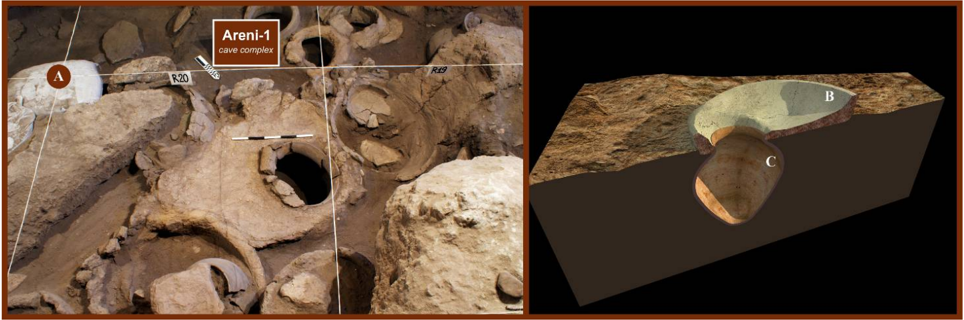
- The earliest culture associated with wine is dated 6000–4000 BC in the South Caucasus; winemaking evidence appears on pottery jars at Shulaveris Gora and Gadachrili Gora (c.6000 BC), and the Areni-1 cave complex in Armenia has a winemaking facility dated to 6100 years ago (c.4100 BC), with LC-MS/MS detecting tartaric acid and the red pigment anthocyanin malvidin.
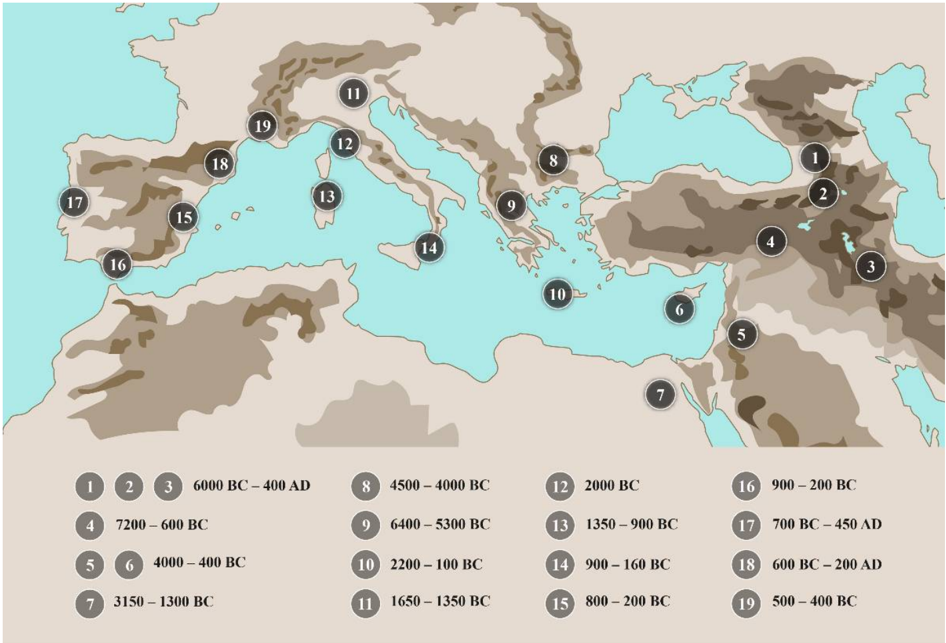
- Wine remains were recovered at Hajji Firuz Tepe in north-western Iran (c.5400–5000 BC); by 4000–2000 BC the Kura-Araxes/Early Transcaucasian Culture spread across the Near East, and during the Early Bronze Age (3500–2400 BC) wine gradually spread beyond the Armenian Highlands toward Mesopotamia, the East Mediterranean, Northern Africa, the Southern Balkans, and the Levant.
- For wine yeasts, 95% of strains isolated worldwide belong to the same cluster; divergence between wine and saké lineages is estimated at about 11,900 years, within the vineyard group about 2700 years and saké group about 3800 years, consistent with the earliest archaeological evidence for winemaking at approximately 9000 years before present.
- Chemical data in Table 4 show wild *V. sylvestris* wines from northeastern Spain with ethanol 8.5–10.8% (v/v), total acidity 8.2–9.5 g/L, pH 3.40–3.53, and colour intensity 10.2–11.5, while domesticated *V. sativa* from Israel had ethanol 11.0–11.9% (v/v), total acidity 2.6–6.0 g/L, pH 3.52–3.88, and colour intensity 2.5–8.6.
Methods
- Narrative review of archaeological, archaeochemical, archaeobotanical, pictorial, and written sources from ancient times to the present in the Mediterranean basin, with selected examples tracing techniques from the Black and Caspian Sea basins to the Mediterranean.
- Evidence includes pottery residues, archaeobotanical remains, inscriptions, papyri, ostraca, and classical texts such as Theophrastus, Cato, Varro, Columella, Pliny the Elder, Palladius, and the *Geoponika*; tables compile archaeological milestones and wine-composition data.
- No primary experimental data are presented; the work is a synthesis and technical interpretation from viticultural and oenological perspectives.
Limitations
- The paper states that the rarity of viable yeasts recovered from ancient ceramic vessels limits elucidation of relationships with ancient specimens; it also notes that the dating of grape domestication is subject to discussion and that identifying true *V. sylvestris* is difficult because of hybridization and feral populations.
- The paper notes that few known archaeological remains give an accurate idea of the true dimension of Phoenician wine in present Portuguese territory.
- Evident from the text: this is a narrative review with selected examples rather than a systematic review, so coverage is illustrative rather than exhaustive, and no explicit limitations section is provided.
Model-written summary. Check it against the paper before relying on it.
Integrity signals
Registry
Cites
Statistics
Figures
Verification
Claims the paper makes
0 Valid · 1 Not valid · 238 Not checked · 30 Own results and interpretations
In the paper
“The domestication was elicited by various divergent selective pressures depending on its niche (e.g., bread, saké, beer, wine), requiring the development of customized genomes for better survival in the fermenting environments”
§ The Rise of Wine among Ancient Civilizations across the Mediterranean Basin > 1.1.2. The Domestication of S. cerevisiae
What the sources say
- Not checked yetcites [33] Steensels, J.; Gallone, B.; Voordeckers, K.; Verstrepen, K.J. Domestication of industrial microbes. Curr. Biol. 2019, 29, R381-R393. [CrossRef] source
plainstates a cause- Asserted: passes — The authors put it forward as true.
- Checkable: passes — It can be checked against evidence.
- Load-bearing: unclear — It is unclear whether the paper’s conclusions depend on it.
- Based: passes — The paper gives a reason why it holds.
In the paper
“The production of fermented beverages and foods is contemporary with the onset and expansion of agriculture [5]”
§ The Rise of Wine among Ancient Civilizations across the Mediterranean Basin > 1.1. The Pre-Requisites for Producing Alcoholic Beverages
What the sources say
- Not checked yetcites [5] McGovern, P.E. Uncorking the Past: The Quest for Wine, Beer, and Other Alcoholic Beverages; University of California Press: Berkeley, CA, USA, 2009. source
plainstates an association- Asserted: passes — The authors put it forward as true.
- Checkable: passes — It can be checked against evidence.
- Load-bearing: unclear — It is unclear whether the paper’s conclusions depend on it.
- Based: passes — The paper gives a reason why it holds.
A conclusion the paper draws from its own results — it cites no other source for it, so there is none to check. The quote shows it is in the paper.
In the paper
“and subsequently reached the Iberian Peninsula and Western Europe during the local beginning of Iron Age (c.8th century BC), following the main maritime civilizations”
§ The Rise of Wine among Ancient Civilizations across the Mediterranean Basin > Abstract
plain- Asserted: passes — The authors put it forward as true.
- Checkable: passes — It can be checked against evidence.
- Load-bearing: passes — The paper’s conclusions depend on it.
- Based: unclear — It is unclear why the paper says it holds.
In the paper
“However, the process is limited by yeast ethanol tolerance that rarely supersedes 16 to 17% (v/v), depending on the fermentation conditions”
§ The Rise of Wine among Ancient Civilizations across the Mediterranean Basin > 1.1.3. The Suitability of S. cerevisiae Metabolic Performance and Crop Preservation
What the sources say
- Not checked yetcites [28] Ribéreau-Gayon, P.; Dubourdieu, D.; Donèche, B.B.; Lonvaud, A.A. Handbook of Enology. Volume 1, The Microbiology of Wine and Vinifications, 3rd ed.; John Wiley and Sons Ltd.: Chichester, UK, 2021. source
plainstates a cause- Asserted: passes — The authors put it forward as true.
- Checkable: passes — It can be checked against evidence.
- Load-bearing: unclear — It is unclear whether the paper’s conclusions depend on it.
- Based: passes — The paper gives a reason why it holds.
In the paper
“At the end of the 19th century, the classical Louis de Pasteur experience, where crushed grapes spontaneously fermented in laboratory flasks, if performed with sound and rot grapes, showed that S. cerevisiae is much more frequent in the samples with rotten grapes”
§ The Rise of Wine among Ancient Civilizations across the Mediterranean Basin > 1.1.1. Fermenting Yeasts: The Agents of Ethanol Production
What the sources say
- Not checked yetcites [31] Barata, A.; Malfeito-Ferreira, M.; Loureiro, V. The microbial ecology of wine grape berries. Int. J. Food Microbiol. 2012, 153, 243-259. [CrossRef] [PubMed] source
plainstates an association- Asserted: passes — The authors put it forward as true.
- Checkable: passes — It can be checked against evidence.
- Load-bearing: unclear — It is unclear whether the paper’s conclusions depend on it.
- Based: passes — The paper gives a reason why it holds.
133 more claims
Create a free account to see all 269 claims and to verify the 316 references still open.
- It may state two separate claims as one. 99
- Probably not a substantial claim. 55
- The quote only partly states this claim. 2
Self-check
Percentages, sums and reported differences re-computed from the paper’s own numbers.
Each contradiction between two passages listed here was confirmed by an independent check.
Rated minor: it would not touch a result — a value no result rests on, a p-value that stays on the same side of the significance level, or a conflict that is clerical, resolved elsewhere in the paper, or outside its own findings.
In the paper
§ The Rise of Wine among Ancient Civilizations across the Mediterranean Basin > 3.1. Grapevine Primary Domestication Centres
“during the Early Bronze Age (3500-3300 cal BP), to be the first place where domesticated varieties were surely used.”
§ The Rise of Wine among Ancient Civilizations across the Mediterranean Basin > 2.1. The First Steps of Wine-Growing and Consumption
“During the Early Bronze Age (EBA: 3500-2400 BC), wine gradually spread beyond the borders of the Armenian Highlands”
Rated minor: it would not touch a result — a value no result rests on, a p-value that stays on the same side of the significance level, or a conflict that is clerical, resolved elsewhere in the paper, or outside its own findings.
In the paper
§ The Rise of Wine among Ancient Civilizations across the Mediterranean Basin > 2.1. The First Steps of Wine-Growing and Consumption
“During the Early Bronze Age (EBA: 3500-2400 BC), wine gradually spread beyond the borders of the Armenian Highlands”
§ The Rise of Wine among Ancient Civilizations across the Mediterranean Basin > 4. Conclusions
“Late EBA(2400-2100 BC) | Plastered basins for treading grapes”
Citations
Cites
Zohary, D., Hopf, M., & Weiss, E. (2012) · Oxford University Press eBooks · doi:10.1093/acprof:osobl/9780199549061.001.0001 · Cited by 2,987
Population genomics of domestic and wild yeasts
Liti, G., Carter, D. M., Moses, A. M., Warringer, J., Parts, L., James, S. A., Davey, R. P., Roberts, I. N., Burt, A., Koufopanou, V., et al. (2009) · Nature · doi:10.1038/nature07743 · Cited by 1,392
Fermented beverages of pre- and proto-historic China
McGovern, P. E., Zhang, J., Tang, J., Zhang, Z., Hall, G. R., Moreau, R. A., Nuñez, A., Butrym, E. D., Richards, M. P., Wang, C.-S., et al. (2004) · Proceedings of the National Academy of Sciences · doi:10.1073/pnas.0407921102 · Cited by 1,091 · cited 1×
“Interestingly, the period is consistent with the earliest archaeological evidence for winemaking, approximately 9000 years before present times [39].”
ResultBrewers' spent grain: generation, characteristics and potential applications
Mussatto, S. I., Dragone, G., & Roberto, I. C. (2006) · Journal of Cereal Science · doi:10.1016/j.jcs.2005.06.001 · Cited by 1,086
Historical origins and genetic diversity of wine grapes
THIS, P., LACOMBE, T., & THOMAS, M. (2006) · Trends in Genetics · doi:10.1016/j.tig.2006.07.008 · Cited by 902
Genetic structure and domestication history of the grape
Myles, S., Boyko, A. R., Owens, C. L., Brown, P. J., Grassi, F., Aradhya, M. K., Prins, B., Reynolds, A., Chia, J.-M., Ware, D., et al. (2011) · Proceedings of the National Academy of Sciences · doi:10.1073/pnas.1009363108 · Cited by 790
The microbial ecology of wine grape berries
Barata, A., Malfeito-Ferreira, M., & Loureiro, V. (2012) · International Journal of Food Microbiology · doi:10.1016/j.ijfoodmicro.2011.11.025 · Cited by 703
Self-citationRibéreau‐Gayon, P., Dubourdieu, D., Donèche, B. B., Lonvaud, A. A., Darriet, P., & Towey, J. (2021) · Wiley eBooks · doi:10.1002/9781119588320 · Cited by 555
Bread, beer and wine: Saccharomyces cerevisiae diversity reflects human history
LEGRAS, J., MERDINOGLU, D., CORNUET, J., & KARST, F. (2007) · Molecular Ecology · doi:10.1111/j.1365-294x.2007.03266.x · Cited by 548
How did Saccharomyces evolve to become a good brewer?
PISKUR, J., ROZPEDOWSKA, E., POLAKOVA, S., MERICO, A., & COMPAGNO, C. (2006) · Trends in Genetics · doi:10.1016/j.tig.2006.02.002 · Cited by 513
Research works printed but not linked: 46
- McGovern, P.E.; Fleming, S.J.; Katz, S.H. (Eds.) The Origins and Ancient History of Wine (Food and Nutrition in History and Antropology Series No. 11); Routledge: London, UK; New York, NY, USA, 2003. · DOI · Paper page
- McGovern, P.E. Ancient Wine: The Search for the Origins of Viniculture; Princeton University Press: Princeton, NJ, USA, 2007.
- Unwin, T. Wine and the Vine: An Historical Geography of Viticulture and the Wine Trade; Routledge: London, UK; New York, NY, USA, 1996.
- Charters, S. Wine and Society: The Social and Cultural Context of a Drink; Butterworth-Heinemann: Oxford, UK, 2006.
- Rasmussen, S.C., Ed.; ACS Symposium Series No. 1211; American Chemical Society: Washington, DC, USA, 2015; pp. 89-138.
- Peacock, D., Blue, L., Whitewright, J., Eds.; BAR International Series No. 2286; Archaeopress: Oxford, UK, 2011; pp. 11-34.
- Dunbabin, K.M.D. The Roman Banquet: Images of Conviviality; Cambridge University Press: Cambridge, UK, 2003.
- Harutyunyan, A. Testimonies of wine offerings in the Armenian lapidary inscriptions. Rev. Ejmiatsin 2011, 2, 121-129.
- Lesko, L.H. Egyptian wine production during the New Kingdom. In The Origins and Ancient History of Wine; · DOI · Paper page
- Norrie, P. The History of Wine as a Medicine: From its Beginnings in China to the Present Day; Cambridge Scholars Publishing: Newcastle upon Tyne, UK, 2019.
- Jouanna, J. Wine and medicine in ancient Greece. In Greek Medicine from Hippocrates to Galen: Selected Papers; van der Eijk, P., Allies, N., Eds.; Brill: Leiden, The Netherlands, 2012; pp. 173-193.
- Godley, A.D. Herodotus: The Persian Wars; Volume I: Books 1-2; Loeb Classical Library 117; Harvard University Press: Cambridge, MA, USA, 1975.
- Hooper, W.D.; Ash, H. Varro: De Re Rustica (On Agriculture); Loeb Classical Library, Harvard University Press: Cambridge, MA, USA, 1934.
- Forster, E.S.; Heffner, E.H. Columella: On Agriculture; Volume II: Books 5-9; Loeb Classical Library 407; Harvard University Press: Cambridge, MA, USA, 1954.
- Forster, E.S.; Heffner, E.H. Columella: On Agriculture; Volume III: Books 10-12; On Trees. Loeb Classical Library 408; Harvard University Press: Cambridge, MA, USA, 1955.
- Rackham, H. Pliny: Natural History; Volume IV: Books 12-16; Loeb Classical Library 370; Harvard University Press: Cambridge, MA, USA, 1945.
- Rackham, H. Pliny: Natural History; Volume V: Books 17-19; Loeb Classical Library 371; Harvard University Press: Cambridge, MA, USA, 1950.
- Jones, W.H.S. Pliny: Natural History; Volume VI: Books 20-23; Loeb Classical Library 392; Harvard University Press: Cambridge, MA, USA, 1951.
- Gorny, R.L. Viticulture and Ancient Anatolia. In The Origins and Ancient History of Wine; · DOI · Paper page
- Renfrew, J.M. Palaeoethnobotanical finds of Vitis from Greece. In The Origins and Ancient History of Wine; · DOI · Paper page
- Badler, V.R. The dregs of civilization: 5000-year-old wine and beer: Residues from Godin Tepe, Iran. Bull. Can. Soc. Mesop. Stud. 2000, 35, 48-56.
- Menozzi, 2002, Palaeoenvironmental investigations in the Massaciuccoli basin (NW Tuscany, Italy), Atti Soc. Tosc. Sci. Nat. Mem. Serie B, 109, 177
- Castelletti, 1995, Indagine preliminare sull’archeologia della vite (Vitis vinifera L.) in base ai caratteri diagnostici del vinacciolo, Riv. Archeol. Dell’antica Prov. Diocesi Como, 176, 333
- Gómez-Bellard, C., Guérin, P., and Pérez-Jordà, G. (1993). Témoignage d’une production de vin dans l’Espagne préromaine. La production du vin et de L’huile en Méditerranée. Actes du Symposium International, Aix-en-Provence et Toulon, 20–22 Novembre, 1991, École française d’Athènes. Bulletin de Correspondance Hellénique, Supplément 26.
- Janssen, 1985, A preliminary palynological study of peat deposits near an oppidum in the Lower Tagus Valley, Portugal. Actas Reun. Quaternário Ibérico 1985, 2, 226–236, Actas Reun. Quaternário Ibérico, 2, 226
- Avetisyan, 2008, Recently found archaeological sites of Armenia (Agarak), Aram. Armen. J. Near East. Stud., 3, 39
- Kalantaryan, 2005, Newly discovered rock-cut mausoleum of Agarak, Cult. Anc. Armen., 13, 154
- 2018, Various aspects of the Turdetani-Punic wine and winery of the sierra de San Cristóbal, in El Puerto de Santa María (Cádiz), Rev. Hist. Puerto, 60, 9
- Brun, J.-P., Garnier, N., Olcese, G., Eds.; Propylaeum: Heidelberg, Germany, 2020; pp. 73-87. 137.
- Maghradze, D., Rustioni, L., Turok, J., Scienza, A., Failla, O., Eds.; Julius Kühn-Institut: Quedlinburg, Germany, 2012; pp. 27-38. 146.
- Hmayakyan, 2010, The Hittite marnuwa, Aram. Armen. J. Near East. Stud., 5, 127
- Greppin, 2008, Did the good wines come from Armenia?, Aram. Armen. J. Near East. Stud., 3, 47
- McGovern, P.E., Fleming, S.J., Katz, S.H., Eds.; Routledge: London, UK; New York, NY, USA, 2003; pp. 123-131. 152. Palanjyan, R.S. Towards some problems of ancient wine-making of the Armenian Highland. In "BEYOND ARAGATS", Archae- ological Studies in Memory of Telemak Khachatryan; Avetisyan, H., Ed.; "Gitutjun" Publishing House: Yerevan, Armenia, 2018; pp. 276-280. 153.
- Powell, M.A. Wine and the vine in ancient Mesopotamia: The cuneiform evidence. In The Origins and Ancient History of Wine; · DOI · Paper page
- James, T.G.H. The earliest history of wine and its importance in ancient Egypt. In The Origins and Ancient History of Wine; · DOI · Paper page
- Palmer, R. Wine and viticulture in the Linear A and B texts of the Bronze Age Aegean. In The Origins and Ancient History of Wine; · DOI · Paper page
- Martínez-Valle, A., Ed.; Ayuntamiento de Requena: Valencia, Spain, 2013; pp. 149-158. 161.
- Allhoff, F. (2008). Muse in a stem glass: Art, wine, and philosophy. Wine and Philosophy: A Symposium on Thinking and Drinking, Blackwell Publishing.
- Dalby, A. (2003). Bacchus: A Biography, British Museum Press.
- Johnston, P.A. Pottery Production at the Phoenician colony of El Castillo de Doña Blanca (El Puerto de Santa María, Spain) c. 750-550 BCE. Ph.D. Dissertation, Harvard University, Cambridge, MA, USA, 2015. 165. Gómez-Bellard, C.; Costa, B.; Gómez-Bellard, F.; Gurrea, R.; Grau, E.; Martínez-Valle, R. La Colonización Fenicia de la Isla de Ibiza, Excavaciones Arqueológicas en España No. 157; Ministerio de Cultura: Madrid, Spain, 1990. 166. Arruda, A.M. A Idade do Ferro orientalizante no vale do Tejo: As duas margens de um mesmo rio. In Territorios Comparados: Los Valles del Guadalquivir, el Guadiana y el Tajo en Época Tartésica, Reunión Científica en Mérida, 3-4 Diciembre, 2015; Anejos de Archivo Español de Arqueología 80;
- Arruda, A.M., Ed.; Centro de Arqueologia da Universidade de Lisboa: Lisbon, Portugal, 2014; pp. 512-535. 168. Delpino, F. Viticoltura, produzione e consumo del vino nell'Etruria protostorica. In Archeologia Della Vite e del Vino in Toscana e nel Lazio: Dalle Tecniche Dell'Indagine Archeologica Alle Prospettive DELLA biologia Molecolare;
- Ciacci, A., Rendini, P., Zifferero, A., Eds.; All'Insegna del Giglio: Florence, Italy, 2012; pp. 189-199. 169.
- Ocete, 1999, Ecologia, ampelografía e estado sanitário de algumas populações de videira silvestre do Alentejo, Enologia, 33, 8
- Martins, 2009, Um regresso ao tema das videiras silvestres, Rev. Assoc. Port. Enol., 53, 8
- Olmo, H.P. The origin and domestication of the Vinifera grape. In The Origins and Ancient History of Wine; · DOI · Paper page
- Maghradze, D., Rustioni, L., Turok, J., Scienza, A., Failla, O., Eds.; Julius Kühn-Institut: Quedlinburg, Germany, 2012; pp. 39-43. 202.
Cited by
Adamashvili, N., Zhizhilashvili, N., & Tricase, C. (2024) · Computers · doi:10.3390/computers13030072 · Cited by 103
Evaluation of the Phytochemistry–Therapeutic Activity Relationship for Grape Seeds Oil
Gîtea, M., BUNGAU, S. G., Gîtea, D., Pașca, B., Purza, A. L., & Radu, A.-F. (2023) · Life · doi:10.3390/life13010178 · Cited by 62
Photosynthesis governed by nanoparticulate titanium dioxide. The Pisum sativum L. case study
Skiba, E., Pietrzak, M., Michlewska, S., Gruszka, J., Malejko, J., Godlewska‐Żyłkiewicz, B., & Wolf, W. M. (2023) · Environmental Pollution · doi:10.1016/j.envpol.2023.122735 · Cited by 33
Agroforestry Systems in Wine Production-Mitigating Climate Change in the Mosel Region
Riekötter, N., & Hassler, M. (2022) · Forests · doi:10.3390/f13111755 · Cited by 16
An evolution of forensic linguistics: From manual analysis to machine learning – A narrative review
Mani, R. T., Palimar, V., Pai, M. S., Shwetha, T. M., & Krishnan, M. N. (2025) · Forensic Science International Reports · doi:10.1016/j.fsir.2025.100417 · Cited by 14
Metadata
- Authors
- Harutyunyan, M., & Malfeito-Ferreira, M.
- Affiliations
- University of Lisbon (PT)
- LEAF—Linking Landscape, Environment, Agriculture and Food—Research Center, Associated Laboratory TERRA, Instituto Superior de Agronomia, Universidade de Lisboa, Tapada da Ajuda, 1349-017 Lisboa, Portugal
- Corresponding author
- Harutyunyan, Mkrtich
- Venue
- Heritage
- Publisher
- MDPI AG
- Published
- 2022-04-02
- Volume
- 5
- Issue
- 2
- Pages
- 788-812
- ISSN
- 2571-9408 (ISSN-L)
- OpenAlex
- W4225585618
- Semantic Scholar
- 9beb70de5a5c7a0812de1a3798d7f43fba24668b
- Cited by
- 76
- References
- 157
- Citations by year
- 2026: 22 · 2025: 24 · 2024: 17 · 2023: 9 · 2022: 4
- FWCI
- 18.95
- Type
- journal article
- Language
- en
- Open access
- gold
- doi.org
- Licence
- Locations
- Heritage (publishedVersion, cc-by)
- DOAJ (DOAJ: Directory of Open Access Journals) (submittedVersion)
- Portuguese National Funding Agency for Science, Research and Technology (RCAAP Project by FCT) (submittedVersion, other-oa)
- Funders
- Calouste Gulbenkian Foundation (No239337/2020)
- Fundação para a Ciência e Tecnologia (UIDB/04129/2020 and UIDP/04129/2020)
- Topics
- Social Sciences › Archeology › Archaeology and ancient environmental studies
- Social Sciences › Arts and Humanities › Archeology (arts and humanities) › Ancient Mediterranean Archaeology and History
- Social Sciences › Business, Management and Accounting › Tourism, Leisure and Hospitality Management › Wine Industry and Tourism
- Keywords
- viticulture, winemaking, wine history, Mediterranean basin, Neolithic, South Caucasus, grapevine domestication, wine trade, ceramic vessel, fermented beverages, Mead, beer, religious rituals, archaeobotany, oenology
About these checks
Registry, retraction, Cites and statistics results are computed, not judged, with one exception: a printed reference that no index lists is read once by a model before it counts as a citation error. Claims are extracted by a model and kept only when their quote appears verbatim in the text; each cited source is then checked, with a model’s help, for whether it says what the claim relies on. Those verdicts can be wrong — read the claim’s quote and the cited source before relying on one.
A language model drew the claims from the paper on 2026-11-24, under version 3 of the claim definition (model deepseek-v4.1-flash, prompt extract-v3).
A second model labelled each claim on 2026-11-24 (model jev-1.13-20260917, definition revision gold-guideline-v0.2).
Statistics and arithmetic are recomputed, not judged.
Confidence bands are shown only for fields calibrated on our annotated test set. None is calibrated yet, so no band is shown.
What counts as a claim ›How we measure confidence ›How we check this ›
Are you an author, or do you see a problem with this page? Request a review
How to cite
Cite CoChat for the checks on this page, and the paper for its own findings.
- This page
- CoChat. (2026). Citation check: The Rise of Wine among Ancient Civilizations across the Mediterranean Basin. https://app.cochat.ai/papers/10.3390/heritage5020043
- The paper
- Harutyunyan, M., & Malfeito-Ferreira, M. (2022). The Rise of Wine among Ancient Civilizations across the Mediterranean Basin. Heritage. https://doi.org/10.3390/heritage5020043
Data sources
Bibliographic data: Semantic Scholar, OpenAlex, Crossref.
Contains information from the Semantic Scholar Academic Graph Datasets, made available under the ODC Attribution License (ODC-BY 1.0).
Semantic Scholar’s data is described in: Kinney, R., et al. (2023). The Semantic Scholar Open Data Platform. arXiv:2301.10140.
