

Burnout in Relation to Specific Contributing Factors and Health Outcomes among Nurses: A Systematic Review
Open accessThe DOI matches its Crossref record; 93 of the 93 references it cites were found in a registry or an index.
Abstract
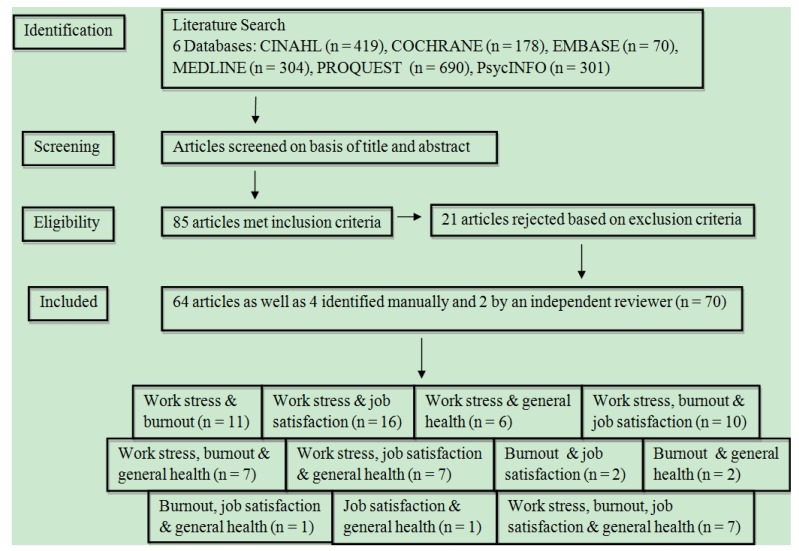
Nurses have been found to experience higher levels of stress-related burnout compared to other health care professionals. Despite studies showing that both job satisfaction and burnout are effects of exposure to stressful working environments, leading to poor health among nurses, little is known about the causal nature and direction of these relationships. The aim of this systematic review is to identify published research that has formally investigated relationships between these variables. Six databases (including CINAHL, COCHRANE, EMBASE, MEDLINE, PROQUEST and PsyINFO) were searched for combinations of keywords, a manual search was conducted and an independent reviewer was asked to cross validate all the electronically identified articles. Of the eighty five articles that were identified from these databases, twenty one articles were excluded based on exclusion criteria; hence, a total of seventy articles were included in the study sample. The majority of identified studies exploring two and three way relationships (n = 63) were conducted in developed countries. Existing research includes predominantly cross-sectional studies (n = 68) with only a few longitudinal studies (n = 2); hence, the evidence base for causality is still very limited. Despite minimal availability of research concerning the small number of studies to investigate the relationships between work-related stress, burnout, job satisfaction and the general health of nurses, this review has identified some contradictory evidence for the role of job satisfaction. This emphasizes the need for further research towards understanding causality.
Overview
The claims and statistics of this paper haven’t been checked yet.
Free: it reads the open-access text and checks the first 5 claims that cite a source we can check. Create a free account to check every claim.
Integrity signals
Registry
Cites
Statistics
Figures
Verification
Claims the paper makes
The claims and statistics of this paper haven’t been checked yet.
Free: it reads the open-access text and checks the first 5 claims that cite a source we can check. Create a free account to check every claim.
Claims other papers make about this one
Each is checked against this paper’s own text: does it say what the citing paper says it does?
The source backs part of the claim, not all of it — or backs it for a different population, condition or comparison.
In the citing paper
“Similarly, documentation responsibilities for nurses can consume up to 60% of their time and account for considerable work stress11–13.”
From Adapted large language models can outperform medical experts in clinical text summarization (2024) · cites this paper as [11]
Experimental — accuracy not yet measured
Self-check
Percentages, sums and reported differences re-computed from the paper’s own numbers.
The self-check needs the paper’s full text.
Citations
Cites
The measurement of experienced burnout
Maslach, C., & Jackson, S. E. (1981) · Journal of Organizational Behavior · doi:10.1002/job.4030020205 · Cited by 14,496 · cited 1×
“evaluation of one’s work related to feelings of reduced competence) [1,2].”
BackgroundA scaled version of the General Health Questionnaire
Goldberg, D. P., & Hillier, V. F. (1979) · Psychological Medicine · doi:10.1017/s0033291700021644 · Cited by 5,459 · cited 1×
“related to anxiety, depression, somatic symptoms and/or social dysfunction [24].”
BackgroundHospital Nurse Staffing and Patient Mortality, Nurse Burnout, and Job Dissatisfaction
Aiken, L. H. (2002) · JAMA · doi:10.1001/jama.288.16.1987 · Cited by 5,226
Maslach, C. (1982) · Cited by 2,389
The Truth about Burnout: How Organizations Cause Personal Stress and What to Do about It
Maslach, C., & Leiter, M. P. (1997) · Cited by 2,001
Job Burnout: New Directions in Research and Intervention
Maslach, C. (2003) · Current Directions in Psychological Science · doi:10.1111/1467-8721.01258 · Cited by 1,489
A model of burnout and life satisfaction amongst nurses
Demerouti, E., Bakker, A. B., Nachreiner, F., & Schaufeli, W. B. (2000) · Journal of Advanced Nursing · doi:10.1046/j.1365-2648.2000.01496.x · Cited by 785
McHugh, M. D., Kutney-Lee, A., Cimiotti, J. P., Sloane, D. M., & Aiken, L. H. (2011) · Health Affairs · doi:10.1377/hlthaff.2010.0100 · Cited by 770 · cited 3×
“Nurses providing direct care while working in poor environments report higher burnout and lower job satisfaction [58].”
BackgroundInfluentialJob satisfaction among hospital nurses revisited: A systematic review
Lu, H., Barriball, K. L., Zhang, X., & While, A. E. (2012) · International Journal of Nursing Studies · doi:10.1016/j.ijnurstu.2011.11.009 · Cited by 562 · cited 1×
“Limited research has identified studies confirming two and three way relationships between work related stress and job satisfaction [20], work related stress, job satisfaction and burnout [21], as well as”
BackgroundJob demands–resources, burnout and intention to leave the nursing profession: A questionnaire survey
Jourdain, G., & Chênevert, D. (2010) · International Journal of Nursing Studies · doi:10.1016/j.ijnurstu.2009.11.007 · Cited by 427 · cited 2×
“001) are significantly associated with psychosomatic complaints [69]”
Background
Research works printed but not linked: 3
- Maslach C. Jackson S.E. Maslach Burnout Inventory: Manual 2nd Consulting Psychologists Press Palo Alto, CA, USA 1986
- Engelbrecht M. Bester C.L. Van Den Berg H. Van Rensburg H.C.J. The Prediction of Psychological Burnout by Means of the Availability of Resources, Time Pressure or Workload, Conflict and Social Relations and Locus of Control of Professional Nurses in Public Health Centres in the Free State proceedings of the European Applied Business Conference (EABR) and Teaching and Learning Conference (TLC) Rothenburg, Germany 8–11 June 2008
- Turnbull J.M. Stress in Nursing Care Alzheimer’s Disease: A Handbook for Caregivers 2nd Hamdy R.C. Turnbull J.M. Clark. W Lancaster M.M. Mosby Boston, MA, USA 1994 319 327
Cited by
Salvagioni, D. A. J., Melanda, F. N., Mesas, A. E., González, A. D., Gabani, F. L., & Andrade, S. M. D. (2017) · PLOS ONE · doi:10.1371/journal.pone.0185781 · Cited by 1,508
Adapted large language models can outperform medical experts in clinical text summarization
Van Veen, D., Van Uden, C., Blankemeier, L., Delbrouck, J.-B., Aali, A., Bluethgen, C., Pareek, A., Polacin, M., Reis, E. P., Seehofnerová, A., et al. (2024) · Nature Medicine · doi:10.1038/s41591-024-02855-5 · Cited by 891
“Similarly, documentation responsibilities for nurses can consume up to 60% of their time and account for considerable work stress 11–13 .”
The relationship between professional burnout and quality and safety in healthcare: a meta-analysis
Salyers, M. P., Bonfils, K. A., Luther, L., Firmin, R. L., White, D. A., Adams, E. L., & Rollins, A. L. (2017) · Journal of General Internal Medicine · doi:10.1007/s11606-016-3886-9 · Cited by 843
Work Related Stress, Burnout, Job Satisfaction and General Health of Nurses
Khamisa, N., Oldenburg, B., Peltzer, K., & Ilic, D. (2015) · International Journal of Environmental Research and Public Health · doi:10.3390/ijerph120100652 · Cited by 828
“This is especially important in developing contexts, with majority of research exploring these relationships being conducted in developed contexts [25–27].”
BackgroundSelf-citationPrevalence of and Factors Associated With Nurse Burnout in the US
Shah, M. K., Gandrakota, N., Cimiotti, J. P., Ghose, N., Moore, M., & Ali, M. K. (2021) · JAMA Network Open · doi:10.1001/jamanetworkopen.2020.36469 · Cited by 671
Metadata
- Authors
- Khamisa, N., Peltzer, K., & Oldenburg, B.
- Affiliations
- IIE MSA (ZA)
- Human Sciences Research Council (ZA)
- Monash University (AU)
- Corresponding author
- Khamisa, Natasha
- Venue
- International Journal of Environmental Research and Public Health
- Publisher
- MDPI AG
- Published
- 2013-05-31
- Volume
- 10
- Issue
- 6
- Pages
- 2214-2240
- ISSN
- 1660-4601 (ISSN-L)
- PMC
- PMC3717733
- OpenAlex
- W2000706103
- Cited by
- 338
- References
- 93
- Citations by year
- 2026: 17 · 2025: 19 · 2024: 20 · 2023: 16 · 2022: 27 · 2021: 39 · 2020: 34 · 2019: 33 · 2018: 23 · 2017: 44 · 2016: 30 · 2015: 23 · 2014: 10 · 2013: 3
- FWCI
- 6.08
- Type
- journal article
- Language
- en
- Open access
- gold
- doi.org
- Licence
- Locations
- International Journal of Environmental Research and Public Health (publishedVersion, cc-by)
- Europe PMC (PubMed Central) (publishedVersion, cc-by)
- PubMed Central (publishedVersion, cc-by)
- PubMed (publishedVersion)
- Minerva Access (University of Melbourne) (submittedVersion, cc-by)
- RePEc: Research Papers in Economics (submittedVersion)
- Topics
- Health Sciences › Medicine › Public Health, Environmental and Occupational Health › Occupational Health and Burnout
- Social Sciences › Psychology › Social Psychology › Stress and Burnout Research
- Health Sciences › Health Professions › General Health Professions › Healthcare professionals’ stress and burnout
- Keywords
- burnout, nurses, job satisfaction, occupational stress, health outcomes, causal relationship
- MeSH terms
- Burnout, Professional, Health Status, Humans, Job Satisfaction, Nurses, Risk Factors, Databases, Factual
About these checks
Registry, retraction, Cites and statistics results are computed, not judged, with one exception: a printed reference that no index lists is read once by a model before it counts as a citation error. Claims are extracted by a model and kept only when their quote appears verbatim in the text; each cited source is then checked, with a model’s help, for whether it says what the claim relies on. Those verdicts can be wrong — read the claim’s quote and the cited source before relying on one.
Statistics and arithmetic are recomputed, not judged.
Confidence bands are shown only for fields calibrated on our annotated test set. None is calibrated yet, so no band is shown.
What counts as a claim ›How we measure confidence ›How we check this ›
Are you an author, or do you see a problem with this page? Request a review
Data sources
Bibliographic data: Semantic Scholar, OpenAlex, Crossref.
Contains information from the Semantic Scholar Academic Graph Datasets, made available under the ODC Attribution License (ODC-BY 1.0).
Semantic Scholar’s data is described in: Kinney, R., et al. (2023). The Semantic Scholar Open Data Platform. arXiv:2301.10140.
