

Work Environment Characteristics and Teacher Well-Being: The Mediation of Emotion Regulation Strategies
Open accessThe DOI matches its Crossref record; 76 of the 77 references it cites were found in a registry or an index.
Abstract
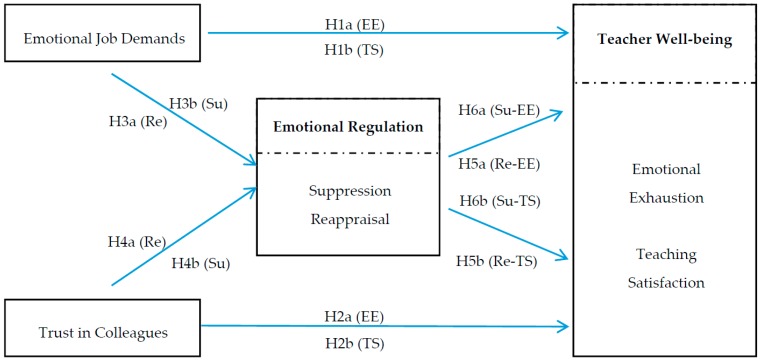
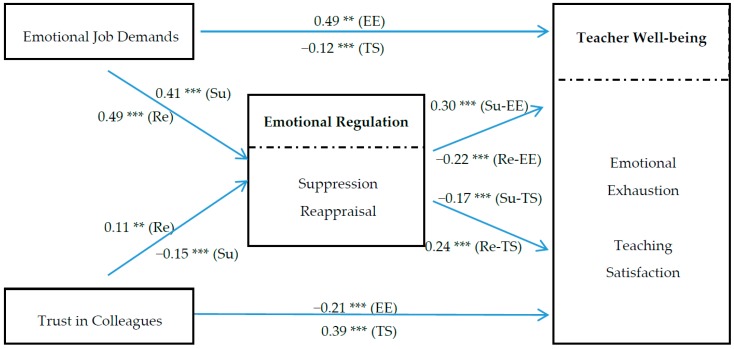
Based on an adjusted Job Demands-Resources (JD-R) model that considers the mediation of personal resources, this study examined the relationships between two characteristics of teachers’ work environment (i.e., emotional job demands and trust in colleagues) and two indicators of teachers’ well-being (i.e., teaching satisfaction and emotional exhaustion). In particular, the study focused on how emotion regulation strategies (i.e., reappraisal and suppression) mediate these relationships. Data collected from a questionnaire survey of 1115 primary school teachers in Hong Kong was analyzed to test the hypothesized relationships. The results of structural equation modeling indicated that: (1) the emotional job demands of teaching were detrimental to teacher well-being, whereas trust in colleagues was beneficial; (2) both emotion regulation strategies mediated the relationships between both emotional job demands and trust in colleagues and teacher well-being; and (3) teachers who tend to use more reappraisal may be psychologically healthier than those tend to adopt more suppression. These findings support the applicability of the JD-R model to school settings and highlight the role of teachers’ emotion regulation in teachers’ well-being. Implications for the improvement of school environments and teachers’ well-being are identified.
Overview
The claims and statistics of this paper haven’t been checked yet.
Free: it reads the open-access text and checks the first 5 claims that cite a source we can check. Create a free account to check every claim.
Integrity signals
Registry
Cites
Statistics
Figures
Verification
Claims the paper makes
The claims and statistics of this paper haven’t been checked yet.
Free: it reads the open-access text and checks the first 5 claims that cite a source we can check. Create a free account to check every claim.
Claims other papers make about this one
Each is checked against this paper’s own text: does it say what the citing paper says it does?
The source backs part of the claim, not all of it — or backs it for a different population, condition or comparison.
In the citing paper
“Teachers' trust in colleagues is positively associated with increased enthusiasm, teaching satisfaction, and contentment, and reduced anxiety, burnout, and depression (Huang et al., 2019;Yin et al., 2016Yin et al., , 2018)).”
From What do we know about interventions to improve educator wellbeing? A systematic literature review (2024) · cites this paper as Yin et al., 2016
Experimental — accuracy not yet measured
Self-check
Percentages, sums and reported differences re-computed from the paper’s own numbers.
The self-check needs the paper’s full text.
Citations
Cites
Structural equation modeling in practice: A review and recommended two-step approach
Anderson, J. C., & Gerbing, D. W. (1988) · Psychological Bulletin · doi:10.1037/0033-2909.103.3.411 · Cited by 41,941 · cited 1×
“The whole test process followed the two-step procedure advised by Anderson and Gerbing [63].”
Method“Stress: appraisal and coping,”
Folkman, S. (2013) · Encyclopedia of Behavioral Medicine · doi:10.1007/978-1-4419-1005-9_215 · Cited by 27,833
Maslow, A. H. (1943) · Psychological Review · doi:10.1037/h0054346 · Cited by 21,563 · cited 2×
“In addition, with regard to the creation of high-quality work environments, trust in colleagues may serve as a determinant and an indicator that teachers’ needs of safety, belongingness, and self-esteem have been satisfied to a certain degree [68].”
BackgroundThe job demands-resources model of burnout.
Demerouti, E., Bakker, A. B., Nachreiner, F., & Schaufeli, W. B. (2001) · Journal of Applied Psychology · doi:10.1037/0021-9010.86.3.499 · Cited by 13,643 · cited 1×
“As stated above, the validity of the JD-R model in different work contexts has been well documented [3,4,29].”
BackgroundThe Job Demands‐Resources model: state of the art
Bakker, A. B., & Demerouti, E. (2007) · Journal of Managerial Psychology · doi:10.1108/02683940710733115 · Cited by 12,996 · cited 3×
“Bakker and Demerouti defined job demands as job characteristics that “require sustained physical and/or psychological (cognitive or emotional) effort or skills and are therefore associated with certain physiological and/or psychological costs,” and job resources as job characteristics that are either “functional in ac…”
BackgroundMethodAsymptotic Confidence Intervals for Indirect Effects in Structural Equation Models
Sobel, M. E. (1982) · Sociological Methodology · doi:10.2307/270723 · Cited by 12,810
Psychological Safety and Learning Behavior in Work Teams
Edmondson, A. (1999) · Administrative Science Quarterly · doi:10.2307/2666999 · Cited by 12,026 · cited 1×
“People may feel more comfortable being themselves when safety has been ensured [55].”
BackgroundGross, J. J., & John, O. P. (2003) · Journal of Personality and Social Psychology · doi:10.1037/0022-3514.85.2.348 · Cited by 11,929 · cited 4×
“, reappraisal & suppression) and other relevant constructs [21].”
BackgroundMethodInfluential(2017) · Defining and Classifying Children in Need · doi:10.4324/9781315258324-16 · Cited by 11,320
Job demands, job resources, and their relationship with burnout and engagement: a multi‐sample study
Schaufeli, W. B., & Bakker, A. B. (2004) · Journal of Organizational Behavior · doi:10.1002/job.248 · Cited by 9,297 · cited 2×
“, [3–5,29,43]).”
Background
Cited by
Yin, H., Huang, S., & Chen, G. (2019) · Educational Research Review · doi:10.1016/j.edurev.2019.100283 · Cited by 300
Self-citationWang, H., Burić, I., Chang, M., & Gross, J. J. (2023) · Social Psychology of Education · doi:10.1007/s11218-023-09810-1 · Cited by 250
“…school and colleague support than others report employing more antecedent-focused emotion regulation and less response-focused emotion regulation in managing their teaching-related emotions (e.g., Chang et al., 2022b; Han et al., 2021; Mittal & Chhabra, 2011; Wu et al., 2020; Yin et al., 2016).”
BackgroundEmotion Display Rules, Emotion Regulation, and Teacher Burnout
Chang, M. (2020) · Frontiers in Education · doi:10.3389/feduc.2020.00090 · Cited by 224
Han, J., Yin, H., Wang, J., & Zhang, J. (2020) · Educational Psychology · doi:10.1080/01443410.2019.1674249 · Cited by 178
“One explanation for the weak link is that emotional exhaustion is a state of fatigue caused by strain on emotional resources (Yin et al., 2016), whereas in this study job resources were mainly measured by external resources available to teachers.”
BackgroundSelf-citationChen, J. (2018) · British Journal of Educational Psychology · doi:10.1111/bjep.12220 · Cited by 196
Metadata
- Authors
- Yin, H., Huang, S., & Wang, W.
- Affiliations
- Chinese University of Hong Kong (HK)
- South China Normal University (CN)
- Corresponding author
- Wang, Wenlan
- Venue
- International Journal of Environmental Research and Public Health
- Publisher
- MDPI AG
- Published
- 2016-09-13
- Volume
- 13
- Issue
- 9
- Pages
- 907
- ISSN
- 1660-4601 (ISSN-L)
- PMC
- PMC5036740
- OpenAlex
- W2519912664
- Cited by
- 214
- References
- 77
- Citations by year
- 2026: 23 · 2025: 36 · 2024: 38 · 2023: 26 · 2022: 21 · 2021: 21 · 2020: 16 · 2019: 18 · 2018: 10 · 2017: 4
- FWCI
- 20.66
- Type
- journal article
- Language
- en
- Open access
- gold
- doi.org
- Licence
- Locations
- International Journal of Environmental Research and Public Health (publishedVersion, cc-by)
- PubMed Central (publishedVersion, cc-by)
- PubMed (publishedVersion)
- RePEc: Research Papers in Economics (submittedVersion)
- DOAJ (DOAJ: Directory of Open Access Journals) (submittedVersion, cc-by-sa)
- Funders
- Research Grants Council of Hong Kong SAR (CUHK 14413314)
- Topics
- Social Sciences › Business, Management and Accounting › Organizational Behavior and Human Resource Management › Job Satisfaction and Organizational Behavior
- Health Sciences › Medicine › Public Health, Environmental and Occupational Health › Occupational Health and Burnout
- Social Sciences › Sociology and Political Science › Emotional Labor in Professions
- Keywords
- teacher well-being, work environment, emotional demands, trust in colleagues, emotion regulation, cognitive reappraisal, emotional suppression, teaching satisfaction, emotional exhaustion, job demands-resources model, primary school teachers, school environment
- MeSH terms
- School Teachers, Adult, Emotions, Female, Hong Kong, Humans, Male, Middle Aged, Personal Satisfaction, Social Environment, Workplace, Trust
About these checks
Registry, retraction, Cites and statistics results are computed, not judged, with one exception: a printed reference that no index lists is read once by a model before it counts as a citation error. Claims are extracted by a model and kept only when their quote appears verbatim in the text; each cited source is then checked, with a model’s help, for whether it says what the claim relies on. Those verdicts can be wrong — read the claim’s quote and the cited source before relying on one.
Statistics and arithmetic are recomputed, not judged.
Confidence bands are shown only for fields calibrated on our annotated test set. None is calibrated yet, so no band is shown.
What counts as a claim ›How we measure confidence ›How we check this ›
Are you an author, or do you see a problem with this page? Request a review
Data sources
Bibliographic data: Semantic Scholar, OpenAlex, Crossref.
Contains information from the Semantic Scholar Academic Graph Datasets, made available under the ODC Attribution License (ODC-BY 1.0).
Semantic Scholar’s data is described in: Kinney, R., et al. (2023). The Semantic Scholar Open Data Platform. arXiv:2301.10140.
