

Are Non-Pharmacological Interventions Effective in Reducing Drug Use and Criminality? A Systematic and Meta-Analytical Review with an Economic Appraisal of These Interventions
Open accessThe DOI matches its Crossref record; 89 of the 90 references it cites were found in a registry or an index, and 1 are not checked yet.
Abstract
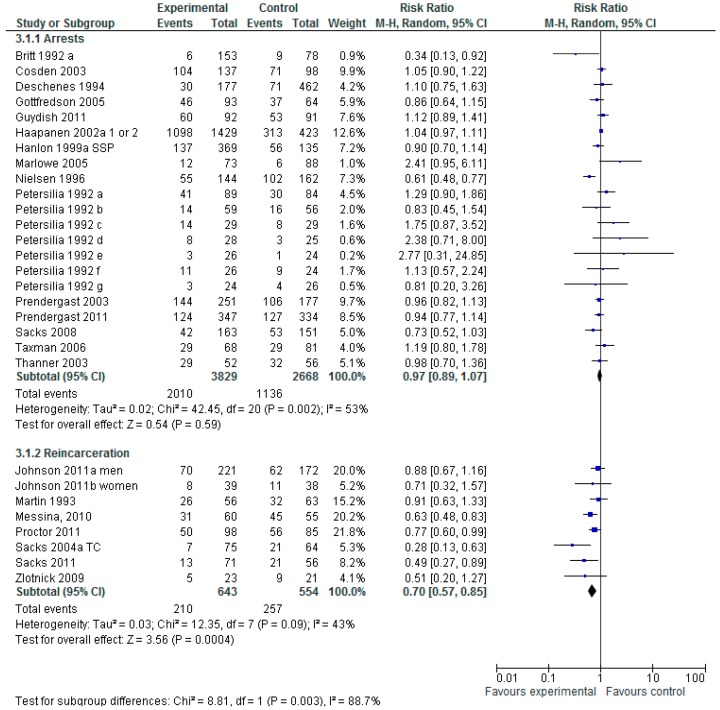
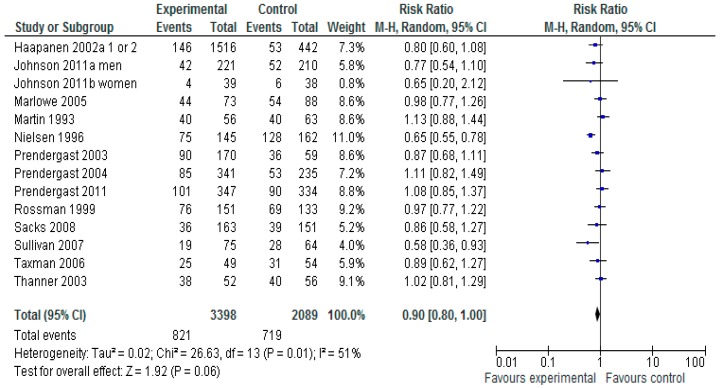
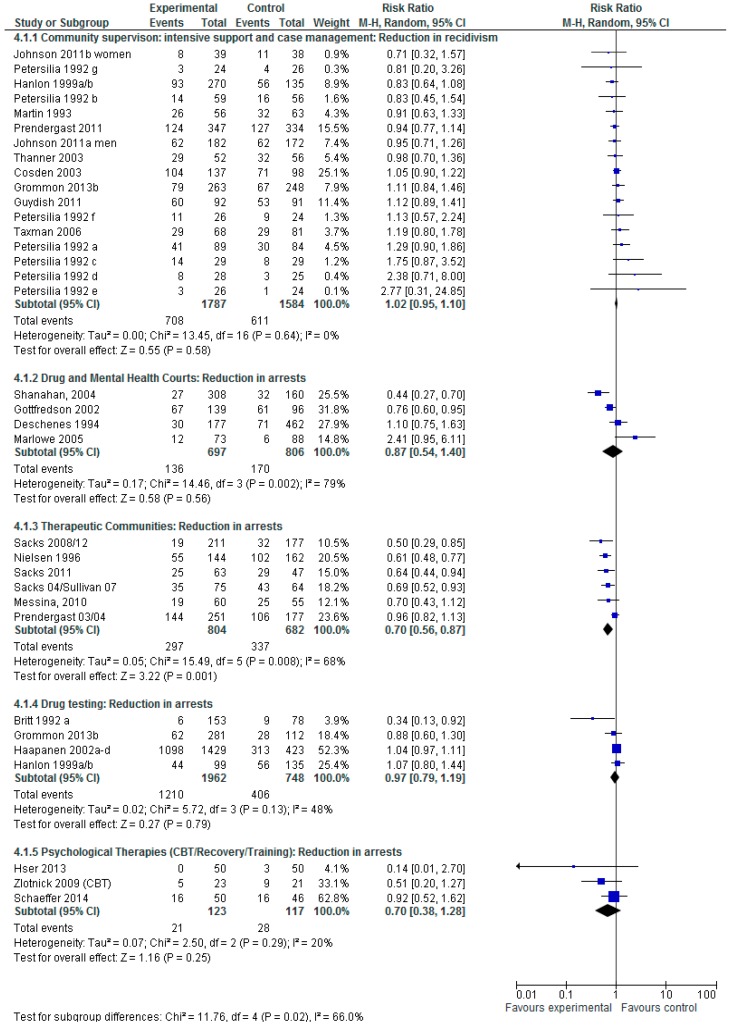
Background: The numbers of incarcerated people suffering from drug dependence has steadily risen since the 1980s and only a small proportion of these receive appropriate treatment. A systematic review to evaluate the effectiveness and economic evidence of non-pharmacological interventions for drug using offenders was conducted. Methods: Cochrane Collaboration criteria were used to identify trials across 14 databases between 2004 and 2014. A series of meta-analyses and an economic appraisal were conducted. Results: 43 trials were identified showing to have limited effect in reducing re-arrests RR 0.97 (95% CI 0.89–1.07) and drug use RR 0.90 (95% CI 0.80–1.00) but were found to significantly reduce re-incarceration RR 0.70 (95% CI 0.57–0.85). Therapeutic community programs were found to significantly reduce the number of re-arrests RR 0.70 (95% CI 0.56–0.87). 10 papers contained economic information. One paper presented a cost-benefit analysis and two reported on the cost and cost effectiveness of the intervention. Conclusions: We suggest that therapeutic community interventions have some benefit in reducing subsequent re-arrest. We recommend that economic evaluations should form part of standard trial protocols.
Overview
The claims and statistics of this paper haven’t been checked yet.
Free: it reads the open-access text and checks the first 5 claims that cite a source we can check. Create a free account to check every claim.
Integrity signals
Registry
Cites
Statistics
Figures
Verification
Claims the paper makes
The claims and statistics of this paper haven’t been checked yet.
Free: it reads the open-access text and checks the first 5 claims that cite a source we can check. Create a free account to check every claim.
Claims other papers make about this one
Each is checked against this paper’s own text: does it say what the citing paper says it does?
The source backs part of the claim, not all of it — or backs it for a different population, condition or comparison.
In the citing paper
“Overall, the effectiveness of most prison-based treatments on recidivism remains unclear because the evidence is inconsistent and subject to a range of limitations.18, 19, 20, 21, 22, 23, 24, 25, 26, 27, 28”
From Effectiveness of psychological interventions in prison to reduce recidivism: a systematic review and meta-analysis of randomised controlled trials (2021) · cites this paper as [25]
Experimental — accuracy not yet measured
Self-check
Percentages, sums and reported differences re-computed from the paper’s own numbers.
The self-check needs the paper’s full text.
Citations
Cites
The Transtheoretical Model of Health Behavior Change.
Prochaska, J. O., & Velicer, W. F. (1997) · American Journal of Health Promotion · doi:10.4278/0890-1171-12.1.38 · Cited by 7,782 · cited 1×
“Interactive journaling uses learning strategies based on the Trans-theoretical Model of Change (TMC; [32]) and Motivational Enhancement Therapy (MET; [33]).”
MethodDOES CORRECTIONAL TREATMENT WORK? A CLINICALLY RELEVANT AND PSYCHOLOGICALLY INFORMED META‐ANALYSIS *
ANDREWS, D. A., ZINGER, I., HOGE, R. D., BONTA, J., GENDREAU, P., & CULLEN, F. T. (1990) · Criminology · doi:10.1111/j.1745-9125.1990.tb01330.x · Cited by 2,084
What is Motivational Interviewing?
Rollnick, S., & Miller, W. R. (1995) · Behavioural and Cognitive Psychotherapy · doi:10.1017/s135246580001643x · Cited by 1,737
Experimental disclosure and its moderators: A meta-analysis.
Frattaroli, J. (2006) · Psychological Bulletin · doi:10.1037/0033-2909.132.6.823 · Cited by 1,502 · cited 1×
“The combination of emotional and cognitive expression used in interactive journaling has been shown to be more effective than cognitive processing alone in regard to behavior change [34].”
Ten Things that Motivational Interviewing Is Not
Miller, W. R., & Rollnick, S. (2009) · Behavioural and Cognitive Psychotherapy · doi:10.1017/s1352465809005128 · Cited by 1,315
A Meta-Analysis of Motivational Interviewing: Twenty-Five Years of Empirical Studies
Lundahl, B. W., Kunz, C., Brownell, C., Tollefson, D., & Burke, B. L. (2010) · Research on Social Work Practice · doi:10.1177/1049731509347850 · Cited by 1,086
A meta-analysis of voucher-based reinforcement therapy for substance use disorders
Lussier, J. P., Heil, S. H., Mongeon, J. A., Badger, G. J., & Higgins, S. T. (2006) · Addiction · doi:10.1111/j.1360-0443.2006.01311.x · Cited by 858
Substance abuse and dependence in prisoners: a systematic review
Fazel, S., Bains, P., & Doll, H. (2006) · Addiction · doi:10.1111/j.1360-0443.2006.01316.x · Cited by 839 · cited 8×
“Schoenwald (1996) Young offenders Community based MST [2] √ √ √ 4”
InfluentialHenggeler, S. W., Pickrel, S. G., & Brondino, M. J. (1999) · Mental Health Services Research · doi:10.1023/a:1022373813261 · Cited by 449 · cited 6×
“In six studies, pre-specified outcomes were presented and were rated as low risk of bias [14,67,75,78,83,86] and two studies presented a high risk of bias [74,92].”
InfluentialEffective Intervention for Serious Juvenile Offenders: A Synthesis of Research
Lipsey, M. W., & Wilson, D. B. (1999) · Serious & Violent Juvenile Offenders: Risk Factors and Successful Interventions · doi:10.4135/9781452243740.n13 · Cited by 443
Research works printed but not linked: 4
- Gerstein D.R. Harwood H.J. Treating Drug Problems: A Study of the Evolution, Effectiveness, and Financing of Public and Private Drug Treatment Systems National Academy Press Washington, DC, USA 1990 25144071
- Taxman F.S. Supervision—Exploring the dimensions of effectiveness Fed. Probat. 2002 66 14 27
- Petersilia J. Turner S. Deschenes E.P. Smat sentencing: The emergence of immediate sanctions Intensive Supervision Programs for Drug Offenders Byrne J.M. Lurigio A.J. Sage Publications Inc. Newbury Park, CA, USA 1992 18 37
- Drummond M. O’Brien B. Stoddart G. Torrance G. Methods for the Economic Evaluation of Health Care Programmes 2nd ed. Oxford University Press Oxford, New York, NY, USA 1997
Cited by
Beaudry, G., Yu, R., Perry, A. E., & Fazel, S. (2021) · The Lancet Psychiatry · doi:10.1016/s2215-0366(21)00170-x · Cited by 196
Self-citationDrug Use Disorders and Violence: Associations With Individual Drug Categories
Zhong, S., Yu, R., & Fazel, S. (2020) · Epidemiologic Reviews · doi:10.1093/epirev/mxaa006 · Cited by 142
Substance Use and Recidivism Outcomes for Prison-Based Drug and Alcohol Interventions
de Andrade, D., Ritchie, J., Rowlands, M. T., Mann, E. M., & Hides, L. M. (2018) · Epidemiologic Reviews · doi:10.1093/epirev/mxy004 · Cited by 115
Conducting Randomized Controlled Trials of Complex Interventions in Prisons: A Sisyphean Task?
Lennox, C., Leonard, S., Senior, J., Stevenson, C., Rybczynska‐Bunt, S., Quinn, C., Byng, R., & Shaw, J. J. (2022) · Frontiers in Psychiatry · doi:10.3389/fpsyt.2022.839958 · Cited by 28
Jorgensen, C., & Harper, A. J. (2020) · Journal of Experimental Criminology · doi:10.1007/s11292-020-09446-7 · Cited by 32
“However, therapeutic community interventions and engagement in aftercare services have been found to provide benefit in reducing subsequent re-arrest and re-incarceration (Perry et al. 2016).”
BackgroundTomlin, J., Meise, E., Wegner, J., & Vӧllm, B. (2024) · Frontiers in Psychiatry · doi:10.3389/fpsyt.2023.1217561 · Cited by 11
Woodhouse, R., Neilson, M., James, M. M., Glanville, J., Hewitt, C. E., & Perry, A. (2016) · Health & Justice · doi:10.1186/s40352-016-0041-y · Cited by 13
Self-citationHsieh, M., Chen, K., Choi, P.-S., & Hamilton, Z. K. (2021) · Criminal Justice and Behavior · doi:10.1177/00938548211052584 · Cited by 8
“…treatment for a high risk/needs population (Perry et al., 2016) unless combined with other evidence-based interventions or adjusted for optimal sequencing in a series of effective programs when correctional clients need more than one intervention (Hofmann et al., 2012; Perry et al., 2016).”
BackgroundInfluentialChoi, S., Bunting, A. M., Nadel, T., Neighbors, C. J., & Oser, C. B. (2023) · Health & Justice · doi:10.1186/s40352-023-00236-7 · Cited by 6
“Consequently, these women encounter additional hurdles due to their intersecting marginalized identities (Link & Oser, 2018; Perry et al., 2012, 2013, 2016; Redmond et al., 2020).”
BackgroundNon-pharmacological Approaches to Violence Among People with Severe Mental Disorders
Vita, A., Stanga, V., Ceraso, A., Deste, G., & Barlati, S. (2019) · Comprehensive approach to psychiatry · doi:10.1007/978-3-030-33188-7_15 · Cited by 3
Cost-effectiveness of comprehensive geriatric assessment: systematic review of economic evaluations
Yigezu, A., Hayes, C., Galvin, R., & Trépel, D. (2026) · Age and Ageing · doi:10.1093/ageing/afag203 · Cited by 1
“…reports the effectiveness in nat-ural units; cost-consequences analysis reports multiple effectiveness outcomes; cost–benefit analysis expresses the effectiveness in monetary terms; and cost-minimisation analysis assumes the interventions are equally effective and only compares the costs [ 20, 21].”
Self-citationSubstance Use and Forensic Psychiatry in South Asia
Bhad, R., & Kaur, M. (2025) · Springer eBooks · doi:10.1007/978-981-96-7206-6_10 · Cited by 1
Improving Case Management for People with Substance Use Disorders
Maetzener, M. (2017) · Brandeis Institutional Repository
Lombardi, B. M., Greeno, C. G., Jacobs, L. A., Gordon, J. D., Collins, K., & Jhon, P. (2021) · Social Work in Mental Health · doi:10.1080/15332985.2021.1928586 · Cited by 1
“Although evidence on the effectiveness has been mixed, some studies suggest treatment – and especially MOUD – can have positive impacts on substance use and criminal justice outcomes (Egli, Pina, Christensen, Aebi, & Killias, 2009; Koehler, Humphreys, Akoensi, Sánchez De Ribera, & Lösel, 2014; Perry et al., 2016; Volk…”
ResultProvision of creative arts interventions in UK drug and alcohol services: A cross-sectional studyPreprint
Megranahan, K., & Cooper, A. J. (2023) · Qeios · doi:10.32388/a81m47
“In addition to the existing national treatment services provision a number of recovery groups exist offering nonpharmacological interventions which are helpful in reducing recidivism in the criminal justice system relating to drug crimes (Perry et al., 2016).”
What Works in Reducing Re‐offending Among Persons Who Misuse Substances or Are Substance Dependent
de Andrade, D. (2024) · Wiley eBooks · doi:10.1002/9781119893073.ch16
Yigezu, A., Galvin, R., & Trépel, D. (2025) · HRB Open Research · doi:10.12688/hrbopenres.14066.1 · Cited by 1
“Studies that applied partial economic evaluation will be excluded from the review 25,27 .”
Self-citationProvision of creative arts interventions in UK drug and alcohol services: A cross-sectional studyPreprint
Megranahan, K., & Cooper, A. (2023) · Qeios · doi:10.32388/a81m47.2
Metadata
- Authors
- Perry, A., Woodhouse, R., Neilson, M., Martyn St James, M., Glanville, J., Hewitt, C., & Trépel, D.
- Affiliations
- University of York (GB)
- Health Economics and Decision Science, School for Health and Related Research (ScHARR), University of Sheffield, Regent Court, 30 Regent Street, Sheffield S1 4DA, UK
- Corresponding author
- Perry, Amanda
- ORCID
- Venue
- International Journal of Environmental Research and Public Health
- Publisher
- MDPI AG
- Published
- 2016-09-29
- Volume
- 13
- Issue
- 10
- Pages
- 966
- ISSN
- 1660-4601 (ISSN-L)
- PMC
- PMC5086705
- OpenAlex
- W2526852483
- Cited by
- 19
- References
- 89
- Citations by year
- 2026: 1 · 2025: 3 · 2024: 2 · 2023: 3 · 2022: 1 · 2021: 3 · 2020: 2 · 2019: 1 · 2018: 1 · 2017: 1 · 2016: 1
- FWCI
- 0.18
- Type
- journal article
- Language
- en
- Open access
- gold
- doi.org
- Licence
- Locations
- International Journal of Environmental Research and Public Health (publishedVersion, cc-by)
- PubMed Central (publishedVersion, cc-by)
- PubMed (publishedVersion)
- White Rose Research Online (University of Leeds, The University of Sheffield, University of York) (acceptedVersion)
- White Rose Research Online (University of Leeds, The University of Sheffield, University of York) (submittedVersion)
- RePEc: Research Papers in Economics (submittedVersion)
- DOAJ (DOAJ: Directory of Open Access Journals) (submittedVersion)
- Funders
- Department of Health, UK
- Topics
- Health Sciences › Medicine › Epidemiology › Substance Abuse Treatment and Outcomes
- Social Sciences › Sociology and Political Science › Criminal Justice and Corrections Analysis
- Social Sciences › Sociology and Political Science › Crime Patterns and Interventions
- Keywords
- non-pharmacological treatment, drug-using offenders, therapeutic communities, drug addiction, recidivism, rearrest, drug use reduction, cost-effectiveness, cost-benefit analysis, economic evaluation of interventions, incarcerated drug users
About these checks
Registry, retraction, Cites and statistics results are computed, not judged, with one exception: a printed reference that no index lists is read once by a model before it counts as a citation error. Claims are extracted by a model and kept only when their quote appears verbatim in the text; each cited source is then checked, with a model’s help, for whether it says what the claim relies on. Those verdicts can be wrong — read the claim’s quote and the cited source before relying on one.
Statistics and arithmetic are recomputed, not judged.
Confidence bands are shown only for fields calibrated on our annotated test set. None is calibrated yet, so no band is shown.
What counts as a claim ›How we measure confidence ›How we check this ›
Are you an author, or do you see a problem with this page? Request a review
Data sources
Bibliographic data: Semantic Scholar, OpenAlex, Crossref.
Contains information from the Semantic Scholar Academic Graph Datasets, made available under the ODC Attribution License (ODC-BY 1.0).
Semantic Scholar’s data is described in: Kinney, R., et al. (2023). The Semantic Scholar Open Data Platform. arXiv:2301.10140.
