

Factors Affecting the Retention of Indigenous Australians in the Health Workforce: A Systematic Review
Open accessThe DOI matches its Crossref record; 43 of the 43 references it cites were found in a registry or an index.
Abstract
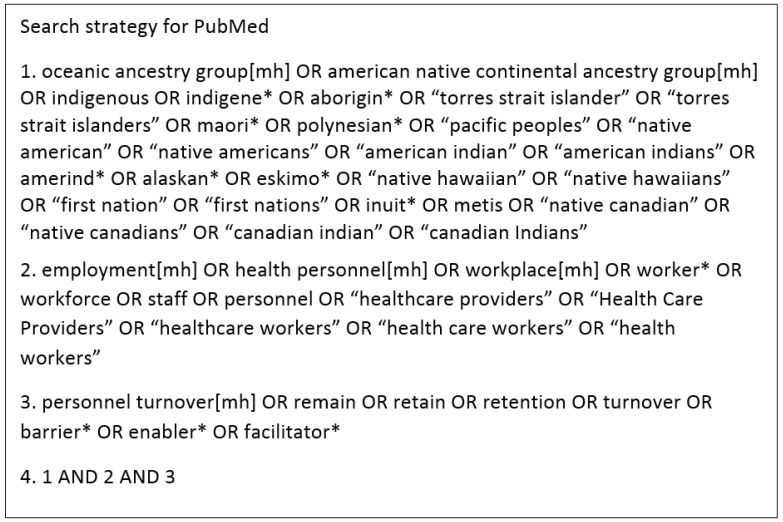
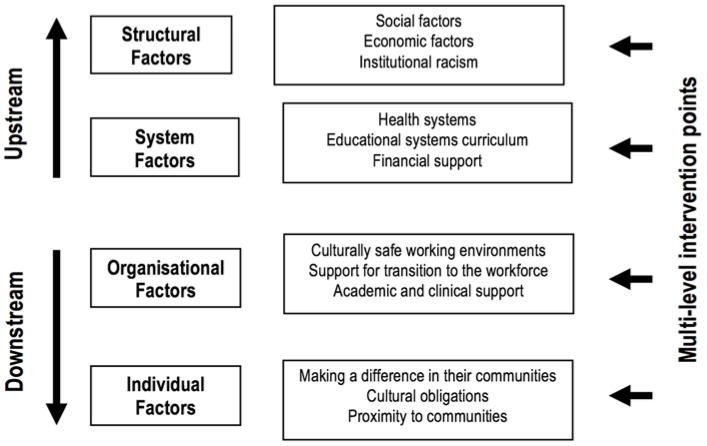
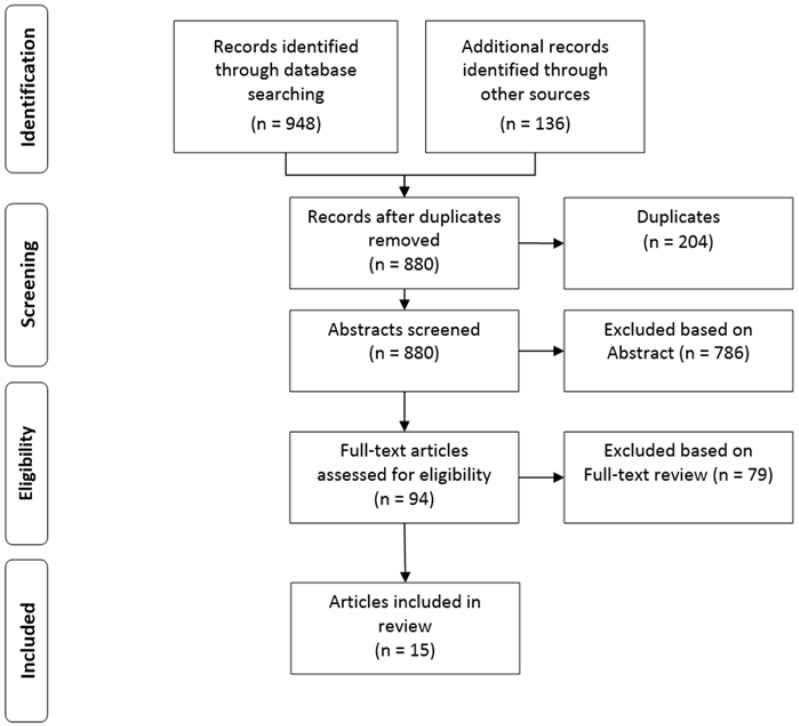
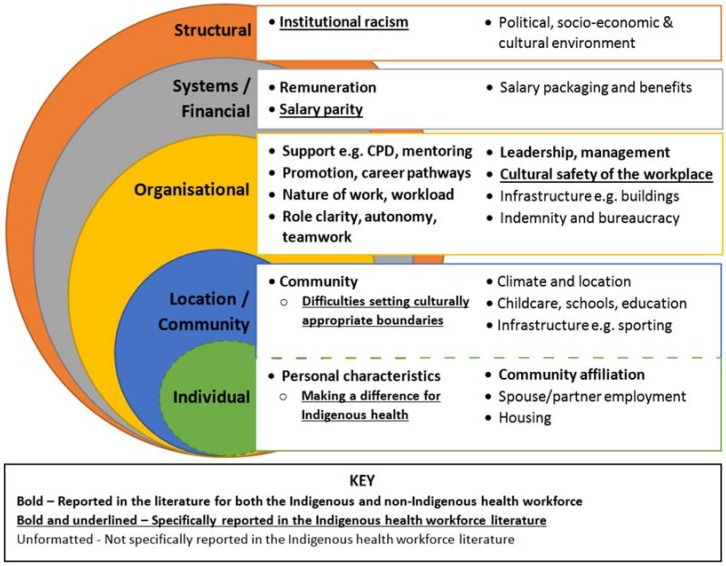
Indigenous Australians are under-represented in the health workforce. The shortfall in the Indigenous health workforce compounds the health disparities experienced by Indigenous Australians and places pressure on Indigenous health professionals. This systematic review aims to identify enablers and barriers to the retention of Indigenous Australians within the health workforce and to describe strategies to assist with development and retention of Indigenous health professionals after qualification. Four electronic databases were systematically searched in August 2017. Supplementary searches of relevant websites were also undertaken. Articles were screened for inclusion using pre-defined criteria and assessed for quality using the Mixed Methods Assessment Tool. Fifteen articles met the criteria for inclusion. Important factors affecting the retention of Indigenous health professionals included work environment, heavy workloads, poorly documented/understood roles and responsibilities, low salary and a perception of salary disparity, and the influence of community as both a strong personal motivator and source of stress when work/life boundaries could not be maintained. Evidence suggests that retention of Indigenous health professionals will be improved through building supportive and culturally safe workplaces; clearly documenting and communicating roles, scope of practice and responsibilities; and ensuring that employees are appropriately supported and remunerated. The absence of intervention studies highlights the need for deliberative interventions that rigorously evaluate all aspects of implementation of relevant workforce, health service policy, and practice change.
Overview
The claims and statistics of this paper haven’t been checked yet.
Free: it reads the open-access text and checks the first 5 claims that cite a source we can check. Create a free account to check every claim.
Integrity signals
Registry
Cites
Statistics
Figures
Verification
Claims the paper makes
The claims and statistics of this paper haven’t been checked yet.
Free: it reads the open-access text and checks the first 5 claims that cite a source we can check. Create a free account to check every claim.
Claims other papers make about this one
Each is checked against this paper’s own text: does it say what the citing paper says it does?
The cited source says what the claim attributes to it.
In the citing paper
“A search for systematic reviews published in the last 10 years examining turnover intention among HCWs on PubMed, PROSPERO and Google Scholar produced nine relevant systematic reviews [11–19]”
From A global overview of healthcare workers’ turnover intention amid COVID-19 pandemic: a systematic review with future directions (2022) · cites this paper as [14]
The cited source says what the claim attributes to it.
In the citing paper
“and many of which were known factors prior to the pandemic [11–19].”
From A global overview of healthcare workers’ turnover intention amid COVID-19 pandemic: a systematic review with future directions (2022) · cites this paper as [14]
Self-check
Percentages, sums and reported differences re-computed from the paper’s own numbers.
The self-check needs the paper’s full text.
Citations
Cites
Preferred Reporting Items for Systematic Reviews and Meta-Analyses: the PRISMA statement
Moher, D., Liberati, A., Tetzlaff, J., Altman, D. G., & for the PRISMA Group (2009) · BMJ · doi:10.1136/bmj.b2535 · Cited by 83,823
Preferred Reporting Items for Systematic Reviews and Meta-Analyses: The PRISMA Statement
Moher, D., Liberati, A., Tetzlaff, J., Altman, D. G., & The PRISMA Group (2009) · PLoS Medicine · doi:10.1371/journal.pmed.1000097 · Cited by 64,042 · cited 1×
“The Preferred Reporting Items for Systematic Review and Meta-Analysis (PRISMA) statement was used with the aim of minimising methodological bias and to meet standards for accurate and consistent reporting [29].”
MethodWang, G., Ma, R., Qiao, G., Wada, K., Aizawa, Y., & Satoh, T. (2015) · Integrative Medicine International · doi:10.1159/000368408 · Cited by 18,657
Pace, R., Pluye, P., Bartlett, G., Macaulay, A. C., Salsberg, J., Jagosh, J., & Seller, R. (2012) · International Journal of Nursing Studies · doi:10.1016/j.ijnurstu.2011.07.002 · Cited by 1,331 · cited 1×
“The MMAT critical appraisal tool was selected as it permits researchers to concomitantly review qualitative, quantitative and mixed methods studies (all of which were included in this review) and has been found to be efficient, reliable and has demonstrated content validity [31,32].”
MethodPluye, P., Gagnon, M.-P., Griffiths, F., & Johnson-Lafleur, J. (2009) · International Journal of Nursing Studies · doi:10.1016/j.ijnurstu.2009.01.009 · Cited by 1,119 · cited 1×
“The MMAT critical appraisal tool was selected as it permits researchers to concomitantly review qualitative, quantitative and mixed methods studies (all of which were included in this review) and has been found to be efficient, reliable and has demonstrated content validity [31,32].”
MethodNurse turnover: A literature review
Hayes, L. J., O’Brien-Pallas, L., Duffield, C., Shamian, J., Buchan, J., Hughes, F., Spence Laschinger, H. K., North, N., & Stone, P. W. (2006) · International Journal of Nursing Studies · doi:10.1016/j.ijnurstu.2005.02.007 · Cited by 873 · cited 1×
“This accords with the findings of a previous review on IHWs [49], as well as findings about the retention of Indigenous Australians in other sectors [50,51] and on retention of non-Indigenous health workers [52,53].”
ResultShields, M. A., & Ward, M. (2001) · Journal of Health Economics · doi:10.1016/s0167-6296(01)00092-3 · Cited by 623
Vos, T., Barker, B., Begg, S., Stanley, L., & Lopez, A. D. (2009) · International Journal of Epidemiology · doi:10.1093/ije/dyn240 · Cited by 593
Buykx, P., Humphreys, J., Wakerman, J., & Pashen, D. (2010) · Australian Journal of Rural Health · doi:10.1111/j.1440-1584.2010.01139.x · Cited by 358
Reducing the health disparities of Indigenous Australians: time to change focus
Durey, A., & Thompson, S. C. (2012) · BMC Health Services Research · doi:10.1186/1472-6963-12-151 · Cited by 319 · cited 1×
“To achieve supportive and culturally safe workplaces, cultural respect for Indigenous Australians must be embedded across the health system [54,55].”
BackgroundSelf-citation
Research works printed but not linked: 1
- Congress of Aboriginal and Torres Strait Islander Nurses and Midwives Catsinam Mentoring Program Review Report Available online: http://catsinam.org.au/static/uploads/files/mentoring-program-review-report-final-may-16-2014-wfvpiqvtkbhj.pdf (accessed on 3 August 2017)
Cited by
Poon, Y.-S. R., Lin, Y. P., Griffiths, P., Yong, K. K., Seah, B., & Liaw, S. Y. (2022) · Human Resources for Health · doi:10.1186/s12960-022-00764-7 · Cited by 394
Mackean, T., Withall, E., Dwyer, J., & Wilson, A. M. (2020) · Australian Health Review · doi:10.1071/ah19101 · Cited by 95
Taylor, E. V., Lyford, M., Parsons, L., Mason, T., Sabesan, S. S., & Thompson, S. (2020) · PLoS ONE · doi:10.1371/journal.pone.0239207 · Cited by 72
“This occurs through managing their workloads, clarifying employee, employer and community expectations, and encouraging productive working relationships, which in turn contribute positively to retention [30, 32, 57].”
BackgroundInfluentialSelf-citationWorking well: strategies to strengthen the workforce of the Indigenous primary healthcare sector
Jongen, C. S., McCalman, J., Campbell, S., & Fagan, R. (2019) · BMC Health Services Research · doi:10.1186/s12913-019-4750-5 · Cited by 69
Taylor, E. V., Lalović, A., & Thompson, S. (2019) · International Journal for Equity in Health · doi:10.1186/s12939-019-1038-7 · Cited by 67
Self-citation
Metadata
- Authors
- Lai, G. C., Taylor, E. V., Haigh, M. M., & Thompson, S. C.
- Affiliations
- The University of Western Australia (AU)
- Corresponding author
- Taylor, Emma V.
- Venue
- International Journal of Environmental Research and Public Health
- Publisher
- MDPI AG
- Published
- 2018-05-04
- Volume
- 15
- Issue
- 5
- Pages
- 914
- ISSN
- 1660-4601 (ISSN-L)
- PMC
- PMC5981953
- OpenAlex
- W2803070235
- Cited by
- 85
- References
- 43
- Citations by year
- 2026: 10 · 2025: 11 · 2024: 15 · 2023: 15 · 2022: 11 · 2021: 9 · 2020: 7 · 2019: 7
- FWCI
- 1.56
- Type
- journal article
- Language
- en
- Open access
- gold
- doi.org
- Licence
- Locations
- International Journal of Environmental Research and Public Health (publishedVersion, cc-by)
- Europe PMC (PubMed Central) (publishedVersion, other-oa)
- PubMed Central (publishedVersion, cc-by)
- PubMed (publishedVersion)
- UWA Profiles and Research Repository (University of Western Australia) (submittedVersion, other-oa)
- UWA Profiles and Research Repository (UWA) (submittedVersion, other-oa)
- DOAJ (DOAJ: Directory of Open Access Journals) (submittedVersion, cc-by-sa)
- Funders
- Australian Government
- Topics
- Health Sciences › Medicine › Public Health, Environmental and Occupational Health › Global Health Workforce Issues
- Social Sciences › Health › Indigenous Health, Education, and Rights
- Health Sciences › Health Professions › General Health Professions › Healthcare Systems and Challenges
- Keywords
- Indigenous health workforce, employee retention, Indigenous health professionals, health disparities, work environment, workload, wage differentials, work-life balance, scope of practice, Indigenous Australians
- MeSH terms
- Attitude of Health Personnel, Australia, Delivery of Health Care, Health Workforce, Health Personnel, Health Services, Indigenous, Humans, Workplace, Native Hawaiian or Other Pacific Islander, Culturally Competent Care
About these checks
Registry, retraction, Cites and statistics results are computed, not judged, with one exception: a printed reference that no index lists is read once by a model before it counts as a citation error. Claims are extracted by a model and kept only when their quote appears verbatim in the text; each cited source is then checked, with a model’s help, for whether it says what the claim relies on. Those verdicts can be wrong — read the claim’s quote and the cited source before relying on one.
Statistics and arithmetic are recomputed, not judged.
Confidence bands are shown only for fields calibrated on our annotated test set. None is calibrated yet, so no band is shown.
What counts as a claim ›How we measure confidence ›How we check this ›
Are you an author, or do you see a problem with this page? Request a review
How to cite
Cite CoChat for the checks on this page, and the paper for its own findings.
- This page
- CoChat. (2026). Citation check: Factors Affecting the Retention of Indigenous Australians in the Health Workforce: A Systematic Review. https://app.cochat.ai/papers/10.3390/ijerph15050914
- The paper
- Lai, G. C., Taylor, E. V., Haigh, M. M., & Thompson, S. C. (2018). Factors Affecting the Retention of Indigenous Australians in the Health Workforce: A Systematic Review. International Journal of Environmental Research and Public Health. https://doi.org/10.3390/ijerph15050914
Data sources
Bibliographic data: Semantic Scholar, OpenAlex, Crossref.
Contains information from the Semantic Scholar Academic Graph Datasets, made available under the ODC Attribution License (ODC-BY 1.0).
Semantic Scholar’s data is described in: Kinney, R., et al. (2023). The Semantic Scholar Open Data Platform. arXiv:2301.10140.
