

The Mediating Role of Self-Concept between Sports-Related Physical Activity and Mathematical Achievement in Fourth Graders
Open accessThe DOI matches its Crossref record; 56 of the 56 references it cites were found in a registry or an index.
Abstract
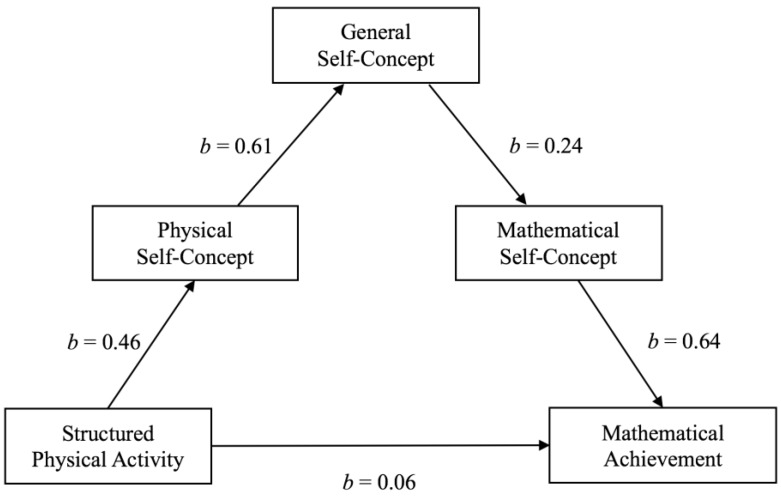
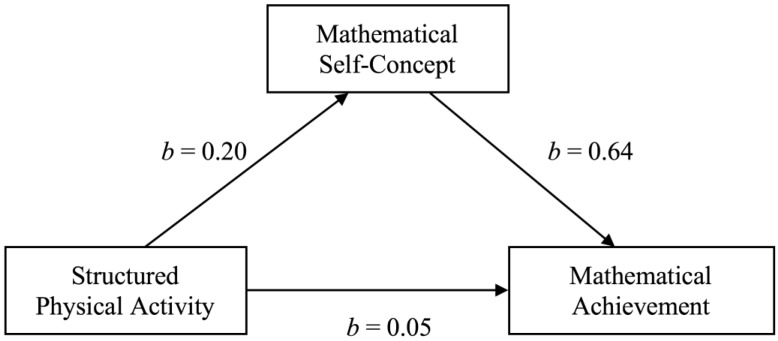
Being physically active has many benefits for children and adolescents. It is essential for various aspects of physical and mental health, and also positively influences academic performance and school achievement. In addressing the still incomplete understanding of the link between physical activity (PA) and academic achievement, the present study scrutinized the open issues regarding different roles of PA type and PA duration within the relation between self-reported PA and objectively measured mathematical achievement in fourth graders. As to the type of PA, the current study distinguished between structured and unstructured sports activities children perform in their leisure time. Moreover, the current study investigated the indirect effect of PA on mathematical achievement by controlling for the mathematical self-concept as a mediating variable. Results showed PA to be positively related to mathematical outcomes if implemented in a structured setting and pursued for at least two hours per week. As to the mediation, the results revealed a full mediation, indicating PA to improve mathematical self-concept, which, in turn, positively affected mathematical achievement. Thus, engaging in structured PA for two hours or more a week may have additional benefits for children’s and adolescents’ self-concept in a way that is favorable and encouraging for promoting their academic achievement.
Overview
The claims and statistics of this paper haven’t been checked yet.
Free: it reads the open-access text and checks the first 5 claims that cite a source we can check. Create a free account to check every claim.
Integrity signals
Registry
Cites
Statistics
Figures
Verification
Claims the paper makes
The claims and statistics of this paper haven’t been checked yet.
Free: it reads the open-access text and checks the first 5 claims that cite a source we can check. Create a free account to check every claim.
Self-check
Percentages, sums and reported differences re-computed from the paper’s own numbers.
The self-check needs the paper’s full text.
Citations
Cites
Statistical power analyses using G∗Power 3.1: tests for correlation and regression analyses
Faul, F., Erdfelder, E., Buchner, A., & Lang, A.-G. (2009) · Behavior Research Methods · doi:10.3758/brm.41.4.1149 · Cited by 37,615 · cited 1×
“A power analysis using the Gpower program [42] revealed 95% power to detect moderate correlations [43] and 83% power to detect moderate effect sizes in comparing two groups with N = 138 and alpha at the 0.”
MethodSPSS and SAS procedures for estimating indirect effects in simple mediation models
Preacher, K. J., & Hayes, A. F. (2004) · Behavior Research Methods, Instruments, & Computers · doi:10.3758/bf03206553 · Cited by 17,383 · cited 1×
“To test the significance of direct and indirect effects, a 2000 resampling bootstrapping procedure for the 95% bias-corrected confidence intervals was executed [54,55].”
MethodMediation in experimental and nonexperimental studies: New procedures and recommendations.
Shrout, P. E., & Bolger, N. (2002) · Psychological Methods · doi:10.1037/1082-989x.7.4.422 · Cited by 11,335 · cited 1×
“To test the significance of direct and indirect effects, a 2000 resampling bootstrapping procedure for the 95% bias-corrected confidence intervals was executed [54,55].”
Method(1985) · Europe PMC (PubMed Central) · Cited by 9,143
A test of missing completely at random for multivariate data with missing values
Little, R. J. A. (1988) · Journal of the American Statistical Association · doi:10.1080/01621459.1988.10478722 · Cited by 8,963 · cited 1×
“30, revealing that the missing data was completely at random [51].”
BackgroundMissing data analysis: making it work in the real world
Graham, J. W. (2009) · Annual Review of Psychology · doi:10.1146/annurev.psych.58.110405.085530 · Cited by 6,163
Janssen, I., & LeBlanc, A. G. (2010) · International Journal of Behavioral Nutrition and Physical Activity · doi:10.1186/1479-5868-7-40 · Cited by 4,829
Self-concept: validation of construct interpretations.
Shavelson, R. J., Hubner, J. J., & Stanton, G. C. (1976) · Review of Educational Research · doi:10.3102/00346543046003407 · Cited by 4,164 · cited 2×
“The results (see Appendix A) seem to confirm such a cascade within the assumption of a multidimensional self-concept [34].”
BackgroundResultLeys, C., Ley, C., Klein, O., Bernard, P., & Licata, L. (2013) · Journal of Experimental Social Psychology · doi:10.1016/j.jesp.2013.03.013 · Cited by 4,147 · cited 3×
“For the unstructured PA, the third MAD was computed similar to the structured PA third MAD (see above).”
BackgroundInfluentialPhysical activity and mental health in children and adolescents: a review of reviews
Biddle, S. J. H., & Asare, M. (2011) · British Journal of Sports Medicine · doi:10.1136/bjsports-2011-090185 · Cited by 2,447 · cited 2×
“Nonetheless, our results are in line with previous studies that, yet without having taken into account a mediational effect, reported positive effects of PA on self-concept [2,31].”
BackgroundResult
Cited by
Physical activity and motor skills in children: A differentiated approach
Dapp, L. C., Gashaj, V., & Roebers, C. M. (2021) · Psychology of sport and exercise · doi:10.1016/j.psychsport.2021.101916 · Cited by 223
“…— have been assumed to be particularly helpful in supporting a positive development in general, as well as being more efficient for motor skill development than practice during unstructured PA (Dapp & Roebers, 2019; Gagen & Getchell, 2006; Iivonen & S ¨ a ¨ akslahti, 2014; Robinson et al., 2015).”
BackgroundSelf-citationOwen, K., Foley, B. C., Wilhite, K. L., Booker, B., Lonsdale, C., & Reece, L. J. (2021) · Medicine & Science in Sports & Exercise · doi:10.1249/mss.0000000000002786 · Cited by 108
“Only one study used a validated sport measure (32); however, this measure is only available in German.”
Physical Activity and Academic Performance in School-Age Children: A Systematic Review
Latino, F., & Tafuri, F. (2023) · Sustainability · doi:10.3390/su15086616 · Cited by 104
“After all, youth who are engaged in the highest amounts of physical activity have the opportunity not only to enhance their physical and mental health but also to solidify their self-esteem and self-efficacy and, consequently, promote their academic achievement [8,9].”
Mediators between physical activity and academic achievement: A systematic review
Visier‐Alfonso, M. E., Sánchez‐López, M., Álvarez‐Bueno, C., Hermosa, A. R., Nieto, M., & Martínez‐Vizcaíno, V. (2021) · Scandinavian Journal of Medicine and Science in Sports · doi:10.1111/sms.14107 · Cited by 61
Escolano-Pérez, E., & Bestué, M. (2021) · International Journal of Environmental Research and Public Health · doi:10.3390/ijerph18041816 · Cited by 33
“), in addition to differential characteristics of the studied samples, may help explain discrepancies between results of the studies [33].”
BackgroundResultSelf-Concept in Primary School Student with Dyslexia: The Relationship to Parental Rearing Styles
Huang, A., Sun, M., Zhang, X., Lin, Y., Lin, X., Wu, K., & Huang, Y. (2021) · International Journal of Environmental Research and Public Health · doi:10.3390/ijerph18189718 · Cited by 28
“The exercise and self-esteem model also showed that taking part in the physical activity could increase physical self-concept, which ultimately increases general self-concept [43].”
BackgroundZurc, J., & Planinšec, J. (2022) · International Journal of Environmental Research and Public Health · doi:10.3390/ijerph19020623 · Cited by 33
“Second, the Academic Competence Scale was used to assess different aspects of children’s academic performance and was not limited to one school subject or the overall grade point average, as is common in previous similar studies [22,26,46].”
BackgroundMethodWang, T., & Guo, C. (2022) · International Journal of Environmental Research and Public Health · doi:10.3390/ijerph19084678 · Cited by 13
“Regarding the direct influence mechanism of physical activity on the academic achievement and cognitive ability of adolescents, there is no definite conclusion yet [2,3], but the development of neurophysiology in recent years has provided us with some basic evidence.”
BackgroundMonacis, D., Trecroci, A., Invernizzi, P. L., & Colella, D. (2022) · International Journal of Environmental Research and Public Health · doi:10.3390/ijerph191912567 · Cited by 24
“(2019), the teaching−learning process and the quality of the motor experience can enhance physical self-perception, mediating the relation between cognitive, motor, emotional, and social functions [16,17].”
BackgroundFlores, P., Coelho, E., Mourão, I., & Forte, P. M. (2023) · Behavioral Sciences · doi:10.3390/bs13121000 · Cited by 25
Mascret, N., Rey, O., Danthony, S., & Maïano, C. (2021) · Psychology of sport and exercise · doi:10.1016/j.psychsport.2021.102016 · Cited by 15
Rigon, M., Invernizzi, P. L., Signorini, G., Trecroci, A., Scurati, R., Formenti, D., Colella, D., Bosio, A., & Cherubini, D. (2024) · PLoS ONE · doi:10.1371/journal.pone.0301858 · Cited by 20
“The quality of experience provided by the teacher through effective teaching processes increases the positive self-perception capacity of young people [37, 38].”
BackgroundLatino, F., Cataldi, S., Bonavolontá, V., Carvutto, R., Candia, M. D., & Fischetti, F. (2021) · Frontiers in Psychology · doi:10.3389/fpsyg.2021.693244 · Cited by 14
Asociaciones entre actividad física y rendimiento académico en estudiantes con altas capacidades
Infantes‐Paniagua, Á., Bustos, J. G. F., Ruíz, A. P., & Jordán, O. R. C. (2023) · Journal of Sport and Health Research · doi:10.58727/jshr.90141 · Cited by 12
Zhou, J., Liu, H., Wen, H., Wang, X., Wang, Y., & Yang, T. (2022) · Frontiers in Psychology · doi:10.3389/fpsyg.2022.862666 · Cited by 16
Pan, W., Zhang, H., & Xu, L. (2025) · Scientific Reports · doi:10.1038/s41598-025-18559-w · Cited by 8
“Palenzuela-Luis, et al. 22 further compared the effects of PA on SC among adolescents from different countries, demonstrating the universally positive influence of PA in boosting SC. PA not only enhances adolescents’ SC but also positively impacts their AA 7,24 .”
Awado, T. M., Abalos, T. J., Pelago, H. R., Morales, V., Torres, J. G., Milano, M. L., Hallarte, D. K., Gonzales, R. R., & Gonzales, G. G. (2024) · Discover Education · doi:10.1007/s44217-024-00388-0 · Cited by 17
“Dapp and Roebers [81] reported the mediating role of self-concept in sports-related physical activity and mathematical achievement.”
De-kun, J., & Gadekallu, T. R. (2022) · Mobile Networks and Applications · doi:10.1007/s11036-022-02074-7 · Cited by 4
“Grey correlation analysis [18, 19] is a kind of multi-factor analysis method, which can intuitively describe the influence of each factor on the solution of the problem.”
MethodAda, E. N., Serin, A. H., Pehlivan, Z., Çepikkurt, F., AHMAD, H. M. A., & Kazak, Z. (2021) · SAGE Open · doi:10.1177/21582440211059175 · Cited by 6
“In a different education setting, Dapp and Roebers (2019) investigated the mediation role of self-concept and they found a full mediation, indicating PA to improve mathematical self-concept, which, in turn, positively affected mathematical achievement.”
BackgroundActive snacks for the promotion of physical activity in Southern Italy: preliminary results
Monacis, D., & Colella, D. (2020) · Journal of Physical Education and Sport · doi:10.7752/jpes.2020.05363 · Cited by 3
Monacis, D., Pascali, G., Annoscia, S., & Colella, D. (2024) · Studia Universitatis Babeş-Bolyai Educatio Artis Gymnasticae · doi:10.24193/subbeag.68(4).31
Marheni, E., Purnomo, E., Suardika, I. K., Donie, D., Okilanda, A., Gumilar, A., Okilanda, A., Jermaina, N., & Abidin, N. E. Z. (2025) · Studia sportiva · doi:10.5817/sts2025-2-13 · Cited by 3
Breuer, C., & Breuer, T. (2026) · Sports economics, management and policy · doi:10.1007/978-3-032-21510-9_7
Metadata
- Authors
- Dapp, L. C., & Roebers, C. M.
- Affiliations
- University of Bern (CH)
- Corresponding author
- Dapp, Laura C.
- Venue
- International Journal of Environmental Research and Public Health
- Publisher
- MDPI AG
- Published
- 2019-07-25
- Volume
- 16
- Issue
- 15
- Pages
- 2658
- ISSN
- 1660-4601 (ISSN-L)
- PMC
- PMC6695979
- OpenAlex
- W2963463332
- Cited by
- 23
- References
- 56
- Citations by year
- 2026: 1 · 2025: 2 · 2024: 3 · 2023: 3 · 2022: 5 · 2021: 8 · 2020: 1
- FWCI
- 2.39
- Type
- journal article
- Language
- en
- Open access
- gold
- dx.doi.org
- Licence
- Locations
- International Journal of Environmental Research and Public Health (publishedVersion, cc-by)
- PubMed Central (publishedVersion, cc-by)
- PubMed (publishedVersion)
- RePEc: Research Papers in Economics (submittedVersion)
- Bern Open Repository and Information System (University of Bern) (submittedVersion, cc-by)
- DOAJ (DOAJ: Directory of Open Access Journals) (submittedVersion)
- Open Access CRIS of the University of Bern
- Topics
- Health Sciences › Medicine › Public Health, Environmental and Occupational Health › Physical Activity and Health
- Social Sciences › Education › Physical Education and Pedagogy
- Social Sciences › Psychology › Developmental and Educational Psychology › Children's Physical and Motor Development
- Keywords
- physical activity, mathematics achievement, mathematics self-concept, physical activity duration, academic performance, children, fourth grade, mediation
- MeSH terms
- Academic Success, Achievement, Child, Female, Humans, Male, Mathematics, Self Concept, Sports, Switzerland, Exercise
About these checks
Registry, retraction, Cites and statistics results are computed, not judged, with one exception: a printed reference that no index lists is read once by a model before it counts as a citation error. Claims are extracted by a model and kept only when their quote appears verbatim in the text; each cited source is then checked, with a model’s help, for whether it says what the claim relies on. Those verdicts can be wrong — read the claim’s quote and the cited source before relying on one.
Statistics and arithmetic are recomputed, not judged.
Confidence bands are shown only for fields calibrated on our annotated test set. None is calibrated yet, so no band is shown.
What counts as a claim ›How we measure confidence ›How we check this ›
Are you an author, or do you see a problem with this page? Request a review
Data sources
Bibliographic data: Semantic Scholar, OpenAlex, Crossref.
Contains information from the Semantic Scholar Academic Graph Datasets, made available under the ODC Attribution License (ODC-BY 1.0).
Semantic Scholar’s data is described in: Kinney, R., et al. (2023). The Semantic Scholar Open Data Platform. arXiv:2301.10140.
