

Studies on the Relationship between Social Anxiety and Excessive Smartphone Use and on the Effects of Abstinence and Sensation Seeking on Excessive Smartphone Use
Open accessThe DOI matches its Crossref record; 43 of the 44 references it cites were found in a registry or an index.
Abstract
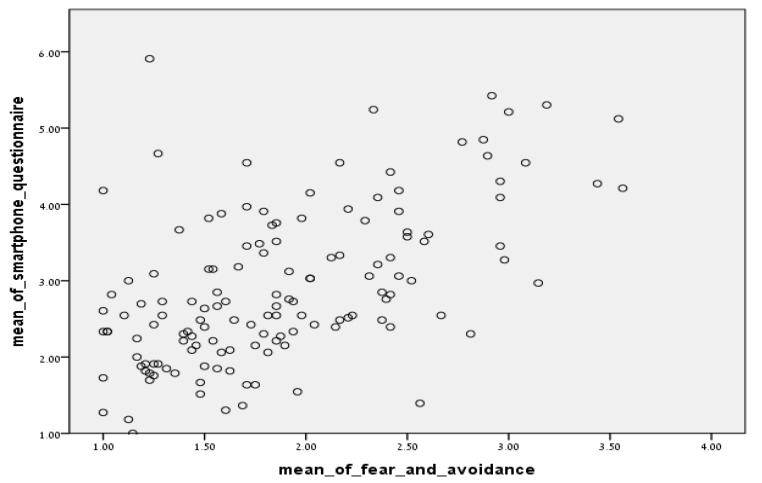
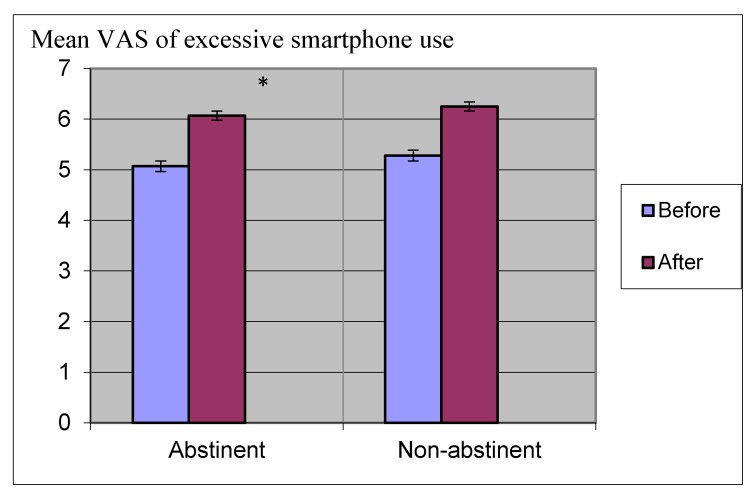
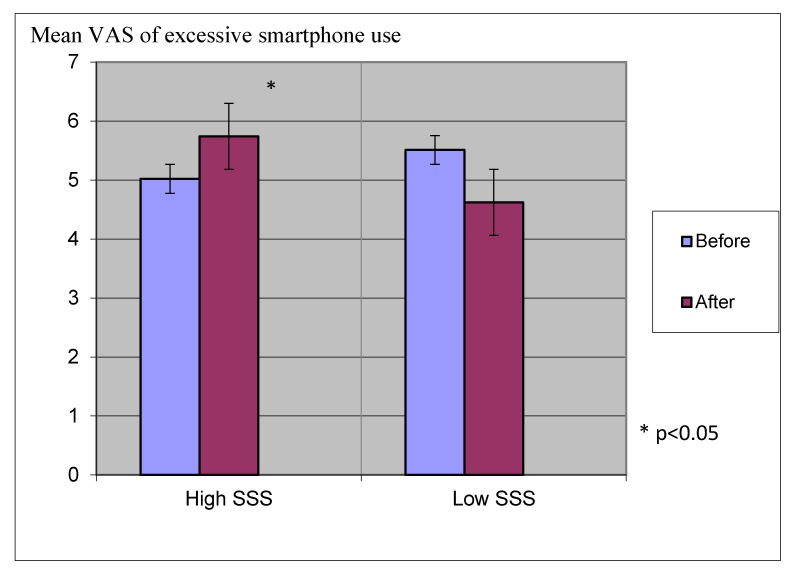
Problematic smartphone use is the excessive use of the smartphone with negative impacts on the quality of life of the user. We investigated the association between social anxiety and excessive smartphone use. The sample consisted of 140 participants, 73 male and 67 female university students with a mean age of 26 years and 4 months (SD = 3.38), who filled in the Liebowitz Social Anxiety Scale and the Smartphone Addiction Scale (SAS). Results showed a positive association between social anxiety and excessive smartphone use. Social anxiety explained 31.5% of the variance of ratings on the SAS. A second study investigated the interaction between abstinence and sensation seeking and excessive smartphone use. The sample consisted of 60 participants, 44 female and 16 male university students. The sample was divided into two experimental conditions: 30 participants were abstinent for 1.5 h from the smartphone and 30 participants were non-abstinent. Results showed that excessive smartphone use increased in the group that abstained compared to those who did not. Secondly, participants who had high baseline sensation-seeking ratings had higher scores of excessive smartphone use after abstinence compared with those with low ratings of sensation seeking. These studies indicate the contribution of social anxiety to problematic smartphone use and how it can be exacerbated by the combination of abstinence and high sensation seeking.
Overview
The claims and statistics of this paper haven’t been checked yet.
Free: it reads the open-access text and checks the first 5 claims that cite a source we can check. Create a free account to check every claim.
Integrity signals
Registry
Cites
Statistics
Figures
Verification
Claims the paper makes
The claims and statistics of this paper haven’t been checked yet.
Free: it reads the open-access text and checks the first 5 claims that cite a source we can check. Create a free account to check every claim.
Self-check
Percentages, sums and reported differences re-computed from the paper’s own numbers.
The self-check needs the paper’s full text.
Citations
Cites
Diagnostic and Statistical Manual of Mental Disorders
American Psychiatric Association (2013) · doi:10.1176/appi.books.9780890425596 · Cited by 116,369
Internet paradox: A social technology that reduces social involvement and psychological well-being?
Kraut, R., Patterson, M., Lundmark, V., Kiesler, S., Mukophadhyay, T., & Scherlis, W. (1998) · American Psychologist · doi:10.1037/0003-066x.53.9.1017 · Cited by 4,793
Development and Validation of a Smartphone Addiction Scale (SAS)
Kwon, M., Lee, J.-Y., Won, W.-Y., Park, J.-W., Min, J.-A., Hahn, C., Gu, X., Choi, J.-H., & Kim, D.-J. (2013) · PLoS ONE · doi:10.1371/journal.pone.0056936 · Cited by 1,670 · cited 19×
“SAS (Kwon et al., 2013) [17]; VAS: visual analog scale for smartphone addiction (Kwon et al., 2013) [17]; SSS: Sensation Seeking Scale (Zuckerman, 1964) [21].”
BackgroundMethodInfluentialDemirci, K., Akgönül, M., & Akpinar, A. (2015) · Journal of Behavioral Addictions · doi:10.1556/2006.4.2015.010 · Cited by 1,529 · cited 1×
“Other factors such as depression, loneliness, anxiety, low sleep quality [12,39], addiction to social networking, shyness, and low self-esteem [40] may also contribute to the variance of excessive smartphone use.”
BackgroundBillieux, J., Maurage, P., Lopez-Fernandez, O., Kuss, D. J., & Griffiths, M. D. (2015) · Current Addiction Reports · doi:10.1007/s40429-015-0054-y · Cited by 1,205 · cited 1×
“[9] have argued that there are no studies supporting the idea of mobile phone addiction.”
BackgroundHabits make smartphone use more pervasive.
Oulasvirta, A., Rattenbury, T., Ma, L., & Raita, E. (2012) · Personal and Ubiquitous Computing · doi:10.1007/s00779-011-0412-2 · Cited by 1,190
Development of a sensation-seeking scale.
Zuckerman, M., Kolin, E. A., Price, L., & Zoob, I. (1964) · Journal of Consulting Psychology · doi:10.1037/h0040995 · Cited by 1,075 · cited 5×
“SAS (Kwon et al., 2013) [17]; VAS: visual analog scale for smartphone addiction (Kwon et al., 2013) [17]; SSS: Sensation Seeking Scale (Zuckerman, 1964) [21].”
MethodInfluentialLepp, A., Barkley, J. E., & Karpinski, A. C. (2014) · Computers in Human Behavior · doi:10.1016/j.chb.2013.10.049 · Cited by 990 · cited 1×
“The easy access and availability of the Internet enables users to send messages, play games, download information, and interact on social networkss; when these are temporarily unavailable, it may exacerbate the experience of boredom and the need for entertainment [41].”
BackgroundPsychometric properties of the Liebowitz Social Anxiety Scale
HEIMBERG, R. G., HORNER, K. J., JUSTER, H. R., SAFREN, S. A., BROWN, E. J., SCHNEIER, F. R., & LIEBOWITZ, M. R. (1999) · Psychological Medicine · doi:10.1017/s0033291798007879 · Cited by 968 · cited 14×
“SAS: Smartphone Addiction Scale (Kwon et al., 2013) [17]; LSAS: Liebowitz Social Anxiety Scale (Heimberg et al., 1999) [18]; LSAS—social fear: a subscale of the Liebowitz Social Anxiety Scale (Heimberg et al., 1999) [18] LSAS—social avoidance: a subscale of the Liebowitz Social Anxiety Scale (Heimberg et al., 1999) [1…”
BackgroundMethodInfluentialInternet Addiction or Excessive Internet Use
Weinstein, A., & Lejoyeux, M. (2010) · The American Journal of Drug and Alcohol Abuse · doi:10.3109/00952990.2010.491880 · Cited by 929 · cited 4×
“The results of this study show for the first time that excessive smartphone use was correlated with high ratings of social anxiety, thus supporting our early results showing an association between Internet addiction and social anxiety [7].”
BackgroundResultSelf-citation
Cited by
Smartphone addiction is increasing across the world: A meta-analysis of 24 countries
Olson, J. A., Sandra, D. A., Colucci, É. S., Al Bikaii, A., Chmoulevitch, D., Nahas, J., Raz, A., & Veissière, S. P. L. (2022) · Computers in Human Behavior · doi:10.1016/j.chb.2021.107138 · Cited by 420
Excessive Smartphone Use Is Associated With Health Problems in Adolescents and Young Adults
Wacks, Y., & Weinstein, A. M. (2021) · Frontiers in Psychiatry · doi:10.3389/fpsyt.2021.669042 · Cited by 424
“(7) have reported an interaction between high sensation seeking and abstinence whereby abstinence for 1.”
BackgroundSelf-citationDigital detox: An effective solution in the smartphone era? A systematic literature review
Radtke, T., Apel, T., Schenkel, K., Keller, J., & von Lindern, E. (2022) · Mobile Media & Communication · doi:10.1177/20501579211028647 · Cited by 342
“A possible solution would be to use laboratory studies (e.g., Clayton et al., 2015; Schmidt et al., 2018; Turgeman et al., 2020), though laboratory studies might confound ecological validity, especially when considering variety and diversity in everyday smartphone use.”
BackgroundBrown, L., & Kuss, D. J. (2020) · International Journal of Environmental Research and Public Health · doi:10.3390/ijerph17124566 · Cited by 150
“[86] found that social anxiety and excessive smartphone use were positively correlated, explaining some participants’ needs to substitute SM with other smartphone applications.”
BackgroundThe association between social anxiety and mobile phone addiction: A three-level meta-analysis
Ran, G., Li, J., Zhang, Q., & Niu, X. (2022) · Computers in Human Behavior · doi:10.1016/j.chb.2022.107198 · Cited by 165
Metadata
- Authors
- Turgeman, L., Hefner, I., Bazon, M., Yehoshua, O., & Weinstein, A.
- Affiliations
- Ariel University (IL)
- Corresponding author
- Weinstein, Aviv
- ORCID
- Weinstein, Aviv
- Venue
- International Journal of Environmental Research and Public Health
- Publisher
- MDPI AG
- Published
- 2020-02-15
- Volume
- 17
- Issue
- 4
- Pages
- 1262
- ISSN
- 1660-4601 (ISSN-L)
- PMC
- PMC7068314
- OpenAlex
- W3006246675
- Cited by
- 46
- References
- 44
- Citations by year
- 2026: 3 · 2025: 6 · 2024: 8 · 2023: 11 · 2022: 9 · 2021: 8 · 2020: 1
- FWCI
- 9.70
- Type
- journal article
- Language
- en
- Open access
- gold
- dx.doi.org
- Licence
- Locations
- International Journal of Environmental Research and Public Health (publishedVersion, cc-by)
- Europe PMC (PubMed Central) (publishedVersion, cc-by)
- PubMed Central (publishedVersion, cc-by)
- PubMed (publishedVersion)
- RePEc: Research Papers in Economics (submittedVersion)
- DOAJ (DOAJ: Directory of Open Access Journals) (submittedVersion, cc-by-sa)
- Topics
- Social Sciences › Sociology and Political Science › Impact of Technology on Adolescents
- Social Sciences › Psychology › Clinical Psychology › Sexuality, Behavior, and Technology
- Social Sciences › Education › Child Development and Digital Technology
- Keywords
- social anxiety, smartphone addiction, sensation seeking, university students, Smartphone Addiction Scale
- MeSH terms
- Smartphone, Adult, Anxiety, Female, Humans, Male, Quality of Life, Sensation, Behavior, Addictive, Young Adult
About these checks
Registry, retraction, Cites and statistics results are computed, not judged, with one exception: a printed reference that no index lists is read once by a model before it counts as a citation error. Claims are extracted by a model and kept only when their quote appears verbatim in the text; each cited source is then checked, with a model’s help, for whether it says what the claim relies on. Those verdicts can be wrong — read the claim’s quote and the cited source before relying on one.
Statistics and arithmetic are recomputed, not judged.
Confidence bands are shown only for fields calibrated on our annotated test set. None is calibrated yet, so no band is shown.
What counts as a claim ›How we measure confidence ›How we check this ›
Are you an author, or do you see a problem with this page? Request a review
Data sources
Bibliographic data: Semantic Scholar, OpenAlex, Crossref.
Contains information from the Semantic Scholar Academic Graph Datasets, made available under the ODC Attribution License (ODC-BY 1.0).
Semantic Scholar’s data is described in: Kinney, R., et al. (2023). The Semantic Scholar Open Data Platform. arXiv:2301.10140.
