

Acute Effects of a Short Bout of Physical Activity on Cognitive Function in Sport Students
Open accessThe DOI matches its Crossref record; 40 of the 41 references it cites were found in a registry or an index.
Abstract
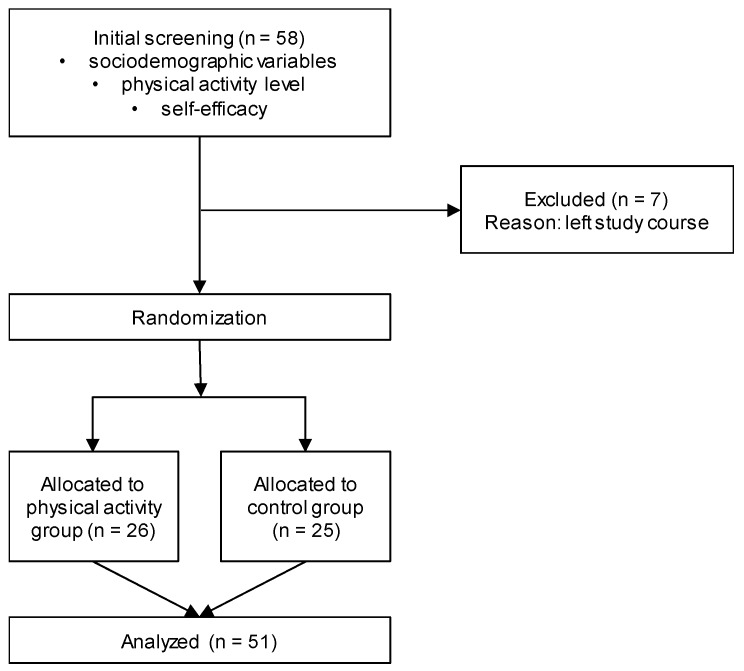
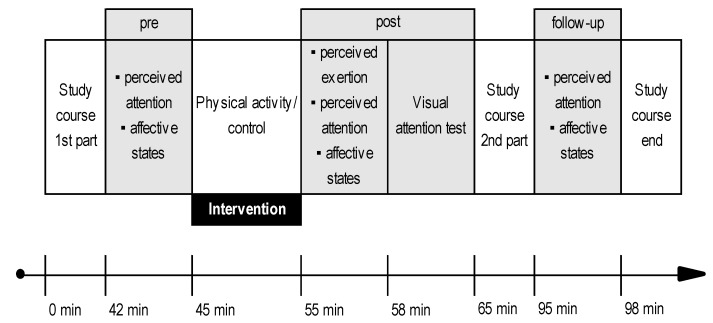
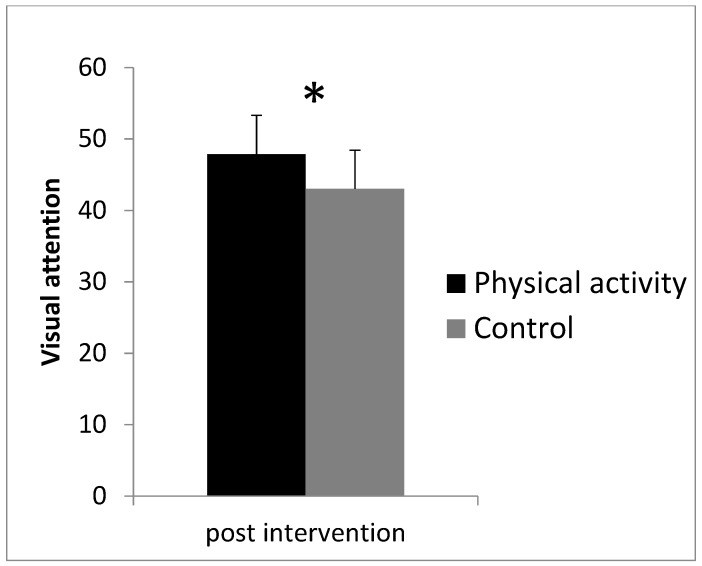
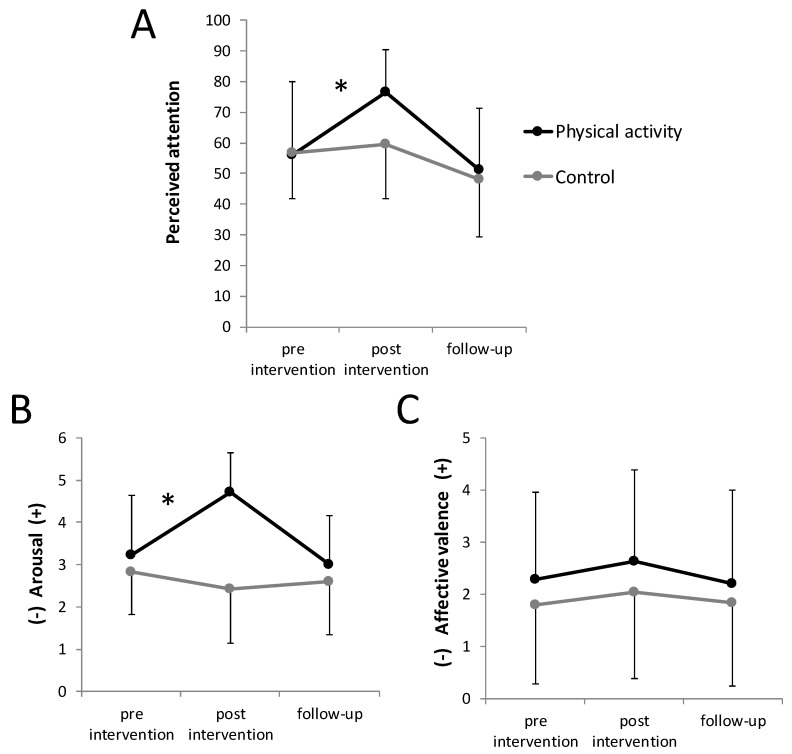
Physical activity is a promising intervention to restore cognitive function after prolonged sedentary periods. However, little is known about the effect of short physical activity bouts on cognition especially among individuals that are used to physical activity. Therefore, the goal of the present study was to assess the impact of a single ten-minute physical activity bout on the cognitive domain of visual attention compared to sedentary behavior in a population of physically active sport students. Using a randomized controlled design, 51 healthy and physically active sport students [mean age: 22.3 (SD: 2.0) years, 33.3% female] were allocated to one of the following interventions in the break of a two-hour study course: physical activity group (running for ten minutes) and sedentary control group. Visual attention was measured post-intervention using a modified trail making test. Pre-, post-, and 30 min after intervention, perceived attention, and affective states were measured. Between-group comparisons were used to analyze whether visual attention and/or changes in perceived attention or affective states differed between groups. The physical activity group showed significantly higher visual attention post-intervention compared with the sedentary control group, p = 0.003, d = 0.89. Perceived attention, p = 0.006, d = 0.87, and arousal, p < 0.001, d = 1.68, showed a significantly larger pre- and post-intervention increase in the physical activity group compared with the sedentary control group, which was not evident 30 min after intervention. A single ten-minute running intervention in study breaks might help to restore the basal visual attentional domain of cognition after prolonged sedentary periods more effectively compared with common sedentary behavior in breaks between study lessons.
Overview
The claims and statistics of this paper haven’t been checked yet.
Free: it reads the open-access text and checks the first 5 claims that cite a source we can check. Create a free account to check every claim.
Integrity signals
Registry
Cites
Statistics
Figures
Verification
Claims the paper makes
The claims and statistics of this paper haven’t been checked yet.
Free: it reads the open-access text and checks the first 5 claims that cite a source we can check. Create a free account to check every claim.
Claims other papers make about this one
Each is checked against this paper’s own text: does it say what the citing paper says it does?
The cited source doesn’t support the claim as written.
In the citing paper
“Four studies investigated selective attention, with two reporting significant improvements [14, 26], one showing no effect [29], and one reporting a negative outcome [32], yielding unclear evidence strength (50%).”
From Effect of classroom physical activity breaks on learning behaviors and academic achievements in university students: a systematic review (2026) · cites this paper as [26]
Checked by a reasoning model — may be wrong.
Experimental — accuracy not yet measuredThe source backs part of the claim, not all of it — or backs it for a different population, condition or comparison.
In the citing paper
“However, another study reported that emotional improvements diminish within 30 min [26], indicating a transient effect and highlighting the importance of timing in optimizing emotional outcomes during instruction.”
From Effect of classroom physical activity breaks on learning behaviors and academic achievements in university students: a systematic review (2026) · cites this paper as [26]
Experimental — accuracy not yet measuredThe cited source says what the claim attributes to it.
In the citing paper
“Regarding the impact of classroom physical activity breaks, seven studies explored positive emotions, with six reporting significant improvements [14, 22, 24–26, 36] and one showing no effect [38], resulting in relatively strong evidence strength (85.7%).”
From Effect of classroom physical activity breaks on learning behaviors and academic achievements in university students: a systematic review (2026) · cites this paper as [26]
Self-check
Percentages, sums and reported differences re-computed from the paper’s own numbers.
The self-check needs the paper’s full text.
Citations
Cites
Faul, F., Erdfelder, E., Lang, A.-G., & Buchner, A. (2007) · Behavior Research Methods · doi:10.3758/bf03193146 · Cited by 65,971 · cited 2×
“No a priori power analysis was performed; however, following the considerations stated recently [14], a sensitivity analysis for the present sample was conducted for the main outcome using G*Power 3.1 (University of Düsseldorf, Düsseldorf, Germany) [20].”
InfluentialInternational physical activity questionnaire: 12-country reliability and validity
CRAIG, C. L., MARSHALL, A. L., SJ??STR??M, M., BAUMAN, A. E., BOOTH, M. L., AINSWORTH, B. E., PRATT, M., EKELUND, U., YNGVE, A., SALLIS, J. F., et al. (2003) · Medicine & Science in Sports & Exercise · doi:10.1249/01.mss.0000078924.61453.fb · Cited by 21,619
Psychophysical bases of perceived exertion
BORG, G. A. V. (1982) · Medicine & Science in Sports & Exercise · doi:10.1249/00005768-198205000-00012 · Cited by 16,580 · cited 2×
“Information about the psychometric properties can be found at Borg [22], and Noble and Robertson [23].”
BackgroundMethodRussell, J. A. (1980) · Journal of Personality and Social Psychology · doi:10.1037/h0077714 · Cited by 16,334 · cited 2×
“Two-dimensional single-item scales based on the Circumplex model [30] were used to assess affective states of valence (pleasure) and arousal: The Feeling Scale assesses affective valence using eleven answer possibilities ranging from “very good” (+5) to “very bad” (−5) [31,32].”
BackgroundMethodMiyake, A., Friedman, N. P., Emerson, M. J., Witzki, A. H., Howerter, A., & Wager, T. D. (2000) · Cognitive Psychology · doi:10.1006/cogp.1999.0734 · Cited by 15,798 · cited 1×
“, working memory, inhibitory control, cognitive flexibility, planning) rely upon lower-level cognitive, perceptual, and motor processes [38,39].”
BackgroundDiamond, A. (2013) · Annual Review of Psychology · doi:10.1146/annurev-psych-113011-143750 · Cited by 13,268
Statistical Methods for Meta-Analysis
Wasserman, S., Hedges, L. V., & Olkin, I. (1988) · Journal of Educational Statistics · doi:10.2307/1164953 · Cited by 10,326
Perceived self-efficacy in cognitive development and functioning
Bandura, A. (1993) · Educational Psychologist · doi:10.1207/s15326985ep2802_3 · Cited by 7,655 · cited 2×
“The selection of the covariates was based on previous research [27,35].”
MethodResultTrail Making Test A and B: normative data stratified by age and education
Tombaugh, T. (2004) · Archives of Clinical Neuropsychology · doi:10.1016/s0887-6177(03)00039-8 · Cited by 3,239 · cited 1×
“The test is similar to the Trail Making Test (part A only) [29] and provides information about the visual search, scanning, and speed of processing [29].”
MethodPredicting and Changing Behavior
Fishbein, M., & Ajzen, I. (2011) · doi:10.4324/9780203838020 · Cited by 2,807
Research works printed but not linked: 3
- 20. American College of Sports Medicine. ACSM's Guidelines for Exercise Testing and Prescription, 10th ed.; Lippincott, Williams, & Wilkins: Philadelphia, PA, USA, 2018.
- 31. Maibach, M.; Niedermeier, M.; Sudeck, G.; Kopp, M. Erfassung unmittelbarer affektiver Reaktionen auf körperliche Aktivität. Zeitschr. Sportpsychol. 2020, 27, 4-12. (In German)
- 46. Kaplan, R.; Kaplan, S. The Experience of Nature: A Psychological Perspective; CUP Archive: Cambridge, UK, 1989.
Cited by
Active School Breaks and Students’ Attention: A Systematic Review with Meta-Analysis
Infantes-Paniagua, Á., Silva, A. F., Ramirez-Campillo, R., Sarmento, H., González-Fernández, F. T., González-Víllora, S., & Clemente, F. M. (2021) · Brain Sciences · doi:10.3390/brainsci11060675 · Cited by 74
“…No AB McGowan et al. (2020) [80] Laboratory Merriman et al. (2020) [81] Report Miklós et al. (2020) [82] Laboratory Napoli et al. (2005) [83] No AB Niedermeier et al. (2020) [84] No pre-posttest on objective measure ofattention Ochoa et al. (2020) [85] Not written in English Owen et al. (2018)…”
BackgroundLynch, J., O’Donoghue, G., & Peiris, C. L. (2022) · International Journal of Environmental Research and Public Health · doi:10.3390/ijerph19137775 · Cited by 44
“01) in a randomised controlled trial [62].”
BackgroundInfluentialPeiris, C. L., O’Donoghue, G., Rippon, L., Meyers, D., Hahne, A., De Noronha, M., Lynch, J., & Hanson, L. C. (2021) · International Journal of Environmental Research and Public Health · doi:10.3390/ijerph18115589 · Cited by 38
“Considering the results of our feasibility study and previous studies with university students [13,14,34,35], future research may like to focus on the effects of breaks after 30–45 min sedentary time and monitor the duration of the benefit.”
BackgroundResultHeiland, E. G., Tarassova, O., Fernström, M., English, C., Ekblom, Ö. B., & Ekblom, M. (2021) · Frontiers in Human Neuroscience · doi:10.3389/fnhum.2021.719509 · Cited by 42
“Acute exercise has previously been found to elicit positive effects on perceived attention and mood, compared with those who were sedentary for 2 h (Niedermeier et al., 2020).”
BackgroundJennings, A., Shannon, O. M., Gillings, R., Lee, V., Elsworthy, R. J., Bundy, R., Rao, G., Hanson, S., Hardeman, W., Paddick, S., et al. (2024) · BMC Medicine · doi:10.1186/s12916-024-03815-z · Cited by 24
“A recent large US cohort study reported that increasing activity by 10 min per day could reduce preventable deaths by 7% per year [45], and 10-min activity bouts have been linked to improved cognition [46].”
Niedermeier, M., Ledochowski, L., Leitner, H., Zingerle, H., & Kopp, M. (2021) · International Journal of Environmental Research and Public Health · doi:10.3390/ijerph18041524 · Cited by 19
“Given previous findings in clinical and healthy populations [10,29,40,50], comparable changes in affective valence and perceived activation between exercise and passive control conditions were an unexpected result, which did not confirm our hypothesis.”
ResultSelf-citationMancı, E., Herold, F., Özdalyan, F., Benli, M. D., Bozkurt, Ç., Gençtürk, U., Gebel, A., Güdücü, Ç., Günay, E., Bediz, C. Ş., et al. (2025) · Scandinavian Journal of Psychology · doi:10.1111/sjop.13105 · Cited by 24
Visual Duration but Not Numerosity Is Distorted While Running
Petrizzo, I., Anobile, G., Chelli, E., Arrighi, R., & Burr, D. C. (2022) · Brain Sciences · doi:10.3390/brainsci12010081 · Cited by 14
“Can the present results be accounted for by variations of the arousal level induced by motor activity? The lack of temporal distortions when duration estimates were made at the end of the physical activity also questions the arousal hypothesis, given that arousal levels have been reported to be still significantly alt…”
ResultLiu, S., & Zhang, R. (2022) · Frontiers in Psychology · doi:10.3389/fpsyg.2022.914568 · Cited by 20
“Interestingly, not only long-term exercise, but even acute exercise has positive benefits on higher-order cognitive functions such as concentration, memory, and even executive function (Niedermeier et al., 2020; Cantelon and Giles, 2021).”
BackgroundThe impact of physical activity on cognitive functions
Sumińska, S. (2021) · Medycyna Pracy · doi:10.13075/mp.5893.01103 · Cited by 18
Effects of physical activity breaks on cognitive function in undergraduate students: a pilot study
Pastor-Vicedo, J. C., León, M. P., González-Fernández, F. T., & Prieto-Ayuso, A. (2024) · Cogent Social Sciences · doi:10.1080/23311886.2024.2326692 · Cited by 11
“…physical activity breaks has also been observed in previous research with children (Ma et al., 2015; Mahar, 2011) and undergraduate students, as niedermeier et al. (2020) demonstrated that 10 min of physical activity increased their visual attention. this finding suggests that even short bouts…”
Physical and/or cognitive warm-up effects on first-person shooter video-games performances
Santos, J. D., Figuireido, T., Benoit, C.-É., & Chaplais, E. (2023) · Entertainment Computing · doi:10.1016/j.entcom.2023.100618 · Cited by 12
Niedermeier, M., Frühauf, A., & Kopp, M. (2022) · Frontiers in Public Health · doi:10.3389/fpubh.2022.828405 · Cited by 8
Self-citationHerbert, C. (2025) · Healthcare · doi:10.3390/healthcare13040368 · Cited by 5
“…guidelines for acute bouts of exercise could assist healthy individuals in combating the loss of attention, concentration, and cognitive inhibitory control associated with a primarily sedentary lifestyle, both during work and at home, for a recent approach in this direction, e.g., [51–53].”
Freyer, M., Jost, C., Jankowiak, S., Bressem, K.-A., & Hegewald, J. (2026) · Frontiers in Physiology · doi:10.3389/fphys.2026.1755356 · Cited by 3
“…following prolonged periods of sitting (McLean et al., 2001; Bergouignan et al., 2016; Vincent et al., 2018; Chrismas et al., 2019; Ding et al., 2020; Niedermeier et al., 2020; Heiland et al., 2021; Chandran et al., 2023; Wu et al., 2023; Giurgiu et al., 2024; Kuo et al., 2024; Chueh et al., 2025).”
InfluentialTHE INFLUENCE OF AGILITY INDICATORS ON FORMATION OF VOCATIONAL READINESS IN LAW ENFORCEMENT OFFICERS
Андрес, А., Kryzhanovskyi, V., Krasovska, I., Bodnarchuk, O., Ханікянц, О., Мандюк, А., Rymar, O., Соловей, А., Sorokolit, N., Stefanyshyn, M., et al. (2023) · SOCIETY INTEGRATION EDUCATION Proceedings of the International Scientific Conference · doi:10.17770/sie2023vol1.7105 · Cited by 4
“The relationship between motor activity (in form of short-term running for 10 minutes) and visual attention was revealed (Niedermeier et al., 2020).”
BackgroundReigal, R. E., Enríquez-Molina, R., Sánchez-García, C., Franquelo, M. A., Contreras-Osorio, F., Campos‐Jara, C., Hernández-Mendo, A., & Morales‐Sánchez, V. (2023) · Cuadernos de Psicología del Deporte · doi:10.6018/cpd.563001 · Cited by 7
Jennings, A., Shannon, O., Gillings, R., Lee, V. Y., Elsworthy, R. J., Rao, G., Hanson, S., Hardeman, W., Paddick, S.-M., Siervo, M., et al. (2023) · medRxiv · doi:10.1101/2023.07.04.23292172 · Cited by 2
“A recent large US cohort study reported that increasing activity by 10 minutes 476 per day could reduce preventable deaths by seven percent per year (38) and 10 minute 477 activity bouts have been linked to improved cognition (39) suggesting that even small 478 changes in activity are important from a public health pe…”
BackgroundPauseNørd Pilot Study: Exploring the Implementation of Mini Movement Breaks in University Lectures
Piccinini, I. M., Hallas, J., Peiris, C. L., Lauridsen, H. H., Dalager, T., & Søgaard, K. (2025) · International Journal of Environmental Research and Public Health · doi:10.3390/ijerph22050739 · Cited by 2
Defining the standard levels of spontaneous cognitive flexibility among master’s students
Bougherra, A., Hamlaoui, A., & Lebchiri, A. (2023) · Physical Education of Students · doi:10.15561/20755279.2023.0402 · Cited by 4
“Furthermore, behavioral interventions targeting cognitive function should ideally be conducted regularly rather than sporadically [20].”
BackgroundHösl, B., Niedermeier, M., & Kopp, M. (2024) · Cogent Psychology · doi:10.1080/23311908.2024.2429896 · Cited by 1
“…necessarily have to be long or extensive, but that even short, ten‑minute sessions are sufficient. in agreement with other authors, it can therefore be recommended to integrate shorter Pa bouts regularly into everyday life, for example in the form of active breaks (Niedermeier et al., 2020; 2022).”
Self-citationGlassbrook, D. J., Chazot, P. L., & Hind, K. (2025) · Applied Neuropsychology Adult · doi:10.1080/23279095.2025.2464884 · Cited by 2
“Moreover, short term cognitive benefits from exercise, such as improved reaction times and visual attention have also been shown (Ando et al., 2024; Niedermeier et al., 2020), and alongside the benefits previously mentioned may also result from modulation of the central nervous system (Kashihara et…”
Deng, Q., Wu, C., & Yang, L. (2026) · International Journal of Behavioral Nutrition and Physical Activity · doi:10.1186/s12966-026-01936-7
“Four studies investigated selective attention, with two reporting significant improvements [14, 26], one showing no effect [29], and one reporting a negative outcome [32], yielding unclear evidence strength (50%).”
Babashev, A., Yerlan, A., Makashev, E., Baytilesova, D., & Atanbayeva, G. (2024) · BIO Web of Conferences · doi:10.1051/bioconf/202410001006
“Relatively short-term interventions can improve cognitive function, confirmed by Niedermeier et al., which shows an improvement in visual attention after a brief intense physical activity [15].”
BackgroundBewegungsaktivierung und Sitzzeitreduzierung im Hochschulalltag
Möckel, J., Wallmann-Sperlich, B., Rupp, R., & Bucksch, J. (2024) · Public Health Forum · doi:10.1515/pubhef-2024-0027
Wachholz, F., Wilhelm, M., Frühauf, A., Niedermeier, M., & Kopp, M. (2025) · Cognition & Emotion · doi:10.1080/02699931.2025.2496822
“Already at the beginning of the condition, the mean values of arousal were similar like during a 10-min running bout exercise (Niedermeier et al., 2020), although the participants were sitting during the assessment of arousal.”
Self-citationJaén‐Carrillo, D., Burtscher, J., & Kopp, M. (2025) · Springer eBooks · doi:10.1007/978-3-662-70316-8_18
Self-citationEffects of an active breaks programme on the psychological performance of university students
García-Taibo, O., Galmes-Panades, A. M., & Vidal‐Conti, J. (2026) · Health Education Journal · doi:10.1177/00178969261420371 · Cited by 1
“…over 10 weeks, surpassing most prior research that focused on single or short-term interventions (Blasche et al., 2018; Contreras et al., 2022; Ferrer and Laughlin, 2017; Keating et al., 2022; Lobach et al., 2024; Niedermeier et al., 2020; Pastor-Vicedo et al., 2024; Pizà-Mir et al., 2022).”
Acute Effect of a Physical Education Lesson on Attention in a Population of Adolescents
Cocca, A., Unterkircher, J., Cocca, M., & Kopp, M. (2026) · Quest · doi:10.1080/00336297.2026.2641133
Self-citationFischer, M., Kraft, V. S., & Hermsdörfer, J. (2026) · Cognitive Processing · doi:10.1007/s10339-026-01380-2
“In contrast, studies with trained individuals revealed positive effects of acute cardiovascular exercise on cognition, which may be restricted to the task type rather than, according to our results, a broad, unspecific boost (Browne et al. 2017 ; Niedermeier et al. 2020).”
Mikhalishchina, A. S., Потапова, О. В., Tyukin, Y. S., Васина, Я. В., Загайный, Э. Д., Nikonov, D. V., Venerin, A. А., & Glazachev, O. S. (2026) · Vestnik psihofiziologii. · doi:10.34985/n1802-4183-8468-x
Temporal Dynamics of Cognitive Change following Acute Aerobic Physical Activity in Emerging Adults
Pasupathi, P. A., O’Brokta, M. M., Cornwall, A. S., Herrera, B. M., Kehoe, A. R. D., & Drollette, E. S. (2026) · Journal of Cognitive Enhancement · doi:10.1007/s41465-026-00370-8
Metadata
- Authors
- Niedermeier, M., Weiss, E. M., Steidl-Müller, L., Burtscher, M., & Kopp, M.
- Affiliations
- Universität Innsbruck (AT)
- Corresponding author
- Niedermeier, Martin
- Venue
- International Journal of Environmental Research and Public Health
- Publisher
- MDPI AG
- Published
- 2020-05-23
- Volume
- 17
- Issue
- 10
- Pages
- 3678
- ISSN
- 1660-4601 (ISSN-L)
- PMC
- PMC7277588
- OpenAlex
- W3026436571
- Semantic Scholar
- 42a6ae0ba6b0d82afc22a5f2d6959bdd206f962b
- Cited by
- 33
- References
- 41
- Citations by year
- 2026: 7 · 2025: 6 · 2024: 5 · 2023: 5 · 2022: 4 · 2021: 6
- FWCI
- 2.25
- Type
- journal article
- Language
- en
- Open access
- gold
- dx.doi.org
- Licence
- Locations
- International Journal of Environmental Research and Public Health (publishedVersion, cc-by)
- PubMed Central (publishedVersion, cc-by)
- PubMed (publishedVersion)
- Digital Library of the University of Innsbruck (University of Innsbruck) (submittedVersion, cc-by)
- RePEc: Research Papers in Economics (submittedVersion)
- DOAJ (DOAJ: Directory of Open Access Journals) (submittedVersion)
- Topics
- Health Sciences › Medicine › Public Health, Environmental and Occupational Health › Physical Activity and Health
- Social Sciences › Psychology › Experimental and Cognitive Psychology › Sleep and Work-Related Fatigue
- Health Sciences › Medicine › Critical Care and Intensive Care Medicine › Intensive Care Unit Cognitive Disorders
- Keywords
- cognitive function, visual attention, sedentary behavior, running, sport students, arousal, affective states, Trail Making Test
- MeSH terms
- Adult, Attention, Cognition, Female, Humans, Male, Sports, Students, Exercise, Young Adult, Athletes, Sedentary Behavior
About these checks
Registry, retraction, Cites and statistics results are computed, not judged, with one exception: a printed reference that no index lists is read once by a model before it counts as a citation error. Claims are extracted by a model and kept only when their quote appears verbatim in the text; each cited source is then checked, with a model’s help, for whether it says what the claim relies on. Those verdicts can be wrong — read the claim’s quote and the cited source before relying on one.
Statistics and arithmetic are recomputed, not judged.
Confidence bands are shown only for fields calibrated on our annotated test set. None is calibrated yet, so no band is shown.
What counts as a claim ›How we measure confidence ›How we check this ›
Are you an author, or do you see a problem with this page? Request a review
Data sources
Bibliographic data: Semantic Scholar, OpenAlex, Crossref.
Contains information from the Semantic Scholar Academic Graph Datasets, made available under the ODC Attribution License (ODC-BY 1.0).
Semantic Scholar’s data is described in: Kinney, R., et al. (2023). The Semantic Scholar Open Data Platform. arXiv:2301.10140.
