

Classroom Movement Breaks Reduce Sedentary Behavior and Increase Concentration, Alertness and Enjoyment during University Classes: A Mixed-Methods Feasibility Study
Open accessThe DOI matches its Crossref record; 34 of the 34 references it cites were found in a registry or an index.
Abstract
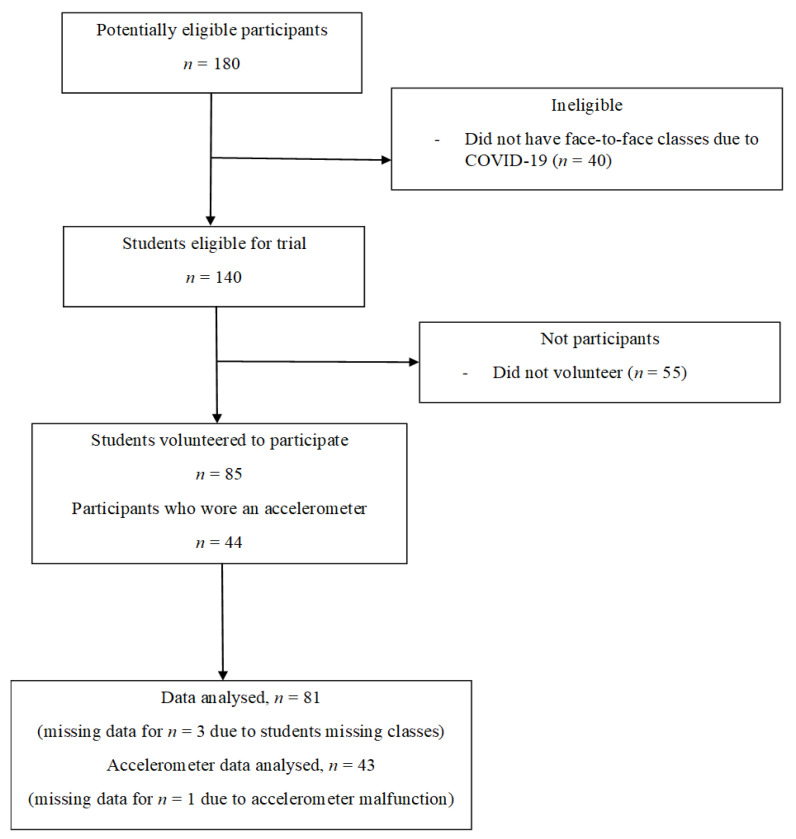
This mixed-methods study aimed to determine the feasibility of incorporating movement breaks into university classes in terms of acceptability (disruption, engagement, satisfaction), practicality (ease of scheduling and conducting breaks) and efficacy (sedentary time, concentration, alertness, enjoyment). Movement breaks of five to 10 min duration were scheduled after 20 min of sedentary time during 2-h classes. Classes without movement breaks were used as a comparison. Data were collected using surveys, objective physical activity monitoring and focus group interviews of students (n = 85) and tutors (n = 6). Descriptive statistics (quantitative data) and independent coding and thematic analysis (qualitative data) were completed. Students (mean age 23 ± 2 years, 69% female) actively engaged in movement breaks with no adverse events. Movement breaks were perceived to be beneficial for concentration, engagement and productivity. Timing of the break was perceived to be important to enhance the benefit and reduce disruption. Students preferred outdoor or competitive movement breaks. Students spent 13 min less time sitting (95%CI 10 to 17), took 834 more steps (95%CI 675 to 994) and had higher levels of concentration, alertness and enjoyment (p < 0.001) in classes with movement breaks compared to classes without. Classroom movement breaks are feasible and may be considered for incorporation into university classes to reduce sedentary behaviour and increase physical activity, alertness, concentration and enjoyment.
Overview
The claims and statistics of this paper haven’t been checked yet.
Free: it reads the open-access text and checks the first 5 claims that cite a source we can check. Create a free account to check every claim.
Integrity signals
Registry
Cites
Statistics
Figures

Verification
Claims the paper makes
The claims and statistics of this paper haven’t been checked yet.
Free: it reads the open-access text and checks the first 5 claims that cite a source we can check. Create a free account to check every claim.
Claims other papers make about this one
Each is checked against this paper’s own text: does it say what the citing paper says it does?
The source backs part of the claim, not all of it — or backs it for a different population, condition or comparison.
In the citing paper
“Four studies investigated selective attention, with two reporting significant improvements [14, 26], one showing no effect [29], and one reporting a negative outcome [32], yielding unclear evidence strength (50%).”
From Effect of classroom physical activity breaks on learning behaviors and academic achievements in university students: a systematic review (2026) · cites this paper as [14]
Experimental — accuracy not yet measuredThe source backs part of the claim, not all of it — or backs it for a different population, condition or comparison.
In the citing paper
“These interventions have been reported to improve perceived readiness to learn, emotional regulation, and several classroom-related outcomes [14, 15].”
From Effect of classroom physical activity breaks on learning behaviors and academic achievements in university students: a systematic review (2026) · cites this paper as [14]
Experimental — accuracy not yet measuredThe source backs part of the claim, not all of it — or backs it for a different population, condition or comparison.
In the citing paper
“Specifically, physical activity breaks in classroom lectures enhance students’ enjoyment and well-being [14, 22], reduce the frequency of mobile phone use, and alleviate negative emotional states such as stress and boredom [33, 34], compared to traditional sedentary classroom formats.”
From Effect of classroom physical activity breaks on learning behaviors and academic achievements in university students: a systematic review (2026) · cites this paper as [14]
Experimental — accuracy not yet measuredThe cited source says what the claim attributes to it.
In the citing paper
“However, most studies failed to address attrition or blinding, with only two studies providing attrition information [14, 35] and only one study implementing subject blinding [28].”
From Effect of classroom physical activity breaks on learning behaviors and academic achievements in university students: a systematic review (2026) · cites this paper as [14]
The cited source says what the claim attributes to it.
In the citing paper
“Regarding the impact of classroom physical activity breaks, seven studies explored positive emotions, with six reporting significant improvements [14, 22, 24–26, 36] and one showing no effect [38], resulting in relatively strong evidence strength (85.7%).”
From Effect of classroom physical activity breaks on learning behaviors and academic achievements in university students: a systematic review (2026) · cites this paper as [14]
Self-check
Percentages, sums and reported differences re-computed from the paper’s own numbers.
The self-check needs the paper’s full text.
Citations
Cites
Using thematic analysis in psychology
Braun, V., & Clarke, V. (2006) · Qualitative Research in Psychology · doi:10.1191/1478088706qp063oa · Cited by 194,414 · cited 1×
“Qualitative data were analysed thematically using an iterative process [31].”
MethodTong, A., Sainsbury, P., & Craig, J. (2007) · International Journal for Quality in Health Care · doi:10.1093/intqhc/mzm042 · Cited by 42,509
von Elm, E., Altman, D. G., Egger, M., Pocock, S. J., Gøtzsche, P. C., Vandenbroucke, J. P., & Initiative, F. T. S. (2007) · PLoS Medicine · doi:10.1371/journal.pmed.0040296 · Cited by 23,020
von Elm, E., Altman, D. G., Egger, M., Pocock, S. J., Gøtzsche, P. C., & Vandenbroucke, J. P. (2007) · The Lancet · doi:10.1016/s0140-6736(07)61602-x · Cited by 21,320 · cited 1×
“The Consolidated Criteria for Reporting Qualitative Research (COREQ) checklist [19] and the Strengthening Reporting of Observational Studies in Epidemiology (STROBE) statement [20] were used to ensure the rigor of reporting.”
Saturation in qualitative research: exploring its conceptualization and operationalization
Saunders, B., Sim, J., Kingstone, T., Baker, S., Waterfield, J., Bartlam, B., Burroughs, H., & Jinks, C. (2018) · Quality & Quantity · doi:10.1007/s11135-017-0574-8 · Cited by 12,033 · cited 2×
“, no new themes or data being identified with further interviews) was achieved [22].”
BackgroundHow we design feasibility studies
Bowen, D. J., Kreuter, M., Spring, B., Cofta-Woerpel, L., Linnan, L., Weiner, D., Bakken, S., Kaplan, C. P., Squiers, L., Fabrizio, C., et al. (2009) · American Journal of Preventive Medicine · doi:10.1016/j.amepre.2009.02.002 · Cited by 4,021
Sedentary Behavior Research Network (SBRN)—Terminology Consensus Project process and outcome
on behalf of SBRN Terminology Consensus Project Participants, Tremblay, M. S., Aubert, S., Barnes, J. D., Saunders, T. J., Carson, V., Latimer-Cheung, A. E., Chastin, S. F. M., Altenburg, T. M., & Chinapaw, M. J. M. (2017) · International Journal of Behavioral Nutrition and Physical Activity · doi:10.1186/s12966-017-0525-8 · Cited by 3,793 · cited 1×
“5 METs), including sitting at a desk, is classified as sedentary behaviour [6].”
BackgroundA critical review of visual analogue scales in the measurement of clinical phenomena
Wewers, M. E., & Lowe, N. K. (1990) · Research in Nursing & Health · doi:10.1002/nur.4770130405 · Cited by 2,580 · cited 2×
“Visual analogue scales are considered valid and reliable, especially when the time between repeat measurements is small [27].”
BackgroundMethodRobert J. Hockey, G. (1997) · Biological Psychology · doi:10.1016/s0301-0511(96)05223-4 · Cited by 1,753 · cited 2×
“, university classes) leads to fatigue, and in response to fatigue, students need to increase their effort (in stress response) to maintain their performance [33].”
BackgroundIncreasing Prevalence of the Metabolic Syndrome Among U.S. Adults
Ford, E. S., Giles, W. H., & Mokdad, A. H. (2004) · Diabetes Care · doi:10.2337/diacare.27.10.2444 · Cited by 1,488
Research works printed but not linked: 2
- Fuzeki, 2017, German national physical activity recommendations for adults and older adults: Methods, database and rationale, Gesundheitswesen, 2, 20
- Liamputtong, P. (2009). Qualitative Research Methods, Oxford University Press. [3rd ed.].
Cited by
Lynch, J., O’Donoghue, G., & Peiris, C. L. (2022) · International Journal of Environmental Research and Public Health · doi:10.3390/ijerph19137775 · Cited by 44
Self-citationYin, M., Zheng, H., Bai, M., Huang, G., Chen, Z., Deng, S., Lyu, M., Deng, J., Zhang, B., Li, H., et al. (2024) · Scandinavian Journal of Medicine and Science in Sports · doi:10.1111/sms.14771 · Cited by 28
Maiztegi-Kortabarria, J., Galarraga, S. A., de Cos, I. L., Espoz-Lazo, S., & Valdívia-Moral, P. (2024) · European Journal of Investigation in Health Psychology and Education · doi:10.3390/ejihpe14030030 · Cited by 24
“Although some studies such as Contreras Jord á n et al. [40] and Peiris et al. [43] support the improvement of AP after intervention with AB, the results of the current study coincide with other studies in which the desired AP was also not obtained [17,25–34].”
MethodResultSedentary behavior and physical inactivity from a comprehensive perspective
Rey‐Brandariz, J., Rial-Vázquez, J., Varela‐Lema, L., Santiago-Pérez, M. I., Candal‐Pedreira, C., Guerra-Tort, C., Ruano‐Raviña, A., & Pérez‐Ríos, M. (2023) · Gaceta Sanitaria · doi:10.1016/j.gaceta.2023.102352 · Cited by 18
Rupp, R., Wallmann-Sperlich, B., & Bucksch, J. (2025) · BMC Public Health · doi:10.1186/s12889-025-22075-x · Cited by 13
“In addition, the introduction and implementation of physical activity breaks or simple standing breaks in university classes have already been shown to enhance students’ self-perceived physical, mental, and cognitive states [3, 16–18].”
Metadata
- Authors
- Peiris, C. L., O’Donoghue, G., Rippon, L., Meyers, D., Hahne, A., De Noronha, M., Lynch, J., & Hanson, L. C.
- Affiliations
- La Trobe University (AU)
- University College Dublin (IE)
- La Trobe Rural Health School, Holsworth Research Initiative, La Trobe University, Bendigo, VIC 3550, Australia
- Corresponding author
- Peiris, Casey L.
- Venue
- International Journal of Environmental Research and Public Health
- Publisher
- MDPI AG
- Published
- 2021-05-24
- Volume
- 18
- Issue
- 11
- Pages
- 5589
- ISSN
- 1660-4601 (ISSN-L)
- PMC
- PMC8197210
- OpenAlex
- W3164813579
- Semantic Scholar
- 76db059e3d999de784ea29026c6293f713223ff5
- Cited by
- 38
- References
- 34
- Citations by year
- 2026: 11 · 2025: 10 · 2024: 8 · 2023: 4 · 2022: 4 · 2021: 1
- FWCI
- 2.67
- Type
- journal article
- Language
- en
- Open access
- gold
- doi.org
- Licence
- Locations
- International Journal of Environmental Research and Public Health (publishedVersion, cc-by)
- PubMed Central (publishedVersion, cc-by)
- PubMed (publishedVersion)
- RePEc: Research Papers in Economics (submittedVersion)
- DOAJ (DOAJ: Directory of Open Access Journals) (submittedVersion)
- Lenus, The Irish Health Repository (Dr Steevens Hospital Library) (submittedVersion, cc-by)
- Funders
- La Trobe University
- Topics
- Health Sciences › Medicine › Public Health, Environmental and Occupational Health › Physical Activity and Health
- Health Sciences › Medicine › Public Health, Environmental and Occupational Health › School Health and Nursing Education
- Health Sciences › Medicine › Public Health, Environmental and Occupational Health › Health and Lifestyle Studies
- Keywords
- sedentary behavior, university students, concentration, alertness, enjoyment, physical activity, feasibility, step count, student engagement
- MeSH terms
- Adult, Feasibility Studies, Female, Humans, Male, Universities, Exercise, Young Adult, Pleasure, Sedentary Behavior
About these checks
Registry, retraction, Cites and statistics results are computed, not judged, with one exception: a printed reference that no index lists is read once by a model before it counts as a citation error. Claims are extracted by a model and kept only when their quote appears verbatim in the text; each cited source is then checked, with a model’s help, for whether it says what the claim relies on. Those verdicts can be wrong — read the claim’s quote and the cited source before relying on one.
Statistics and arithmetic are recomputed, not judged.
Confidence bands are shown only for fields calibrated on our annotated test set. None is calibrated yet, so no band is shown.
What counts as a claim ›How we measure confidence ›How we check this ›
Are you an author, or do you see a problem with this page? Request a review
How to cite
Cite CoChat for the checks on this page, and the paper for its own findings.
- This page
- CoChat. (2026). Citation check: Classroom Movement Breaks Reduce Sedentary Behavior and Increase Concentration, Alertness and Enjoyment during University Classes: A Mixed-Methods Feasibility Study. https://app.cochat.ai/papers/10.3390/ijerph18115589
- The paper
- Peiris, C. L., O’Donoghue, G., Rippon, L., Meyers, D., Hahne, A., De Noronha, M., Lynch, J., & Hanson, L. C. (2021). Classroom Movement Breaks Reduce Sedentary Behavior and Increase Concentration, Alertness and Enjoyment during University Classes: A Mixed-Methods Feasibility Study. International Journal of Environmental Research and Public Health. https://doi.org/10.3390/ijerph18115589
Data sources
Bibliographic data: Semantic Scholar, OpenAlex, Crossref.
Contains information from the Semantic Scholar Academic Graph Datasets, made available under the ODC Attribution License (ODC-BY 1.0).
Semantic Scholar’s data is described in: Kinney, R., et al. (2023). The Semantic Scholar Open Data Platform. arXiv:2301.10140.
