

Risk Perception and Depression in Public Health Crises: Evidence from the COVID-19 Crisis in China
Open accessThe DOI matches its Crossref record; 48 of the 50 references it cites were found in a registry or an index, and 1 are not checked yet.
Abstract
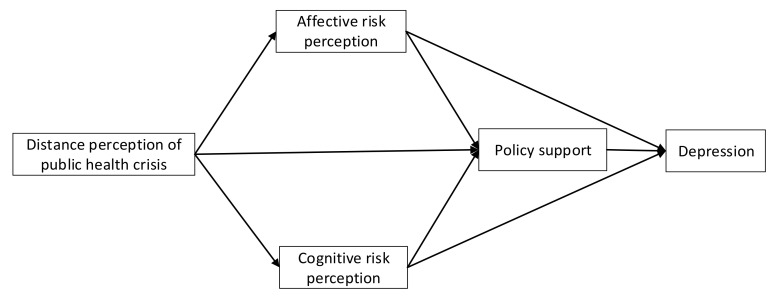
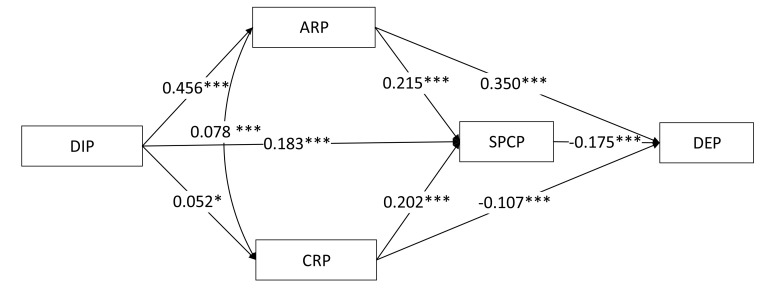
Background: Scant attention has been paid to how risk perceptions of public health crises may affect people’s mental health. Aims: The aims of this study are to (1) construct a conceptual framework for risk perception and depression of people in public health crises, (2) examine how the mental health of people in the crisis of Coronavirus Disease 2019 (COVID-19) is affected by risk perception and its associated factors, including distance perception of the crisis and support of prevention and control policies, and (3) propose policy recommendations on how to deal with psychological problems in the current COVID-19 crisis. Methods: Online questionnaire survey was implemented. A total of 6373 people visited the questionnaire online, 1115 people completed the questionnaire, and the number of valid questionnaires was 1081. Structural equation modeling was employed for data analysis. Results: Risk perception and its associated factors significantly affect the mental health of people in public health crises. Specifically, (1) distance perception of public health crises is negatively associated with depression among people, (2) affective risk perception is positively associated with depression of people in public health crises, (3) cognitive risk perception is negatively associated with depression of people in public health crises, and (4) support of prevention and control policies is negatively associated with depression of people in public health crises. Conclusion: The findings of this study suggest that risk perception plays an important role in affecting the mental health of people in a public health crisis. Therefore, health policies aiming to improve the psychological wellbeing of the people in a public health crisis should take risk perception into consideration.
Overview
The claims and statistics of this paper haven’t been checked yet.
Free: it reads the open-access text and checks the first 5 claims that cite a source we can check. Create a free account to check every claim.
Integrity signals
Registry
Cites
Statistics
Figures
Verification
Claims the paper makes
The claims and statistics of this paper haven’t been checked yet.
Free: it reads the open-access text and checks the first 5 claims that cite a source we can check. Create a free account to check every claim.
Self-check
Percentages, sums and reported differences re-computed from the paper’s own numbers.
The self-check needs the paper’s full text.
Citations
Cites
SCL-90: an outpatient psychiatric rating scale--preliminary report.
Derogatis, L. R., Lipman, R. S., & Covi, L. (1973) · PubMed · Cited by 4,633
Will raising the incomes of all increase the happiness of all?
Easterlin, R. A. (1995) · Journal of Economic Behavior & Organization · doi:10.1016/0167-2681(95)00003-b · Cited by 3,116
Integration of the cognitive and the psychodynamic unconscious
Epstein, S. (1994) · American Psychologist · doi:10.1037/0003-066x.49.8.709 · Cited by 2,883
Mental health problems and social media exposure during COVID-19 outbreak
Gao, J., Zheng, P., Jia, Y., Chen, H., Mao, Y., Chen, S., Wang, Y., Fu, H., & Dai, J. (2020) · PLoS ONE · doi:10.1371/journal.pone.0231924 · Cited by 2,830
Mental Health Problems and Social Media Exposure During COVID-19 Outbreak
Gao, J., Zheng, P., Jia, Y., Chen, H., Mao, Y., Chen, S., Wang, Y., Fu, H., & Dai, J. (2020) · SSRN Electronic Journal · doi:10.2139/ssrn.3541120 · Cited by 2,830
Mazza, C., Ricci, E., Biondi, S., Colasanti, M., Ferracuti, S., Napoli, C., & Roma, P. (2020) · International Journal of Environmental Research and Public Health · doi:10.3390/ijerph17093165 · Cited by 1,899 · cited 1×
“We referred to previous studies [31,38,39] and determined that if the total score of the depression scale was between 13 and 26, no significant depression was identified.”
Wu, P., Fang, Y., Guan, Z., Fan, B., Kong, J., Yao, Z., Liu, X., Fuller, C. J., Susser, E., Lu, J., et al. (2009) · The Canadian Journal of Psychiatry · doi:10.1177/070674370905400504 · Cited by 1,647 · cited 1×
“In addition, Wu and colleagues found that, during the 2005 SARS event, respondents who were closer to SARS-related risks were more likely to report mental health problems [50].”
BackgroundGonzález-Sanguino, C., Ausín, B., Castellanos, M. Á., Saiz, J., López-Gómez, A., Ugidos, C., & Muñoz, M. (2020) · Brain, Behavior, and Immunity · doi:10.1016/j.bbi.2020.05.040 · Cited by 1,373 · cited 2×
“For instance, a survey in Italy found that about 22% of the sample had mental health problems [39], and a survey in Spain showed that about 25% of the sample had depression symptoms [38].”
BackgroundVeenhoven, R. (1991) · Social Indicators Research · doi:10.1007/bf00292648 · Cited by 1,358
A Psychological Study of the Inverse Relationship Between Perceived Risk and Perceived Benefit
Alhakami, A. S., & Slovic, P. (1994) · Risk Analysis · doi:10.1111/j.1539-6924.1994.tb00080.x · Cited by 1,151
Cited by
Items 101–157 of 157
Latent trait models for perceived risk assessment using a Covid-19 data survey
Bacci, S., Fabbricatore, R., & Iannario, M. (2021) · Journal of Applied Statistics · doi:10.1080/02664763.2021.1937584 · Cited by 4
“A study on the association between risk perception and well-being during the Covid-19 crisis highlighted that, while affective risk perception negatively impacts public depression and policy support, a better cognitive risk perception increases people’s support for prevention policies and reduces people’s depression […”
BackgroundMorales, V. I., Castillo, J. P., & Vega, D. R. (2025) · International Journal of Social and Psychological Aspects of Healthcare · doi:10.51847/tw0pkdahvi · Cited by 4
Youth Attitude and Perception during the Covid-19 contingency in Morelia, Michoacan
Valenzo-Jiménez, M. A., Lázaro-López, D. A., & Arroyo, J. A. M. (2021) · Nova Scientia · doi:10.21640/ns.v13ie.2613 · Cited by 4
Santoso, J., Bintarsari, N. K., & Lestari, S. (2024) · Humanities and Social Science Research · doi:10.30560/hssr.v7n2p1 · Cited by 4
Cilović‐Lagarija, Š., Eitze, S., Skočibušić, S., Musa, S., Stojisavljević, S., Šabanović, H., Dizdar, F., Palo, M., Nitzan, D., de Arriaga, M. T., et al. (2025) · PLoS ONE · doi:10.1371/journal.pone.0320433 · Cited by 4
RISK PERCEPTION AND DOMESTIC TRAVEL INTENSION DURING THE COVID-19 PANDEMIC: A CONCEPTUAL PAPER
Li, J., Furuoka, F., Lim, B., & Pazim, K. H. (2020) · BIMP-EAGA Journal for Sustainable Tourism Development · doi:10.51200/bimpeagajtsd.v9i1.3175 · Cited by 5
Joudeh, J. M. M., Allan, M. S., Abu-Loghod, N. A., Khader, J. A., & Al-Gasawneh, J. A. (2023) · International Journal of Membrane Science and Technology · doi:10.15379/ijmst.v10i3.2029 · Cited by 3
“The results are similar to the studies of [35-39], which referred to the fact that workers still feel that the COVID-19 crisis caused job losses and unemployment, job insecurity, a decrease in income, a decrease in living conditions, loss of salaries, heavy debt, and hindering personal growth.”
BackgroundResultPacheco, B. G., & Pacheco, M. H. (2023) · British Food Journal · doi:10.1108/bfj-02-2023-0169 · Cited by 3
Stressors and Mental Well-Being Among Hospitality Employees During COVID-19 Pandemic
Kosnin, R., Sumardi, N. A., Jafarudin, N. N., Saidin, S. S., & Ali, A. F. M. (2024) · Studies in systems, decision and control · doi:10.1007/978-3-031-54379-1_78 · Cited by 3
Risk perception and citizens’ policy compliance in the COVID-19 pandemic crisis
Xie, S., Tan, X., & Zhan, X. (2025) · Journal of Asian Public Policy · doi:10.1080/17516234.2025.2566766 · Cited by 2
Self-citationŞenyapar, H. N. D. (2026) · Social Work in Public Health · doi:10.1080/19371918.2026.2626377 · Cited by 2
“R Public health crises, such as COVID-19 and natural disasters, intensify inequalities, disproportionately affecting vulnerable populations, including older adults, people with disabilities, and those in poverty (Almuhaideb & Saeed, 2020; Ding et al., 2020).”
RetractedTing, S., & Sim, E. U. (2021) · International Journal of Current Research and Review · doi:10.31782/ijcrr.2021.sp169 · Cited by 2
COVID-19 RİSK ALGISI ÖLÇEĞİNİN TÜRKÇE’YE UYARLAMASI: GEÇERLİLİK VE GÜVENİRLİK ÇALIŞMASI
Yalçın, A., & ASLAN, A. (2022) · Çukurova Üniversitesi Sosyal Bilimler Enstitüsü Dergisi · doi:10.35379/cusosbil.977428 · Cited by 5
Figueiredo, S., & Devezas, M. (2021) · Análisis y Modificación de Conducta · doi:10.33776/amc.v47i176.7064 · Cited by 2
Çakal, H., Keshavarzi, S., Ruhani, A., Dakhil‐Abbasi, G., & Ünver, H. (2022) · Journal of Community & Applied Social Psychology · doi:10.1002/casp.2666 · Cited by 2
“This finding highlights the important role of contextual factors in identity outcomes (Ding et al., 2020; Trifiletti et al., 2021).”
BackgroundLiu, Y., Liu, L., & Shi, Z. (2023) · Frontiers in Psychiatry · doi:10.3389/fpsyt.2023.1086155 · Cited by 3
Hong, V. L., & Hsu, L. (2023) · Journal of Quality Assurance in Hospitality & Tourism · doi:10.1080/1528008x.2023.2278633 · Cited by 4
“Therefore, one item was deleted from the thirteen of Ding et al. (2020) original questions.”
InfluentialReview Article on the Role of Effective Leadership in Crisis Management
Gupta, P. V. (2024) · International Journal For Multidisciplinary Research · doi:10.36948/ijfmr.2024.v06i01.12462 · Cited by 3
“(Ding Y 2020) Crisis, unemployment and psychological wellbeing in Canada 4 Long-term Canadian data might be used to examine the impact of unemployment on mental health.”
BackgroundElishar-Malka, V., Ariel, Y., & Saks, D. W. (2025) · Asian Journal of Communication · doi:10.1080/01292986.2025.2531498 · Cited by 2
“…it is support for climate change mitigation framed as immediate (Guo & Hou, 2024), compliance with pandemic health measures perceived as geographically or hypothetically close (Blauza et al., 2023), or heightened emotional responses and risk perception (Ding et al., 2020; Wong et al., 2023).”
Longitudinal analysis of social isolation effects on finger tapping in the Blursday database
Hiroyasu, E. M. G., Laje, R., Nomura, K., Spiousas, I., Hayashi, M. J., & Yotsumoto, Y. (2023) · Scientific Reports · doi:10.1038/s41598-023-38488-w · Cited by 1
Greco, M., Maietti, E., Rallo, F., Reno, C., Treré, D., Savoia, E., Fantini, M. P., & Gori, D. (2021) · medRxiv · doi:10.1101/2021.02.04.21250922 · Cited by 2
“During the COVID-19 pandemic, many student-driven 273 initiatives and volunteer responses have been reported worldwide, highlighting benefits both for 274 students and healthcare services [18-23].”
BackgroundYetişkin bireylerde salgın algısı, yaşamda anlam ve dini yönelim ilişkisi
Demir, H. (2022) · Dspace Repository (Marmara Üniversitesi) · Cited by 4
PERCEPTIONS OF THE LOCKDOWN: CURRENT AND RETROSPECTIVE ASSESSMENTS
Егорова, М. А., Parshikova, O. V., Tkachenko, D. P., & Chertkova, Y. D. (2021) · Psychological applications and trends · doi:10.36315/2021inpact043 · Cited by 1
Política de salud y crisis sanitaria frente a la covid-19 del cono norte - Lima
Rojas, L. R. M. (2022) · Ciencia Latina Revista Científica Multidisciplinar · doi:10.37811/cl_rcm.v6i1.1497 · Cited by 1
Covid-19 Causal Factors Perception Questionnaire (Covid-19-CFPQ)
Andreu, J. M. P. (2022) · Behavioral Psychology/Psicología Conductual · doi:10.51668/bp.8322107n · Cited by 1
The Psychological impact of Covid-19 on General Population in Pakistan
Ain, Q. U. (2022) · PAKISTAN LANGUAGES AND HUMANITIES REVIEW · doi:10.47205/plhr.2022(6-ii)16 · Cited by 1
Depressive Symptoms and Perception of COVID-19 Risk in Ohio Adults
Bischof, K. M., Chakraborty, P., Miller, W. C., & Turner, A. N. (2022) · Ohio Journal of Public Health · doi:10.18061/ojph.v5i1.8805 · Cited by 1
Shimamoto, K., McElroy, E., & Ibuka, Y. (2022) · SSM - Population Health · doi:10.1016/j.ssmph.2022.101269 · Cited by 1
“its methodological advantage, evidence is still limited from studies using structural equation 18 modeling (SEM) in the assessment of mental health by measures of depression, anxiety, fear, 19 risk perceptions, and negative emotions during the COVID-19 pandemic (35, 42-47).”
Don’t say it’s over: The perceived epidemic stage and COVID preventive behaviour
Эдуардовна, С. Я., Eritsyan, K. Y., Antonova, N. A., & Sharin, N. A. (2024) · Journal of Health Psychology · doi:10.1177/13591053231222338 · Cited by 2
“Most research finds that depressive symptoms are negatively associated with the implementation of preventive measures (Ding et al., 2020; Liu et al., 2020; Stickley et al., 2020).”
Hu, X., Zhu, W., Zhou, B., & Liang, L. (2025) · Journal of Contingencies and Crisis Management · doi:10.1111/1468-5973.70030 · Cited by 1
Adel, I. A. P., Utomo, H. B., Setiyowati, N., & Hidayat, E. (2025) · Jurnal Ners · doi:10.31004/jn.v9i3.44664 · Cited by 2
Naik, B. N., Singh, C., Biswas, B., Pandey, S., Nirala, S. K., & Chaudhary, N. (2021) · National Journal of Community Medicine · doi:10.5455/njcm.20210607111817
Sun, J. (2021) · Advances in Social Science, Education and Humanities Research/Advances in social science, education and humanities research · doi:10.2991/assehr.k.211020.208
“If people read more news about public health crisis, they are more likely to feel depressed and their risk perception are more likely to be high[4].”
BackgroundImpact of COVID-19 on Nigeria Hospitality Workers: Risk Perception and DepressionPreprint
Obinna, M. O. (2021) · SSRN Electronic Journal
The Effect of COVID on Child Maltreatment: A Review
Rokach, A., & Chan, S. (2021) · Journal of Clinical Research and Reports · doi:10.31579/2690-1919/201
“…also shown that traumatized individuals who perceived the pandemic to be more severe and demonstrated psychological distress from COVID-19 were predicted to have poorer psychiatric outcomes across several countries (Li et al., 2020; Ding et al., 2020; Simione et al., 2020; Rodriguez et al., 2020).”
BackgroundOhio Journal of Public Health Vol. 5, Issue 1 (August 2022): Full Issue
Ohio Public Health Association OPHA (2022) · Ohio Journal of Public Health · doi:10.18061/ojph.v5i1.9195
The development of coronaphobia scale and psychometric effect among UAE people
Abdelrahman, R. M., & الدواش, ف. م. (2022) · Heliyon · doi:10.1016/j.heliyon.2022.e10875
“Similarly, another study by Ding et al. (2020) also aimed to study the construction of a conceptual framework for risk perception and depression of people in a public health crisis and examined how the mental health of people during the current crisis is affected by risk perception and factors…”
GÜNER, N. G., Durmuş, C., Yürümez, Y., Yamaç, E., Güneysu, F., & Durmuş, E. (2022) · Kocatepe tıp dergisi. · doi:10.18229/kocatepetip.935503
Xu, X., Fan, Y., Wu, Y., & Zhou, S. (2022) · Sustainability · doi:10.3390/su142013304
The Effect of COVID on Child Maltreatment: A Review
Rokach, A., & Chan, S. (2022) · Journal of Psychology and Psychotherapy Research · doi:10.12974/2313-1047.2022.09.3
Rana, I. A., Kamil, I., & Waseem, H. B. (2023) · International Journal of Disaster Risk Reduction · doi:10.1016/j.ijdrr.2023.103918
How did the pandemic affect child maltreatment
Rokach, A., & Clayton, S. (2023) · Elsevier eBooks · doi:10.1016/b978-0-323-85853-3.00012-4
Depressive Disorders of Polish University Students During the Covid-19 Pandemic
Przybysz-Zaremba, M. (2023) · International Journal of Positivity & Well-Being · doi:10.61518/ijpw-5
Community series in mental health promotion and protection, volume II
(2023) · Frontiers research topics · doi:10.3389/978-2-8325-3735-0
Antonova, N. A., Eritsyan, K. Y., Усачева, Н. М., & Tsvetkova, L. (2023) · Frontiers in Psychology · doi:10.3389/fpsyg.2023.1286036
“It was found that mental health characteristics were significantly associated with social preventive behaviors: higher levels of depressed symptoms are negatively related with recommended protective measures (Ding et al., 2020; Liu et al., 2020; Stickley et al., 2020).”
BackgroundObosi, A. C. (2024) · IBADAN JOURNAL OF THE SOCIAL SCIENCES · doi:10.36108/ijss/4202.22.0150
Liu, W., Dong, H., & Lu, H. (2025) · Research Square · doi:10.21203/rs.3.rs-7532487/v1
Fear of COVID-19 and hygiene behaviors: a study of secondary school students in İstanbul
Göksu, Z., Uysal, H. K., Demırci, M., DÜLGER, D., & Ekici, S. (2025) · TURKISH JOURNAL OF MEDICAL SCIENCES · doi:10.55730/1300-0144.6087
Gao, Y., & Yang, J. (2025) · Psychology Health & Medicine · doi:10.1080/13548506.2025.2575409
“Following the methodological framework proposed by Martens and Haase (2006), the analysis of the CLPA was conducted through comparative model fit evaluation to identify the most optimal model.”
InfluentialZheng, R., Zhou, Y., Xu, S., Mei, X., Cheng, F., Li, D., Woo, C., Wu, X., Jiang, Y., & Li, J. (2025) · Lecture notes on data engineering and communications technologies · doi:10.1007/978-981-95-1595-0_9
Sun, Z., Jin, Z., Zhao, K., Wen, X., Lu, H., Hu, N., Zhu, Q., Zhang, Y., Ye, M., Huang, Y., et al. (2024) · Figshare · doi:10.6084/m9.figshare.25237389
Risk perception and participation intent in China’s domestic tourism sector / Li Jingyi
Li, J. (2023) · University of Malaya Students Repository
Tan, A. A. T. R., & Ibrahim, H. I. (2026) · International Journal For Multidisciplinary Research · doi:10.36948/ijfmr.2026.v08i02.73026
Xie, R., Zhuang, J., Zhou, J., & Li, L. (2026) · Telematics and Informatics · doi:10.1016/j.tele.2026.102396
Guzmán, M. O., Romero, J. A. P., Romero, C. P., & Miguel-Corona, R. (2025) · Revista Electrónica de Psicología Iztacala
Metadata
- Authors
- Ding, Y., Xu, J., Huang, S., Li, P., Lu, C., & Xie, S.
- Affiliations
- Central China Normal University (CN)
- Corresponding author
- Xie, Shenghua
- Venue
- International Journal of Environmental Research and Public Health
- Publisher
- MDPI AG
- Published
- 2020-08-07
- Volume
- 17
- Issue
- 16
- Pages
- 5728
- ISSN
- 1660-4601 (ISSN-L)
- PMC
- PMC7460398
- OpenAlex
- W3047964078
- Semantic Scholar
- de5ba933ec48355d0e51f6132853539b33cd0c76
- Cited by
- 146
- References
- 50
- Citations by year
- 2026: 2 · 2025: 8 · 2024: 10 · 2023: 26 · 2022: 40 · 2021: 52 · 2020: 8
- FWCI
- 12.59
- Type
- journal article
- Language
- en
- Open access
- gold
- doi.org
- Licence
- Locations
- International Journal of Environmental Research and Public Health (publishedVersion, cc-by)
- PubMed Central (publishedVersion, cc-by)
- PubMed (publishedVersion)
- RePEc: Research Papers in Economics (submittedVersion)
- DOAJ (DOAJ: Directory of Open Access Journals) (submittedVersion)
- Funders
- Fundamental Research Funds for the Central Universities (No. CCNU19TD005)
- Topics
- Social Sciences › Psychology › Clinical Psychology › COVID-19 and Mental Health
- Social Sciences › Sociology and Political Science › Risk Perception and Management
- Health Sciences › Medicine › Public Health, Environmental and Occupational Health › Maternal Mental Health During Pregnancy and Postpartum
- Keywords
- risk perception, depression, public health crisis, COVID-19 pandemic, mental health, affective risk perception, cognitive risk perception, distance perception, psychological well-being, health policy
- MeSH terms
- Betacoronavirus, Natural Disasters, COVID-19, SARS-CoV-2, Adult, China, Communicable Disease Control, Female, Humans, Male, Mental Health, Middle Aged, Pneumonia, Viral, Public Health, Socioeconomic Factors, Coronavirus, Coronavirus Infections, Risk Assessment, Pandemics
About these checks
Registry, retraction, Cites and statistics results are computed, not judged, with one exception: a printed reference that no index lists is read once by a model before it counts as a citation error. Claims are extracted by a model and kept only when their quote appears verbatim in the text; each cited source is then checked, with a model’s help, for whether it says what the claim relies on. Those verdicts can be wrong — read the claim’s quote and the cited source before relying on one.
Statistics and arithmetic are recomputed, not judged.
Confidence bands are shown only for fields calibrated on our annotated test set. None is calibrated yet, so no band is shown.
What counts as a claim ›How we measure confidence ›How we check this ›
Are you an author, or do you see a problem with this page? Request a review
Data sources
Bibliographic data: Semantic Scholar, OpenAlex, Crossref.
Contains information from the Semantic Scholar Academic Graph Datasets, made available under the ODC Attribution License (ODC-BY 1.0).
Semantic Scholar’s data is described in: Kinney, R., et al. (2023). The Semantic Scholar Open Data Platform. arXiv:2301.10140.
